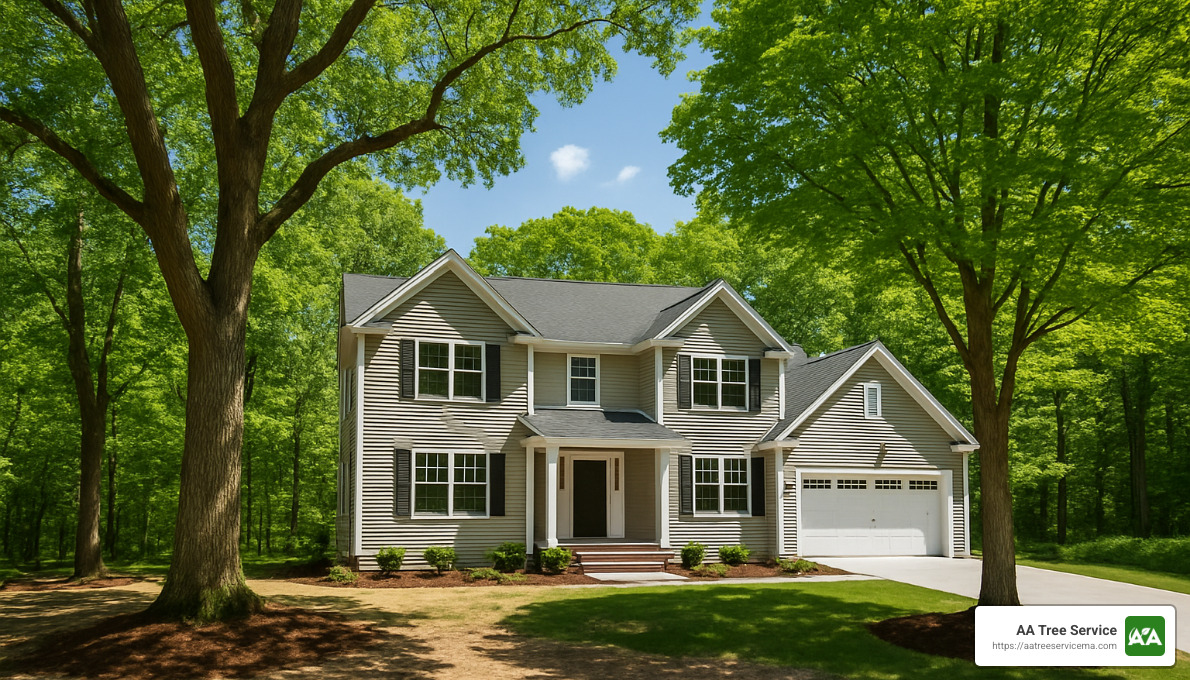
The Value of Protecting Our Leafy Assets
When that bulldozer rolls onto your property, your trees suddenly face their greatest challenge. Tree preservation during construction isn’t just a nice idea—it’s a smart investment in your property’s future. Think of it as protecting living assets that work around the clock to make your home more valuable and comfortable.
Those majestic oaks and maples that took decades to grow can boost your property value by up to 12%, according to Penn State Extension research. Beyond their dollar value, these silent sentinels provide cooling shade during Massachusetts summers, filter the air you breathe, absorb stormwater that might otherwise flood your basement, and create habitat for the birds that serenade you each morning.
“Trees and machinery can get along,” as Purdue University researchers optimistically note—but this peaceful coexistence doesn’t happen by accident. Without proper protection, construction activities can inflict silent damage that might not show symptoms until months or even years later. By then, saving that beloved backyard tree might be impossible.
For homeowners in Massachusetts and New Hampshire, preserving trees during your renovation or new build requires some planning, but the payoff is substantial. A healthy mature tree that survives construction remains a valuable asset, while replacing it could take a generation—if it’s possible at all.
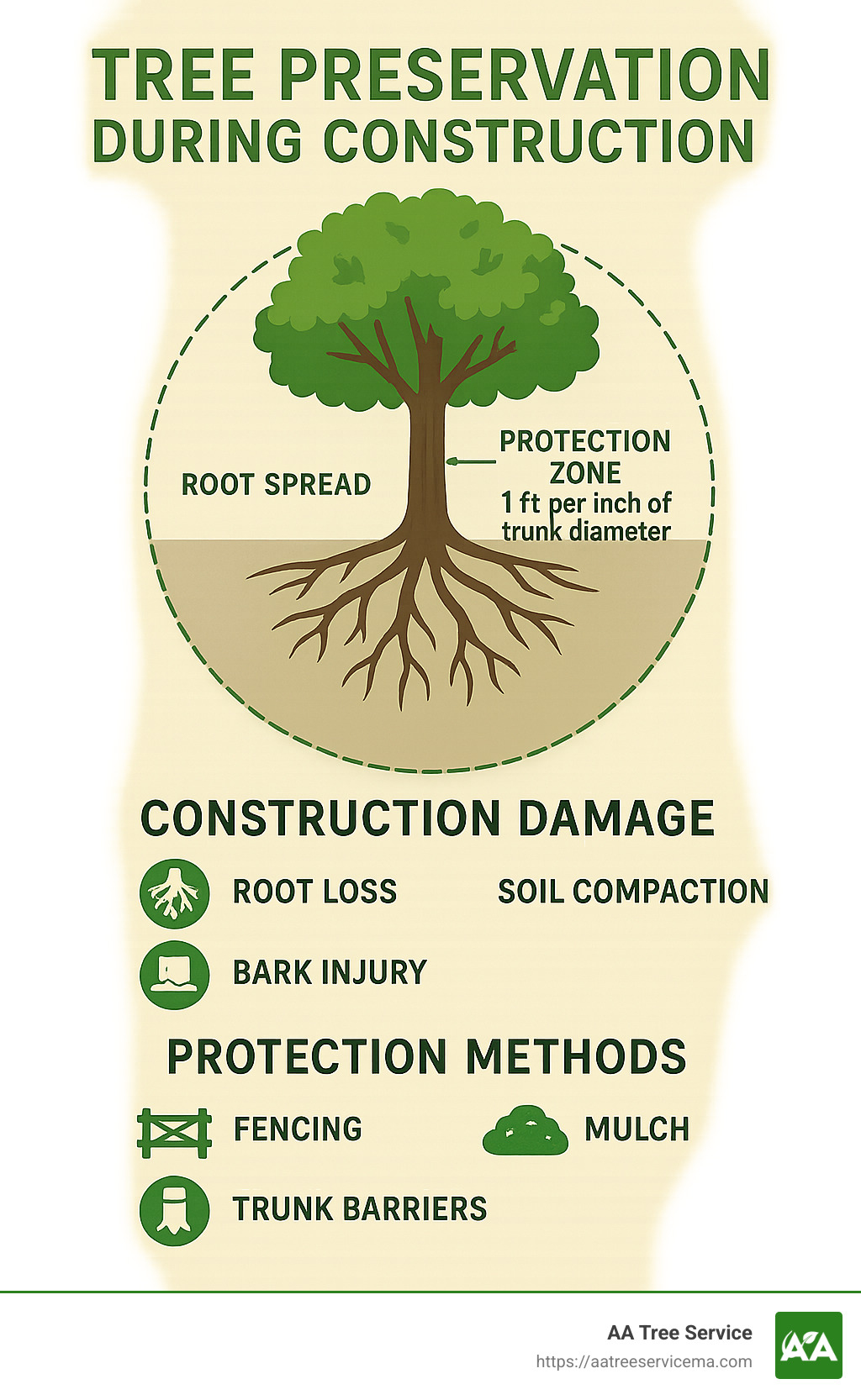
Most trees need at least 60-70% of their root system intact to weather the stress of nearby construction. What many homeowners don’t realize is that roots typically spread far beyond the drip line, with most concentrated in the top 6-24 inches of soil. This hidden vulnerability is why proper protection is essential.
Effective tree preservation during construction follows several key principles:
– Early assessment identifies which trees are worth saving based on health, species, and location
– Protection zones keep equipment and materials away from critical root areas
– Soil compaction prevention maintains healthy root function
– Grade preservation keeps roots at their preferred depth
– Physical barriers protect trunks and major roots from mechanical damage
– Ongoing monitoring catches problems early when they’re still fixable
When you’re planning your next building project in eastern Massachusetts or southern New Hampshire, your trees are silent stakeholders in the process. With some thoughtful planning and the right expertise, your leafy assets can continue enhancing your property for generations to come.
Easy Tree preservation during construction glossary:
– Professional tree service Massachusetts
– Tree debris removal service
– tree trimming reading
Tree Preservation During Construction: Why It Matters
When you look across a wooded property in Massachusetts or New Hampshire, you’re not just seeing trees—you’re witnessing decades of natural history that brings tremendous value to your home and community.
Those mature maples, oaks, and pines aren’t just beautiful—they’re financial assets. Research consistently shows that established trees can boost property values by up to 12%. A home nestled among stately trees in Bedford, NH or North Andover, MA simply commands more market appeal than an identical house on a barren lot.
“Historic trees are valued as living witnesses to earlier times, events, and stories,” notes the National Center for Preservation Technology and Training. This connection to the past creates a sense of place that’s impossible to recreate once lost.
The benefits extend far beyond your wallet:
Shade and energy savings make a real difference in your comfort and budget. Properly positioned trees can slash summer cooling costs by 15-35%, creating natural climate control for your home.
Stormwater management happens silently as tree roots and soil absorb thousands of gallons of rainfall annually, reducing erosion and flooding risks on your property.
Carbon capture continues 24/7 as trees pull carbon dioxide from the atmosphere, helping fight climate change right in your backyard.
Air quality improvements occur daily as leaves filter pollutants, creating healthier outdoor spaces for your family.
Wildlife habitat forms naturally in and around mature trees, supporting birds, beneficial insects, and other creatures that enrich your property’s ecosystem.
Not all trees handle construction stress equally. In our New England climate, river birch, red maple, and sycamore typically show better resilience, while oaks, sugar maples, and white pines tend to be more sensitive to disturbance during building projects.
Christina Reyes, an experienced arborist, puts it perfectly: “No two trees are the same, it’s impossible to know what’s going on underground just by looking at the surface.” This highlights why professional assessment before construction begins is so crucial.
Many towns across Massachusetts and New Hampshire have adopted tree protection ordinances that require specific preservation measures during construction. These local regulations often specify minimum protection standards and may require permits for removing trees over a certain diameter.
At AA Tree Service, we’ve seen countless success stories where thoughtful planning preserved magnificent trees during construction. Unfortunately, we’ve also witnessed many cases where lack of protection led to decline and death of valuable trees years after construction ended.
The science behind tree preservation during construction is clear. According to scientific guidelines on preserving trees, protecting even a few key specimens can maintain the character, ecological function, and value of your property for generations to come.
Pre-Construction Blueprint: Inventory, Assessment & TPZ
Before the first excavator arrives on site, a thorough tree inventory and assessment is essential for successful tree preservation during construction. This critical first step helps you identify which trees are worth saving and develops a protection strategy custom to each tree’s needs.
The Tree Inventory Process
When we walk a property with homeowners in Andover or Nashua, we’re not just looking at trees—we’re evaluating living assets. A professional tree inventory captures the complete picture of each tree’s condition and value.
A good inventory identifies tree species (oak, maple, pine) since each responds differently to construction stress. We measure the diameter at breast height (DBH) at 4.5 feet above ground, which helps determine protection needs. The health assessment looks at foliage density, bark condition, and signs of disease or pests that might compromise survival.
We also evaluate each tree’s structure, looking for defects that might pose safety risks during or after construction. The inventory includes precise mapping of tree locations relative to planned structures, and finally, we assign a preservation suitability rating to help prioritize protection efforts.
“Having a certified arborist evaluate each tree for feasibility of preservation before construction begins is essential,” explains a Colorado State University fact sheet. Our certified arborists provide this crucial assessment throughout Massachusetts and New Hampshire, creating the foundation for effective preservation.
Establishing the Tree Protection Zone (TPZ)
The Tree Protection Zone (TPZ) is like a safety bubble around your tree. This critical area protects both the visible tree and its extensive root system, which typically extends well beyond the canopy edge.
Tree preservation during construction: Calculating Your TPZ
There’s real science behind determining how much space your trees need to survive construction. Here’s how the experts calculate it:
| Method | Calculation | Example (20″ DBH Tree) | Protection Level |
|---|---|---|---|
| Basic DBH Method | 1 ft radius per 1″ DBH | 20 ft radius | Minimum |
| Improved DBH Method | 1.5 ft radius per 1″ DBH | 30 ft radius | Better |
| Critical Root Radius | 1.25 ft radius per 1″ DBH | 25 ft radius | Standard |
| Dripline Method | Radius extends to edge of canopy | Varies by tree | Variable |
| Stress-Tolerance Based | Varies by species sensitivity | 20-40 ft radius | Customized |
For most situations, we recommend the improved DBH method—allowing 1.5 feet of protection radius for each inch of trunk diameter. For a stately 20-inch oak, this creates a generous protection zone with a 30-foot radius.
Research from the University of New Hampshire Extension confirms that “a healthy tree may survive if at least 60-70% of its root zone remains undisturbed.” The TPZ calculation helps ensure your trees meet this survival threshold.
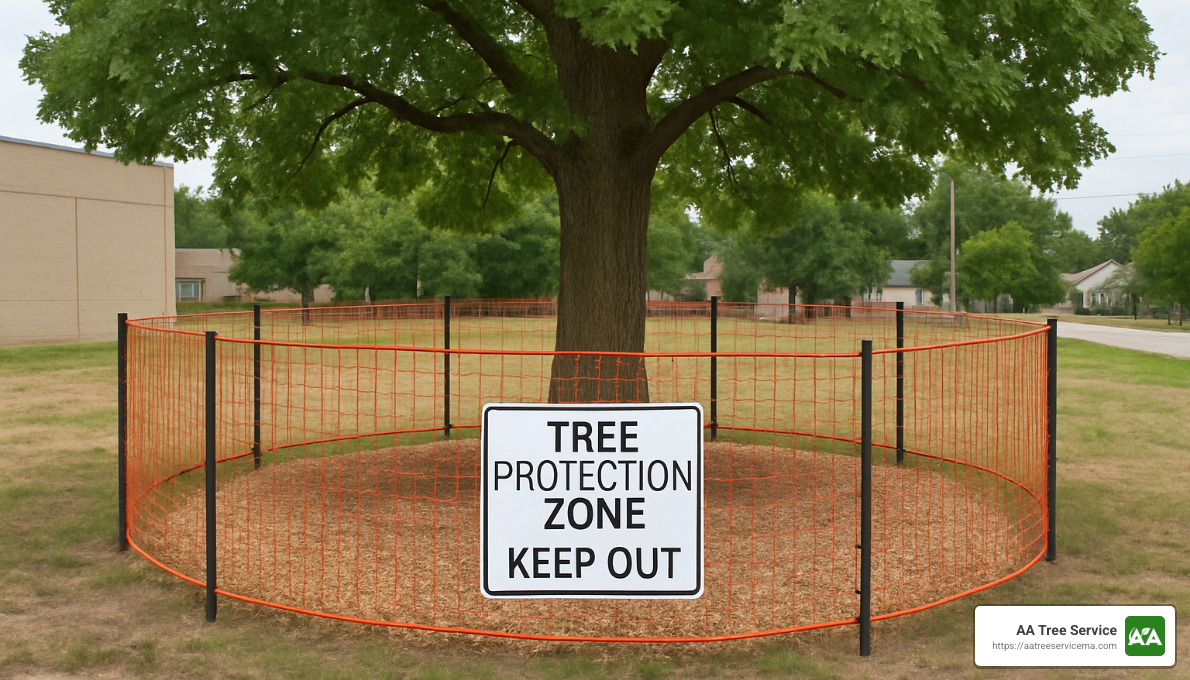
Once we’ve calculated your TPZ, it needs clear marking with sturdy fencing (at least 4 feet high and firmly anchored), visible signage stating “Tree Protection Zone – Keep Out,” and a protective 3-4 inch layer of wood chip mulch inside the zone to reduce soil compaction.
“Installing fencing around the Tree Protection Zone at 1.5× the canopy dripline diameter” is recommended by preservation experts for historic and significant trees. This extra buffer provides insurance against accidental damage.
Throughout Massachusetts and New Hampshire, we help property owners establish appropriate protection zones before construction begins. This preparation significantly improves the odds that your beautiful mature trees will thrive long after the construction equipment leaves.
Need help protecting your trees during construction? Our certified arborists can walk you through the process with a professional assessment custom to your property’s specific needs.
Smart Construction Practices: Root, Soil & Canopy Protection
Once you’ve identified valuable trees and established protection zones, the real work of tree preservation during construction begins. The most critical damage often happens where you can’t see it—underground, where roots silently sustain the trees you’re trying to save.
Protecting the Root System
Think of tree roots as an iceberg—what you see above ground is just a fraction of the story. Most roots spread in the top 6-24 inches of soil and reach far beyond the dripline, often extending 2-3 times the tree’s height. These hidden networks are the lifelines for water, nutrients, and stability.
“Everything a tree needs is in mulch,” observes Dan Herms, PhD, from Ohio State University. This simple insight guides many of our protection strategies at AA Tree Service.
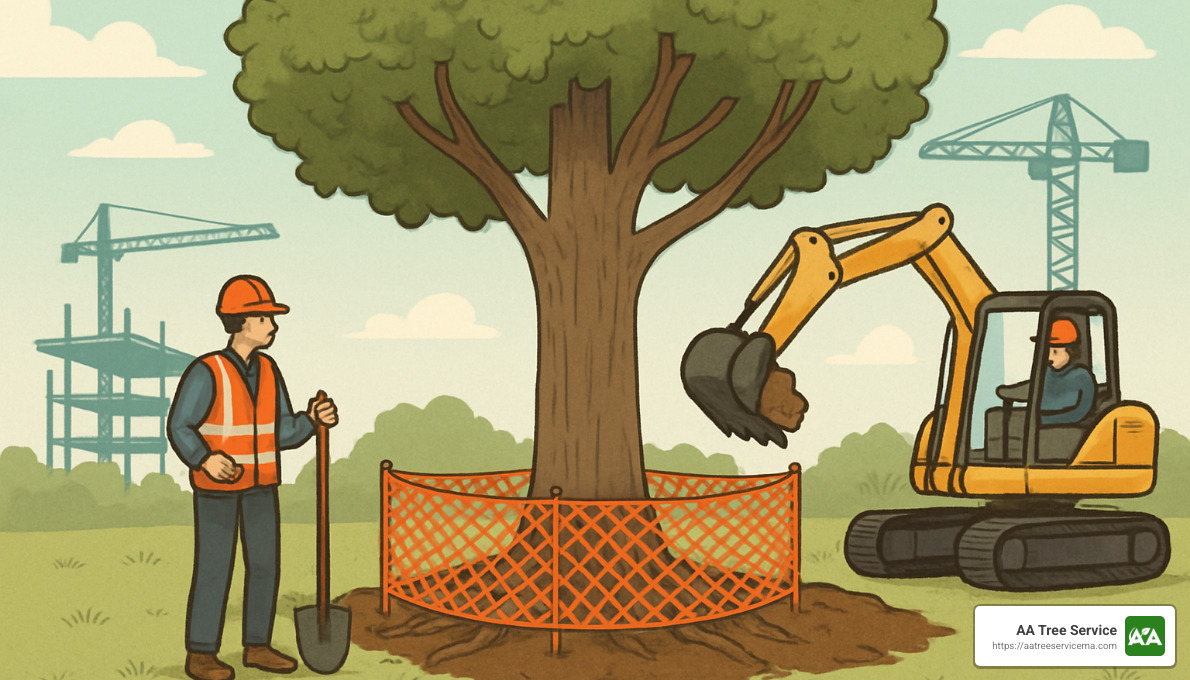
Soil compaction is perhaps the most insidious threat to trees during construction. When heavy equipment or even frequent foot traffic compresses soil, it squeezes out air pockets that roots need to breathe. This damage is nearly impossible to reverse and can slowly kill trees over months or years.
To prevent compaction, we recommend spreading 6-8 inches of wood chip mulch over geotextile fabric in areas where some traffic can’t be avoided. For heavier equipment, plywood or steel plates help distribute weight when crossing the TPZ is absolutely necessary. Whenever possible, designate specific routes for vehicles and materials that completely bypass tree protection zones.
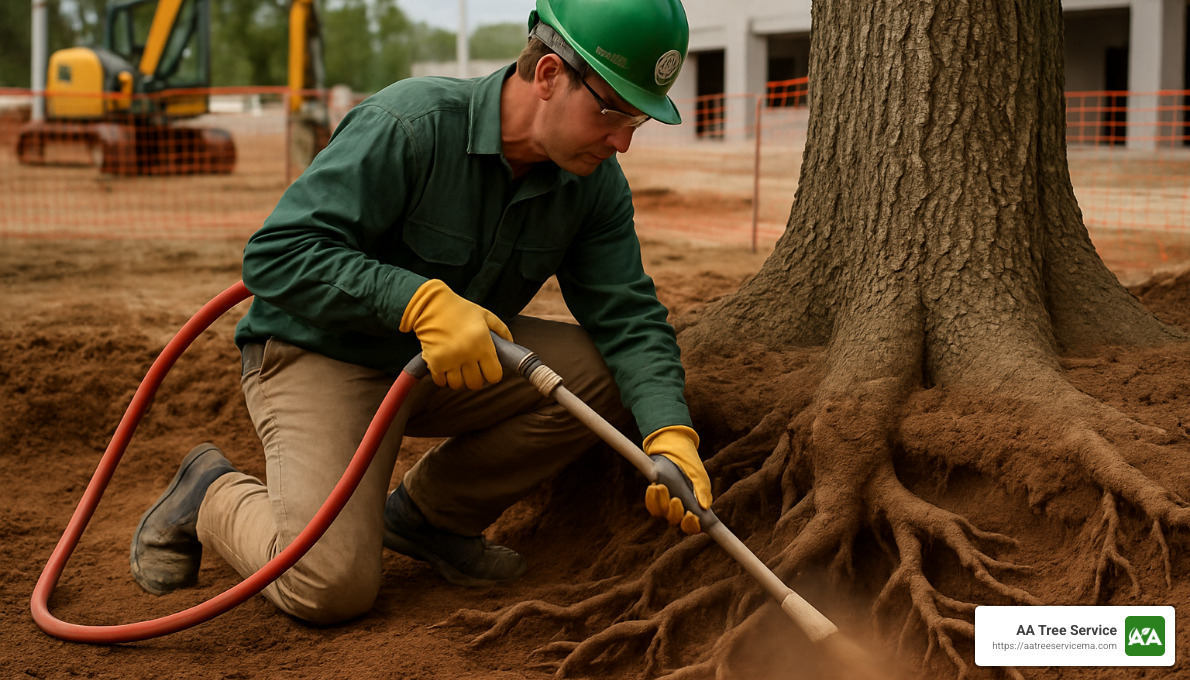
Trenching for utilities presents another major risk. Traditional trenching can sever critical roots, effectively cutting off the tree’s lifelines. When possible, use tunneling or boring techniques instead. If trenching can’t be avoided, hand-excavation near roots allows for careful work, and any roots larger than 1 inch should be cleanly cut—never torn. A good rule of thumb: keep trenches at least 8 feet from tree trunks.
“When digging near a tree, certain impacts are unavoidable, but there are protective measures and best management practices we implement to minimize damage,” explains Christina Reyes, an experienced arborist. Modern techniques like hydro-excavation or air-spading use pressurized water or air with vacuum systems to safely expose roots without mechanical damage.
Grade changes—altering the soil level around trees—can be surprisingly devastating. Even adding just 3 inches of soil over root zones can suffocate sensitive species. If raising the grade is necessary, install aeration systems with perforated pipe. When lowering grades, consider retaining walls to preserve the original soil level around valued trees.
Protecting Trunks and Canopies
While roots need the most protection, trunks and branches deserve attention too. Wrap trunks with 2×4 lumber or corrugated plastic pipe to prevent accidental scrapes and impacts from equipment. Before construction begins, have a certified arborist perform any necessary clearance pruning—it’s better to make careful, planned cuts than to have branches broken during work.
When equipment must operate near trees, carefully secure branches to prevent breakage. And always plan utility lines to avoid conflicts with existing tree canopies—those overhead wires might seem harmless now, but they’ll eventually lead to aggressive pruning or removal.
Tree preservation during construction: On-Site Do’s and Don’ts
| DO | DON’T |
|---|---|
| Maintain fence integrity throughout construction | Allow any construction activity inside the TPZ |
| Water protected trees during dry periods | Store materials or chemicals within the TPZ |
| Perform clean cuts when root pruning is necessary | Trench through critical root zones |
| Use mulch to protect soil structure | Change grades around trees without protection measures |
| Monitor tree health throughout construction | Attach anything to trees (signs, cables, etc.) |
| Consult an arborist before working near TPZs | Allow equipment leakage or washing near trees |
“Trees take in oxygen and water from the soil through their roots. The more compacted the soil is, the more difficult it is for oxygen and water to move through it which has significant negative implications for the long-term health of the trees,” Christina Reyes explains.
Here in Massachusetts and New Hampshire, our team at AA Tree Service regularly partners with contractors to implement these protective measures. We’ve seen that with thoughtful planning and respect for these gentle giants, construction and healthy trees can peacefully coexist.
After the Build: Recovery, Monitoring & FAQs
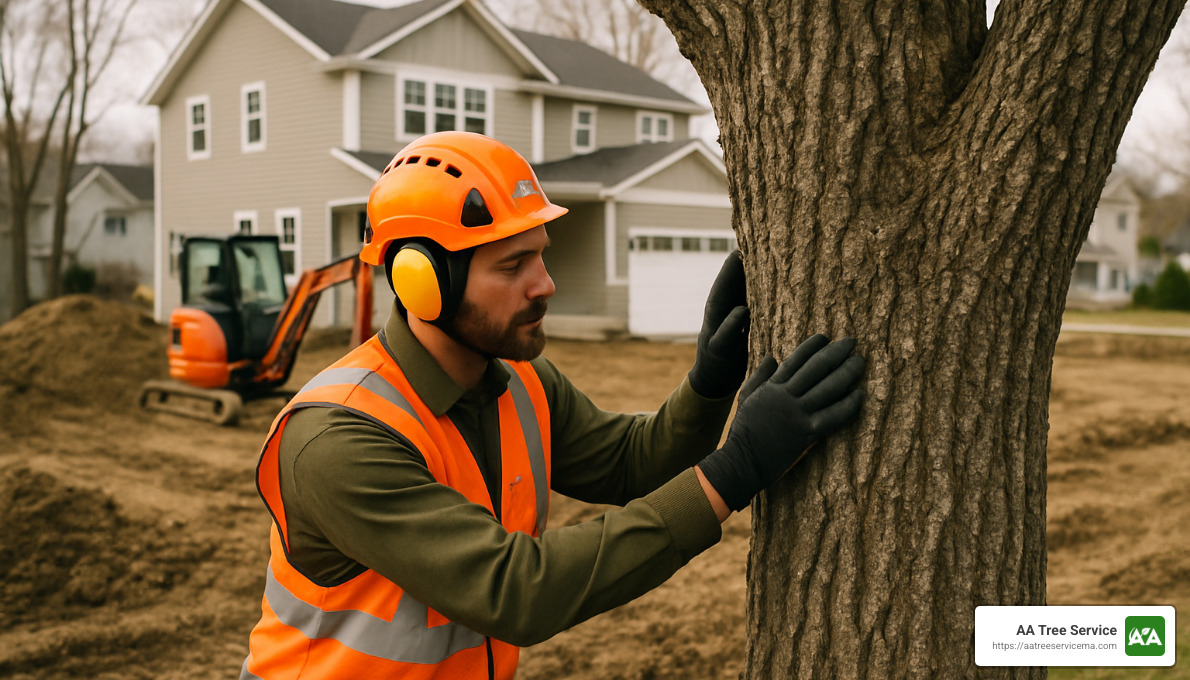
The final nail is in, but for your trees, the journey to recovery is just beginning. Construction stress can linger in trees long after the builders have packed up and gone home. In fact, many trees don’t show symptoms until months or even years later. That’s why post-construction care is absolutely vital for successful tree preservation during construction.
Post-Construction Recovery Strategies
Trees are remarkably resilient, but they need our help after enduring construction stress. Start with consistent, deep watering – a 10-inch diameter tree needs about 200 gallons weekly during dry periods. Think of it as a slow, deep soak rather than a quick sprinkle. This supplemental watering should continue for at least two growing seasons as your tree recovers.
A good layer of mulch works wonders for stressed trees. Apply 3-4 inches of organic wood chips or shredded bark, extending to the dripline if possible. Just remember to keep that mulch pulled back 3-6 inches from the trunk – we want to help the tree, not create a cozy home for fungi and pests! Refresh this mulch annually as it naturally breaks down.
“If a natural woodland ‘floor’ suddenly becomes a manicured and chemically-maintained lawn, the soil microorganisms that the tree relied on for normal health will be gone, and no chemicals can replace them,” warns Gary Johnson, PhD, from the University of Minnesota. His insight reminds us how important it is to maintain a somewhat natural environment around preserved trees.
For trees that experienced soil compaction despite your best efforts, aeration can be a lifesaver. Core aeration improves oxygen flow, while vertical mulching (drilling 2-inch holes 12-18 inches deep and filling with compost) helps severely compacted soils. For valuable specimens, air-spading loosens soil without damaging delicate roots.
Be cautious with fertilization after construction. Contrary to what you might think, heavy fertilizing can actually stress recovering trees. If you do fertilize, choose a slow-release, low-nitrogen formula based on soil test results rather than guesswork. Fall application (September-October) often works best for trees in our New England climate.
When it comes to pruning, patience pays off. Wait until dieback becomes evident before removing branches, focusing only on dead, dying, or broken limbs using proper techniques. Limit pruning to no more than 25% of the canopy in a single year – your tree needs those leaves for photosynthesis and recovery!
Monitoring for Signs of Stress
Keep a watchful eye for these warning signs that your tree is struggling:
Leaf issues like smaller size or unusual coloration can be early indicators of trouble. Premature fall color often signals distress, not early autumn. Branch dieback, especially in the upper canopy, suggests root damage. Excessive deadwood, fungal growth, or trunk sprouting are the tree’s cry for help.
At AA Tree Service, we’ve seen countless trees saved through early intervention. That’s why we recommend professional inspections annually for at least three years following construction. Our certified arborists throughout Massachusetts and New Hampshire can spot subtle signs of decline and recommend targeted treatments before it’s too late.
“A tree does not heal, or fill, a wound,” explains Penn State Extension. “Instead, it defends against decay and discoloration by compartmentalizing the wound.” This natural defense works best when the tree isn’t battling multiple stressors simultaneously.
Frequently Asked Questions about Tree Preservation
Why is a pre-construction tree inventory essential?
Not all trees deserve the same preservation effort. A professional inventory helps you identify which trees are truly worth saving based on species, condition, and location. Some trees might be poor specimens, invasive species, or already declining – focusing resources on your property’s most valuable trees makes both ecological and economic sense.
In Massachusetts and New Hampshire, where magnificent sugar maples, oaks, and white pines can take decades to reach maturity, preserving healthy specimens is particularly valuable. The inventory becomes your roadmap for protection efforts, ensuring you’re investing in trees that will continue enhancing your property for years to come.
How much root loss can a tree survive?
Most healthy trees can survive losing up to 30-40% of their root system, though this varies dramatically by species, age, and overall health. However, structural stability becomes a real concern after removing more than one-third of the roots, potentially creating hazardous conditions down the road.
The International Society of Arboriculture has found that trees with 70% or more of their critical root area protected have excellent survival rates. Trees with 50-60% protection show about 50% survival, while those with less than 40% protection rarely survive long-term.
For Massachusetts and New Hampshire homeowners, this means protecting as much of the root zone as possible – ideally the entire area within 1.5 feet for every inch of trunk diameter – gives your trees the best chance of thriving after construction.
When should I prune or fertilize after construction?
Timing is everything with post-construction tree care. For pruning, it’s generally best to wait until stress symptoms appear, allowing you to identify which branches truly need removal. Immediate pruning should focus only on hazardous or obviously damaged limbs.
Fertilization timing depends on your specific soil conditions and tree health. We always recommend soil testing before applying any fertilizer. If needed, apply slow-release fertilizers in early spring or fall. For stressed trees in our New England climate, fall fertilization (September-October) often produces better results, as the tree can direct those resources to root development during dormancy.
At AA Tree Service, we provide soil testing and customized fertilization programs specifically designed for trees recovering from construction stress throughout Massachusetts and New Hampshire. We’ve helped countless homeowners nurse their valuable trees back to health after building projects, preserving both their beauty and their property value for generations to come.
Conclusion
Tree preservation during construction isn’t just an environmental choice—it’s a smart investment in your property’s future. In our Massachusetts and New Hampshire climate, where trees can take decades to reach maturity, protecting existing specimens makes far more sense than starting over with saplings.
The journey of successful tree preservation is like building a good relationship—it requires thoughtful planning, consistent attention, and ongoing care. But like all worthwhile investments, the payoff is substantial. That magnificent oak or maple that survives your renovation becomes an immediate asset, providing shade, wildlife habitat, and natural beauty that new plantings simply cannot match for many years to come.
Success doesn’t happen by accident. Throughout our years serving property owners across Massachusetts and New Hampshire, we’ve found that effective tree preservation during construction always hinges on four essential elements:
- Professional assessment and thorough inventory before the first shovel hits the ground
- Creating and respecting adequate Tree Protection Zones
- Consistent implementation of protection measures from project start to finish
- Thoughtful post-construction care and vigilant monitoring
At AA Tree Service, we’ve guided countless homeowners through this process. Our certified arborists understand the unique challenges of New England soils, weather patterns, and native tree species. We know what works and what doesn’t in our region.
Construction damage often reveals itself gradually—sometimes taking 3-7 years to become fully evident. This delayed response means proper protection isn’t just about seeing your trees survive the construction phase—it’s about ensuring their health and stability for years to come.
As one wise preservation expert puts it, “Prevention is easier than correction.” By investing in proper tree preservation during construction measures now, you avoid the costly and emotional toll of removing damaged trees later, not to mention the decades-long wait for replacements to mature.
For property owners in Massachusetts and New Hampshire planning construction projects, AA Tree Service offers comprehensive preservation services from start to finish—initial inventory and assessment, protection planning, implementation during construction, and vital post-construction care. With our expertise guiding you, your valuable trees can remain healthy assets to your property for generations.
For more information about our tree removal and preservation services throughout Massachusetts and New Hampshire, contact us today for a free consultation.