Protecting Your Property With Proper Tree Risk Assessment
Tree hazard assessment is the systematic evaluation of trees to identify potential dangers before they cause harm or damage.
Quick Answer: How to Conduct a Basic Tree Hazard Assessment
- Identify potential targets (people, buildings, vehicles) within falling distance of the tree
- Examine the tree’s structure for defects (dead branches, cracks, decay, leaning)
- Evaluate the likelihood of failure based on defect severity
- Assess potential impact if failure occurs
- Determine risk level by combining likelihood of failure with potential consequences
Every year in Massachusetts and New Hampshire, homeowners face property damage, personal injuries, and power outages from fallen trees and branches. While trees provide valuable benefits to our communities—shade, clean air, and aesthetic beauty—they also come with inherent risks that increase as trees age or face environmental stressors.
“Trees provide numerous benefits which increase with tree size and age, but so do the risks of falling branches,” notes the International Society of Arboriculture.
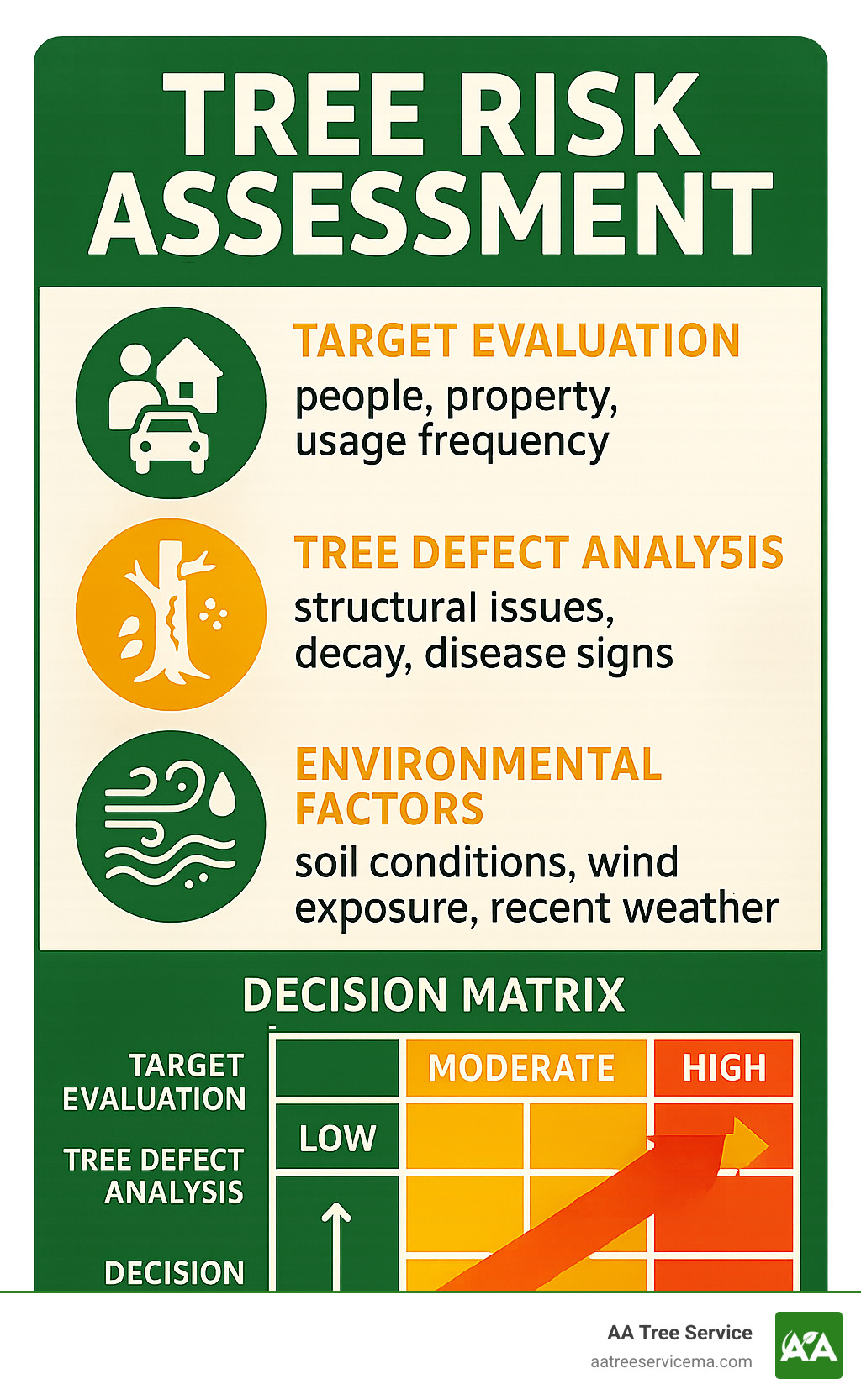
A proper tree hazard assessment helps identify these risks before they become emergencies. Unlike a casual glance at your landscape, a structured assessment evaluates three critical components: the tree’s structural condition, the likelihood of failure, and the potential targets that could be impacted.
For homeowners in New England, where nor’easters and ice storms regularly test the structural integrity of our trees, understanding how to spot hazardous conditions can prevent costly damage and ensure family safety.
While this guide will help you identify potential hazards, complex or high-risk situations should always be evaluated by a certified arborist with specialized training in tree risk assessment.
Tree hazard assessment terms made easy:
– Protect trees during construction
– Emergency tree cutting services
– Tree removal cost estimate
Understanding Tree Hazard Assessment
When we talk about a tree hazard assessment, we’re describing something much more comprehensive than just glancing up at your maple tree and wondering if that branch looks a bit iffy. It’s actually a careful, systematic process that helps protect your family and property from potential tree-related dangers.
The USDA Forest Service breaks down a tree hazard assessment into three fundamental components that work together:
- The tree itself – its structural health and any concerning defects
- The surrounding environment – soil conditions, exposure to wind, nearby construction
- The potential “targets” – what (or who) could be harmed if something goes wrong
Understanding these elements helps homeowners in Massachusetts and New Hampshire make smart decisions about their trees before problems escalate into emergencies.
What “Tree Hazard Assessment” Really Means
There’s an important distinction between “hazard” and “risk” that’s central to understanding tree hazard assessment:
A hazard is simply the potential for harm – like that dead branch hanging over your driveway. Risk, on the other hand, is the actual probability of that hazard causing damage – considering how often you park beneath it, for instance.
As one experienced arborist once told me, “Every tree comes with some level of risk. Our job isn’t to eliminate all risk – that’s impossible unless you cut down every tree. Instead, we want to manage risk to a reasonable level.”
Professional arborists often use the Quantified Tree Risk Assessment (QTRA) system, which considers a risk threshold of 1 in 10,000 as generally acceptable for significant harm. This benchmark helps put tree risks in perspective alongside other everyday risks we routinely accept.
The concept of “targets” is equally crucial in any thorough tree hazard assessment. A target is anything valuable that could be damaged or anyone who might be injured if a tree or branch fails. In Massachusetts and New Hampshire properties, common targets include:
- Your home, garage, or garden shed
- Family members and visitors
- Parked vehicles
- Power lines (especially important during New England winters)
- Expensive landscape features or neighboring properties
The risk level increases significantly based on how frequently a target is present. A decaying tree deep in a wooded lot presents minimal risk, while that same tree beside your child’s backyard swing set becomes an urgent concern.
By understanding these fundamental concepts, you’ll be better prepared to evaluate the trees on your property or to have a more informed conversation with a certified arborist about your specific situation and risk tolerance.
Legal & Ethical Responsibilities in Massachusetts and New Hampshire
As a property owner in Massachusetts or New Hampshire, you have important responsibilities when it comes to the trees on your land. These aren’t just legal obligations—they’re about being a good neighbor and community member.
Think of your trees as silent neighbors that occasionally need your attention. When they’re healthy, they provide wonderful benefits. But when they become hazardous, you have a duty to address the situation.
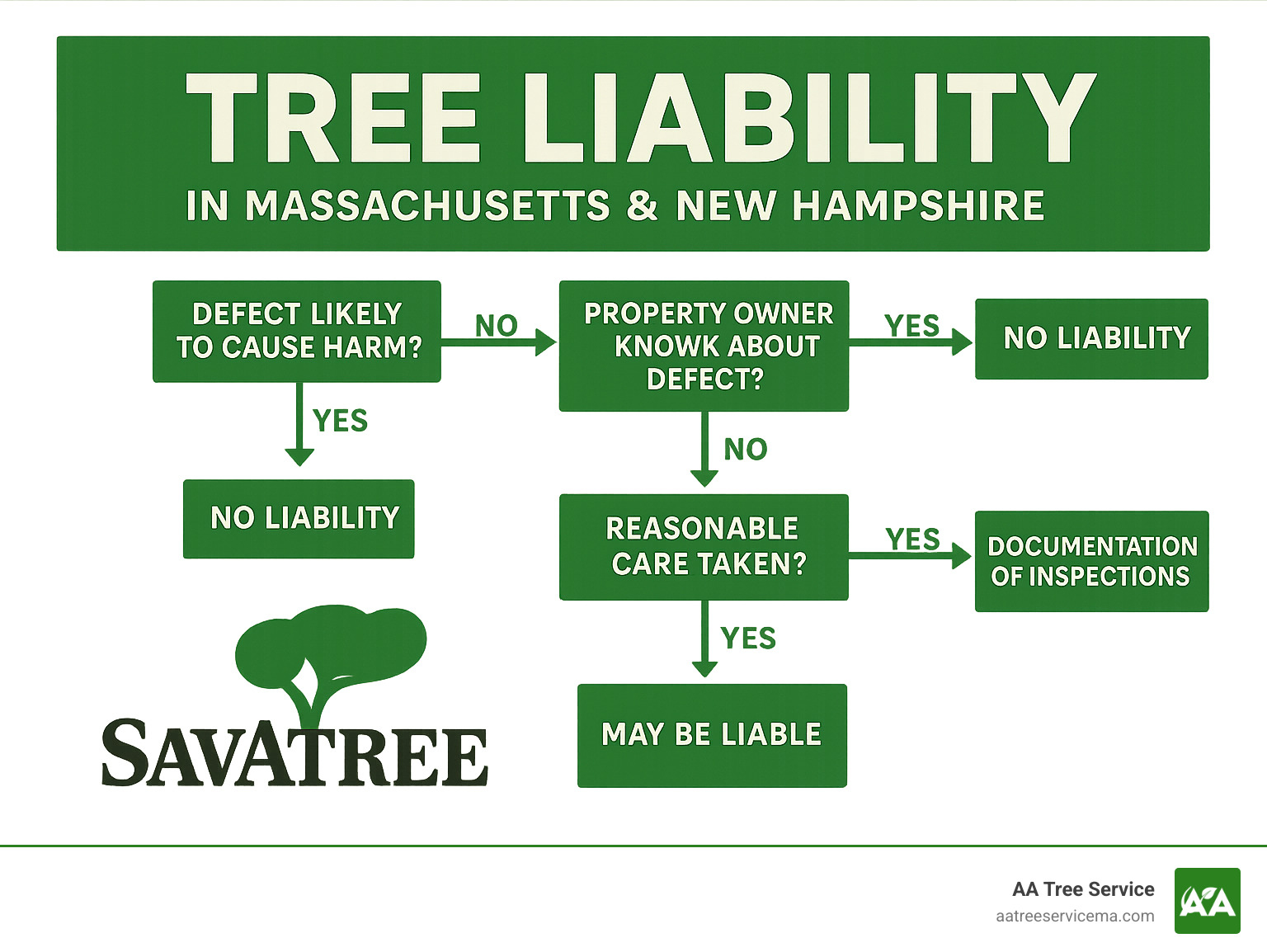
In both MA and NH, the law recognizes a concept called “duty of care.” This means you’re expected to take reasonable steps to prevent foreseeable harm from your trees. You don’t need to be perfect, but you do need to be prudent.
What does “reasonable care” actually mean? Courts typically look at three key factors:
- Did you know (or should you have known) about the hazardous condition?
- Did you take reasonable steps to address it?
- Was the harm foreseeable?
The landmark Goode v. City of Burnside case (2007) highlighted something important: documentation matters. The judge emphasized that systematic, well-documented tree inspections demonstrate you’re taking your responsibilities seriously.
For Massachusetts and New Hampshire property owners specifically, the legal standards boil down to this: if you knew (or reasonably should have known) a tree was hazardous and did nothing about it, you could be liable for resulting damages. On the flip side, if you’re proactive about tree hazard assessment and maintenance, you’re not only protecting others—you’re protecting yourself legally.
Beyond legal requirements, there’s an ethical dimension to tree ownership. These magnificent plants clean our air, provide habitat, and improve our communities. The goal isn’t to remove every tree that might pose any risk—it’s to find the balance between preservation and protection.
For those with multiple trees or properties in high-traffic areas, we recommend establishing a regular care routine that includes:
- Annual documented inspections by a qualified arborist
- Additional checks after severe weather events (particularly important in New England!)
- Maintaining simple records of assessments and work performed
- Promptly addressing identified hazards, especially near sidewalks, driveways, or playgrounds
Municipalities often have additional requirements for trees in public spaces. If you’re unsure about a tree near a property line or public way, it’s worth checking local regulations or consulting with a professional.
A tree hazard assessment isn’t just about avoiding liability—it’s about peace of mind. Knowing your trees have been properly evaluated means you can enjoy their beauty without worrying about what might happen during the next nor’easter.
Step-by-Step Tree Hazard Assessment Process
Wondering how to check if that giant maple in your yard is safe? Don’t worry – you don’t need to be an expert to conduct a basic tree hazard assessment. Let me walk you through a straightforward approach that any homeowner in Massachusetts or New Hampshire can follow.
Step 1: Survey Your Property
Start by taking a stroll around your yard with fresh eyes. Make note of all trees, especially those that could potentially reach your home, garage, driveway, or favorite patio spot if they fell. Those beautiful shade trees that tower over your kids’ swing set? They deserve special attention.
Step 2: Identify Potential Targets
For each tree, think about what would be in harm’s way if something went wrong. Is your car usually parked underneath? Do your children play nearby? Is there a power line running through the branches? The more frequently people or valuable property occupy the space near a tree, the more important its assessment becomes.
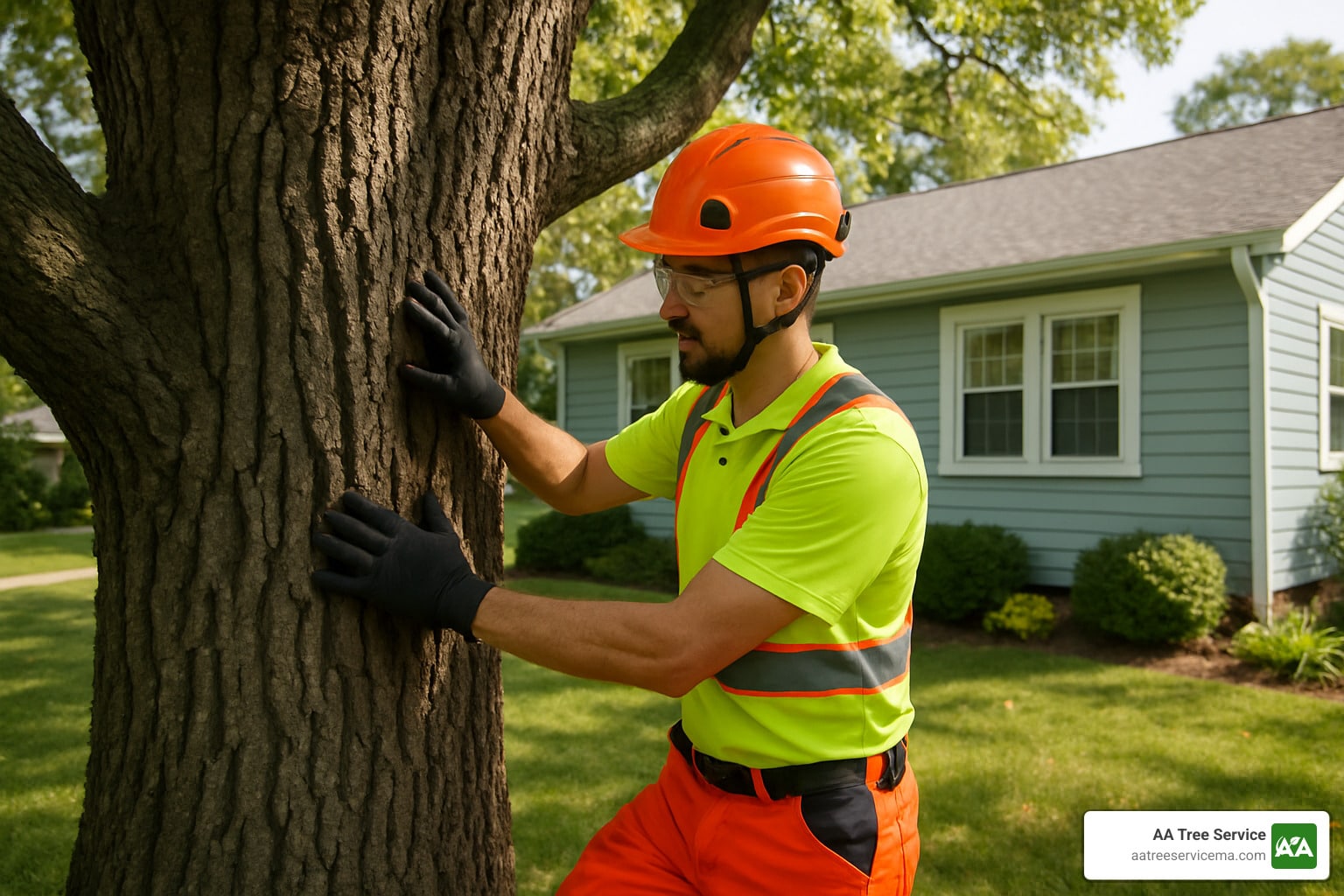
Step 3: Conduct a Visual Inspection
Now for the detective work! Walk completely around each tree, looking at it from every angle (what arborists call a “360° inspection”). Bring binoculars for those tall specimens – you’ll want to examine:
The crown – Look up at the branches and leaves. Are there dead branches? Does the leaf coverage look thin or uneven?
The trunk – Examine it from ground level up. Any cracks, holes, or strange growths?
The root collar – Check where the trunk meets the ground. See any mushrooms or soil heaving?
The surrounding soil – Notice any recent changes, like new construction or drainage issues?
Step 4: Document Your Findings
Pull out your phone and take photos from multiple angles. Jot down what you see, including the tree species (if you know it), its location, and any concerns. Dating your inspection provides valuable history, especially after storms or as trees age. This documentation isn’t just for your memory – it shows you’ve been diligent if questions of liability ever arise.
Level-2 “Basic Tree Hazard Assessment” Checklist
Ready to take your tree hazard assessment to the next level? Here’s what professional arborists look for during a more thorough evaluation:
When examining the crown, look for dead or broken branches (especially those thicker than your wrist), sparse or discolored foliage, and multiple stems with bark growing between them (called included bark – a structural weakness).
For the trunk, check for cracks or splits, cavities or holes, mushrooms or conks growing on the bark (sign of internal decay), oozing sap, and any significant lean that wasn’t there before.
At the base, investigate for exposed or damaged roots, fungal growth near the trunk, heaving soil, signs of construction damage, or poor drainage.
While this checklist is helpful for homeowners, some problems remain invisible to untrained eyes. When something looks concerning or you’re assessing high-value trees, it’s worth consulting a certified arborist for professional guidance.
Level-3 Advanced “Tree Hazard Assessment” Techniques
Sometimes, what’s happening inside a tree matters most, and that’s where advanced tree hazard assessment technology comes into play. Professional arborists use sophisticated tools to see what eyes can’t:
Resistograph Testing works like a tiny drill, measuring wood density as it penetrates the tree, revealing hidden decay while causing minimal damage.
Sonic Tomography creates a cross-sectional image of the tree’s interior using sound waves – think of it as an ultrasound for your oak or maple.
Pull Tests help evaluate root stability by applying measured force to the trunk while monitoring movement – crucial for determining if a leaning tree might uproot.
Drone Imaging offers a bird’s-eye view of tall canopies, capturing details of upper branches that would otherwise require dangerous climbing.
These advanced methods are particularly valuable for heritage trees, specimens with suspected internal problems, or trees in high-traffic areas where failure could have serious consequences. At AA Tree Service, we employ these technologies when necessary to provide Massachusetts and New Hampshire homeowners with the most thorough risk assessments possible.
Need more guidance on maintaining your trees after assessment? Check out our Tree Maintenance Services for expert care that preserves both beauty and safety.
Common Defects & Site Conditions That Increase Risk
Knowing what to look for during a tree hazard assessment is crucial for keeping your property safe. Let’s explore the most common tree problems that might be hiding in your yard right now.
Structural Defects
Deadwood is more than just an eyesore—it’s a serious safety concern. When branches larger than 6 inches in diameter die, they become what loggers ominously call “widow makers” because they can fall without warning, even on calm days. During your assessment, pay special attention to branches that lack leaves during growing season or show peeling bark.
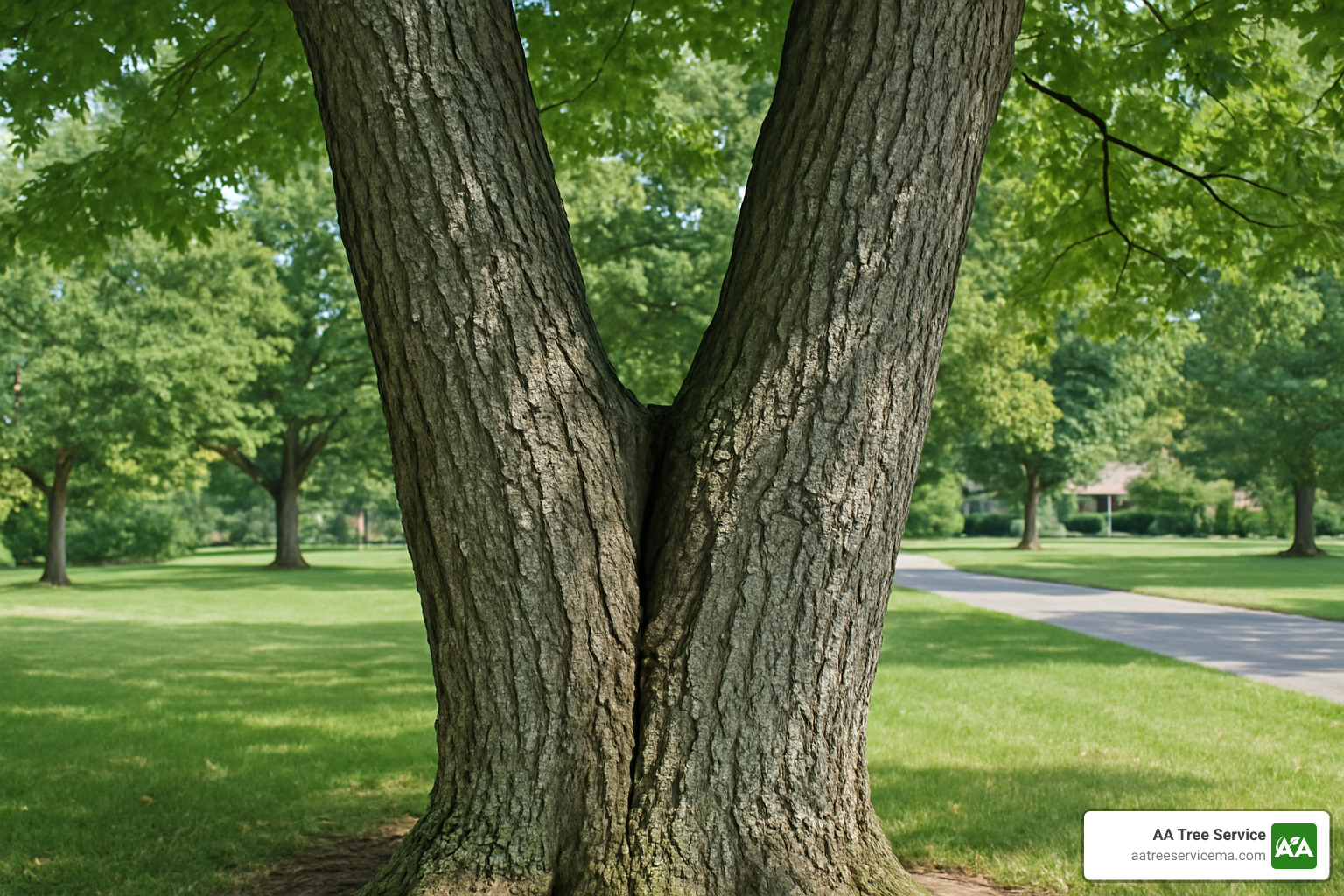
Codominant stems are a hidden weakness many homeowners overlook. These are trees with multiple trunks of similar size, and they’re surprisingly fragile. Research has found these trees fail at just 45% of the wood strength compared to their single-stemmed cousins (which maintain 79% strength). The junction where these stems meet often can’t support the weight as the tree matures.
Those hollow spots you might notice in a trunk or major branch? They’re called cavities and decay zones, and they significantly weaken a tree’s structure. Arborists often use the “One-Third Rule” as a guideline: if less than one-third of a tree’s radius remains as solid wood, that tree has a high potential for failure. Think of it like a house with damaged support beams.
Root plate issues are particularly troublesome because they’re often hidden underground. More than half of urban tree failures can be traced back to root problems. Keep an eye out for mushroom-like growths (fungal conks) at the tree’s base, soil that’s heaving or cracking around the trunk, or roots that are exposed or damaged. These are all red flags that your tree might be at risk.
While many trees naturally grow at a slight angle, significant leans that appear suddenly or worsen over time indicate potential root failure. As one arborist puts it, “A sudden lean is like a tree’s cry for help—it indicates immediate risk and calls for prompt action, whereas a long-standing lean has usually developed compensatory strength.”
Included bark is another sneaky defect. When bark grows between branches or stems instead of forming a proper union, it prevents the wood fibers from connecting correctly. These weak spots are prime failure points, especially during those fierce New England storms we experience in Massachusetts and New Hampshire.
Site Conditions
The environment around your tree plays a huge role in its stability too:
Soil compaction is especially common in urban and suburban areas of MA and NH. When soil gets packed down from foot traffic, vehicles, or construction, it restricts root growth and oxygen flow, leading to poor tree health and reduced stability.
Recent construction near trees can be devastating to their root systems. Even if the tree looks fine today, damage to roots within the drip line (the area directly below the branches) can destabilize trees and show effects years later. This is particularly relevant for new home additions or landscape renovations.
Exposure to wind affects trees more than you might think. Trees grown in forests or groups develop differently than solitary trees. When neighboring trees are suddenly removed, previously sheltered trees become vulnerable to winds they weren’t developed to withstand.
Poor drainage creates a double problem—waterlogged soil weakens root systems while encouraging root rot. Many parts of Massachusetts and New Hampshire have clay soils that drain poorly, making this a common issue in our region.
Species characteristics matter too. Some trees are simply more prone to certain types of failure. Silver maples and bradford pears, common in New England landscapes, often have weak branch attachments. Pines, meanwhile, with their relatively shallow root systems, may snap during high winds—something we see frequently during nor’easters.
Identifying High-Priority Defects During a Tree Hazard Assessment
During your tree hazard assessment, certain red flags deserve immediate attention:
Severe decay signs like fungal conks on the trunk aren’t just unsightly—they’re announcing serious internal decay. Research shows trees with these mushroom-like growths are 12 times more likely to fail than trees without them. Certain species like Ganoderma and Laetiporus (chicken of the woods) are particularly concerning when found on living trees.
Cracks through wood are much more serious than surface bark splits. To tell the difference, try inserting a pencil into the crack—if it goes deeper than 3 inches, you’re likely dealing with a structural crack that extends into the wood itself, significantly compromising the tree’s integrity.
Multiple serious defects compound risk exponentially. A leaning tree might be okay, and a tree with some decay might be manageable, but a leaning tree with decay? That’s a much higher priority for professional evaluation.
Lightning damage can be sneakier than you’d expect. The intense heat can vaporize internal moisture, causing explosive damage that might not be immediately obvious from the outside. Look for vertical scars and splitting, especially after storms.
Recent changes in a tree’s condition are always cause for concern. Any sudden lean, soil heaving, or fresh cracks require prompt attention as they often indicate active failure is underway.
While this guide helps you spot common issues, a professional arborist brings trained expertise to detect subtle signs that might be missed in a DIY assessment. At AA Tree Service, we’ve been helping homeowners throughout Massachusetts and New Hampshire identify and address tree hazards for over 20 years—often catching problems before they become emergencies.
Tools & Rating Systems for Precise Risk Evaluation
Professional arborists use standardized tools and rating systems to ensure consistent tree hazard assessment results. Understanding these systems can help you communicate more effectively with tree care professionals.
Common Rating Systems
ISA Basic Tree Risk Assessment Form:
Developed by the International Society of Arboriculture, this form evaluates:
– Likelihood of failure (Improbable, Possible, Probable, Imminent)
– Likelihood of impact (Very Low, Low, Medium, High)
– Consequences of failure (Negligible, Minor, Significant, Severe)
These factors combine to create a risk rating from Low to Extreme.
USDA Forest Service 7-Point Scale:
Used extensively in public recreation areas, this system:
– Rates failure impact from 1-3 points
– Rates failure potential from 1-4 points
– Combines these for a total hazard rating from 1-7
Quantified Tree Risk Assessment (QTRA):
This more detailed system quantifies risk as a probability:
– Target values are assigned based on usage frequency and value
– Impact potential is rated based on size of the potential failing part
– Probability of failure is estimated as a fraction (e.g., 1/1000)
These values are multiplied to calculate a risk of harm as a ratio (e.g., 1/10,000).
Digital Tools for Assessment
Modern arborists often use:
– Mobile apps with built-in risk assessment forms
– GIS mapping to track tree locations and conditions
– Cloud databases for storing historical inspection data
– Digital measurement tools for precise defect documentation
These tools help create comprehensive records that track changes over time and support management decisions.
Selecting the Right Method for Your Next Tree Hazard Assessment
When planning a tree hazard assessment, consider these factors to determine the appropriate level of assessment:
Site Usage:
High-traffic areas or trees near structures typically warrant more detailed assessments than those in remote locations.
Tree Value:
Historic, rare, or high-value landscape trees may justify advanced testing methods even when risk appears low.
Assessor Qualifications:
Basic assessments can be performed by informed homeowners, but complex situations require certified professionals, preferably with Tree Risk Assessment Qualification (TRAQ) credentials.
Budget Considerations:
While basic visual assessments are relatively inexpensive, advanced testing methods involve specialized equipment and expertise that increase costs.
Legal Concerns:
When liability is a significant concern (e.g., trees near public spaces or property lines), more thorough documentation and professional assessment are advisable.
At AA Tree Service, we tailor our assessment approach to each situation, ensuring the right level of scrutiny without unnecessary expense. Our certified arborists can help determine which assessment method best suits your specific trees and circumstances.
Mitigation Actions & Inspection Scheduling
Once your tree hazard assessment is complete, it’s time to roll up your sleeves and address any issues you’ve found. Think of this as the “what now?” phase of keeping your property safe.
Pruning
Pruning is often your first line of defense—and the gentlest approach for the tree. Like a good haircut, proper pruning can transform a potentially dangerous situation into a safe one while keeping the tree healthy.
“Pruning is both an art and a science,” says one veteran arborist. “When done correctly, you might remove 20% of the canopy but eliminate 80% of the risk.”
Good pruning targets those troublemakers: dead branches hanging like swords of Damocles over your driveway, diseased limbs that could snap in the next storm, and those overextended branches that have grown too heavy for their own good. It can also thin the canopy to reduce wind resistance during those famous New England nor’easters.
Proper pruning follows established standards—not just lopping off branches willy-nilly. Our Tree Pruning Services adhere to ANSI A300 standards, ensuring your trees remain both safe and beautiful.
Cabling and Bracing
Some trees are like family heirlooms—too precious to remove despite their flaws. For these special cases, structural support systems can be lifesavers.
Steel cables installed high in the canopy can provide crucial support between major limbs, while bracing rods can reinforce weak branch unions or repair splits. For particularly valuable specimens, lightning protection systems offer peace of mind during thunderstorm season.
These systems aren’t “set it and forget it” solutions, though. They need professional installation and regular check-ups every 3-5 years to ensure they’re still doing their job.
Moving Targets
Sometimes the smartest solution isn’t changing the tree at all—it’s changing what’s underneath it. This approach is often overlooked but can be brilliantly effective.
That picnic table directly under the aging oak? Move it to a safer spot. The playground equipment beneath those brittle branches? Relocate it to an open area. Your prized convertible parked under the massive pine? Find it a new home in the garage during winter ice storms.
As one practical-minded arborist puts it, “Moving the target can be a more cost-effective hazard mitigation strategy than tree removal or pruning.” It’s simple physics—if nothing’s there when a branch falls, no damage occurs.
Tree Removal
When other options won’t suffice, removal becomes necessary. This is typically the right call for trees with:
Severe structural defects that can’t be adequately remedied
Extensive root damage or decay compromising stability
Active failure where the tree has already begun to fall
Inappropriate species planted in the wrong location years ago
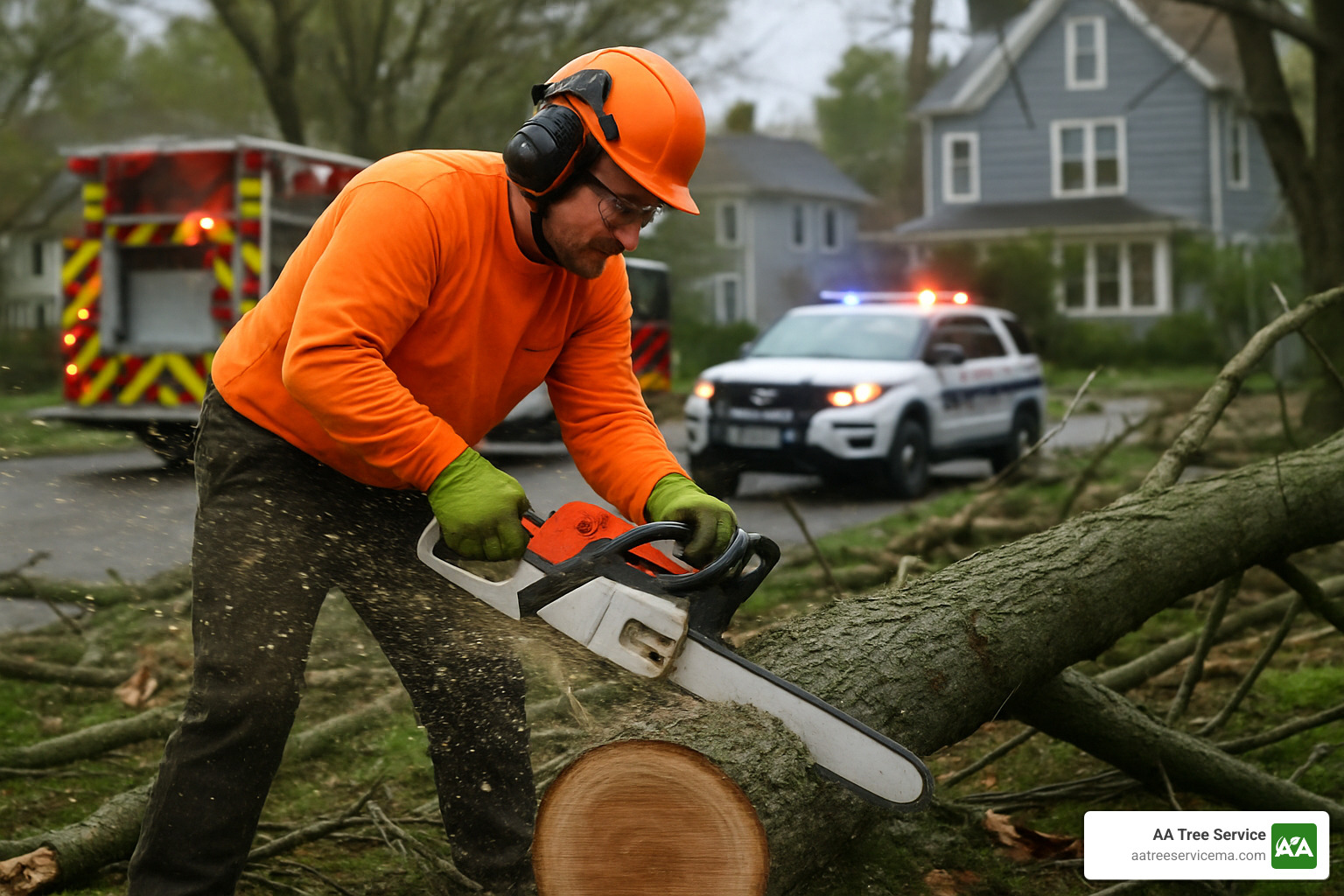
In emergency situations where trees pose immediate danger, our Emergency Tree Removal Service provides rapid response throughout Massachusetts and New Hampshire, any time of day or night.
Monitoring Plans
Not every risk requires immediate action. For moderate-risk situations, a “watch and wait” approach with a formal monitoring plan often makes sense. This includes:
Regular documented check-ups to track changes
Photographs from the same angles to compare over time
Clear trigger points that signal when it’s time to take action
This approach is particularly valuable for historic or beloved trees where you want to preserve them as long as safely possible.
Inspection Scheduling
How often should you conduct a tree hazard assessment? It depends on your trees and property, but here’s a good rule of thumb:
For high-value or high-risk trees in Massachusetts and New Hampshire, annual professional inspections are a wise investment. Those gorgeous old maples lining your driveway? They deserve an annual check-up.
After major weather events—those howling nor’easters, ice storms, or summer thunderstorms—a quick walk-around inspection is always warranted. Trees can suffer hidden damage that might not be immediately obvious but could lead to failure weeks later.
The seasons in New England also provide natural inspection points:
Spring reveals winter damage and early disease signs
Summer shows whether foliage is healthy and full
Fall offers the perfect time to spot structural issues before leaf drop
Winter exposes the skeleton of the tree when problems are easier to spot
Cost Ranges for Common Hazard Mitigation in MA & NH
What might tree care cost? Based on internet data (not actual costs for AA Tree Service), here are typical ranges you might encounter:
Pruning a small ornamental cherry might run $250-$500, while that towering oak could range from $900-$1,200 or more. The difference comes down to size, complexity, and equipment needed.
Cabling systems start around $400-$600 for basic installations but can climb to $1,500-$2,000+ for comprehensive support systems in large trees with multiple weak points.
When removal becomes necessary, costs vary dramatically based on size, location, and complexity. A small tree might cost $800-$1,200, while large or hazardous removals can range from $2,500-$5,000 or significantly more if specialized equipment is needed.
Investing in regular care often prevents those middle-of-the-night emergency calls that come with premium pricing. An ounce of prevention truly is worth a pound of cure when it comes to tree care.
By addressing hazards proactively, you’re not just protecting your property—you’re preserving the beauty and benefits of your landscape for years to come.
Frequently Asked Questions about Tree Hazard Assessment
How often should mature trees be inspected in New England?
If you’re a homeowner in Massachusetts or New Hampshire, you might be wondering how frequently you should check on those towering maples or sturdy oaks in your yard. For most residential properties in our New England region, we recommend:
Annual professional inspections are ideal for trees near your home, garage, or areas where your family spends time outdoors. Think of it as a yearly check-up for your leafy friends!
For trees that already have known issues—perhaps a split trunk or some concerning decay—more frequent monitoring (about 2-3 times per year) will help you stay ahead of potential problems.
After those fierce nor’easters, ice storms, or the occasional hurricane that sweeps through our region, it’s always wise to do an immediate inspection once it’s safe to go outside.
New England weather is uniquely challenging for trees. As one arborist I know puts it, “Trees in active-use areas should be inspected annually for defects and conditions leading to failure, with additional checks after significant storms.”
Between professional visits, you can certainly do your own visual checks. Early spring (before leaves appear) and fall (as leaves drop) offer the best views of branches and structure, making potential issues easier to spot.
What is a “target” and how do I lower its value?
When conducting a tree hazard assessment, a “target” isn’t something you aim at—it’s anything that could be damaged or anyone who might be injured if a tree or branch falls. The value of a target depends on:
- How often people or property are present (occupancy rate)
- The value itself (with people being the highest priority, of course)
- What might happen if something falls on it
Fortunately, there are several ways to lower target value without removing the tree:
Relocate movable items like picnic tables, children’s play equipment, or even where you park your car. This simple step can significantly reduce risk with minimal effort.
Reduce how often people are in the area by limiting access beneath concerning trees until you can address the problem.
Create safety zones with fencing or barriers to keep family and visitors at a safe distance from potential hazards.
Be strategic about timing by planning outdoor activities during seasons when tree failures are less common—avoiding those windy fall days, for instance.
As professional guidelines often note, “Changing the target can often be more practical than removing a borderline hazardous tree, especially for trees with significant ecological or aesthetic value.”
Can I do a Tree Hazard Assessment myself or must I hire a TRAQ arborist?
Yes, you absolutely can perform basic tree hazard assessments yourself using the guidelines we’ve shared in this article! Homeowner assessments are incredibly valuable for:
Keeping an eye on your trees between professional visits, spotting obvious red flags like hanging branches or trees that have developed a concerning lean, documenting changes you notice over time, and making informed decisions about when it’s time to call in the experts.
That said, certain situations call for professional expertise:
Trees with multiple or complex problems, historic or particularly valuable specimens, scenarios where failure could cause significant damage or injury, legal situations where you might need formal documentation, or when you need advanced testing to evaluate hidden internal decay.
While any certified arborist can provide valuable insights, those with Tree Risk Assessment Qualification (TRAQ) have specialized training specifically in risk assessment methodology. This credential means the arborist has proven their expertise in the latest risk evaluation techniques.
At AA Tree Service, our team includes TRAQ-certified arborists who provide thorough risk assessments throughout Massachusetts and New Hampshire. We’re here to help with those tricky situations where you need more than just a casual opinion about your trees’ health and safety.
Conclusion
A thorough tree hazard assessment is an essential part of responsible property ownership in Massachusetts and New Hampshire. By understanding the basics of tree risk evaluation, you can protect your property, ensure family safety, and preserve the health and beauty of your landscape trees.

Tree care isn’t just about addressing problems—it’s about proactive management that preserves both safety and the incredible benefits trees provide to our New England communities. The shade on a hot summer day, the vibrant fall colors, and the natural habitat for wildlife are all worth protecting through thoughtful risk management.
Regular inspections form the foundation of effective tree care. By combining annual professional assessments with your own seasonal observations, you’ll catch potential issues before they become hazards. It’s like preventive healthcare for your landscape—addressing small concerns before they develop into major problems.
Documentation might seem tedious, but those records become invaluable over time. Keeping track of inspections, work performed, and changes you notice creates a history that helps identify patterns and demonstrates your commitment to responsible tree ownership. Many of our clients keep a simple tree journal that proves incredibly useful when making care decisions.
Finding the right balance between risk and benefits is perhaps the most important aspect of tree management. As one client told us, “I was ready to remove my old maple until your arborist showed me how selective pruning could preserve the tree while making my yard safe again.” Trees that have stood for generations deserve thoughtful consideration before removal.
When you do identify high-risk situations, prompt action prevents emergencies. Those hanging branches after an ice storm or that leaning tree following heavy rains won’t fix themselves—and delaying necessary work often leads to more extensive damage down the road.
While this guide helps you perform basic assessments, professional expertise brings specialized knowledge to complex situations. Our certified arborists understand the unique challenges facing trees in Massachusetts and New Hampshire, from coastal salt exposure to inland frost patterns.
At AA Tree Service, we’ve spent over 20 years helping property owners throughout Massachusetts and New Hampshire manage their tree risks with care and expertise. Our team understands the delicate balance between preserving valuable trees and ensuring property safety—whether you’re in a densely populated Boston suburb or a rural New Hampshire homestead.
Whether you need a comprehensive property assessment, emergency response after storm damage, or preventive pruning to reduce risks, we provide 24/7 service with free same-day quotes. Our approach focuses on finding solutions that protect both your property and your trees whenever possible.
For more information about our service areas or to schedule a professional tree hazard assessment, visit our service area page or contact us today.
Investing in proper tree care today creates a safer, more beautiful landscape for tomorrow—one that will continue to provide shade, beauty, and environmental benefits for generations to come.