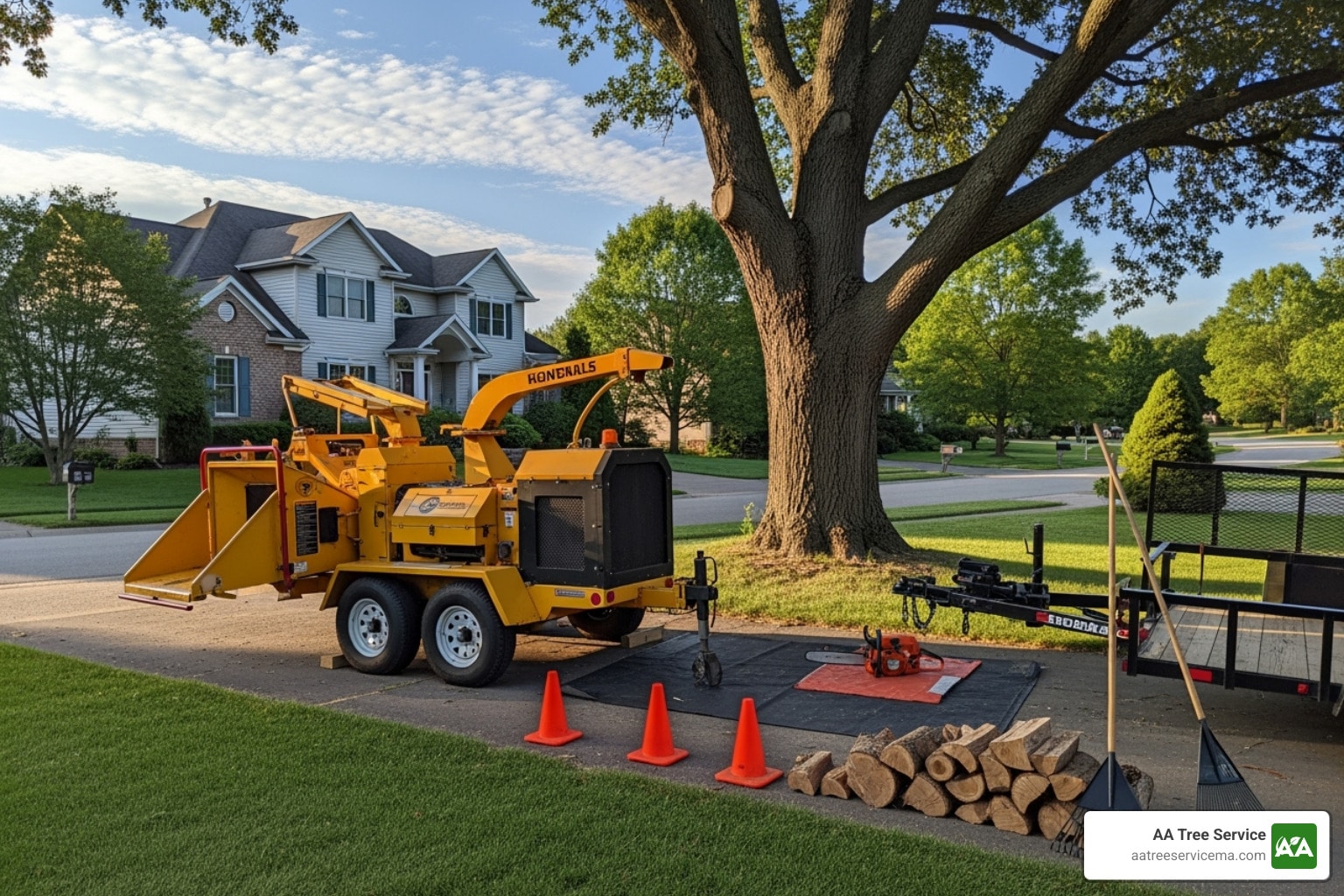
Why Professional Tree Care Matters for Your Property
A tree service company provides specialized care for trees, including removal, pruning, and emergency services. These companies employ certified arborists and use professional equipment to ensure safe, effective tree maintenance that protects both your property and the people on it. Investing in professional care is an investment in your property’s future, enhancing its value while mitigating significant risks.
Top tree service companies typically offer:
- Tree removal for hazardous, diseased, or unwanted trees
- Pruning and trimming to maintain tree health and appearance
- Stump grinding to eliminate tripping hazards
- Emergency services for storm damage
- Land clearing for new projects
- Plant Health Care (PHC) including fertilization and pest management
Properly maintained trees are valuable assets that can increase property value by up to 20%. They provide shade that lowers summer cooling costs, act as windbreaks, improve air quality, and offer undeniable curb appeal. However, they can become serious liabilities when diseased, damaged, or neglected. Professional tree care isn’t just about aesthetics—it’s about safety and financial prudence. Storm-damaged trees near power lines, diseased trees that could fall on your home, or overgrown branches all require expert attention. A single falling limb can cause thousands of dollars in damage to a roof, vehicle, or fence, and the legal liability for injuries can be devastating. Furthermore, attempting complex tree work without the right training or equipment is one of the most dangerous jobs a homeowner can undertake, leading to severe injury or worse.
The key is knowing what separates quality providers from fly-by-night operations. Certified arborists have extensive training in tree biology and safe work practices. Legitimate companies carry proper insurance to protect you from liability and follow strict safety protocols established by industry organizations like the Tree Care Industry Association (TCIA). They understand that one wrong cut can permanently damage or kill a valuable tree, turning an asset into a costly removal project.
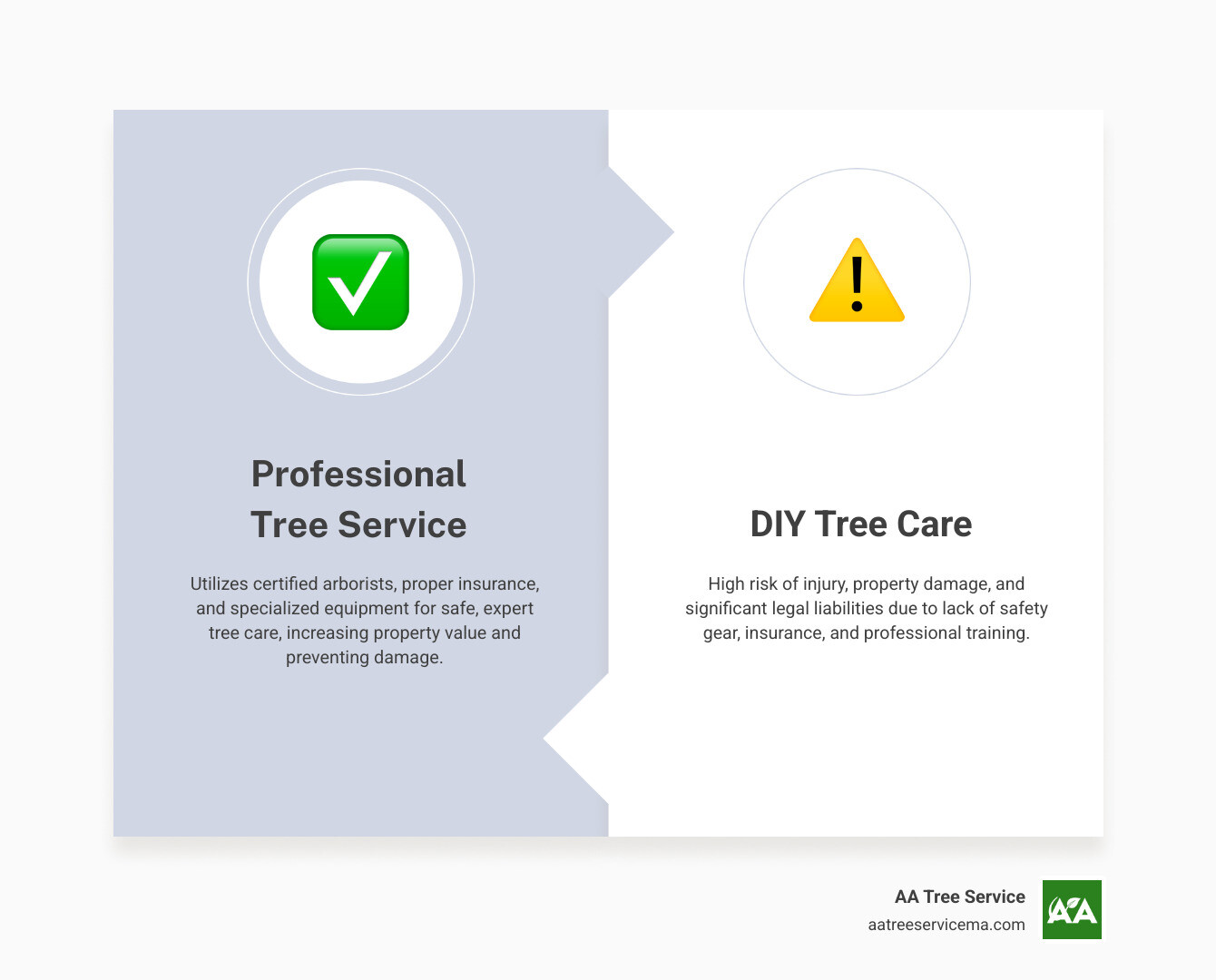
Basic tree service company terms:
What to Look for in a Professional Tree Service Company
Finding the right tree service company is simpler when you know what to look for. The best companies are transparent about their qualifications and happy to answer your questions. Prioritize providers who have proper insurance, certified arborists, and solid experience. Always ask for a detailed written estimate that outlines the scope of work, and check recent customer reviews on multiple platforms. Most importantly, observe their commitment to safety protocols—from the equipment they use to the personal protective gear their crew wears—as this indicates how they’ll treat your property.
More info about our credentials shows how we approach transparency with our clients. You can also Find a certified arborist via the ISA to verify any company’s credentials independently.
The Importance of Qualifications and Certifications
The ISA Certified Arborist credential is a key indicator of expertise. To earn this, an individual must have a minimum of three years of full-time experience in the field before they can even sit for a comprehensive exam covering everything from tree biology and soil science to safe work practices and tree risk assessment. Maintaining the certification requires ongoing education, ensuring they are current with the latest research and safety standards. Another mark of excellence is TCIA Accreditation. This is a credential for the business itself, not just an individual. It involves a rigorous audit of the company’s safety programs, business ethics, customer service, and overall professionalism. A TCIA-accredited company has proven its commitment to the highest industry standards. Certified professionals understand how different cuts affect tree health and how to perform complex jobs without damaging your property.
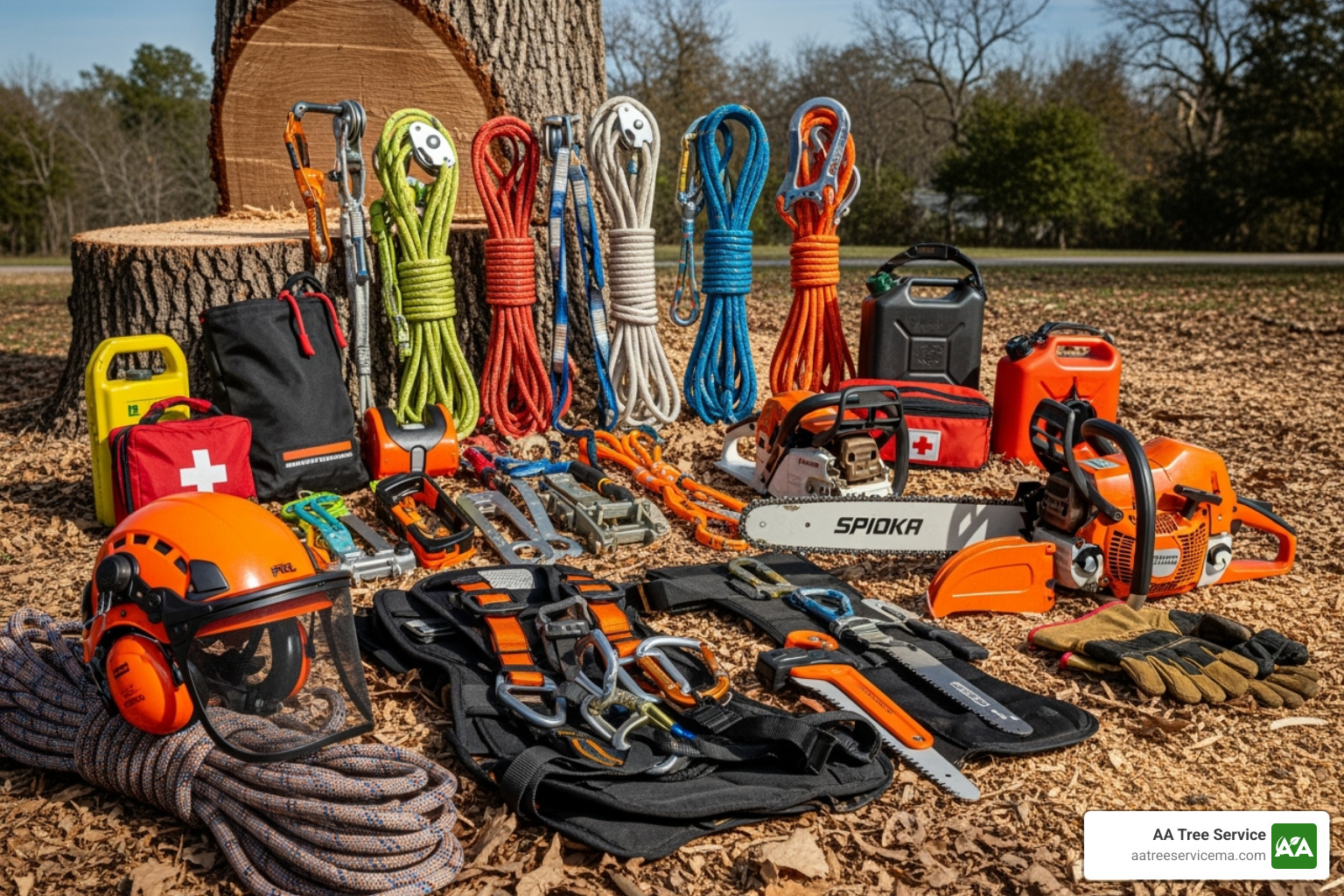
Why Experience Matters in a Tree Service Company
An experienced tree service company brings invaluable local knowledge. In Massachusetts and New Hampshire, this means understanding our unique climate challenges, from heavy snow and ice loads in winter to summer droughts and the specific threats of nor’easters. Experienced arborists have hands-on expertise with local tree species and can spot problems that newcomers might miss, such as early signs of infestation by invasive pests like the Emerald Ash Borer or Asian Longhorned Beetle. This is especially critical for complex removals near power lines or homes, where problem-solving skills that only come with experience make all the difference. They can anticipate how a tree will behave when cut and plan for a safe, controlled descent of every limb. For specialized situations, like Tree Preservation During Construction, experienced companies know how to protect valuable trees from soil compaction and root damage.
Verifying Insurance and Liability
Proof of insurance is essential protection for you and your property. Never take a company’s word for it; always request current certificates for comprehensive liability coverage and worker’s compensation insurance. Worker’s compensation is legally required and protects you from being sued if a worker is injured on your property. Without it, you could be liable for their medical bills and lost wages. General liability insurance covers any damage to your property—or your neighbor’s. To ensure the certificate is authentic, ask for it to be sent to you directly from the insurance agency. A reputable company will have no issue with this request. Never work with an uninsured or underinsured tree service, as the potential costs of an accident far outweigh any initial savings.
A Deep Dive into Core Tree Care Services
A reliable tree service company offers a comprehensive approach to maintaining your landscape’s health, safety, and beauty. The best companies combine specialized equipment, certified expertise, and years of experience to handle everything from routine maintenance to complex emergencies. Each service serves a specific purpose, requiring the right tools, knowledge, and safety protocols to be performed correctly and without causing unintended harm.
For more detailed information about our comprehensive approach to tree care, you can explore more info about our tree care services. We offer Massachusetts and New Hampshire residents complete tree care solutions backed by over 20 years of experience.
Tree Removal and Land Clearing
Tree removal is essential when a tree becomes a hazard, is irreversibly diseased, or is located in an undesirable spot. The process for a large or hazardous tree is highly technical. An arborist first assesses the tree and its surroundings to plan the safest method of dismantlement. This often involves a climber ascending the tree to set rigging lines. Limbs are then carefully cut and lowered to the ground in a controlled manner, preventing damage to your home, landscape, and other property. For the most challenging trees, a crane may be used to lift large sections up and away from obstacles.
Reasons for removal include:
- Hazardous Trees: Trees with extensive decay, structural defects like included bark, or significant storm damage.
- Diseased Trees: Removal can prevent diseases like Dutch elm disease or oak wilt from spreading to healthy trees nearby.
- Unwanted Trees: Trees that are poorly located, causing foundation or sewer line issues, or interfering with construction.
Land clearing is large-scale tree and brush removal to prepare for new construction, landscaping projects, or habitat restoration. This requires careful planning, sometimes including obtaining municipal permits, and uses heavy equipment like forestry mulchers, excavators, chippers, and cranes to handle projects of any size efficiently.
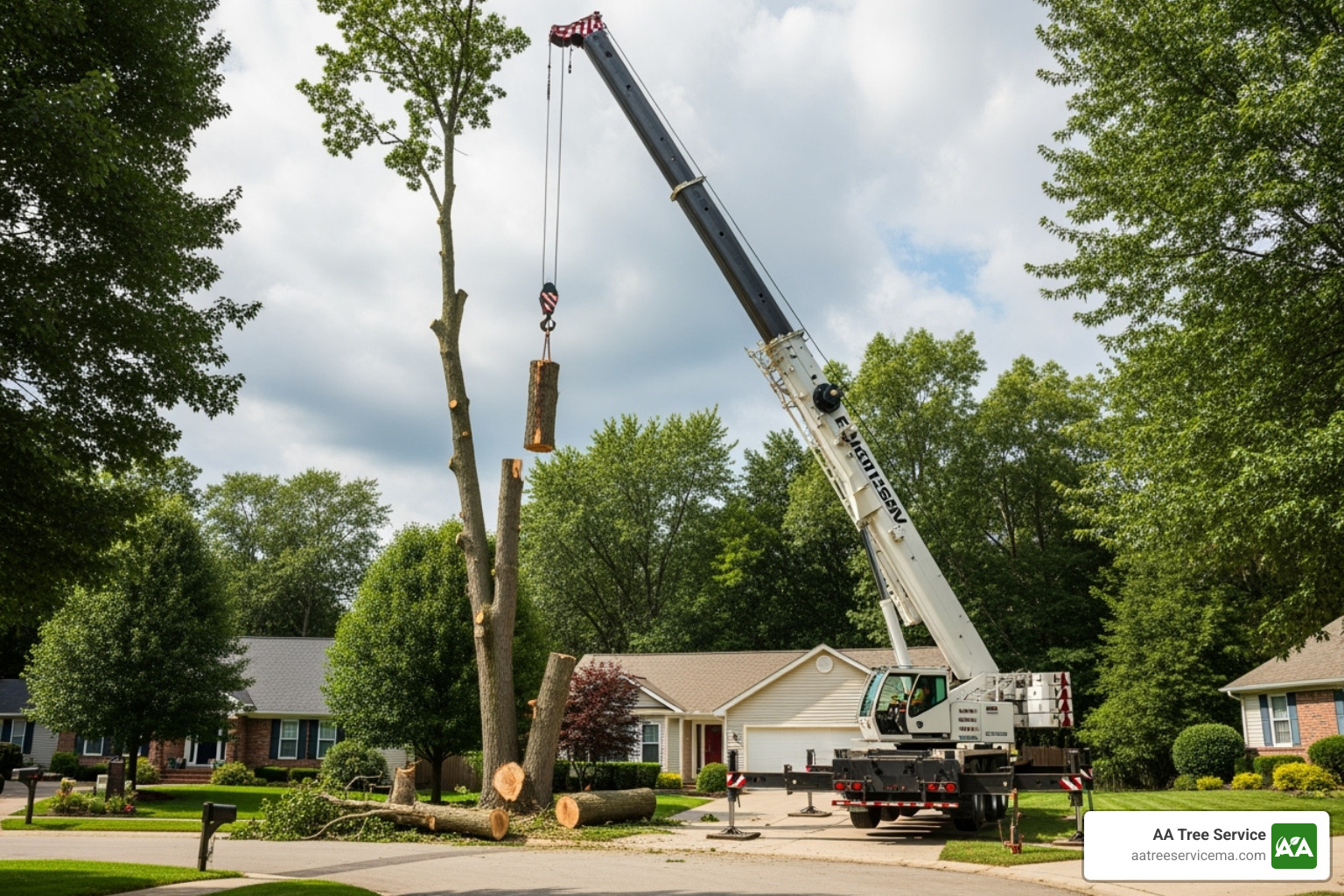
If you’re considering tree removal or land clearing, our Tree Removal Services and Land Clearing Services pages provide more details.
Tree Pruning and Trimming
Proper pruning is a science and an art, vital for a tree’s health, safety, and appearance. This service requires a deep understanding of tree biology to avoid causing harm. Improper cuts can create entry points for pests and diseases or lead to weak, hazardous regrowth. A key principle is to avoid damaging the branch collar—the raised area where a branch joins the trunk—which contains specialized cells that heal the wound. A professional arborist never performs or recommends “topping,” a harmful practice of cutting off the entire top of a tree that leads to decay and weakly attached new growth.
Common types of pruning include:
- Health Pruning (Crown Cleaning): Removing dead, diseased, or damaged branches to prevent falls and stop the spread of decay.
- Crown Thinning: Selectively removing branches to improve air circulation and light penetration, which reduces wind resistance and the risk of storm damage.
- Crown Raising: Removing lower branches to provide clearance for pedestrians, vehicles, or buildings.
- Crown Reduction: Reducing the overall size of the tree’s canopy by pruning back leaders and branch terminals to smaller, lateral branches that can sustain them. This is the proper alternative to topping.
- Structural Pruning: Guiding strong branch development in young trees to prevent future problems like co-dominant stems and weak branch unions.
The timing of pruning matters; most trees benefit from pruning during their dormant season in winter. Our certified arborists use proven techniques that promote long-term health. Learn more from our Tree Trimming Services and Tree Limb Removal Service pages.
Stump Grinding and Removal
After tree removal, the remaining stump can be an eyesore and a safety hazard. Stump grinding and removal services help you reclaim your yard.
- Aesthetics: Stumps detract from your landscape’s appearance and can sprout unsightly new growth.
- Safety: Stumps are tripping hazards, especially for children or when mowing, and can damage lawn equipment.
- Pest Prevention: Decaying stumps attract termites, carpenter ants, and other pests that can then migrate to your home.
- Reclaiming Space: Removing a stump frees up space for lawn, a garden, or a new tree.
We offer both stump grinding (grinding the stump below ground level) and complete stump removal (excavating the entire stump and root ball). Grinding is typically more cost-effective and less disruptive. A powerful machine with a rotating cutting wheel grinds the stump into small wood chips. These chips can be used as natural mulch in garden beds or hauled away. Grinding is sufficient for most residential needs. Find out how we can help on our Stump Grinding Services page.
The Professional Advantage: Safety, Efficiency, and Emergencies
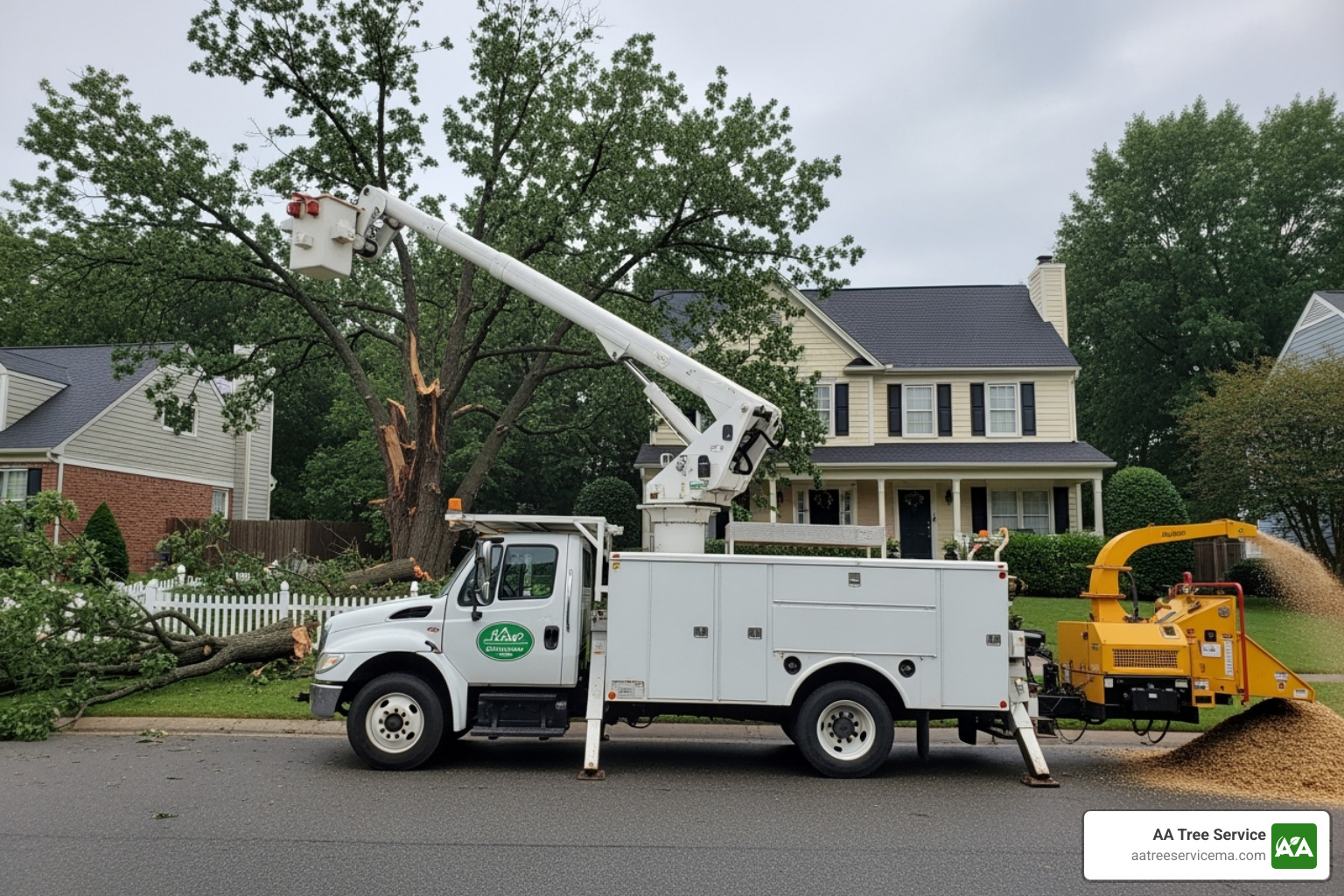
The difference between hiring a professional tree service company and attempting DIY work is significant, especially concerning safety, efficiency, and the ability to respond to emergencies. Professionals invest heavily in training and equipment to manage the inherent risks of arboriculture. They use advanced equipment like aerial lifts, industrial chippers, and cranes to work safely and efficiently. An aerial lift provides a stable, mobile platform high in the canopy, a far safer alternative to climbing with ladders. This specialized equipment, operated by trained arborists wearing appropriate Personal Protective Equipment (PPE) like helmets, eye protection, and chainsaw-resistant legwear, allows us to complete complex jobs in hours instead of days with minimized risk to your property.
Perhaps most importantly, we’re available when emergencies strike. New England weather can be unpredictable, causing trees to fall at any time. We maintain 24/7 availability for emergency situations, ready to respond immediately with the right equipment and expertise when you need it most. This rapid response capability is a hallmark of a professional service.
Handling Emergency Tree Situations
Tree emergencies don’t wait for business hours, and neither do we. Our 24/7 availability is a commitment to residents in Massachusetts and New Hampshire who face damage from ice storms, thunderstorms, and nor’easters. When you call, our rapid response team mobilizes immediately to secure the site and mitigate hazards.
Our certified arborists are trained in storm damage assessment to identify all hazards, not just the obvious ones. This includes looking for subtle cracks in limbs, signs of root plate lifting (heaving soil at the tree’s base), and weakened branches that could fail later. The removal of fallen trees and hazardous limbs requires extreme skill, as downed trees can be under tremendous tension and can shift or roll unexpectedly during cutting. We coordinate with utility companies when power lines are involved and have the experience to dismantle and remove trees from houses and other structures with surgical precision. Our goal is to make your property safe as quickly as possible while preventing further damage.
For immediate assistance, visit our Emergency Tree Removal page or learn about our Tree Removal After Storm services.
Average Cost of Tree Services
Understanding typical costs helps you budget and identify quotes that are too good to be true. A suspiciously low bid often indicates a lack of insurance, proper equipment, or experience.
Important note: The prices shared here are average costs based on internet data and do not reflect AA Tree Service’s actual pricing. We provide free, personalized estimates for every job.
| Service | Average Cost Range (Internet Data) |
|---|---|
| Tree Removal | $400 – $3,000+ |
| Tree Trimming/Pruning | $200 – $1,500+ |
| Stump Grinding | $100 – $600+ |
Several factors influence the final price:
- Tree Size: Larger trees (height and diameter) require more time, crew members, and specialized equipment like cranes.
- Location & Accessibility: Trees in tight spaces, on steep slopes, or far from vehicle access are more complex and costly to service.
- Tree’s Condition: A healthy tree being removed for landscaping is more predictable than a storm-damaged or diseased tree, which can be more dangerous and difficult to handle.
- Complexity: Proximity to power lines, homes, fences, or other structures requires extra precautions, time, and skill.
- Debris Removal: Ensure your quote specifies whether hauling away all wood and chips is included. Some companies charge extra for this.
- Tree Species: Dense hardwoods like oak can be more difficult and time-consuming to cut and process than softer woods like pine.
Emergency services typically cost more due to the need for immediate, often after-hours, response and the increased risks involved.
Finding a Local Pro in Massachusetts & New Hampshire
When searching for a professional tree service company, choosing a local provider in Massachusetts and New Hampshire makes a significant difference. With over 20 years of serving New England communities, we understand the unique challenges of our regional climate, from harsh ice storms to summer droughts. This local knowledge extends to knowing which tree species thrive here, which are vulnerable to regional pests, and the specific municipal bylaws in different towns regarding tree removal and pruning. Working with a local company means partnering with neighbors invested in maintaining the natural beauty of our communities.
Typical Service Areas for a Reputable Tree Service Company
As a dedicated tree service company with deep roots in New England, we’re proud to serve communities throughout Massachusetts and New Hampshire. Our service area spans from the busy streets of Boston to the quiet neighborhoods of small New Hampshire towns, and everywhere in between.
We serve dozens of communities across both states, including Amesbury MA, Amherst NH, Arlington MA, Ashby MA, Ayer MA, Bedford MA, Bedford NH, Belmont MA, Beverly MA, Billerica MA, Boston MA, Boxborough MA, Boxford MA, Brookline NH, Burlington MA, Cambridge MA, Carlisle MA, Chelmsford MA, Chelsea MA, Concord MA, Danvers MA, Derry NH, Dover NH, Dracut MA, Dunstable MA, Essex MA, Everett MA, Exeter NH, Framingham MA, Georgetown MA, Gloucester MA, Greenland NH, Groton MA, Groveland MA, Hamilton MA, Hampton NH, Haverhill MA, Hollis NH, Holliston MA, Hopkinton MA, Hudson MA, Hudson NH, Ipswich MA, Lawrence MA, Lexington MA, Lincoln MA, Littleton MA, Londonderry NH, Lowell MA, Lynn MA, Lynnfield MA, Malden MA, Manchester MA, Manchester NH, Marblehead MA, Marlborough MA, Maynard MA, Medford MA, Melrose MA, Merrimac MA, Merrimack NH, Methuen MA, Milford NH, Nahant MA, Nashua NH, Natick MA, New Castle NH, Newbury MA, Newburyport MA, Newington NH, Newton MA, North Andover MA, North Hampton NH, North Reading MA, Peabody MA, Pelham NH, Pepperell MA, Portsmouth NH, Reading MA, Revere MA, Rockport MA, Rowley MA, Rye NH, Salem MA, Salem NH, Salisbury MA, Saugus MA, Seabrook NH, Sherborn MA, Shirley MA, Somerville MA, South Hampton NH, Stoneham MA, Stow MA, Sudbury MA, Swampscott MA, Tewksbury MA, Topsfield MA, Townsend MA, Tyngsborough MA, Waltham MA, Watertown MA, Wayland MA, Wenham MA, Westford MA, Weston MA, Wilmington MA, Winchester MA, Windham NH, Winthrop MA, Woburn MA.
Whether you need Tree Removal in Boston, MA, Tree Removal in Lexington, MA, Tree Removal in Framingham, MA, or Tree Removal in Salem, NH, our commitment remains the same.
Frequently Asked Questions about Tree Services
Over our 20+ years in business, we’ve answered countless questions about tree care. Most homeowners aren’t tree experts, and that’s okay! Our job is to provide clear, honest information. Here are answers to some of the most common questions we hear from residents in Massachusetts and New Hampshire.
How do I know if my tree needs to be removed?
Deciding to remove a tree is difficult, but sometimes it’s necessary for safety. Look for these warning signs:
- Serious Decay: Large cavities, soft or crumbling wood, or significant cracks in the trunk. The presence of mushrooms or other fungal growth on the trunk or at the base is a major red flag, as these are the fruiting bodies of decay fungi that are breaking down the tree from the inside.
- A Sudden Lean: A new or worsening lean, especially with heaving soil on the opposite side, can indicate root failure.
- Major Storm Damage: Split trunks, severe limb breakage, or partial uprooting create extreme hazards that often cannot be repaired.
- Dead or Dying Tree: A tree with more than 50% dead branches or one that fails to leaf out in spring is often a fall risk.
- Proximity to Structures: Even a healthy tree can become a liability if its roots are damaging a foundation or its branches are growing into your roof or power lines.
- Severe Pest Infestations: Pests like the Emerald Ash Borer can kill an ash tree in just a few years, compromising its structural integrity.
If you see these signs, a certified arborist can perform a professional risk assessment to determine if removal is the safest option.
What is the best time of year to prune my trees?
Generally, the dormant season (late winter to early spring) is the best time for pruning most trees in New England. Pruning during this time reduces stress on the tree, lowers the risk of disease transmission, and allows us to see the tree’s structure clearly without leaves. There are key exceptions:
- Flowering Trees: Prune species like dogwoods, magnolias, and lilacs right after they finish blooming to avoid cutting off next year’s flower buds.
- Oak and Elm Trees: To prevent the spread of deadly diseases like Oak Wilt and Dutch Elm Disease, these trees should only be pruned in the dormant season.
- Hazardous Limbs: Dead, broken, or dangerous branches should be removed any time of year for safety.
Heavy summer pruning is generally discouraged as it can stress the tree. An arborist can recommend the best timing for your specific trees.
Are stump grinding and stump removal the same thing?
While often used interchangeably, these are two different services.
Stump grinding is the more common and affordable option. A machine with a high-speed cutting wheel grinds the stump into small wood chips, typically going 6-12 inches below ground level. The main roots are left to decompose naturally. This method is less disruptive to your lawn and quickly allows you to reclaim the area for grass or a flower bed.
Stump removal is a more intensive process that involves excavating the entire stump and its main root ball with heavy machinery. This leaves a large hole that needs to be backfilled with soil but completely clears the area, allowing you to plant a new tree or begin construction in the same spot. It is more expensive and disruptive to your landscape.
How should I prepare my property for tree work?
Preparing your property helps the job go smoothly and safely. First, clear the work area of any obstacles like patio furniture, potted plants, garden decorations, and vehicles. If our crew needs access to your backyard, please ensure gates are open uped. It’s also important to keep children and pets indoors for the entire duration of the job. Finally, it’s a good courtesy to inform your immediate neighbors that a tree crew will be working, especially if the work is near a property line.
What are the red flags of a bad tree service company?
Be wary of companies that use high-pressure tactics or show up uninvited after a storm. Red flags include:
- No proof of insurance or certification: A reputable company will readily provide these.
- “Topping” as a recommended service: This is an outdated and harmful practice.
- Vague, verbal estimates: Demand a detailed, written contract.
- Requesting full payment upfront: A deposit is normal, but full payment should only be made upon satisfactory completion of the job.
- Lack of professional equipment or safety gear: This is a major indicator of inexperience and a disregard for safety.
Conclusion
Choosing the right tree service company is a critical decision for your property’s safety and value. Your trees are living investments that can become serious liabilities if neglected. Professional tree care is about ensuring your family’s safety, protecting your home, and preserving the natural beauty of your landscape.
Safety must always come first. That’s why certified arborists, proper insurance, and professional equipment are non-negotiable. A reputable company will provide clear communication and stand behind their work, ensuring the long-term health of your trees.
For residents throughout Massachusetts and New Hampshire, AA Tree Service provides comprehensive care backed by over 20 years of experience. We are your trusted local partners, ready to handle everything from routine pruning to 2 AM storm emergencies. We’ve built our reputation on providing safe, reliable, and professional service to thousands of your neighbors.
Ready to experience the difference that true professionalism makes? Request a Quote today and let us show you why so many homeowners trust us with their most valuable trees.