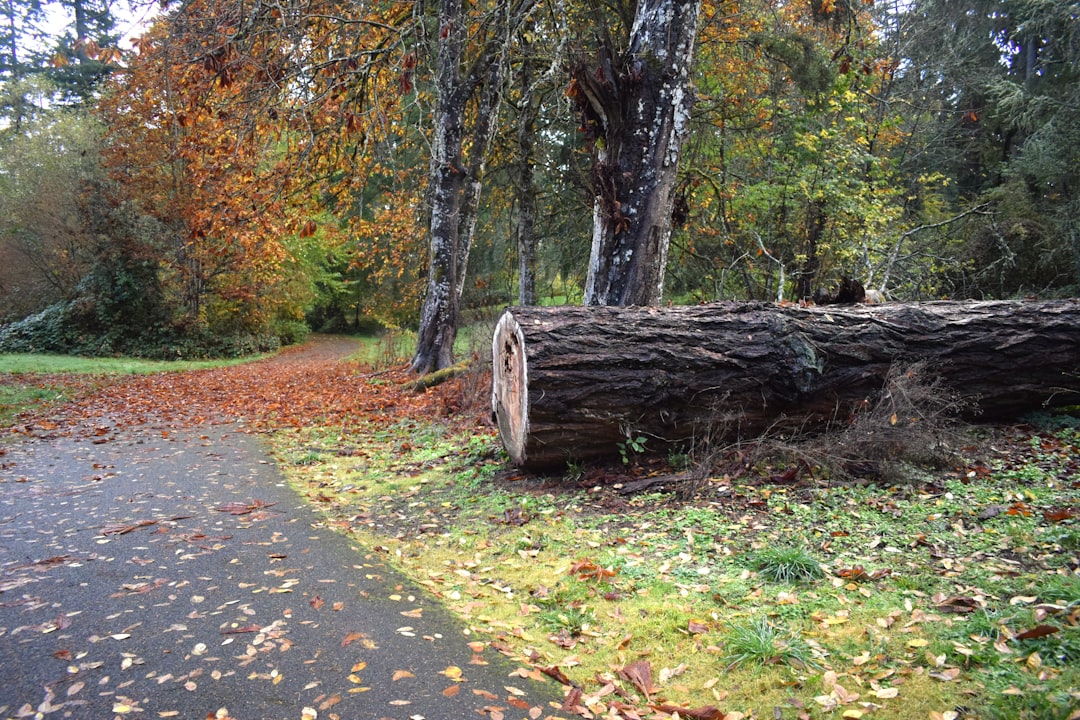
When Nature Strikes: Understanding Your Post-Storm Tree Removal Options
Tree removal after storm damage is often necessary when trees pose immediate safety risks or have sustained severe structural damage. Here’s what you need to know right away:
Immediate Action Steps:
- Stay safe – avoid downed power lines and unstable trees
- Assess damage – look for split trunks, major root damage, or >50% crown loss
- Call professionals – for trees over 30 feet, near power lines, or structurally compromised
- Document everything – take photos for insurance claims
- Act quickly – prevent further property damage and safety hazards
When storms hit Massachusetts and New Hampshire, high winds and heavy precipitation can turn your landscape into a hazard zone. Trees can break, lean dangerously, or be completely uprooted, causing thousands in damage to homes and vehicles and posing serious safety risks.
Not every damaged tree needs to be removed. Some can be saved with proper care, but distinguishing between a salvageable tree and a hazardous one is critical. A tree that looks fine might have hidden internal damage, making a professional assessment essential for your safety and property protection.
Related content about tree removal after storm:
The Morning After: Immediate Safety and Damage Assessment
After the storm, your first priority is safety. It’s natural to want to inspect the damage, but you must proceed with caution.
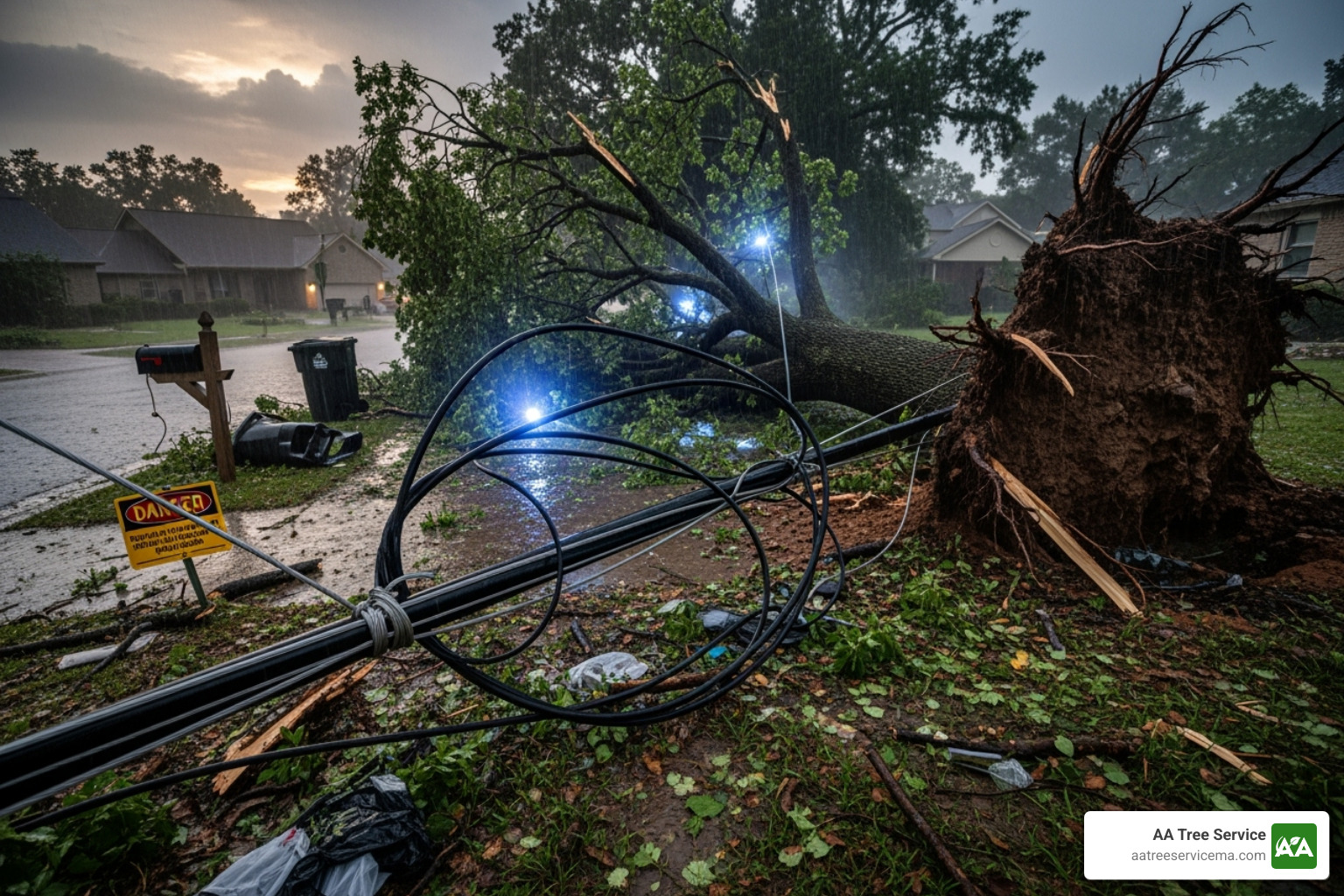
Never approach downed power lines. A wire tangled in branches could be live and deadly. These lines can be hidden by debris, making them hard to see. If you spot downed lines, call your utility company immediately and keep everyone, including pets, far away. Review the CDC guidelines on electrical safety after a disaster for crucial life-saving information.
Once you’ve confirmed there are no electrical hazards, inspect your property from a safe distance. Look for cracked trunks, precariously hanging branches (widow-makers), leaning trees, and uprooted trees. Take plenty of photos and videos from multiple angles for your insurance claim. This documentation also helps professionals understand the scope of the damage before arriving. For more details on identifying these hazards, see our guide on broken trees.
What Constitutes Storm Damage to Trees?
Understanding the severity of damage helps determine if tree removal after storm events is necessary.
- Minor Damage: The tree has lost small limbs, but the main trunk and more than half of the crown (leafy part) are intact. These trees usually recover with proper pruning.
- Moderate Damage: The tree has significant limb loss or looks unstable, with 25% to 50% of its crown gone. This requires a professional assessment to determine if it can be saved.
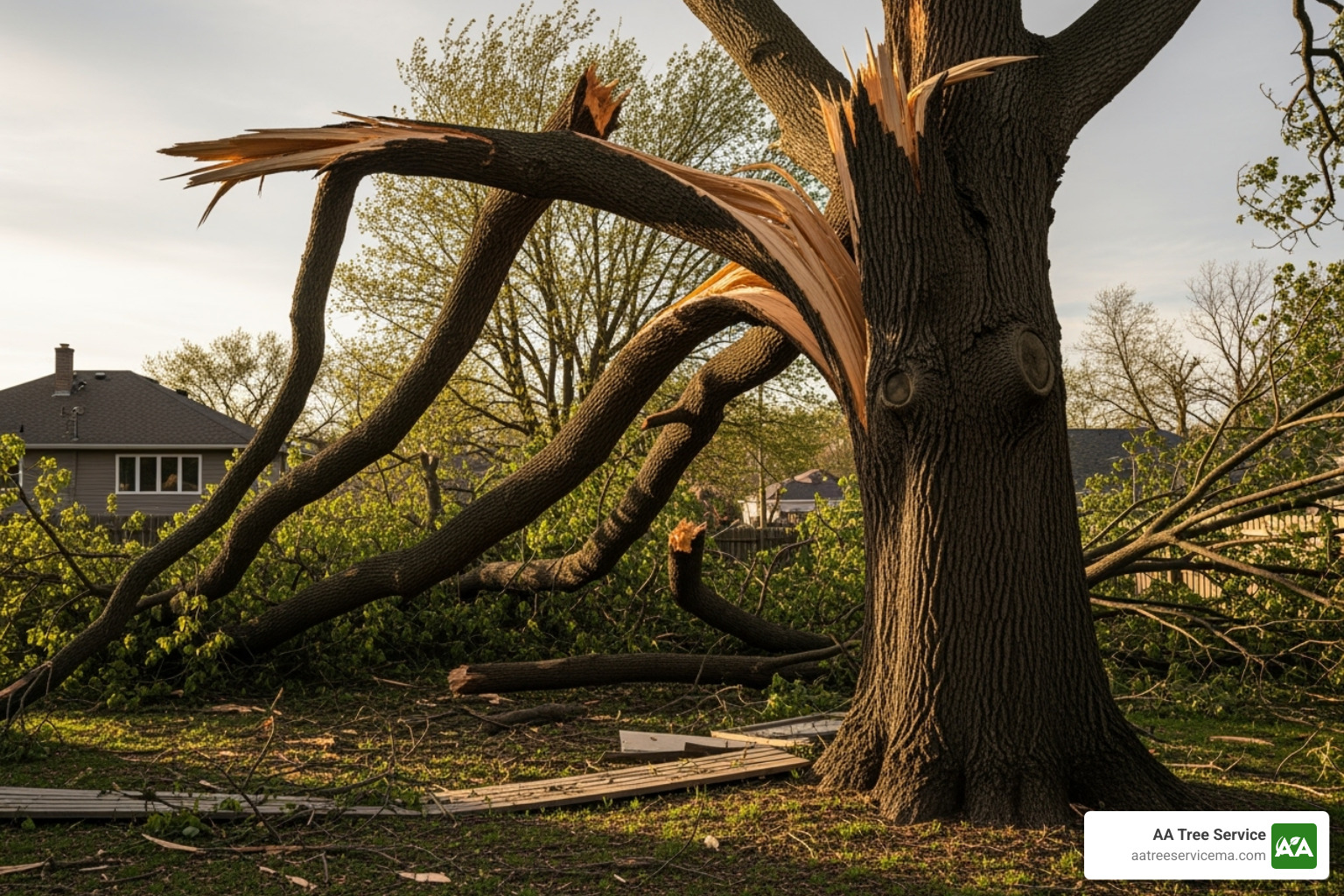
- Severe Damage: This includes split trunks, uprooted trees, a lean of more than 45 degrees, or the loss of over half the crown. These trees are typically beyond saving.
Our team has a guide to assessing damage that provides more detail on these categories.
The Immediate Risks of Damaged Trees
Storm-damaged trees pose ongoing dangers:
- Personal Injury: The most immediate danger comes from unstable trees and hanging branches that can fall without warning, even days after a storm has passed. These “widow-makers” can cause severe head trauma or other life-threatening injuries. The ground may also be littered with sharp, broken branches and other debris hidden under leaves, creating trip-and-fall hazards. Children and pets are especially vulnerable as they may not recognize these dangers while playing in the yard.
- Property Damage: A leaning or structurally compromised tree is a ticking time bomb. Its eventual fall can cause catastrophic damage to your home, garage, deck, or fence. Beyond the obvious structures, falling trees can crush vehicles, sheds, and outdoor furniture. The impact can also damage underground utilities like septic systems, sprinkler lines, or gas lines, leading to complex and expensive repairs.
- Blocked Access: Fallen trees and large limbs can completely block driveways and walkways. This not only inconveniences you by preventing you from leaving for work or errands but can also critically impede access for emergency vehicles like ambulances or fire trucks. It can also block access for other utility crews trying to restore power or communications in the neighborhood.
- Electrical Hazards: Trees or branches that have fallen onto or become entangled with power lines pose a lethal threat. The tree itself can become energized, electrifying the surrounding ground and any puddles of water. Never assume a downed line is dead. These situations require the specialized training and equipment of both the utility company and a professional tree service to resolve safely.
- Pest Infestation: Dead and dying wood is an open invitation for destructive pests. Wood-boring insects like carpenter ants, termites, and bark beetles will quickly colonize the damaged tree. From there, they can easily spread to other healthy trees on your property or, even worse, migrate into the wooden structures of your home, leading to a secondary infestation that can compromise your house’s integrity.
If you’re facing these hazards, our storm cleanup services can quickly restore safety to your Massachusetts or New Hampshire property.
To Save or Remove? Making the Right Decision
After addressing immediate safety concerns, you must decide if a storm-damaged tree can be saved or if tree removal after storm is the only safe choice. This decision is complex and best made with professional guidance.
The assessment considers the tree’s health before the storm, its species, and its age. Some species are more brittle, while younger trees often recover more easily. We evaluate a tree’s long-term viability, not just its current appearance. A tree that looks terrible might recover, while one that seems fine could have hidden structural flaws.
For salvageable trees, professional pruning removes damaged branches to promote healing. In some cases, cabling and bracing can provide extra support during recovery.
Warning: Do not attempt major storm cleanup yourself. Chainsaws are dangerous, and storm-damaged wood under tension is unpredictable. A seemingly simple cut can turn deadly. Leave this work to trained professionals.
When a Storm-Damaged Tree Can Be Saved
Many storm-damaged trees can make a full recovery. A tree is a good candidate for saving if:
- It retains at least 50% of its crown. This allows it to produce enough energy to survive.
- It was healthy before the storm. A vigorous tree has a better chance of healing.
- Damage is limited to minor limb breaks. These can be treated with proper pruning cuts.
Our tree clean up service focuses on careful cuts to promote long-term health. For more help, see our checklist for repairing storm-damaged trees.
When is Professional Tree Removal After a Storm Necessary?
Sometimes, removal is the only safe option. The table below outlines the key signs.
| Signs for Saving a Tree (with Professional Care) | Signs for Professional Tree Removal |
|---|---|
| Less than 50% crown damage | More than 50% crown damage |
| Minor limb breakage | Large, critical limb breakage |
| Healthy before storm | Pre-existing decay or disease |
| Trunk and major branches intact | Split trunk (especially at the base) |
| Minor root exposure | Major root damage or uprooting |
| Minimal lean (can be corrected) | Leaning more than 45 degrees |
| Not posing immediate threat to structures/lines | Direct threat to structures/power lines |
| Can form a new branch structure | Insufficient foliage to recover |
| Young, vigorous tree | Old, severely compromised tree |
Key indicators for removal require a closer look, as they often signal that the tree’s structural integrity is fatally compromised.
- A split trunk, especially a vertical crack that extends deep into the wood, is one of the most serious forms of damage. This type of split compromises the tree’s entire vascular system, hindering its ability to transport water and nutrients, and creates a massive weak point. The tree is no longer a single, solid unit and is highly likely to fail completely, often splitting in half during the next weather event.
- Major root damage is another critical sign. If you see the ground heaving or mounding around the base of the tree, or if major roots (thicker than your arm) are visibly torn or severed, the tree has lost its anchor. The root system is responsible for both stability and nutrient uptake. Without a solid foundation, the tree is a significant falling hazard and may not be able to sustain itself long-term.
- A hollow core exposed by the storm is a major concern. While many trees can live for years with some degree of internal decay, a storm can break away the protective outer wood, revealing the extent of the hollowness. A certified arborist must assess if the remaining “shell” of healthy wood is thick and strong enough to support the tree’s weight. Often, it is not, making removal the only safe choice.
- A significant lean of more than 45 degrees is an obvious sign of instability, but even a less severe lean that is new since the storm is a red flag. A new lean, particularly when accompanied by heaving soil on the opposite side of the lean, indicates root failure. The tree is in the process of uprooting and must be removed immediately to prevent a complete fall.
- If a damaged tree, even one that might otherwise be salvageable, now threatens critical targets like your home, public sidewalks, or power lines, the risk associated with trying to save it often outweighs the potential reward. In these cases, removal becomes a priority for safety and liability reasons.
When these hazards are present, our fallen tree removal service can handle the situation safely.
The Professional Process for Tree Removal After a Storm
Professional tree removal after storm damage requires specialized expertise, equipment, and a safety-first approach. It’s far more than just starting a chainsaw.
After major storms in Massachusetts and New Hampshire, we use a triage approach, prioritizing the most critical situations first. Trees on homes are addressed immediately, followed by those blocking access routes. Our emergency crews are available 24/7 to handle complex removals safely.
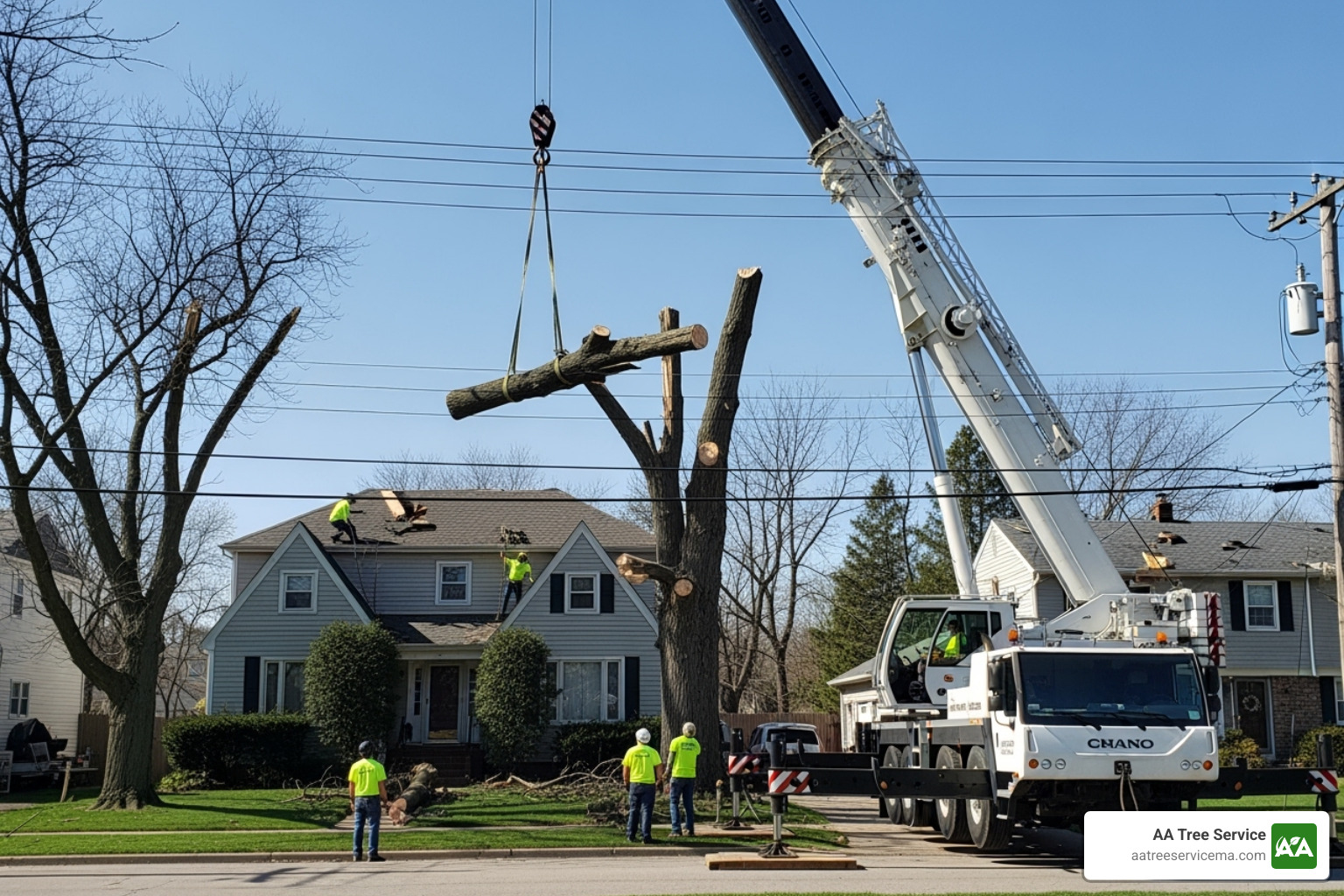
Every job begins with a thorough site assessment by a certified arborist to plan the safest removal strategy. We use professional-grade equipment like cranes to lift large sections from precarious spots, bucket trucks for safe access at height, and wood chippers to process debris efficiently on-site.
Our crews use proven safe removal techniques, typically dismantling trees from the top down to prevent uncontrolled falls and further damage. We handle all debris hauling and can provide stump grinding to leave your property safe and clean.
For urgent situations, learn more info about emergency tree removal.
Understanding the Costs of Tree Removal After a Storm
Cost is a major concern for homeowners, but there’s no single price for tree removal after storm damage. Several factors influence the final cost.
Note: All prices referenced are average ranges based on internet data and not actual costs for AA Tree Service. For example, average tree removal in MA/NH may range from $300 to $3,000+, with large or hazardous removals exceeding $5,000.
- Tree Size: A small tree (under 30 ft) might cost $350-$1,200, while a large one (60-120 ft) could be $1,600-$5,000+, with complex jobs costing more.
- Location & Accessibility: A tree in an open yard is less expensive to remove than one in a tight, inaccessible space.
- Type of Damage: A cleanly fallen tree is simpler than one tangled in power lines, which requires more time and precautions.
- Equipment: Jobs requiring cranes or specialized rigging cost more than standard removals.
- Debris & Stump Removal: Most quotes include debris hauling, but stump grinding is usually an additional fee, starting around $250.
For comprehensive cleanup, we offer a tree debris removal service.
How to Hire a Reputable Tree Service
After a storm, be wary of “storm-chasers”—unlicensed individuals who prey on homeowners. To hire a reputable service:
- Verify Insurance: Always confirm both liability and workers’ compensation coverage. Ask for proof.
- Check Credentials: Look for companies with certified arborists who have extensive training and experience.
- Read Reviews: Check Google and Yelp for consistent feedback on professionalism and quality.
- Get Written Estimates: Obtain detailed quotes from several companies. Be wary of verbal estimates or pressure tactics.
- Avoid Storm-Chasers: Legitimate companies don’t show up unannounced or demand cash upfront.
With over 20 years of experience in Massachusetts and New Hampshire, we are fully licensed and insured. For emergencies, our 24 hour emergency tree removal team is ready to help.
Navigating Insurance Claims for Storm-Damaged Trees
Dealing with tree removal after storm damage is stressful, but understanding your homeowners insurance can save you money and time. The rules are generally straightforward.
If a tree falls due to a “covered peril” like wind, hail, or lightning and damages an insured structure (your house, garage, or fence), your policy typically covers the repairs and the cost of removing the tree from that structure. This applies whether it was your tree, your neighbor’s, or a city tree.
However, there are exceptions. If a tree falls in your yard without hitting an insured structure, you usually have to pay for removal yourself. Some policies make an exception if the tree blocks your driveway. Damage to vehicles is covered by your auto insurance’s comprehensive coverage, not your homeowners policy.
Crucially, if your insurer determines the tree fell due to negligence (e.g., you knew it was diseased and did nothing), they may deny your claim. This is why regular tree maintenance is a wise investment.
Does Homeowners Insurance Cover Fallen Trees?
Yes, but the key is that it must damage an insured structure. When a storm causes a tree to fall on your house in Massachusetts or New Hampshire, your own homeowners insurance handles the claim, regardless of who owned the tree. This “your insurance covers your property” rule simplifies the process, avoiding disputes between insurance companies.
To file a claim, you need solid documentation. Take plenty of photos and videos of the damage. Keep all receipts from your tree service professionals and record all communications with your insurance company. We have over 20 years of experience working with homeowners and insurance adjusters and can provide the detailed invoices needed to support your claim.
For more details on insurance coverage, see our guide on storm damaged tree removal. Since every policy is different, it’s always a good idea to review your specific coverage.
Proactive Protection: Preparing Your Trees for Future Storms
While we can’t control the weather, we can prepare our trees to withstand it, reducing the likelihood of needing tree removal after storm damage. Think of it as a training program for your trees.
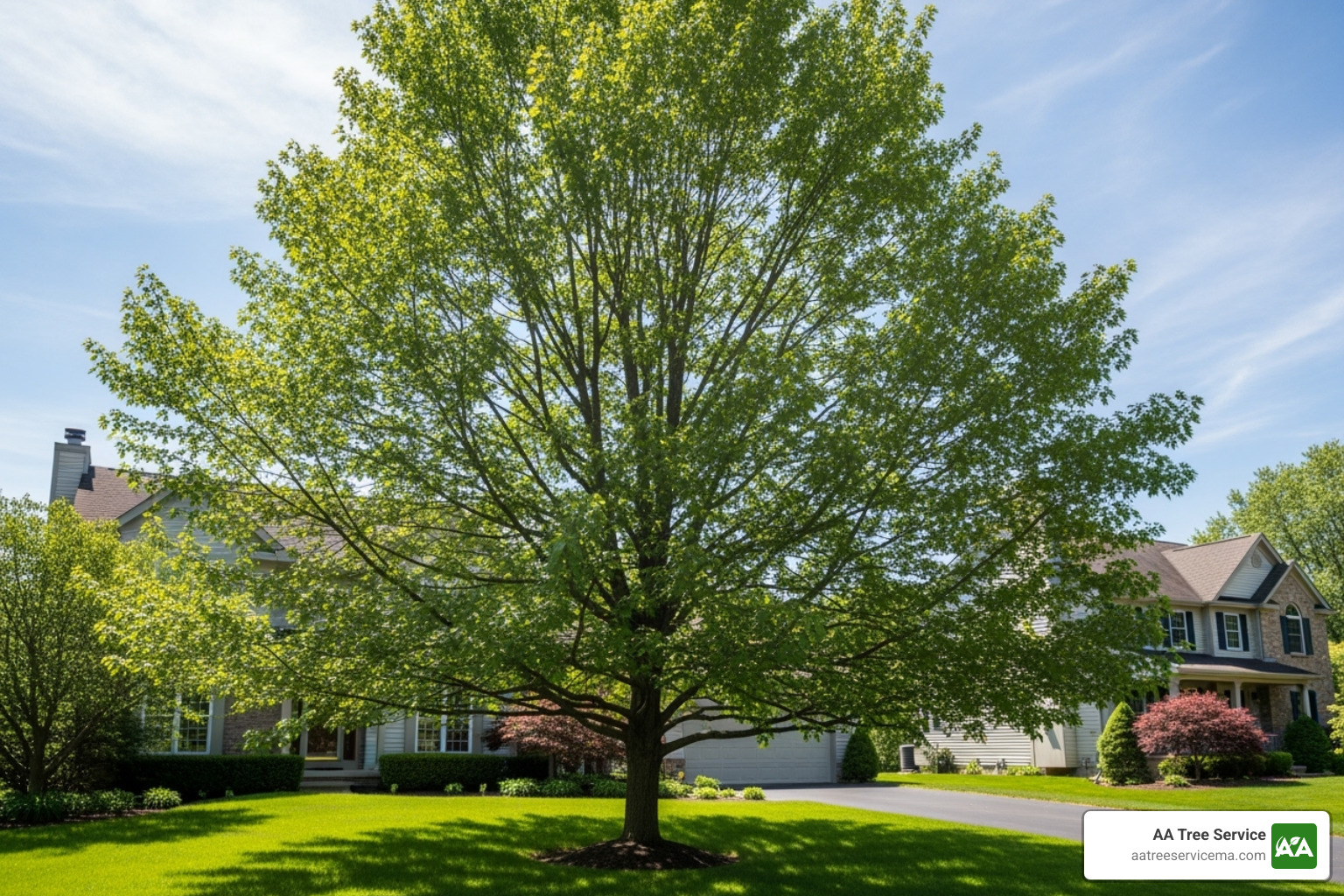
Preventative maintenance is the key. Regularly inspect your trees for red flags like cracks in the trunk, dead branches, or mushrooms growing on the bark, which can signal internal decay. Also, look for weak, V-shaped branch attachments that are prone to splitting in high winds.
Proper pruning is a tree’s best defense:
- Crown thinning selectively removes interior branches, allowing wind to flow through the canopy instead of pushing against it.
- Crown reduction decreases the tree’s overall size and weight, reducing stress on limbs, especially in large, top-heavy trees.
When planting new trees in Massachusetts or New Hampshire, choose storm-resilient species and give them enough space to develop strong roots away from homes and power lines. Root health is the foundation of a stable tree, so avoid compacting the soil around its base.
For mature trees with structural issues, cabling and bracing can provide extra support to weak limbs or split trunks.
Investing in preventative care can save you thousands in future damage. A well-maintained tree is safer, healthier, and more valuable. For all tree care needs, from pruning to emergencies, learn about our tree removal service.
Frequently Asked Questions about Post-Storm Tree Care
After a storm in Massachusetts or New Hampshire, homeowners often have the same urgent questions. Here are answers to the most common concerns about tree removal after storm situations.
How long should I wait to clean up after a storm?
Your safety comes first. Wait until the storm has completely passed and you have daylight to see clearly. Stay far away from any downed power lines and call your utility company if you see any. For immediate hazards like a tree on your house or blocking your driveway, call professionals right away. Minor debris like small branches can wait until you’ve safely assessed the entire situation.
What’s the difference between emergency and standard tree removal?
Emergency tree removal is for immediate threats, like a tree that has fallen on your house. Our crews respond 24/7, often in difficult conditions. This immediate, high-risk service comes at a premium cost.
Standard tree removal is scheduled during regular business hours for non-urgent situations, like removing a dead tree that isn’t an immediate hazard. Because it can be planned under normal conditions, the cost is lower.
Who is responsible if my neighbor’s tree falls in my yard?
In most cases, your own homeowners insurance covers damage to your property, regardless of where the tree came from. Storms are considered “Acts of God,” so if your neighbor’s tree falls on your garage during a storm, your policy pays for your repairs. The only exception is if you can prove your neighbor was negligent by not removing a tree they knew was hazardous, which can be difficult to do. It’s best to let your insurance company handle it.
Conclusion: Restoring Safety and Peace of Mind to Your Property
When a storm leaves your property in disarray, it’s easy to feel overwhelmed. But you don’t have to handle the cleanup and safety risks alone.
Safety first. Never attempt to remove large, unstable, or leaning trees yourself. Damaged trees are unpredictable and dangerous. The key to a successful recovery is a professional assessment from a Certified Arborist who can distinguish a salvageable tree from a hazardous one.
Making an informed decision about tree removal after storm damage protects your family and property long-term. This experience also highlights the value of preventative care. A well-maintained tree is your best defense against future storm damage.
For over 20 years, AA Tree Service has helped homeowners in Massachusetts and New Hampshire steer these challenging situations. We understand the stress and worry that comes with storm damage, which is why we offer 24/7 emergency services to respond quickly and professionally.
Whether you need immediate help or want to prepare for the future, we are here to restore safety and peace of mind to your property.
Ready to get your property back to normal? Contact us for emergency tree removal and let our experienced team handle the heavy lifting.