Why Understanding Full Tree Removal Service Matters for Your Property
A full tree removal service is a professional process for safely removing an entire tree from your property, including cutting it down, hauling away debris, and optionally grinding the stump. This service is essential when trees become safety hazards, are dead or dying, interfere with construction, or detract from your property’s appearance.
Key reasons for full tree removal in Massachusetts and New Hampshire:
- Safety: Trees leaning towards homes, damaged by storms, or showing structural weakness.
- Health: Dead or diseased trees that could fall unexpectedly.
- Development: Clearing space for home additions, pools, or new landscaping.
- Location: Trees blocking views, threatening foundations, or interfering with power lines.
Whether you have a dead ash tree, a storm-damaged oak, or need to clear space, understanding the process helps you make informed decisions. Tree removal requires specialized equipment, safety protocols, and expertise. Trees over 10 feet tall should never be a DIY project due to serious injury risks.
This guide covers everything from identifying when removal is necessary to understanding costs and navigating local permits in Massachusetts and New Hampshire.
When is Tree Removal Necessary?
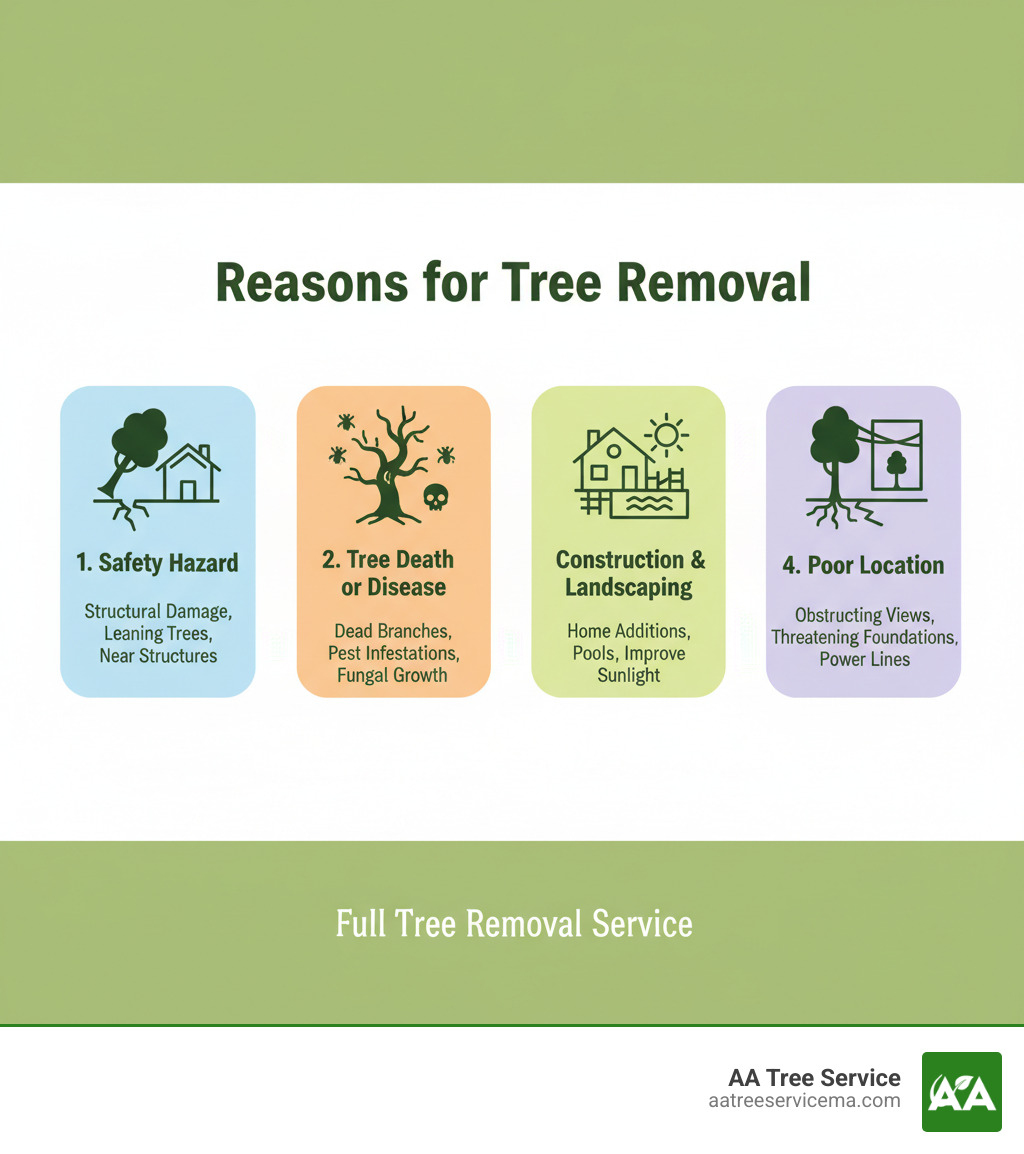
While trees add value and beauty, sometimes removal is the only safe and practical option. The decision usually comes down to four main reasons: a tree has become hazardous, it’s dead or dying, it’s in the way of property development, or it’s simply in the wrong location.
If you’re concerned about a tree’s stability, our hazardous tree removal team can assess the situation and act quickly to protect your property.
Telltale Signs of a Hazardous Tree
Some warning signs are obvious, while others are subtle. Here’s what to look for:
- Sudden leaning: A tree that abruptly starts leaning, especially after a heavy rain or windstorm, is a major red flag. This often signifies that the root system, which acts as the tree’s anchor, has been critically compromised or has failed.
- Visible root decay: Look for roots that are lifting out of the ground, are soft or spongy to the touch, or have mushrooms growing on them. A healthy root system is firm and widespread; a decaying one cannot support the tree’s weight.
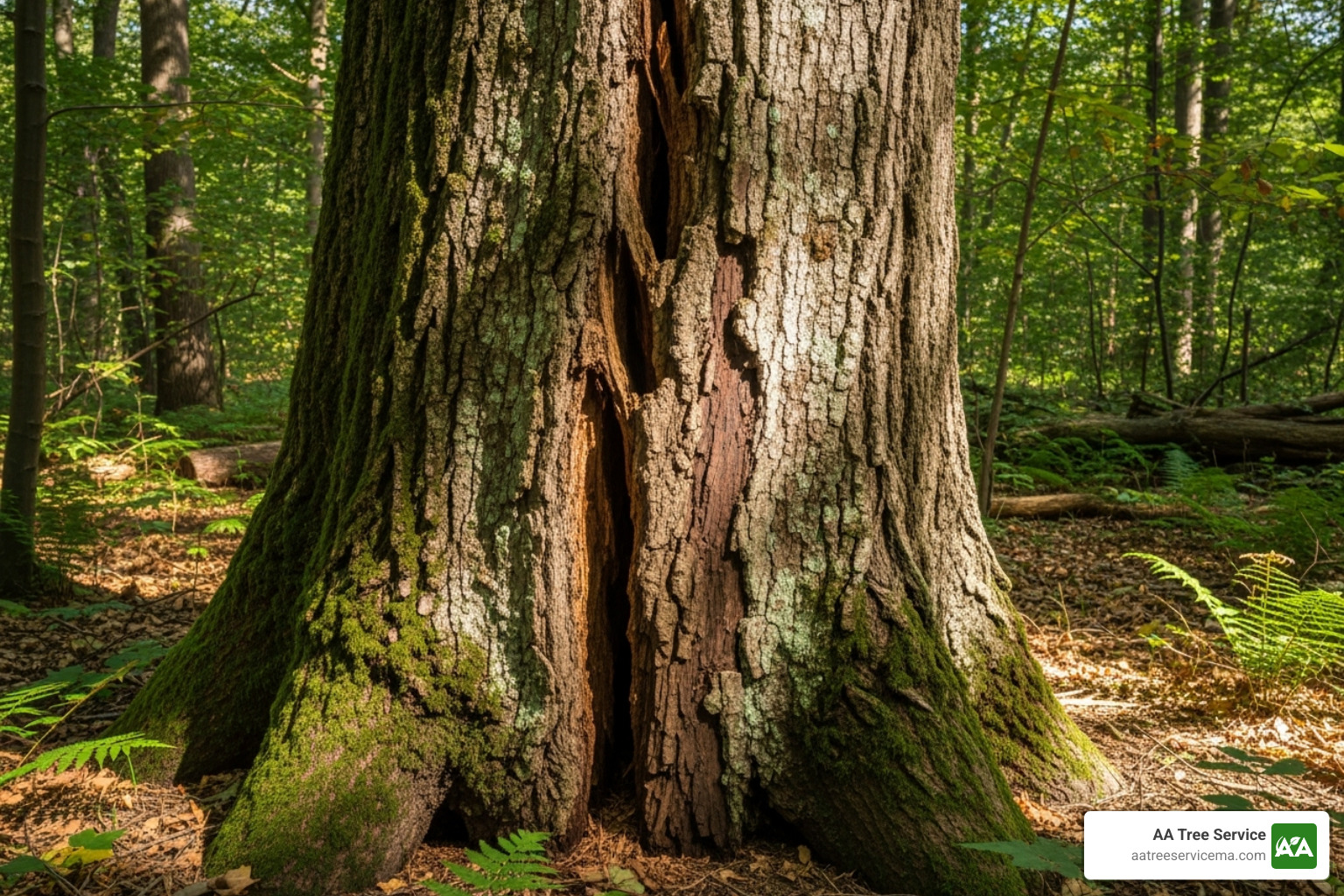
- Large cracks or cavities: Deep splits, hollows, or cavities in the trunk or major limbs are clear signs of structural failure. These weak points make the tree susceptible to snapping under its own weight or during a storm.
- Dead or hanging branches: Known as “widowmakers,” these brittle branches can break off and fall at any moment, posing a serious risk to anyone or anything below.
- Fungal growth at the base: The presence of mushrooms, shelf fungi, or other fungal bodies on the trunk or near the base is a strong indicator of internal rot. The decay may be extensive even if the outside of the tree looks relatively healthy.
- Significant bark damage: If more than 25% of the bark around the trunk is gone (a condition known as girdling), the tree’s ability to transport water and nutrients is severely hampered, leading to its eventual death.
Tree Health and Disease Indicators
A struggling tree can quickly become a hazard. Catching these health problems early is key:
- Pest infestations: Look for small D-shaped exit holes (a sign of Emerald Ash Borer), sawdust-like frass at the base of the tree (from carpenter ants or other borers), or tunnels under the bark. These pests can hollow out a tree from the inside, making it dangerously unstable.
- Lack of leaves: A tree that fails to produce leaves in the spring, or drops them prematurely in the summer, is likely suffering from disease, pest infestation, or root problems. Pay close attention to branches that remain bare while the rest of the tree leafs out.
- Discolored or misshapen leaves: Leaves that are yellowed, spotted, or have a stunted or twisted appearance can indicate a range of issues, from fungal diseases to nutrient deficiencies in the soil.
- Excessive deadwood: While a few dead twigs are normal, a large number of dead branches throughout the canopy (a condition called crown dieback) suggests the tree is in significant decline and may not be salvageable.
If a storm has damaged your trees, our guide on storm damaged trees explains the next steps.
Removal for Landscaping and Development Goals
Sometimes, a healthy tree must be removed to meet your property goals.
- Clearing space for construction: Home additions, pools, and patios often require removing trees.
- Improving sunlight for other plants: A large tree can cast too much shade for lawns, gardens, and other plants to thrive.
- Removing trees that obstruct views: Opening up a blocked vista can significantly improve your property’s appeal.
- Preventing foundation issues: Aggressive root systems from species like Silver Maples or Willows can seek out moisture, invading and cracking home foundations, driveways, sidewalks, and even septic systems, leading to thousands of dollars in repairs.
For larger projects, our land clearing for development services can prepare your property efficiently.
The Professional Full Tree Removal Service Process
Professional full tree removal service is a carefully orchestrated process that prioritizes safety and property protection. It’s far more than just taking a chainsaw to a tree.
We begin with a comprehensive site assessment, where a certified arborist meticulously examines not just the tree but its entire environment. This includes identifying the tree species (as some woods are more brittle or heavier than others), measuring its height and canopy spread, and evaluating its health and structural integrity. We map out all surrounding obstacles, including your home, garage, fences, sheds, delicate landscaping, and crucial utilities like overhead power lines and underground pipes or septic systems. This detailed analysis allows us to create a custom removal strategy that outlines the safest, most efficient approach.
Our team uses specialized, commercial-grade equipment, including chainsaws, rigging systems, and climbing gear that meet strict industry safety standards. This professional machinery is essential for a safe and efficient job.
When emergencies like storm damage occur, our emergency tree removal services are available 24/7 throughout Massachusetts and New Hampshire to respond when you need us most.
Standard Tree Removal Techniques
The method we use depends on the tree’s location, condition, and surroundings.
- Tree climbing: Our climbers use harnesses, ropes, and specialized climbing techniques to safely ascend the tree, allowing for precise cuts from within the canopy.
- Rigging systems: We use a sophisticated system of heavy-duty ropes, blocks, pulleys, and friction-saving devices to carefully lower heavy branches and trunk sections. This rigging gives our ground crew complete control over the descent of each piece, preventing them from free-falling and causing damage to your lawn, garden, or structures.
- Controlled felling: When space allows, we make precise directional cuts at the base to fell the entire tree in a predetermined direction. This is efficient but requires ample clearance and a clear drop zone, free of any obstacles.
- Section-by-section dismantling: For trees in tight quarters or overhanging structures, we work from the top down. Our climber ascends the tree and systematically removes branches before cutting the trunk into manageable sections. Each piece is then carefully lowered via the rigging system to a designated drop zone, where the ground crew manages it for processing.

Handling Difficult-to-Access and Large Trees
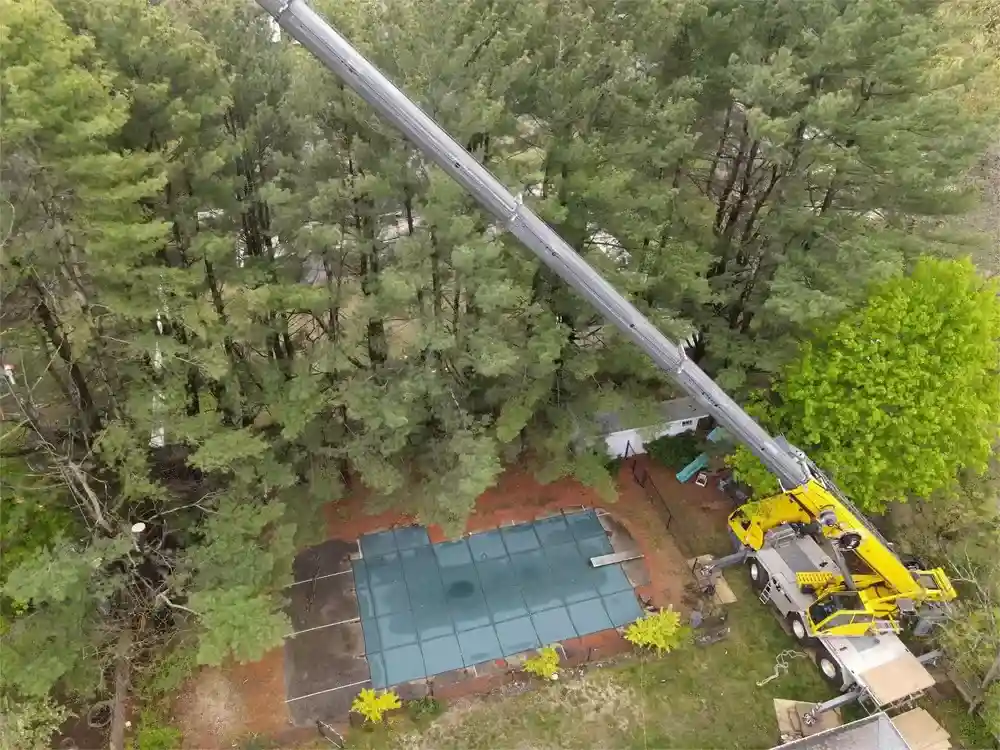
For massive trees, those leaning over homes, or trees in tight spaces, crane-assisted tree removal is the solution. The crane operator and ground crew work in sync to lift large sections of the tree up and over obstacles, placing them in a safe zone for processing. This method is indispensable when a tree is located in an enclosed backyard, has fallen on a roof, or is so large and decayed that climbing would be unsafe.
This method offers several key benefits:
- Minimal landscape impact: By lifting sections directly out, we avoid dragging heavy logs across your lawn, garden beds, and other sensitive areas.
- Increased efficiency: Crane removal is often significantly faster than traditional methods, reducing labor costs and minimizing disruption to your property.
- Improved safety: It provides the best possible control when removing trees near structures or power lines, dramatically minimizing risk to property and personnel.
- Access to tight spaces: Cranes can reach trees in backyards, courtyards, or other areas that are completely inaccessible to other heavy equipment.
Our team is trained to handle any challenge. Learn more about our specialized crane services and how they make difficult removals possible.
Why Hiring a Professional is Non-Negotiable
While the DIY spirit is admirable, a full tree removal service is a job strictly for professionals. Removing any tree over 10 feet tall—especially near homes or power lines—is extremely dangerous without the proper training, equipment, and experience. The potential savings are not worth the risk to your safety, property, or finances.
When you hire professionals, you get expertise, proper insurance, and the peace of mind that the job will be done correctly and safely. For a closer look at what professional care entails, see our guide on professional tree service in Massachusetts.
The Dangers of DIY Tree Removal
Attempting to remove a tree yourself is a serious gamble. The risks include:
- Severe personal injury: Chainsaws are unforgiving, and falls from trees can be catastrophic. These are leading causes of injury in DIY accidents.
- Unpredictable tree behavior: Internal decay or wind can cause a tree to fall in an unexpected direction, damaging homes, cars, or neighboring properties.
- Major financial liability: Most homeowner’s insurance policies will not cover damage from DIY tree work. You could be personally liable for all repair costs and injuries.
- Inadequate equipment: Using a ladder instead of climbing gear or a consumer-grade chainsaw for a large tree dramatically increases the danger.
- Legal trouble: If you hire uninsured help and someone gets hurt, you could be responsible for their medical bills and lost wages.
The Professional Advantage: Safety, Insurance, and Qualifications
Hiring AA Tree Service provides a safety net that protects you and your property.
- Worker’s compensation: If one of our team members is injured, our insurance covers them. This protects you from personal liability for medical costs.
- General liability insurance: Our comprehensive policy covers any accidental damage to your property, giving you complete peace of mind.
- Proper licensing: We are licensed to operate in Massachusetts and New Hampshire, meaning we meet all state and local requirements for legitimate and accountable tree service operations.
- Strict safety protocols: Our team receives ongoing training in industry best practices and uses state-of-the-art equipment to ensure every job is done safely.
Insurance can be complex. Our guide on tree service insurance claims helps clarify what your policy might cover.
After the Fall: Debris Cleanup and Stump Grinding
A full tree removal service isn’t finished when the tree is on the ground. A crucial part of our job is restoring your property to a clean, safe, and usable state. We manage every branch, log, and wood chip, and then address the remaining stump.
Our tree debris removal service ensures you won’t be left with a messy yard or the hassle of disposing of a massive tree trunk.
What Happens to the Removed Tree?
We believe in responsible disposal and repurposing. Here’s where the wood goes:
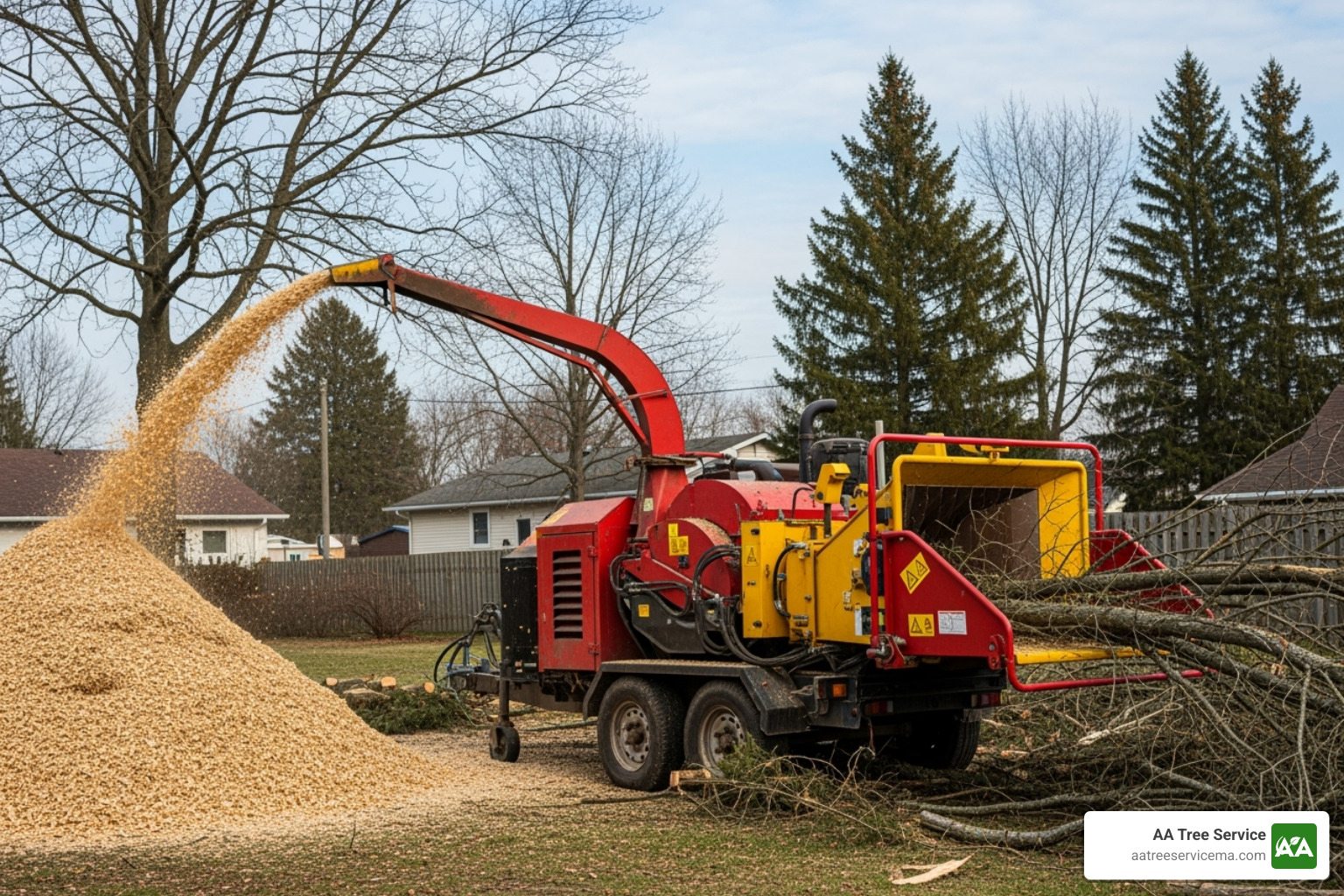
- Wood Chipping: Smaller branches are processed through an industrial chipper. We can leave the resulting wood chips for you to use as mulch or haul them away.
- Debris Hauling: We clean up and remove every twig and leaf, leaving your property tidy. You won’t have to do any cleanup after we’re gone.
- Firewood: We can cut larger trunk sections into firewood-sized logs for you to keep. Otherwise, we haul it all away.
- Repurposing: Whenever possible, high-quality wood is sent to local sawmills for lumber, and other wood is used for biomass energy. The tree continues to serve a purpose even after it leaves your yard.
Completing the Job with Stump Grinding
An old stump is more than an eyesore; it’s a hazard. That’s why stump grinding is an essential final step.
Stump grinding uses a specialized machine to pulverize the stump and major roots into wood chips, typically grinding 6 to 12 inches below ground level. This process offers several benefits:
- Complete Removal: Grinding below grade ensures the stump is gone, allowing you to plant grass or use the space for a patio or garden.
- Pest Prevention: Decaying stumps attract termites, carpenter ants, and other pests. Grinding eliminates this habitat before they can move toward your home.
- Safety: A stump is a tripping hazard, especially for children or in poorly lit areas. Removing it makes your yard safer.
- Ready for Landscaping: We backfill the hole with topsoil, leaving the area smooth and ready for your next project.
Our stump grinding service ensures the problematic tree is truly gone, root and branch.
Understanding Costs and Local Regulations
When planning a full tree removal service, it’s important to understand the costs and local regulations. Pricing varies by job, and some towns in Massachusetts and New Hampshire require permits for tree removal.
We believe in transparency, which is why we offer free, same-day estimates with no hidden fees. For a general overview of pricing, visit our tree removal cost estimate page.
Factors Influencing the Cost of a Full Tree Removal Service
No two tree removal jobs are the same. The cost is determined by several key factors:
- Tree Size and Height: Larger, taller, and wider trees require more time, a bigger crew, and more complex equipment, making them more expensive to remove.
- Location and Accessibility: A tree in an open front yard is straightforward. However, a tree in a fenced backyard with no gate access for machinery means every branch and log must be carried out by hand, significantly increasing labor time and cost. Trees on steep slopes, near septic fields, or entangled in other trees also present challenges that influence the price.
- Tree’s Condition: Dead, diseased, or storm-damaged trees are often unstable and unpredictable. They require extra safety precautions and specialized techniques, which can increase the cost.
- Equipment Needed: Jobs requiring a crane for safety and efficiency will have higher costs due to the specialized machinery, certified operators, and additional crew members needed.
- Urgency of the Job: Emergency tree removal, especially after a storm or outside of normal business hours, often costs more than a scheduled removal. This premium covers the immediate mobilization of our crew and equipment to address an urgent safety hazard.
- Additional Services: The total price will also include your chosen services like stump grinding, wood chipping, and complete debris hauling.
Based on industry data, average tree removal costs can range from $300 to $1,000, with large or complex jobs costing $2,000 to $3,000 or more. Please note these are industry averages, not our prices. We often provide more competitive pricing; for example, removing a dead ash tree typically ranges from $500-$1,000, including disposal.
For more details, our guide on tree removal cost breaks it down further.
Navigating Tree Removal Permits in Massachusetts & New Hampshire
Tree removal regulations vary significantly from town to town in both Massachusetts and New Hampshire. Some municipalities have strict bylaws to preserve their urban tree canopy, designating certain species or trees above a specific diameter as “heritage” or “significant” trees that require a special permit for removal.
A permit may be required for trees over a certain diameter or for specific protected or historic species. The good news is that most towns make exceptions for hazardous trees. If a tree is dead, dying, or poses an immediate threat, it can often be removed without a permit or through an expedited process. Attempting to remove a regulated tree without a permit can result in substantial fines.
With over 20 years of experience in the region, we are familiar with the permitting requirements in many MA and NH towns. We can advise you on whether a permit is needed and assist with the application process, ensuring all work is done in full compliance with local ordinances. As an example, you can review the Town of Arlington, MA’s Tree Maintenance Information. Always check with your local authorities or let us help you determine what’s required before starting work.
Frequently Asked Questions about Full Tree Removal
With over 20 years of experience serving Massachusetts and New Hampshire, we’ve answered countless questions about full tree removal service. Here are some of the most common ones.
Does homeowner’s insurance typically cover preventative tree removal?
Generally, no. Insurance policies are designed to cover damage after an event, like a tree falling on your house during a storm. The cost of removing a tree proactively, even if it’s unhealthy, is typically considered routine maintenance and is an out-of-pocket expense for the homeowner.
In rare cases, an insurer might consider coverage if a certified professional documents that the tree poses an imminent threat, but this is not standard. Always call your insurance provider to understand your specific policy coverage before proceeding.
How long does the removal process take?
The timeline depends entirely on the job’s complexity.
A straightforward removal of a small tree in an open area might take just a few hours. However, a complex job involving a massive tree overhanging a house, requiring a crane, or located in a tight space could take a full day or more. Safety and precision are our priorities, and we never rush.
When we provide your free estimate, we’ll give you a realistic timeline based on your specific situation.
What is the difference between tree removal and land clearing?
Think of it as surgery versus renovation.
Tree removal is a precise service focused on one or more individual trees. When you call for residential tree removal, we target specific problem trees while preserving the rest of your landscape.
Land clearing is a large-scale operation to clear most or all vegetation from an area. This is done to prepare a lot for new construction, a driveway, or other development. Our land clearing services use heavy equipment to transform raw land into a usable space.
Both services require professional expertise but serve very different goals.
Conclusion: Your Next Steps for a Safer Property
You now have a clear understanding of what a full tree removal service involves and why it’s a job for professionals. The most important takeaway is that safety always comes first. Attempting to remove a large or hazardous tree yourself is a dangerous risk to your health and property.
With over 20 years of experience, AA Tree Service provides the expertise, insurance, and 24/7 emergency response needed to protect your property in Massachusetts and New Hampshire. We handle every step of the process, from the initial assessment to the final cleanup and optional stump grinding, ensuring your complete peace of mind.
Your property deserves to be safe and beautiful, free from the stress of problematic trees. Let us bring our decades of expertise to your project.
Ready to take the next step? Contact us today for a free quote on your full tree removal service and find why homeowners throughout Massachusetts and New Hampshire trust us with their most challenging tree care needs.