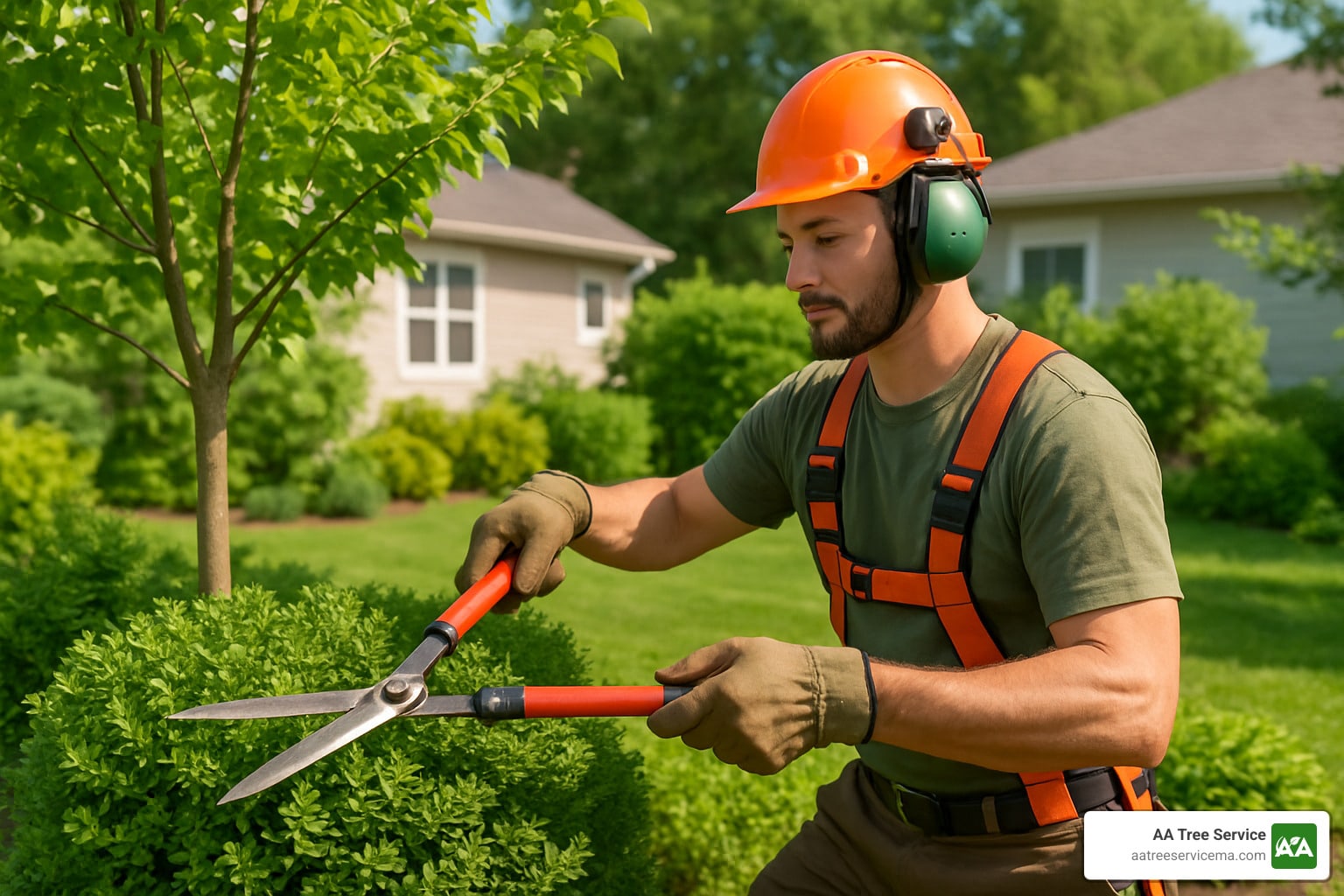
Why Tree and Shrub Service Matters for Your Property
A professional tree and shrub service provides comprehensive care including pruning, fertilization, disease management, pest control, and removal to maintain healthy landscapes and protect property value.
Key tree and shrub services include:
– Pruning & trimming – Health cuts and structural training
– Fertilization – Deep-root injection and soil care
– Disease & pest management – IPM treatments and prevention
– Tree removal – Safe removal of dead or hazardous trees
– Stump grinding – Complete stump elimination
– Emergency services – 24/7 storm damage response
Your trees and shrubs represent a major investment in your property. Research shows that properly maintained trees and shrubs can increase property value by up to 20%. But without regular care, these valuable assets can become safety hazards or decline in health.
Massachusetts and New Hampshire homeowners face unique challenges with harsh winters, humid summers, and local pests like Emerald Ash Borer. Professional tree care goes far beyond occasional pruning – it requires ongoing monitoring, soil analysis, and specialized treatments that most homeowners simply can’t provide on their own.
As one satisfied customer shared: “Your company did a great job and saved my trees from dying. You also charged a fair price for the job. I would definitely recommend your company to others.”
The key is finding the right balance between preventive care and reactive treatments. Companies typically recommend 6-8 visits per year for optimal tree and shrub health, catching problems early before they become expensive emergencies.
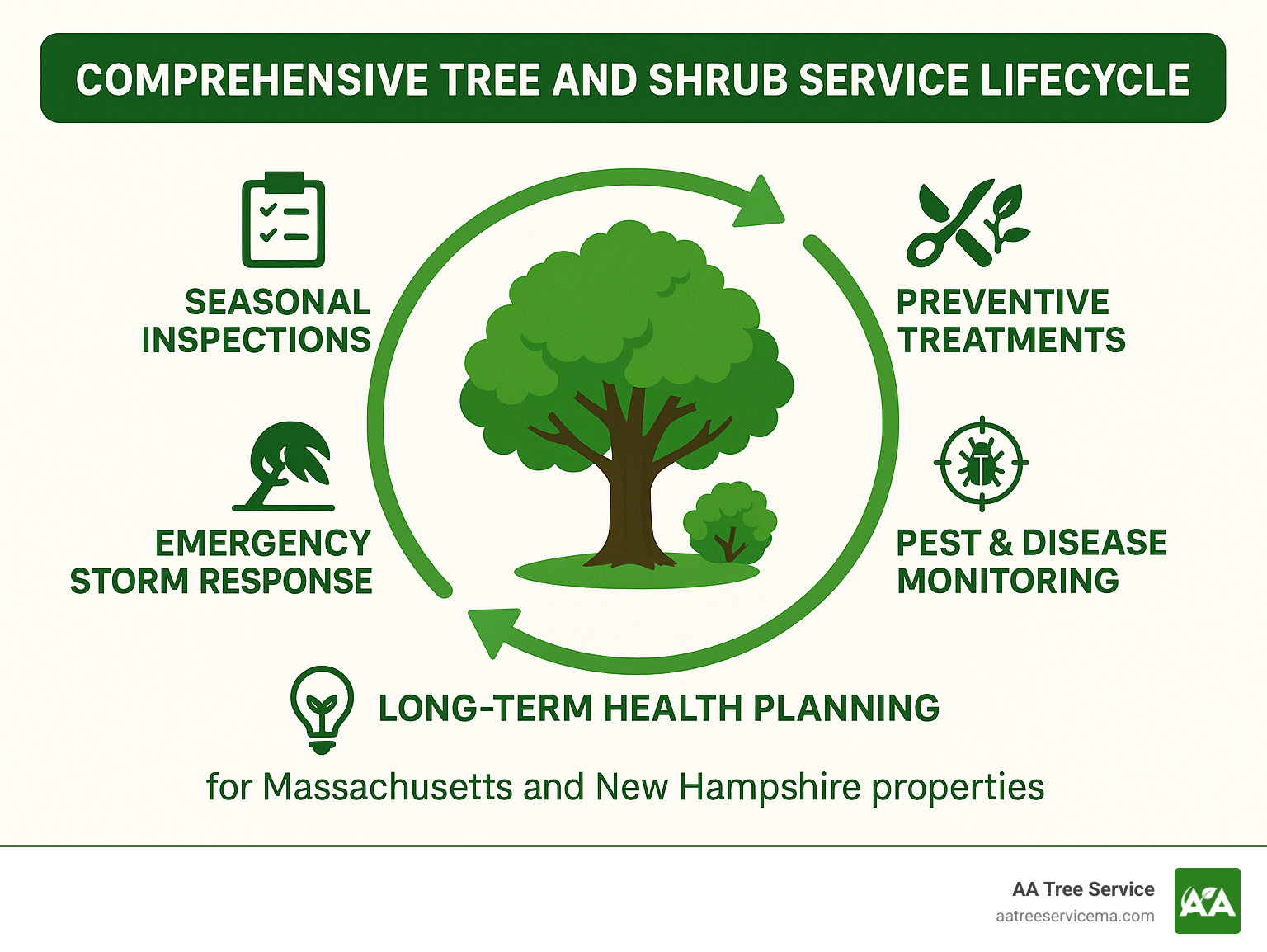
Tree and shrub service glossary:
– stump removal service
– tree cutting service
– tree maintenance services
Tree and Shrub Service: Why It Matters
Your trees and shrubs do so much more than just look pretty in your yard. They’re working around the clock to improve air quality, provide natural cooling during those sweltering New England summers, and create homes for local wildlife. During our heavy spring rains and snow melts here in Massachusetts and New Hampshire, they’re also quietly managing stormwater runoff and preventing erosion.
But let’s talk about what really catches most homeowners’ attention: properly maintained trees and shrubs can increase property value by up to 20%. We’re not just talking about making your neighbors jealous of your curb appeal (though that’s a nice bonus). This is real money that stays in your pocket when it comes time to sell your home.
Unfortunately, the flip side of this equation isn’t pretty. Neglected trees become ticking time bombs. Over our 20+ years serving Massachusetts and New Hampshire, we’ve responded to countless emergency calls where dead branches or weakened trees have crashed into homes, crushed cars, or taken down power lines. The worst part? Most of these disasters could have been prevented with proper tree and shrub service.
Our New England climate throws some serious curveballs at your trees. Harsh winters dump heavy snow loads that can snap branches without warning. Hot, humid summers create perfect breeding grounds for pests and diseases. Spring storms love to target trees that have been weakened over the winter months. And don’t get us started on what road salt does to trees planted near driveways and streets.
This challenging environment is exactly why professional arborists recommend inspection frequencies of every 6-8 weeks during the growing season. It’s not about drumming up business – it’s about catching small problems before they become expensive emergencies.
The Role of Regular Inspections
Think of regular tree inspections like your annual doctor’s checkup. You might feel fine, but a trained professional can spot warning signs you’d never notice. When we conduct a root-to-canopy assessment, we’re looking at your trees with decades of experience behind our eyes.
Early detection is everything in tree care. During our inspections, we examine the root zone for compaction and drainage issues, check the trunk for decay or pest entry points, analyze branch structure for weak unions, and assess foliage for signs of disease or nutrient problems.
Storm preparation is another crucial part of regular inspections. We identify potential hazards before severe weather hits, recommending preventive pruning or support systems to reduce wind resistance. As one of our customers put it: “Kyle is a wealth of knowledge/expertise, and we appreciate all the teaching he does each time he is here! Without his help in showing us what is wrong and telling us what to do, we would worry constantly about problems that are treatable!”
Having certified arborist eyes on your property makes all the difference. We see things that homeowners miss, and we know how to fix problems before they become disasters.
Common Warning Signs Your Plants Need Help
Even between our professional visits, you can be your trees’ first line of defense by watching for these red flags:
Dieback in branches often signals the start of bigger problems. When you notice branches losing leaves out of season or entire sections looking lifeless, disease, pests, or root issues might be the culprit.
Leaf discoloration tells a story to trained eyes. Yellowing, browning, or unusual spotting patterns can indicate everything from nutrient deficiencies to environmental stress. Different colors and patterns point to different solutions.
Pest frass – those tiny holes in bark or sawdust-like material around tree bases – are calling cards left by destructive insects. Early detection of threats like Emerald Ash Borer can mean the difference between successful treatment and complete tree removal.
Fungal growth is never a good sign. Mushrooms sprouting from trunks, bracket fungi on bark, or powdery substances on leaves all indicate problems that need professional attention quickly.
Soil compaction might seem minor, but it’s actually a tree killer. If water pools around your trees after rain or the ground feels rock-hard, your trees’ roots can’t function properly, and nutrient uptake suffers dramatically.
Comprehensive Tree and Shrub Service Options
When most people think of tree and shrub service, they picture someone with a chainsaw cutting down a dead tree. But modern arboriculture has evolved far beyond the old “cut it down” mentality. Today’s approach follows the philosophy of “Cure It. Don’t Cut It” – using scientific methods to preserve and improve tree health whenever possible.
More info about Tree Care Services
After two decades of serving Massachusetts and New Hampshire homeowners, we’ve learned that comprehensive tree care is like healthcare for your landscape. Just as you wouldn’t wait until you’re seriously ill to see a doctor, your trees and shrubs need regular attention to stay healthy and beautiful.
Pruning & Structural Training
Think of pruning as giving your trees a good haircut – except the stakes are much higher. Proper pruning isn’t just about making trees look tidy; it’s about promoting long-term health and preventing future problems.
Health cuts are our first priority. We remove dead, diseased, or damaged wood that can become a highway for pests and diseases to invade healthy tissue. These cuts also improve air circulation through the canopy, which reduces the humid conditions that fungal problems love.
Seasonal timing can make or break a pruning job. Most deciduous trees get their best cuts during dormancy when they’re “sleeping” and won’t stress from the procedure. But maples and birches? We prune them in late summer to avoid the excessive bleeding that weakens these species.
We follow ANSI A300 standards for every cut we make. These aren’t just industry guidelines – they’re based on decades of research about how trees heal. A properly placed cut will close over cleanly in a few years. A bad cut can create decay that haunts a tree for the rest of its life.
More info about Tree Pruning Services
Soil Care & Fertilization
Here’s something that surprises most homeowners: the real action in tree and shrub service happens underground. While you’re admiring the canopy, the root system is working 24/7 to keep your trees alive and thriving.
Deep-root injection is like an IV drip for trees. Instead of spreading fertilizer on the surface where grass will steal most of it, we inject nutrients directly into the root zone where trees can actually use them. This method is especially important for mature trees whose roots extend far beyond what you can see above ground.
Micronutrients often make the difference between a tree that struggles and one that flourishes. Iron deficiency turns leaves yellow, manganese shortage causes brown spots, and missing just one trace element can spell disaster. New England soils are notorious for lacking these essential nutrients.
Getting mulch depth right requires more skill than most people realize. Too little (under 1 inch) and you lose the moisture retention benefits. Too much (over 3 inches) and you create a soggy environment that encourages shallow roots and fungal problems. That sweet spot of 1-3 inches makes all the difference.
Scientific research on native soil microbes
Disease & Pest Management
Gone are the days when pest control meant dousing everything with chemicals and hoping for the best. Modern Integrated Pest Management (IPM) follows a smarter approach: monitor first, identify the problem accurately, then use the least toxic method that actually works.
Horticultural oils have become one of our favorite tools because they’re effective without being harsh on the environment. These treatments smother overwintering insects and their eggs while leaving beneficial species unharmed. It’s pest control with a conscience.
For serious threats like Emerald Ash Borer, we use trunk injections that deliver systemic treatments directly into the tree’s circulatory system. This targeted approach means the treatment goes exactly where it’s needed without affecting anything else in your landscape.
Timing is everything in pest management. The same treatment that saves a tree in early spring might be completely useless by midsummer. That’s why regular monitoring is so crucial to successful tree and shrub service.
More info about Tree Maintenance Services
Removal, Stump Grinding & Hazard Mitigation
Sometimes, despite our best efforts, removal becomes the only safe option. Dead tree felling isn’t a job for weekend warriors – dead wood is unpredictable and dangerous, even for experienced professionals.
Crane work has revolutionized how we handle large trees in tight spaces. What used to be impossible jobs that required damaging surrounding property are now routine operations. We can lift massive sections over houses, around power lines, and between buildings without breaking a sweat.
Stump grinding completes the removal process and eliminates those annoying trip hazards that seem to grab everyone’s toes. Modern grinders can handle stumps of any size, grinding them well below grade so you can plant grass or install new landscaping right over the spot.
More info about Stump Grinding
Cabling, Bracing & Lightning Protection
Not every problematic tree needs to come down. Cabling and bracing systems can extend the life of valuable specimens while keeping your property safe from failure.
Weak unions where multiple trunks join are like ticking time bombs during storms. Properly installed cables redistribute the stress loads, allowing these trees to withstand much higher winds than they could on their own.
Mature oaks often benefit from support systems as they age gracefully. These magnificent trees can live for centuries with proper care, but their massive limbs sometimes need a helping hand as wood strength naturally decreases over time.
Hardware lifespan varies depending on installation quality and environmental conditions, which is why we inspect and maintain these systems regularly. A cable system is only as good as its weakest component, and regular maintenance ensures continued protection.
DIY vs. Professional Tree and Shrub Service
Let’s be honest – we’ve all looked at a tree and thought, “How hard could it be to trim a few branches?” The DIY approach seems appealing, especially when you’re trying to save money. But after 20+ years of cleaning up well-intentioned DIY disasters, we’ve learned that tree and shrub service is more complex than most homeowners realize.
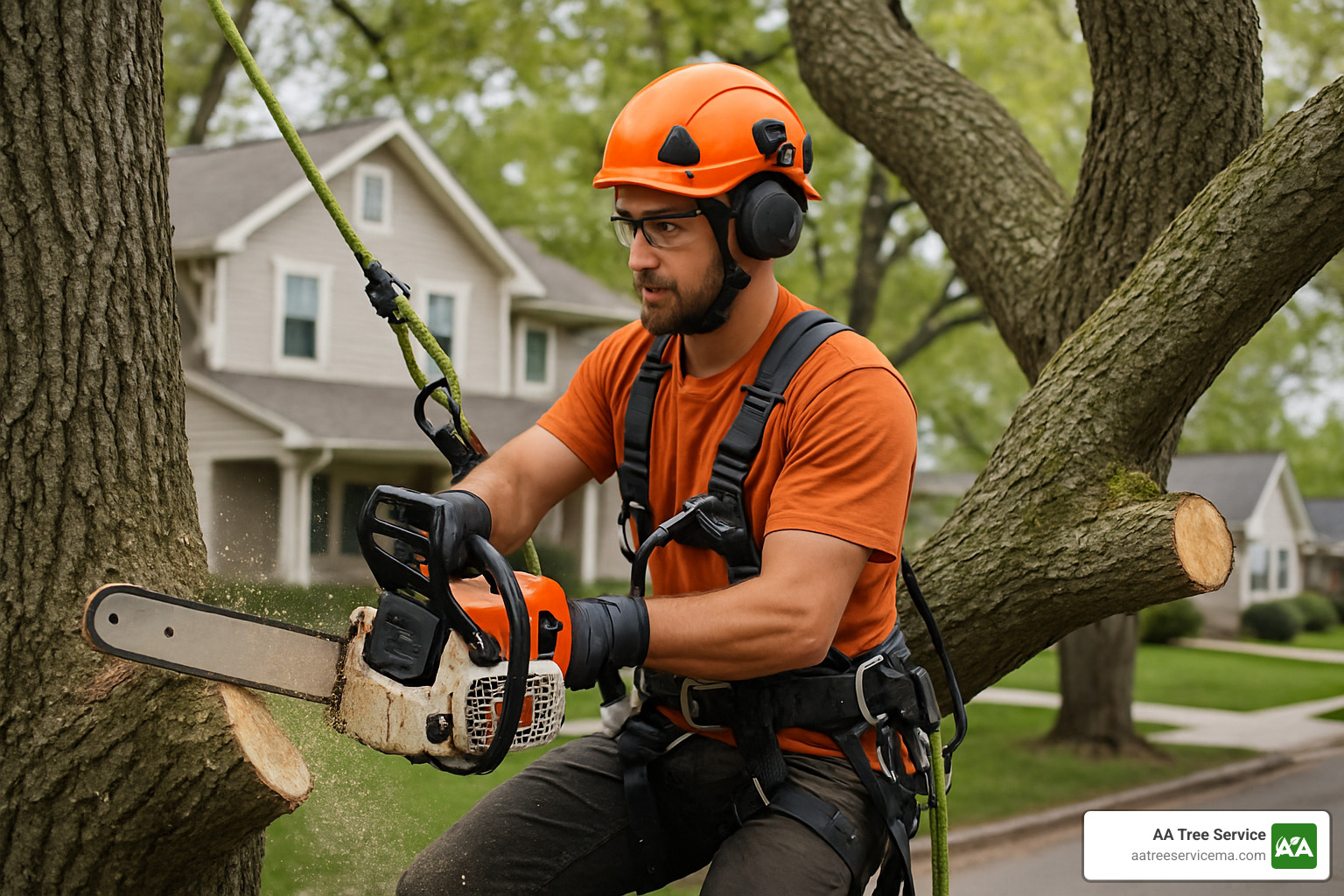
The skill gap between weekend warriors and certified professionals is enormous. We don’t say this to be snobby – it’s just reality. Understanding tree biology, proper pruning techniques, and disease identification takes years of training. Making the wrong cut can doom a tree to decades of decline or create a safety hazard that threatens your family.
Safety equipment alone represents a major investment. Professional-grade chainsaws, climbing gear, and protective equipment cost thousands of dollars. More importantly, knowing how to use this equipment safely requires extensive training. We’ve seen too many emergency room visits from homeowners who underestimated the dangers.
The time investment often surprises people. What takes our experienced crews a few hours can consume entire weekends for DIY enthusiasts. Factor in multiple trips to rent equipment, research proper techniques, and clean up afterward, and the “savings” start looking less attractive.
Liability issues represent the biggest concern. If you injure yourself or damage property during tree work, your homeowner’s insurance might deny coverage for DIY activities. Professional tree and shrub service companies carry specialized insurance that protects both the workers and your property.
ISA standards ensure that certified arborists follow science-based practices. These aren’t arbitrary rules – they’re based on decades of research into how trees respond to different treatments.
| Aspect | DIY Approach | Professional Service |
|---|---|---|
| Cost | Equipment + time | Service fee |
| Safety | High risk | Insured professionals |
| Results | Variable quality | Consistent, guaranteed |
| Time | Weekends/evenings | Scheduled completion |
| Liability | Homeowner assumes | Company coverage |
Why Hire a Certified Arborist
Credentials matter in tree care, and not all tree services are created equal. ISA (International Society of Arboriculture) certification requires passing comprehensive exams covering tree biology, pruning, disease diagnosis, and safety. It’s not just a piece of paper – it represents proven knowledge and ongoing commitment to professional standards.
Continuing education keeps certified arborists current with evolving best practices. Tree care science advances constantly, with new research informing everything from pruning techniques to pest management strategies. What worked 20 years ago might actually harm trees by today’s standards.
Diagnosis accuracy separates professionals from well-meaning amateurs. Correctly identifying whether those yellow leaves indicate drought stress, nutrient deficiency, or disease makes the difference between effective treatment and wasted money. As one customer told us: “Kyle is a wealth of knowledge/expertise, and we appreciate all the teaching he does each time he is here!”
Insurance coverage protects everyone involved. Professional tree services carry liability insurance and workers’ compensation, transferring risk away from property owners. When accidents happen – and they do – you want someone else’s insurance handling the claims.
More info about Professional Tree Service Massachusetts
Tree and Shrub Service Plans & Guarantees
Visit schedules for comprehensive tree and shrub service typically include 6-8 visits per year. This isn’t about generating extra business – it’s about providing seasonal treatments and ongoing monitoring that keep problems manageable. Spring fertilization, summer pest monitoring, fall pruning, and winter storm preparation all require different timing and expertise.
Satisfaction guarantees demonstrate confidence in service quality. We offer a “No Nonsense Guarantee” because we stand behind our work. If you’re not satisfied, we’ll return at no charge or refund your money. Try getting that guarantee from a DIY approach.
Emergency response availability sets professional services apart from casual providers. When storms strike Massachusetts and New Hampshire, having 24/7 access to trained crews can prevent minor damage from becoming major disasters. We’ve responded to countless emergency calls where quick action saved homes, cars, and power lines from further damage.
The peace of mind that comes with professional tree and shrub service often outweighs any initial cost savings from DIY attempts. Your trees are valuable assets – protect them with proper care.
Choosing the Right Tree and Shrub Service Company in MA & NH
Finding the right tree and shrub service company can feel overwhelming, especially when you’re dealing with valuable trees and significant property investments. The truth is, not all tree services are created equal – and the difference between a qualified professional and someone with just a truck and chainsaw can be dramatic.
We’ve seen too many situations where homeowners hired the cheapest option, only to end up with damaged property, injured workers, or trees that were actually harmed by improper care. It’s heartbreaking, and it’s completely preventable.
Licensing requirements in Massachusetts and New Hampshire exist for good reasons. Legitimate companies maintain all necessary permits and certifications because they understand the legal and safety responsibilities involved. When a company operates without proper licensing, they’re essentially telling you they don’t take regulations seriously.
Proof of insurance should be your first non-negotiable requirement. Any company working on your property must provide certificates showing both liability coverage and workers’ compensation. Don’t just take their word for it – call their insurance company to verify the coverage is current and adequate. If they hesitate or make excuses, walk away immediately.
The equipment quality you see often reflects the company’s overall professionalism. Modern, well-maintained trucks and tools indicate a business that invests in doing quality work safely. Conversely, beat-up equipment and dull chainsaws suggest corner-cutting that could affect your property and safety.
Local reviews tell the real story about customer experiences. Look for patterns in the feedback – companies that consistently receive praise for thorough cleanup, punctuality, and quality results are usually safe bets. Pay special attention to how companies respond to any negative reviews, as this shows their commitment to customer satisfaction.
Most reputable companies offer free quotes as standard practice. This allows you to compare not just pricing, but also the thoroughness of their assessment and the professionalism of their communication.
More info about Tree Hazard Assessment
Key Questions to Ask Before Signing
Before hiring any tree and shrub service, have an honest conversation and ask these essential questions. The answers will tell you everything you need to know about their professionalism.
Do you employ certified staff? ISA certification or equivalent credentials aren’t just fancy letters – they represent years of study and proven knowledge about tree biology and proper care techniques. Companies that invest in certification care about doing things right.
Can you provide a written estimate? Verbal quotes lead to misunderstandings and disputes later. Professional companies provide detailed written estimates that specify exactly what work will be performed, the timeline, and the total cost. If they won’t put it in writing, that’s a red flag.
What’s your cleanup policy? This question reveals a lot about company standards. Professional services should leave your property cleaner than they found it, with all debris removed and the work area properly restored. Make sure you understand whether cleanup is included or costs extra.
What are your emergency rates? Storm damage often requires immediate attention, and emergency work typically costs more than scheduled service. Understanding these rates upfront prevents unpleasant surprises when you need help most urgently.
Are there service exclusions? Some companies exclude certain tree species, sizes over a specific height, or trees near power lines. It’s better to know these limitations before you need the service than to find them during an emergency.
Understanding Average Costs in New England
Pricing for tree and shrub service varies significantly based on factors like tree size, location accessibility, job complexity, and local market conditions. Here’s what you can typically expect to invest:
Pruning costs range from $200 for small ornamental trees to $1,500 or more for large mature specimens. The wide range reflects the difference between basic trimming and complex structural work on valuable shade trees.
Tree removal pricing spans $400 to $4,000 per tree, depending on size, location, and complexity. A small dead tree in an open yard costs far less than a large oak hanging over your house and power lines.
Stump grinding typically runs $100 to $900 per stump, with pricing based on diameter, root system complexity, and accessibility. Large stumps in tight spaces naturally cost more than small ones in open areas.
Fertilization programs generally range from $150 to $600 annually, based on your property size and the number of trees requiring treatment. Comprehensive programs that include soil testing and customized treatments cost more but deliver better results.
Disclaimer: These are average costs based on internet data only and do not represent actual pricing from AA Tree Service.
The lowest bid isn’t always the best value. Quality work, proper insurance, and professional expertise justify higher prices when they prevent property damage and ensure your trees thrive for decades to come. Think of it as an investment in your property’s future rather than just an expense.
Environmental, Safety & Property Benefits
When you invest in professional tree and shrub service, you’re contributing to something much bigger than just your own backyard. The ripple effects of healthy trees extend throughout our Massachusetts and New Hampshire communities in ways that might surprise you.
Think about it – every mature tree on your property is like a hardworking employee that never takes a day off. A single mature tree absorbs 48 pounds of CO2 annually while producing enough oxygen for two people. Multiply that across an entire neighborhood, and you’re looking at a significant impact on air quality and climate change.
But the environmental benefits go well beyond carbon sequestration. Stormwater control becomes more critical every year as development increases the amount of pavement and roofing in our communities. Tree canopies intercept rainfall before it hits the ground, while healthy root systems help soil absorb runoff that might otherwise overwhelm storm drains and cause flooding.
Native species are the real champions here. When we maintain trees and shrubs that naturally belong in Massachusetts and New Hampshire, they require less water, fewer treatments, and provide better wildlife habitat for our local birds and beneficial insects. It’s like working with nature instead of against it.
One of our long-term customers put it perfectly: “The trees you’ve helped us maintain don’t just make our yard beautiful – they’ve become home to so many birds and wildlife. It’s like having our own little nature preserve.”
Scientific research on urban canopy
Boosting Curb Appeal and Home Value
Here’s where the environmental benefits meet your wallet in the most pleasant way possible. Landscape improvements consistently rank among the highest ROI of all home improvements, and properly maintained trees lead the pack.
Buyer impressions form within seconds of pulling into your driveway. Healthy, well-pruned trees and shrubs send an immediate message: “This property has been cared for.” It’s the kind of emotional connection that can make the difference between a quick sale and a house that sits on the market.
Mature tree premiums represent real money – we’re talking thousands of dollars in added property value for large, healthy specimens. These trees took decades to develop, making them irreplaceable assets that smart buyers recognize and pay for.
The beauty of investing in professional tree care is that unlike most home improvements, trees continue appreciating in value over time. That oak tree you’re maintaining today will be worth even more in ten years, assuming it stays healthy.
Safety During Storm Season
Living in Massachusetts and New Hampshire means dealing with some serious weather. We’ve seen what happens when homeowners skip regular tree maintenance and then face a nor’easter or ice storm.
Wind-throw risks multiply dramatically with neglected trees. Dead branches that looked “probably fine” in calm weather become projectiles during storms. Weak branch unions that developed over years can fail suddenly under wind stress, potentially damaging homes, cars, or worse.
Snow load problems are particularly challenging in our region. That beautiful, heavy wet snow that makes perfect snowmen can snap branches that appeared perfectly healthy during summer. We’ve responded to countless emergency calls where homeowners said, “I had no idea that branch was weak.”
Emergency readiness isn’t just about having our number in your phone (though we appreciate that!). It’s about identifying and addressing potential hazards before storm season arrives. Arborist inspections conducted in late summer or early fall can spot problems while there’s still time for preventive action.
The difference in cost between preventive pruning and emergency storm cleanup is dramatic. Removing a dead branch during a scheduled visit might cost a few hundred dollars. Emergency removal of that same branch after it’s damaged your roof? That’s potentially thousands in combined tree service and home repairs.
As one customer told us after we helped them prepare for a major storm: “You probably saved us from major damage. The branches you removed were exactly where my car would have been parked.”
Frequently Asked Questions about Tree and Shrub Service
How often should I schedule professional visits?
The sweet spot for tree and shrub service visits is every 6-8 weeks during the growing season, which typically means 6-8 visits throughout the year. This might seem frequent, but there’s solid reasoning behind this schedule.
Spring visits focus on early pest detection and fertilization when trees are actively growing. Summer monitoring catches stress issues before they become serious problems. Fall preparations help trees survive winter conditions, while winter inspections reveal structural issues hidden by leaves.
Think of it like regular dental checkups – catching small problems early prevents expensive emergencies later. As one of our long-term customers shared: “The regular visits have saved us thousands in potential tree removal costs over the years.”
The frequency also allows us to time treatments perfectly. Pest control works best when applied during specific life cycles, and fertilization needs vary throughout the growing season. Seasonal timing makes all the difference between treatments that work and money thrown away.
What qualifies an arborist in Massachusetts or New Hampshire?
Neither Massachusetts nor New Hampshire requires specific arborist licensing, which means you need to know what credentials actually matter when choosing a tree and shrub service.
ISA Certification tops the list of meaningful qualifications. The International Society of Arboriculture certification requires passing comprehensive exams covering tree biology, safety, and proper care techniques. More importantly, certified arborists must complete continuing education to maintain their credentials.
Insurance coverage protects both you and the workers. Any legitimate tree service should carry liability insurance and workers’ compensation. Don’t just take their word for it – ask to see current certificates.
Business licensing shows the company operates legally and professionally. Valid business licenses and any required contractor permits indicate a company that follows regulations and stands behind their work.
Local experience in Massachusetts and New Hampshire climates matters enormously. Our region’s harsh winters, humid summers, and specific pest pressures require specialized knowledge that comes only from years of local practice.
When is emergency service necessary after a storm?
Storm damage creates genuinely dangerous situations that require immediate professional attention. Never attempt to handle storm-damaged trees yourself – they’re unpredictable and can cause serious injury or property damage.
Call emergency tree service immediately if you see trees or large branches blocking roads or driveways. Even if you can squeeze your car around the obstruction, emergency crews and delivery vehicles might not be able to pass safely.
Power line contact represents the most serious emergency situation. If branches are touching or threatening power lines, call both the utility company and emergency tree service. Don’t assume the power is off – treat all lines as live and dangerous.
Structural threats include trees leaning against homes, garages, or other buildings. The weight and pressure can cause additional damage over time, and the tree might shift unexpectedly. Hanging branches pose similar risks, especially large limbs that appear ready to fall.
Root damage from saturated soil or strong winds can compromise tree stability even when the tree appears upright. If you notice exposed roots, soil mounding around the base, or trees that seem to be leaning differently than before the storm, these situations need professional assessment.
Our emergency crews respond 24/7 because storm damage doesn’t wait for business hours. Quick response prevents minor damage from becoming major disasters, and we’ve seen too many cases where delayed action led to much higher repair costs.
Conclusion
Your trees and shrubs deserve the same level of professional care you’d give any valuable investment. After all, we’re talking about living assets that can increase your property value by 20% while providing decades of beauty, shade, and environmental benefits.
The difference between thriving landscapes and struggling ones often comes down to one simple choice: working with experienced professionals who truly understand tree and shrub service.
At AA Tree Service, we’ve been helping Massachusetts and New Hampshire homeowners protect and improve their landscapes for over 20 years. We’ve seen how proper care transforms properties – and how neglect can turn beautiful trees into expensive problems.
What makes our approach different? We believe in building long-term relationships, not just completing one-time jobs. When you call us, you’re not just getting a tree service – you’re getting partners who care about your landscape’s future.
Our 24/7 emergency response means you’re never alone when storms threaten your property. We’ve been there at 2 AM helping customers deal with fallen trees, and we’ll be there for you too. Because emergencies don’t wait for business hours.
Free same-day quotes help you make informed decisions without pressure or delay. We believe you should know exactly what to expect before any work begins. No surprises, no hidden costs – just honest pricing for quality work.
From routine pruning to complex removals, from pest management to emergency storm response – we handle every aspect of tree and shrub service with the same attention to detail and commitment to excellence.
As one of our customers put it: “Your company did a great job and saved my trees from dying. You also charged a fair price for the job. I would definitely recommend your company to others.”
That’s the kind of satisfaction we deliver every day. Because we’re not satisfied until you are.
Ready to give your trees and shrubs the professional care they deserve? Contact us today for your free assessment. Let us show you how proper tree and shrub service can transform your property’s beauty, safety, and value.
More info about professional tree removal
Your landscape is more than just trees and shrubs – it’s your family’s outdoor living space, your property’s first impression, and your contribution to the community’s environmental health. With the right care, it will provide joy and value for generations to come.