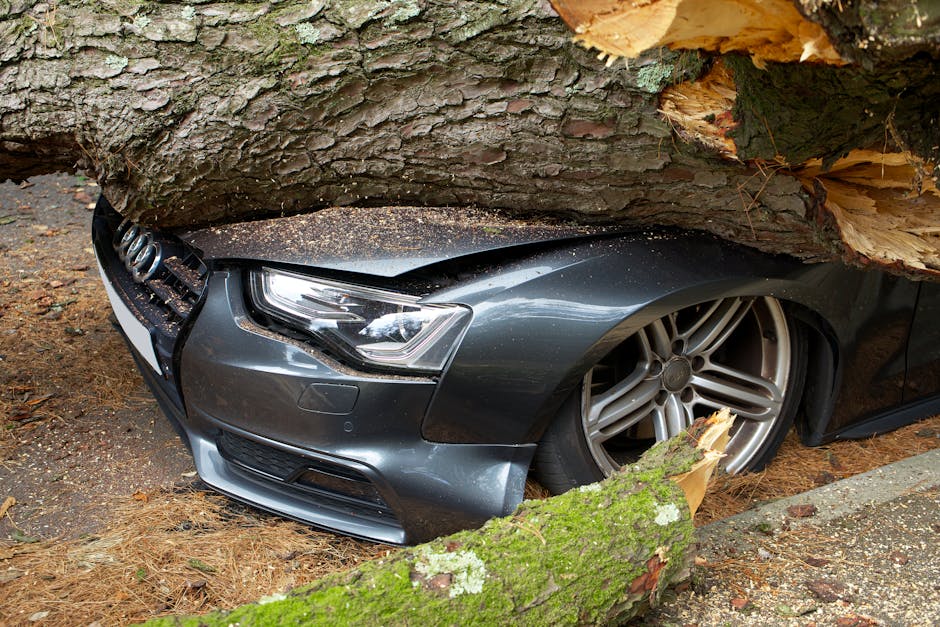
When Minutes Matter: Understanding Emergency Tree Removal
24 hour tree removal services provide immediate assistance when trees pose an urgent risk to your property or safety. These services operate around the clock to address hazardous situations that can’t wait until regular business hours.
“When disaster strikes and you have a fallen tree or tree limb on your property, you need emergency tree removal fast!”
What is 24 Hour Emergency Tree Removal?
| Emergency Tree Removal | Description |
|---|---|
| Service Hours | Available 24/7, including nights, weekends, and holidays |
| Response Time | Typically within 1-4 hours of your call |
| Common Scenarios | Storm damage, fallen trees, hazardous leaning trees, branches on structures |
| Service Area | Throughout Massachusetts and Southern New Hampshire |
When severe weather strikes or trees unexpectedly fail, waiting until morning isn’t an option. Fallen trees can block driveways, damage homes, or create dangerous situations that require immediate attention. Professional emergency tree services employ certified arborists with specialized equipment to safely handle these situations, regardless of the time of day.
Most of the property damage resulting from severe storms in Massachusetts occurs due to falling trees and limbs. This is why having access to reliable 24-hour emergency tree removal is essential for homeowners. The service not only addresses immediate hazards but also helps prevent further damage to your property.
Regular tree maintenance can significantly reduce the likelihood of needing emergency services, but when the unexpected happens, knowing who to call can make all the difference.
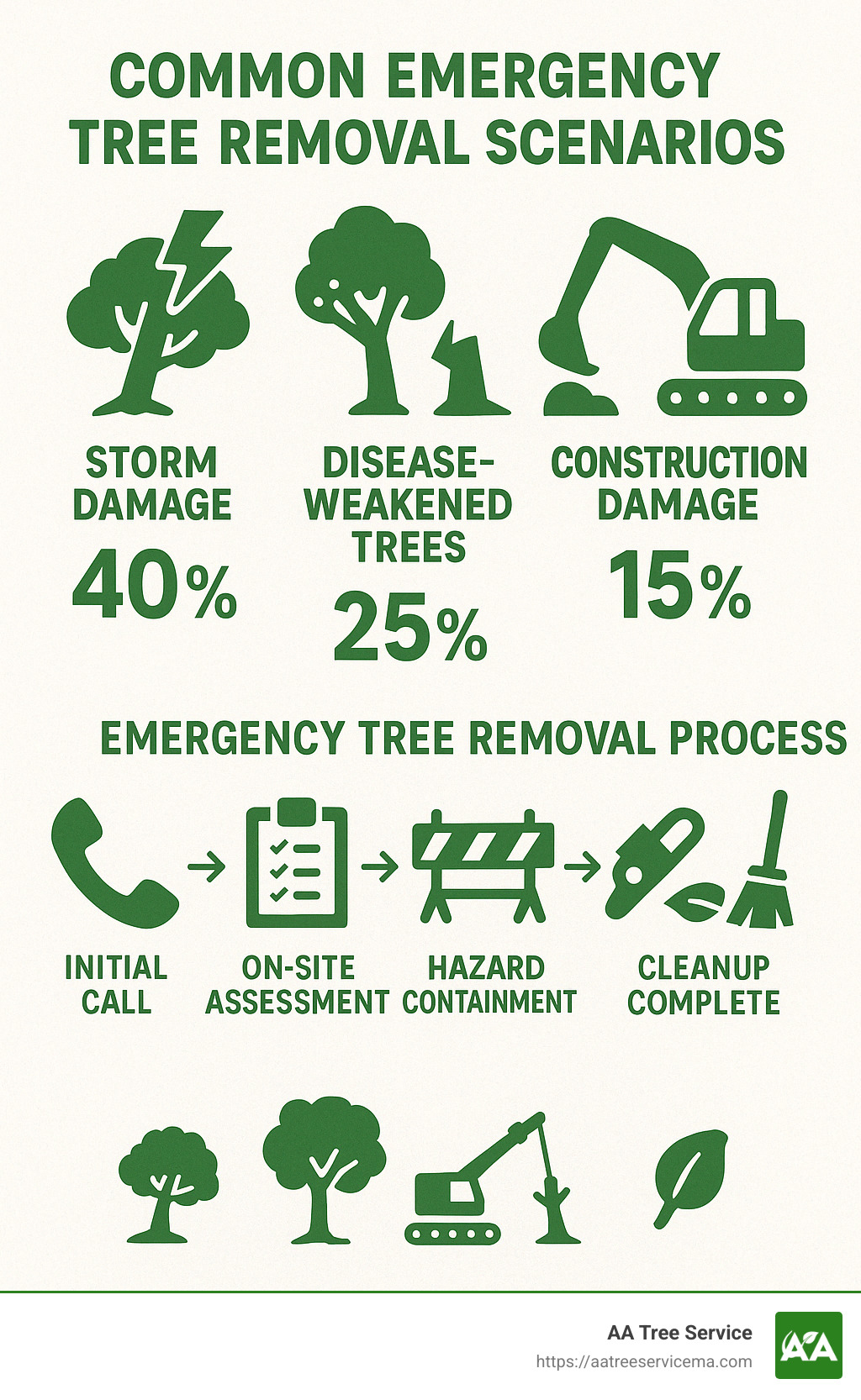
24 hour tree removal terms at a glance:
Common Scenarios Requiring 24-Hour Emergency Tree Removal
When Mother Nature flexes her muscles or trees reach the end of their lifespan, waiting for regular business hours just isn’t an option. As Massachusetts and New Hampshire residents know all too well, tree emergencies don’t follow a convenient 9-to-5 schedule. Here are the situations when you’ll likely need 24 hour tree removal services:
Storm Damage
New England weather can be unpredictable and fierce. From nor’easters to summer thunderstorms, our local trees often bear the brunt of nature’s fury. After a severe weather event, our phones start ringing with urgent calls about:
Trees completely uprooted by saturated soil and high winds. These gentle giants can suddenly transform into dangerous hazards when their root systems fail during a storm.
Split trunks that have been weakened by lightning strikes or excessive wind stress. A tree that’s been split down the middle is not only damaged beyond saving but poses an immediate danger to everything nearby.
The aftermath of these storms often leaves neighborhoods looking like nature’s battlefield, with trees and limbs scattered across properties throughout Massachusetts and New Hampshire.
Fallen Trees Blocking Access
There’s never a good time for a tree to fall across your driveway, but it always seems to happen at the worst possible moment. We’ve received countless panicked calls from homeowners who:
Can’t get to work because a massive oak is blocking their only exit. Can’t get home after returning from a trip to find their access completely obstructed. Need emergency services to reach an ill family member but can’t get an ambulance through.
For businesses, blocked access means lost revenue and frustrated customers—a situation that demands immediate resolution regardless of the hour.
Hazardous Hanging Branches
Sometimes the danger isn’t on the ground but lurking overhead. Partially detached branches—what arborists grimly call “widow-makers”—can fall without warning. These suspended hazards are particularly concerning when they’re:
Hovering over children’s play areas where unsuspecting little ones could be harmed. Dangling above power lines, threatening to cause widespread outages if they fall. Positioned over your roof, where even a moderate breeze could send them crashing through your shingles.
As one of our clients, Tom from Lowell, told us after we removed a dangerous hanging branch at 11 PM: “I couldn’t sleep knowing that branch could come down any minute. Your team arrived quickly and handled it professionally, even in the dark. Worth every penny for the peace of mind.”
Disease-Induced Failure
Not all tree emergencies come with the warning of a storm. Sometimes trees that appear healthy to the untrained eye are silently being destroyed from within. These disease-compromised trees can fail suddenly on even a calm day, catching property owners completely by surprise.
The signs are often subtle—perhaps some fungal growth at the base of the trunk, or unusual leaf patterns during the growing season. By the time many homeowners notice something’s wrong, the tree may already be at critical risk of failure.
In Nashua, we recently responded to an emergency call where a seemingly healthy maple suddenly tilted toward a family’s home. Upon inspection, our arborists finded extensive internal decay that had hollowed nearly 70% of the trunk—a ticking time bomb that fortunately was addressed before catastrophe struck.
When minutes matter and safety is on the line, knowing who to call for 24 hour tree removal can make all the difference between a close call and a costly disaster. At AA Tree Service, we’ve seen every emergency scenario imaginable across Massachusetts and New Hampshire, and we’re always ready to respond—day or night, weekday or weekend, holiday or ordinary Tuesday.
The Importance of 24 Hour Tree Removal Services
When disaster strikes, waiting until morning simply isn’t an option. That’s why 24 hour tree removal services aren’t just convenient—they’re essential for protecting your family and property. Let me share why having access to round-the-clock emergency tree care can make all the difference when minutes matter.
Immediate Risk Mitigation
Tree emergencies don’t politely wait for business hours. That massive oak that’s suddenly leaning toward your bedroom after a midnight storm? It needs attention now—not tomorrow.
The reality is that compromised trees create immediate dangers that can escalate in seconds. A weakened branch can suddenly give way, potentially causing serious injury to anyone underneath. Your parked car, that garden shed you just built, or even your home’s roof could be crushed without warning. Even more concerning, damaged trees near power lines can create dangerous electrical situations affecting your entire neighborhood.
That’s precisely why our teams at AA Tree Service remain available 24/7—because safety threats don’t follow a 9-to-5 schedule.
Preventing Further Property Damage
What starts as a minor tree issue can quickly snowball into a major disaster. I’ve seen it countless times: a tree that’s merely leaning against a roof at 10 PM has punched through that same roof by morning as it settled overnight. Those small branches that cracked your shingles? They’re now funneling rainwater directly into your attic, damaging insulation, electrical systems, and ceilings.
The physics of fallen trees can be unpredictable too. That tree that fell but seems “stable” can shift during wind gusts or roll unexpectedly, causing new damage to structures it didn’t initially hit. Even the exposed root plate of an uprooted tree can continue causing damage, potentially disrupting underground utilities or foundation structures if not properly addressed.
By accessing Emergency Tree Removal services immediately, Massachusetts and New Hampshire homeowners can prevent these cascading damage scenarios and potentially save thousands in additional repair costs.
Safety of Occupants
Nothing matters more than keeping your family safe. A tree emergency can transform your peaceful home into a danger zone in minutes. Immediate removal services ensure your family isn’t exposed to unnecessary risks.
Imagine the stress of knowing a partially uprooted tree is hovering near your child’s bedroom, or that your elderly parent can’t safely exit the house because a fallen tree has blocked all doorways. For families with young children or pets who might wander into hazardous areas, prompt removal eliminates these worries. And for households with elderly or mobility-impaired residents, ensuring safe access to and from the home can be literally lifesaving.
As one customer told us after a midnight emergency removal: “I couldn’t have slept a wink knowing that split tree was hanging over our roof. Having it removed immediately gave us priceless peace of mind.”
How 24 Hour Services Operate
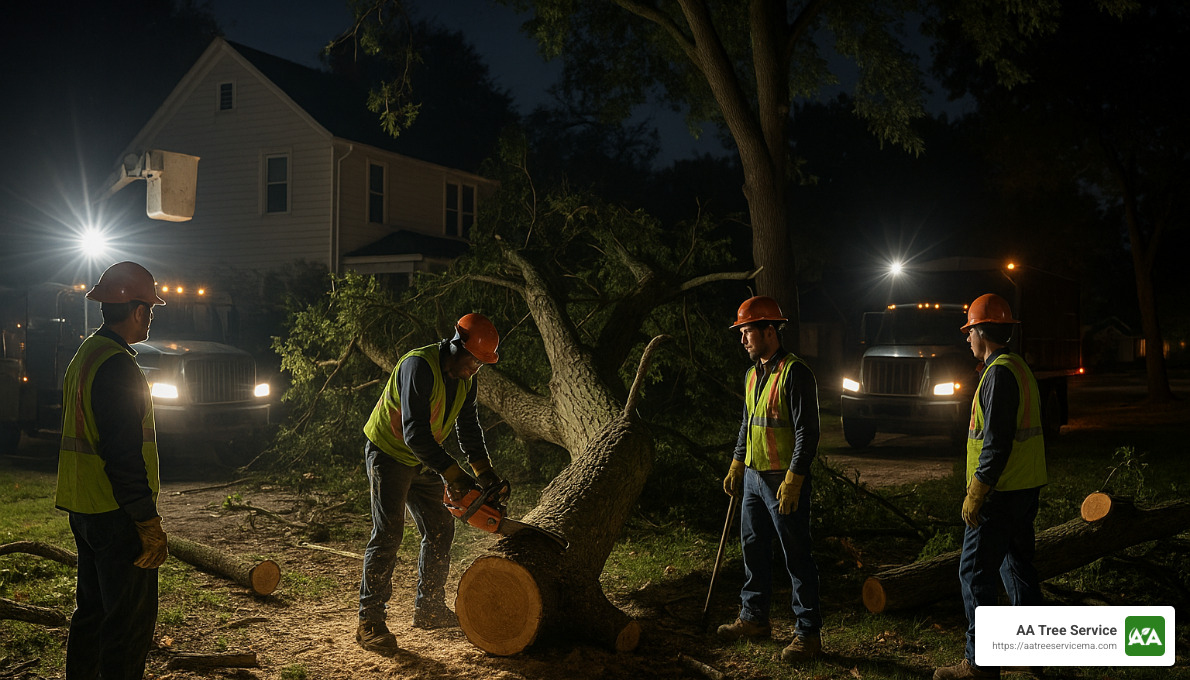
Providing genuine around-the-clock emergency response isn’t as simple as answering the phone after hours. It requires specialized systems and dedicated teams ready to spring into action at a moment’s notice.
Round-the-Clock Availability
True 24 hour tree removal means exactly that—someone answers when you call, whether it’s Tuesday afternoon or 3 AM Sunday. At AA Tree Service, we maintain rotating on-call teams throughout Massachusetts and New Hampshire, ensuring we’re always ready to respond. Our emergency dispatch system immediately alerts the appropriate crew, maintaining consistent response times regardless of when disaster strikes. You’ll never hear “call back during business hours” when facing a tree emergency.
Rapid Response Teams
Our emergency crews aren’t just regular tree workers pulling overtime—they’re specialists trained specifically for urgent, high-risk situations. They remain on standby with fully-equipped vehicles, ready to mobilize within minutes of receiving your call. We strategically position these teams throughout our service area to minimize travel time to your property. When minutes count, this preparation makes all the difference.
Special Equipment Considerations
Nighttime emergency tree work presents unique challenges that require specialized equipment. Our night crews arrive with powerful spotlights and portable lighting systems that transform darkness into workable conditions. For complex removals, we deploy heavy-duty cranes capable of reaching over structures and specialized rigging equipment that ensures controlled removal—even in challenging visibility.
As Mike, one of our veteran emergency responders, explains: “Working at 2 AM during a storm is nothing like regular tree work. We train specifically for these situations, using specialized lighting and communication systems that let us work just as safely and effectively as we would in broad daylight. When a family is counting on us to protect their home in the middle of the night, that preparation makes all the difference.”
For more information about emergency tree services, you can visit the International Society of Arboriculture website, which provides valuable resources on tree care standards and safety protocols.
Ensuring Safety During Emergency Tree Removal
When a tree comes crashing down at 2 AM during a thunderstorm, the last thing you want is a crew that cuts corners on safety. That’s why we take extraordinary precautions during 24 hour tree removal operations – especially since emergency situations often involve compromised trees in less-than-ideal conditions.
Certified Arborists Lead the Way
Every emergency call we respond to at AA Tree Service is directed by certified arborists who bring expertise when you need it most. These aren’t just tree cutters – they’re highly trained professionals who understand the physics and biology of trees in crisis.
Our certified arborists can read a damaged tree like a book, identifying how it might fail during removal and developing a removal strategy that protects everyone involved. They make split-second decisions based on years of training and experience, not guesswork – something particularly valuable when dealing with a tree that’s partially collapsed onto your roof at midnight.
Specialized Equipment for Safe Removal
Emergency situations demand specialized tools, and we arrive prepared for anything. Our fleet includes bucket trucks with advanced stabilization systems that keep our team safely aloft even on uneven terrain. For larger removals, we bring in cranes capable of precisely controlling multi-ton tree sections.
The equipment difference becomes especially apparent during night operations, where our industrial-grade lighting systems transform darkness into workable conditions. Every piece of rigging hardware we use is designed with redundant safety features, because when you’re removing a massive oak tree hanging over your bedroom, there’s no room for equipment failure.
For more details about our emergency capabilities, visit our Emergency Tree Cutting Services page.
Safety Protocols Specific to Emergencies
“Regular tree work is like chess – emergency tree work is like speed chess in the dark,” explains one of our veteran crew leaders. That’s why we follow improved safety protocols during emergency calls:
Our teams conduct rapid but thorough site assessments, identifying hazards like hidden power lines or unstable ground that might not be immediately obvious. We establish clear communication systems so every team member knows their role and can instantly alert others to changing conditions. And we constantly monitor weather conditions, especially during storm cleanup, to ensure we’re not putting our crew at risk from secondary hazards.
Risk Assessment Before Action
Even when time is of the essence, we never skip the critical assessment phase. Our arborists conduct a rapid but thorough evaluation that includes examining the tree’s condition, identifying failure points, checking soil stability, and scanning for electrical hazards from downed lines.
This assessment might take a few extra minutes, but it prevents hours of additional damage or potential injuries. As one client told us after we removed a storm-damaged pine threatening their home: “I was impressed that even in an emergency, they took the time to explain exactly what they were doing and why – it was reassuring to know they weren’t just rushing in.”
Safety Measures Used by Professionals
Protective Gear and Personal Safety
Our crews arrive looking like they’re ready for a mission – because they are. Impact-resistant helmets with integrated face shields protect against falling debris. Cut-resistant clothing prevents chainsaw injuries. Fall protection harnesses keep climbers secure, and high-visibility gear ensures everyone can be seen during night operations.
This protective equipment isn’t just for show – it’s saved our team members from injury countless times over our decades of service throughout Massachusetts and New Hampshire.
Use of Cranes and Rigging
For large or precariously positioned trees – like that 80-foot oak leaning toward your house – we employ sophisticated crane and rigging techniques. Our crane operators secure massive sections before cutting begins, using specialized calculations to determine safe lifting capacity. Meanwhile, our ground crew uses tag lines to provide directional control, ensuring that even in the middle of the night, that thousand-pound branch ends up exactly where it should.
Traffic Control When Necessary
When emergency removal involves trees near roadways, we implement comprehensive traffic management. Certified flaggers direct vehicles safely around the work zone, while reflective barriers establish clear perimeters. For major operations affecting public roads, we coordinate directly with local authorities to ensure everyone’s safety.
“Safety isn’t just a procedure for us – it’s a mindset,” explains our operations manager. “Whether we’re working at noon or midnight, our team follows strict protocols using advanced equipment and techniques to safely remove hazardous trees without causing additional damage to your property. That’s our promise, 24 hours a day.”
Benefits of Hiring Professionals vs. DIY Emergency Tree Removal
When a tree comes crashing down in the middle of the night or dangles precariously after a storm, it’s tempting to grab a chainsaw and handle it yourself. But before you do, let’s talk about why calling professional 24 hour tree removal experts is almost always the smarter choice.
Expertise and Experience
There’s simply no substitute for years of hands-on experience when dealing with unpredictable emergency situations. Professional arborists bring crucial knowledge that most homeowners don’t have:
Our teams at AA Tree Service have responded to thousands of emergency calls throughout Massachusetts and New Hampshire over the years. We’ve seen it all – from massive oaks crashed through roofs during nor’easters to precariously balanced pines threatening power lines after ice storms.
What might look straightforward to an untrained eye often hides serious dangers that only professionals can spot. We know exactly how different tree species react under stress, which branches might snap unexpectedly, and how to safely dismantle even the most dangerously positioned trees without causing further damage.
Safety Risks of DIY
Let’s be blunt: emergency tree removal ranks among the most dangerous activities a homeowner can attempt. The statistics are sobering:
Each year, thousands of people are seriously injured trying to handle tree emergencies themselves. Chainsaw kickbacks can happen in milliseconds, sending the blade toward your body with devastating force. Working at heights during already dangerous conditions multiplies the risk exponentially.
Even more concerning is that damaged trees behave unpredictably. What looks stable might suddenly shift or split when cutting begins. The physics of removing large, heavy objects suspended above your home requires specialized knowledge that comes only with training and experience.
“I thought I could handle that broken branch myself after the storm,” one Massachusetts homeowner told us. “Twenty minutes later I was in the ER with a broken wrist and still had a tree hanging over my garage. Some things just aren’t worth the risk.”
Proper Equipment Availability
Professional 24 hour tree removal services arrive fully equipped for any scenario. While you might have a chainsaw in your garage, we bring:
Commercial-grade equipment designed specifically for emergency conditions is expensive and specialized. Most homeowners don’t have access to bucket trucks, cranes, heavy-duty rigging systems, or specialized cutting tools – especially during off-hours when rental facilities are closed.
Our trucks come stocked with everything needed to handle emergencies safely, from multiple chainsaw sizes to specialized rigging equipment that can gently lower massive sections of trunk without damaging your property below.
Liability Concerns
The financial implications of DIY emergency tree removal can be significant. Your homeowner’s insurance likely won’t cover damage that results from your own tree removal attempts. If that falling branch damages your neighbor’s property or, worse, injures someone, you could be personally liable for all costs.
Professional services carry comprehensive insurance specifically designed for these high-risk operations. We’re fully covered for any potential property damage or injuries, providing you complete peace of mind during an already stressful situation.
Risks of Attempting DIY Tree Removal
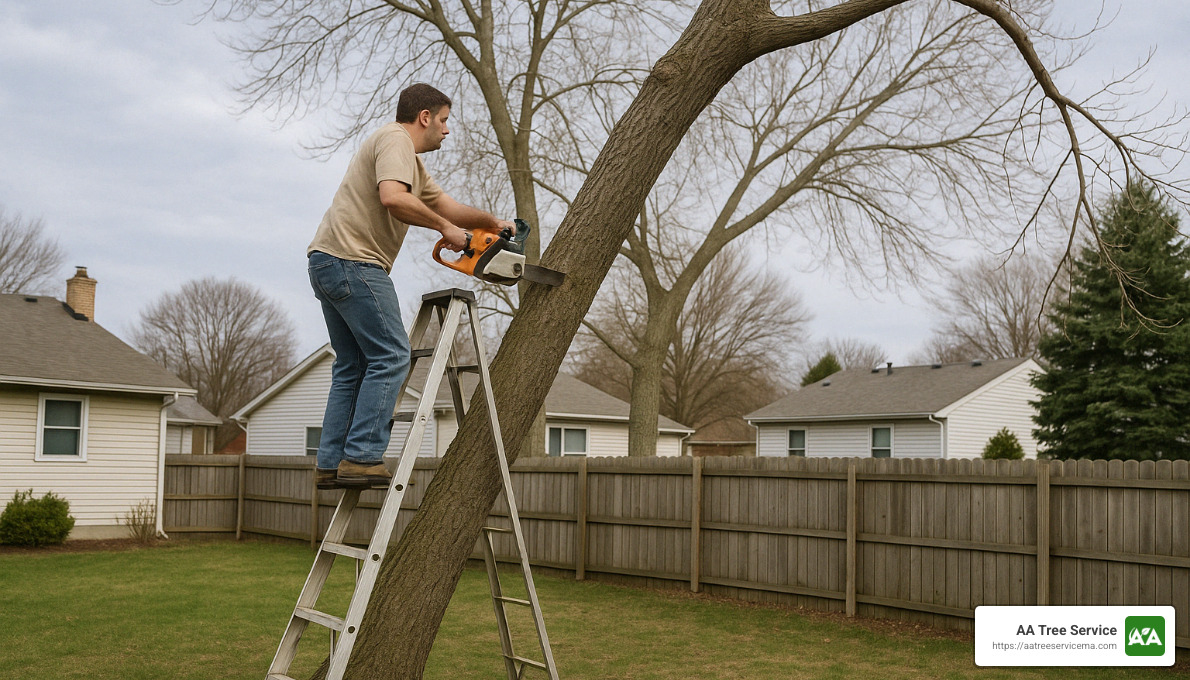
Injury Potential
The physical dangers of amateur emergency tree work can’t be overstated. Without proper training, you risk serious injuries including deep lacerations from chainsaws, crushing injuries from falling limbs, and falls from ladders or trees. These risks increase dramatically when working in poor weather or limited visibility – conditions common during tree emergencies.
Property Damage
Without the right techniques and equipment, DIY attempts often result in “controlled” tree sections falling uncontrollably. We’ve been called to many homes where initial DIY efforts created even more damage than the original emergency. Tree sections can crash through roofs, destroy landscaping, damage driveways, or take out power lines – turning a manageable situation into a major disaster.
Lack of Proper Tools
Most homeowners simply don’t have the specialized equipment needed for safe emergency tree work. That homeowner chainsaw that works fine for trimming small branches isn’t designed for the demands of emergency removal. Without proper rigging equipment, fall protection, and specialized cutting tools, you’re essentially attempting brain surgery with kitchen scissors.
As Mark from Andover told us after we completed an emergency removal following his neighbor’s failed attempt: “My neighbor spent four hours trying to remove a storm-damaged oak branch himself. He ended up with a broken window, a trip to the emergency room for stitches, and eventually called AA Tree Service anyway. The money he thought he was saving ended up costing him much more in the end.”
When facing a tree emergency in Massachusetts or New Hampshire, professional 24 hour tree removal services aren’t just a convenience – they’re an investment in your safety and property. Some jobs are simply better left to the professionals who do this work every day.
Assessing the Urgency and Severity of Tree Emergencies
When a tree starts causing concern on your property, it’s not always obvious whether you need someone at your doorstep right now or if it can wait until morning. Knowing how to evaluate the situation can save you both unnecessary panic and dangerous delays when considering 24 hour tree removal services.
Visual Inspections: What to Look For
Walking around your property after a storm or when you notice something off about a tree can tell you a lot about what you’re dealing with. Start by checking the tree’s trunk for visible damage – deep gashes, splits, or areas where bark has been torn away often indicate serious structural problems beneath the surface.
Look up at the canopy too. Are major limbs cracked or hanging? Is the tree leaning in a way it wasn’t before? Check the ground around the base – soil that’s heaving upward or cracking around the roots suggests the tree might be in the early stages of uprooting.
“We often get calls from homeowners who aren’t sure if their situation is an emergency,” says our lead arborist. “We always tell them to look for fresh damage, sudden changes, and anything that puts the tree in contact with their home or power lines.”
Signs of Tree Instability
Some tree problems announce themselves quite dramatically. Fresh cracks that run deep into the trunk aren’t just cosmetic – they’re telling you the tree’s structural integrity is compromised. If you hear creaking or cracking sounds coming from a tree, especially during light winds, consider this nature’s warning system telling you something is about to give way.
Trees that have suddenly developed a lean of more than 15 degrees from vertical are in active failure. They haven’t fallen yet, but they’ve started the process. The same goes for trees with exposed roots and moving soil around the base – the anchoring system is failing, and it’s only a matter of time before gravity wins.
Proximity to Structures
Location matters enormously when assessing tree emergencies. A damaged tree threatening your bedroom or living room needs immediate attention, while the same tree in a distant corner of your yard might safely wait until morning.
Trees blocking driveways or access routes need quick attention, especially if emergency vehicles might need to reach your home. Trees near power lines are particularly dangerous and should never be approached – these require professional emergency response, often coordinating with utility companies.
Potential for Harm
When evaluating whether to call for 24 hour tree removal, think about all possible “targets” in harm’s way:
- Are there spaces where people sleep or spend time directly in the tree’s fall path?
- Could essential services like electricity or water be disrupted?
- Would a sudden failure block access to or from your property?
- Is the tree hanging over a neighbor’s property, creating liability issues?
The more “yes” answers, the more urgent the situation.
Indicators of a Tree Emergency
Leaning Trees
A tree that has suddenly started leaning isn’t just being quirky – it’s telling you something is seriously wrong. Unlike trees that have grown at an angle over many years (and developed the structural strength to support that angle), a new lean means the root system is actively failing.
“When roots fail, it’s like the foundation of your house cracking,” explains our emergency response coordinator. “The whole structure becomes unstable, and failure can happen suddenly, especially if rain softens the soil further or wind provides the final push.”
Cracks in Trunk
Significant cracks in a tree’s trunk are never good news. These fractures indicate the tree can no longer support its own weight properly and has begun breaking under the stress. Horizontal cracks are particularly dangerous, as they suggest the tree might split in half without warning.
Fresh, deep cracks that appear after storms or develop over just a few days represent an immediate hazard requiring professional assessment. Don’t wait to see if they “get worse” – by then, it might be too late.
Uprooted Roots
When you notice soil heaving around a tree’s base or exposed roots where there weren’t any before, the tree has already begun the falling process. The root plate – the network of roots that anchors the tree to the ground – is failing, and the tree’s days (or hours) are numbered.
This situation is particularly dangerous because the tree might appear otherwise healthy with full foliage and no visible damage to the trunk or branches. Don’t be fooled – a tree can’t stand without its foundation.
Dead or Hanging Limbs
There’s a reason arborists call large hanging branches “widow-makers.” These detached or partially attached limbs can drop without warning, even on perfectly calm days. The weight of these branches – sometimes hundreds of pounds – makes them deadly serious threats to anyone unfortunate enough to be underneath when gravity finally takes over.
After storms, always check for hanging limbs, especially over driveways, walkways, play areas, and patios. These situations often can’t wait and justify calling for emergency service.
Your safety comes first. If you’re concerned about a tree on your property, stay at a safe distance and call professionals who have the training and equipment to handle the situation safely. As one of our customers put it after a particularly close call: “I never realized how dangerous that old oak was until part of it missed my car by inches. Having experts who knew exactly what to do and came right away was worth every penny.”
Equipment and Techniques Used in Emergency Tree Removal
When disaster strikes, having the right tools can make all the difference. Professional 24 hour tree removal services rely on specialized equipment that allows them to work safely and efficiently, even in the most challenging conditions.
Cranes: The Backbone of Emergency Removal
The massive trees that tower over Massachusetts and New Hampshire homes require serious equipment when they become hazardous. Modern cranes are truly the workhorses of emergency tree removal operations.
These powerful machines can delicately reach over your home to access a damaged tree without causing additional damage to your property. Our skilled crane operators work in perfect coordination with climbers, using hand signals and radio communication to secure large sections before cutting begins.
“The precision we can achieve with today’s hydraulic systems is remarkable,” explains one of our operators. “We can control a 2,000-pound section of trunk with inch-perfect placement, even when working in the dark after a storm.”
Before any lift begins, our team performs detailed weight calculations to ensure every operation stays well within safe lifting parameters. This mathematical approach to tree removal is what separates professionals from amateurs.
Chainsaws: Specialized for Emergency Work
The chainsaws we use for emergency work bear little resemblance to what you might find at your local hardware store. Our professional-grade saws feature significantly higher horsepower, specialized safety features, and are maintained to exacting standards.
We maintain a fleet of saws with various bar lengths to handle everything from small limbs to massive trunks. Each saw includes critical safety features like chain brakes and anti-vibration systems that reduce operator fatigue during extended emergency operations.
For night work in residential neighborhoods, we often employ battery-powered saws that significantly reduce noise while still providing the cutting power needed for most operations. This consideration for neighbors is especially appreciated during middle-of-the-night emergency removals.
Stump Grinders: Complete Removal
Once the immediate danger is addressed, we don’t leave behind hazardous stumps. Our commercial stump grinders can completely remove even massive stumps, grinding them more than 20 inches below ground level.
We maintain different sized machines to steer various access challenges – from compact units that can fit through a standard gate to powerful tracked grinders for larger jobs. These machines efficiently handle not just the stump itself, but also the surrounding root flares and surface roots that could present tripping hazards or lead to regrowth.
Rigging Systems: Controlled Dismantling
Perhaps the most technical aspect of emergency tree removal is our rigging system. This complex network of ropes, pulleys, and friction devices allows for the controlled dismantling of trees in tight spaces.
Our specialized ropes are specifically rated for the extreme loads encountered in tree work – far stronger than standard ropes you might use for other purposes. We employ sophisticated friction devices that give our ground crew precise control over descent speed when lowering heavy sections.
For particularly challenging removals, we use impact-absorbing rigging points that reduce shock loads on both the tree and our equipment. Multiple anchor points allow for complex removals where directional control is critical – such as working around power lines or over structures.
Specialized Tools for 24 Hour Tree Removal
Aerial Lifts
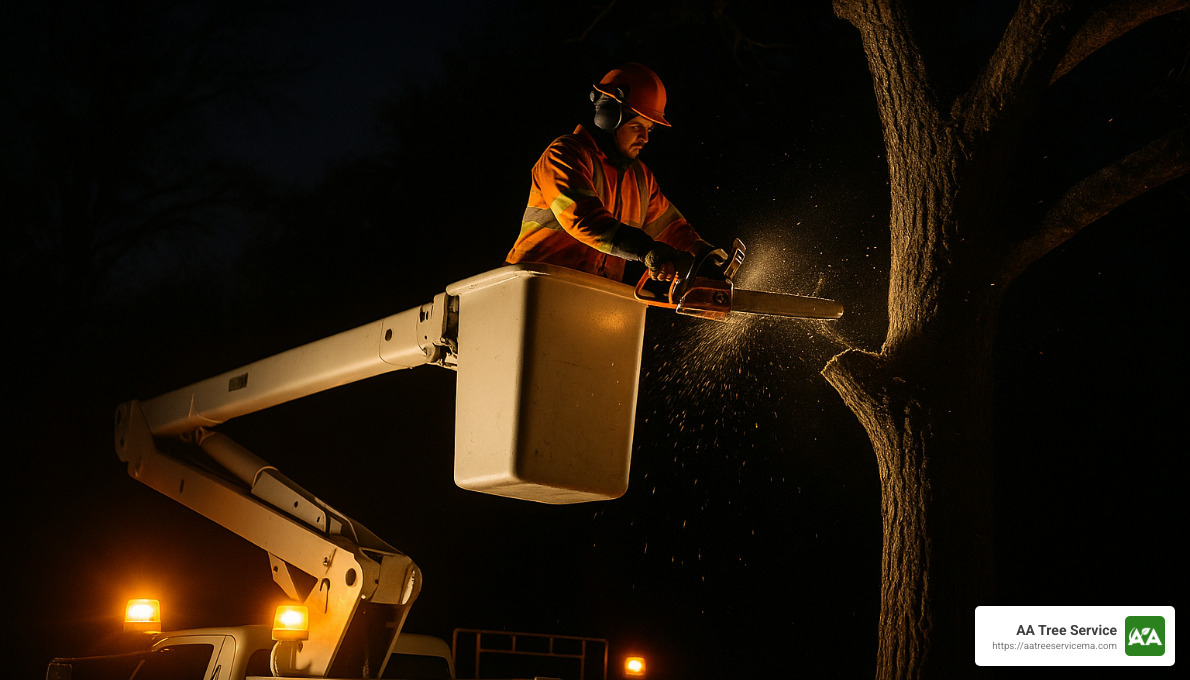
When a tree emergency strikes, our aerial lift trucks often arrive first on the scene. These specialized vehicles provide our crew with safe access to heights without the time-consuming process of climbing. The stable platforms allow for precise cutting operations even in windy conditions that might follow a storm.
One critical advantage of these lifts is their ability to position workers precisely around obstacles like power lines or building corners. When working near electrical lines – a common hazard after storms – we use buckets with specialized insulation to protect our workers.
Wood Chippers
Emergency tree removals generate significant debris, which is why our on-site processing equipment is so valuable. Our industrial wood chippers allow for immediate reduction of brush and smaller limbs, making the cleanup process much more efficient during emergency operations.
This on-site processing transforms potentially hazardous debris into usable mulch that many homeowners appreciate for their gardens. More importantly, it dramatically reduces hauling requirements, allowing us to complete jobs faster and move on to help the next family in need after a major storm event.
Lighting Systems
Night operations require specialized illumination systems that create safe working conditions. Our equipment features powerful mounted spotlights that transform night into day in the immediate work area. For wider illumination, we deploy portable generator-powered lighting arrays that eliminate dangerous shadows.
Every worker wears high-powered headlamps that keep their hands free for the technical work of cutting and rigging. Our comprehensive scene lighting minimizes shadows and blind spots – critical for identifying potential hazards during overnight emergency removals.
“The difference between amateur and professional tree removal is night and day,” explains our equipment manager. “Our specialized tools allow us to safely handle situations that would be extremely dangerous with consumer-grade equipment, especially during emergency conditions.”
When you’re facing a tree emergency in Massachusetts or New Hampshire, the specialized equipment we bring makes all the difference between a risky situation and a safely resolved crisis.
The Role of Regular Maintenance in Preventing Emergencies
While 24 hour tree removal services provide crucial support during emergencies, the best approach is to prevent these situations from happening in the first place. Regular tree maintenance isn’t just about aesthetics—it’s a vital safety measure that protects your property and family.
Pruning: The First Line of Defense
Think of pruning as preventative medicine for your trees. Regular structural pruning does far more than just keep your landscape looking tidy. By removing dead or dying branches before they become hazards, you’re eliminating what would likely be the first things to fall during a storm.
“I’ve seen countless cases where simple preventative pruning could have saved homeowners thousands in emergency removal costs,” explains one of our senior arborists. “Those dead limbs hanging over your roof might seem harmless on a calm day, but they’re ticking time bombs during high winds.”
Proper pruning also improves the overall structure of your trees, making them more resilient against New England’s unpredictable weather. By strategically reducing the canopy, we can lower wind resistance, preventing the sail-like effect that can topple trees during storms.
Health Assessments: Early Problem Detection
Many tree emergencies don’t happen suddenly—they’re the culmination of long-developing issues that went unnoticed. Professional arborist inspections can identify problems invisible to untrained eyes.
Internal decay, for instance, might show no external symptoms until the tree suddenly fails. Our certified arborists use specialized tools and techniques to detect hollow areas, fungal infections, and structural weaknesses long before they create emergency situations.
These assessments are particularly important for mature trees around your Massachusetts or New Hampshire property. The magnificent oak that’s stood for generations might look perfectly healthy while harboring significant internal decay—a situation we can identify and address before it becomes dangerous.
Disease Prevention: Maintaining Vitality
Healthy trees are naturally more resilient. Just as a person in good health recovers better from injury, trees with strong immune systems withstand environmental stresses more effectively.
Proper fertilization, timely disease treatment, and appropriate soil management all contribute to tree vitality. These practices strengthen root systems and overall tree health, creating natural resistance to the conditions that often lead to emergency situations.
The investment in preventative care is minimal compared to the cost of emergency removal—not to mention the potential damage a fallen tree can cause to your home or property.
Structural Support: Reinforcing Vulnerable Trees
Sometimes trees with historical or aesthetic value have structural issues that can be addressed without removal. For these special cases, we offer solutions like:
Cabling systems that reduce stress on weak branch unions
Bracing rods that reinforce split trunks
Lightning protection that prevents catastrophic strike damage
Root collar excavation that improves foundation health
These interventions can add years or even decades to a tree’s safe lifespan, preserving valuable landscape features while ensuring safety.
For more information about how preventative approaches can help avoid emergencies, visit our Emergency Tree Branch Removal page.
Preventive Measures to Reduce Emergency Risks
Implementing a few specific practices can dramatically reduce your chances of needing 24 hour tree removal services:
Regular Inspections
We recommend having your trees professionally assessed at least once a year, with additional inspections after major storms. Trees near structures deserve special attention, and mature specimens generally need more frequent monitoring than younger ones.
These inspections often reveal minor issues that can be addressed inexpensively—before they escalate into major problems requiring emergency response.
Removing Dead Branches
Dead branches are not just unsightly—they’re usually the first parts of a tree to fail. Proactive removal of these branches eliminates common failure points, reduces habitat for decay organisms, and prevents unpredictable branch drops that can damage property or cause injury.
“After every major storm in Massachusetts, we see the same pattern,” notes our operations manager. “Properties with regular maintenance have far fewer emergency calls than those without preventative care.”
Cabling and Bracing Weak Limbs
For trees with concerning structural issues, professional reinforcement systems can provide crucial support. Steel cables installed between major limbs reduce movement and stress during storms, while threaded rods can reinforce weak unions prone to splitting.
These systems require professional installation and periodic inspection to ensure they’re functioning properly, but they’re extremely effective at preventing failures in otherwise healthy trees.
“In my twenty years with AA Tree Service, the clearest pattern I’ve seen is that properly maintained trees rarely become emergencies,” explains our head arborist. “The few minutes you spend scheduling regular maintenance could save you from a middle-of-the-night emergency and potentially thousands in property damage.”
While 24 hour tree removal services are always available when you need them, the best emergency is the one that never happens. A modest investment in preventative care today can prevent major headaches tomorrow.
Immediate Steps for Property Owners After a Tree Emergency
When a tree comes crashing down on your property, those first moments can feel overwhelming. Your heart’s racing, you’re worried about damage, and you might not know exactly what to do. Let’s walk through the essential steps to take after a tree emergency happens – keeping you safe while setting the stage for efficient 24 hour tree removal.
Ensure Personal Safety First
Nothing matters more than keeping yourself and your loved ones safe when a tree emergency occurs.
Take a deep breath and make safety your absolute priority. Move everyone – family members and pets included – away from the danger zone surrounding the fallen or compromised tree. If the tree has impacted your home, consider evacuating areas that might be at risk if the tree shifts or falls further.
Stay far away from any downed power lines – they might look harmless, but they can be deadly. Always assume fallen lines are energized. And while you might feel tempted to grab a chainsaw and start clearing things yourself, resist that urge. Emergency tree situations require professional skills and equipment.
Assess Damage Cautiously
Once everyone’s safely away from the danger, it’s time to evaluate the situation – but do this from a safe distance.
Take a careful look to determine if the tree has damaged your home, garage, or other structures. Note whether any utility lines are entangled with the tree, as this significantly increases the hazard level. Check if the tree is blocking your driveway, sidewalk, or street access. Also pay attention to whether the tree appears stable or if it seems to be continuing to move or fail further.
James from Andover told us: “When that oak fell against my garage during last winter’s ice storm, I wanted to rush in and check the damage up close. Looking back, I’m glad I stayed back – part of it collapsed further while we were waiting for AA Tree Service to arrive.”
Contact Emergency Services When Needed
Some tree emergencies require immediate assistance from public services before tree removal can begin.
If anyone has been injured, call 911 immediately. When power lines are involved, your utility company needs to be your first call – they must secure the electrical hazards before any tree work can begin safely. For trees creating imminent dangers like blocking fire hydrants or threatening to fall on structures, notify your local fire department. And don’t forget to report any trees blocking public roadways to local authorities.
Document With Photos
While waiting for help to arrive, thorough documentation will prove invaluable – especially for insurance purposes.
Grab your smartphone and take clear, well-lit photos of the damage from multiple safe vantage points. Capture different angles of the tree and any affected property. If personal belongings or valuable landscaping features were damaged, document these specifically. Make note of the date and time everything occurred, and keep a record of any emergency services you contacted.
Contacting 24 Hour Tree Removal Services
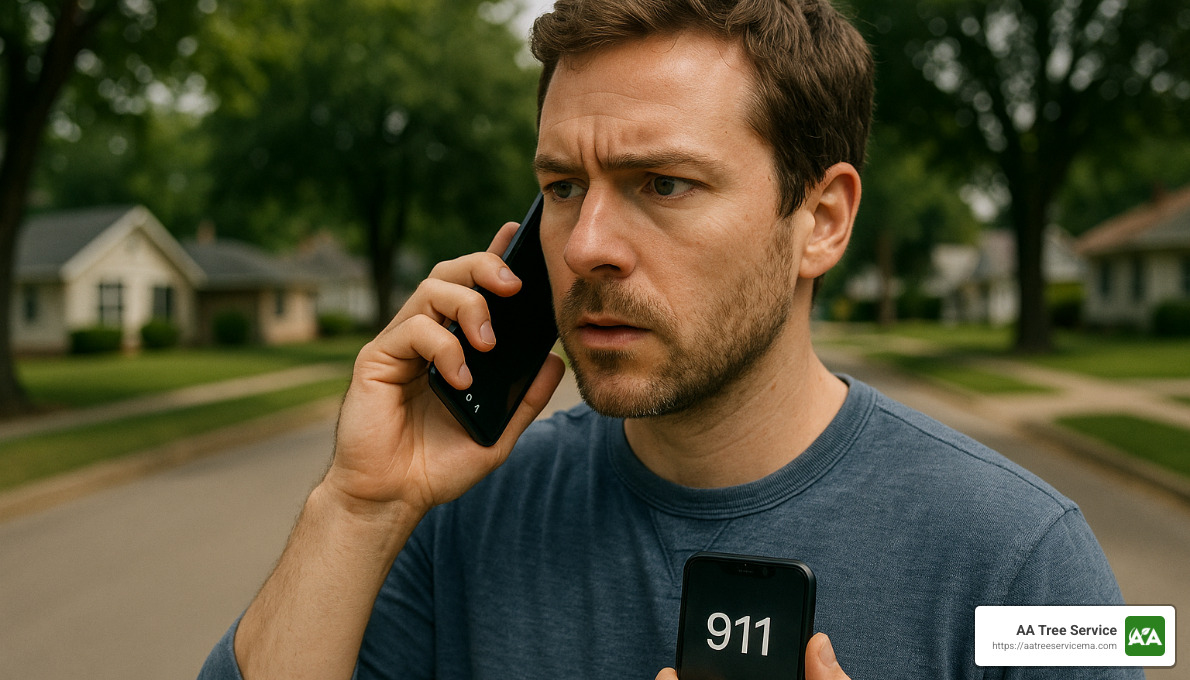
When it’s time to call in the professionals, knowing who to contact can make all the difference in how quickly your emergency gets resolved.
24/7 Availability
At AA Tree Service, we understand that trees don’t wait for business hours to fail. That’s why our emergency line is staffed around the clock by knowledgeable team members – not automated answering services or outsourced call centers. When you call, you’ll speak with someone who can provide immediate guidance on safety measures while help is on the way. Our emergency dispatchers can give you realistic arrival time estimates based on current conditions and your location in Massachusetts or New Hampshire.
Quick Response Times
When facing a tree emergency, waiting hours for help can feel like an eternity. We’ve structured our emergency response system to minimize that waiting time:
Our crews are strategically positioned throughout Massachusetts and New Hampshire to enable fast response times. Most emergency situations receive an on-site response within 1-4 hours of your call. We prioritize dispatching based on safety risk assessment – situations with active danger to people or structures receive top priority. And if unexpected delays occur due to road conditions or multiple emergencies, we’ll keep you updated on our arrival time.
“Last summer when that maple split and landed partly on my roof at 2 AM, I was amazed that AA Tree Service had someone at my door within an hour,” shares Martha from Nashua. “They secured the tree that night and came back at first light to complete the removal. Knowing help was available even in the middle of the night made all the difference.”
For more details about how we handle tree emergencies, visit our Emergency Tree Services page.
Pro tip: Save our emergency number in your phone now, before you need it. Having immediate access to 24 hour tree removal services when disaster strikes can save precious minutes when they matter most.
Insurance Considerations for Emergency Tree Removal
When a tree emergency strikes your property, understanding how insurance factors into the equation can save you significant financial stress. Let’s explore what you need to know about insurance coverage for 24 hour tree removal situations.
Homeowner’s Insurance Policies
Most homeowners are surprised to learn that insurance doesn’t automatically cover every fallen tree scenario. Standard policies typically have specific guidelines:
Your insurance will usually cover tree removal costs if the tree damages insured structures like your home, garage, or fence. That massive oak that crashed through your roof during last night’s thunderstorm? Your policy likely has you covered.
Many policies also include coverage for trees blocking essential access points such as driveways or handicap access ramps, recognizing these as safety issues rather than mere inconveniences.
However, if a tree falls in your yard without hitting anything of value, you might be on your own financially. Most standard policies exclude removal of trees that fall without damaging insured property, considering this regular maintenance rather than an insurable event.
“The first question we always hear after an emergency is ‘Will my insurance cover this?'” says our customer service manager. “The answer depends entirely on the specific circumstances and your individual policy.”
Coverage for Storm Damage
Weather-related tree failures generally receive more favorable insurance treatment:
After major storms sweep through Massachusetts and New Hampshire, insurance companies typically classify tree damage under “Act of God” provisions. This means damage caused by fallen trees during storms is usually covered when structures are impacted.
The removal costs themselves may be included in your coverage if the tree damaged your home or other insured structures. This often includes not just cutting up and removing the tree but also addressing the stump and any associated landscape damage.
Your policy deductible will apply to any covered claims, so factor this into your financial calculations when determining out-of-pocket costs.
Filing Claims
When dealing with insurance after a tree emergency, timing and documentation are everything:
Contact your insurance company as soon as it’s safe to do so—ideally within 24-48 hours of the incident. Many companies have specific time limits for reporting claims.
Before any removal work begins, thoroughly document all damage with clear, well-lit photographs from multiple angles. These visual records are invaluable during the claims process.
Keep every receipt and invoice related to your emergency tree removal services. Your insurance adjuster will need these to process your claim accurately.
Ask your 24 hour tree removal service to provide detailed documentation describing the emergency nature of the work. This should include information about the tree’s condition, the risks it posed, and why immediate removal was necessary.
Working with Insurers
A smooth claims process requires coordination between several parties:
Request a detailed written estimate from your tree service that breaks down costs for removal, cleanup, and any additional services. Insurance adjusters prefer itemized documentation rather than lump-sum quotes.
If the cause of tree failure is apparent (disease, storm damage, etc.), ask your arborist to document this in their assessment. This information can be crucial for insurance purposes.
Many tree emergencies can be resolved more efficiently when there’s direct communication between your tree service and insurance provider. At AA Tree Service, we’re experienced in working with insurance adjusters throughout Massachusetts and New Hampshire to facilitate this process.
Understanding Your Insurance Policy
Policy details vary significantly between insurance companies and even between different policies from the same provider. Here’s a general comparison of common coverage scenarios:
| Scenario | Typically Covered | Coverage Limitations | Documentation Needed |
|---|---|---|---|
| Tree falls on home | Yes | Up to policy limits; deductible applies | Photos, repair estimates, tree removal invoice |
| Tree falls in yard (no damage) | Usually not covered | Some policies offer limited coverage for debris removal | Photos showing location and lack of structural damage |
| Tree threatens structure | Sometimes covered | May require arborist certification of hazard | Professional assessment documenting imminent risk |
| Neighbor’s tree damages your property | Yes (your policy) | Your insurer may seek reimbursement from neighbor’s insurance | Photos, property line documentation |
“Is tree removal covered by insurance? In some cases, yes—especially if the tree is a threat to structures or has fallen due to a storm,” explains our customer service manager. “It’s important to consult with your insurance provider about your specific policy coverage.”
Many homeowners are surprised to learn that if a neighbor’s tree falls on your property, it’s typically your insurance that’s responsible—not theirs. Your insurer may later seek reimbursement from your neighbor’s insurance company, particularly if there’s evidence the tree was unhealthy or poorly maintained.
The bottom line? Review your homeowner’s policy before an emergency happens so you understand exactly what’s covered. Consider taking photos of valuable trees on your property during regular inspections, as this documentation can prove invaluable if you ever need to file a claim.
Handling Debris and Cleanup After Emergency Removal
When the chainsaws quiet down and the immediate danger has been addressed, a new phase of 24 hour tree removal begins—the cleanup. This often overlooked but crucial step transforms your property from disaster zone back to safe, usable space.
Tree Removal Debris
The aftermath of emergency tree removal can be surprising, even overwhelming, for many homeowners. What was once a single tree becomes a substantial amount of material scattered across your property:
“I had no idea one tree could create so much debris,” shares Massachusetts homeowner Mark T. “When my oak came down in that winter storm, it seemed to multiply once it was on the ground.”
A mature tree can generate several tons of wood, with branches and limbs creating massive brush piles that overwhelm standard yard waste disposal. The smaller stuff—twigs, leaves, and sawdust—works its way into every corner of your yard. And if you’re dealing with an uprooted tree, that root ball brings along soil, rocks, and sometimes even parts of your walkway or garden features.
Our emergency crews don’t just remove the hazard and leave you with the mess. We handle every piece of debris, from the largest trunk sections to the finest sawdust.
Stump Removal
After emergency removal, the stump remains as evidence of what happened. You have several options:
Immediate grinding is often the cleanest solution, though it might be scheduled as a follow-up visit depending on the urgency of your emergency situation. Our commercial grinders can reduce stumps to 18-24 inches below ground level, allowing for future landscaping or construction.
For less urgent situations, chemical treatments can accelerate natural decomposition, though this takes considerably longer than grinding. Some homeowners opt for complete excavation, particularly when they plan to replant in the same location or need to prepare the area for construction.
Creative homeowners sometimes choose decorative repurposing, changing the stump into a garden feature, planter, or natural seating area—turning misfortune into an opportunity for landscape improvement.
Site Cleanup
True professionals don’t consider the job complete until your property is thoroughly restored:
“The cleanup was as impressive as the removal itself,” notes New Hampshire client Jennifer M. “I expected to spend days raking and hauling, but when AA Tree Service left, my yard looked better than before the emergency.”
Our comprehensive site cleanup includes removal of all wood debris from your property—we don’t leave piles of branches for you to deal with later. We thoroughly rake small fragments and sawdust, ensuring your lawn isn’t left with a layer of wood debris that can damage grass and create future maintenance headaches.
In cases of uprooted trees, we perform soil grading where root plates disturbed the ground, preventing water pooling and creating a smooth surface for future use. Throughout the process, we implement lawn protection measures to prevent rutting and soil compaction, using specialized equipment and ground protection mats when necessary.
Environmental Considerations
Responsible 24 hour tree removal services prioritize environmental stewardship even during emergencies:
We ensure proper disposal at authorized facilities, never dumping debris illegally or burning materials on-site unless permitted. Our operations emphasize recycling of wood waste whenever possible, keeping valuable organic materials out of landfills.
During cleanup, we’re careful to minimize soil compaction that can damage remaining tree roots and impact soil health. We also take precautions to protect surrounding vegetation from damage during the cleanup process, preserving your landscape’s health and appearance.
Disposal and Recycling of Tree Materials
What happens to all that wood? At AA Tree Service, we’ve developed several environmentally responsible options:
Mulching
Those branches and smaller limbs don’t go to waste. Our commercial chippers transform them into valuable wood chips that can be left on-site for your landscaping use. This fresh mulch works beautifully when spread in garden beds to suppress weeds and retain soil moisture.
Many clients choose to have mulch used around remaining trees as beneficial protection for roots. If you don’t need the mulch, no problem—we’ll haul it away and ensure it’s put to good use elsewhere in our Massachusetts and New Hampshire communities.
Firewood
Larger trunk sections become a resource rather than waste. We can cut wood to fireplace length and split it if you’d like to season it for your own use. Our crews will neatly stack the wood on-site in a location of your choosing.
Don’t need firewood? We can donate it to community programs that provide heating assistance to families in need throughout Massachusetts and New Hampshire. Alternatively, it’s processed through our commercial firewood operation, ensuring nothing goes to waste.
Eco-Friendly Practices
Environmental responsibility remains a priority even during emergencies. Our approach includes recycling 100% of wood waste as mulch, firewood, or biomass fuel. We’re committed to minimizing landfill impact through proper sorting and recycling of all materials.
Even our equipment reflects this commitment, with biodegradable bar and chain oil used in our chainsaws to reduce environmental impact. Throughout the process, we implement low-impact removal techniques that minimize disturbance to your property.
“After a tree emergency, the last thing homeowners want is a mess left behind,” notes our cleanup crew supervisor. “Our comprehensive approach ensures that once we leave, your property is safe, clean, and ready for recovery or replanting.”
For more information about our complete emergency services, including cleanup and debris removal, visit our Emergency Tree Branch Removal page.
Understanding the Costs of Emergency Tree Removal
When disaster strikes and you need a tree removed immediately, cost is often a secondary concern to safety—but it’s still important to understand what factors influence the price of 24 hour tree removal services. Let’s break down what goes into these costs so you can be prepared.
Factors Influencing Cost
Not all emergency tree removals are created equal. The final price tag depends on several key elements that tree service professionals consider when providing an estimate.
The size and species of the tree play a major role—removing a 70-foot oak requires significantly more resources than a 25-foot ornamental. The complexity of the situation matters too; a tree that’s fallen cleanly in an open yard is much simpler to handle than one precariously leaning against your home.
Accessibility is another crucial factor. If our crew can easily reach the tree with our equipment, the job will cost less than situations where we need to steer tight spaces or challenging terrain. And of course, the timing of your emergency affects pricing—middle-of-the-night calls naturally come with different rates than daytime emergencies.
Tree Size and Location
The physical characteristics of your tree and its surroundings dramatically impact the final bill. Larger trees not only contain more material to remove but also require more specialized equipment and labor hours. A massive pine tree with a 40-inch diameter trunk represents a much bigger project than a slender birch.
Location is equally important. Trees situated near structures require precise, careful dismantling to prevent further damage. Our crews must use specialized rigging techniques and sometimes even cranes to safely remove sections without allowing them to fall onto your home or garage.
“The worst situations are when a large tree has partially fallen on a house during a storm,” explains our operations manager. “We need to stabilize the tree, remove it piece by piece without causing additional damage, and do it all while battling weather conditions. That’s when our experience really makes a difference.”
Urgency
The timing of your emergency significantly affects the cost:
After-hours service, especially overnight calls, typically comes with premium rates—our crews must be compensated for responding outside normal business hours. Holiday emergencies or calls during major storm events may also affect pricing due to high demand and challenging conditions.
The nature of the emergency itself matters too. A tree that has already crashed through your roof requires immediate attention and may incur expedited service charges. By contrast, a tree that’s leaning dangerously but hasn’t failed yet might allow for a scheduled removal the next day at more standard rates.
Labor and Equipment Costs
Behind the scenes, professional 24 hour tree removal services must account for significant overhead costs that influence pricing:
Our emergency teams consist of highly trained professionals—certified arborists, experienced climbers, and equipment operators who command skilled labor rates. The specialized equipment required doesn’t come cheap either—cranes, bucket trucks, heavy-duty chippers, and specialized rigging systems represent major investments.
Insurance coverage for emergency tree work is substantially higher than for standard operations due to the increased risks. All reputable companies maintain extensive liability coverage and workers’ compensation insurance that protects both their team and your property.
Average Costs and Influencing Factors
Based on internet data (not actual costs for AA Tree Service), emergency tree removal generally ranges between $500 and $2,000 for standard situations. However, complex cases involving very large trees, difficult access, or hazardous conditions can push costs significantly higher—sometimes reaching $5,000 or more.
| Factor | Lower Cost | Higher Cost |
|---|---|---|
| Tree Size | Small (under 30 ft) | Large (over 60 ft) |
| Accessibility | Easy access, open area | Limited access, near structures |
| Complexity | Simple felling possible | Requires sectional dismantling |
| Timing | During business hours | Middle of night, holidays |
| Additional Services | Basic cleanup | Stump removal, extensive debris management |
While emergency services typically cost more than scheduled work, the investment prevents further property damage and ensures safety. When a tree is threatening your home during a midnight storm, the value of having a professional team arrive quickly with the right equipment becomes crystal clear.
“Most clients are surprised by how reasonable the cost can be when they consider the alternative of handling the situation themselves or allowing further damage to occur,” notes our customer service manager. “The peace of mind alone is worth it for many homeowners.”
Frequently Asked Questions about 24 Hour Tree Removal
Is Emergency Tree Removal Covered by Insurance?
One of the most common questions we hear during tree emergencies is about insurance coverage. The good news is that in many cases, homeowner’s insurance will cover emergency tree removal—but there are important conditions to understand.
Your insurance typically covers removal when a tree damages insured structures like your home, garage, or fence. Trees blocking essential access points such as driveways or accessibility ramps are often covered as well. When healthy trees fall due to covered perils like wind storms or lightning strikes, your policy generally includes removal costs.
However, if a tree falls without damaging any property, you might be responsible for the removal costs yourself. Insurance companies carefully evaluate several factors: Was the tree previously healthy or showing signs of neglect? Did it cause damage to insured property? What specifically caused the tree to fail?
To maximize your chances of coverage, we recommend contacting your insurance provider immediately after the incident. Document everything thoroughly with clear photos from multiple angles. Keep all receipts and estimates from tree services, and ask our arborists to document the likely cause of failure when possible. This documentation can make a significant difference in your claim’s outcome.
How Quickly Can Emergency Tree Removal Services Respond?
When facing a tree emergency, waiting isn’t an option. That’s why at AA Tree Service, we’ve designed our emergency response protocols for rapid deployment throughout Massachusetts and New Hampshire.
Our teams typically arrive within 1-4 hours of your call, with priority given based on our safety risk assessment. During major storm events when calls increase dramatically, we implement special surge response plans to handle multiple emergencies efficiently. We maintain dedicated crews specifically trained for emergency situations so regular scheduled work doesn’t affect our emergency response capability.
Several factors can influence our exact response time, including current weather conditions (which might be the same conditions that caused your tree emergency), road closures or access issues in your area, multiple simultaneous emergencies in the region, and your specific location within our service area.
What sets us apart is our commitment to communication—we always provide realistic arrival estimates and send updates if unexpected delays occur. We understand that waiting during an emergency is stressful, so we keep you informed every step of the way.
Can Emergency Tree Removal Be Done at Night?
Absolutely! True 24 hour tree removal services are equipped and trained for nighttime operations, and we take pride in our ability to work safely and effectively regardless of the hour.
Our night operations rely on powerful portable lighting systems and vehicle-mounted spotlights that transform dark scenes into workable environments. Our crews receive specialized training for night work, with improved safety protocols designed specifically for reduced visibility conditions. We modify certain techniques to accommodate nighttime conditions while maintaining our high safety standards.
“The middle of the night is when many people find they need emergency tree services—especially during storms,” explains our operations director. “That’s why we’ve invested in the equipment and training needed to respond any time, day or night.”
There are some special considerations for nighttime work. We remain mindful of noise ordinances in residential areas, though emergency situations generally allow for necessary work regardless of hour. We implement additional safety measures for night operations, and there may be somewhat higher costs due to overtime and specialized lighting equipment. We also prioritize nighttime work based on immediate risk level—if a tree is on your house or blocking access, that takes precedence over less urgent situations.
“In the event of an emergency situation related to your trees, our knowledgeable arborists are available to assist exactly when you need help the most—day or night,” affirms our operations director.
Conclusion
When tree emergencies strike in Massachusetts and New Hampshire, every minute counts. The unpredictable nature of tree failures—especially during severe weather events—means that waiting until regular business hours simply isn’t an option when your safety or property is at risk.
The value of reliable 24 hour tree removal services becomes crystal clear when you’re standing in your yard at midnight, watching a partially fallen tree threatening your home. These moments of crisis require immediate, professional response from experienced teams who understand both the urgency and complexity of emergency tree situations.
At AA Tree Service, we’ve spent over two decades building our emergency response capabilities throughout Massachusetts and Southern New Hampshire. Our teams have worked through blizzards, midnight storms, and holiday emergencies—because trees don’t check the calendar before they fail. This experience has taught us that the right equipment, proper training, and quick response can make the difference between minor inconvenience and major disaster.
While emergency services are invaluable when needed, the best emergency is one that never happens. Regular maintenance plays a crucial role in preventing many tree failures. Professional pruning removes potential hazards before they become problems, health assessments identify internal issues invisible to untrained eyes, and proactive removal of compromised trees eliminates risks before nature takes matters into its own hands.
When facing a tree emergency, remember these essential steps:
First, ensure everyone’s safety by keeping clear of hazardous areas. Document everything thoroughly with photos for insurance purposes. Then call professionals with proper equipment and expertise—attempting DIY removal during an emergency significantly increases risk to both people and property. Finally, understand that proper emergency removal, while sometimes costly, prevents the much greater expense of structural damage or injury.
“In the event of an emergency situation related to your trees, knowledgeable arborists are available to assist exactly when you need help the most.”
The peace of mind that comes from knowing professional help is just a phone call away—regardless of the hour—is perhaps the greatest value of 24 hour tree removal services. Nature’s timing is unpredictable, but your response doesn’t have to be.
For more information about our emergency tree removal services or to schedule a preventative assessment that might help you avoid emergencies altogether, please visit our Emergency Tree Removal page or contact our 24/7 emergency line. We’re committed to being there when you need us most—because when it comes to hazardous trees, waiting simply isn’t an option.