Understanding Tree Removal Expenses
Quick Answer: Tree Removal Cost Estimate (2025)
- National Average Cost: $657 per tree
- Typical Price Range: $341-$1,523
- Small Trees (under 30 ft): $150-$450
- Medium Trees (30-60 ft): $450-$1,200
- Large Trees (60-80 ft): $800-$1,500
- Very Large Trees (over 80 ft): $1,000-$3,000
- Stump Removal: Additional $100-$500
- Emergency Service: Can reach $5,000
When you need a tree removal cost estimate, understanding the factors that influence pricing can help you budget appropriately for this necessary service. Whether you’re dealing with a diseased tree threatening your property or simply need to clear space for a new project, tree removal costs can vary significantly based on numerous factors.
In Massachusetts and New Hampshire, homeowners face unique considerations due to the region’s dense forests, varied tree species, and local regulations. While national averages provide a starting point, local factors like accessibility, tree species, and municipal requirements will ultimately determine your final cost.
The price to remove a tree isn’t simply about cutting it down – it’s about safely dismantling and disposing of a potentially massive structure without damaging your property or endangering people. This complexity is why professional services are recommended, especially for larger trees.
As one certified arborist put it: “It would be strange if a company is able to give you a price over the phone without actually seeing the tree.” This highlights why getting an on-site estimate is crucial for accuracy.
Winter and early spring are often the most cost-effective seasons for tree removal in New England, as frozen ground provides better equipment access and trees without leaves are lighter and easier to handle. Some companies offer discounts of up to 10% during these off-peak times.
Basic Tree removal cost estimate vocab:
– Affordable stump grinding
– Land clearing for development
– Protect trees during construction
Tree Removal Cost Estimate: 2025 National & Local Averages
Looking to budget for tree removal in 2025? As we enter the new year, tree removal cost estimates continue to reflect both nationwide trends and local variations. Based on the latest data, you can expect to pay between $200 and $2,000 per tree for removal services across the country. Here in Massachusetts and New Hampshire, prices typically fall within this range but often trend toward the higher end – thanks to our region’s densely populated areas and the magnificent (but challenging) native tree species that call New England home.
Industry data shows the national average for tree removal hovers around $657 per tree, though your actual cost might vary significantly depending on your specific situation. In our New England corner, prices tend to run about 10-15% higher than the national average. This premium reflects our higher regional labor rates and the prevalence of larger, more established trees that have been part of our landscape for generations.
| Region | Small Tree (≤30ft) | Medium Tree (30-60ft) | Large Tree (60-80ft) | Very Large (80ft+) |
|---|---|---|---|---|
| U.S. National | $150-$450 | $450-$1,200 | $800-$1,500 | $1,000-$3,000 |
| MA/NH | $200-$700 | $600-$1,500 | $1,000-$2,000 | $1,500-$4,500 |
These figures reflect industry averages based on internet data and not actual costs for AA Tree Service. Our pricing is customized to each specific job after a thorough on-site assessment.
Understanding the “Tree removal cost estimate” baseline
When you request a tree removal cost estimate, it helps to know what’s typically included in the baseline service. Standard tree removal usually covers:
Cutting down the tree, breaking the trunk into manageable sections, basic cleanup of branches and debris, and hauling away the main trunk and larger branches. This foundational service averages around $657 nationally, but the actual range can start as low as $200 for smaller, easily accessible trees and climb to $2,000 or more for larger specimens.
Many homeowners are surprised when they learn that stump removal isn’t typically included in the base price. Think of it as buying a car without the premium sound system – it’s usually offered as an add-on with its own separate pricing structure.
For those truly impressive specimens towering over 80 feet or trees in particularly challenging locations, costs can easily exceed $3,000. These aren’t your average weekend warrior projects – they’re complex operations requiring specialized equipment and expertise.
Why estimates vary from one property to another
There’s a good reason professional arborists insist on providing on-site estimates rather than quoting prices over the phone – every tree removal job is uniquely complex, with numerous variables affecting the final price:
Site Access can dramatically impact your cost. A tree with limited access might require specialized equipment or additional labor hours. For example, that maple wedged between two houses with fences nearby? It could increase labor costs by 25-50% compared to a similar tree standing proudly in an open yard.
Terrain challenges like sloped yards, soft ground, or rocky areas can complicate equipment positioning and increase removal time. Your beautiful hillside property view comes with its own removal premium.
Proximity to structures matters tremendously. Trees near homes, power lines, or other structures require more precise dismantling techniques and additional safety measures – precision work that comes at a premium.
Local labor rates in Massachusetts and New Hampshire tend to run higher than the national average, which naturally affects overall pricing. Our skilled New England workforce commands competitive wages.
Equipment requirements vary widely between jobs. Some removals might need specialized equipment like bucket trucks, cranes, or complex rigging systems, potentially adding $500 to $2,000 to your total cost.
Hazard assessment plays a crucial role in pricing. Trees posing immediate dangers (leaning precariously, split trunks, visible decay) often command premium pricing due to increased risk and urgency.
As one industry expert colorfully put it, “The same 50-foot oak tree could cost $700 to remove in an open front yard but $1,500 if it’s wedged between structures with limited access.” This perfectly illustrates why getting an actual on-site tree removal cost estimate is so important for accurate budgeting.
Key Factors That Drive Your Tree Removal Cost
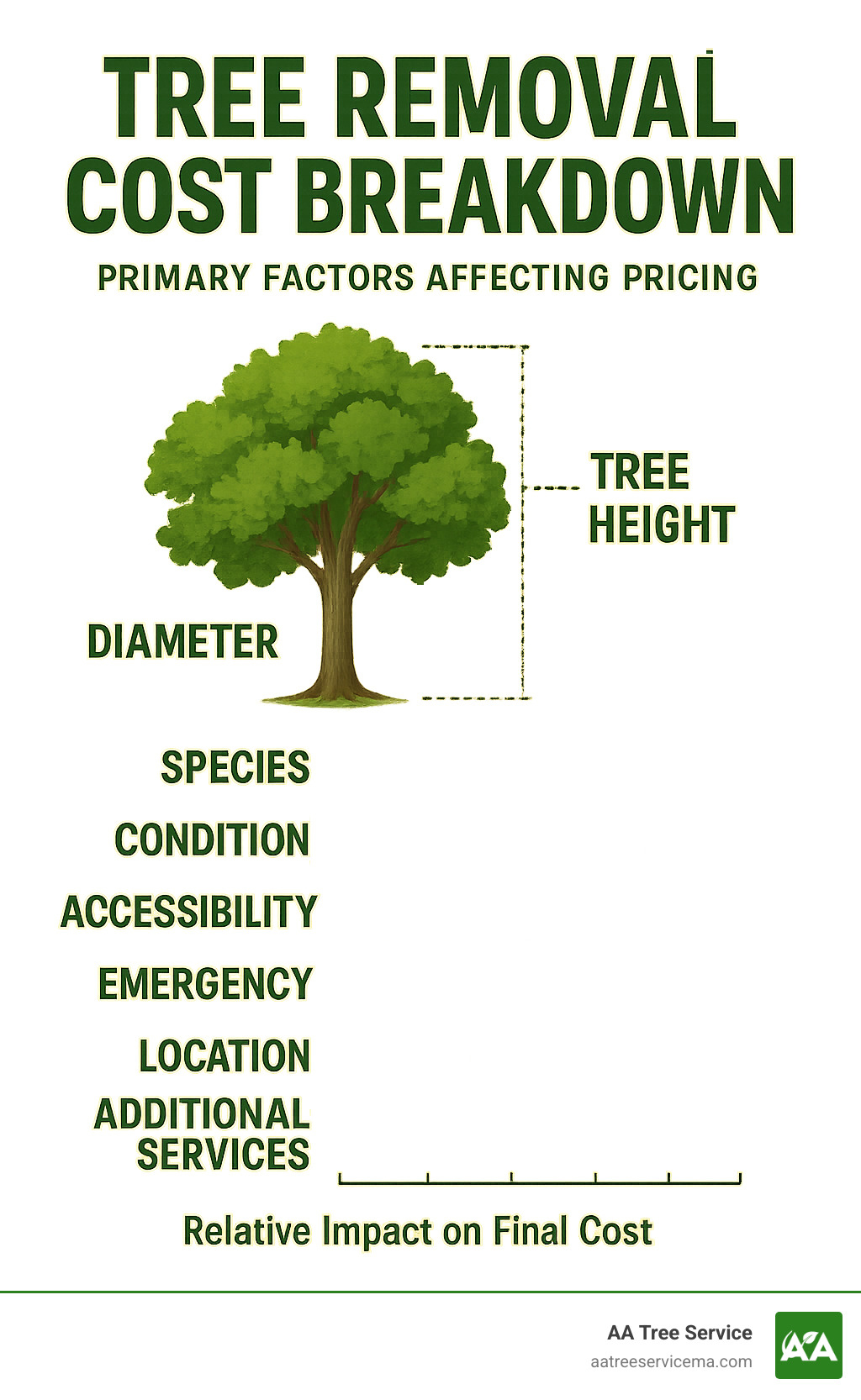
When you’re staring up at that towering maple in your backyard, wondering what it might cost to remove, several key factors will determine your final bill. Let’s explore what actually goes into your tree removal cost estimate so you can better understand why prices can vary so dramatically from one job to another.
Tree size & diameter impact on your “Tree removal cost estimate”
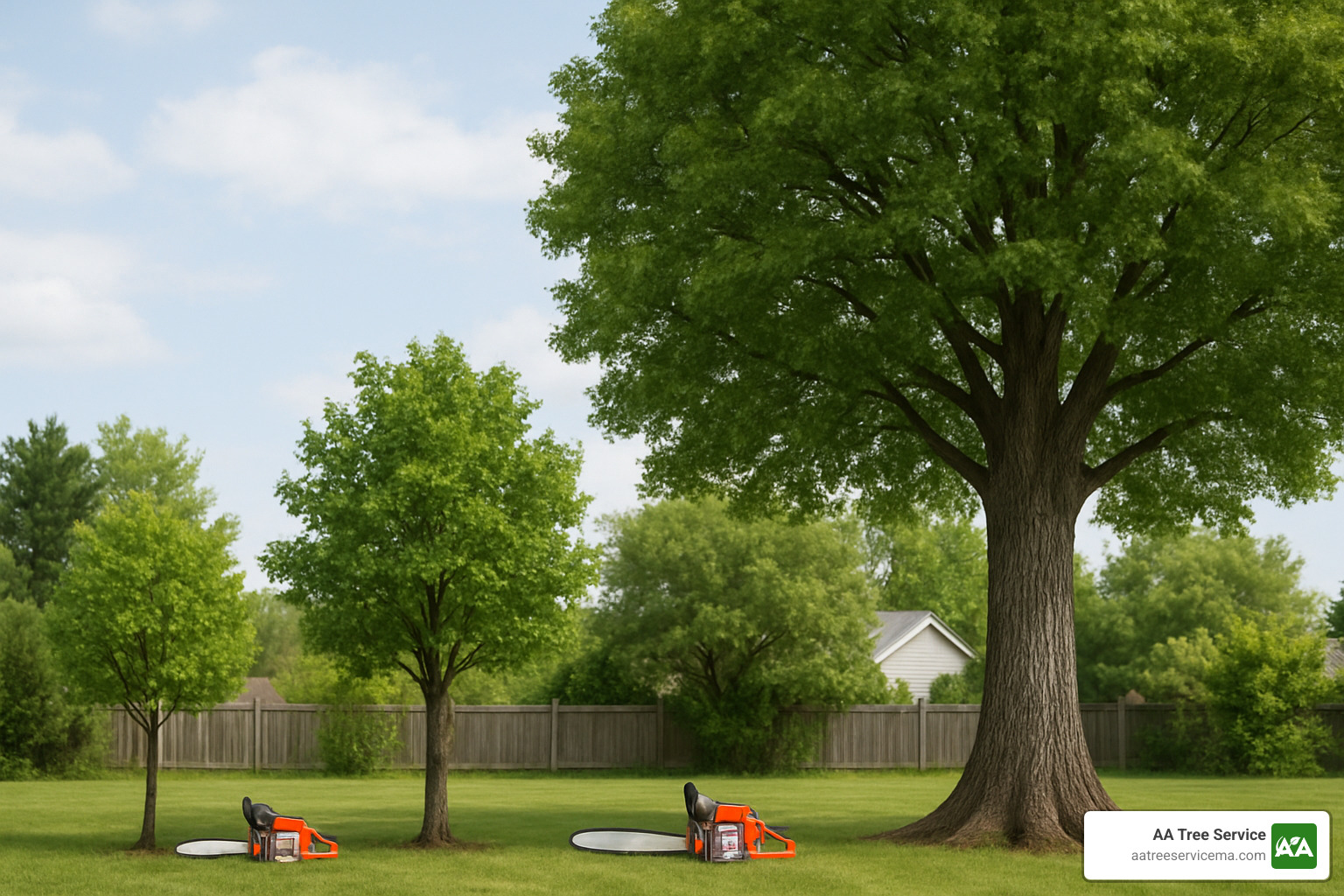
Size matters—a lot—when it comes to your tree removal cost estimate. That 100-foot pine will naturally cost more than the ornamental cherry by your driveway, but it’s not just about height.
Think of tree removal like a three-dimensional puzzle. Taller trees require more labor hours, more careful planning, and often specialized equipment. Many tree services charge roughly $9.50-$14.50 per foot of height, which quickly adds up for towering specimens.
But don’t forget about trunk diameter. A thick trunk takes significantly longer to cut through, section by section. Sometimes a shorter tree with an exceptionally wide trunk can actually cost more than a taller, slimmer tree because of the sheer volume of wood that needs processing.
When trees reach the 80-foot mark and beyond, cranes often become necessary—adding approximately $500 for the equipment and extra crew members. These massive removals typically range from $1,500 to $3,000, though particularly challenging cases can reach $5,000 or more. The extra expense isn’t just for show—it’s about safely managing tons of wood that could otherwise cause serious damage.
Healthy vs diseased, dead, or fallen trees
The tree’s condition plays a fascinating role in removal costs. Contrary to what you might think, a healthy tree isn’t always the most expensive to remove.
Healthy trees have predictable wood density and structure—arborists know exactly how they’ll behave when cut. While their weight and strength require more labor, the predictability can make the job safer.
Diseased or dying trees sometimes cost less due to lighter, softer wood, but the unpredictability factor can actually drive prices higher. If disease has compromised structural integrity, special rigging systems might be needed, pushing costs into the $400-$900 range or higher.
Dead trees present their own challenges. They’re typically lighter but much more brittle and unpredictable. Branches may snap unexpectedly, and the entire structure could behave in ways that create serious safety hazards. This unpredictability often results in higher costs despite the reduced weight.
Fallen trees offer significant savings—typically one-third the cost of removing the same tree while standing. With no climbing or careful directional cutting required, prices generally range from $100-$600. However, if that tree has fallen on your house or car, costs climb quickly due to the complexity and care needed.
After major storms, emergency removal services can command premium pricing, sometimes $450-$3,000 or more, due to high demand, hazardous conditions, and the immediate nature of the work.
Location, permits, and insurance considerations
Where your tree stands might matter almost as much as how tall it is. Trees growing in open yards with easy equipment access naturally cost less than those wedged between structures or perched on steep slopes.
Accessibility challenges can increase your costs by 25-50%. If heavy equipment can’t reach the tree, workers may need to carry gear in by hand or use more labor-intensive techniques. That perfect spot for shade unfortunately often means imperfect conditions for removal.
Proximity to structures requires extra precautions too. Trees near homes, garages, fences, or power lines need precise dismantling techniques to prevent property damage. Each cut must be planned and often controlled with ropes—a time-consuming process that increases labor costs.
Permit requirements vary across Massachusetts and New Hampshire municipalities, but many require permits for removing trees over a certain size (typically 10 feet). These permits generally cost between $60-$150 per tree. Some historic districts or conservation areas have additional restrictions that can affect both permissions and costs.
Insurance considerations are often overlooked until it’s too late. Most homeowners insurance policies don’t cover preventative tree removal, but they may cover removal if a tree falls due to a covered peril like a windstorm. It’s always worth checking your policy before you need it.
According to research from ISA Certified Arborists, professional assessment of these factors is crucial for both accurate estimates and safe removal procedures. Professional certification ensures your arborist has the knowledge to evaluate these complex variables.
For answers to more common questions about tree removal costs and processes, you can explore our detailed FAQs page.
Price Ranges by Tree Size, Condition, and Species
Understanding how tree characteristics affect pricing can help you develop reasonable expectations for your project. Here’s a breakdown of typical costs based on tree size, condition, and species.
Typical costs to remove small, medium, and large trees
Small Trees (up to 30 feet)
– Price Range: $150-$700
– Labor Hours: Typically 1-4 hours
– Examples: Dogwood, crabapple, fruit trees, small ornamental trees
– Notes: While these are the least expensive removals, costs can still vary based on accessibility and complexity. Stump removal is usually extra.
Medium Trees (30-60 feet)
– Price Range: $450-$1,500
– Labor Hours: Typically 4-8 hours
– Examples: Mature maple, elm, smaller oak varieties
– Notes: May require more equipment and crew members. Cleanup and disposal become more significant factors at this size.
Large Trees (60-80 feet)
– Price Range: $800-$2,000
– Labor Hours: Often a full day (8+ hours)
– Examples: Large oak, mature pine, American elm
– Notes: Often requires specialized equipment and rigging. Sectional dismantling becomes necessary, increasing labor time and complexity.
Very Large Trees (over 80 feet)
– Price Range: $1,000-$4,500
– Labor Hours: 1-2 full days
– Examples: Tall pines, mature tulip trees, large oaks
– Notes: Almost always requires crane assistance ($500-$2,000 additional). These removals are the most complex and dangerous, requiring extensive planning and specialized equipment.
These prices reflect industry averages based on internet data and not actual costs for AA Tree Service. Each job requires a customized quote based on specific circumstances.
Cost difference between standing and fallen removals
The state of the tree significantly impacts removal costs:
Standing Tree Removal
– Requires careful planning, rigging, and controlled cutting
– Full price based on size, species, and location
– Higher labor and equipment requirements
– Greater safety concerns and expertise needed
Fallen Tree Removal
– Typically costs $100-$600, about one-third the price of standing removal
– Primarily involves cutting the trunk into sections and hauling away
– Reduced safety concerns and equipment needs
– May still be expensive if the tree has fallen on structures or in difficult-to-access areas
Emergency Removal Considerations
– Trees threatening structures or safety may require immediate attention
– Emergency services can increase costs by 50-100%
– After storms, demand surges can further increase pricing
– Weekends, holidays, and after-hours service typically command premium rates
As one tree service professional noted, “A fallen upright tree eliminates most safety hazards, lowering the cost significantly. However, if it’s fallen onto a structure or tangled in power lines, the complexity and cost can quickly escalate.”
Add-On Services & Ways to Save Money
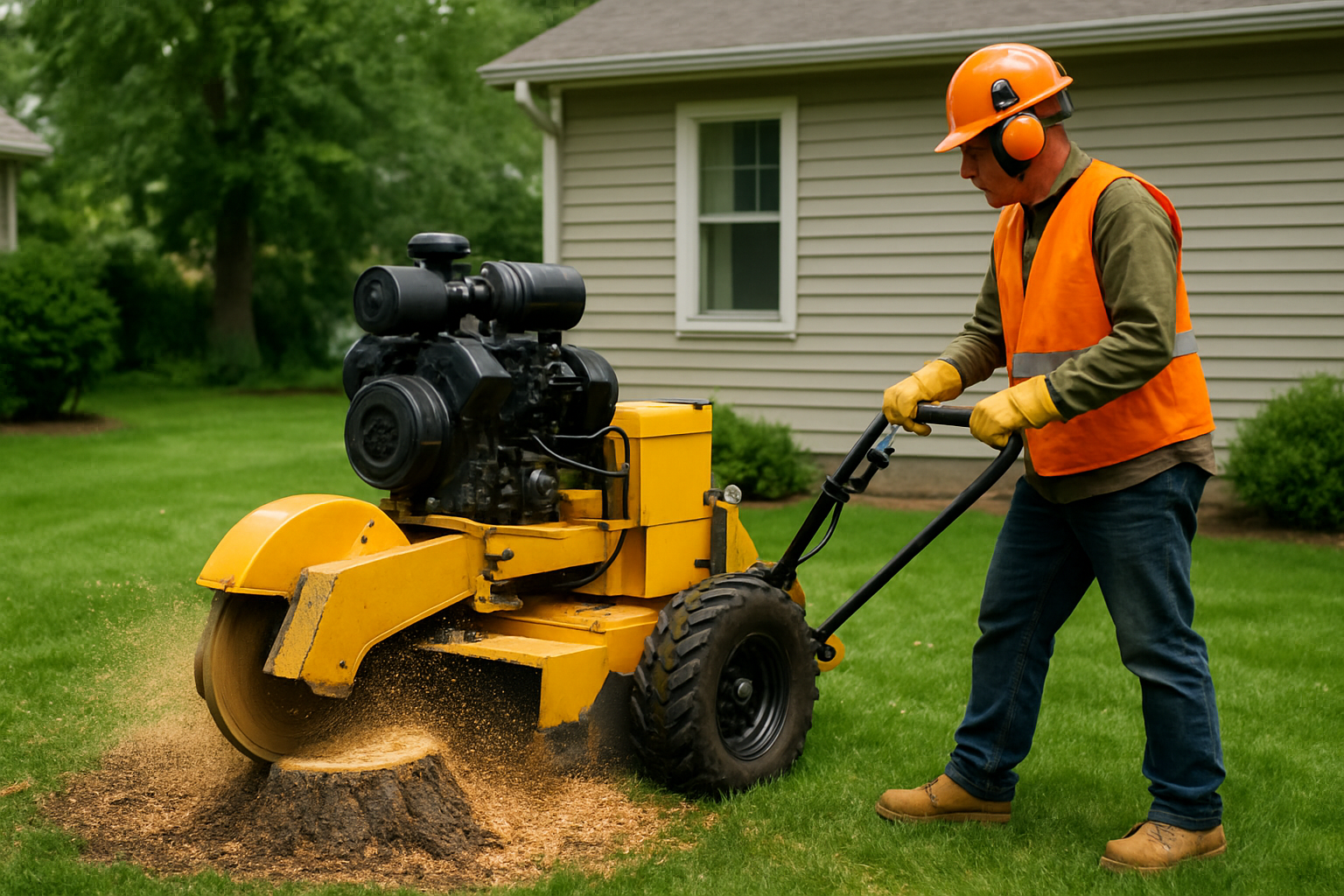
When planning your tree removal project, it’s worth knowing about the extra services that might benefit your property—and the smart ways you can keep costs manageable. Let’s look at what goes beyond basic tree cutting and how to make the most of your budget.
Stump removal and grinding costs
That leftover stump might seem like a minor issue compared to the towering tree that once stood there, but many homeowners are surprised to find that stump removal isn’t typically included in your basic tree removal cost estimate.
Stump grinding—the most common removal method—uses specialized equipment to chew the stump down to below ground level, usually 4-6 inches deep. This service generally costs between $100-$500 per stump, with the average homeowner paying around $250. The price varies mostly based on the stump’s diameter, with many companies charging by the inch.
If you’re looking for complete stump removal instead, which extracts the entire stump and major root system, expect to pay between $250-$500 per stump. This method is more labor-intensive but leaves your yard ready for new landscaping or construction.
“Many homeowners don’t realize how extensive tree roots can be,” explains one tree service professional. “They can spread two to three times wider than the canopy above ground.”
Good news if you have multiple stumps to remove: most companies offer significant discounts on additional stumps during the same service call. You’ll typically pay full price for the first stump but 25-50% less for each additional one—making it economical to tackle all your stumps at once.
For more information about affordable options in Massachusetts and New Hampshire, visit our Affordable Stump Grinding page.
DIY vs Hiring a Pro: Equipment, Safety, and Insurance
The temptation to save money by removing trees yourself is understandable, but before firing up that chainsaw, consider the full picture.
DIY tree removal comes with significant equipment costs. Between chainsaw purchase or rental ($50-$300), safety equipment ($75-$150), climbing gear ($100-$300), ropes ($50-$150), debris removal transportation ($50-$100/day), and possibly stump grinder rental ($75-$250/day), you’re looking at $400-$1,250 in equipment alone—not counting your time and effort.
Beyond the financial considerations, there’s the crucial matter of safety. Tree removal consistently ranks among the most dangerous DIY projects homeowners attempt. Even professional arborists with years of training face significant risks—trees don’t always fall as predicted, and working at heights with powerful equipment creates numerous hazards.
Professional tree services offer several advantages that DIY simply can’t match:
Professional liability insurance protects your property if something goes wrong. Your homeowner’s insurance might not cover DIY accidents, leaving you financially exposed if a tree damages your home or a neighbor’s property.
Workers’ compensation insurance means you’re not liable if someone gets injured during the removal process. Professional-grade equipment and expertise allow for safer, more efficient removal. And the proper disposal of debris saves you multiple trips to the dump.
“What might take a homeowner an entire weekend can often be completed by professionals in just a few hours,” notes one industry expert.
That said, DIY might make sense for very small trees (under 20 feet) that have already fallen and are away from structures and power lines—but only if you have proper equipment and experience.
Looking to save money while still hiring professionals? Consider these smart approaches: Schedule during winter months when many companies offer seasonal discounts (often around 10%), remove multiple trees at once to qualify for volume pricing, clear access obstacles yourself before crews arrive, or keep the wood for firewood to reduce hauling costs.
For professional tree removal services that prioritize safety and efficiency, visit our Tree Removal Service page.
Regional Insight: Massachusetts & New Hampshire Specifics
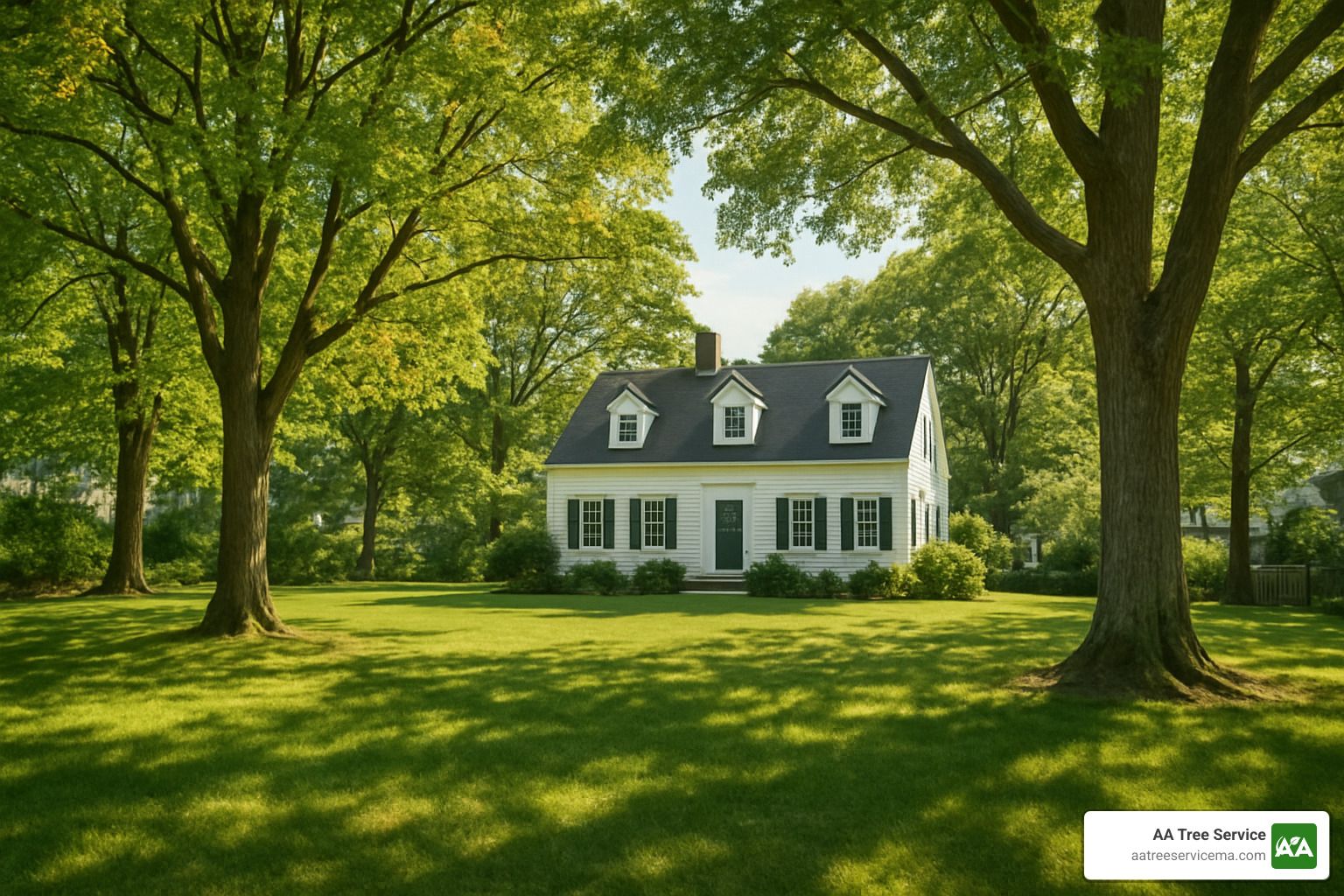
When you’re looking for a tree removal cost estimate in New England, you’ll quickly find that Massachusetts and New Hampshire have their own unique characteristics that influence pricing. The picturesque landscapes that make our region so beautiful also create specific challenges for tree removal professionals.
New England’s labor rates tend to run about 15-20% higher than the national average, which directly impacts service costs. Our region is famous for its towering white pines, especially in New Hampshire, where these giants can reach heights of 100+ feet. These magnificent trees require specialized equipment and techniques for safe removal, adding to the overall cost.
Winter in New England presents both challenges and opportunities. While snow and ice can complicate access, the frozen ground actually provides better support for heavy equipment, often making winter removals more efficient. Many local companies, including AA Tree Service, may offer winter discounts of 5-10% during this traditionally slower season.
“The best time to remove a tree in New England is often January through March,” notes one local arborist. “The frozen ground means less lawn damage from equipment, and bare branches make assessment and cutting much more straightforward.”
Permit requirements and average fees in MA & NH
Navigating local regulations is an important part of the tree removal process in New England. Massachusetts tends to have more stringent requirements than New Hampshire, particularly in densely populated areas.
In Massachusetts, many towns require permits for removing trees over 10-12 inches in diameter, with fees typically ranging from $75-$150. Boston and its surrounding communities often have stricter regulations, especially for street trees or those in historic districts. Towns like Cambridge and Brookline have specific “heritage tree” designations that may prohibit removal of historically significant specimens altogether.
New Hampshire’s approach is generally more relaxed, particularly in rural areas, with permit fees averaging $60-$125. However, if your property falls within shoreland protection zones, you’ll face additional regulations designed to prevent erosion and protect water quality. Urban areas like Manchester and Nashua maintain stricter oversight similar to their Massachusetts counterparts.
Both states typically require basic documentation including application forms detailing the tree’s location, size, and reason for removal. In some cases, you may need site plans or property surveys, particularly for trees near property lines. For diseased or hazardous trees, an arborist inspection report may be required to justify removal.
According to research on canopy heights, New England features some of the tallest deciduous forest canopies in the eastern United States, with mature forests averaging 66-82 feet. This regional characteristic explains why our local tree removals often involve larger specimens requiring more complex strategies.
Using local tools to refine your “Tree removal cost estimate”
Getting an accurate tree removal cost estimate in Massachusetts or New Hampshire requires understanding both the general pricing factors and our region’s specific considerations.
Many online calculators allow you to enter your ZIP code for location-specific estimates that account for regional labor rates and typical tree species. While these tools provide helpful ballpark figures, they’re no substitute for a professional on-site assessment. The same tree removed in downtown Boston might cost 30-40% more than in rural New Hampshire simply due to access challenges and municipal regulations.
Bundled service quotes are particularly valuable in New England, where winter storms often damage multiple trees. Local companies frequently offer volume discounts of 10-30% when removing several trees at once. This approach not only saves money but also minimizes disruption to your property.
Seasonal timing can significantly impact your costs. Winter removals often come with discounts around 10% due to better equipment access on frozen ground. Spring and summer typically see higher demand and prices as homeowners prepare for outdoor activities. Fall provides excellent visibility after leaf drop, making tree assessment more accurate.
The dense historic neighborhoods common throughout Massachusetts present unique access challenges. Narrow streets, limited parking, and close proximity to neighboring structures often necessitate specialized equipment and techniques. Rural New Hampshire properties may incur travel surcharges but typically offer better equipment access.
Snow and ice considerations are part of winter work in New England. While frozen ground helps with equipment stability, heavy snow can complicate access and increase labor time. Many companies factor these seasonal challenges into their winter pricing structure.
For a free, personalized quote specific to your property in Massachusetts or New Hampshire, visit our Free Estimates Tree Removal page. Our team understands the unique challenges of New England properties and can provide same-day estimates custom to your specific situation.
Frequently Asked Questions about Tree Removal Costs
How long does a typical removal take?
Ever wonder why the crew next door seemed to be working on that one tree all day? Tree removal timing varies dramatically depending on what they’re dealing with.
For small trees under 30 feet, most professionals can wrap things up in 1-4 hours, including the basic cleanup. Your medium-sized trees (30-60 feet) usually require 4-8 hours of work, while those large 60-80 footers typically need a full day’s effort. When you’re looking at those towering specimens over 80 feet, be prepared for a 1-2 day project, especially when crane work enters the picture.
Of course, the clock can tick longer when your tree hugs close to your house or power lines. Poor access to your backyard, nasty weather conditions, or a smaller crew can all stretch the timeline too. And if you’re adding stump grinding to your tree removal cost estimate, factor in another 1-2 hours.
I remember talking with an experienced arborist who put it perfectly: “What homeowners see as a quick morning job can turn into an all-day affair when we find that beautiful maple is actually hollow inside or has roots wrapped around the gas line. There’s often more complexity than meets the eye.”
Does homeowners insurance cover tree removal?
The answer here isn’t as straightforward as we’d all like. When it comes to your insurance covering tree removal cost estimates, timing and circumstances matter tremendously.
Preventative removal – taking down that leaning tree before it falls – typically comes straight from your pocket. Insurance companies generally don’t pay for “might happen” scenarios, no matter how obvious the risk seems to you.
However, if that oak comes crashing down during a windstorm, lightning strike, or fire, your policy might have your back. Many policies cover removal when trees fall due to these “covered perils,” especially when they damage your home, garage, fence, or other insured structures.
Before you get too excited about that coverage, know that most policies cap tree removal benefits at $500-$1,000 per tree. Your deductible still applies, and some basic policies only cover removal when the tree actually damages a structure – not when it merely blocks your driveway.
Smart homeowners take plenty of “before” photos and keep all receipts if they need to file a claim. Even smarter ones review their specific policy details before storm season, since coverage varies wildly between companies and policy types.
Should I remove a tree close to my house?
That magnificent maple near your bedroom window might provide wonderful shade, but is it a ticking time bomb? Whether to remove a tree near your home isn’t always an easy call.
Generally speaking, trees within 15-20 feet of your foundation warrant regular professional evaluation, especially larger species with extensive root systems. When considering your tree removal cost estimate versus the risk of keeping it, several factors should influence your decision.
First, assess the tree’s health. Visible decay, large dead branches, hollow areas, trunk cracks, or fungal growth all suggest potential problems. Watch for soil heaving on one side or extensive root damage from recent construction – these are red flags that shouldn’t be ignored.
The species matters too – some trees have naturally more aggressive root systems that can damage foundations or plumbing. And that slight lean might not be problematic now, but if it’s angling toward your roof, the risk increases with every passing year.
Before rushing to removal, consider alternatives for healthy specimens. Regular professional pruning can maintain safe clearance from your roof, while cable or bracing systems might save structurally valuable trees. For certain species, root barriers can prevent foundation issues while preserving the tree.
As one client in Lexington, MA told us after postponing removal of a concerning oak: “I saved $1,200 on removal, but ended up with $14,000 in roof damage after that November nor’easter. I should have listened to your arborist.” The cost of preventative removal almost always pales compared to repairing damage from a fallen tree.
For a free, no-obligation assessment of trees near your home, our certified arborists can help you make the right call for your property’s safety and your peace of mind.
Conclusion
When it comes to removing trees from your property, understanding the costs involved helps you plan and budget effectively. While national averages give you a starting point, your tree removal cost estimate will be uniquely yours – based on your specific tree, property, and location.
In Massachusetts and New Hampshire, we face distinct regional factors that affect pricing. Our New England winters create both challenges and opportunities (frozen ground can actually make some removals easier and less expensive). Our mature forests often contain larger specimens than other parts of the country, and our mix of urban and rural settings creates varying accessibility scenarios.
At AA Tree Service, we’ve spent over 20 years helping homeowners throughout Massachusetts and New Hampshire steer these considerations. We’ve seen how each property presents its own unique situation – from the historic neighborhoods of Boston with their tight spaces and permit requirements to the expansive rural properties of New Hampshire with their tall pines and challenging terrain.
What we’ve learned is that providing truly personalized service matters most. When a storm damages your beloved maple at 2 AM, you need more than just a service provider – you need a partner who understands the urgency and responds quickly. That’s why we offer 24/7 emergency services for those situations that simply can’t wait.
We believe in transparent pricing, which is why we provide free same-day quotes. Our experienced estimators carefully evaluate all factors affecting your specific project – from tree size and species to location challenges and seasonal considerations. This thorough approach ensures you receive an accurate tree removal cost estimate without surprises.
While DIY removal might seem tempting for smaller trees, we’ve unfortunately seen the aftermath of projects gone wrong. Professional removal provides invaluable peace of mind, protecting both your property and your personal safety. The investment in professional service typically pays for itself in risk reduction alone.
For homeowners throughout our service area, we’re here to help with comprehensive tree care solutions delivered by insured, experienced crews who treat your property with respect. Our commitment to customer satisfaction shows in everything we do – from our careful planning to our thorough cleanup.
Ready to get a clear picture of what your specific tree removal will cost? We invite you to contact us for a free, no-obligation quote custom to your unique situation. Our experts will walk your property, assess all relevant factors, and provide a detailed tree removal cost estimate that helps you make an informed decision.
Understanding what drives tree removal pricing empowers you to make choices that balance cost considerations with safety and property protection – and we’re here to guide you through every step of the process.