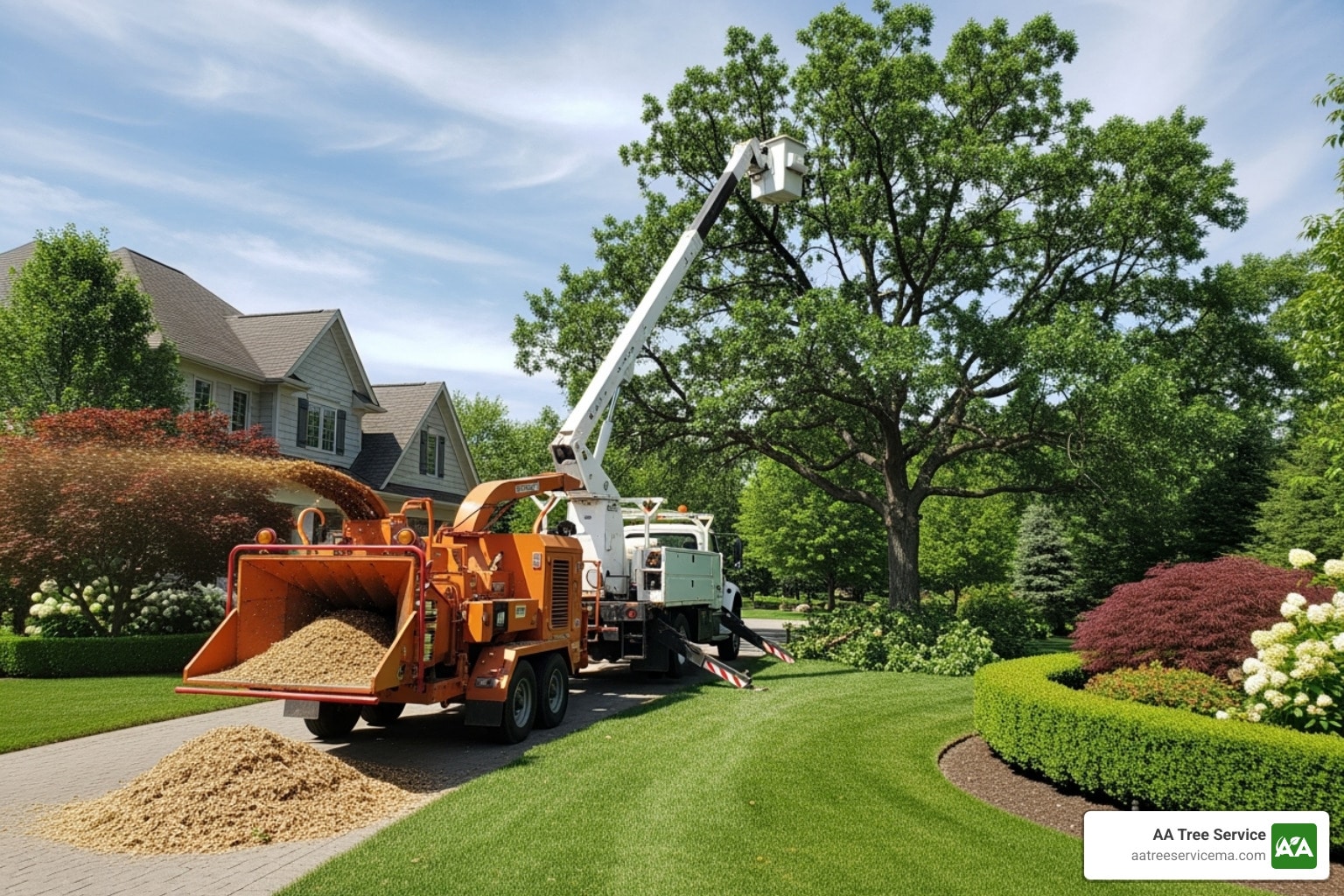
Why Tree Removal and Pruning Regulations Matter
Tree removal and pruning are essential property maintenance services governed by strict local regulations in Massachusetts and New Hampshire. These rules are designed to protect public safety, preserve community aesthetics, and maintain environmental health. Understanding them before starting work can save you from costly fines and legal issues.
Key differences and requirements:
- Tree removal: Complete elimination of a tree from your property.
- Tree pruning: Selective cutting of branches to improve tree health.
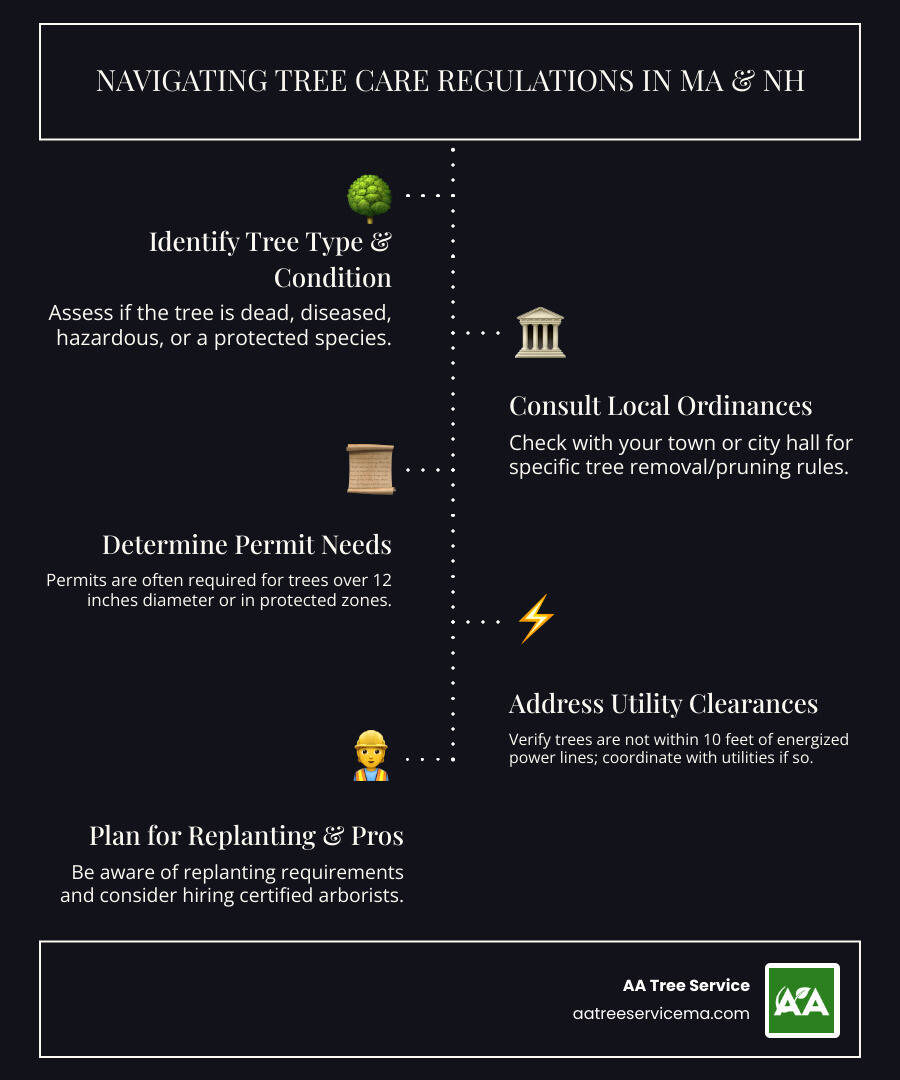
- Permits: Often required for trees over 12 inches in diameter.
- Utility clearance: May be mandated for trees within 10 feet of power lines.
- Replanting: Frequently applies when removing protected trees.
Many homeowners don’t realize that removing even one tree can require a permit. These regulations exist to protect public infrastructure and neighborhood character. Whether you’re dealing with a storm-damaged tree or planning routine pruning, knowing the rules upfront helps you make informed decisions and avoid project delays or penalties. Once you understand the basic framework, navigating tree care regulations becomes much more manageable.
Tree removal and pruning definitions:
The What and Why: Defining Tree Care and Its Importance
Tree maintenance is a smart investment in your property’s long-term health, safety, and value. Proactive tree care boosts curb appeal, keeps your family safe, and can increase property value. Healthy trees provide shade, clean the air, and offer homes for wildlife. Regular care also helps you spot potential hazards before they become major problems.
While we aim to keep trees healthy, sometimes intervention is needed. To learn more, explore our full range of tree care services.
Reasons for Complete Tree Removal
Tree removal is a complex job that we consider a last resort. Here are key reasons a tree might need to be removed:
- Dead or Dying Trees: A dead or dying tree is a safety hazard. Signs include missing leaves, discolored foliage, and brittle branches.
- Diseased Trees: Some serious diseases are untreatable and can make a tree unsafe. Look for fungal growths or insect infestations. Dead limbs can spread decay to the rest of the tree.
- Storm Damage: Severe weather can cause large broken limbs, a split trunk, or uprooting, making a tree an immediate hazard. We offer Storm Damaged Tree Removal for these emergencies.
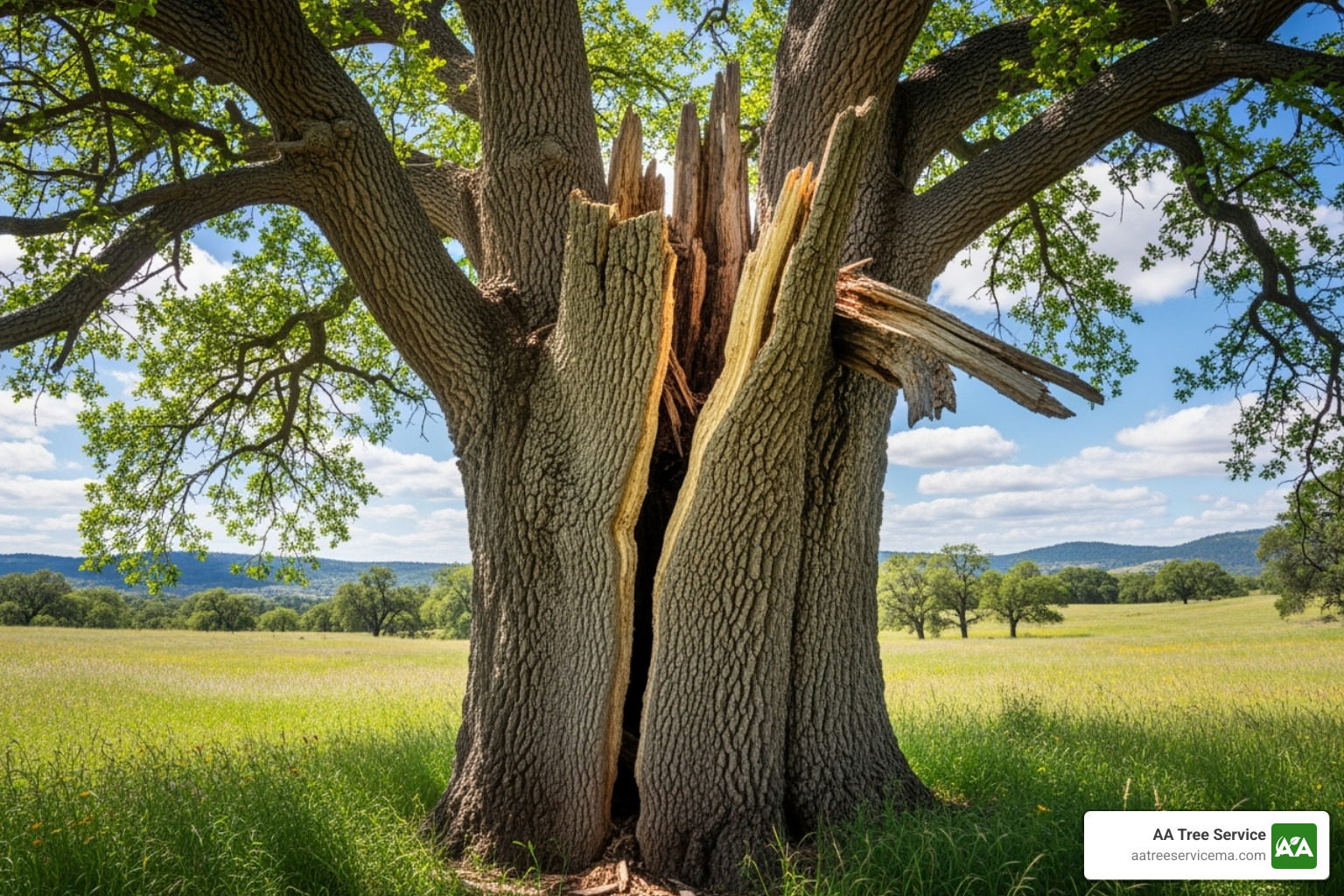
- Structural Instability: Large cracks, hollow spots, or a sudden lean are red flags that a tree might be unstable and could fall.
- Root Damage to Property: Tree roots can damage foundations, sidewalks, driveways, and underground utility lines, sometimes making removal the only solution.
- Obstructing Construction: A tree may need to be removed to make space for a new addition or landscaping project.
- Poor Location: A tree planted too close to a house, power lines, or other structures can become a safety risk as it grows. A professional Tree Hazard Assessment can determine if your tree is a hazard.
The Benefits of Proper Tree Pruning and Trimming
Unlike removal, tree pruning makes a tree healthier, stronger, and more beautiful. While “trimming” often refers to shaping for aesthetics, “pruning” involves strategic cuts to improve a tree’s health and safety.
Here’s how proper tree pruning and trimming benefits your property:
- Promoting Healthy Growth: Removing dead or diseased branches allows the tree to focus energy on healthy growth, promoting vitality and longevity.
- Improving Tree Structure: Proper pruning, especially on young trees, creates a strong trunk and well-spaced branches, making the tree more resilient to storms.
- Increasing Sunlight and Air Circulation: Thinning the canopy lets more sunlight reach the ground and improves air flow, which helps prevent fungal diseases.
- Enhancing Fruit Production: Strategic pruning can lead to a larger, higher-quality fruit yield.
- Removing Hazardous Branches: Pruning eliminates dead wood and weak branches that could fall and cause injury or damage.
- Aesthetic Improvement: A well-pruned tree has a better shape and improves your home’s curb appeal. We can also perform Tree Crown Reduction to manage size while maintaining health.
- Clearance: Pruning creates necessary space for buildings, vehicles, pedestrians, and utility lines.
Regular tree pruning and trimming is essential for the well-being of your trees and property.

Navigating Local Tree Removal and Pruning Regulations
Understanding local rules for tree removal and pruning is crucial. Regulations in Massachusetts and New Hampshire exist to keep people safe, protect the environment, and maintain community aesthetics. Many towns have specific guidelines to preserve the local tree canopy.
Your first step for any tree work should be to contact your local town or city hall. Each municipality has its own set of rules, and what’s allowed in one town might require a permit in another. Getting this information upfront can prevent fines and other headaches.
A critical rule involves utility lines. Utility companies often consider a tree a hazard if it’s within 10 feet of an energized power line. This is a key safety measure to prevent outages and ensure electrical safety.
Do You Need a Permit?
The most common question about tree removal or pruning is whether a permit is needed. The answer depends on several factors:
- Tree Diameter Rules: Many towns in Massachusetts and New Hampshire require a permit if a tree’s diameter exceeds a certain size.
- Protected or Historic Trees: Trees protected for their age, species, or historical significance almost always require a permit for any work, often involving a thorough review.
- Proximity to Public Property: A tree on your property but near a public street or park may be subject to town oversight, especially if it’s in a public right-of-way.
- Conservation Areas or Wetlands: Properties in or near environmentally sensitive zones have much stricter tree ordinances, and work requires special permission.
- Replanting Requirements: A permit to remove a tree may come with the condition that you plant a new one in its place to maintain the community’s green canopy.
To know for sure, contact your local municipal office, such as the Public Works Department, Conservation Commission, or Planning Department.
Understanding Utility Company Easements
Trees and power lines require careful management to prevent public safety hazards and power outages. Utility companies have “easements” that grant them the right to manage vegetation near their equipment.
- Power Lines: Trees growing too close to power lines are a major risk for accidents and fires.
- Public Safety Hazard: A dead, diseased, or unstable tree near power lines is an immediate threat.
- Preventing Outages: Tree branches touching power lines are a leading cause of outages, which is why utilities perform routine trimming.
- Professional Line Clearance: NEVER attempt to prune or remove a tree near power lines yourself. This is extremely dangerous. Only utility companies or their authorized contractors are trained and equipped for this work.
- Homeowner vs. Utility Responsibility: The utility company is typically responsible for clearing main power lines. However, the homeowner is usually responsible for trees threatening the “service drop” (the line from the pole to your house). If you suspect a tree is a danger to any power line, call the utility company first.
The Homeowner’s Decision: Timing, Costs, and DIY Dangers
When it comes to tree removal and pruning, making informed decisions is key. This means understanding the best time for tree work, budgeting for professional services, and assessing the real risks of DIY attempts. Your trees are valuable living assets that deserve careful planning.
When Is the Best Time for Tree Work?
Properly timing your tree work can make a significant difference in a tree’s recovery. The dormant season—late fall through winter—is often the best time for most major pruning.
During these cooler months, arborists can clearly see the tree’s structure without leaves, making it easier to spot problem areas. Trees experience less stress when dormant, allowing them to heal cuts more effectively. Dormant pruning can also help with disease management, as many pests and diseases are inactive in the cold. Plus, there’s no leaf cleanup.
However, emergency situations don’t wait for the perfect season. A storm-damaged tree threatening your home requires immediate attention, regardless of the calendar. Safety always comes first. Generally, it’s best to avoid heavy pruning during the spring growth flush or in the fall when trees are preparing for winter.
How Tree Service Costs Are Determined
The cost of tree removal and pruning varies widely, which is why we provide free, on-site estimates rather than quoting over the phone.
Tree removal in Massachusetts and New Hampshire can range from $300 to $3,000 or more depending on complexity, with some large or hazardous removals exceeding $5,000. These are average costs based on internet data and not actual costs for AA Tree Service.
| Cost Factor | Description | Impact on Cost |
|---|---|---|
| Tree Size and Height | Taller and wider trees require more time, specialized equipment (like cranes or bucket trucks), and a larger crew. | Small trees (up to ~30 feet) might average $350-$700+. Large trees (60-120 feet) could range from $1,600-$3,700+, and exceptionally large or complex trees can exceed $5,000. |
| Accessibility | How easy is it for equipment and crew to reach the tree? Obstructions like fences, sheds, or narrow passages increase complexity and labor. | Easy access generally means lower cost. If a crane or specific rigging is needed due to tight spaces (e.g., tree between houses), costs will rise. |
| Tree Condition and Risk Level | Is the tree healthy, dead, diseased, or storm-damaged? Proximity to structures, power lines, or high-traffic areas increases complexity. | Hazardous trees require extra precautions and specialized techniques. Emergency tree removal may incur higher costs due to urgency and increased risk. |
| Equipment Needed | Whether the job can be done with standard equipment or requires a crane, boom truck, or advanced rigging gear. | The use of heavy machinery significantly impacts the price. |
| Debris and Stump Removal | Does the quote include hauling away all wood chips and logs? Will the stump be ground down? | Debris removal and Stump Grinding are typically separate services that add to the total cost. |
Every tree situation is unique. A healthy oak in an open backyard is a different project than a storm-damaged maple leaning over a house.
The Risks of DIY Tree Removal and Pruning
While DIY projects can be satisfying, tree removal and pruning carry significant risks that far outweigh potential savings. Tree care is consistently ranked as one of the most dangerous occupations due to heavy equipment, falling debris, and working at heights.
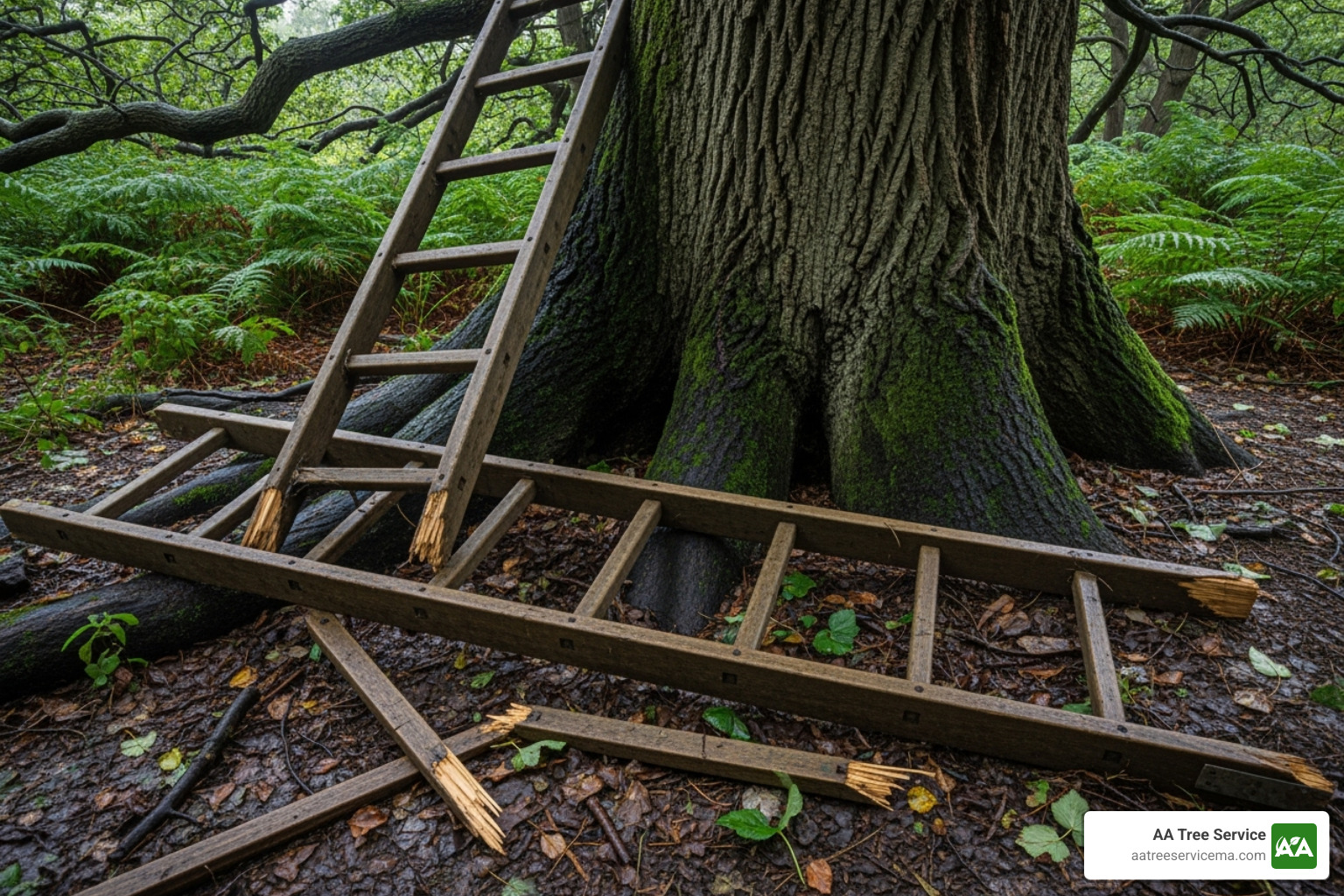
Personal injury and property damage are the top concerns. Ladder falls, chainsaw accidents, and falling branches can cause severe injuries. A miscalculation can lead to thousands of dollars in damage to your home, vehicles, or neighboring properties, which your homeowner’s insurance may not cover. You could also face significant legal and financial liability if your project injures someone or damages a neighbor’s property.
Improper cuts can harm your tree’s long-term health, leading to decay, disease, and weak regrowth. When pruning, do not remove more than 1/3 of the tree’s canopy within a pruning cycle. Practices like “topping” weaken the tree and create future hazards.
Power line electrocution is the most serious risk. Trees can conduct electricity, and the consequences are often fatal. Never attempt tree work near power lines yourself. While small pruning tasks from the ground may be manageable, any substantial work should be left to professionals.
Hiring a Professional: What to Look For
Finding the right tree service professional is essential when dealing with tree removal and pruning. You are trusting them with valuable trees and your property. Vetting companies thoroughly ensures quality work and protects you from potential disasters like accidents or property damage.
At AA Tree Service, we believe in transparency. Our Local Tree Services are built on over 20 years of experience serving Massachusetts and New Hampshire communities.
Essential Qualifications and Certifications
When interviewing tree service companies, look for several non-negotiable qualifications that act as a safety net for you and the workers.
ISA Certified Arborists are the gold standard. The International Society of Arboriculture certifies professionals who have demonstrated extensive knowledge through rigorous testing. They understand tree biology and can identify problems untrained eyes might miss. An ISA Certified Arborist is invaluable for services like Arborist Tree Removal. You can verify credentials through the Find an Arborist directory.
TCIA Accreditation from the Tree Care Industry Association is another indicator of professionalism, as it sets high standards for safety, quality, and business ethics.
State licenses in Massachusetts and New Hampshire show that a company adheres to legal requirements.
Insurance coverage is absolutely critical. A reputable service must carry comprehensive liability insurance and worker’s compensation. Liability insurance protects your property, while worker’s compensation protects you from liability if a crew member is injured. Always ask for current certificates of insurance and verify them if needed. A company that hesitates to provide proof is a major red flag.
Professional Safety Measures
Safety is reflected in how professionals approach the job. A skilled crew’s process is noticeably different.
Site assessment is the first step. Arborists inspect the area for hazards like power lines, structures, and underground utilities, and they analyze the tree’s condition to plan the work safely.
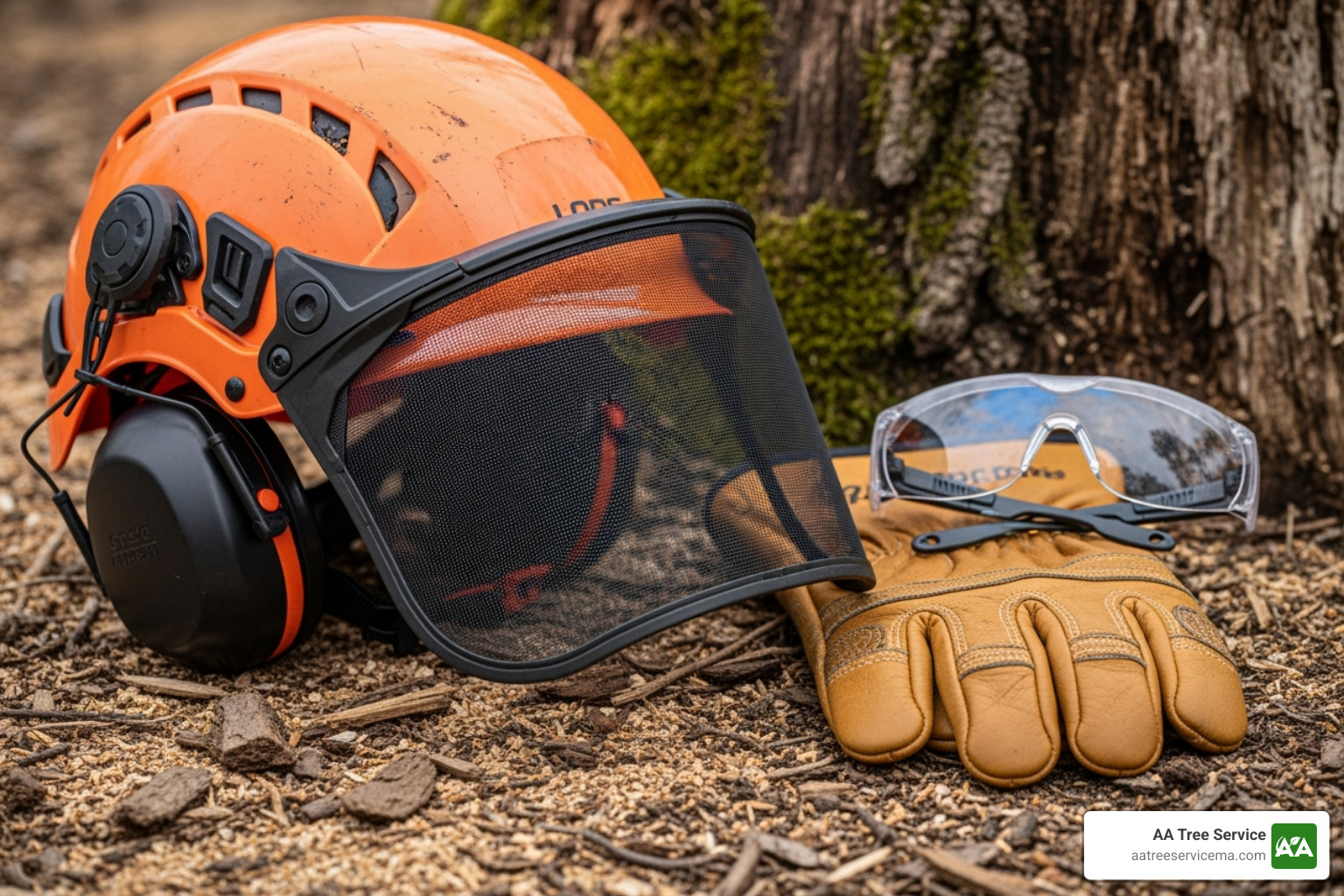
Personal Protective Equipment (PPE), including hard hats, safety glasses, and cut-resistant clothing, should be worn by every crew member. A lack of PPE is a sign of a poor safety culture.
Controlled rigging techniques are used to lower large sections with ropes and pulleys, rather than just dropping them. Every cut is planned to control where each piece falls.
Traffic control and clear work zones protect everyone on and around the property.
Equipment quality is vital for safety and results. Professionals use well-maintained chainsaws, chippers, and rigging gear that are less likely to fail.
Job site cleanup shows respect for your property. Professional crews clean up debris and leave your property looking tidy. Our Tree Debris Removal Service ensures nothing is left behind. Hiring a true professional means investing in expertise, proper equipment, insurance, and peace of mind.
Frequently Asked Questions about Tree Removal and Pruning
Over our 20+ years in business serving Massachusetts and New Hampshire, certain questions come up frequently. Here are the answers to what we hear most often.
How can I tell if my tree is a hazard?
Spotting a hazard isn’t always easy, but there are key signs to look for. Large dead branches, cracks or splits in the trunk, and mushrooms or fungal growth at the base (a sign of internal decay) are serious warnings. A tree that has recently developed a significant lean or has roots cracking a driveway is also a concern. Other signs include cavities in the trunk and visible pest infestations.
Any tree with branches near power lines requires immediate professional attention. While these signs are helpful, a professional Tree Hazard Assessment is the most reliable way to know for sure. Our certified arborists can spot hidden issues and recommend the safest course of action.
Does removing a tree stump cost extra?
Yes, stump removal or grinding is a separate service from tree removal and pruning. It is quoted as a distinct line item because it requires different equipment and processes.
We don’t recommend leaving stumps behind. They can rot and attract pests like termites, create tripping hazards, and complicate mowing and landscaping. They are also unsightly and can sprout new growth from the remaining root system.
You can request our Stump Removal Service when getting your estimate. We can explain the process and help you decide what’s best for your property.
How much of a tree can be pruned at one time?
The general rule in arboriculture is to never remove more than one-third of a tree’s living canopy in a single pruning cycle. There is solid science behind this guideline.
Trees need leaves for photosynthesis to produce energy. Removing too much of the canopy, or “over-pruning,” starves the tree and makes it vulnerable to disease, pests, and sunscald. Harmful practices like “topping” (cutting large branches to stubs) can lead to decay and weakly attached new branches that are more dangerous than the original ones.
Each cut changes how a tree grows, so strategic, limited removal is key to long-term health. When we perform tree removal and pruning, we consider the tree’s health and the time of year to avoid shocking the tree with too much removal at once.
Conclusion
Navigating tree removal and pruning can seem complex, but hopefully, you now feel more confident. We’ve covered local regulations, the benefits of professional care, and the risks of DIY attempts. Every decision about your trees impacts your property’s safety and the health of our shared environment.
Understanding the rules in Massachusetts and New Hampshire, prioritizing safety, and recognizing the value of professional tree care are essential for protecting your investment and enjoying a beautiful, safe outdoor space.
At AA Tree Service, we are your local experts in tree removal and pruning. With over 20 years of experience, we bring expertise, dedication, and a commitment to customer satisfaction to every job. We are available with 24/7 emergency services and offer free same-day quotes across Massachusetts and New Hampshire.
Ready to give your trees the care they deserve? For expert guidance on all your tree care needs, contact us for a free quote. We’re here to help.