When Tree Emergencies Strike: Recognizing the Warning Signs
Tree emergency services are specialized, 24/7 rapid-response teams dispatched for hazardous tree situations that pose an immediate threat to safety or property. Unlike scheduled tree work, these services are designed to address crises as they happen, often in the midst of severe weather and under dangerous conditions. The goal is to mitigate the immediate danger, secure the area, and prevent further damage. Here’s a more detailed look at when to make that critical call:
Immediate Emergency Situations:
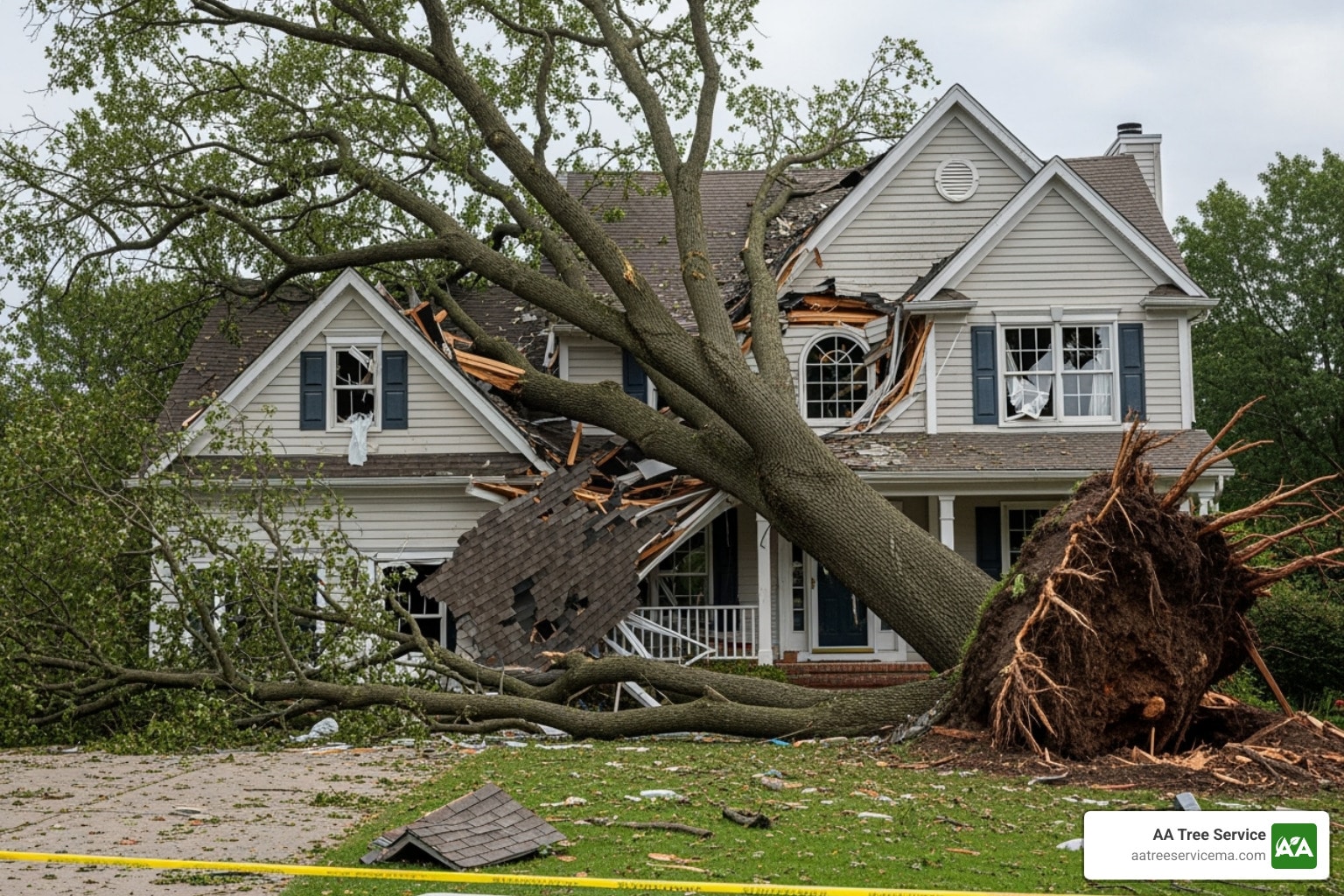
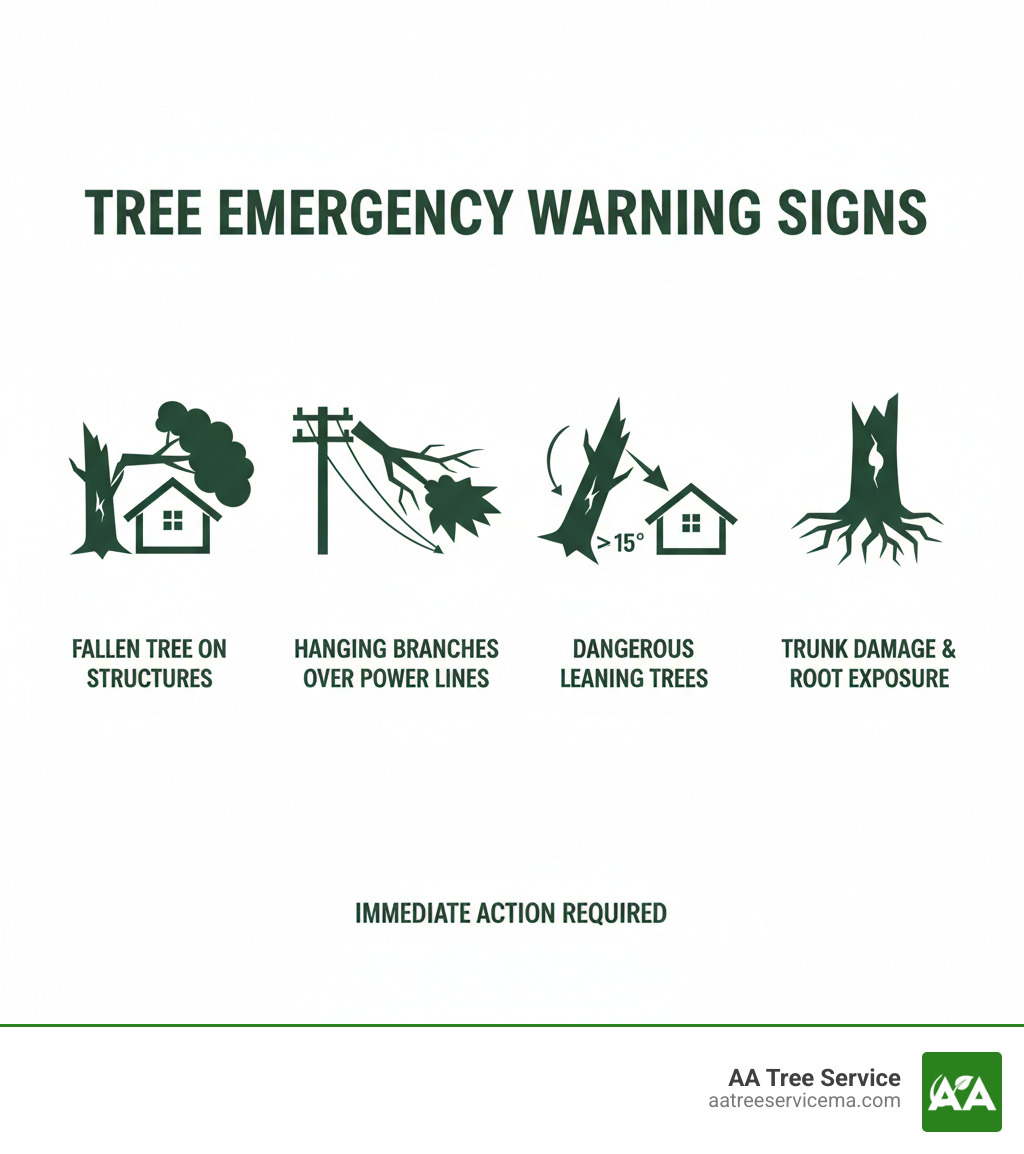
- Tree fallen on your home, car, or power lines: This is the most urgent scenario. A tree’s immense weight can cause catastrophic structural failure to a roof or vehicle. If power lines are involved, it creates a live, high-voltage hazard zone that can be lethal. Never approach a tree entangled with electrical wires.
- Large branches hanging dangerously over structures: Often called “widow-makers,” these are limbs that have cracked or broken but are still lodged in the tree. They are extremely unstable and can fall without warning from a gust of wind or a slight shift in weight, posing a deadly risk to anyone or anything below.
- Tree leaning at an unsafe angle (over 15 degrees): A sudden or progressive lean, especially when accompanied by heaving soil or exposed roots on the opposite side, is a red alert for root failure. The tree’s entire support system is compromised, and a complete collapse could be imminent.
- Storm-damaged trees threatening to fall: After a storm with high winds, heavy snow, or ice, a tree may have a split trunk, deep cracks, or be partially uprooted. Even if it’s still standing, its structural integrity may be critically weakened, making it a ticking time bomb.
- Trees blocking roads or emergency access: A fallen tree across a driveway, private road, or public street is more than an inconvenience; it’s a public safety hazard that can prevent emergency vehicles like ambulances and fire trucks from reaching people in need.
Common Causes of Tree Failure:
- Severe weather: New England Nor’easters, summer thunderstorms with high winds, and heavy, wet snow or ice storms are primary culprits. Wind acts like a sail on a tree’s canopy, while ice can add thousands of pounds of weight, exceeding the load a branch or trunk can bear.
- Root damage: Often invisible, this can be caused by recent construction, trenching, soil compaction from heavy equipment, or poor drainage leading to root rot. Damaged roots can no longer anchor the tree effectively.
- Disease, pest infestations, or fungal growth: Insects like the emerald ash borer can kill a tree from the inside out, while fungal diseases can decay wood, creating hollows and weak points. By the time significant external signs appear, the tree may already be dangerously unstable.
- Dead or weakened branches: As a tree ages, it naturally sheds some branches. However, large, dead limbs that remain in the canopy are brittle and can snap off easily.
When these situations happen in Massachusetts or New Hampshire, you need fast, professional help. The key is knowing when a tree problem becomes an emergency. Quick action is needed when a tree poses an immediate risk to structures, power lines, or people. Attempting DIY removal is extremely dangerous and can result in serious injury, electrocution, or further property damage. Understanding what constitutes a true emergency can protect your family and property when severe weather strikes and prevent a manageable situation from becoming a costly disaster.
Quick tree emergency services terms:
Identifying a Tree Emergency: When to Make the Call
A tree situation becomes an emergency when it poses an immediate danger to people, property, or power lines. It can be overwhelming to face a potentially dangerous tree, but understanding the specific warning signs will empower you to make a timely call for professional help, preventing a potential catastrophe. A tree that looks healthy from a distance can harbor hidden dangers that only become apparent upon closer inspection or during a storm.
For homeowners who’ve recently experienced severe weather, our guides on Storm Damaged Tree Removal and Tree Removal After Storm offer additional resources.
A Deeper Look at Common Causes of Tree Emergencies
After 20 years of responding to tree emergency services calls in Massachusetts and New Hampshire, we’ve seen that emergencies are rarely sudden events. They are often the culmination of long-term stress or underlying conditions.
Severe weather is a primary culprit. In New England, this means more than just a windy day. Nor’easters can bring sustained, hurricane-force gusts that can uproot even healthy trees. Heavy, wet snow clings to branches, adding immense weight, while ice storms can encase entire trees, making them brittle and prone to shattering. A tree that has survived many storms may be weakened over time, and the next storm could be the one that causes it to fail.
Compromised roots create a dangerously unstable foundation. This is often a man-made problem. Excavation for a new foundation, driveway, or utility line within a tree’s root zone can sever critical anchor roots, dooming the tree years later. Soil compaction from vehicles or construction materials suffocates roots, leading to a slow decline and eventual failure. Look for signs like soil mounding or heaving at the base of the tree, which indicates the root plate is lifting.
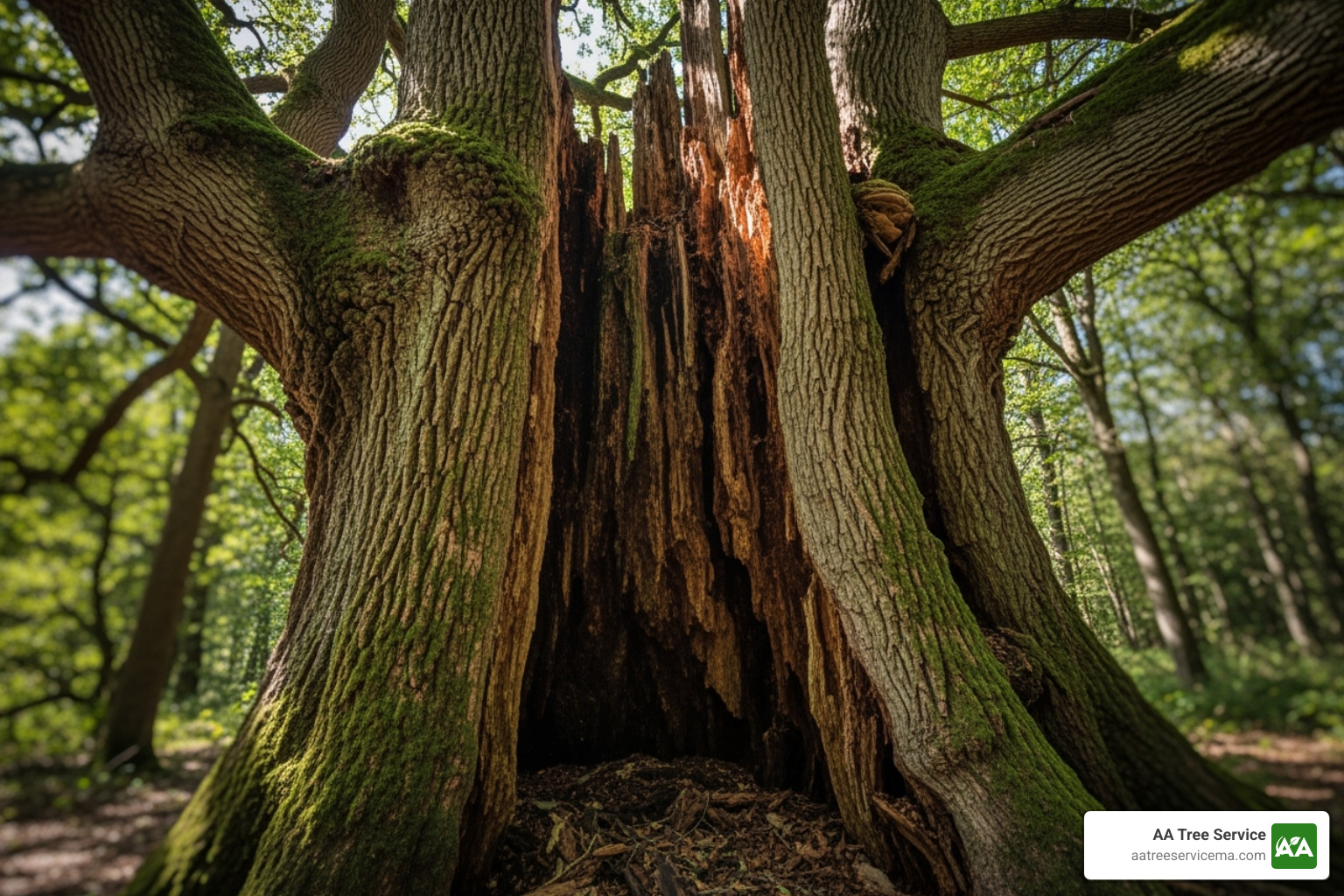
Pest infestations and fungal growth are insidious threats. Pests like the Asian longhorned beetle or emerald ash borer tunnel through the tree’s vascular system, cutting off nutrient flow and structurally weakening the wood. Fungi, often visible as mushrooms or conks on the trunk or near the roots, are the fruiting bodies of an extensive internal decay network. A tree can be almost completely hollowed out by rot while still producing green leaves, masking the extreme danger it poses.
Critical Signs You Need Immediate Help
Recognizing these critical warning signs should prompt you to clear the area and call for help immediately:
- A tree leaning at an unsafe angle: Any sudden lean of more than 15 degrees from vertical is a major alarm. Look for cracks in the soil and heaving ground on the side opposite the lean—this is a clear sign the root system has failed and the tree is actively falling.
- Large, dangling branches: These “hangers” are unpredictable hazards. They can be precariously balanced and may fall with the slightest provocation. Never attempt to remove branches near electrical power lines yourself; the risk of electrocution is severe.
- Deep cracks or splits in the trunk: Look for deep fissures that penetrate the bark, especially if they are accompanied by decay or are widening over time. A split trunk indicates the tree is under immense stress and its core structure is compromised.
- Hollows, cavities, and significant decay: Large cavities in the trunk or major limbs are a sign of advanced decay. While some trees can compartmentalize decay, a large hollow significantly reduces the tree’s strength and makes it susceptible to collapse.
- A significant portion of the tree is dead: More than 50% dead wood, especially in the upper canopy, creates an unstable and unpredictable structure. Dead wood is brittle, lacks the ability to bend in the wind, and can break away in large sections unexpectedly.
- Sudden leaf drop or discoloration in summer: While this can have many causes, a sudden loss of leaves on major branches during the growing season can indicate a pest infestation, disease, or a severed root system that is cutting off water to the canopy.
- If a tree has already fallen on your property: This is a confirmed emergency. The situation is hazardous due to the immense weight, potential for shifting, and the complex tensions within the fallen wood. Professional removal is essential for safety and proper cleanup.
Trust your instincts. If a tree feels dangerous, it probably is. It’s always better to call for a professional assessment than to wait for a disaster to happen.
Your Immediate Action Plan: Safety First
When a tree comes crashing down on your property, the sound is terrifying and the aftermath is chaotic. In this high-stress moment, your primary job isn’t to grab a chainsaw; it’s to ensure everyone’s safety and make smart, calm decisions until professional tree emergency services arrive. We are trained to handle the immense dangers of a fallen tree, and we know how to secure the scene and protect your property from further harm.
Our Storm Clean Up Near Me team has helped thousands of homeowners in Massachusetts and New Hampshire navigate these crises. Here’s a step-by-step guide on what to do—and what not to do—in the immediate aftermath of a tree fall.
Step 1: Ensure Everyone’s Safety
Before you assess the damage or even think about your insurance policy, you must get everyone to safety. A damaged tree is an unstable and unpredictable hazard. It could shift, roll, or drop more branches without warning.
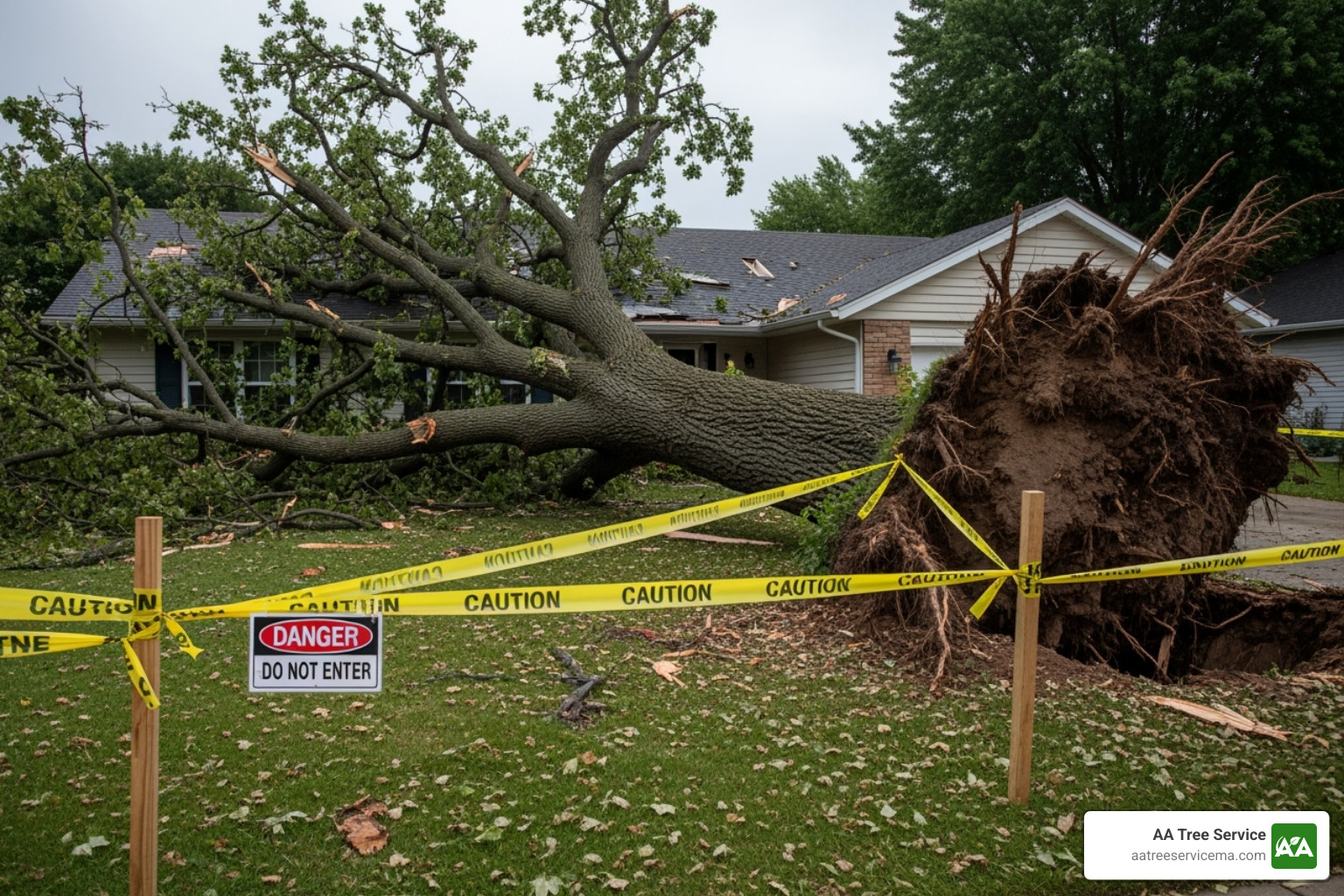
- Evacuate the area immediately. Move all family members and pets to a safe location. The minimum safe distance is at least 1.5 to 2 times the height of the tree. This is known as the “fall zone,” and you should stay well outside of it.
- If the tree has hit your house, evacuate the building. There may be structural damage you cannot see. Wait for professionals to deem it safe before re-entering.
- Keep everyone away and warn neighbors. Use caution tape, rope, or even lawn furniture to create a clear barrier around the danger zone. Inform your neighbors of the situation, especially if the tree or debris is near their property line.
- If you see any power lines down or touching the tree, call 911 and your utility company immediately. This is the most critical safety instruction. Assume every downed wire is live and energized. Electricity can travel through the tree and the wet ground, creating a large and lethal hazard zone. Do not go anywhere near it.
Step 2: Document the Scene (From a Safe Distance)
Once everyone is confirmed to be safe, your next step is to document the scene for your insurance company. Thorough documentation can significantly speed up your claim process and prevent disputes later.
- Take plenty of photos and videos from multiple angles. Use your smartphone to capture wide shots of the entire scene, showing the fallen tree and its position relative to your house, car, or other structures.
- Get close-up shots of specific damage, but only if you can do so from a safe distance. Photograph the point where the tree broke, the impact points on your roof or vehicle, and any resulting damage like broken windows or cracked walls. Do not enter the fall zone to get a better picture.
- Document the condition of the tree if possible. If you can safely see that the trunk was hollow or rotten, take a picture. This can sometimes be relevant for insurance purposes, especially in cases involving a neighbor’s tree.
You don’t have to wait for an insurance adjuster to arrive before calling for emergency tree removal. In fact, most insurance policies require you to take reasonable steps to mitigate further damage, which includes removing the tree from your roof to prevent water damage from rain.
Step 3: Call for Professional Help
Now it’s time to hand the situation over to the experts. Attempting to cut or move a large, fallen tree is incredibly dangerous. The trunk and limbs are under extreme tension and can react in violent and unpredictable ways when cut. When you call our 24/7 Tree Care team, you’re getting professionals who live and breathe the safety protocols required for these complex situations.
- Be ready to describe the situation clearly. When you call, have the following information ready:
- Your name, address, and phone number.
- The approximate size and type of the tree.
- What the tree has fallen on (house, garage, car, open yard).
- Whether any power lines are involved (this is the most important detail).
- The accessibility of the site for heavy equipment.
- Do not try to handle this yourself. Emergency tree removal often requires cranes, rigging, and a deep understanding of physics and engineering. It involves dangers that even professionals treat with extreme caution. Your safety is not worth the risk.
Leave the heroics to us. We have the training, equipment, and insurance to handle these situations safely and efficiently, restoring safety to your property.
What to Expect from Professional Tree Emergency Services
In the chaos of a tree emergency, you need a team that brings order, expertise, and safety to the scene. Professional tree emergency services provide a comprehensive, methodical response that goes far beyond simply cutting up wood. It’s a specialized service designed to handle high-risk, complex situations from start to finish, ensuring the safety of everyone involved and preventing further damage to your property.
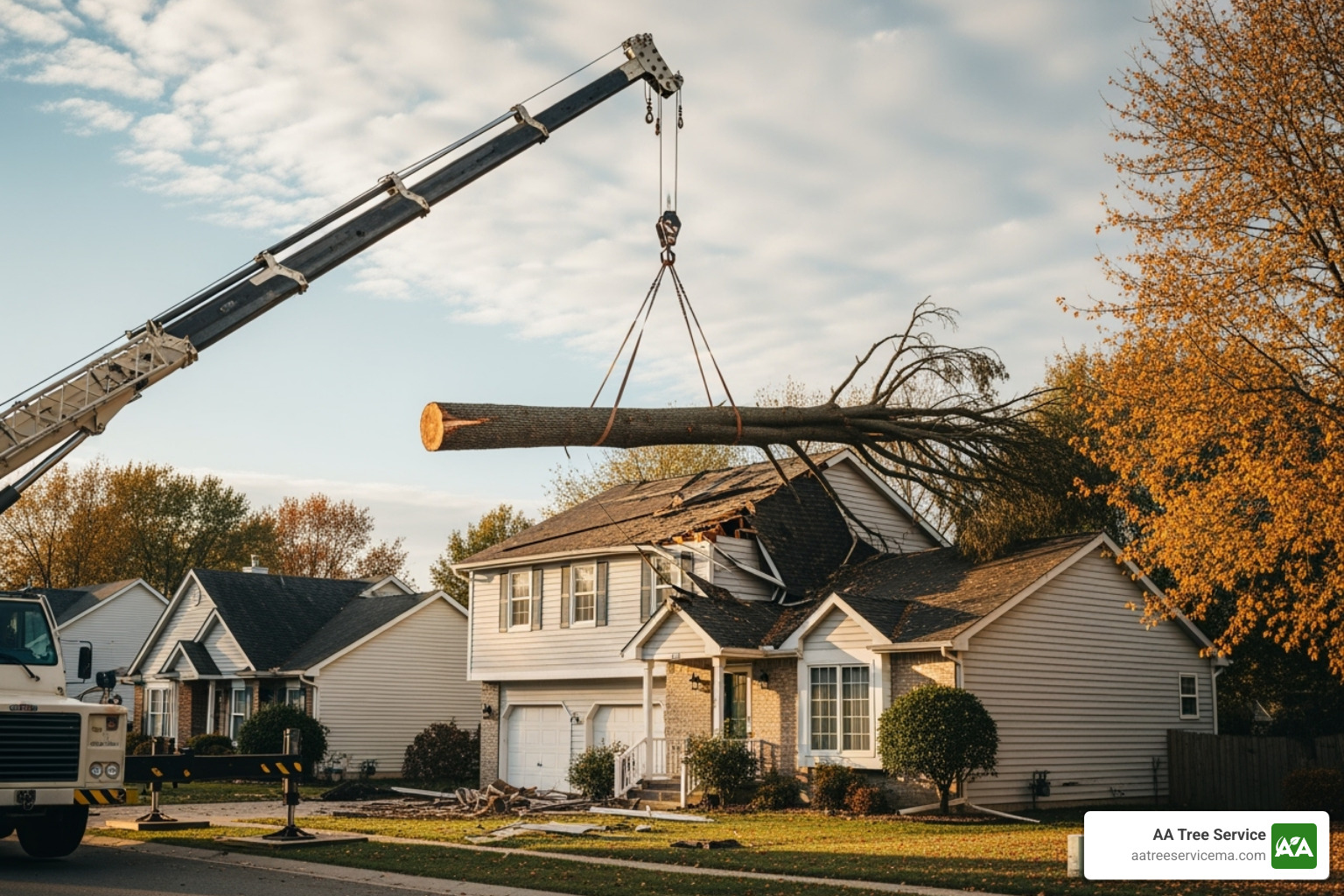
We arrive with specialized equipment like cranes, bucket trucks, and rigging gear to assess the damage and formulate a plan that prioritizes safety above all else. Our goal is to systematically remove the threat, protect your property, and restore your peace of mind. If you need help now, our Emergency Tree Removal team is ready to deploy.
The Emergency Response Process: A Step-by-Step Breakdown
Our 24/7 availability means we dispatch a qualified crew to your Massachusetts or New Hampshire location immediately after your call. Here’s what happens when we arrive:
- Site Security and Risk Assessment: The crew leader’s first action is to secure the site. We establish a clear, safe work zone and confirm any hazards, especially electrical ones. We then conduct a detailed on-site risk assessment, evaluating the tree’s stability, the structural integrity of anything it’s leaning on, and the potential for shifting. We analyze the forces and tensions at play to plan our cuts safely.
- Strategic Removal Plan: Based on the assessment, we create a custom removal plan. This isn’t guesswork. It’s a strategic process that considers weight distribution, balance points, and the safest way to dismantle the tree. For trees on structures, this almost always involves using a crane to lift sections vertically, preventing them from dragging across or rolling down your roof and causing more damage.
- Triage and Prioritization: In widespread storm events with multiple downed trees, we triage the situation. Trees posing the most immediate threat—those on houses, blocking access, or entangled with power lines—are addressed first. Our goal is to stabilize the most dangerous parts of the scene as quickly as possible.
- Systematic Removal: The crew executes the plan. This involves precise, calculated cuts made by highly trained arborists. We remove the tree piece by piece, controlling the descent of each section with ropes or a crane. You can find local help at Emergency Tree Removal Near Me.
Comprehensive Services Included in an Emergency Package
Our emergency response is a full-service solution designed to get your property back to a safe and stable condition.
- Hazardous Tree and Limb Removal: This is the core service—safely dismantling and removing the fallen or threatening tree and its branches.
- Tarping and Board-Up Services: Once the tree is off your roof, the damage is exposed to the elements. We provide immediate tarping services for damaged roofs and board-up services for broken windows or walls to prevent water damage and secure your home.
- Complete Debris Hauling: An emergency job isn’t finished until the site is clear. We manage the loading and hauling of all wood and debris, leaving your property clean and safe.
- Stump Grinding: After the tree is gone, the stump remains. We can perform stump grinding to grind the stump below ground level, allowing you to repair the lawn and fully reclaim the area.
- Comprehensive Storm Cleanup: Our response includes more than just the main tree. We offer comprehensive Storm Cleanup Services to clear smaller branches and debris scattered across your property.
How Professional Services Coordinate with Utilities and Authorities
Working around electrical hazards is the most dangerous part of the job and requires certified training. Our crews are trained to follow strict safety standards like ANSI Z133.1. We maintain a safe distance from all lines until the utility company gives the all-clear.
- Direct Communication with Power Companies: We have established relationships and direct lines of communication with power companies like Eversource and National Grid. We coordinate with them to de-energize and, if necessary, remove lines from the work area. Our work often cannot begin until they have declared the scene electrically safe.
- Clearing Roads for Emergency Access: During major storms, our first priority is often clearing roads for emergency access. We work in conjunction with local municipalities and fire departments to open up blocked streets, ensuring first responders can do their jobs and public safety is maintained.
Navigating Costs and Insurance for Emergency Tree Work
When a tree damages your property, the financial implications can be an enormous source of stress on top of an already chaotic situation. Understanding the costs associated with tree emergency services and how your homeowner’s insurance works can help you navigate the process with confidence. Transparency is key, and it’s important to understand why emergency work costs more than a scheduled job.
| Feature | Emergency Tree Removal | Non-Emergency Tree Removal |
|---|---|---|
| Urgency & Timing | Immediate, 24/7 response required, often after-hours, on weekends, or during holidays. Crews are mobilized on-demand. | Scheduled weeks in advance at your convenience during standard business hours. |
| Risk Factor | Extremely high. Involves unstable trees, compromised structures, adverse weather (rain, wind, snow), and potential electrical hazards. Requires heightened safety protocols. | Low and controlled. Work is done in a planned environment during good weather. |
| Equipment Needs | Often requires specialized heavy equipment like large cranes, which must be mobilized on short notice. Cranes are essential for safely lifting wood off structures without causing further damage. | Standard tree removal equipment is usually sufficient. Cranes may be used, but their use is planned and scheduled, reducing costs. |
| Crew & Expertise | Requires larger, more experienced crews with specialized training in complex rigging, crane operations, and high-risk scenarios. Overtime and holiday pay rates apply. | Standard crew sizes with general tree removal skills. Work is performed during regular hours at standard pay rates. |
| Cost | Significantly higher (often 50-300% more than non-emergency rates) due to the combination of urgency, overtime pay, extreme risk, and specialized equipment mobilization. (Average internet data: $1,500 – $9,000+, not AA Tree Service costs) | Lower, predictable rates based on a standard assessment. (Average internet data: $200 – $2,000+, not AA Tree Service costs) |
| Insurance | Highly likely to be covered by homeowner’s insurance if an insured structure is damaged. The focus is on mitigating further loss. | Generally not covered unless it’s part of a claim for damage that has already occurred. Proactive removal of a healthy tree is a homeowner maintenance cost. |
Understanding the Potential Costs of Emergency Tree Removal
Emergency tree removal costs are higher because the service itself is fundamentally different from routine work. This premium reflects the reality of providing a specialized, high-risk service under difficult and unpredictable conditions. Key factors influencing the final cost include:
- Accessibility: How difficult is it to get heavy equipment to the tree? A backyard tree with no access for a crane will be more complex and costly to remove than a front-yard tree.
- Size and Type of Tree: A massive, multi-trunk oak will cost more to remove than a smaller pine tree.
- Complexity of the Situation: A tree resting on a roof is far more complex than one that fell in an open yard. The need for a crane is the single largest cost driver.
- Urgency and Time of Day: A call at 2 AM on a holiday will naturally cost more than a call during business hours due to overtime pay for the crew.
Based on internet data, emergency tree removal can range from $1,500 to $9,000 or more, depending on these factors. These are average costs and not actual costs for AA Tree Service. For personalized pricing, visit our Tree Removal Cost Estimate page.
The Role of Homeowner’s Insurance
Your homeowner’s insurance policy is your financial lifeline in a tree emergency. Most standard policies provide coverage for tree-related damage, but the details matter.
- What’s Covered? Generally, if a tree falls and damages an insured structure (your house, garage, shed, or fence), your policy will cover the cost of repairs to the structure as well as the cost to remove the tree from that structure.
- Debris Removal Sublimits: Where things get tricky is the cost of removing the debris from your property. Many policies have a separate, lower limit for debris removal, often around $500 to $1,500. This means if the tree removal costs $5,000, your insurance might only reimburse you for the $1,500 sublimit, leaving you to cover the rest. However, the portion of the work involving a crane to lift the tree off the house is often considered part of the structural repair, not debris removal.
- Act Now, Don’t Wait: Insurance companies expect you to take reasonable steps to prevent further damage. This is called the “duty to mitigate.” This means you should call an emergency tree service to have the tree removed from your roof and have the roof tarped. Don’t wait for an adjuster to see it first. Document the scene thoroughly, and then call for help.
- When a Neighbor’s Tree Falls on Your House: In almost all cases, your own homeowner’s insurance is your primary source of coverage. It’s your policy that pays for your damage. Your insurance company may then choose to seek reimbursement from your neighbor’s insurance company (a process called subrogation), but only if they can prove your neighbor was negligent (e.g., they knew the tree was dead and did nothing about it). If the tree was healthy and fell in a storm (an “Act of God”), your neighbor is typically not considered liable.
We have decades of experience working with insurance companies and can provide all the detailed documentation and invoicing needed to streamline your claim. For more details, see our More info about tree removal services page.
Preventing Future Emergencies & Choosing a Provider
The best tree emergency is one that never happens. While you can’t control the weather, proactive tree care can dramatically reduce your risk of tree failure, saving you immense stress, money, and potential property damage. Regular maintenance is not an expense; it’s an investment in the safety and beauty of your property.
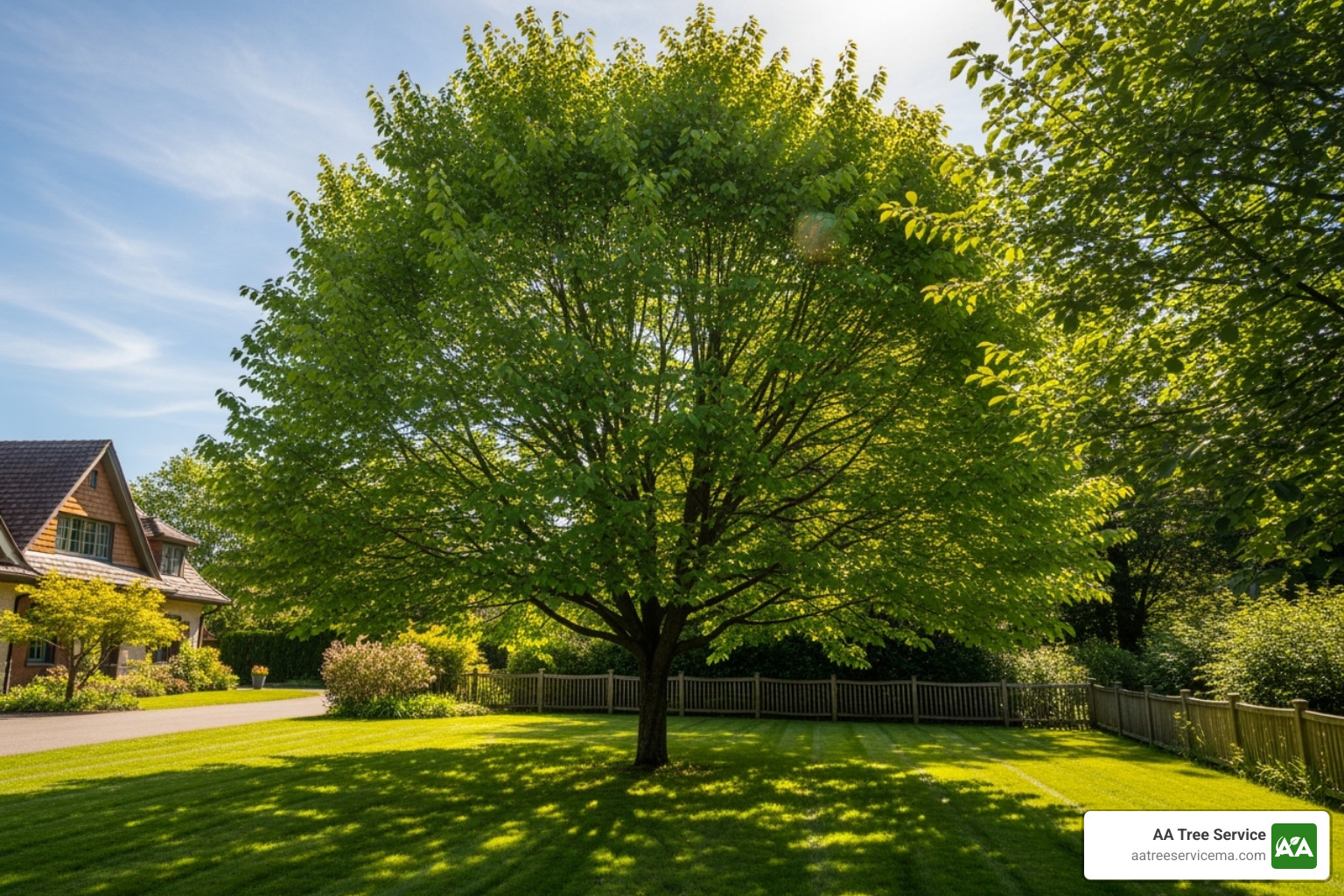
For those in Nashua, NH and surrounding areas, a proactive approach is the key to helping your trees withstand the rigors of New England storms.
Proactive Tree Care: A Seasonal Guide for New England Homes
Think of tree care like a wellness plan for the largest living things on your property. A certified arborist can help you create a long-term health and safety plan.
- Late Winter/Early Spring: This is the ideal time for structural pruning. With the leaves off, an arborist can easily see the tree’s entire structure to identify and remove dead, weak, or crossing branches. It’s also a good time to install support systems like cables or braces on trees with weak branch unions.
- Summer: This is the time for a health check. Inspect leaves for discoloration, wilting, or signs of pests. Look at the trunk and branches for fungal growth (like mushrooms), cracks, or insect activity (like small holes with sawdust). Addressing disease and pest issues early can prevent them from causing structural damage.
- Fall: Before the winter storms arrive, have a final inspection done. Look for any branches that have died over the summer or been damaged in early-season storms. Ensure young trees are properly staked to withstand winter winds, and apply a layer of mulch around the base of your trees to protect the roots from freezing temperatures.
- Anytime: Conduct regular visual inspections yourself. After any significant storm, walk your property and look for new cracks, leaning, or broken branches. Avoid compacting the soil around the root zone with vehicles or construction materials, and ensure proper drainage to prevent root rot.
How to Choose the Right Tree Emergency Services Provider
When an emergency strikes, you’ll be stressed and short on time. It’s crucial to choose a reputable and qualified provider. A bad choice can lead to further damage, financial liability, or unsafe work. Here’s what to demand from a tree emergency services company in Massachusetts or New Hampshire:
- Proper Licensing and Full Insurance: This is non-negotiable. Ask for proof of both general liability insurance and worker’s compensation insurance. Liability insurance protects your property from damage, while worker’s comp protects you from being sued if a worker is injured on your property. A legitimate company will readily provide a certificate of insurance.
- True 24/7 Availability: A real emergency service has crews on standby, ready to dispatch immediately. Be wary of companies that just use an answering service after hours and can’t give you a firm ETA. When you call, you should be speaking to someone who can mobilize a team.
- Deep Local Experience: A company familiar with New England’s weather, common tree species (like oaks, maples, and pines), and local regulations will provide safer, more effective service. They understand how a frozen oak behaves differently from a waterlogged pine and have relationships with local utility companies.
- Recent Reviews and Verifiable References: Look for reviews on Google, Yelp, or the BBB that specifically mention emergency services. A company’s true character is revealed in how they perform under pressure. Don’t be afraid to ask for references from recent emergency jobs.
- Specialized Equipment and Safety Protocols: A professional company will own or have immediate access to the right equipment, especially cranes. Ask about their safety protocols. They should be able to speak confidently about ANSI standards, electrical hazard awareness, and their on-site safety procedures. If they sound casual about safety, that’s a major red flag.
Choosing the right provider in a crisis gives you peace of mind that the job will be done safely and correctly. If you’re looking for a trusted partner, check out our Tree Company Near Me page.
Frequently Asked Questions about Tree Emergencies
In the stressful moments of a tree emergency, you’re bound to have urgent questions. With over 20 years of experience helping homeowners across Massachusetts and New Hampshire, we’ve heard them all. Here are clear, straightforward answers to the most common concerns.
What should I do if a tree falls on my house?
First, prioritize safety above all else. Ensure everyone is safe and evacuate the home immediately if you have any concerns about its structural integrity. Do not go on the roof or attempt to remove any part of the tree yourself. A fallen tree is unstable and can shift unexpectedly, causing further damage or serious injury. Once you are safe, call a reputable 24/7 emergency tree service. While you wait for the crew to arrive, document the damage with photos from a safe distance for your insurance claim. If any power lines are involved, your first call should be to 911 and your utility company.
Will my homeowner’s insurance cover the cost of removal?
In most cases, yes, especially if the tree has damaged a covered structure like your home, garage, or fence. Your policy will typically cover the cost to repair the structure and the cost to remove the tree from that structure. However, be aware of policy sublimits. Many policies have a separate, lower cap (e.g., $500 to $1,500) for the cost of hauling away the debris once it’s on the ground. Always review your specific policy, but do not wait for an adjuster to arrive before calling for help. Insurance companies expect you to take reasonable steps to prevent further damage, which includes removing the tree from your roof.
How much more expensive are tree emergency services?
Emergency services command a premium, often costing 50% to 300% more than a scheduled tree removal. This increased cost is due to several factors: the immediate, 24/7 response (often requiring overtime or holiday pay), the significantly higher risk involved in working with unstable trees and structures, and the need to mobilize specialized equipment like cranes on short notice. Based on internet data (not our pricing), emergency costs can range from $1,500 to $9,000+. While the price is higher, the cost of emergency removal is almost always less than the cost of additional structural or water damage that can occur from waiting.
Can I remove a small fallen branch myself?
It depends on the situation, but extreme caution is advised. If a small branch has fallen in an open area of your yard, is not under any tension, and can be safely cut with hand tools, you may be able to handle it. However, never attempt to remove a branch that is larger than you can comfortably lift, is resting on a structure, is suspended in the air, or is anywhere near a power line. The risks of it falling, rolling, or being under unexpected tension are too high.
What happens if a tree falls on my car?
If a tree falls on your car, the damage is typically covered by the comprehensive portion of your auto insurance policy, not your homeowner’s insurance. The process is similar: stay at a safe distance, document the damage thoroughly with photos, and contact your auto insurance provider to start a claim. They will guide you on the next steps for assessment and repairs. You will still need to hire a tree service to remove the tree from the vehicle.
Your Partner in a Crisis
When a tree threatens your Massachusetts or New Hampshire home, a fast, professional, and safe response is critical. These situations are inherently stressful and dangerous, which is why you need an experienced team you can trust to take control and manage the risk effectively.
For over 20 years, AA Tree Service has been the trusted partner for homeowners in crisis, from the suburbs of Framingham, MA to the neighborhoods of Manchester, NH. We understand that behind every emergency call is a family that needs help, fast. Our crews are not just equipment operators; they are highly trained problem-solvers who work with precision and a deep commitment to safety. We arrive ready to assess the situation, develop a strategic plan, and work efficiently to restore safety and peace of mind to your property.
By understanding the warning signs of a hazardous tree, taking immediate safety precautions during an event, and calling a qualified team, you can manage these crises effectively. Remember the key steps: ensure everyone’s safety, stay away from downed power lines, document the scene from a distance, and leave the dangerous work to the professionals. That’s what we’re here for.
If you’re facing a tree emergency, don’t wait. The risk of further damage or injury increases with every passing moment. Contact us immediately for reliable, professional Emergency Tree Removal. We’re standing by 24/7 to help get your life back to normal.