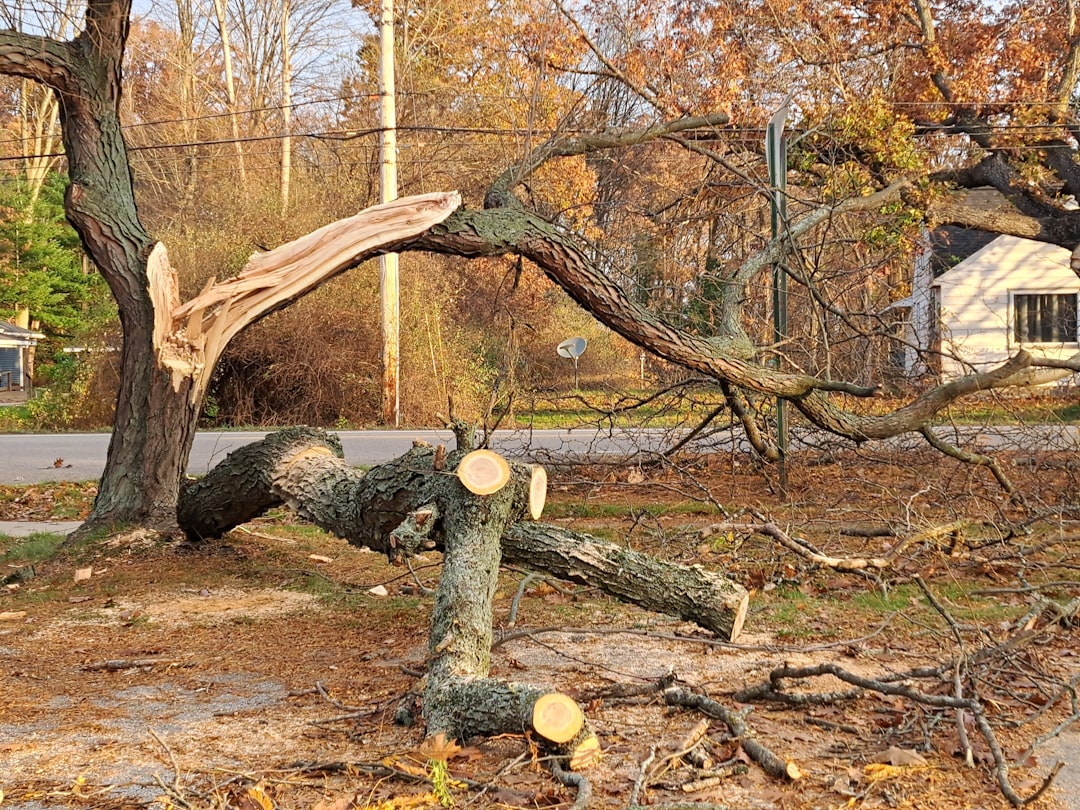
Why Storm Tree Service Response Time Matters After Severe Weather
A storm tree service is your first line of defense when Mother Nature leaves dangerous debris threatening your Massachusetts or New Hampshire property. When high winds and heavy rain push trees to their breaking point, you need professional help fast.
Quick Storm Tree Service Essentials:
– Emergency Response: 24/7 availability for immediate hazards
– Safety Assessment: Professional evaluation of unstable trees and hanging limbs
– Debris Removal: Complete cleanup including branches, trunks, and stump grinding
– Tree Salvage: Cabling and bracing to save damaged but recoverable trees
– Insurance Support: Documentation and claims assistance for property damage
Strong winds paired with heavy rain can snap full-grown trees like matchsticks, leaving homeowners facing serious safety risks. Trees with cracks affecting more than half of the main trunk generally need removal, while leaning trees that lost half their branches pose immediate falling risks.
The difference between a quick recovery and months of headaches often comes down to how fast you get the right help. Professional storm tree services bring specialized equipment, insurance coverage, and the expertise to handle tensioned debris that can shift unpredictably.
Never attempt DIY removal of storm-damaged trees. As one arborist warns: “Tree debris contains points of tension and compression that can release unpredictable movements if not handled properly.”
Storm tree service terms you need:
– tree debris
– broken trees
– storm damaged
Step 1: Assess Your Trees Safely Before You Call
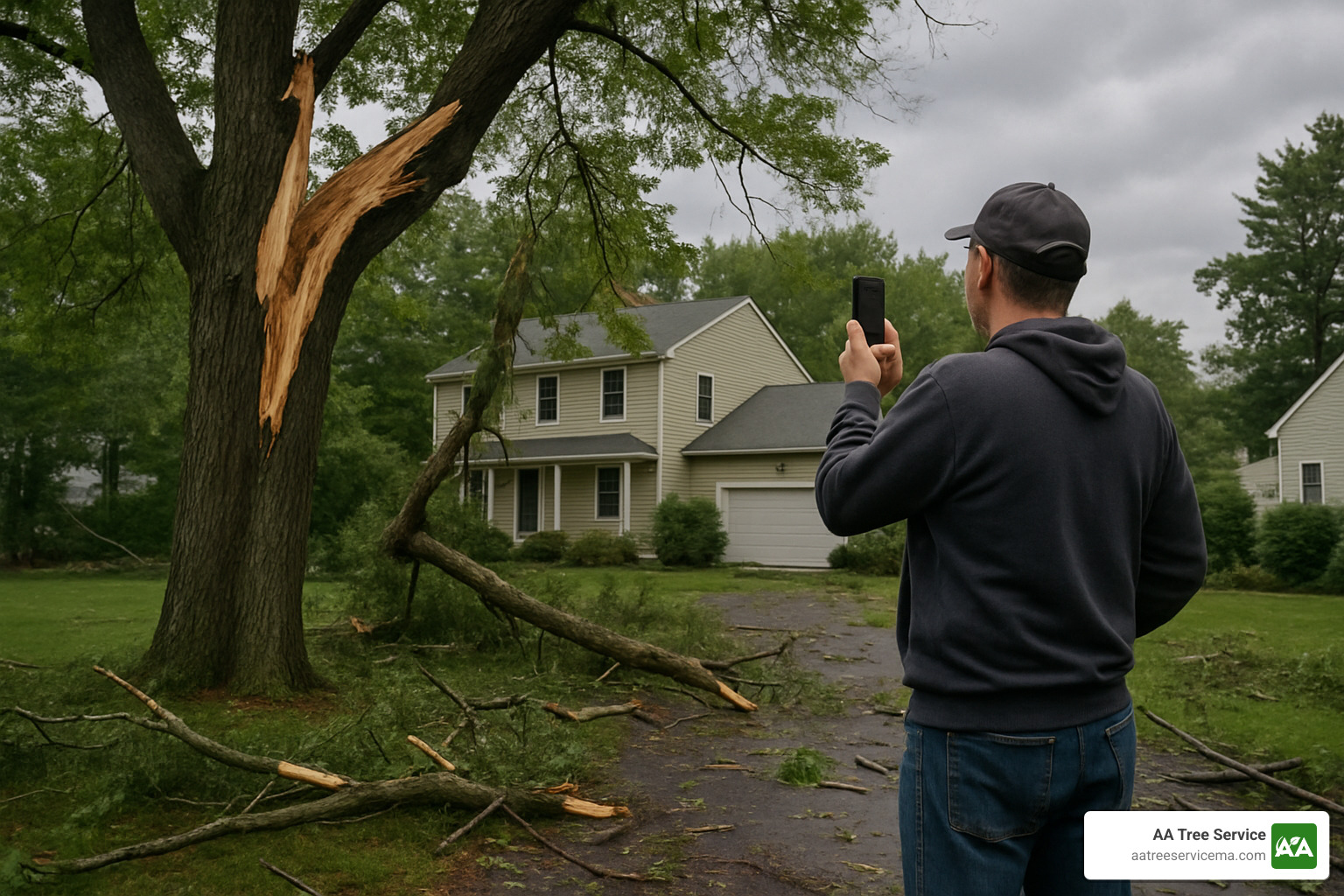
After a storm hits your Massachusetts or New Hampshire property, your first instinct might be to rush outside and check the damage. But before you call a storm tree service, you need to assess safely from a distance first.
Stay at least 20 feet back from any tree that looks damaged. From this safe distance, you can spot obvious problems: hanging limbs that are partially broken, cracked trunks that show deep splits, and uprooted roots where you can see the root ball pushed up through the soil.
Power lines are your biggest danger. If you see any tree touching electrical wires, stop everything and call 911 immediately. Don’t assume a line is “dead” just because your lights are still on.
While doing your safety assessment, take photos from multiple angles. Your insurance company will want documentation, and these pictures help us understand the situation before we arrive. Focus on any soil heaving around tree bases – when the ground is pushed up around a tree, it means the roots have been compromised.
Signs You Need a Storm Tree Service Immediately
Trees or branches resting on your house top the emergency list. Even if they seem stable, they’re adding weight your roof wasn’t designed to handle.
Significant canopy loss – when a tree has lost more than half its branches – creates an unstable situation. The remaining trunk and root system are now supporting a completely different weight distribution.
Trunk splits that affect more than half the tree’s diameter are particularly dangerous. Major splits compromise the tree’s structural integrity permanently.
Soil heaving around the base tells us the root system has been damaged. When you can see roots that should be underground, that tree has lost its anchor and becomes a falling hazard.
The “lean test” is simple: if a tree that was straight before the storm is now leaning more than 15 degrees, especially if it’s also lost major branches, it poses immediate danger.
DIY vs. Professional: Hidden Dangers
Storm tree work consistently ranks among the most dangerous jobs in America. Chainsaw kickback happens when the chain catches and throws the saw back toward you. Tensioned wood is the invisible killer – when a branch is bent or partially broken, it’s storing energy like a coiled spring. Wet conditions after storms create slip hazards and increase electrical dangers.
The International Society of Arboriculture requires extensive training for certified arborists. Insurance liability adds another layer of risk – if you hurt yourself during DIY cleanup, your homeowner’s policy might not cover the costs.
What looks like a simple cleanup job often involves complex rigging, specialized equipment, and years of experience to execute safely.
What to Look for in a Storm Tree Service Company
When your property looks like a war zone after a storm hits Massachusetts or New Hampshire, you need help fast. Not every truck with a chainsaw qualifies as professional storm tree service.
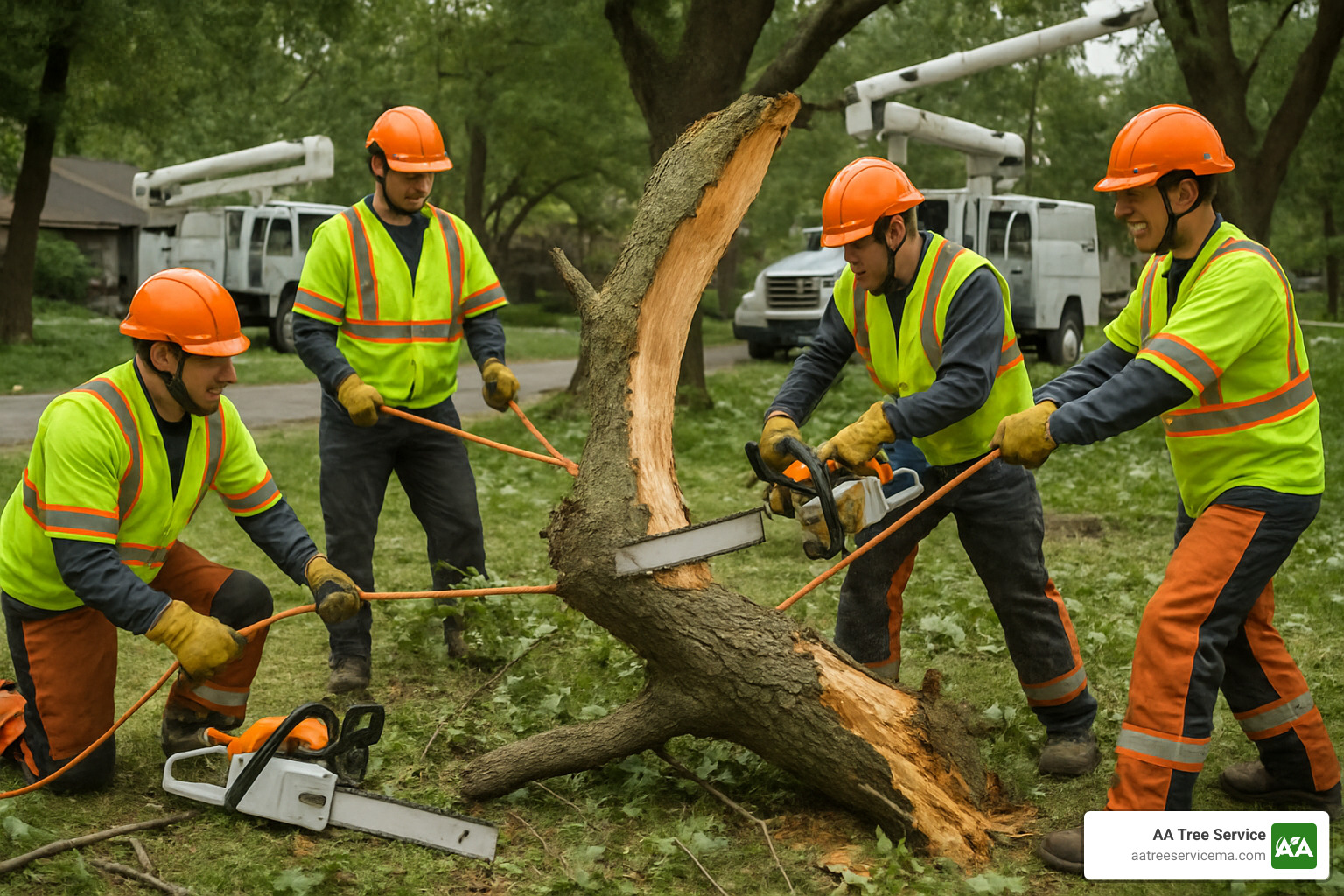
Legitimate professionals have ISA-certified arborists on their crew, offer 24/7 emergency dispatch, and carry comprehensive insurance that protects both their workers and your property. They show up with proper equipment including cranes for heavy lifting, chippers for debris processing, and full safety gear for every crew member.
Here’s what should make you nervous: anyone demanding cash-only payment, especially if they knocked on your door right after the storm. If someone pressures you for immediate payment or won’t provide insurance certificates, keep looking.
| Licensed Professional | Unlicensed Operator |
|---|---|
| ISA certification displayed | No professional credentials |
| Insurance certificates provided | “Trust me, I’m covered” |
| Written estimates with scope details | Verbal quotes only |
| Established business location | Works from personal vehicle |
| References from recent local jobs | No verifiable work history |
| Proper safety equipment for entire crew | Minimal or improvised safety gear |
How Professionals Deliver Storm Tree Service Safely
Professional storm tree service starts with risk triage – figuring out what needs immediate attention versus what can wait. Trees touching power lines get handled first, then anything threatening structures.
Controlled felling is where experience shows. Storm-damaged trees don’t behave like healthy ones. They’re often under tension, which means they can move unexpectedly when you start cutting. Professional crews use specialized rigging techniques to control exactly where each piece lands.
For trees that can be saved, we use cabling and bracing systems to provide structural support while they recover. Our Emergency Tree Removal Service includes evaluation for salvage potential, not just automatic removal.
The cleanup phase involves complete debris haul-away using professional equipment. Professional chippers can process branches efficiently, while stump grinders eliminate tripping hazards.
Questions to Ask Before Hiring
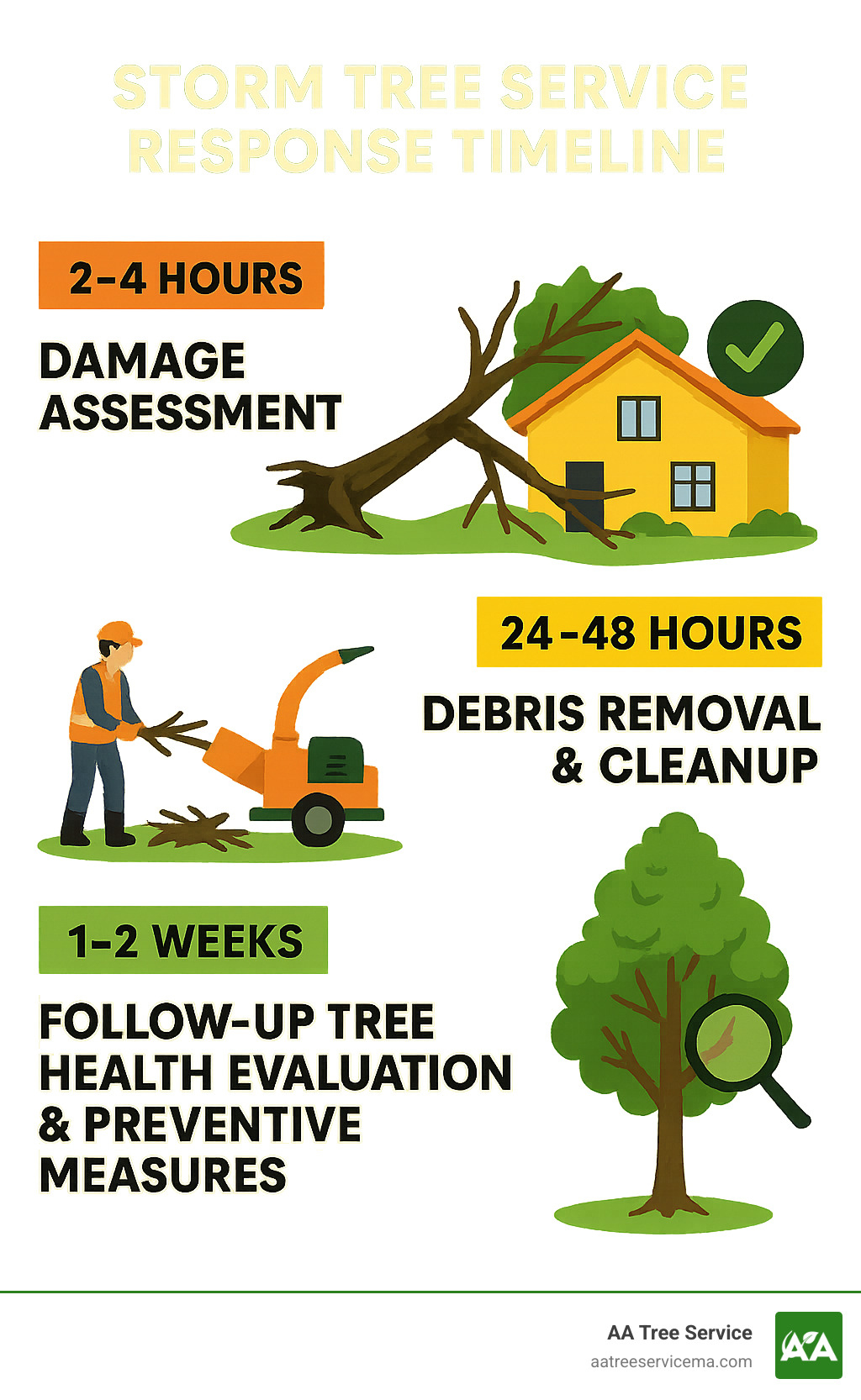
Before you sign anything, you need answers to basic questions. Start with response time expectations. For true emergencies, you should get response within 2-4 hours. Regular storm cleanup typically schedules within 24-48 hours.
Ask about their equipment list for your specific job and clarify cleanup scope upfront. Don’t forget about permits if your situation requires them, and ask about payment options – legitimate businesses offer multiple payment methods and don’t demand full payment upfront.
Top Emergency Services You Might Need in MA & NH
When severe weather tears through Massachusetts and New Hampshire, the aftermath creates different challenges that each need specialized solutions. After responding to hundreds of storm calls over our 20+ years in business, we’ve learned the services needed tend to fall into predictable categories.
Emergency tree removal tops the list when trees have fallen on structures or pose immediate safety threats. Limb pruning becomes critical when a tree has lost some branches but can be saved. Our Storm Cleanup Services handle comprehensive site clearing that transforms debris-filled yards back into usable space.
Fallen Tree Removal requires special expertise when trees are tangled in power lines or resting on structures. Cabling and bracing services focus on saving valuable trees that suffered damage but aren’t beyond help. Stump grinding completes the process by removing the root system and restoring planting areas.
Service Spotlight: Rapid Branch & Debris Removal
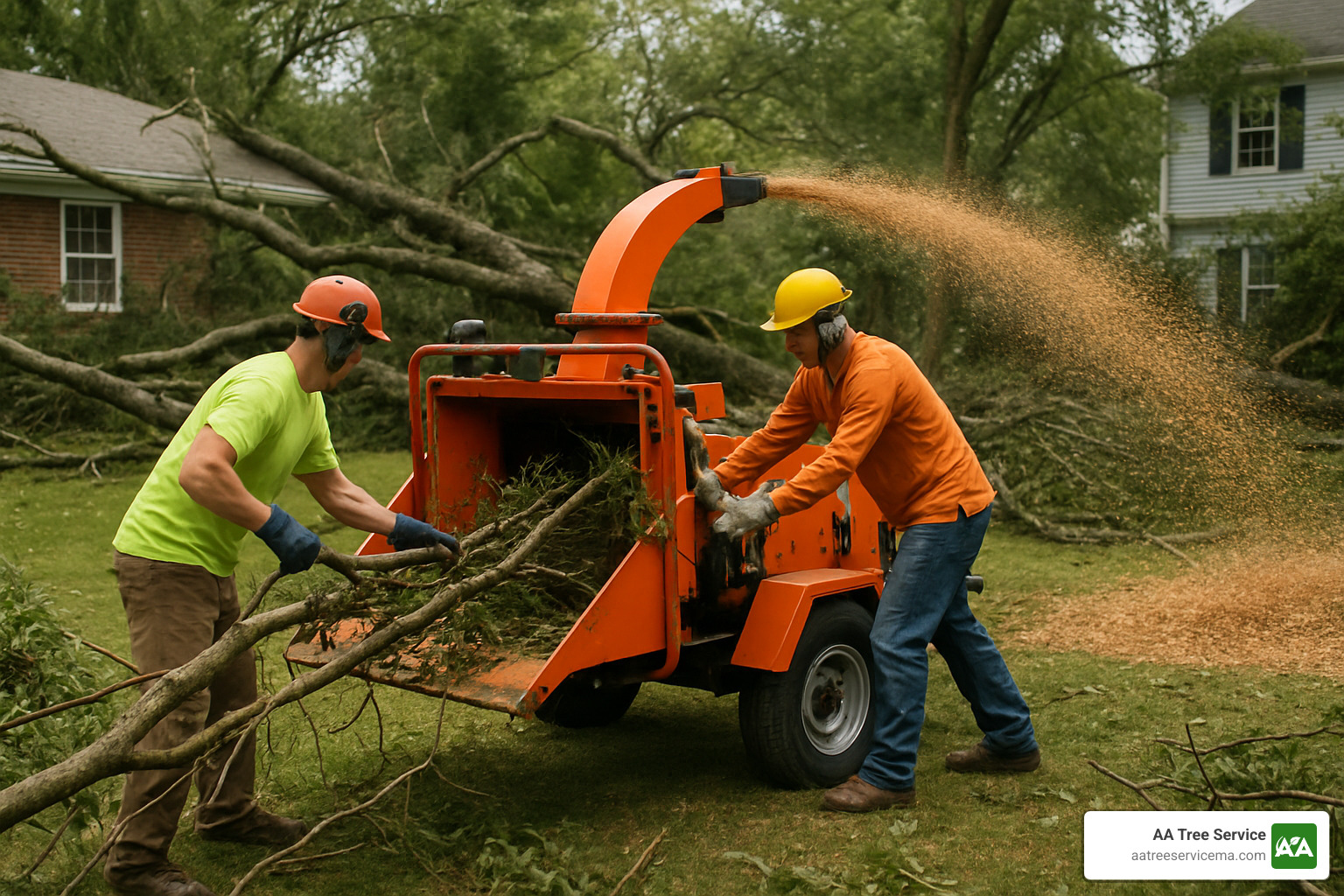
The mountain of branches and leaves that storms leave behind can make your property look like a war zone. Our chipper crews can process in hours what would take homeowners weeks to handle.
On-site chipping transforms piles of debris into useful mulch right in your yard. Our professional wood chippers handle everything from pencil-thin twigs to branches several inches in diameter. The resulting wood chips can stay as valuable mulch or we can haul everything away.
Site safety remains our top priority during debris removal. Storm debris creates hidden hazards – branches under tension, unstable piles, and debris that may be hiding obstacles. Our crews maintain clear escape routes and use proper safety protocols throughout cleanup.
Service Spotlight: Cabling, Bracing & Tree Salvage
Sometimes the most valuable service we provide is the tree we don’t remove. Tree salvage through structural support systems can often save specimens that homeowners assume are goners.
Cable systems use flexible steel cables that provide support while allowing natural movement. Bracing rods handle situations where major splits need rigid support. Our Emergency Tree Branch Removal service often reveals salvage opportunities that aren’t obvious at first glance.
Lightning splits present unique challenges because damage often extends internally beyond what’s visible. Wind-proofing your remaining healthy trees often makes sense after major storms – preventive cabling can help them handle future storms more successfully.
Average Costs, Insurance & Response Times
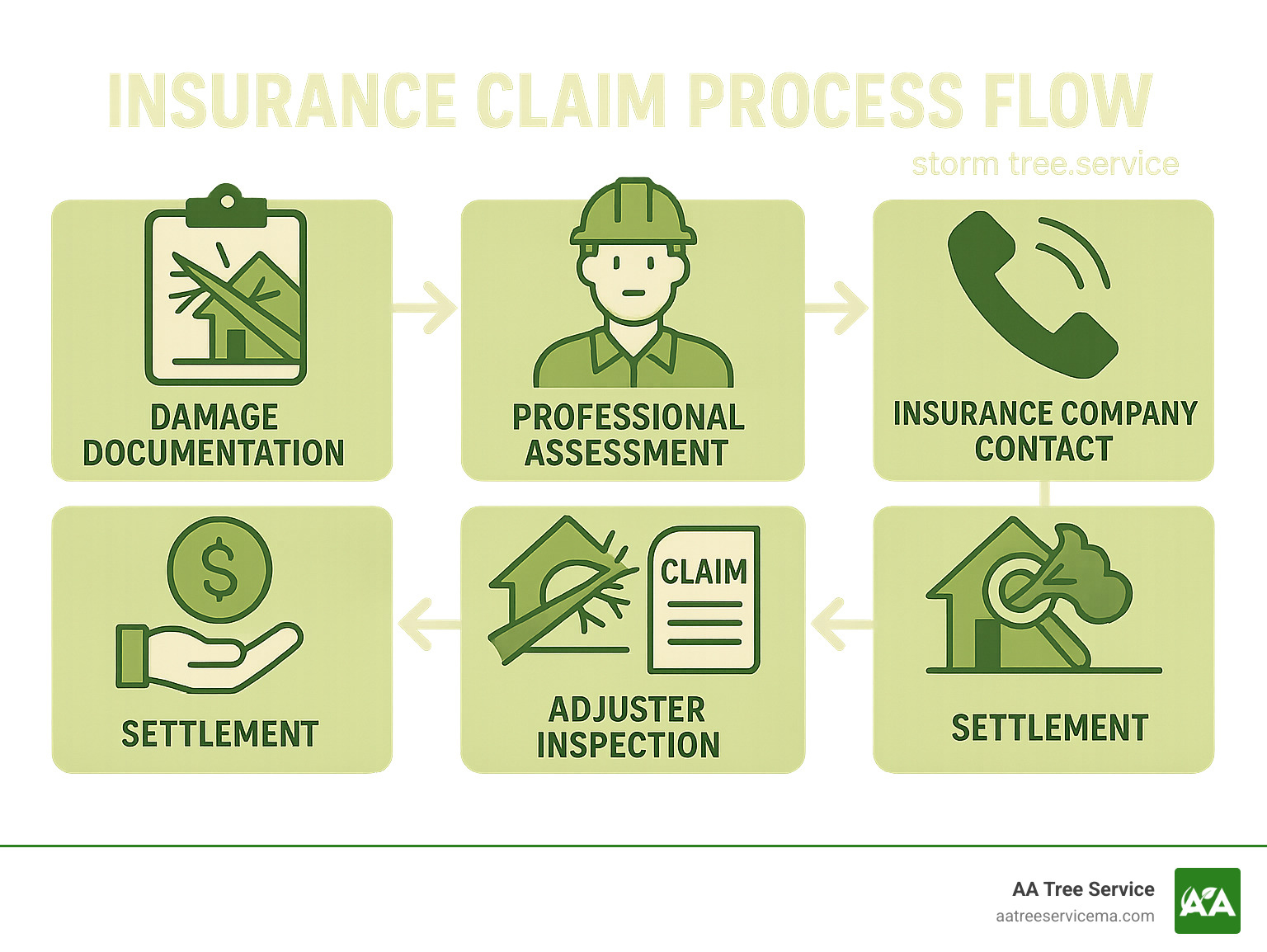
Understanding storm tree service costs helps you make smart decisions during stressful situations. Storm tree work is more complex than regular maintenance, often requires specialized equipment, and sometimes needs immediate response regardless of the hour.
Emergency tree removal typically ranges from $500 to $3,000 or more, depending on size and complexity. Small branch removal might cost $250 to $1,500, while comprehensive debris cleanup usually runs $200 to $800 per day. Crane services add another $500 to $2,000 or more.
These are average costs based on internet research and not actual pricing for AA Tree Service. Every situation is unique, which is why we provide free same-day quotes.
Stump grinding adds $100 to $400 per stump, while cabling and bracing ranges from $300 to $1,200 per tree. Tree size, proximity to structures, access challenges, and emergency timing all influence final costs.
Understanding Insurance for Storm Tree Service
Most homeowner’s insurance policies do cover storm tree damage, but details matter. Standard coverage typically includes trees that fall on structures, emergency removal when trees threaten additional damage, and debris cleanup from covered areas.
Coverage limitations can catch homeowners off guard. Insurance rarely covers healthy tree removal, landscaping restoration is often limited, and preventive maintenance remains your responsibility. Deductible requirements mean you’ll pay the first portion out of pocket.
Documentation is everything when filing claims. You’ll need before and after photos, professional estimates from licensed tree services, receipts for emergency services, and detailed inventory of damaged landscaping and structures.
Typical Response Times in Massachusetts & New Hampshire
For true emergencies – trees on structures or power line contact – we typically respond within 2-4 hours. Urgent but not immediately dangerous situations usually get attention within 24-48 hours. Non-emergency cleanup typically schedules within 1-3 days.
Storm severity creates high demand, geographic location affects travel time, and weather conditions can prevent safe work. Our priority system ensures life safety threats get immediate attention, followed by property protection and access restoration.
Future-Proofing: Making Your Landscape Storm-Resilient
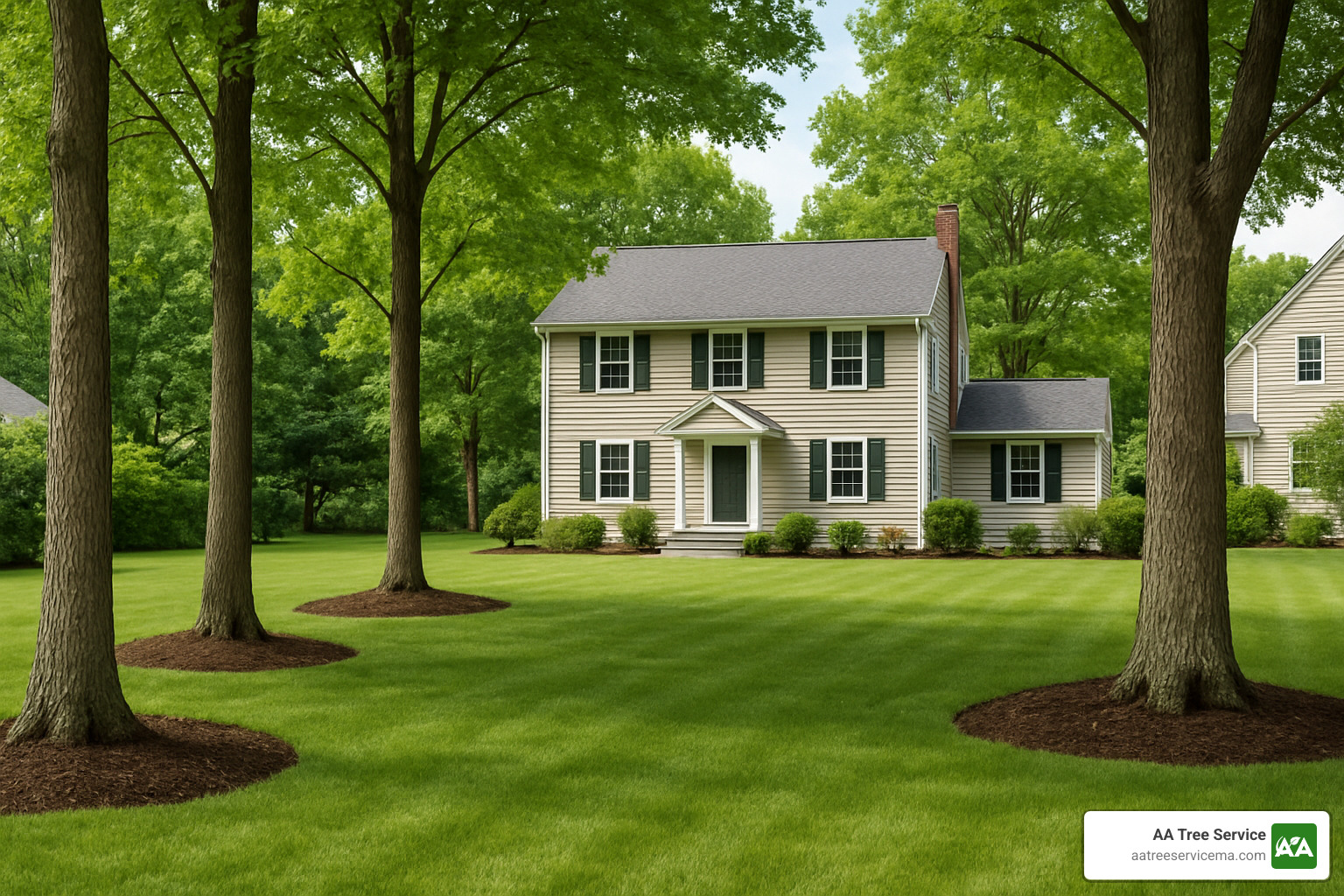
After dealing with storm cleanup once, you’ll never want to go through it again. The smartest approach is working with a storm tree service that doesn’t just clean up the mess – they help prevent the next one.
Preventive pruning removes weak branches before they become flying missiles. Strategic mulching keeps roots healthy and soil stable, helping trees anchor themselves better. Regular health assessments catch problems while they’re still small – a crack we can fix with cabling today might mean a tree through your roof next winter.
When replanting after storm damage, choose wisely. Red Oak and Sugar Maple are workhorses in Massachusetts and New Hampshire – they bend instead of breaking. Eastern White Pine handles wind beautifully when properly maintained. Avoid Bradford Pear trees – they’re designed to fall apart. Silver Maple grows fast but means weak wood.
Support systems for existing trees make a huge difference. Cable systems, lightning protection, and root zone improvements all help trees weather the next storm. Our Tree Debris Removal Service includes consultation on these long-term strategies.
Scientific research shows that proper tree care significantly improves storm resilience.
Annual Storm Tree Service Plan
A good storm tree service plan spreads work throughout the year, addressing different needs as seasons change. Spring is when we inspect every tree for winter damage and check cable systems. Summer is pruning season – we remove dead, diseased, and crossing branches while trees can heal quickly.
Fall preparation is crucial in New England. We do final pruning and install cable systems before winter ice loading. Winter monitoring helps us respond quickly when ice storms load branches beyond their breaking point.
This systematic approach means fewer emergency calls and healthier trees. After twenty years in this business, an ounce of prevention really is worth a pound of cure.
Frequently Asked Questions about Storm Tree Service
What should I do if a tree falls on my house?
When a tree crashes into your home, your safety comes first. Get everyone out of the affected area immediately. If anyone is injured, call 911.
Once everyone is safe, call your insurance company as soon as possible to report the claim. Document everything from the outside with photos from multiple angles. Never try to remove the tree yourself – we’ve seen homeowners cause thousands in additional damage.
If the tree created openings in your roof or walls, you may need temporary protection like tarps while you wait for professional removal. Save your receipts – many insurance policies cover these emergency measures.
How do arborists decide to remove or save a storm-damaged tree?
The decision depends on several factors that trained arborists evaluate. We look at the tree’s overall condition before making recommendations. The “50% rule” is a good guideline – trees that lose more than half their canopy often struggle to recover.
Root damage is often the deciding factor. Soil heaving or visible roots above ground indicate the tree’s foundation has been compromised. Trunk splits are serious – cracks affecting more than half the trunk’s diameter usually mean removal is safest.
The tree’s age and species matter. Younger, resilient species like oak and maple can recover from significant damage, while older trees or brittle species may not be worth the risk. Location plays a huge role – we always err on the side of safety when structures could be at risk.
Does AA Tree Service help with insurance paperwork?
We can’t file your claim or negotiate with adjusters, but we help make the process smoother by providing professional documentation insurance companies need.
We provide detailed written estimates that break down exactly what work needs to be done and why. Our certified arborists include technical assessments that explain damage in terms insurance adjusters understand. Photo documentation shows the extent of damage and quality of cleanup work.
After handling hundreds of insurance-related jobs across Massachusetts and New Hampshire, we know what information adjusters typically need and format our reports to include details that speed up the approval process.
Conclusion
When severe weather threatens your Massachusetts or New Hampshire property, having the right storm tree service on speed dial isn’t just convenient – it’s essential for your family’s safety and your home’s protection.
Never attempt to handle storm-damaged trees yourself. Professional storm tree service brings specialized equipment, years of training, and comprehensive insurance that protects everyone involved. Time is your ally when you act quickly – those hanging branches won’t wait for convenient business hours to become dangerous.
The smartest homeowners think beyond just cleanup. Preventive maintenance and storm-resistant landscaping can save thousands in future emergency costs. After we’ve helped you recover from storm damage, we can help you prepare for the next one.
At AA Tree Service, we’ve spent over 20 years helping our neighbors recover from everything from minor branch damage to major storm disasters. Our comprehensive approach covers everything from emergency removal and debris cleanup to professional damage documentation that helps with insurance claims.
We’re not just another tree service – we’re your partners in maintaining a safe, beautiful landscape that can weather whatever Mother Nature throws at it. Our free same-day quotes, professional equipment, and commitment to customer satisfaction mean you’re getting peace of mind.
Don’t wait until you’re standing in your yard after the next storm, wondering who to call. Whether you need immediate emergency assistance or want to discuss making your property more storm-resilient, we’re here to help.
For immediate storm damage assistance or to schedule preventive maintenance, visit our Emergency Tree Services page or call us 24/7. Because when it comes to storm damage, the best time to find a reliable storm tree service is before you actually need one.