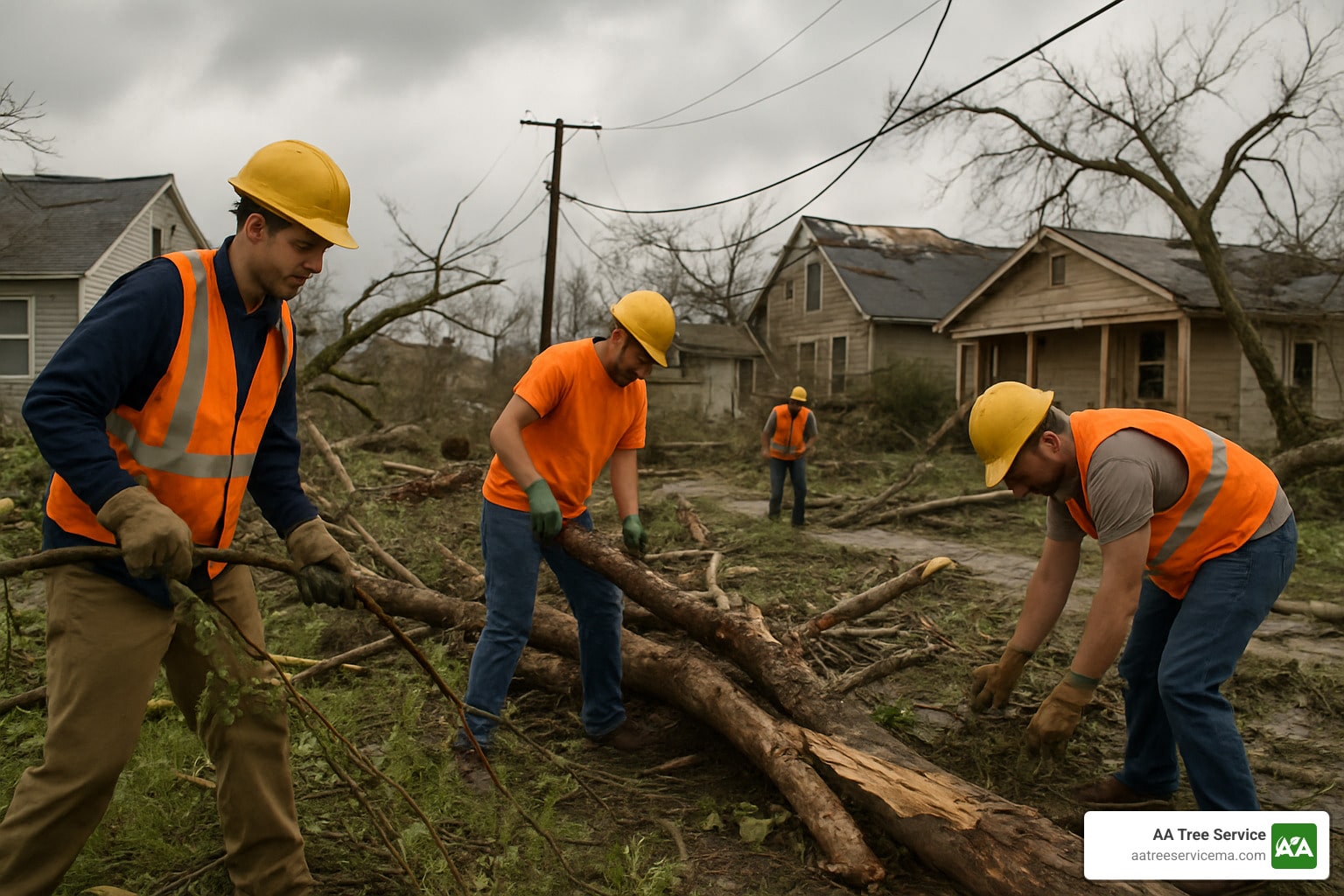
When Disaster Strikes: Finding Storm Clean Up Near Me
Looking for storm clean up near me services? Here’s what you need to know immediately:
- Emergency Response Time: Most professional services offer 24/7 response within 4-6 hours
- Average Cost: $3,000-$7,000 for standard cleanup (can range from $200 for minor debris to $17,000 for tornado damage)
- Safety First: Never attempt to remove trees near power lines or structures
- Insurance Coverage: Most homeowner policies cover storm damage cleanup when trees fall on structures
- Professional vs DIY: Consider professional services for anything beyond small branches and yard debris
When severe weather tears through Massachusetts or New Hampshire, the aftermath demands immediate attention. Storm clean up near me services become essential when you’re facing fallen trees, scattered debris, and potential structural damage to your home. The hours immediately following a storm are critical not just for safety, but for preventing secondary damage like mold growth and further structural compromise.
“After a storm passes, it’s time to take a look at the damage your home suffered,” advises restoration experts. But where do you even start when your yard resembles a disaster zone?
Professional storm cleanup crews combine specialized equipment, safety training, and efficient processes to restore your property quickly. While minor debris like small branches and leaves can be handled personally, larger jobs involving downed trees, structural damage, or flooding require professional intervention.
The difference between DIY and professional storm cleanup often comes down to three factors: safety, time, and thoroughness. Professional teams bring chainsaws, cranes, wood chippers, and protective equipment—along with the expertise to use them safely. They’re also trained to spot hidden damage that might escape an untrained eye.
For homeowners in Massachusetts and New Hampshire, finding reliable storm cleanup services quickly can mean the difference between a swift recovery and prolonged disruption. Local services familiar with regional weather patterns and tree species can provide the most effective response.
Common storm clean up near me vocab:
– broken trees
– emergency tree branch removal
– storm damaged
Why Fast, Safe Cleanup Matters
The urgency of storm cleanup goes beyond aesthetics. Paul Abrams, a restoration professional, notes that “without professionals after major storms like Harvey and Irma, homeowners risk serious mold growth.” This highlights one of the primary reasons for swift action—preventing secondary damage that can multiply your problems.
Fast cleanup matters for three critical reasons:
- Public Safety: Fallen trees and branches create hazards for your family, neighbors, and passersby. Dangling limbs (called “widow makers” in the industry) can fall without warning.
- Property Value Protection: Standing water, debris piles, and unaddressed damage can lead to long-term devaluation of your property. What starts as storm debris can quickly become a breeding ground for pests and mold.
- Mold Prevention: After water intrusion, you have approximately 24-48 hours before mold begins to develop. Professional cleanup services prioritize moisture removal to prevent this costly and health-threatening complication.
“The howling wind has finally died down, and the rain has stopped falling. While the storm is officially out of town, the mess it left behind remains,” describes one cleanup specialist. This mess requires immediate attention to prevent it from becoming a much bigger problem.
Storm Clean Up Near Me: Key Facts & Safety Essentials
Before you even begin cleanup efforts—whether DIY or professional—understanding the hazards is crucial. Post-storm environments present multiple hidden dangers that require careful navigation.
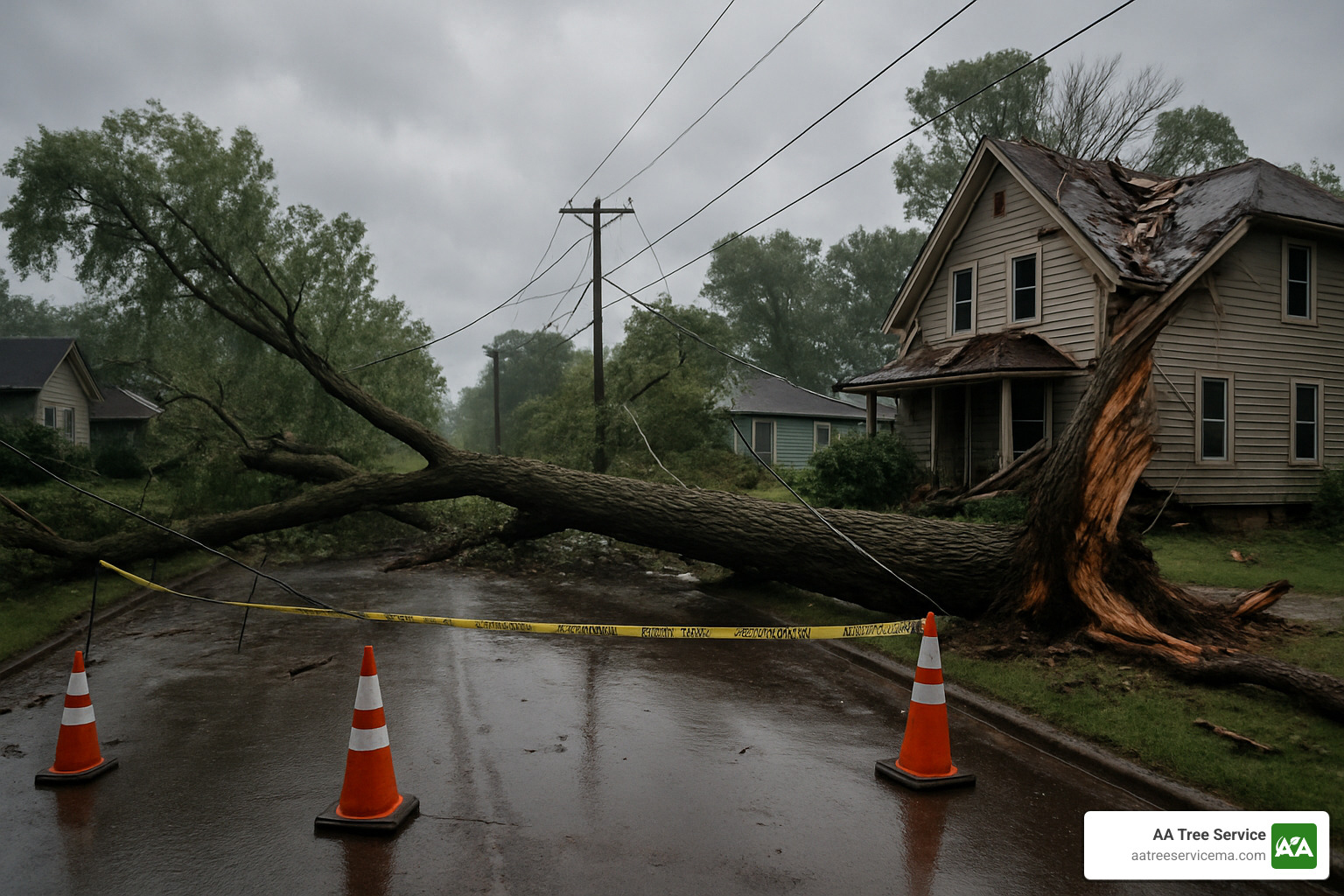
The aftermath of a storm can be deceptively dangerous. I remember talking to a homeowner in Concord who thought the worst was over once the winds died down—until a seemingly stable tree suddenly shifted near their garage. The most immediate threats after a storm aren’t always obvious.
Downed power lines should always be treated as live and lethal. Keep at least 30 feet away—about the length of two parked cars—and contact your utility company right away. Even if they look harmless, they can energize puddles, metal fences, and other conductors from a distance.
Unstable trees might show no external signs of danger. As one of our arborists noted after last year’s nor’easter, “A tree that leaned over 20° failed to recover without intervention.” The root system could be compromised even when the trunk appears intact, creating a ticking time bomb in your yard.
Floodwater contaminants make wading through standing water particularly hazardous. What looks like simple rainwater often contains sewage, household chemicals, and other toxins. A client in Manchester learned this the hard way when a seemingly harmless puddle in their basement led to a nasty infection from contaminated water.
Structural instability isn’t always obvious to untrained eyes. Roofs, decks, and walls can be seriously compromised by wind and water damage. What looks like a simple cleanup job could become dangerous if weakened structures give way while you’re working.
When it comes to personal protection, there’s no room for shortcuts. At minimum, you should gear up with work gloves to prevent cuts, safety glasses to protect your eyes from debris, sturdy boots with thick soles (those hidden nails are sneaky!), and a hard hat when working around trees or damaged structures. If you’re dealing with moldy materials or dusty debris, a proper respirator mask is essential—not just the cloth masks we’ve all become familiar with.
Before diving into cleanup, take a moment to assess the situation systematically:
- Use your nose first—check for gas leaks by smell or hissing sounds
- Scan for electrical hazards like sparking wires or wet electrical equipment
- Test structural stability from a safe distance before approaching damaged areas
- Look up and around for hanging branches (what tree workers ominously call “widow makers”)
- Document everything with detailed photos for your insurance claim
- Create a priority list starting with the most serious safety issues
If flooding has reached your kitchen, proper sanitation becomes crucial for family health. The CDC recommends a simple but effective method for sanitizing dishes: after washing with hot, soapy water, immerse them for 10-15 minutes in a solution of 1 tablespoon of unscented liquid bleach per gallon of water. This extra step kills lingering bacteria that could make your family sick.
What Counts as Storm Debris?
Storm debris isn’t just branches and leaves—it’s a complex mix of materials that each require specific handling approaches.
The most common vegetative debris includes fallen trees, broken limbs, uprooted shrubs, and scattered leaves. While this might seem straightforward to clean up, large trees can weigh several tons and create serious hazards when attempting removal without proper equipment.
Construction and demolition debris often surprises homeowners with its volume. Those damaged shingles, torn siding pieces, broken gutters, shattered window glass, and water-soaked drywall add up quickly. A client in Nashua was shocked when what seemed like “just a few shingles” turned into three truckloads of construction debris.
Household items damaged by storms present their own challenges. Water-damaged furniture, soaked carpeting, and flooded appliances are heavy, awkward to move, and potentially hazardous if electrical components are involved.
Perhaps most concerning is hazardous waste displaced by flooding—paints, household chemicals, propane tanks, and waterlogged electronics containing batteries. These items require special handling and disposal methods to protect both people and the environment.
As one Florida restoration specialist humorously put it after a hurricane, “Sometimes a hurricane ‘laughs and throws a car’ through your window.” While we don’t see quite that level of destruction in Massachusetts and New Hampshire, the variety of debris can still be surprising after severe weather events.
DIY vs. Pro Clean-up
The decision between handling storm cleanup yourself or calling professionals often comes down to honest assessment of the situation’s scope, safety concerns, and equipment requirements.
DIY cleanup makes sense for minor situations like gathering small branches from your yard, sweeping up broken glass from a single window, or mopping up minor water from small leaks. If you’re reasonably fit, have basic safety equipment, and the damage is limited, handling it yourself can save money and give you a sense of control in a chaotic situation.
Professional help becomes necessary when you’re facing more significant challenges. Trees resting on structures or tangled in power lines require specialized knowledge and equipment. As one professional explains, “It is a big no to handle hazardous or heavy junk removal on your own as it risks your health.” This isn’t just caution—it’s wisdom born from seeing too many DIY disasters.
The equipment gap between homeowners and professionals is substantial. While you might have a basic chainsaw and ladder, professionals arrive with commercial-grade equipment: powerful chainsaws with various bar lengths, wood chippers, cranes, specialized rigging equipment, industrial water pumps, and professional-grade dehumidifiers. This equipment difference translates directly to safety and efficiency.
Liability concerns also favor professional services. If that half-cut tree suddenly falls in an unexpected direction and damages your neighbor’s property, your homeowner’s insurance might deny coverage if you were attempting work beyond your expertise. Professional services carry insurance specifically for these situations.
For comprehensive Storm Cleanup Services, AA Tree Service brings over 20 years of experience to properties across Massachusetts and New Hampshire. Our teams arrive prepared with both the equipment and expertise to handle everything from fallen branches to massive tree removal, ensuring your property returns to normal as quickly and safely as possible.
Finding & Vetting Local Pros
When searching for storm clean up near me services, proper vetting is essential. The aftermath of storms often brings out both legitimate professionals and opportunistic, unqualified workers.
Start by verifying these essential qualifications when calling around. First, check for proper licensing – legitimate tree services should have state licensing. In Massachusetts, for example, tree removal companies need to be registered with the Department of Agricultural Resources if they’re applying pesticides.
Insurance is non-negotiable – never hire an uninsured company. Proper coverage should include general liability (minimum $1 million), workers’ compensation, and property damage coverage. Don’t just take their word for it – ask to see certificates and even call the insurance company to verify if you have concerns.
If you’re dealing with tree-related storm damage, look for an ISA-Certified Arborist. This certification from the International Society of Arboriculture isn’t just a fancy title – it indicates professional knowledge and adherence to industry standards that can make all the difference in safely handling damaged trees.
Storms don’t follow business hours, which is why 24/7 emergency response capability is crucial. Companies like AA Tree Service offer round-the-clock emergency response throughout Massachusetts and New Hampshire, ensuring you’re not left waiting when dangers are present on your property.
Reputable services should also provide same-day quotes – free of charge – to help you make quick decisions during emergency situations. This responsiveness often indicates a company’s overall reliability and customer service approach.
| Comparison | Licensed Professionals | Unlicensed Workers |
|---|---|---|
| Insurance Coverage | Comprehensive liability and workers’ comp | Limited or none |
| Equipment Quality | Commercial grade, regularly maintained | Often consumer grade or poorly maintained |
| Safety Protocols | OSHA compliant, formal training | Minimal or no formal safety training |
| Disposal Methods | Legal, environmentally responsible | May dump illegally or improperly |
| Cost | Higher upfront, lower long-term risk | Lower upfront, higher risk of additional costs |
| Warranty | Often provided in writing | Rarely offered |
Typical Cost Ranges & Insurance Coverage
Storm cleanup costs vary widely based on the extent and type of damage. According to industry data, average costs fall between $3,000 and $7,000, with most homeowners paying around $5,000 for comprehensive cleanup.
The price tag changes dramatically depending on what Mother Nature threw your way. Snow and ice damage might run $200–$1,500, while windstorm cleanup typically costs $200–$3,000. Minor fire cleanup averages $400–$1,000, and flood restoration jumps to $2,000–$5,000. Thunderstorm aftermath usually runs $2,000–$5,500, with hail damage reaching $3,000–$12,000. The most expensive? Tornado cleanup, which can range from $4,000 all the way to $17,000.
These figures represent industry averages based on internet data and not actual costs for AA Tree Service. Your actual price will depend on several factors: debris volume (more debris means more labor, equipment, and disposal fees), danger level (hazardous conditions like trees on structures or near power lines increase costs), location (access difficulties can increase labor costs), equipment needs (specialized equipment like cranes adds to the overall price), and disposal fees (local dump fees and regulations affect final costs).
When it comes to insurance, there’s good news: homeowner’s policies typically cover removal of storm-damaged trees that fall on structures due to natural causes. As one insurance specialist confirmed to me recently, “Homeowner’s insurance often covers damage from – and removal of – storm-damaged trees that fall on your home or other structures due to natural causes.” However, this coverage may not apply if the damage resulted from neglect or poor maintenance of your trees.
Documentation is absolutely critical for insurance claims. Before cleanup begins, take extensive photos of all damage, document the condition of trees before removal, keep all receipts and written estimates, and request itemized invoices that separate labor, equipment, and disposal costs.
7-step Hiring Checklist for “Storm Clean Up Near Me”
When you need storm cleanup services quickly, follow this seven-step process to ensure you hire qualified professionals:
First, search reviews and references. Look for companies with established presence and positive reviews specifically mentioning storm cleanup. Ask neighbors who they’ve used successfully – word-of-mouth recommendations are gold in this industry.
Second, verify credentials thoroughly. Request proof of business license, insurance certificates (call the insurance company to verify), professional certifications, and membership in professional organizations like Tree Care Industry Association.
Third, request an on-site quote. Never accept estimates over the phone for storm damage – what looks minor could hide major issues. Reputable companies like AA Tree Service offer free same-day quotes with detailed scope of work.
Fourth, confirm the disposal plan. Ask specifically where debris will be taken, whether disposal fees are included in the quote, if recyclable materials will be handled separately, and whether they’ll leave a clean site when finished.
Fifth, clarify the timeline. Establish when work will begin, the estimated completion time, priority order of tasks, and contingency plans for additional damage found during the cleanup process.
Sixth, get a written contract. Ensure it includes detailed scope of work, cost breakdown, payment terms, warranty information, and liability clauses. Verbal agreements leave too much room for misunderstanding.
Finally, keep documentation of everything. Maintain before and after photos, all written communications, receipts and invoices, and warranty information. This paper trail protects you and simplifies insurance claims.
As one lawn care professional wisely noted, “You’re selling convenience, not just labor,” highlighting why professional storm cleanup services command higher rates than standard yard work. After a devastating storm, that convenience – and the peace of mind that comes with it – is worth every penny.
Emergency Tree Removal & Limb Clearing
When storms tear through Massachusetts and New Hampshire, fallen trees and dangerous hanging limbs create immediate hazards that can’t wait. Emergency tree removal often becomes the first priority in storm clean up near me situations.
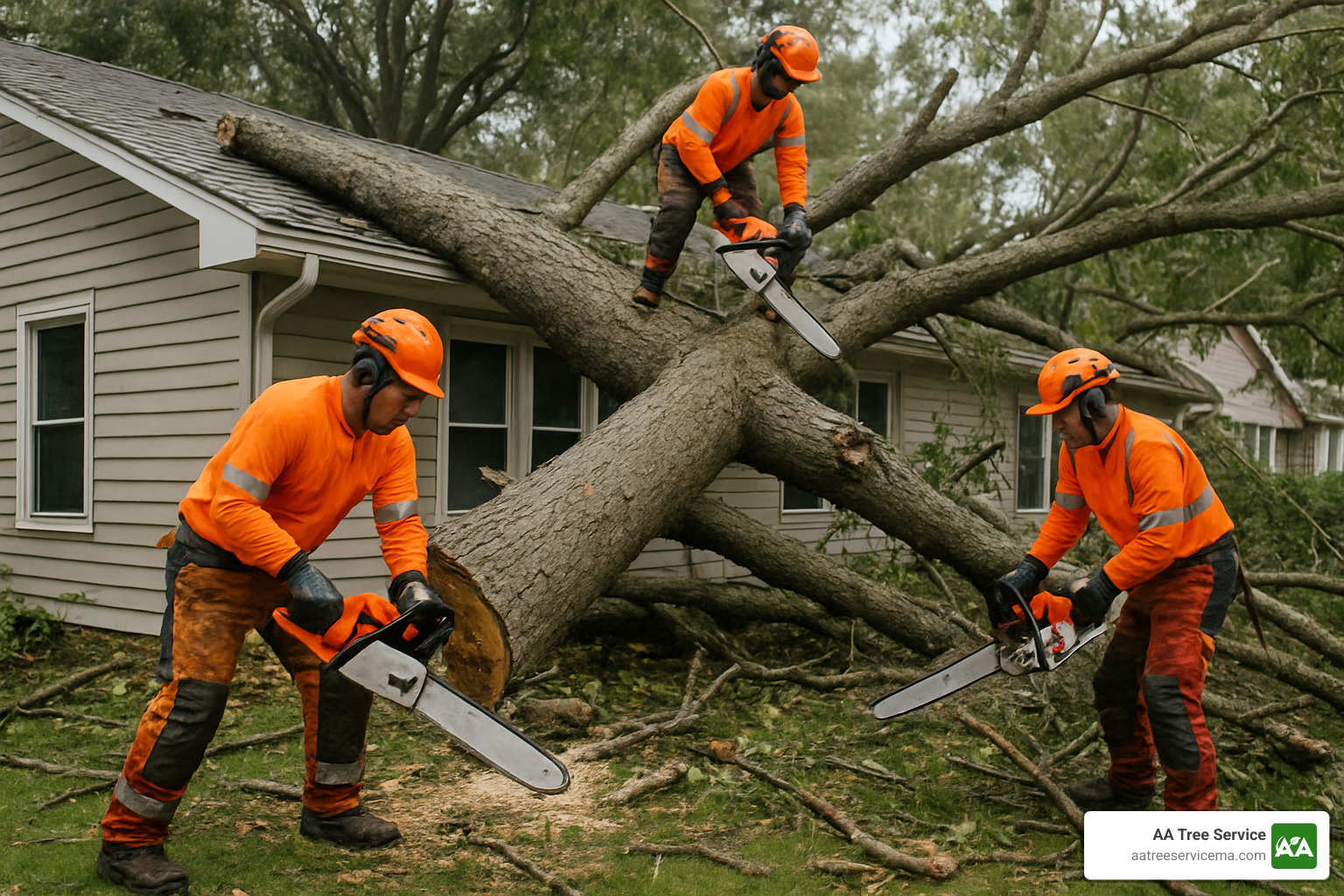
“That massive oak that’s been in your yard for decades can become your home’s worst enemy in just seconds during a nor’easter,” explains one of our arborists. “When a tree lands on your home, professional crews work to minimize further damage during removal.” This precision work isn’t just about cutting wood—it’s about preventing a bad situation from becoming catastrophic.
After storms rage through, we typically see several emergency scenarios that need immediate attention:
Complete uprooting happens when entire trees get pulled from saturated ground, often leaning precariously against homes. Trunk failures occur when trees snap partway up, creating unpredictable fall patterns that threaten anything nearby. Partial falls might look stable but are actually “widow makers” waiting to drop. Those hanging limbs that seem to defy gravity? They won’t stay up there forever. Even leaning trees that haven’t fallen indicate root plate failure that puts your property at risk with every passing breeze.
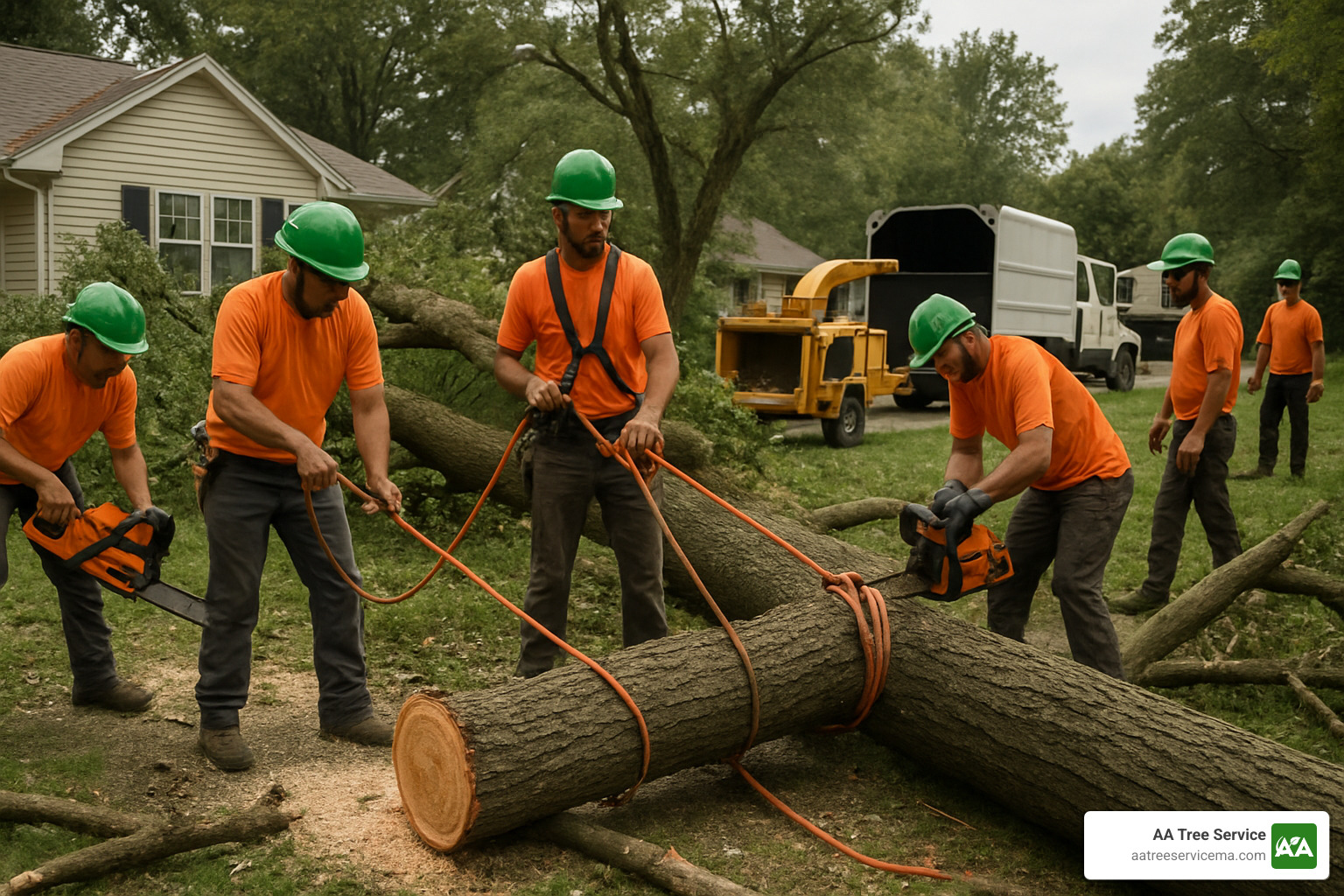
The removal process isn’t as simple as “cut it down.” Professional emergency removal follows careful steps to ensure safety and minimize property damage. We start with a thorough assessment of the tree’s stability and potential fall zones. Then we secure the area with safety perimeters to protect family members and neighbors. Rigging preparation involves setting up specialized equipment for controlled dismantling, followed by systematic removal where we cut the tree in carefully planned sections. The lowering of debris uses controlled techniques to prevent additional damage to your home. Finally, we perform stump evaluation to determine if immediate grinding is necessary.
For trees already resting on your home or garage, AA Tree Service employs crane-assisted removal when necessary. This technique allows us to literally lift tree sections away from your structure without adding pressure to already damaged areas—like removing a splinter with tweezers instead of pushing it deeper.
Don’t forget what’s underground, either. “Even after all visible debris is cleared, compromised root systems from neighboring trees can pose ongoing hazards,” cautions our head arborist. “That’s why our Emergency Tree Removal service includes thorough evaluation of remaining trees that might have been weakened by the same storm.”
Safety Protocols & Equipment
Professional tree crews don’t just bring bigger chainsaws—they bring comprehensive safety systems that make all the difference in storm cleanup situations.
The equipment arsenal for safe emergency tree work goes far beyond what most homeowners have in their garage. Professional-grade chainsaws with safety features like chain brakes and anti-kickback devices are just the starting point. Winches and come-alongs provide controlled directional pulling to guide fallen trees. Rigging equipment including specialized ropes, pulleys, and friction devices allows for precise control of heavy sections. Every crew member wears comprehensive personal protective equipment including hard hats, face shields, cut-resistant chaps, and steel-toed boots. And communication devices keep everyone coordinated during complex removals when chainsaws make verbal commands impossible.
What truly separates professionals from DIYers isn’t just the tools, but the protocols. Before the first cut, our crews perform a complete 360° hazard assessment of the tree and surrounding area. We establish clear escape routes that everyone memorizes before work begins. Our cut planning determines precise notch placement and cutting sequence to prevent binding or unexpected movement. We identify areas of tension and compression in the wood that could cause dangerous kickback. Spotters are strategically positioned to watch for hazards the cutter can’t see. And we continuously monitor weather conditions that might change during the operation.
“I once watched a homeowner try to remove a storm-damaged maple with nothing but a ladder and a homeowner chainsaw,” shares one of our veteran crew leaders. “He was lucky to walk away with just a broken wrist. That same job took our professional crew three hours using specialized rigging to avoid crushing the garden shed below.”
Having seen the aftermath of hundreds of New England storms, we know that even seemingly minor damage can hide serious hazards. “After a home addition excavation, a nearby oak showed wilting and yellowing foliage,” one of our arborists recalls. “The homeowners ignored it until a moderate thunderstorm sent it crashing through their new sunroom.” This highlights why professional assessment matters—we spot the warning signs others miss.
When you’re searching for storm clean up near me services after severe weather strikes Massachusetts or New Hampshire, emergency tree work combines the danger of tree removal with the urgency of disaster response. This isn’t the time to save a few dollars with an unqualified crew or a DIY approach. Your safety, your property, and potentially your insurance coverage all depend on proper handling of these dangerous situations.
Debris & Junk Hauling Services
After the immediate dangers are addressed, the next challenge is managing the substantial debris left behind by storms. Professional Tree Debris Removal Service offers efficient solutions for clearing everything from branches to construction materials.
“Why go through the trouble of a dumpster rental and hiring someone for the hard labor? You can simply call for junk removal service and pay less!” advises one cleanup specialist. This highlights the convenience factor of full-service debris removal.
Storm debris typically includes a mix of:
- Vegetative materials (branches, leaves, uprooted plants)
- Building materials (shingles, siding, broken gutters)
- Damaged household items (furniture, carpeting, appliances)
- Miscellaneous debris (fence sections, outdoor decorations, play equipment)
Professional hauling services offer several advantages over dumpster rental:
- Labor Included: No need to fill the container yourself
- Flexible Capacity: Pay only for what you need removed
- No Property Damage: Avoid having a heavy dumpster sitting on your driveway or lawn
- Sorting Expertise: Professionals know what can be recycled, what requires special disposal
- Immediate Removal: No waiting period for dumpster pickup
“Customers enjoy having their windows ‘boarded up’ by our team and not worrying about doing it themselves,” mentions one service provider, emphasizing the value of comprehensive services during stressful times.
Municipal curbside collection rules vary significantly across Massachusetts and New Hampshire communities. Some key considerations:
- Many towns limit branch diameter (typically 4 inches or less)
- Length restrictions (often 4-6 feet) apply to branches
- Special pickup schedules may be implemented after declared disasters
- Some communities require advance scheduling for storm debris collection
Disposal & Recycling Options
Responsible storm debris management includes proper sorting and recycling whenever possible. Professional services prioritize environmental responsibility in debris handling.
“Professional providers can handle all types of waste—solid, gas, and liquid—safely,” notes one removal specialist. This comprehensive approach ensures compliance with environmental regulations.
Common recycling and disposal paths include:
Wood Debris:
– Chipping for mulch (AA Tree Service can often leave useful mulch on-site if desired)
– Biomass fuel production
– Composting of smaller materials
Metal Components:
– Scrap metal recycling for gutters, flashing, and other metal building components
– Appliance recycling with proper refrigerant recovery
Construction Materials:
– Sorting for recyclable components (clean wood, metal, some plastics)
– Proper disposal of treated or contaminated materials
Electronic Waste:
– Specialized e-waste collection for water-damaged electronics
– Data recovery when possible
After the massive storms in Philadelphia in recent years, recycling programs diverted thousands of tons of storm debris from landfills, demonstrating the potential for environmental benefits even in disaster situations.
“Recycling reusable materials during clean up reduces landfill waste and generates revenue for environmental causes,” explains one junk removal professional, highlighting the dual benefits of proper sorting.
For Massachusetts and New Hampshire residents, AA Tree Service provides comprehensive debris removal with a focus on responsible disposal practices, ensuring that as much material as possible is recycled or repurposed.
Water Extraction & Mold Mitigation
When storms bring flooding or water intrusion, swift action is essential to prevent long-term damage and health hazards. Professional water extraction services use specialized equipment to remove water and begin the drying process.
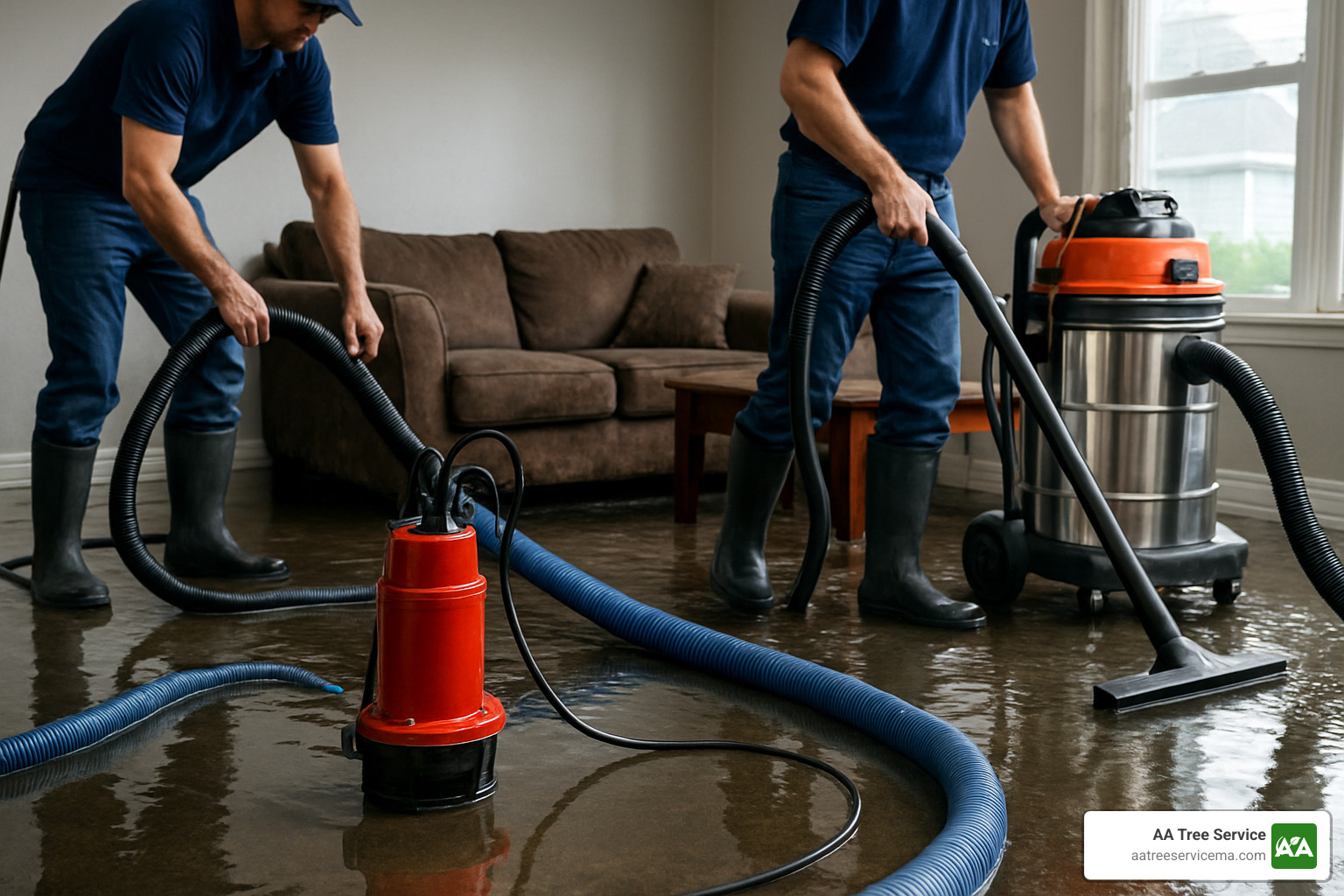
“After a storm passes, it’s time to take a look at the damage your home suffered,” advises one restoration expert. For water damage, this assessment must lead to immediate action—not tomorrow, not next week, but right now.
The arsenal of professional water extraction equipment is impressive and purpose-built. Submersible pumps tackle standing water deeper than 2 inches, while wet/dry vacuums handle the residual moisture. Commercial dehumidifiers and air movers work together to accelerate evaporation and dry out spaces. The real magic happens with moisture meters and thermal imaging cameras, which reveal hidden water lurking in walls, floors, and ceilings that would otherwise go undetected until mold appears.
A typical extraction process unfolds like a well-choreographed dance. First comes the assessment, where technicians determine just how bad things really are. Then the actual water removal begins with pumps and vacuums. Any saturated materials that can’t be saved (like soaked drywall or insulation) must go. Next, drying equipment is strategically positioned to create optimal conditions. Throughout the process, moisture levels are carefully monitored until normalcy returns. Finally, antimicrobial treatments are applied to prevent unwelcome mold visitors.
“Pump out flooded basements gradually—about one-third per day—to avoid structural collapse,” recommends one water damage specialist. This counterintuitive advice highlights why professionals bring value; what seems logical (removing water as fast as possible) could actually cause your foundation walls to buckle inward.
Don’t forget your HVAC system after flooding. These complex systems can become perfect breeding grounds for mold and bacteria, potentially distributing contaminants throughout your home when restarted. A licensed technician should always inspect them before you turn them back on.
Preventing Secondary Damage
The clock starts ticking the moment water enters your home. You have a narrow 24-48 hour window before mold takes hold and structural deterioration accelerates. This is why professional mitigation focuses on this crucial timeframe.
“Without professionals after Harvey and Irma, homeowners risk serious mold growth,” warns one restoration expert. This isn’t just true for historic hurricanes—even a relatively minor flood from a Massachusetts nor’easter carries the same biological timeline.
Rapid moisture removal forms the cornerstone of preventing secondary damage. Water doesn’t just sit there—it immediately begins soaking into materials, wicking up walls, and creating perfect conditions for mold. Proper material assessment requires experience; professionals can determine what can be saved versus what must be removed, often saving homeowners thousands in unnecessary replacements.
The strategic placement of equipment might look random to untrained eyes, but professionals position air movers and dehumidifiers based on airflow physics and moisture mapping. They also continuously monitor humidity levels to maintain the sweet spot for drying without creating new problems like wood warping from drying too quickly.
The CDC provides detailed scientific research on bleach disinfection that guides professional cleaning practices after flooding. These aren’t just arbitrary guidelines—they include specific dilution ratios and contact times based on laboratory testing of pathogen elimination.
“Open all windows and direct fans at perimeter walls to prevent mold,” suggests one cleanup specialist. This simple but effective strategy can help homeowners take action while awaiting professional help, especially important in areas of New Hampshire and Massachusetts where service delays might occur during regional flooding events.
Different structural materials demand different approaches. Wood structures need gradual drying to prevent warping and splitting. Concrete requires thorough drying before refinishing to prevent adhesion failures down the road. And that water-saturated drywall? It usually needs to go, serving as perfect mold food once wet.
AA Tree Service partners with trusted water mitigation specialists throughout Massachusetts and New Hampshire to provide comprehensive storm clean up near me services. While tree damage might be the most visible issue after a storm, the hidden water damage often poses the greater long-term threat to your home and health.
Roof Tarping & Structural Stabilization
When storms tear through your property, your home might be left vulnerable to the elements. Quick action with temporary roof tarping and structural supports can be the difference between minor repairs and catastrophic damage to your home’s interior.
“Heavy, wet snow and ice can pull down limbs and even uproot trees,” explains one tree care professional. When these fallen trees and branches impact your home, acting fast becomes essential to prevent water from causing thousands in additional damage.
Professional roof tarping isn’t just throwing a blue tarp over the damage—it’s a systematic process that includes:
First, a thorough damage assessment where professionals identify all compromised areas needing protection. Next comes debris removal, clearing everything from broken branches to scattered shingles from your roof surface. Crews will perform temporary repairs wherever possible, securing loose materials before applying protective underlayment beneath the tarp for extra water resistance.
The actual tarp securing uses lumber battens rather than just nails or staples, creating a wind-resistant seal that won’t tear away during the next gust. Finally, careful edge sealing ensures water can’t sneak in around the perimeter—a step many DIY tarping attempts miss.
Beyond your roof, structural stabilization might be necessary with temporary support beams propping up damaged rafters, bracing for compromised wall sections, foundation shoring, or board-ups for broken windows and doors. These measures protect both your property and your family’s safety until permanent repairs can begin.
“Lightning strikes can damage a tree’s trunk and internal structure,” notes one arborist. This invisible damage principle applies equally to homes, where storm impacts may have caused structural weaknesses that aren’t immediately visible but require professional assessment.
Before any tarping or board-up begins, make sure comprehensive photos document all damage for your insurance claims. These “before” pictures are worth their weight in gold when filing for coverage.
When it comes to emergency roof work, safety is paramount. Professional teams never cut corners with ladder safety, using proper positioning and securing techniques, fall protection equipment, multiple crew members for stability, and weather-appropriate safety gear. What might seem like a simple tarp job can quickly become dangerous for inexperienced homeowners.
Response Time Expectations
When your home is exposed to the elements, every minute counts. Understanding typical response times for storm clean up near me services helps set realistic expectations during what’s already a stressful situation.
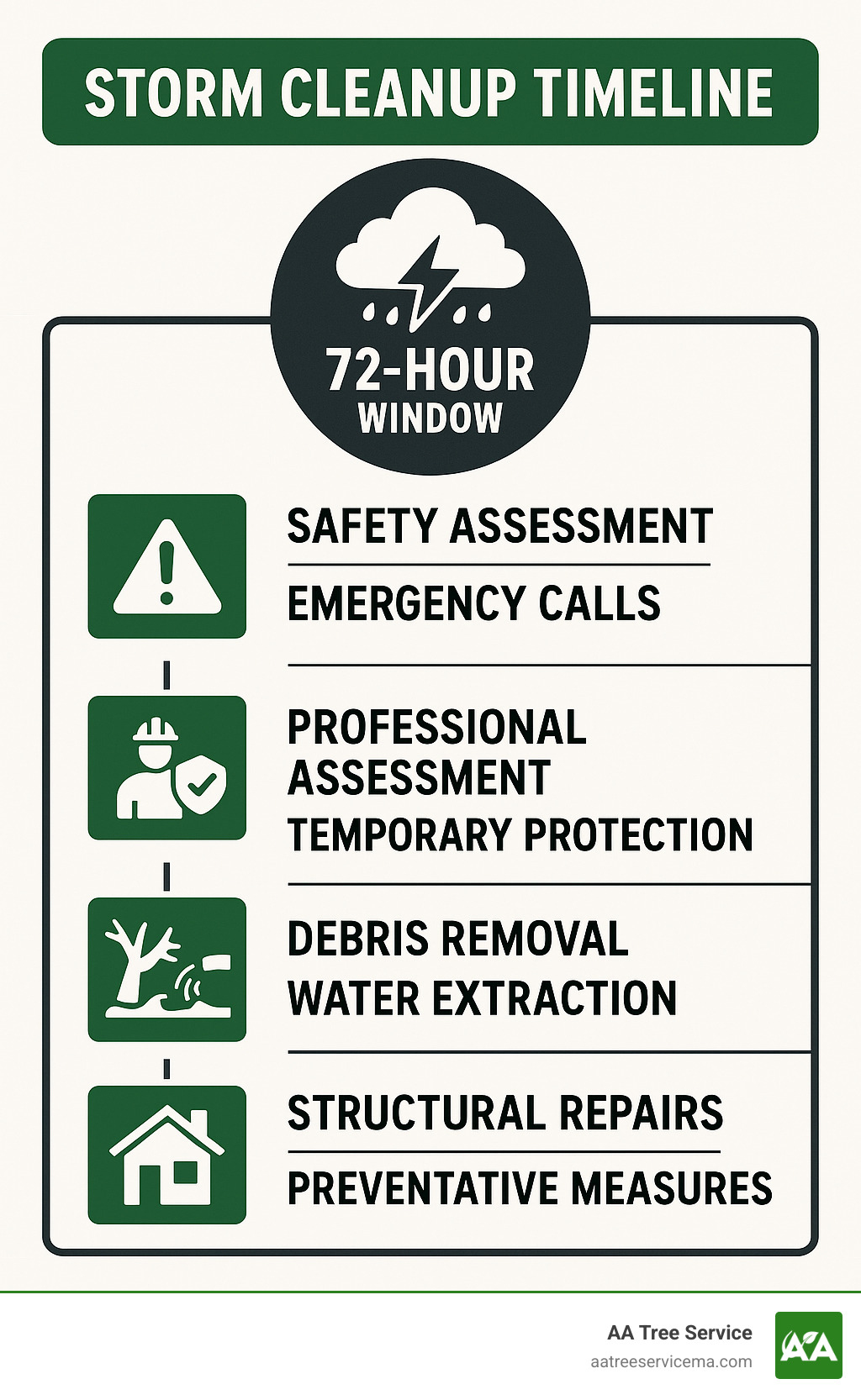
Most professional emergency services aim to provide initial phone response within 15-30 minutes of your call. You can generally expect an on-site assessment within 1-4 hours (weather and road conditions permitting), with emergency tarping and board-up completed within 4-6 hours from your initial call. A detailed written assessment for insurance and permanent repairs typically follows within 24-48 hours.
Several factors affect how quickly help arrives at your door. The storm’s severity and regional impact play a major role—during widespread disasters, crews are stretched thin. Travel conditions and road closures can delay even the most responsive teams, while material availability might be limited during large-scale emergencies. Most importantly, companies prioritize based on severity, with homes at risk of structural collapse receiving immediate attention.
The journey from emergency protection to permanent repair typically follows this timeline: emergency protection within the first 24 hours, detailed assessment and repair estimates within 1-3 days, insurance approval in 3-10 days, and permanent repairs scheduled within 1-4 weeks, depending on the extent of damage.
“Storm teams are available 24/7, 365 days a year,” emphasizes one restoration company, highlighting the round-the-clock commitment that characterizes professional emergency services. This immediate availability can mean the difference between a minor inconvenience and a major renovation project.
AA Tree Service’s 24/7 emergency response team prioritizes rapid deployment throughout Massachusetts and New Hampshire, ensuring homes are protected from additional damage as quickly as possible. Their crews arrive ready to secure your property and provide peace of mind when you need it most.
Yard & Landscape Restoration
Once immediate hazards are addressed, restoring your landscape becomes the focus. Professional yard restoration services help reclaim your outdoor spaces after storm damage.

“The howling wind has finally died down, and the rain has stopped falling. While the storm is officially out of town, the mess it left behind remains,” as one landscape professional so aptly puts it. That mess doesn’t just disappear on its own – it requires a thoughtful, systematic approach to restoration.
After the chainsaws quiet and the emergency crews depart, your yard might look like a battlefield. Soil erosion often leaves deep channels where rainwater carved new paths. Lawn damage appears as torn-up turf from fallen trees or heavy equipment used during cleanup. Many homeowners also face significant plant loss, with cherished landscaping uprooted or crushed beyond saving.
Less visible but equally troublesome are irrigation damage to sprinkler systems and hardscape damage affecting patios, walkways, and retaining walls. These issues won’t resolve themselves and require professional attention to prevent further deterioration.
“We often see homeowners focus exclusively on tree damage while missing the subtler landscape issues that can create problems down the road,” explains one restoration specialist from Massachusetts. “Proper grading and drainage restoration prevents future flooding and foundation issues.”
The restoration process typically begins with thorough debris removal – getting rid of every last twig, leaf cluster, and wood chip from the cleanup operation. Next comes a careful soil assessment to identify contamination or nutrient deficiencies that might hinder new growth. Many storms in New England leave behind sandy deposits or expose clay subsoil that needs amendment.
Proper grading and erosion control follow, restoring the natural contours of your property and ensuring water flows away from structures. This often involves bringing in additional topsoil and creating subtle berms or swales to direct water movement.
“Plant water-loving shrubs or trees near recurring puddles to help absorb excess water,” suggests one landscape expert. “Native species like red maple or river birch thrive in those spots and create natural solutions to drainage problems.”
Smart homeowners don’t waste those storm-damaged leaves and small debris. “Use storm-damaged leaves for compost rather than disposal,” recommends one expert. This environmentally friendly approach creates valuable soil amendment for next season while reducing landfill waste.
Proactive Tree Care for Next Storm
The best defense against future storm damage is proactive tree care. Professional arborists can identify and address potential issues before they become hazards.
“Healthy, well-maintained trees are more likely to survive future storms,” explains one tree care professional. “It’s like preventative medicine – a little care now prevents catastrophic failure later.”
Structural pruning forms the foundation of storm preparation. By removing dead or diseased limbs, thinning dense canopies to reduce wind resistance, and eliminating crossing branches, arborists create stronger, more resilient trees. This isn’t just about aesthetics – it’s about creating tree structures that can flex and bend without breaking when the next nor’easter hits Massachusetts or New Hampshire.
For trees with identified weaknesses, cabling and bracing provides additional support. These systems reduce stress on weak branch unions and can save valuable mature trees that might otherwise need removal. “The cost of cabling a cherished oak is typically a fraction of what removal and replacement would cost,” notes one certified arborist.
What happens below ground matters just as much as what you can see. Root zone management through proper mulching (not volcano mulching!), preventing soil compaction, and appropriate irrigation encourages deep, extensive root systems that anchor trees more securely.
“Consistent plant health care—mulching, watering and fertilizing—improves storm resilience,” notes one arborist. “Trees are living organisms that respond to care. When we improve their growing conditions, they develop stronger structures naturally.”
Fertilization and health care complete the picture. Based on soil testing, targeted nutrient applications address specific deficiencies. Disease and pest management prevents weakening from secondary issues. In some cases, growth regulation treatments can actually strengthen woody tissue while reducing excessive canopy growth.
For trees with existing damage from previous storms, AA Tree Service offers comprehensive Broken Trees assessment and remediation services throughout Massachusetts and New Hampshire. Their certified arborists can determine whether damaged trees can be salvaged or require removal before they become hazards in the next storm.
“Perform regular mulching and fertilizing throughout the year,” advises one tree care professional. “Just like you wouldn’t wait until you’re sick to start eating well, don’t wait until after storm damage to start caring for your trees.”
With proper restoration and proactive care, your landscape can recover from storm damage and develop greater resilience for the future. The investment pays dividends in property value, environmental benefits, and peace of mind when the next storm clean up near me search becomes necessary.
Frequently Asked Questions about Storm Clean Up Near Me
How Soon Should I Call a Cleanup Crew?
The moment you can safely assess storm damage is the moment you should be reaching for your phone. Ideally, professional cleanup crews should be contacted within the first 24 hours after a storm passes. This isn’t just about getting your property back to normal faster—it’s about preventing a cascade of secondary problems.
“Don’t wait until after you’ve talked to your insurance — call restoration pros ASAP,” as one weathered cleanup expert puts it. This advice recognizes a simple truth: water damage doesn’t wait for insurance adjusters, and neither should you.
For truly urgent situations—like that massive oak now resting on your roof or water rapidly rising in your basement—companies like AA Tree Service offer genuine 24/7 emergency response throughout Massachusetts and New Hampshire. Less pressing matters like general yard debris can typically wait 1-3 days, though earlier is always better.
Even if you’re on the fence about whether professional help is necessary, reputable services offer free assessments. There’s no downside to having experts evaluate your situation, and it might reveal hidden dangers you hadn’t noticed.
Does Homeowner’s Insurance Pay for Debris Removal?
When it comes to insurance coverage for storm cleanup, the answer is a qualified “yes”—with several important asterisks attached. Your policy typically covers debris removal under specific circumstances:
Trees on Structures: If that 80-foot pine fell on your house because of wind or lightning, you’re generally covered for both the structural damage and the tree removal. This is the most straightforward scenario.
Property Access Issues: Many policies will cover removing trees blocking driveways or handicap access points, even if no structures were damaged.
General Yard Debris: Here’s where coverage often falls short. Basic yard debris cleanup usually isn’t covered unless it’s directly related to a covered structure loss.
“Homeowner’s insurance typically covers damage from – and removal of – storm-damaged trees that fall on your home or other structures due to natural causes,” confirms an insurance specialist who’s seen countless post-storm claims.
The fine print matters enormously here. Your policy specifics will determine what’s covered, so contacting your insurance provider should be high on your priority list after ensuring everyone’s safety. Key considerations include your deductible (typically $500-$2,500), coverage limits (often $500-$1,000 per tree with a maximum of $1,000-$5,000 per incident), and cause of damage (neglected trees might not qualify).
Documentation is your best friend during this process. Take extensive before-and-after photos and request detailed, itemized invoices from your cleanup service. As one tree professional notes, “Insurance companies often itemize payments for removing a tree from a structure versus debris removal,” making clear documentation essential for maximum reimbursement.
What Can I Do Before the Professionals Arrive?
While waiting for the pros to arrive at your Massachusetts or New Hampshire property, you’re not entirely helpless. There’s plenty you can do safely to mitigate damage and prepare for efficient cleanup.
Safety always comes first. Keep family members and pets away from hazardous areas, stay clear of any downed power lines (report these immediately to your utility company), and don’t hesitate to turn off utilities if you suspect damage to gas, water, or electrical systems. If a structure looks severely compromised, stay out—no possession is worth risking your safety.
Document everything. Your smartphone camera is an invaluable tool after storm damage. Take extensive photos and videos from multiple angles, focusing on all damaged areas. Make detailed lists of affected items and note the date and nature of the storm event. This documentation will prove invaluable during insurance claims.
Handle only what’s truly safe to tackle. Clear small branches and debris from walkways if you can do so safely. Use tarps to cover minor roof damage or broken windows (if you can reach them without a ladder). Move valuable items away from water-damaged areas if the structure is sound enough to enter.
For water issues, quick action helps. Mop or blot excess water where possible, prop up wet upholstery cushions for even drying, and remove items from wet furniture surfaces. Leather goods and furs should be hung separately at room temperature.
“Sort debris into ‘keep,’ ‘donate,’ and ‘dispose’ categories before arrival,” suggests one cleanup veteran. This simple preparation helps crews work more efficiently when they arrive.
Just as important is knowing what NOT to do: Don’t use household vacuums to remove standing water, avoid using electrical appliances while standing on wet floors, don’t attempt to move large debris requiring equipment, and never enter rooms with sagging ceilings.
AA Tree Service provides detailed guidance to customers awaiting their arrival, ensuring you can take smart, safe steps while professional help is on the way to your storm clean up near me location.
Conclusion
When fierce winds, heavy rains, and falling trees turn your peaceful Massachusetts or New Hampshire property into a disaster zone, having a trusted partner for recovery makes all the difference. That’s where AA Tree Service steps in – not just as service providers, but as neighbors who understand what you’re going through.
For over two decades, we’ve been helping homeowners just like you transform chaos back into comfort after storms sweep through our communities. What sets us apart isn’t just our experience – it’s our genuine commitment to getting your life back to normal as quickly as possible.
“The days after a storm can feel overwhelming,” shares one of our long-time customers. “Having someone show up quickly, explain exactly what needs to be done, and then actually do it properly – that’s priceless when you’re stressed about your home.”
Our approach to storm clean up near me services is comprehensive and compassionate:
When you call our 24/7 emergency response line, you’re not reaching an answering service – you’re connecting with professionals ready to mobilize immediately. We understand that fallen trees don’t wait for business hours, and neither do we.
Within hours, not days, you’ll have a clear, detailed, no-obligation quote in your hands. This free same-day assessment gives you the information you need to make decisions quickly, whether for insurance purposes or peace of mind.
From massive trunk removal to the smallest branch debris, our teams handle the entire cleanup process with specialized equipment including cranes, bucket trucks, and industrial chippers that make quick work of even the most challenging situations.
“Trees are prized treasures that deserve the utmost care,” has always been our philosophy at AA Tree Service. This approach guides everything we do – we’re not just removing hazards, we’re preserving the healthy trees that make your property special while safely eliminating dangers.
We work hand-in-hand with insurance companies, providing the detailed documentation and professional assessments they require to process your claim efficiently. Our itemized invoices and thorough reporting help maximize your coverage during these stressful times.
As committed members of our local communities, we take environmental responsibility seriously too. We don’t just haul away debris – we ensure it’s properly recycled or repurposed whenever possible, minimizing landfill impact from storm cleanup.
For more information about our Emergency Tree Removal services or to request immediate assistance after a storm hits your Massachusetts or New Hampshire property, reach out to AA Tree Service today.
Don’t let storm damage linger – every hour matters when it comes to preventing secondary issues like mold, structural damage, or further property loss. With AA Tree Service by your side, you’re never facing the aftermath alone. Let us help you reclaim your clean slate and turn disaster back into the home you love.