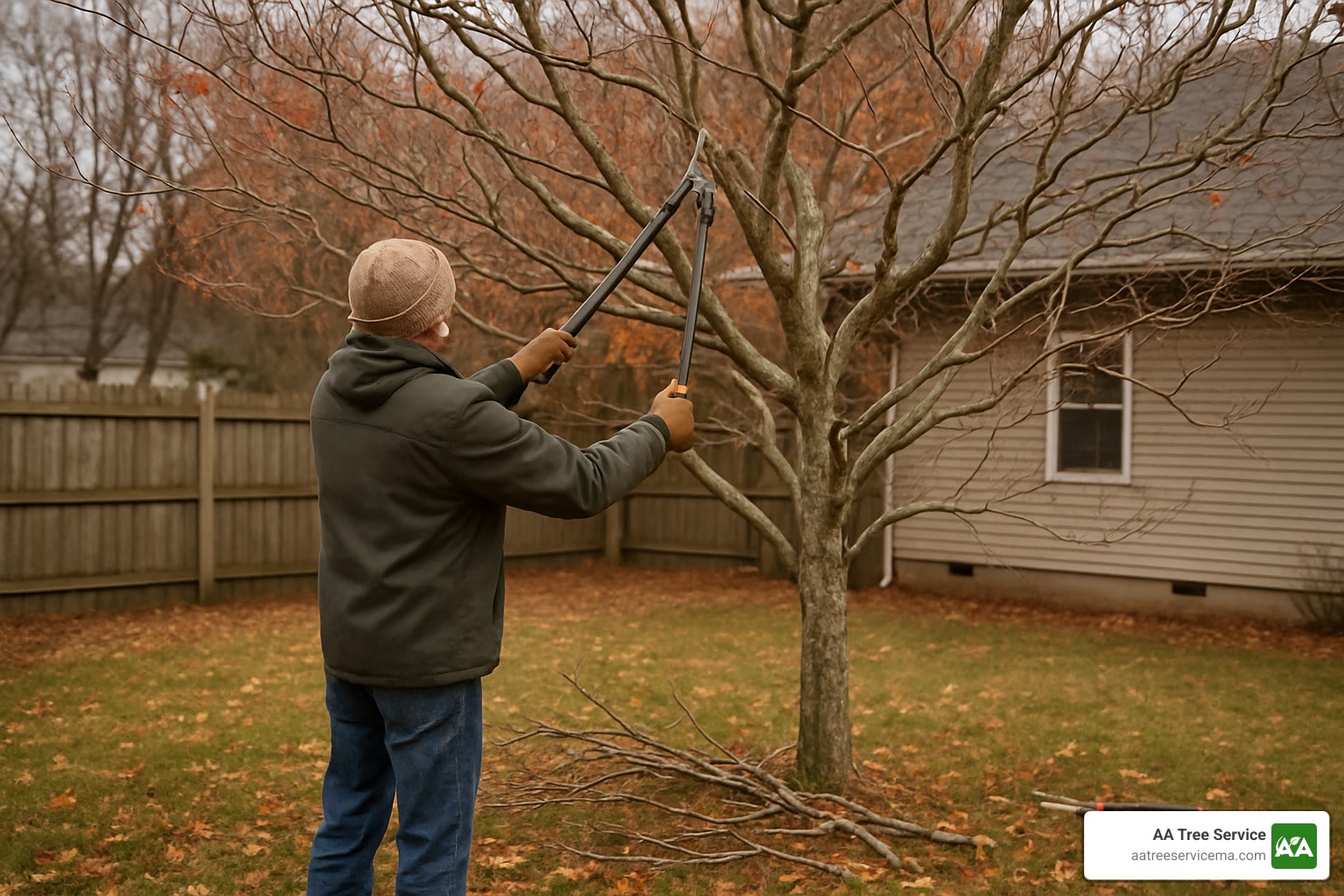
Why Your Overgrown Dogwood Needs the Right Pruning Approach
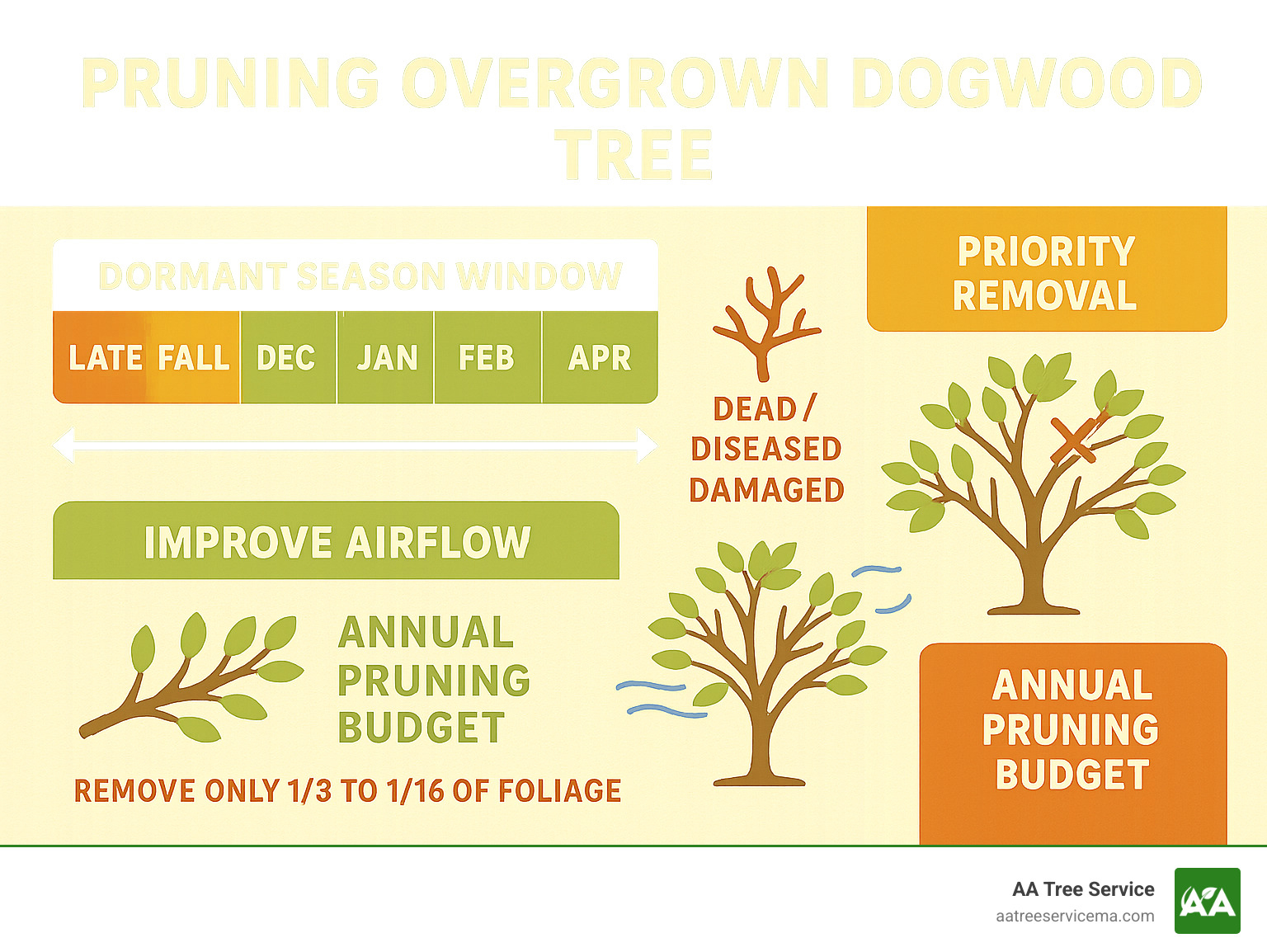
Pruning overgrown dogwood tree requires careful timing and technique to avoid damaging these naturally graceful specimens. Here’s what you need to know:
Best Time: Late fall through early spring (dormant season)
Maximum Removal: Only 1/8 to 1/16 of total foliage per year
Priority Order: Dead/diseased branches first, then thinning for airflow
Key Rule: Never top or remove more than one-third of living branches at once
If you’ve noticed your dogwood has become a tangled mess of crossing branches, lost its vibrant spring blooms, or developed that “overgrown shrub” look instead of its signature tiered canopy, you’re not alone. Many Massachusetts and New Hampshire homeowners face this challenge after years of benign neglect.
The good news? Dogwoods are amazingly resilient when pruned correctly. The bad news? They’re also easily damaged by overzealous cutting or wrong-season pruning.
As one expert puts it: “Dogwoods are seldom improved by pruning of any consequence and can quickly be spoiled by it.” This doesn’t mean you can’t prune – it means you need to be strategic and patient.
The key is working within what arborists call your “pruning budget” – removing only small amounts each year while focusing on the most critical issues first. Rush the process, and you’ll trigger a explosion of ugly watersprouts that can take years to correct.
Quick look at pruning overgrown dogwood tree:
– dogwood bush pruning
– tree pruning services
When & Why to Tackle an Overgrown Dogwood
Picture this: it’s a crisp January morning, and you’re sipping coffee while looking out at your overgrown dogwood. The bare branches reveal the tangled mess that’s been hiding behind those beautiful spring blooms. Good news – this is actually the perfect time to start planning your pruning strategy.
The timing of pruning overgrown dogwood tree makes all the difference between a healthy recovery and a stressed, vulnerable tree. Dogwoods are notorious “bleeders” that lose massive amounts of sap when cut during their growing season. Think of it like performing surgery on someone who’s wide awake versus someone who’s safely anesthetized.
Best Time for pruning overgrown dogwood tree
Here in Massachusetts and New Hampshire, Mother Nature gives us a generous dormant-season window from late November through early March. This isn’t just convenient timing – it’s absolutely critical for your dogwood’s survival.
Late fall through winter offers the sweet spot for pruning. The tree has shut down its active systems, sap flow drops to nearly zero, and those pesky boring insects are nowhere to be found. Plus, fungal spores that cause anthracnose and other diseases are dormant, giving your cuts the best chance to heal cleanly.
Early spring can work too, but you’re racing against the clock. Once those buds start swelling, you’ve missed your window. Our New England springs can be unpredictable, so it’s better to finish your work by mid-February rather than gamble with March weather.
Whatever you do, avoid the growing season like the plague. We’ve seen too many well-meaning homeowners create disaster by summer pruning. The heavy sap bleeding attracts dogwood borers faster than a picnic attracts ants, and open wounds become highways for disease.
The only exception? Emergency situations where storm damage or obvious disease threatens the tree’s life. In those cases, immediate action trumps perfect timing.
Why Prune at All?
You might wonder if it’s worth disturbing a tree that’s survived just fine without your help. Here’s the thing – while dogwoods are naturally graceful, an overgrown specimen faces real challenges that pruning can solve.
Disease removal tops the priority list. Dead wood doesn’t just look ugly – it becomes a breeding ground for fungi and bacteria that can spread to healthy tissue. Removing diseased branches before pathogens spread can literally save your tree’s life.
Air circulation might sound technical, but it’s simple: crowded branches create humid microclimates that fungi love. Thinning the canopy lets air move freely, dramatically reducing your tree’s risk of developing anthracnose and other moisture-loving diseases.
Storm safety becomes crucial as branches grow larger and heavier. Crossing limbs create weak points that fail during ice storms or high winds. We’ve seen beautiful dogwoods split in half because overlapping branches created stress fractures that finally gave way.
Shape control helps restore that classic tiered dogwood silhouette that makes these trees so distinctive. An overgrown dogwood often loses its architectural beauty, becoming a shapeless mass instead of the neat specimen it should be.
Finally, there’s the longevity factor. A well-pruned dogwood channels its energy more efficiently, producing better blooms, stronger twig color in winter, and overall healthier growth. It’s like the difference between a cluttered, chaotic workspace and an organized one – everything just works better.
The key is respecting your dogwood’s natural wildlife habitat value while addressing these practical concerns. Strategic pruning can actually improve nesting sites by creating better branch structure while maintaining the fruit production that songbirds depend on.
Gear Up: Tools, Safety & Sanitation
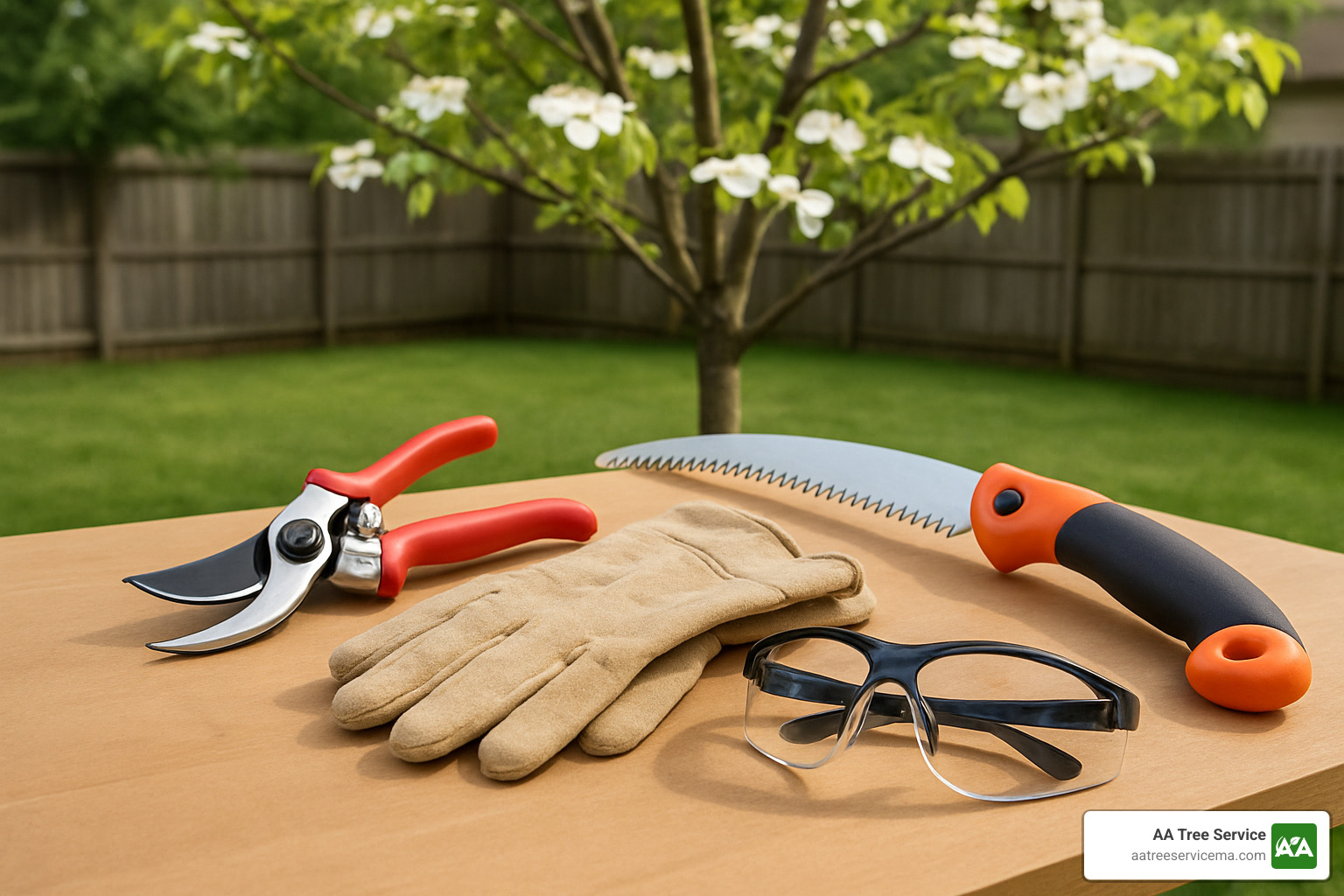
The right tools can make or break your pruning overgrown dogwood tree project. Trust me – I’ve seen too many homeowners struggle with dull loppers, trying to muscle through branches that should cut like butter with proper equipment.
Bypass pruners are your best friend for anything under an inch thick. Unlike anvil-style pruners that crush stems, bypass pruners make clean cuts that heal quickly. For branches between 1-4 inches, you’ll need a good pruning saw with aggressive teeth designed for green wood.
Here’s where many people make a costly mistake: they grab a ladder to reach high branches. Don’t do it. A pole saw keeps you safely on the ground while giving you the reach you need. Yes, it takes some getting used to, but it beats a trip to the emergency room.
Safety gear isn’t optional when you’re working around branches that can spring back unexpectedly. Safety glasses protect your eyes from flying wood chips, while work gloves give you a secure grip even when your hands get sweaty. If you’re dealing with larger branches overhead, throw on a hard hat – falling wood hurts more than your pride.
The sanitation part is where most DIYers drop the ball. Dogwoods are susceptible to diseases that spread through dirty tools. Keep a spray bottle filled with 70% rubbing alcohol handy, along with clean rags. Disinfect your tools between cuts when removing diseased material, and definitely between trees if you’re working on multiple specimens.
A sharp tool is a safe tool. Dull blades crush and tear tissue, creating ragged wounds that invite disease and heal poorly. If your pruner requires more than gentle pressure to cut through a pencil-thick branch, it needs sharpening.
For trees over 15 feet tall or extensive renovation work, consider calling in the pros. More info about Tree Care Services can help you decide when a project moves beyond DIY territory.
Step-by-Step Guide to pruning overgrown dogwood tree
The secret to successfully rehabilitating an overgrown dogwood lies in patience and proper technique. You’re working with a strict “pruning budget” – dogwoods should have no more than one-eighth to one-sixteenth of their foliage removed in a single session.
The Five-Step Process:
1. Remove dead, diseased, and damaged wood
2. Thin for improved airflow and light penetration
3. Address suckers and problematic lower limbs
4. Shape structure without topping
5. Clean up and sanitize
This systematic approach ensures you address the most critical issues first while staying within safe removal limits. Scientific research on dormant pruning supports this methodical strategy.
1. Remove Dead, Diseased, Damaged
Start with the “three D’s” – this work doesn’t count against your pruning budget since you’re removing non-functional wood.
Identifying Problem Wood:
– Dead branches: No bark, brittle, hollow sound when tapped
– Diseased wood: Cankers, discolored bark, fungal growth
– Damaged branches: Storm breaks, mechanical injury, pest damage
Proper Cutting Technique:
Always cut back to the branch collar – the swollen area where the branch meets the trunk or parent limb. This preserves the tree’s natural healing mechanism and prevents decay from entering the main stem.
Sanitation Protocol:
Dip tools in alcohol between cuts when removing diseased material. Bag and dispose of diseased wood – never compost it or leave it near healthy trees.
2. Thin for Airflow & Light
Now you’re working within your pruning budget. Focus on removing branches that compromise the tree’s structure or health:
Priority Removals:
– Branches growing toward the center of the tree
– Limbs that cross and rub against others
– Parallel branches competing for the same space
– Weak, spindly growth that will never develop properly
Thinning Strategy:
Work from the bottom up and inside out, making cuts in a gentle spiral pattern. This maintains the dogwood’s natural tiered appearance while opening the canopy gradually.
Remove the weaker of any two competing branches, keeping those with better angles and stronger attachment points. Aim to create an open vase shape that allows air to circulate freely through all levels of the canopy.
3. Address Suckers & Lower Limbs
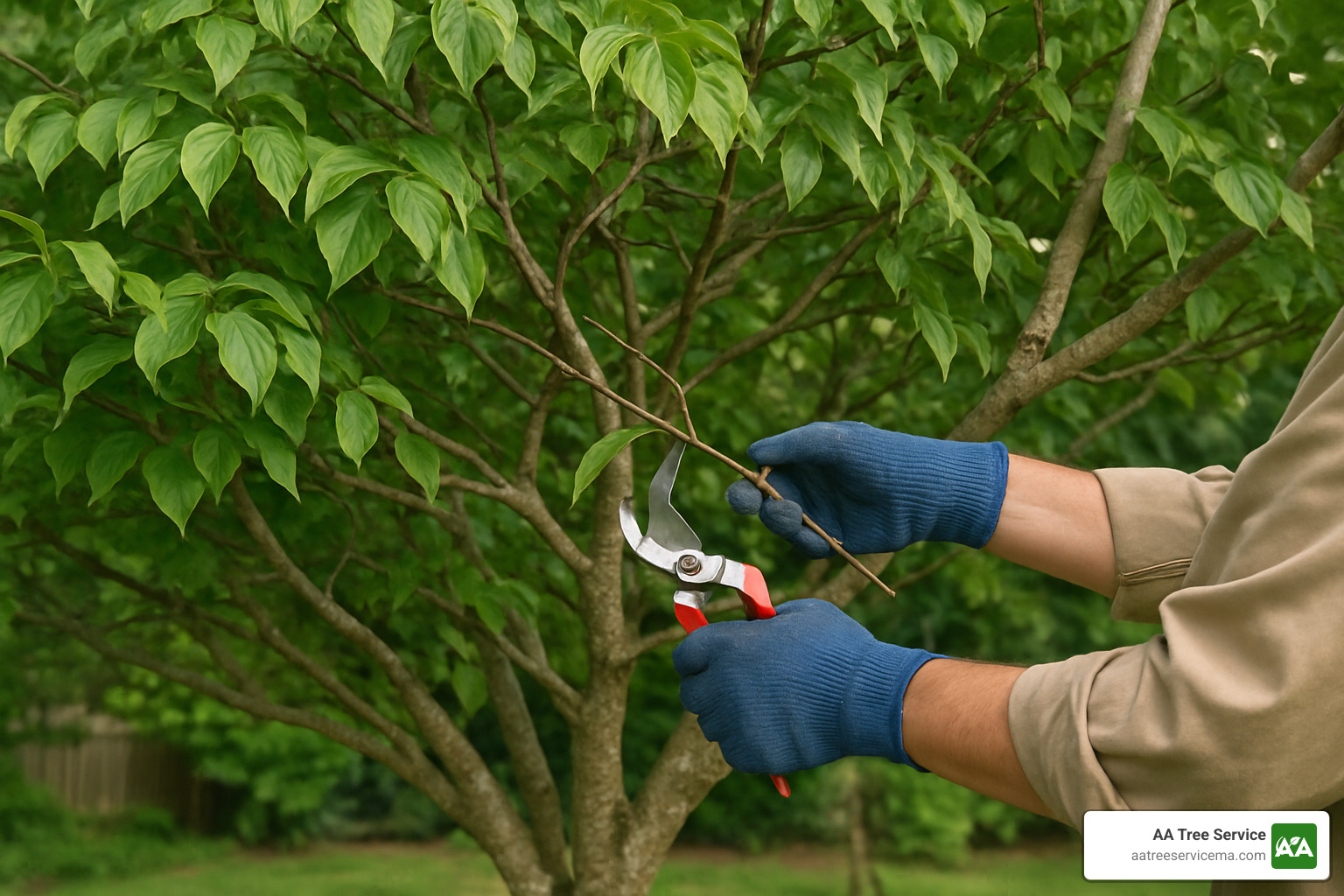
Sucker Removal:
Remove shoots growing from the base of the tree or below the graft union (if your dogwood is grafted). These rootstock shoots will have different characteristics than your desired variety and drain energy from the main tree.
Cut suckers flush with the trunk or root surface. For persistent suckers, you may need to dig slightly to reach their point of origin.
Lower Branch Decisions:
Think carefully before removing lower branches. Many experts prefer retaining them because they:
– Protect the trunk from sun scald
– Contribute photosynthesis to support trunk development
– Improve the natural viewing angle of upward-facing blooms
– Provide wildlife habitat
Only remove lower branches if they truly interfere with foot traffic or maintenance activities. More info about Tree Pruning and Trimming can help you make these decisions.
4. Structural Shaping Without Topping
Never top a dogwood – this destroys the natural leader and triggers excessive watersprout growth. Instead, use these techniques:
Drop-Crotch Cuts:
To reduce height, cut back to a well-placed lateral branch that’s at least one-third the diameter of the removed portion. This maintains the tree’s natural form while achieving size control.
Leader Management:
Preserve the central leader whenever possible. If it’s damaged, select the strongest vertical shoot near the top to train as a replacement.
Pruning Budget Enforcement:
Stop when you’ve removed your allotted amount – typically 1/8 to 1/16 of the total foliage. Mark your calendar to continue the work next dormant season if needed.
5. Post-Prune Cleanup
Tool Sanitation:
Clean all tools with alcohol or bleach solution before storing. This prevents disease transmission to other plants.
Debris Management:
– Chip healthy wood for mulch
– Burn or dispose of diseased material
– Compost small twigs and leaves (if disease-free)
Wound Monitoring:
Check cut sites periodically for signs of decay or pest activity. Properly made cuts should heal cleanly without intervention.
Aftercare & Long-Term Rejuvenation
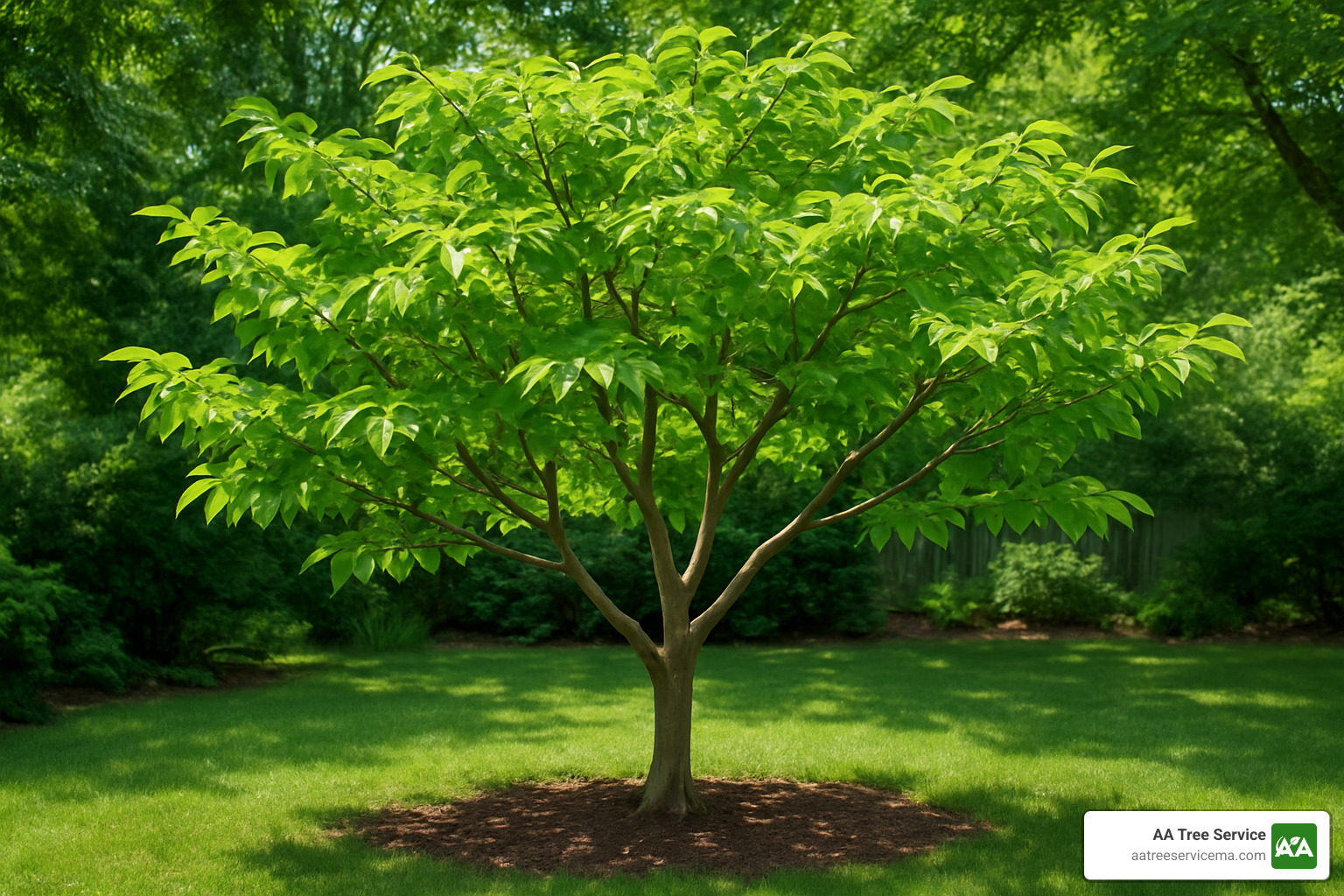
Your dogwood’s journey back to health doesn’t end when you put down the pruning saw. The weeks and months following pruning overgrown dogwood tree are actually when the real magic happens – but only if you give your tree the support it needs to recover properly.
Think of your freshly pruned dogwood like a patient recovering from surgery. It needs time, attention, and the right conditions to heal strong. The first priority is deep watering – not frequent shallow drinks, but thorough soakings that encourage roots to grow deep and stable. This builds resilience for Massachusetts and New Hampshire’s unpredictable weather patterns.
Next comes the mulch ring – your tree’s best friend during recovery. Spread 2-3 inches of organic mulch in a wide circle around the base, but keep it a few inches away from the trunk itself. This living blanket conserves moisture, moderates soil temperature, and slowly releases nutrients as it breaks down.
Here’s where many well-meaning homeowners make a mistake: they rush to fertilize their stressed tree. Resist this urge completely. Your dogwood needs to focus all its energy on healing those pruning cuts and establishing new growth patterns. Adding fertilizer now is like asking someone with a broken leg to run a marathon.
Instead, focus on pest scouting during the growing season. Fresh cuts can attract boring insects, especially if you had to do any emergency pruning during active periods. A quick weekly walk-around can catch problems before they become serious.
The real reward comes in understanding that recovery follows predictable staggered thinning cycles. Your dogwood will likely respond to proper pruning with a flush of vigorous new growth. This is exactly what you want to see – it means the tree is redirecting energy from maintaining too much weak wood into producing strong, healthy branches.
Rejuvenating a Neglected Specimen
For dogwoods that have been ignored for years or even decades, patience becomes your most valuable tool. The wait-thin-wait approach might feel frustratingly slow, but it’s the difference between success and a yard full of ugly watersprouts.
Year one focuses on the absolute necessities – dead wood, obvious disease, and the most problematic structural issues. Then you wait and watch. This gives the tree time to adjust its internal plumbing and energy distribution. Rushing ahead too quickly triggers the tree’s emergency response system, flooding you with vertical shoots that take years to correct.
The multi-year plan typically unfolds like this: remove the worst problems first, let the tree recover for a full growing season, then tackle the next tier of issues. Some severely neglected dogwoods need three to five cycles to return to their natural grace.
During recovery years, a light fertilization schedule can help – but only after the tree shows strong new growth and all cuts have healed cleanly. A simple compost top-dress in early spring provides gentle, slow-release nutrition without overstimulating growth.
This methodical approach might test your patience, but it produces results that last. Professional arborists have seen too many beautiful dogwoods ruined by well-intentioned but overzealous pruning. More info about Tree Pruning Services can help you develop a realistic timeline for your specific situation.
The change when done right is remarkable – crossing branches disappear, air flows freely through the canopy, spring blooms return with renewed vigor, and that classic tiered silhouette emerges like a sculpture being revealed from rough stone.
Avoiding Common Mistakes & Disease Spread
Here’s the hard truth: we’ve watched too many beautiful dogwoods get butchered by homeowners who meant well but didn’t understand these trees’ quirky nature. Pruning overgrown dogwood tree specimens requires a light touch and serious patience – qualities that seem to disappear when people get excited about “fixing” their landscape.
The biggest mistake? Treating dogwoods like they’re oak trees or maples. They’re not. These delicate beauties will punish you for years if you get aggressive with the pruning shears.
Let’s talk about the topping disaster first. We see this every spring – someone decides their dogwood is “too tall” and whacks off the top. What happens next isn’t pretty. The tree responds by shooting out dozens of ugly watersprouts that grow straight up like a bad haircut. These weak shoots break easily in storms and completely destroy the dogwood’s graceful, tiered appearance.
Never cut the main leader or reduce height by chopping branches wherever it’s convenient. If you absolutely must reduce size, use drop-crotch cuts back to properly-sized lateral branches. Better yet, learn to love your tree’s natural height.
The flush cut trap catches many DIY pruners. It seems logical to cut branches “clean” against the trunk, right? Wrong. That swollen area where the branch meets the trunk – called the branch collar – contains special cells that seal wounds and prevent decay. Cut it off, and you’ve just created a highway for rot to enter your tree’s heartwood.
Over-pruning stress is perhaps the most common problem we encounter. Dogwoods are drama queens when it comes to pruning. Remove too much at once, and they’ll throw a tantrum that lasts for years. Stick to that one-eighth to one-sixteenth rule religiously, even if it means your tree looks “unfinished” for a season or two.
Disease prevention becomes critical when you’re working with stressed, overgrown specimens. Anthracnose loves dogwoods that are already struggling, and it’s particularly nasty in our Massachusetts and New Hampshire climate. The fungus thrives in humid, shaded conditions – exactly what you get with an overgrown, poorly-ventilated canopy.
Your pruning strategy should focus on getting sunlight and air movement into the tree’s interior. Aim for at least 30% direct sunlight reaching through the canopy. Remove branches that create dense, humid pockets where fungal spores can party all summer long.
Tool sanitation isn’t optional when dealing with diseased wood. A quick alcohol wipe between cuts takes five seconds but can save you from spreading problems throughout your landscape. We’ve seen entire neighborhoods lose their dogwoods because one infected tree spread disease through contaminated pruning tools.
Scientific research on dogwood diseases shows that prevention is far more effective than treatment once anthracnose takes hold.
The species difference matters more than most people realize. If you’re working with our native Cornus florida (Eastern dogwood), you need to be extra gentle. These trees are incredibly sensitive to over-pruning and highly susceptible to anthracnose. Korean dogwoods (Cornus kousa) are slightly more forgiving, but that doesn’t mean you can get careless.
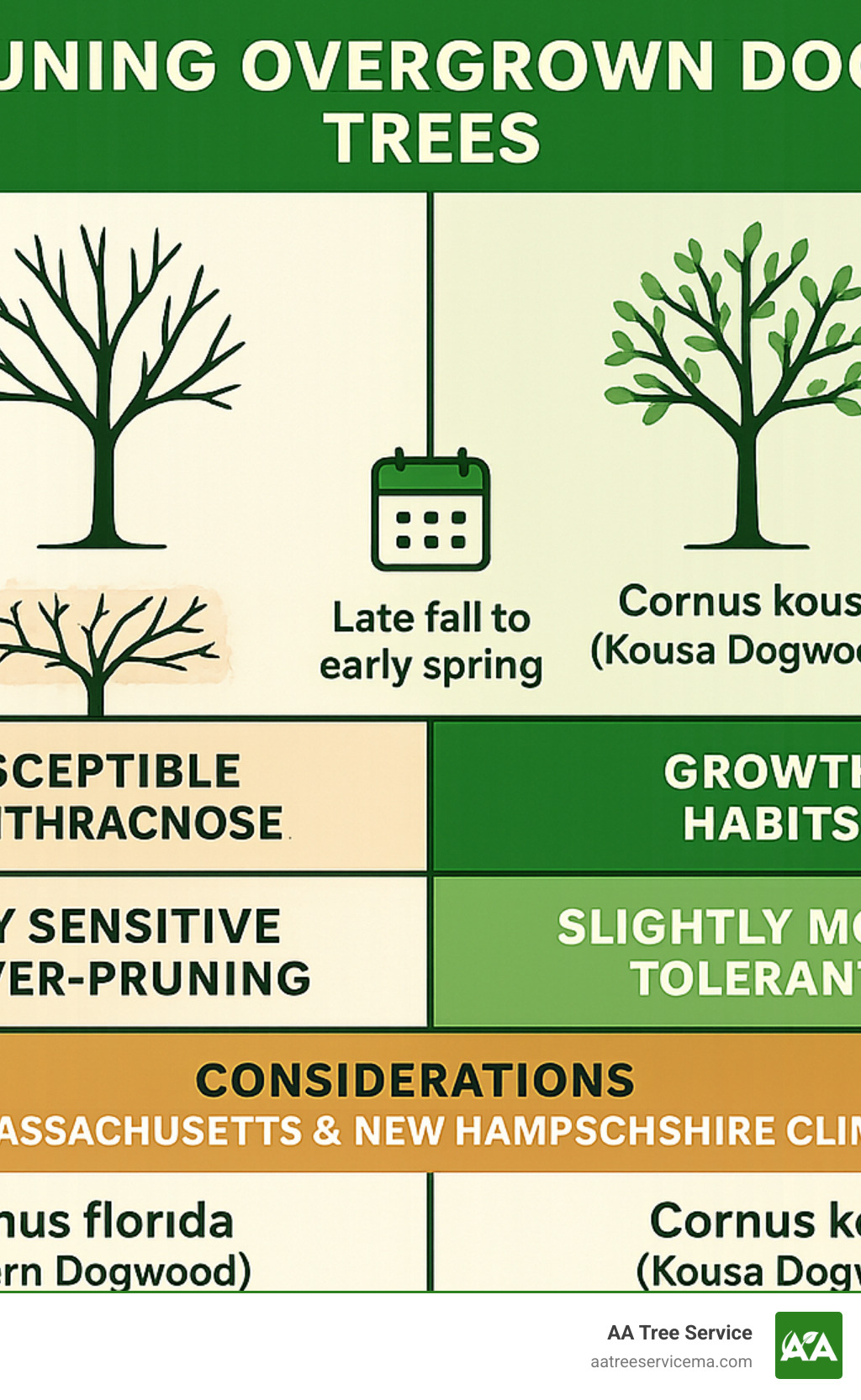
| Characteristic | Cornus florida (Eastern) | Cornus kousa (Korean) |
|---|---|---|
| Disease Resistance | Susceptible to anthracnose | More disease resistant |
| Pruning Tolerance | Very sensitive to over-pruning | Slightly more tolerant |
| Best Timing | Late fall to early spring | Late fall to early spring |
| Watersprout Tendency | High | Moderate |
| Maximum Annual Removal | 1/16 of foliage | 1/8 of foliage |
| Recovery Time | 2-3 years | 1-2 years |
Remember: dogwoods would rather be left alone than pruned incorrectly. When in doubt, do less rather than more. Your tree will thank you with better blooms, healthier growth, and fewer pest problems down the road.
Frequently Asked Questions about Overgrown Dogwood Pruning
How much can I safely remove at once?
This is the question that separates successful dogwood pruning from disaster. Pruning overgrown dogwood tree requires serious restraint – you can safely remove no more than one-eighth to one-sixteenth of the total foliage in a single session.
I know this sounds incredibly conservative, especially when you’re staring at a tangled mess that looks like it needs major surgery. But here’s the thing: dogwoods are drama queens when it comes to pruning. Remove too much, and they’ll respond with an explosion of ugly watersprouts that can take years to correct.
Think of it this way – if your dogwood has 100 branches, you’re looking at removing maybe 6-12 of them, max. The good news? Dead, diseased, and damaged wood doesn’t count toward this limit since you’re removing non-functional material anyway.
This “pruning budget” approach means most overgrown dogwoods need a multi-year rehabilitation plan. It’s not as satisfying as a dramatic one-day change, but your tree will thank you with healthy growth instead of a forest of watersprouts.
Should I ever coppice my dogwood tree?
Coppicing – cutting everything back to stumps about 3-4 inches above ground – works beautifully for shrub dogwoods like red-twig dogwood that you’re growing for colorful winter stems. But for tree forms like our native Cornus florida or the popular Kousa dogwood? Almost never.
These tree dogwoods have spent years developing their neat tiered structure. Coppicing destroys all that architecture and forces them to start over from scratch. The result is usually a mess of competing shoots rather than the graceful canopy you’re hoping for.
If your tree dogwood is severely damaged by storms, disease, or decades of neglect, gradual rehabilitation over 3-5 years is almost always the better choice. Yes, it requires patience, but you’ll end up with a properly structured tree instead of an overgrown shrub.
The only exception might be a young tree dogwood (under 5 years old) that’s been severely damaged. Even then, selective pruning is usually preferable to starting completely over.
Can I prune during summer for emergency clearance?
Sometimes life doesn’t wait for the perfect pruning window. If a storm has left dangerous hanging branches or a dogwood limb is threatening your roof, emergency pruning can be done any time of year – safety always comes first.
But here’s what you need to know: summer cuts on dogwoods are like opening a faucet. They’ll bleed heavily, creating sticky sap that attracts boring insects and other pests. The open wounds also provide entry points for diseases that are active during the growing season.
Keep emergency summer pruning to the absolute minimum needed for safety. Make clean cuts just outside the branch collar, avoid leaving stubs, and resist the temptation to “clean up” other issues while you’re at it.
After emergency summer pruning, monitor the cut sites closely for the next few weeks. Watch for signs of borer activity (sawdust around cuts) or fungal infections (discolored or oozing wounds). If you spot problems early, they’re much easier to address.
The rest of your pruning wishlist can wait until the proper dormant season window. Your dogwood will be much happier – and healthier – if you can be patient.
Conclusion
Successfully pruning overgrown dogwood tree specimens is like restoring a classic piece of furniture – it takes patience, the right tools, and deep respect for what you’re working with. The reward? A healthier, more beautiful tree that will grace your landscape for decades to come.
Take a moment the day after your pruning session to walk around your dogwood with fresh eyes. Does it look more open and balanced while still maintaining that graceful, tiered silhouette dogwoods are famous for? Can you see light filtering through the canopy in a way that wasn’t possible before? These are the signs of a job well done.
Keep these essential principles in mind for every pruning session: work only during the dormant season from late fall through early spring, stay religiously within your pruning budget of one-eighth to one-sixteenth of total foliage annually, and always prioritize removing dead, diseased, and damaged wood first. Topping destroys dogwoods and flush cuts prevent proper healing.
If you notice any concerning signs in the weeks following your work – wilting leaves, yellowing foliage, or an explosion of watersprouts – don’t panic. These symptoms often indicate the tree was stressed by removing too much at once. The solution is simple: back off on future pruning and focus on supportive care like deep watering and proper mulching.
For severely overgrown specimens, accept the multi-year approach. Your dogwood didn’t become overgrown overnight, and it won’t be restored in a single session. Plan for a three to five-year rehabilitation cycle that allows the tree to recover between pruning sessions.
During the growing season, keep an eye out for drought stress and pest activity. Monitor your pruning cuts to ensure they’re healing cleanly without signs of decay or insect damage.
When the project feels overwhelming or involves trees over 15 feet tall, there’s no shame in calling for backup. Professional arborists have the experience, equipment, and insurance to handle complex situations safely. More info about tree-pruning services can help you decide when to tackle the work yourself versus when to bring in the experts.
At AA Tree Service, we’ve spent over 20 years helping Massachusetts and New Hampshire homeowners steer these decisions. Our science-based approach means we understand that every dogwood is unique, and our commitment to safe, methodical pruning practices ensures your tree gets the care it deserves without unnecessary risk to your property or our crew.
Your overgrown dogwood has been waiting patiently for this attention. With the right approach, you’ll be amazed at how quickly it responds with healthier growth, better flowering, and that classic elegance that makes dogwoods such treasured landscape trees.