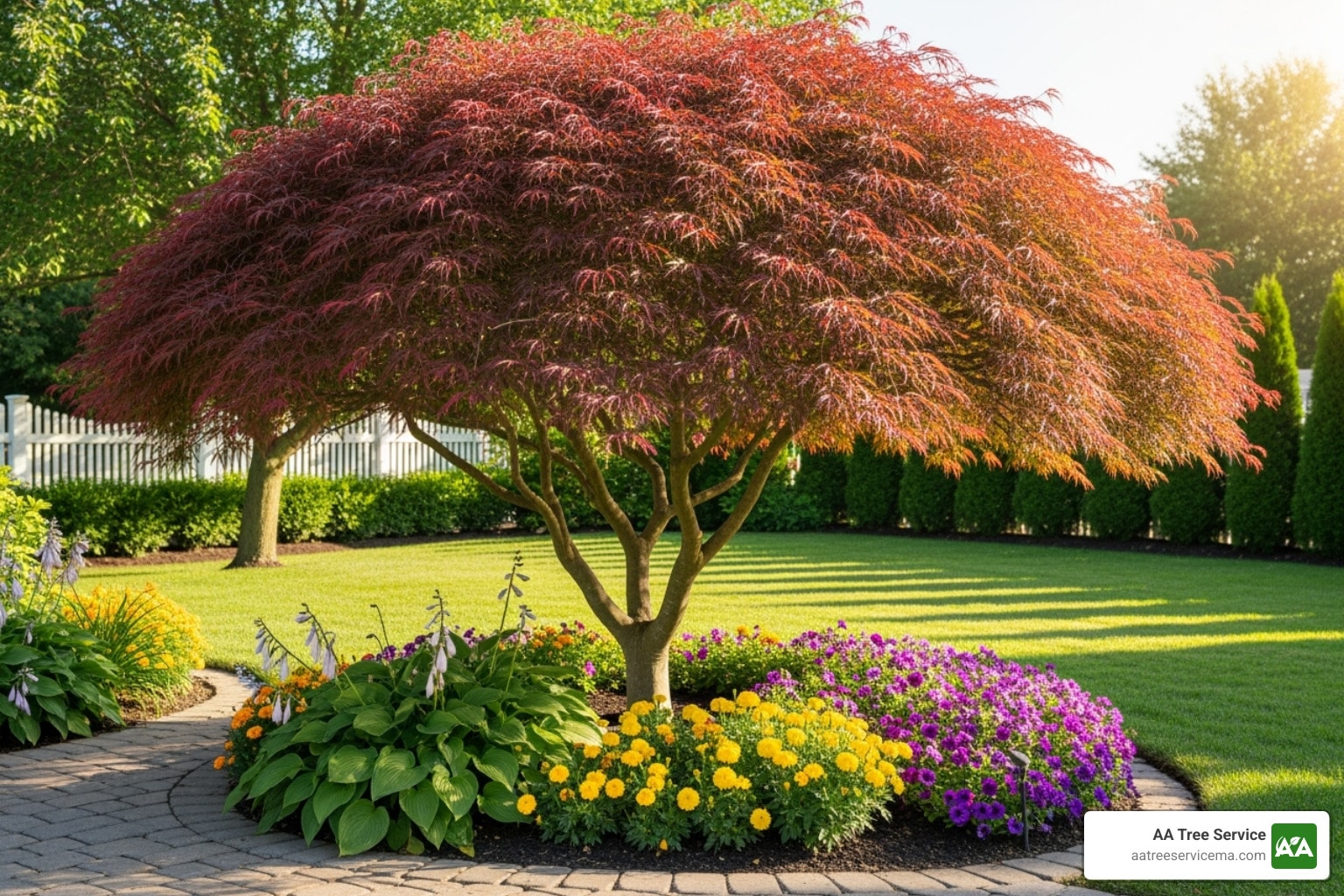
Why Your Ornamental Trees Need Professional Care
Ornamental tree pruning near me is more than a search—it’s the key to protecting your landscape investment. Your ornamental trees add beauty and value to your Massachusetts or New Hampshire home, but without proper care, they can become hazards or decline in health.
Quick Answer for “Ornamental Tree Pruning Near Me”:
- Best Time: Late winter (dormant season) or immediately after flowering
- Cost Range: $150-$1,500+ depending on tree size and complexity (prices vary widely based on industry data)
- What to Look For: ISA Certified Arborists, full insurance, local MA/NH experience
- Key Benefits: Improved tree health, appearance, and storm resistance
- When to Call: Trees touching structures, dead/diseased branches, overgrown canopy
As one expert puts it: “Good pruning is when it still looks like a tree when you finish. Great pruning is when it’s difficult to tell the tree was ever pruned.” This highlights why professional care matters.
Ornamental trees like Japanese Maples and Dogwoods need specialized care. In New England’s climate, proper pruning techniques, which involve mostly thinning to improve natural branching, can mean the difference between a thriving tree and an expensive problem. This delicate work requires understanding tree biology, timing, and the right tools.
What is Ornamental Tree Pruning and Why is it Essential for Your New England Landscape?
Ornamental trees – like Japanese Maples, Dogwoods, and Flowering Cherries – are the showstoppers of your Massachusetts or New Hampshire landscape. They are planted specifically for their aesthetic contributions, from vibrant spring flowers and rich fall color to neat winter silhouettes. However, ornamental tree pruning is a highly specialized service, fundamentally different from trimming hedges or production fruit trees. It’s a delicate blend of art and science, focused on enhancing a tree’s natural form while safeguarding its long-term health and structural integrity.
In New England, where our weather can be unforgiving, proper pruning is vital. Our heavy snow loads and powerful nor’easters can turn unpruned, weak, or poorly attached branches into dangerous projectiles, threatening your home and family. A well-pruned tree has a stronger, more resilient structure, capable of flexing and withstanding these harsh conditions.
Health benefits are also paramount. Thinning crowded branches dramatically improves sunlight penetration and air circulation throughout the canopy. This simple act is one of the most effective ways to prevent common fungal diseases like powdery mildew and anthracnose, which thrive in the damp, stagnant air of our humid summers. For flowering trees, correct timing and technique are absolutely essential. Pruning a magnolia or lilac at the wrong time of year can completely eliminate the next season’s cherished blooms. Our Tree Pruning and Trimming services focus on getting this timing perfect for each individual species.
Common Ornamental Trees in New England and Their Unique Needs
Not all ornamental trees are the same. Each species has a unique growth habit and specific requirements:
- Japanese Maples (Acer palmatum): Prized for their delicate foliage and graceful, sculptural forms, these trees require a light and precise touch. The goal is to improve their natural shape by thinning out crossing branches and removing any dead wood. Heavy-handed pruning can ruin their structure and lead to unsightly dieback.
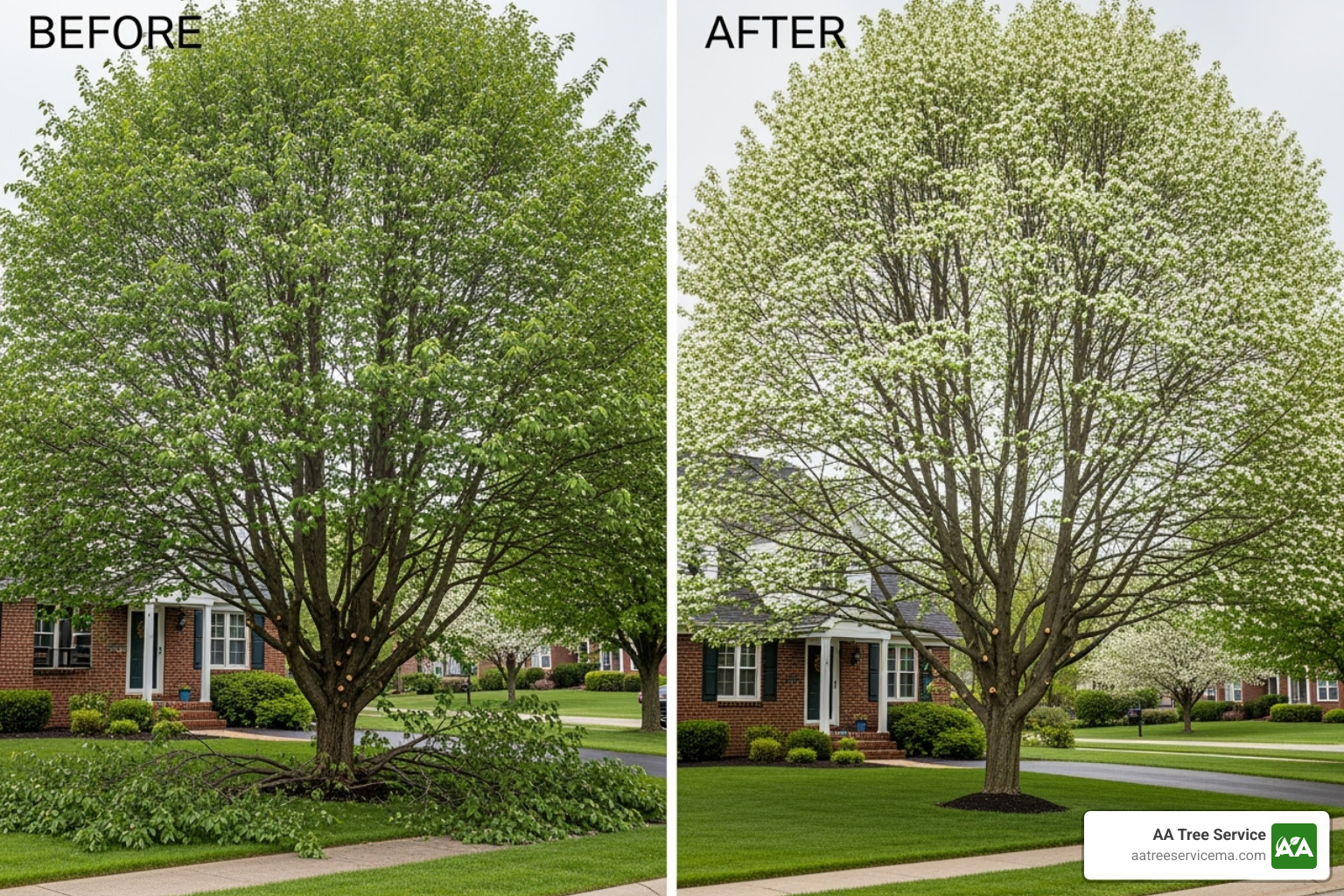
- Flowering Dogwoods (Cornus florida): A native favorite, dogwoods are sensitive to stress. Pruning should be done right after they finish blooming in the spring to avoid removing next year’s flower buds. Proper thinning improves air circulation, which is critical for preventing dogwood anthracnose, a devastating fungal disease.
- Flowering Crabapples (Malus spp.): These hardy trees can become a tangled mess of branches, suckers, and watersprouts if left unattended. Regular pruning is needed to maintain an open structure, which not only looks better but also helps prevent common diseases like apple scab and fire blight.
- Magnolias (Magnolia spp.): Known for their large, dramatic flowers, magnolias heal slowly from pruning cuts. Therefore, pruning should be minimal and conservative, focused only on removing dead, damaged, or awkwardly placed limbs. Like dogwoods, they should be pruned soon after flowering.
The Art and Science of Pruning
Ornamental tree pruning works with a tree’s natural growth pattern, never against it.
- Enhancing natural form: We don’t force trees into unnatural shapes like spheres or boxes. Instead, our goal is to reveal the neat branching structure that is often hidden beneath a tangle of crossing or awkward growth.
- Selective thinning: We remove entire branches back to their point of origin (a larger branch or the trunk), rather than just shortening them (stubbing). This creates clean lines, encourages better structure, and directs the tree’s energy to its healthiest parts.
- Understanding tree biology: Every cut is a wound. Trees don’t heal in the same way humans do; they compartmentalize or wall off damage. Making clean, precise cuts in the right places is crucial for allowing the tree to seal the wound effectively and prevent the entry of decay fungi.
- Redirecting growth: We can strategically guide branches away from structures, utility lines, or other limbs by cutting just above a bud or side branch that points in a more desirable direction. This is a proactive approach to prevent future conflicts.
The Arbor Day Foundation provides excellent resources that support these professional, science-based techniques.
Key Benefits of Regular Pruning
Regular, professional pruning is a critical investment in your property’s beauty, safety, and overall value.
- Increased lifespan and vigor: Removing dead, diseased, or damaged wood (the three D’s) eliminates entry points for pests and decay, allowing the tree to allocate its resources to healthy growth and defense.
- Superior aesthetic appeal: A well-pruned tree showcases its natural architecture, changing an overgrown, shapeless plant into a stunning landscape centerpiece. This is especially evident in our Dogwood Bush Pruning work.
- Reduced property risk: A tree with a strong, balanced framework is far less likely to suffer catastrophic failure during MA and NH ice storms, high winds, and heavy snow, preventing expensive damage to your home, vehicles, or other structures.
- Improved health for the whole garden: Thinning the canopy allows more sunlight and air to reach the turf and other plantings beneath the tree, reducing fungal growth on the lawn and helping understory plants thrive.
The Right Time, Tools, and Techniques for Pruning Ornamental Trees
Getting ornamental tree pruning right depends on a masterful combination of three elements: timing, tools, and technique. Approaching your prized Japanese Maple or neat Dogwood is not just about cutting branches; it’s about working in harmony with the tree’s natural life cycle. Getting any of these elements wrong can cause significant stress, introduce disease, or permanently damage the tree’s structure and aesthetic.
When is the Best Time to Prune?
In Massachusetts and New Hampshire, timing is critical and varies significantly by species and pruning goals.
Winter pruning (dormant season), performed from late fall after leaf drop to late winter before bud break, is ideal for most major structural work. Without leaves obscuring the view, an arborist can easily assess the tree’s entire framework to identify weak unions, crossing limbs, and other structural defects. Because the tree is dormant, the pruning causes less physiological stress, and the cold temperatures reduce the risk of transmitting diseases like oak wilt or fire blight.
Summer pruning is best reserved for light, corrective pruning once the leaves are fully developed. It can be used to remove wayward shoots, manage a tree’s size, or improve clearance. Because summer cuts remove leaf area, they tend to slow the growth of the pruned branch, which can be a useful technique for size management.
For spring-flowering trees that bloom on old wood (growth from the previous year), such as Dogwoods, Magnolias, Flowering Cherries, and Lilacs, pruning must be timed for the period immediately after they finish flowering. Pruning them in winter or early spring would remove the flower buds and sacrifice the season’s display. The only exception to these rules is the removal of dead, diseased, or hazardous wood, which can and should be done any time of year for the health and safety of the tree and your property.
Here are our typical recommendations:
- Japanese Maples: Late winter for structural pruning, with very light summer touch-ups for shape.
- Dogwoods: Immediately after the spring blooms fade.
- Flowering Cherries: Same post-bloom schedule, focusing on thinning and removing suckers.
- Magnolias: Minimal pruning is best. When necessary, prune right after flowering to remove damaged limbs.
Essential Tools for the Job
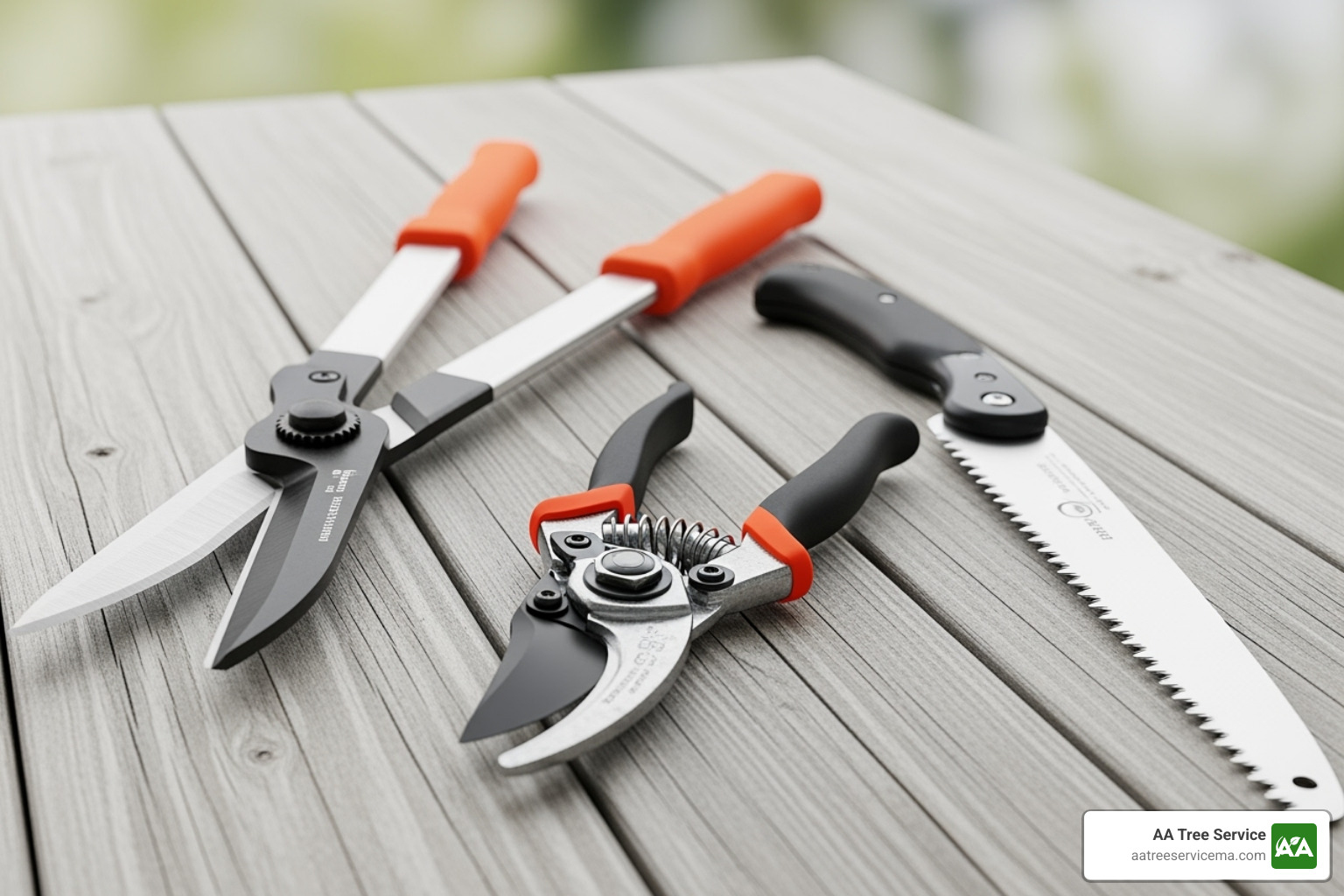
Using the right tool for the cut is non-negotiable for ensuring clean wounds that heal properly.
- Bypass Hand Pruners: For small, delicate branches up to an inch in diameter. The bypass action makes a clean, scissor-like cut.
- Loppers: Essentially long-handled pruners, they provide more leverage for branches up to two inches thick.
- Curved Pruning Saws: Designed to cut on the pull stroke, these saws make clean, smooth cuts on branches up to three or four inches thick without damaging surrounding tissue.
- Pole Pruners and Saws: Allow arborists to safely reach higher branches from the ground, reducing the need for ladders in many situations.
We never use chainsaws for delicate ornamental pruning. Their power and design create rough, torn cuts that heal poorly and leave trees highly vulnerable to disease and pests. Sharp, sterilized tools are an absolute must. Dull tools crush and tear wood fibers, creating ragged wounds. Unsterilized tools can easily spread pathogens like a dirty needle, transferring fungal spores or bacteria from a diseased tree to a healthy one.
Proper Pruning Techniques Explained
Our techniques are grounded in arboricultural science (specifically, the ANSI A300 Pruning Standards) and work with a tree’s natural biology.
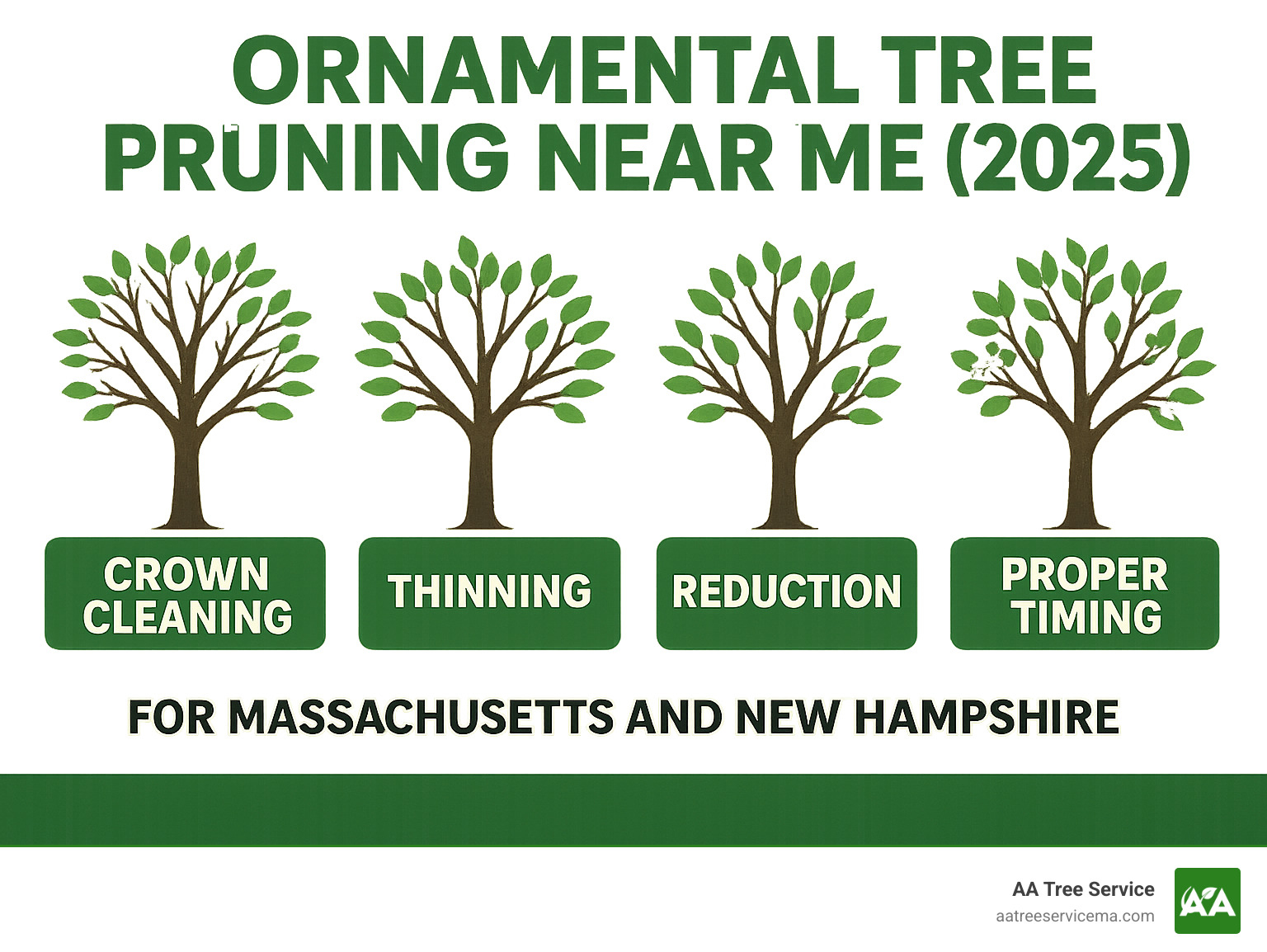
- Crown Cleaning: This is the foundational first step of any professional pruning job. It involves the systematic removal of dead, dying, diseased, or broken branches (the “4 D’s”).
- Crown Thinning: We selectively remove entire branches back to their point of origin to reduce density, improve light penetration, and increase air circulation. This improves the tree’s natural shape without it looking artificially “pruned.”
- Crown Reduction: When a tree’s size must be reduced, we use reduction cuts. This involves pruning branches back to a healthy, lateral branch that is at least one-third the diameter of the branch being cut. This maintains the tree’s structural integrity and form, unlike topping.
- The Three-Cut Method: For any branch over an inch or two in diameter, this method is essential to prevent the branch from falling under its own weight and tearing a long strip of bark from the trunk. The process involves: 1) An undercut a foot or two from the trunk to stop a tear. 2) A top cut just outside the first cut to remove the branch’s weight. 3) The final, precise cut just outside the branch collar to remove the remaining stub.
Respecting the branch collar—the slightly swollen area of trunk tissue where a branch grows—is critical. This collar contains specialized cells that initiate the process of closing the wound. Cutting into or behind the collar (a flush cut) creates a much larger wound and removes this healing tissue, leaving the tree open to decay.
Harmful Pruning Practices to Avoid
An educated homeowner should be aware of outdated and damaging techniques that so-called “tree guys” might perform.
- Topping: This is the indiscriminate cutting of tree branches to stubs or lateral branches not large enough to assume the terminal role. It is perhaps the most harmful practice, as it starves the tree, creates large wounds that invite decay, and promotes the growth of weak, poorly attached sprouts that are prone to failure.
- Lion-Tailing: This involves removing all the interior foliage and smaller branches along a limb, leaving leaves only at the very end. This destroys the branch’s natural taper, displaces weight to the end of the limb, and makes it much more likely to break in a storm.
- Flush Cutting: As mentioned, cutting a branch flush with the trunk removes the branch collar and dramatically hinders the tree’s ability to compartmentalize and seal the wound.
- Using Wound Paint or Sealant: While once common, research has shown that these dressings are unnecessary and can even be harmful. They can seal in moisture and decay, preventing the tree from forming its natural protective callus tissue. The best practice is to let a clean, proper cut heal on its own.
For more on proper size management, see our guide on Pruning an Oak Tree to Keep it Small.
DIY vs. Hiring a Professional: Making the Right Choice for Your Trees
While DIY projects can be satisfying, ornamental tree pruning is one best left to professionals. A mistake with a precious Japanese Maple or Dogwood can lead to irreversible damage or costly replacement. We’ve seen many well-intentioned DIY jobs end in disaster.
Here’s a comparison to help you decide:
| Feature | DIY Ornamental Pruning | Hiring a Professional |
|---|---|---|
| Cost | Appears cheaper, but risks expensive tree replacement, property damage, or medical bills. | Higher initial cost, but prevents mistakes and includes cleanup and debris removal. |
| Safety | High risk of falls, cuts, and electrical hazards, especially near power lines. | Professionals have safety equipment, training, and full insurance coverage. |
| Equipment | Often inadequate tools that crush branches; expense of buying quality equipment. | Access to specialized, sharp, well-maintained tools for delicate work. |
| Expertise | Limited knowledge of tree biology and species-specific needs. | Certified expertise in plant health, proper timing, and techniques for long-term vitality. |
| Time | Takes much longer than expected, including research and cleanup. | Efficient completion by an experienced team. |
| Results | Often disappointing: damaged health, poor appearance, increased disease risk, or a dead tree. | Professional results that improve tree health and beauty with proper healing. |
The Risks of DIY Pruning
Attempting your own ornamental pruning carries significant risks:
- Personal injury: Falls from ladders, cuts from tools, and electrocution are real dangers.
- Improper cuts: Jagged wounds from dull tools or cuts in the wrong place invite disease and insects.
- Spreading disease: Unsterilized tools can transfer infections from one branch or tree to another.
- Over-pruning stress: Removing more than 25% of a tree’s live crown in one year (the 25% rule) can cause decline or trigger weak, dangerous growth.
- Insurance liability: If you or a friend cause damage or injury, you could be financially responsible.
The Advantages of a Professional Service
Choosing a professional for ornamental tree pruning near me in MA or NH provides expertise, safety, and peace of mind.
- Expert knowledge: Our ISA Certified Arborists understand the unique needs of each tree species.
- Proper equipment: We use sharp, specialized tools for clean cuts that promote healing, along with safety gear to protect your property.
- Safety protocols: Our insured crew follows strict procedures, especially when working near homes and power lines.
- Efficiency and results: We complete the job quickly and correctly, leaving your tree looking naturally beautiful, not obviously “worked on.”
- Peace of mind: Knowing your valuable trees are in capable, insured hands is priceless.
For professional care, consider our Certified Arborist Tree Service Near Me in Massachusetts and New Hampshire.
How to Find and Choose a Reputable Ornamental Tree Pruning Service Near Me
Finding the right professional for your ornamental tree pruning near me search is crucial for protecting your landscape investments in Massachusetts or New Hampshire. A little research upfront can prevent major headaches later.
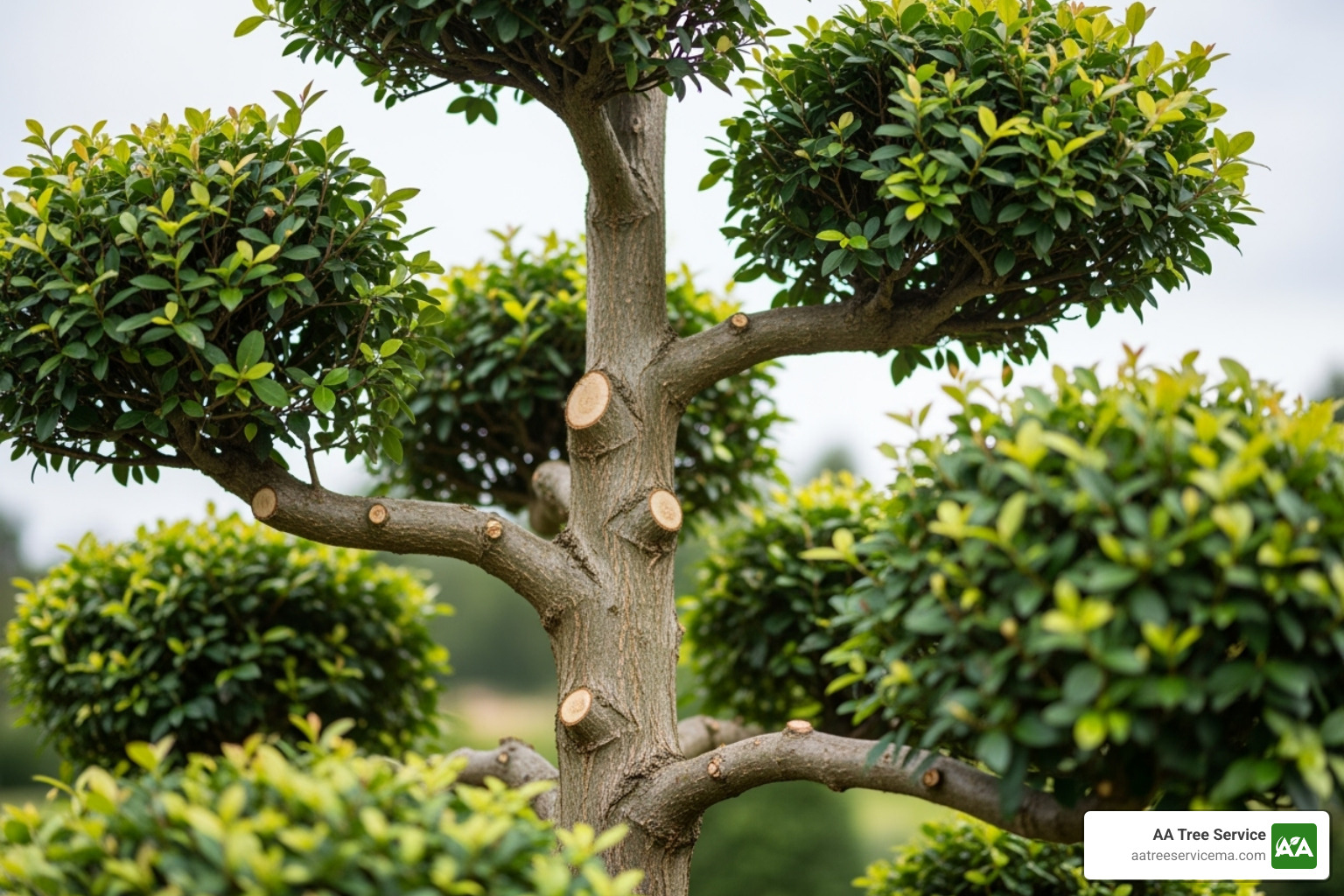
How to Find the Best Ornamental Tree Pruning Near Me
When starting your search, think like you’re finding a trusted doctor.
- Online reviews: Use Google to search for “ornamental tree pruning Massachusetts” or your specific town. Read comments that mention delicate work on ornamental trees and note how companies respond to feedback.
- Local recommendations: Ask neighbors with beautiful trees or staff at your local garden center for honest insights on pricing, professionalism, and results.
- Better Business Bureau (BBB): A high BBB rating indicates a company is committed to ethical practices and customer satisfaction.
- Verify they’re truly local: Look for a physical street address and local phone number in MA or NH. A local company understands our climate, common tree species, and is accountable to the community.
Must-Have Qualifications: What to Look For
Once you have a shortlist, verify these essential qualifications to protect your trees.
- ISA Certified Arborists: This is the gold standard. These professionals have passed rigorous exams on tree biology, pruning techniques, and safety. Ask if a certified arborist will be on-site for the job. You can verify an arborist’s credentials here.
- Insurance coverage: This is critical for your financial protection. The company must have liability coverage for property damage and workers’ compensation to cover injuries to their crew. Ask for current certificates of insurance sent directly from their provider.
- Experience in Massachusetts and New Hampshire: A service with deep local experience (like our 20+ years) understands how to prune trees to survive our harsh winters and ice storms.
Understanding the Cost of Ornamental Tree Pruning Near Me
Pricing for ornamental tree pruning varies based on several factors.
Please note: Price ranges mentioned are based on general industry data and are not quotes from our company. For an accurate quote, a direct consultation is required.
Costs can range from $150 for small, simple jobs to $1,500 or more for large, complex trees. Some extensive projects could reach $4,500 or higher.
Key factors influencing cost include:
- Tree size: Larger trees require more time, equipment, and safety measures.
- Tree species: Trees with complex branching patterns or dense wood may cost more.
- Health and condition: Overgrown trees or those with extensive deadwood require more work.
- Accessibility: Trees in tight spaces or near power lines are more challenging and costly to prune.
- Amount of pruning needed: A simple crown cleaning costs less than comprehensive structural pruning. Most professional quotes include debris removal.
Frequently Asked Questions about Ornamental Tree Pruning
We receive many excellent questions from homeowners searching for ornamental tree pruning near me, which shows that Massachusetts and New Hampshire residents are dedicated to making informed decisions for their valuable trees. Here are detailed answers to some of the most common queries we encounter.
How often should I have my ornamental trees pruned?
There’s no single, universal schedule, but a general guideline for most mature ornamental trees is a professional pruning every 2-3 years. The ideal frequency depends on the tree’s age, species, health, and location.
- Young trees (under five years old) benefit greatly from light, annual structural pruning. This early training establishes a strong, dominant leader and well-spaced branches, preventing many future problems and setting the tree up for a long, healthy life.
- Mature trees typically need a professional crown cleaning and thinning every two to three years to remove deadwood, maintain structure, and manage density. However, we strongly recommend an annual visual inspection (especially after major storms) to catch any emerging issues like broken branches or signs of disease before they become serious.
- Species-specific needs are key. A fast-growing tree like a Weeping Willow or certain Crabapples may require more frequent attention than a slow-growing Kousa Dogwood or Magnolia.
Neglecting a tree for more than three years often allows preventable structural problems to become large, complex, and more expensive to correct.
What are the most common signs that my ornamental tree needs pruning?
Your trees often provide clear signals that they need attention. You should call a certified arborist if you notice:
- Branches touching structures: Any limb rubbing against your house, roof, or windows needs to be addressed to prevent damage to both the tree and your property.
- Dead, broken, or diseased limbs: These are not only unsightly but also pose a safety hazard and can be entry points for pests and decay.
- A very dense canopy: If little sunlight can penetrate the tree’s canopy and the grass or plants underneath are struggling, it’s a sign the tree needs thinning to improve light and air flow.
- Crossing or rubbing branches: When branches rub against each other, they create wounds in the bark, making the tree vulnerable to disease.
- An unbalanced or misshapen appearance: A lopsided tree may have structural weaknesses that need to be corrected to prevent failure.
- Low-hanging branches: Limbs that obstruct walkways, driveways, or views can be selectively removed to improve clearance and usability of your space.
Can pruning save a sick or dying ornamental tree?
The answer is a cautious “sometimes, depending on the problem.” Pruning is a powerful tool, but not a cure-all.
- Pruning can help if the tree is suffering from a localized fungal or bacterial disease (like fire blight) on a few branches. Surgically removing the infected wood well below the visible symptoms can stop the disease from spreading to the rest of the tree.
- Strategic thinning can significantly improve conditions for a tree struggling with issues caused by poor air circulation, such as powdery mildew or sooty mold.
- Removing dead or dying branches is always beneficial, as it allows the tree to redirect its finite energy and resources toward healthy growth and defense mechanisms.
However, pruning cannot save a tree with a systemic disease that has spread throughout its vascular system, severe root damage from construction or soil compaction, or extensive internal decay in the trunk. In these situations, an arborist’s assessment is crucial to determine if the tree is beyond saving and has become a candidate for removal.
What is the difference between pruning and trimming?
While many people use these terms interchangeably, in the arboriculture industry, they have distinct meanings.
- Trimming most often refers to the maintenance of hedges and shrubs. The goal is typically uniformity and neatness, like giving a haircut to create a formal geometric shape. It’s primarily about controlling size and shape on a surface level.
- Pruning is a more precise and health-focused practice applied to trees and larger shrubs. It involves the selective removal of specific branches—such as those that are dead, diseased, crossing, or structurally weak—to improve the plant’s long-term health, safety, and natural form. For ornamental trees, where the goal is to improve their inherent beauty and structure, pruning is the correct and more accurate term for the service provided by a certified arborist.
What other services support the health of my ornamental trees?
Ornamental tree pruning is a critical component of a complete plant health care (PHC) program, but it works best in conjunction with other services.
- Soil management and fertilization: Healthy soil is the foundation of a healthy tree. Soil testing can reveal nutrient deficiencies or pH imbalances that can be corrected with targeted fertilization, giving trees the building blocks they need to thrive.
- Pest and disease management: Proactive monitoring and early treatment of insect infestations (like Japanese beetles or aphids) and diseases are far more effective and less stressful for the tree than waiting until it is seriously compromised.
- Proper mulching and watering: A 2-3 inch layer of organic mulch over the root zone (kept away from the trunk) helps retain soil moisture, regulate soil temperature, and suppress weeds. Consistent, deep watering during dry spells in the summer is crucial for tree health, especially for younger trees.
For a holistic approach, consider our full range of Tree Maintenance Services. Comprehensive care helps your valuable trees live longer, healthier, and more beautiful lives.
Keep Your Landscape Beautiful with Expert Tree Care
Your ornamental trees are living investments that add significant value and curb appeal to your Massachusetts or New Hampshire home. As this guide has shown, ornamental tree pruning near me is a search that should lead to a specialized professional, not a DIY project. Proper pruning balances a tree’s natural beauty with its long-term health needs.
Think of professional pruning as preventive medicine for your landscape. By investing in expert care now, you avoid the future cost and heartbreak of losing a beloved tree to storm damage, disease, or structural failure, while ensuring it continues to improve your property value.
For over 20 years, we have cared for trees across Massachusetts and New Hampshire. Our team of ISA Certified Arborists understands that every tree is unique and brings the right expertise and tools to every job. We are fully insured, offer 24/7 emergency services, and provide free same-day quotes because your peace of mind is our priority.
With professional care, you can avoid the risks of improper cuts and simply enjoy watching your trees flourish. Don’t let your valuable ornamental trees suffer from neglect or harmful DIY attempts.
Contact us today for a free, no-obligation consultation on your ornamental tree pruning needs!
Ready to give your trees the care they deserve? Explore our full range of Tree Care Services and see how we can help your entire landscape thrive.