Why the Right Brush Clearing Equipment Matters
Brush clearing equipment is essential for managing overgrown vegetation, from small residential yards to large-scale land development. The right tools can transform an impenetrable thicket into usable space safely and efficiently.
Essential brush clearing equipment includes:
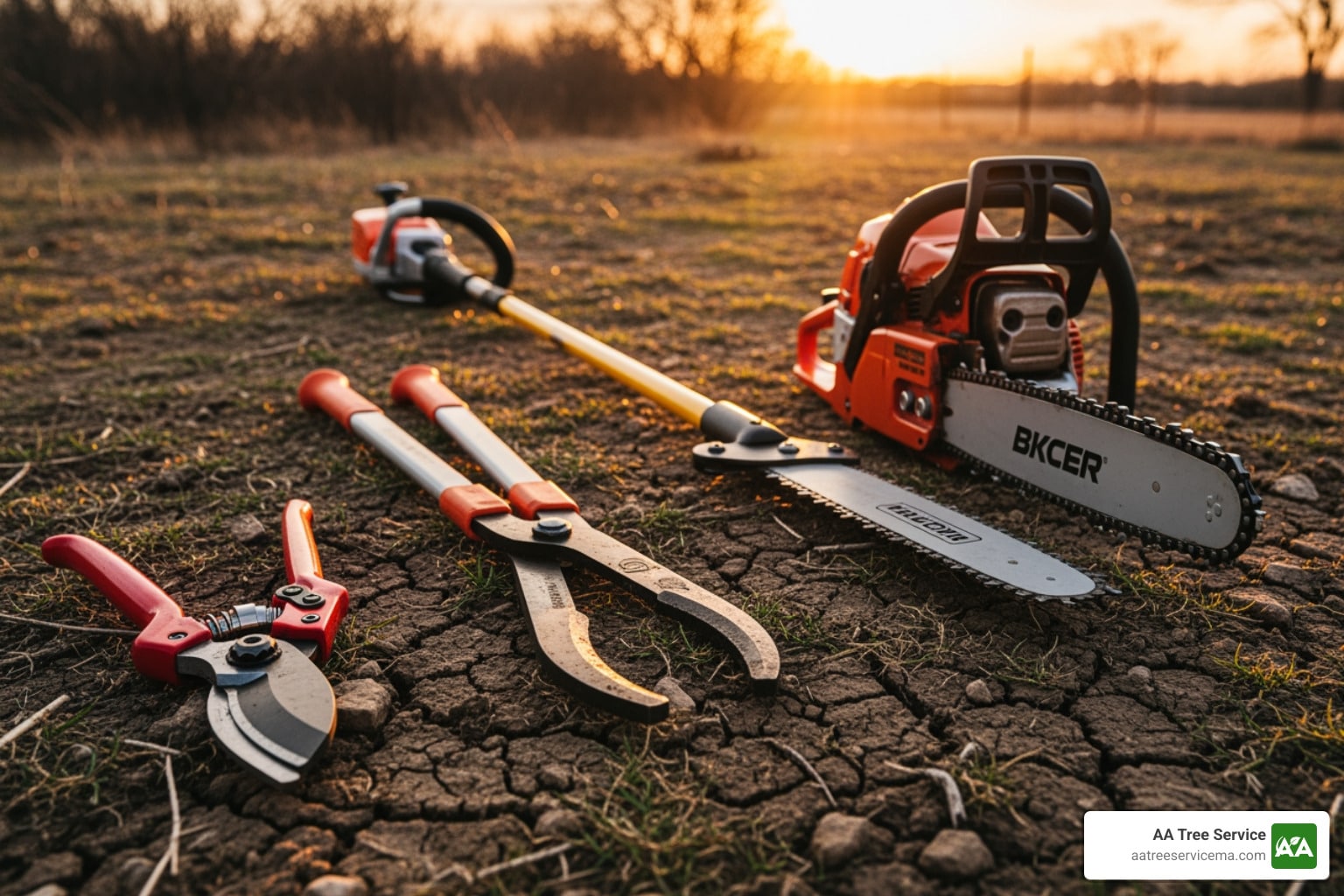
- Manual Tools: Pruning shears, loppers, and pole saws for small branches and precision work
- Walk-Behind Mowers: Self-propelled brush cutters for clearing trails, meadows, and saplings up to 2 inches
- Heavy Machinery: Skid steers, excavators, and compact track loaders with attachments like mulchers, brush hogs, and flail mowers for dense vegetation and large areas
- Key Considerations: Match equipment to vegetation type, terrain, project size, and your budget (rental vs. purchase vs. professional services)
Whether you’re reclaiming an overgrown Massachusetts property, clearing land in Southern New Hampshire for construction, or maintaining trails on your acreage, choosing the wrong equipment wastes time and money. A homeowner with a few saplings to remove doesn’t need a $50,000 skid steer. Conversely, tackling five acres of dense brush with a handheld string trimmer is an exercise in frustration.
This guide walks you through the spectrum of clearing tools—from basic hand tools to industrial forestry mulchers—and helps you understand which equipment matches your specific project. You’ll learn about machine specifications like hydraulic flow rates and horsepower, find when renting makes more sense than buying, and understand the critical safety protocols that protect both operator and property.
For homeowners in Massachusetts and New Hampshire facing significant clearing projects, understanding your options helps you decide whether to tackle the job yourself or call in professionals with commercial-grade equipment.
Find more about brush clearing equipment:
The Spectrum of Clearing Tools: From Manual to Mechanized
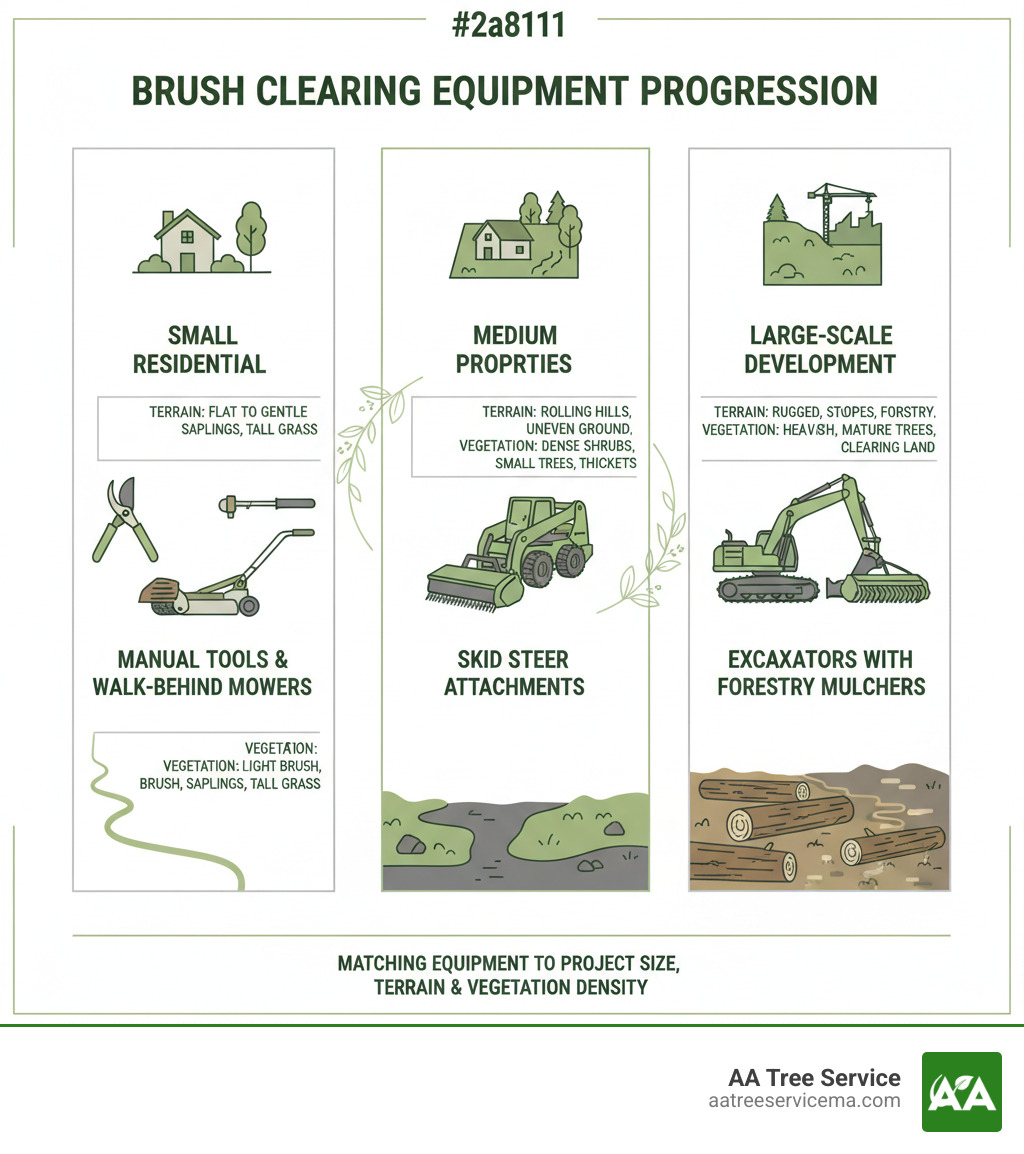
Think of brush clearing equipment as a toolkit that scales with your ambition. Whether you’re trimming back a few wayward shrubs or reclaiming acres of overgrown Massachusetts woodland, there’s a tool designed for that challenge. The trick isn’t finding the biggest machine—it’s matching the right equipment to your specific project.
Let’s walk through your options, starting small and working our way up to the heavy hitters.
Manual and Handheld Power Tools
For tight spaces, precision work, or smaller clearing jobs around your New Hampshire or Massachusetts property, manual and handheld power tools offer control and cost-effectiveness.
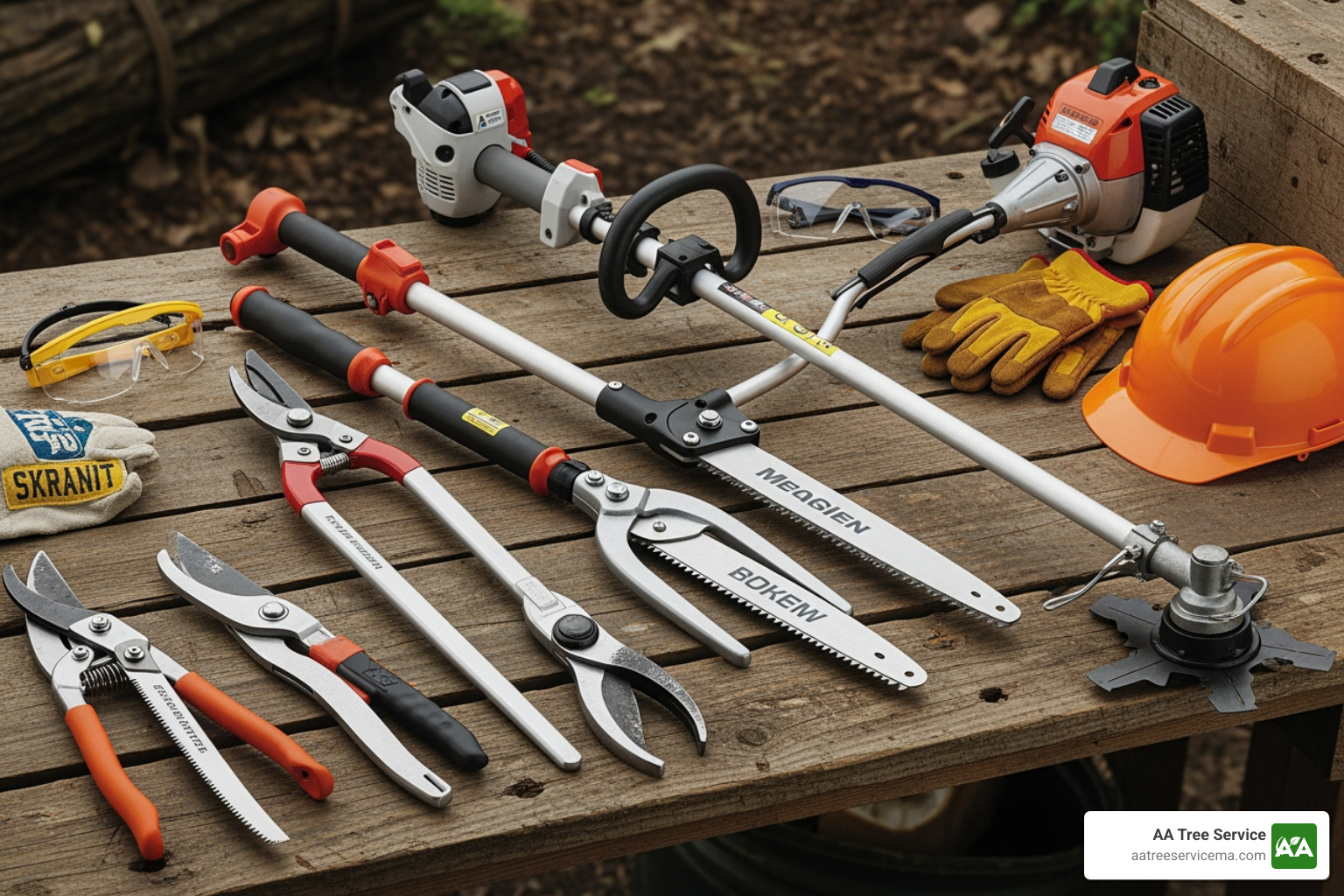
Pruning shears are for branches up to ¾ inch thick. When branches get thicker, loppers provide extra leverage to tackle branches up to 2.5 inches in diameter. For anything over 3 inches, a pruning saw is necessary.
For ground clearing, string trimmers handle tall grass and weeds, while handheld brush cutters use metal blades to cut through thick brush and small saplings. These tools are accessible, affordable, and ideal for homeowners managing fence lines, garden edges, or light overgrowth.
Walk-Behind Brush Mowers
When handheld tools feel inadequate and you’re facing a field of dense brush, walk-behind brush mowers bridge the gap between manual labor and heavy equipment. These self-propelled units are purpose-built for clearing overgrown meadows, creating trails, and tackling vegetation that would overwhelm a regular lawn mower.
These machines typically feature hydrostatic drive systems for smooth, variable speed control. Their cutting width usually ranges from 26 to 28 inches, and their cutting capacity is impressive—they can handle saplings up to 2 inches in diameter and brush up to 6 feet tall.
Walk-behind brush mowers excel at clearing dense undergrowth, creating and maintaining walking trails, and reclaiming small to medium-sized overgrown plots. If you have an acre or two of meadow that’s gotten away from you on your New Hampshire property, these machines deliver professional results.
For smaller lot clearing projects where a walk-behind mower might be the perfect fit, our Lot Clearing Services guide offers additional insights.
Heavy-Duty Brush Clearing Equipment and Attachments
When you’re facing dense forests, commercial site preparation, or large-scale clearing projects across Massachusetts or New Hampshire, heavy-duty brush clearing equipment provides the necessary power.
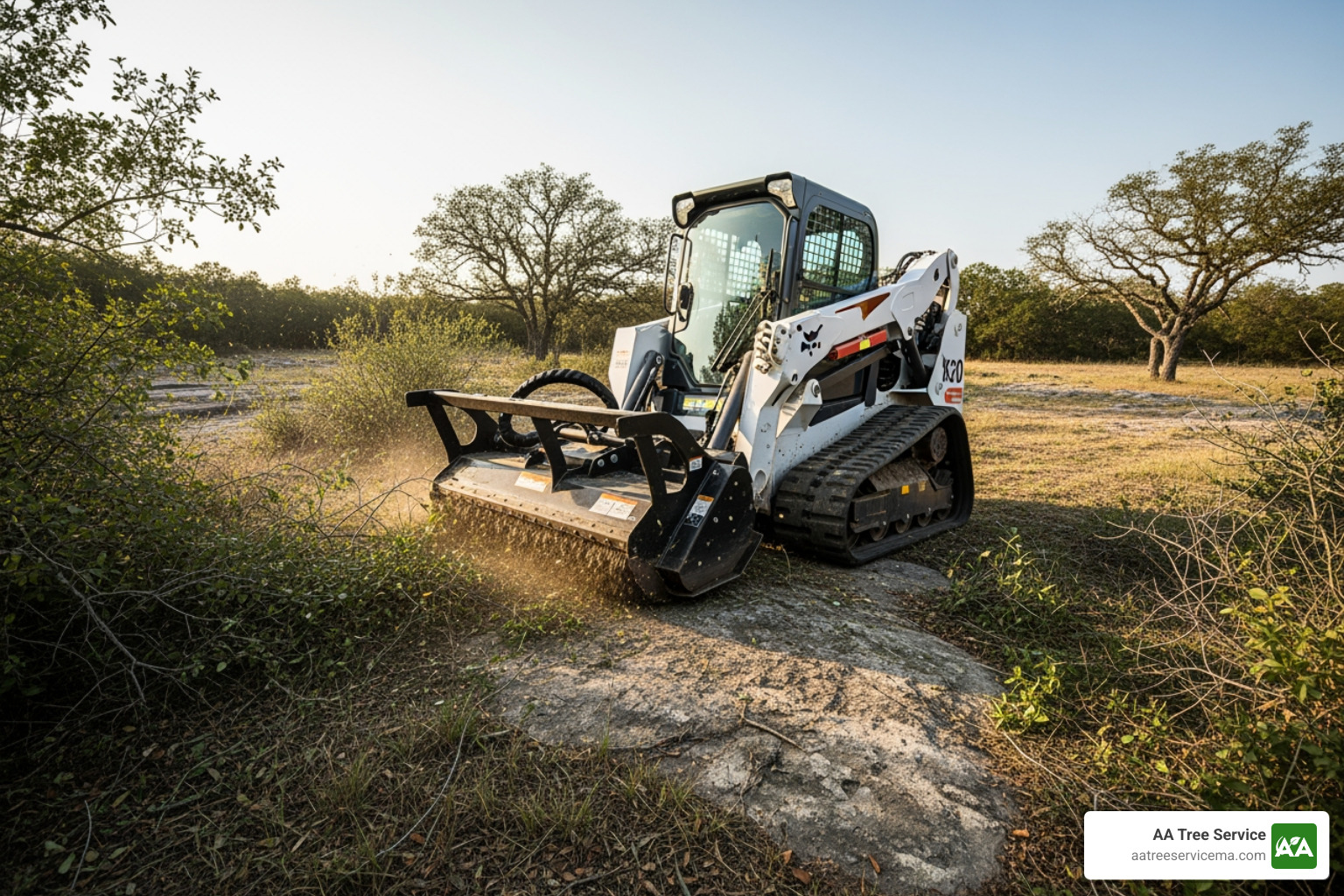
Skid steer loaders are agile and perfect for jobs requiring tight turns. Their tracked cousins, compact track loaders, offer superior traction on soft, muddy, or uneven terrain, minimizing ground disturbance. Excavators excel at uprooting large trees, moving boulders, and clearing tough obstacles.
The true versatility comes from attachments. Forestry mulchers shred vegetation into fine mulch on-site, handling trees up to 5 inches in diameter or more. Flail mowers cut and shred vegetation while containing debris, a key safety feature near roads or on slopes. Brush hogs are heavy-duty rotary cutters for thick brush and saplings. Grapples act like giant claws to move logs and debris, while stump grinders remove stumps below ground level, leaving the area ready for new use.
For comprehensive information on tackling larger projects with this level of equipment, explore our Brush and Land Clearing Services page.
How to Choose the Right Brush Clearing Equipment
Matching your brush clearing equipment to the demands of your project is about safety, cost-effectiveness, and lasting results. Whether you’re tackling an overgrown backyard in Massachusetts or a large New Hampshire property, understanding these factors helps you make smart decisions.
Assessing Your Project: Vegetation and Terrain
The right tools depend on what’s growing and where.
Vegetation type and density are key. Tall grass and light brush can be handled by a walk-behind or handheld brush cutter. Dense brush with saplings up to 3 inches thick requires heavy-duty walk-behind mowers or skid steers with brush cutters. For small trees (up to 8 inches), skid steers or CTLs with forestry mulchers are essential, as they process material on-site. Large trees and stumps require excavators and dedicated stump grinders.
Property size also dictates equipment. While handheld tools might work for a half-acre, several acres of dense vegetation make heavy machinery the only practical choice.
The terrain is often the deciding factor. Flat, stable ground is fine for wheeled skid steers and walk-behind mowers. However, the uneven, soft, or muddy ground common in New Hampshire and Massachusetts makes compact track loaders invaluable due to their superior traction and low ground pressure. Steep slopes and ditch banks require the reach and stability of excavators with flail mowers. Rocky terrain demands robust equipment that can withstand impacts.
Here’s how different equipment types match up with terrain and vegetation challenges:
| Equipment Type | Ideal for Terrain | Best for Vegetation |
|---|---|---|
| Walk-Behind Brush Mower | Flat to gently sloped | Tall grass, weeds, light brush, saplings (up to 2″) |
| Skid Steer w/ Brush Mower | Flat to moderately uneven, stable ground | Dense brush, saplings (up to 5″), small trees |
| Compact Track Loader w/ Mulcher | Uneven, muddy, soft, moderately sloped | Dense brush, small to medium trees (up to 8″) |
| Excavator w/ Mulcher/Flail | Steep slopes, hard-to-reach areas, rocky terrain | Large trees, stumps, very dense, heavy woody material |
For more detailed insights into preparing your land for development or other uses, see our guide on Site Clearing Services.
Understanding Machine Specifications
Understanding technical specifications is the key to unlocking an equipment’s true potential and ensuring you don’t rent or buy an underpowered machine. Horsepower (HP) is the most commonly cited metric, representing the engine’s raw output. More horsepower translates directly to more cutting force, allowing the machine to power through dense, woody vegetation without bogging down or stalling.
For demanding attachments like forestry mulchers, higher horsepower is not just a benefit—it’s a necessity. Hydraulic flow (GPM) and pressure (PSI) are the lifeblood of your attachments. Think of GPM (gallons per minute) as the speed of the hydraulic fluid and PSI (pounds per square inch) as the force. A high-flow system (e.g., 30-45 GPM) is required to spin a large mulching head at the optimal speed, while high pressure provides the torque to shred hardwood.
Mismatched hydraulics will lead to frustratingly slow performance, overheating, and potential damage to both the attachment and the machine. Operating weight directly influences stability and ground pressure. A heavier machine is generally more stable, especially when wielding a heavy attachment on uneven ground. However, weight can also lead to soil compaction and ground disturbance. This is the primary advantage of compact track loaders (CTLs), which distribute their weight over a larger surface area, resulting in lower ground pressure than a wheeled skid steer of similar weight.
Cutting width determines your project’s efficiency, dictating how wide a path you can clear in a single pass. Wider attachments clear large, open areas faster, making them ideal for big properties. Finally, cutting capacity is the specification that tells you the maximum diameter of a tree or sapling the equipment can effectively process. This ranges from 2-inch saplings for a robust walk-behind mower to over 8-inch trees for an industrial-grade forestry mulcher.
Cost Analysis: Renting, Buying, or Hiring a Pro
The financial side of brush clearing equipment decisions involves weighing upfront costs against long-term value and convenience against expertise.
Renting equipment is ideal for one-time projects, as it avoids storage, insurance, and maintenance costs. Based on internet data, daily rental rates for a skid steer with a mulching attachment can range from $300 to over $1,500, but these are average costs and not actual costs for AA Tree Service. Renting allows you to match the machine to the specific job.
Purchasing equipment is a major investment best suited for businesses or large landowners with continuous clearing needs. For most property owners in Massachusetts and New Hampshire, the high upfront cost, maintenance, storage, and insurance make purchasing impractical.
Hiring professional services provides expertise and specialized equipment. Professionals work faster, safer, and handle all regulations and disposal. While the upfront cost is higher than a rental, the total value often makes it the most cost-effective choice for large or complex projects, saving you time, risk, and potential mistakes.
When you’re evaluating options, consider the frequency of your clearing needs and the scale of your projects. For many property owners in Massachusetts and New Hampshire, contacting a Ground Clearing Company like ours delivers the best combination of value, safety, and results.
Maintenance and Safety for Brush Clearing Equipment
When working with brush clearing equipment, keeping your machinery running smoothly and keeping everyone safe are essential for getting the job done right.
Essential Maintenance Practices
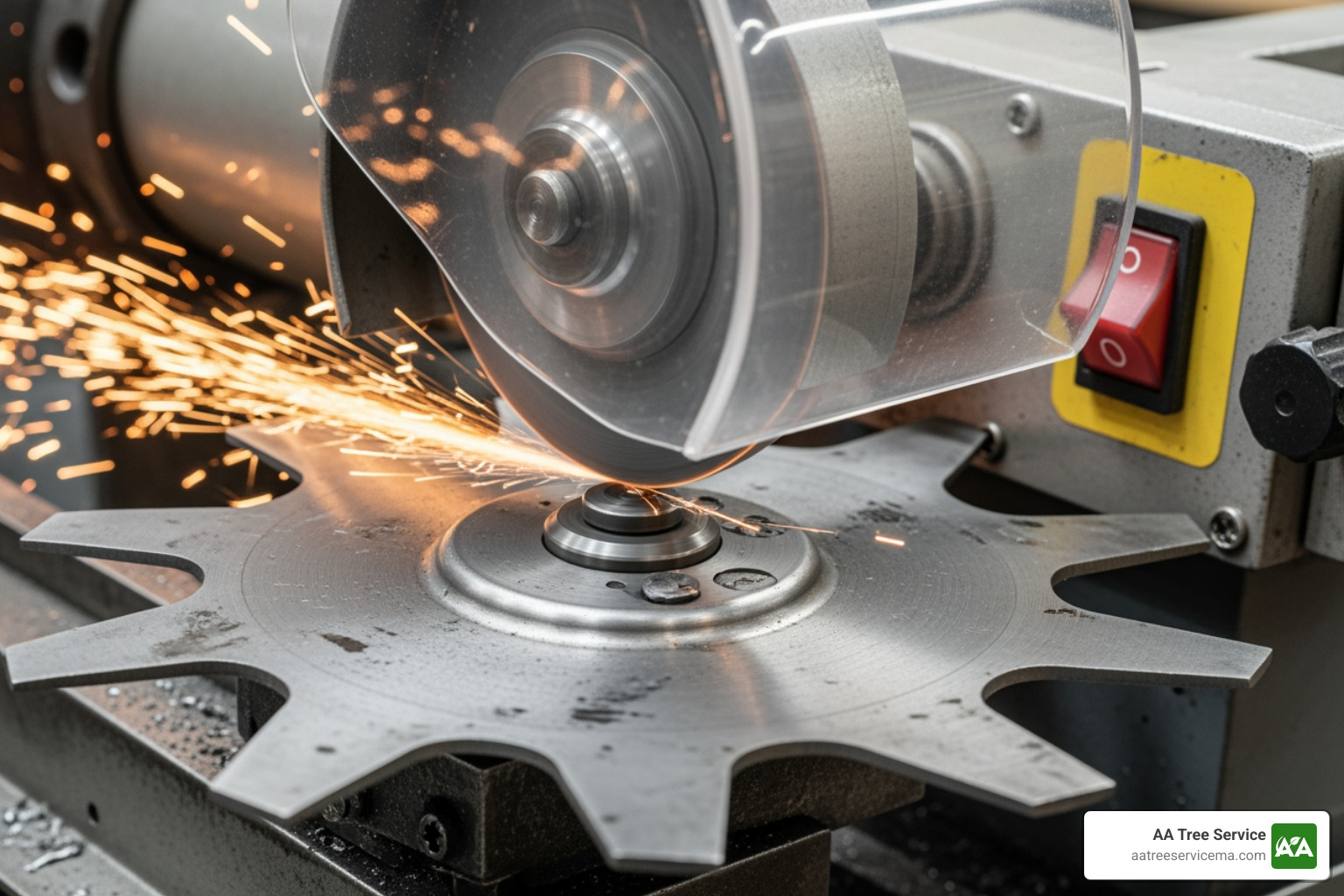
Proper maintenance of your brush clearing equipment is crucial for performance and longevity. Before each use, perform a daily inspection, checking for loose bolts, worn hoses, damaged blades, and fluid leaks. Sharp blades are essential; they cut efficiently and reduce engine strain, so inspect, sharpen, or replace them regularly. For hydraulic attachments, check fluid levels daily and follow the manufacturer’s schedule for changes. Regularly greasing all pivot points prevents friction and wear. After each job, clean the equipment thoroughly to prevent rust and overheating, paying special attention to mulching heads. Always follow the manufacturer’s guidelines to ensure reliability.
Critical Safety Protocols
Powerful brush clearing equipment demands respect and a zero-tolerance approach to safety.
Personal protective equipment (PPE) is non-negotiable. This includes hard hats, safety glasses, hearing protection, heavy-duty gloves, long pants, and steel-toed boots.
Before starting, inspect the site for hidden hazards like rocks, metal debris, and uneven terrain. Be especially careful with utilities. Always call 811 before you dig to locate underground lines and maintain a safe distance from overhead power lines.
Establish a safe perimeter around operating machinery to keep unauthorized personnel out of the danger zone. While attachments may have debris guards, a safe distance is the best protection.
Ensure all operators are properly trained on the specific equipment they are using. They must understand its controls, capabilities, limitations, and emergency procedures.
Environmental and Regulatory Considerations
Clearing land isn’t just about knocking down vegetation—it’s about doing it responsibly. In Massachusetts and New Hampshire, environmental responsibilities and regulations guide how we work.
We plan our operations to minimize soil disruption and implement erosion control measures when necessary. Compact track loaders help by distributing weight more evenly across the ground.
Forestry mulching is actually good for the environment. By converting vegetation into mulch and leaving it on the ground, we return organic matter to the soil. This improves soil health, helps retain moisture, and suppresses weed growth naturally.
When we encounter invasive plant species, we take extra precautions to prevent their spread, such as thoroughly cleaning equipment between sites.
Local regulations in Massachusetts and New Hampshire cover everything from land clearing permits to wetland protection. We stay current on these regulations because compliance protects the environment and keeps everyone out of legal trouble. For a deeper dive into environmentally responsible clearing practices, check out our Forest Clearing Services Complete Guide.
Frequently Asked Questions about Brush Clearing
What is the most efficient way to clear a large, overgrown field?
When you’re staring down a large field choked with thick brush and saplings, you need serious power and efficiency. A skid steer or compact track loader (CTL) equipped with a heavy-duty brush cutter (often called a brush hog) or a forestry mulcher is your best bet for tackling these substantial clearing jobs.
These machines are workhorses that can cover significant ground quickly, cutting and processing material in a single pass. The real magic happens with forestry mulchers—they don’t just cut vegetation, they grind it down into fine mulch right where it falls. This means no hauling, no disposal costs, and no mountains of brush piles to deal with. The Caterpillar D1 Mulcher, for instance, can clear a 72-inch swath in a single pass, leaving behind a carpet of beneficial mulch that enriches the soil.
For property owners in Massachusetts and New Hampshire with multiple acres to reclaim, this approach saves both time and money while leaving your land in better condition than traditional clearing methods.
Can I clear brush on a steep hill?
Clearing brush on steep hills or embankments isn’t just challenging—it can be downright dangerous without the right equipment and approach. This is where specialized brush clearing equipment and careful planning become absolutely critical.
A compact track loader (CTL) offers significantly more stability and traction on slopes compared to a wheeled skid steer, making it a much safer choice for moderately sloped terrain. The tracks distribute weight more evenly and grip better on uneven ground, reducing the risk of tipping or sliding.
For very steep slopes or hard-to-reach banks where even a CTL isn’t safe, an excavator with a long-reach boom and a flail mower attachment becomes the solution. The excavator can position itself on stable ground while its extended arm safely reaches the slope. Specialized ditch bank flail mowers are specifically engineered for these challenging angles, featuring hydraulic offset and tilt capabilities that let operators adjust the cutting head to match the terrain without repositioning the machine.
If you’re facing steep terrain in MA or NH, this is often a situation where professional expertise and equipment make all the difference between a successful project and a potentially dangerous mishap.
How much does it cost to have land professionally cleared?
The honest answer? It depends on quite a few factors specific to your property and project. Professional land clearing costs vary significantly based on your acreage, the density and type of vegetation (light brush versus mature hardwood trees makes a big difference), the terrain (flat and dry versus rocky, sloped, or wetland areas), and what you want the finished result to look like.
While hiring professionals represents a larger investment than renting a walk-behind brush mower for a weekend, the value equation is quite different. Professional services bring industrial-grade brush clearing equipment, experienced operators who know how to handle unexpected challenges, comprehensive insurance, and knowledge of all local Massachusetts and New Hampshire regulations. This often saves property owners significant time, considerable effort, and potentially costly mistakes that can happen when inexperienced operators tackle complex clearing projects.
We also handle all the details—from utility location and erosion control to proper debris management and site cleanup—that might not be obvious until you’re in the middle of a DIY project.
For an accurate estimate custom to your specific property and goals, we recommend reaching out for a free consultation. Every clearing project is unique, and we’re happy to walk your land with you and discuss the best approach. Learn more about what we offer through our Tree Clearing Services page, or contact us directly for a no-obligation quote for your Massachusetts or New Hampshire property.
Conclusion: Reclaim Your Land with the Right Approach
Choosing the right brush clearing equipment doesn’t have to feel overwhelming. Throughout this guide, we’ve walked through everything from handheld loppers to industrial forestry mulchers, and the truth is simple: the right tool for your project depends entirely on what you’re facing.
Start by honestly assessing your property. What kind of vegetation are you dealing with—light brush and weeds, or dense saplings and mature trees? Is your terrain flat and stable, or are you working with steep slopes and muddy ground? How many acres do you need to clear? These answers point you directly toward the equipment that will work efficiently and safely.
The beauty of modern brush clearing equipment lies in its versatility. A single skid steer or compact track loader becomes a multi-tool powerhouse when paired with the right attachments—forestry mulchers, brush hogs, flail mowers, grapples, and stump grinders. This adaptability means you can tackle varied tasks without needing an entire fleet of specialized machines.
But here’s what matters most: safety and proper maintenance are non-negotiable. Even the best equipment becomes dangerous when operated carelessly or maintained poorly. Daily inspections, sharp blades, proper hydraulic fluid levels, and appropriate personal protective equipment aren’t just recommendations—they’re essential practices that protect you, your property, and everyone around you.
For smaller projects—clearing a fence line, maintaining trails, or managing light overgrowth—handheld tools or walk-behind brush mowers might be all you need. These jobs often make perfect DIY projects for homeowners with time and energy to invest.
However, when you’re looking at significant acreage, dense vegetation, challenging terrain, or steep slopes in Massachusetts or New Hampshire, professional services make practical sense. The investment in expertise, industrial-grade equipment, and efficiency often costs less than the combination of equipment rental, your time, and the risk of mistakes that need expensive correction.
At AA Tree Service, we’ve spent over 20 years changing overgrown properties across Massachusetts and New Hampshire. We’ve seen every type of terrain and vegetation challenge these regions offer, and we bring the right combination of knowledge, equipment, and experience to handle them safely and efficiently.
Whether you’re preparing land for construction, reclaiming pasture, creating fire breaks, or simply want to see your property again, we’re here to help. Contact us for professional land clearing services and let’s discuss how we can bring your vision to life.