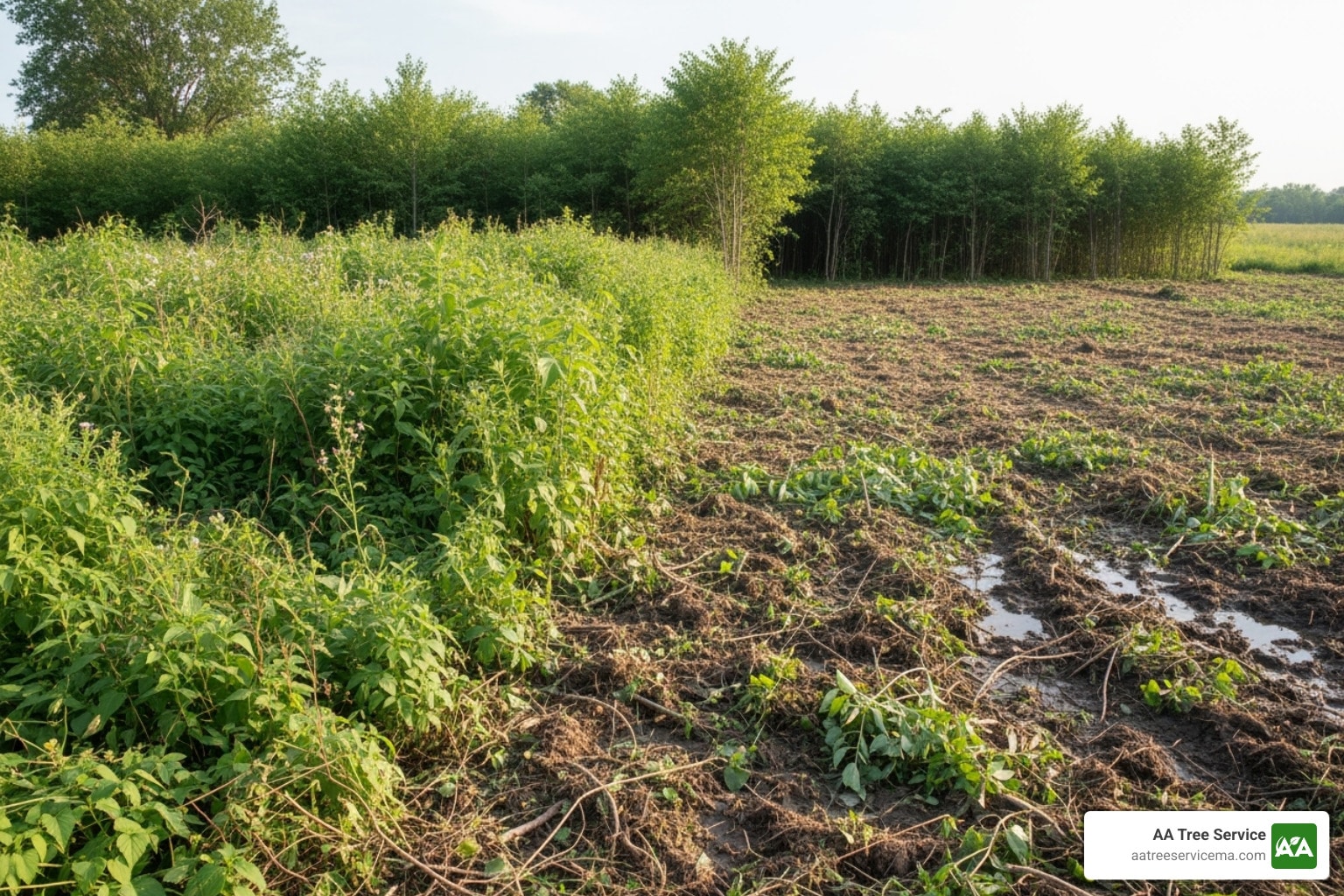
Why Understanding Brush Clearing Cost Matters for Your Property
Brush clearing cost is a primary concern for homeowners facing an overgrown property. Whether preparing land for construction, reducing fire hazards, or reclaiming usable space, understanding the financial commitment is key to effective planning.
Quick Answer: What Does Brush Clearing Cost?
- National Average (Range): $1,500 to $9,000+ for most projects
- Per Acre Pricing: $500 to $5,600 depending on vegetation density
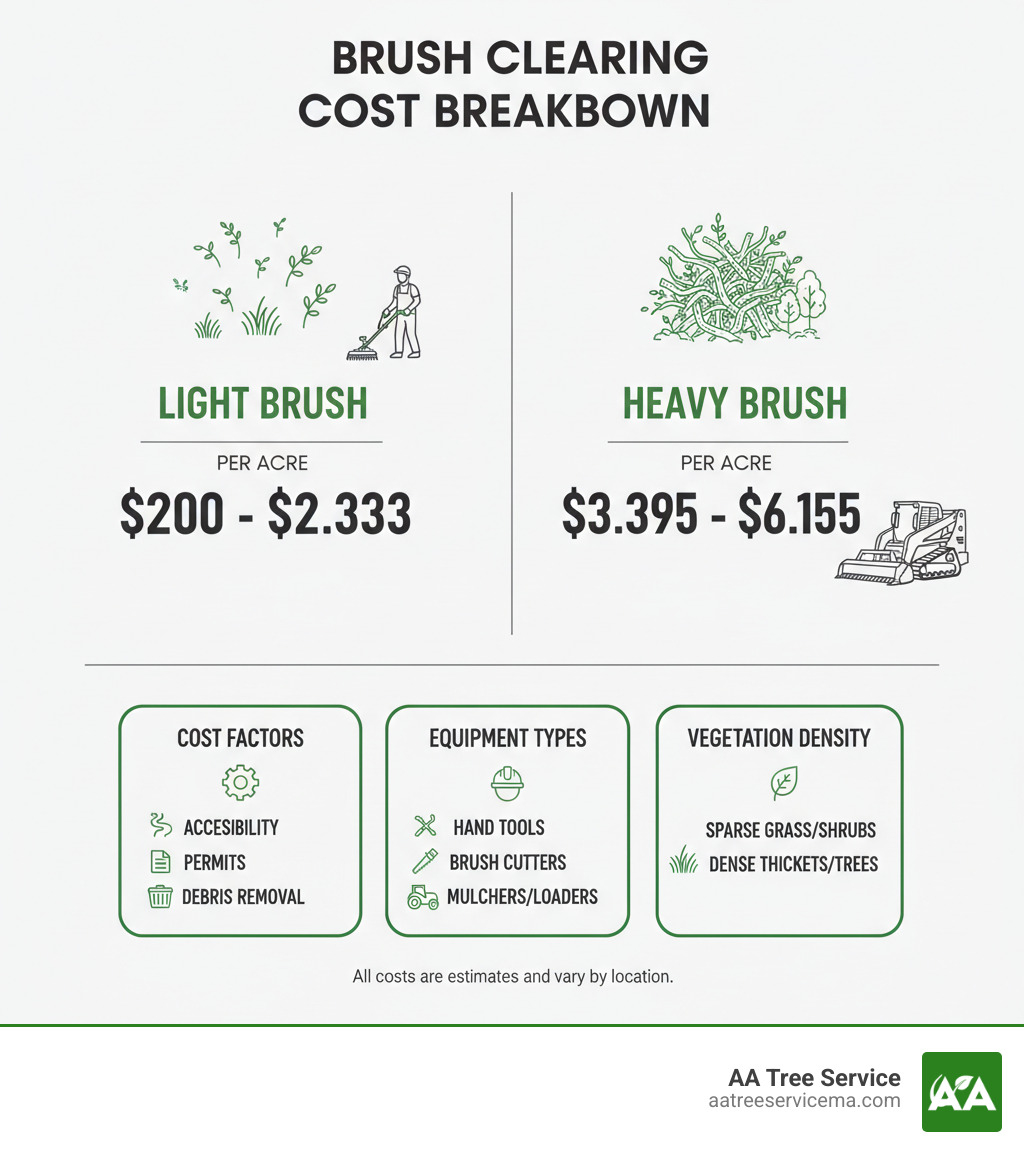
- Light Brush Clearing: $200 to $2,333 per acre
- Heavy Brush Clearing: $3,000 to $9,000 per acre
- Hourly Rates: $100 to $350 per hour for professional services
These are average costs based on internet data and actual costs may vary by location and project specifics.
Brush clearing is more than aesthetics; it’s crucial for site preparation, creating defensible space against wildfires, improving property values, and reclaiming land. A half-acre lot can seem manageable, but dense undergrowth, stumps, and rocky terrain often require specialized equipment for safe and effective clearing.
The cost varies dramatically based on factors like vegetation density, land accessibility, your location in Massachusetts or New Hampshire, and whether you need services like stump removal or debris hauling. Understanding these variables helps you avoid sticker shock when quotes arrive.
Common brush clearing cost vocab:
Understanding the National Average Brush Clearing Cost
When facing an overgrown property, the brush clearing cost is the first major question. Let’s break down the numbers to help you plan your budget and understand what drives the price up or down.
Across the U.S., property owners pay an average of around $2,900 for brush clearing, with a typical range between $1,000 and $9,000+. This wide range reflects the vast differences in projects nationwide. A simple half-acre clearing in a low-cost-of-living area might be on the lower end, while a multi-acre project on a steep, rocky slope in a high-cost area like New England could easily exceed the upper range. For land preparation ahead of construction, the average is about $2,581, but this often excludes major tree removal or extensive grading. These are national averages from internet data; your actual cost in Massachusetts or New Hampshire will depend on your unique property’s specific challenges.
No two properties are alike, so professionals use different pricing models to provide an accurate quote. These include per-acre rates for large areas, hourly charges for smaller or more intricate jobs, and fixed project-based quotes for clearly defined work. Understanding these models helps you compare quotes effectively.
Brush Clearing Prices Per Acre
Lot size is the most obvious factor affecting your total brush clearing cost. While more land means more work, larger properties often benefit from economies of scale. The initial cost of mobilizing a crew and heavy equipment to your site is significant. For a five-acre job, that mobilization cost is spread over a larger area, bringing the per-acre rate down compared to a single-acre project.
- Up to a quarter acre: $200 to $1,000. These are often considered half-day projects. While the work area is small, the price reflects the minimum cost for a professional crew to load up, travel to your site, and deploy their equipment.
- Quarter to half acre: $400 to $2,800. The cost variance here is significant and depends heavily on vegetation density and terrain. A flat half-acre with just tall grass and weeds will be on the low end, while a sloped, overgrown lot will be on the high end.
- Full acre: $500 to $5,870. This is where the type of vegetation becomes the primary cost driver. Lightly forested land with saplings and underbrush might run $500 to $2,000 per acre. In contrast, heavily wooded areas with mature trees, dense thickets of invasive species, and old stumps can push costs to $3,000 to $9,000 per acre.
- Multiple acres: Costs scale accordingly, but the per-acre rate typically decreases. For example, five acres could range from $2,500 to $28,000 or more. A ten-acre project might see a 10-20% reduction in the per-acre rate compared to a one-acre job, depending on the contractor and the land’s condition. Your specific property will need a professional assessment to determine the actual cost.
All prices are based on internet data and are for estimation purposes only.
Light vs. Heavy Brush Clearing Cost
The density and type of vegetation dramatically influence your final bill. It’s not just about how much there is to clear, but how difficult it is to clear it.
Light brush clearing typically costs $200 to $2,333 per acre. This category includes sparse undergrowth, tall grasses, weeds, and small bushes or saplings (typically under 2-3 inches in diameter). This type of clearing can often be done quickly with a heavy-duty brush hog or a smaller forestry mulcher. The goal is usually to reclaim a meadow or prepare a field for mowing.
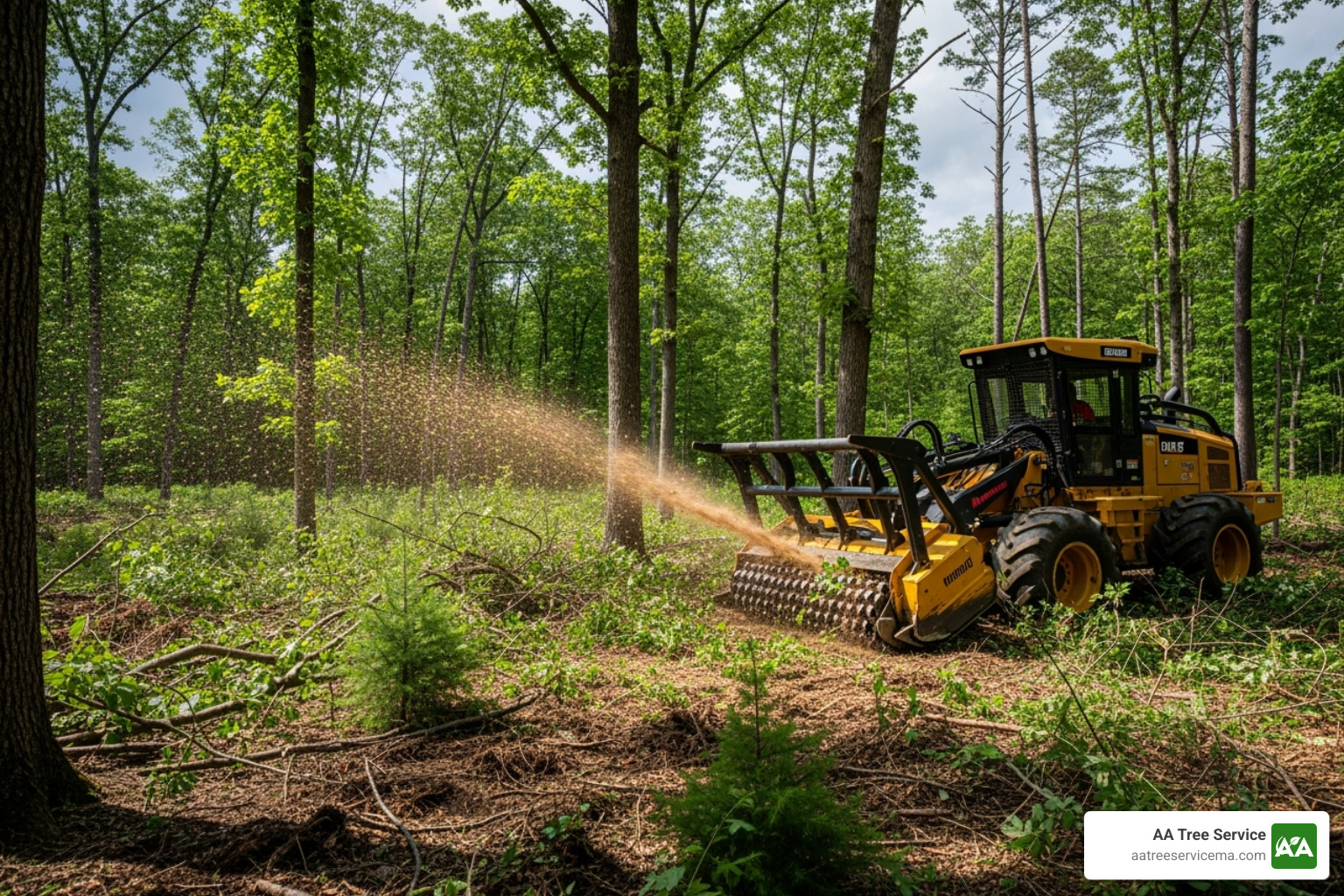
Heavy brush and heavily wooded land clearing is a different challenge, demanding more powerful equipment, more time, and greater expertise. The brush clearing cost for these properties ranges from $3,000 to $9,000 per acre, and sometimes more. This includes dense, tangled undergrowth (like multiflora rose or bittersweet vines), established shrubs, and trees with diameters exceeding 4-6 inches. The work often requires a large forestry mulcher or an excavator with a grinding head, plus chainsaws for felling larger trees. The complexity of intertwined root systems, the need to handle larger-diameter wood, and the sheer volume of biomass to process all contribute to the higher cost.
Alternative Pricing: Per Hour and Per Project
For situations where per-acre pricing isn’t a good fit, professionals offer other models.
Hourly rates typically range from $100 to $350 per hour. This rate usually covers a skilled operator and one piece of equipment, plus fuel. This model is ideal for:
- Small, specific tasks: Such as clearing a path to a pond or creating a small clearing for a shed.
- Selective clearing: When you want to carefully remove underbrush while preserving mature trees.
- Difficult or sensitive areas: Working around existing structures, septic systems, or delicate landscape features where precision is more important than speed.
Project-based quotes offer cost predictability and are the most common model for residential projects. After a thorough on-site assessment, the contractor provides a fixed price for the entire job as described in the scope of work. This could be a day rate (e.g., $1,300 for an operator and machine for 8 hours) or a total project price. This model eliminates uncertainty about the final cost and is ideal for larger, well-defined projects like clearing a lot for a new home. At AA Tree Service, we provide free, transparent project-based quotes for your property in Massachusetts or New Hampshire, so you know exactly what to expect before work begins. No surprises, just honest pricing.
Key Factors That Influence Your Final Bill
Your brush clearing cost is shaped by more than just acreage and vegetation density. A professional quote is a detailed calculation of time, labor, equipment, and risk. Several key factors can add complexity and cost to your project.
- Accessibility: How easily can we get heavy machinery to the work site? A property with a wide, flat driveway is ideal. However, narrow paths, steep driveways, wetlands, or existing structures like fences and septic systems complicate access. This may require using smaller, less efficient equipment (increasing labor hours), laying down protective mats, or even clearing a temporary access path first, all of which add to the cost.
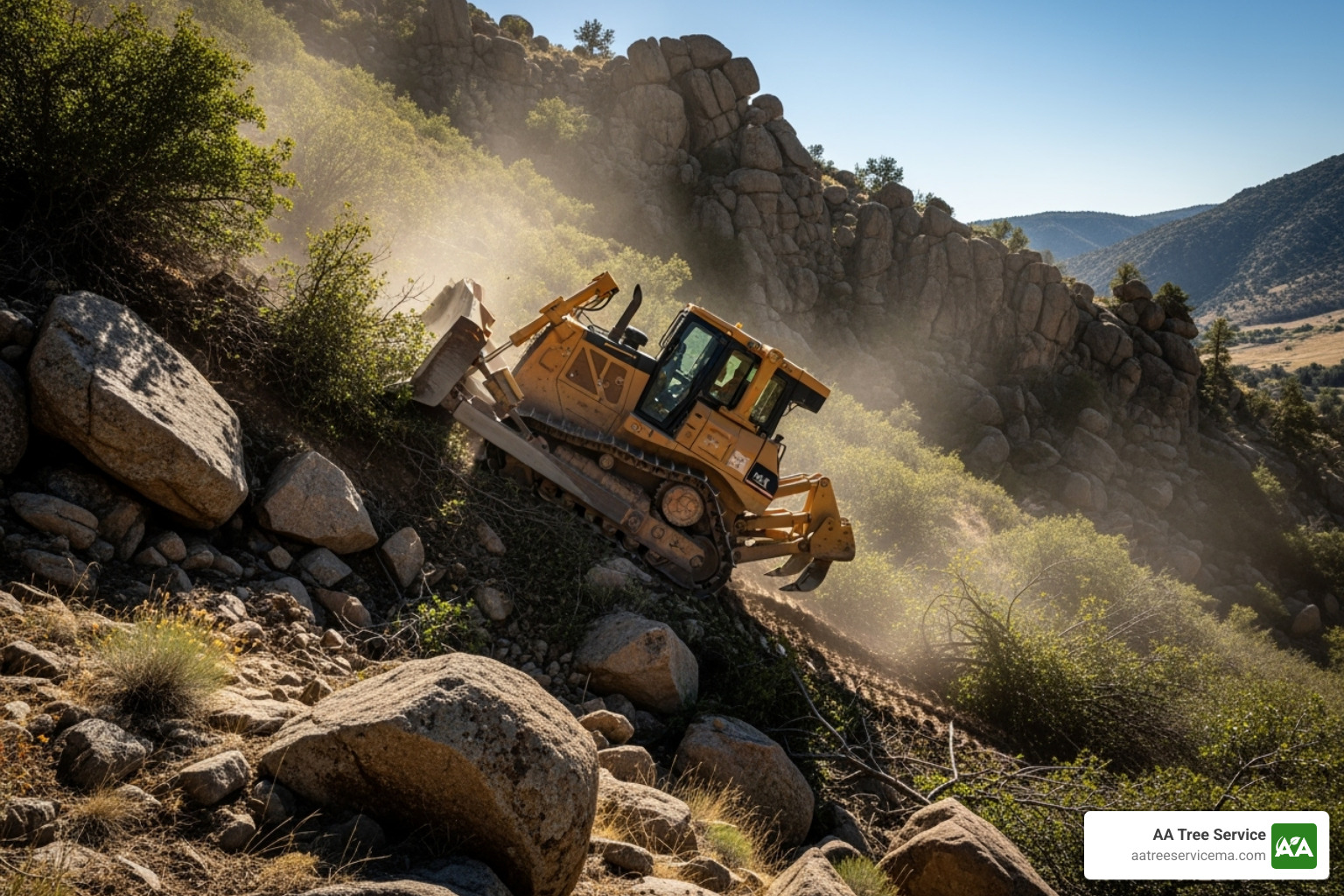
- Slope: Working on an incline is a precision operation that dramatically increases time and risk. It requires extra safety measures, specialized equipment (like tracked machines with better stability or even spider excavators for extreme slopes), and a slower, more methodical approach. Sloped land is also prone to erosion once cleared, so your project may require the additional cost of installing silt fences, erosion control blankets, or hydroseeding.
- Rocky Terrain: New England soil is notoriously rocky. Encountering surface boulders or extensive underground rock requires more than just a mulcher. It necessitates bringing in an excavator with a hydraulic thumb or hammer attachment. Breaking up and moving large rocks is time-consuming and adds significant wear and tear on equipment. Large rock removal alone can add $600 to $2,000 per acre to your project, based on internet data.
- Local Labor Rates: The cost of doing business varies by location. Your final quote will reflect the cost of skilled, insured labor, fluctuating fuel prices, equipment maintenance, and general business overhead in your specific area of Massachusetts and New Hampshire.
Site Preparation and Permits
Investing in preliminary steps is crucial for a safe, legal, and successful project, preventing costly mistakes and delays.
- Land Surveys: Establishing exact property lines is non-negotiable to avoid disputes with neighbors. A survey for a typical half-acre lot runs $300 to $1,000+ (based on internet data) and provides legal certainty.
- Geotechnical Testing: If you plan to build, a soil analysis ($1,000 – $5,000) is a wise investment. It identifies soil composition, stability, and drainage, preventing catastrophic structural issues down the road. These are average costs based on internet data.
- Local Permits: Permit requirements vary widely by town in Massachusetts and New Hampshire. You may need a permit for disturbing a certain square footage of soil, clearing within a buffer zone of wetlands or rivers, or removing a certain number of “significant” trees (defined by trunk diameter). Costs can range from $200 to $2,500 and may require a detailed site plan or arborist report. With over 20 years of experience, we can help you navigate the local permit process.
- Call 811 (Dig Safe): This free, mandatory service marks the location of all underground utility lines (gas, electric, water, cable). We never begin work without confirming that all lines have been marked. Hitting a utility line is incredibly dangerous and can result in massive fines and repair costs.
Vegetation and Debris Removal
What you clear has to go somewhere, and disposal is a significant part of the job and cost.
- Tree Removal: This is often a separate line item from general brush clearing. Based on internet data, small trees (under 30 ft) may cost $350 to $1,100 to remove, while large, mature trees can run $1,500 to $4,500 or more, especially if they are near structures. After trees are gone, stump grinding services are needed, costing $120 to $400 per stump or $90 to $270 per hour.
- Debris Hauling: If material isn’t mulched on-site, it must be hauled away. Costs depend on volume. A pickup-truck load might be $50 to $200, but a typical clearing job generates many loads. Three truck loads could cost $400 to $1,200. For larger projects, weekly dumpster rental ($250 to $750) can be more economical, but you must factor in the labor to load the dumpster.
- Brush Pile Removal: If you have existing piles of brush from past yard work, removing them is priced separately. This is often done at an hourly rate ($50 to $150) or, for very large piles, on a per-acre basis ($800 to $3,000). All prices are based on internet data.
Specialized Clearing Methods
The method used directly impacts your brush clearing cost, the project timeline, and the final condition of your land.
- Forestry Mulching: This modern, eco-friendly method uses a single machine to cut, grind, and spread vegetation as a protective mulch layer. It’s often more cost-effective as it eliminates hauling costs. Based on internet data, it often ranges from $300 to $1,500+ per acre or $150 to $450 per hour. The resulting mulch helps prevent erosion, retains soil moisture, and suppresses weed regrowth, leaving the land immediately usable.
- Brush Hogging: Essentially extreme mowing with a tractor attachment, this is a quick and affordable option for clearing lighter vegetation like tall grasses, weeds, and small saplings (typically under 2″ diameter). It does not remove stumps or roots, so regrowth is expected.
- Manual Clearing: Using chainsaws, loppers, and hand tools is ideal for small, steep, or sensitive areas where heavy machinery can’t or shouldn’t go. It’s labor-intensive and therefore more expensive for large areas, but it allows for surgical precision in preserving desirable plants.
- Controlled Burning: While used in large-scale land management, this is rarely a practical or legal option for residential properties in Massachusetts or New Hampshire. Strict regulations, air quality concerns, and the high risk of fire escaping make it generally unfeasible.
DIY vs. Professional: A Cost and Safety Comparison
The idea of saving money with a DIY approach to brush clearing is tempting, but it’s crucial to understand the full scope of the risks and true costs involved before you rent that bulldozer.
Safety is paramount. Land clearing is consistently ranked as one of the most dangerous jobs. Professionals are trained to manage a host of risks that the average homeowner is unprepared for. These include:
- Falling Trees & Branches: So-called “widow-makers” (dead, hanging branches) can fall unexpectedly. Felling a tree is a science; a miscalculation can send it crashing into your home or onto a person.
- Hidden Hazards: Overgrown lots hide dangers like hornet nests, unseen holes, sharp stumps, and tangled vines that can trip you or jam equipment. Poison ivy, oak, and sumac can cause severe reactions.
- Equipment Rollover: Heavy machinery is top-heavy and can easily roll over on unseen slopes or unstable ground, with potentially fatal consequences.
- Underground Utilities: Even if you call 811, the markings are only an approximation. A professional knows how to work cautiously around these zones; a DIYer might accidentally sever a gas line or electrical cable.
Equipment rental costs can be shocking. A bulldozer can cost $200 to $800 per day, and an excavator adds another $200 to $3,500 daily. Add in a stump grinder ($190 to $570) and other attachments, and you could easily spend $3,500 to $10,500 in a week on rentals alone. This price doesn’t include hidden costs like delivery and pickup fees ($100-$300+), mandatory damage waivers, fuel (which can be hundreds of dollars per day), and dump fees for debris.
Time is another factor. A project that takes our experienced crew a day or two could consume your entire summer. What starts as a weekend project can stretch into months of frustrating, back-breaking work.

The Value of Hiring a Professional
Paying for professional services provides significant value that goes far beyond just labor. You are paying for experience, efficiency, and peace of mind.
- Experience: With over 20 years of work in Massachusetts and New Hampshire, our team can instantly assess your property, identify potential problems (like invasive species or drainage issues), choose the right approach, and execute the job efficiently. This avoids the costly and time-consuming trial-and-error of a DIY project.
- Efficiency: We own and maintain a fleet of specialized equipment like forestry mulchers, excavators, and brush hogs. Our skilled crews can complete jobs in days that might take a DIYer weeks or even months. We know how to get the most out of our machines to deliver a better result, faster.
- Insurance: This is one of the most critical benefits. Our comprehensive liability and workers’ compensation insurance protects you completely. If an accident occurs—whether it’s damage to your property or an injury to a worker—you are not financially responsible. The potential cost of a single accident in a DIY scenario could dwarf the entire cost of hiring a professional.
- Proper Equipment: We have the right tools for any challenge. This includes specialized attachments for rock removal, precision tools for sensitive areas, and even crane services for difficult jobs that are simply impossible to tackle with standard rented equipment.
The True DIY Brush Clearing Cost
When you add up the real costs, the DIY option is rarely the bargain it appears to be.
| Item | Typical Daily Cost Range (Internet Averages) |
|---|---|
| Bulldozer Rental | $200 – $800 |
| Excavator Rental | $200 – $3,500 |
| Stump Grinder Rental | $190 – $570 |
| Fuel (per day) | $100 – $400 |
| Delivery/Pickup Fees | $100 – $300 |
| Dumpster/Hauling Fees | $250 – $750+ |
| Estimated Total Daily DIY Cost | $1,040 – $6,320+ |
| Professional Service (Hourly) | $100 – $350 (includes equipment, fuel & labor) |
| Professional Service (Daily) | $1,300+ (all-inclusive) |
Note: These are average costs based on internet data. Rental prices do not include your time, potential repair costs, or the immense safety risks.
Looking at these numbers, the daily brush clearing cost for a DIY project can quickly meet or exceed professional rates—and you’re still doing all the dangerous, strenuous work yourself. For very light brush on a small, flat lot, you might save a little money. But for anything more substantial, hiring professionals is often the smarter, safer, and more cost-effective decision.
Frequently Asked Questions about Brush Clearing
With over 20 years of experience serving Massachusetts and New Hampshire, we’ve heard every question about land clearing. Here are detailed answers to the most common ones.
When is brush clearing necessary?
Clearing is often a practical necessity for several reasons, each with its own set of goals:
- Construction Preparation: To create a clean, stable, and properly graded slate for foundations, driveways, septic systems, and utilities.
- Fire Hazard Reduction: To create “defensible space” around homes as recommended by fire safety officials. This involves removing flammable underbrush and ladder fuels (vegetation that allows fire to climb into treetops), which can be critical in fire-prone areas and may even lower insurance premiums.
- Farmland Creation: To convert wooded or overgrown areas into new pastures for livestock or fields for crops. This often involves complete removal of stumps and roots.
- Habitat Restoration: To strategically remove invasive species like buckthorn, bittersweet, or multiflora rose that choke out native plants and disrupt the local ecosystem.
- Reclaiming Usable Space: To expand a backyard for children to play, create a new garden, install a pool, or simply enjoy more of your property that has been lost to overgrowth.
- Aesthetic Improvement & Property Value: To boost curb appeal, open up views, and increase the market value of a property. A clean, well-maintained lot is far more attractive to potential buyers.
How can I save money on my land clearing project?
While brush clearing cost is a significant investment, there are smart ways to manage expenses without cutting corners on safety or quality:
- Timing: Schedule your project during the off-season. Winter clearing, when the ground is frozen, can be more efficient as it minimizes ground disturbance and provides better visibility for operators. This can sometimes lead to more competitive pricing from contractors.
- DIY Debris (with caution): For smaller projects, you can reduce professional labor hours by handling some of the final cleanup yourself, like gathering small branches and loose debris into piles. Be realistic about the volume, as it’s often more than people expect.
- Sell Timber: If your property has a significant number of mature, high-value hardwood trees like oak, maple, or black walnut, selling the timber to a logger or sawmill could help offset costs. This is typically only viable for multi-acre projects and requires a separate assessment.
- Bundle Services: If you also need tree removal, stump grinding, and grading, ask for a comprehensive package quote. It’s always more cost-effective for a contractor to perform all services in one visit rather than mobilizing their crew and equipment multiple times.
- Strategic Clearing: Instead of clear-cutting the entire area, consider a selective approach. Removing only the underbrush and unhealthy trees while preserving healthy, mature ones can create a beautiful, park-like feel at a lower cost and is better for the environment.
- Check for Grants: Occasionally, local conservation districts or state programs in MA or NH may offer cost-sharing or grant funding for projects related to wildfire mitigation, invasive species removal, or habitat restoration. Availability varies greatly by locality and year.
How long does it take to clear one acre of land?
The timeline depends entirely on the property’s condition, the equipment used, and the desired finish. Here’s a comparison:
- Ideal Scenario (2-4 hours): An acre of flat, dry land with light brush, grass, and saplings under 3 inches in diameter. A large forestry mulcher can move through this quickly, leaving a layer of mulch behind.
- Challenging Scenario (1-3 days): A heavily wooded acre on a slope with dense, mature trees, thick invasive vines, rocks, and old stumps. This requires a multi-step process: felling large trees with chainsaws, using an excavator to remove stumps and rocks, and then bringing in a mulcher to process the remaining brush and debris. Each step adds significant time.
What is the best time of year for brush clearing?
Each season has its pros and cons:
- Winter: Often the best time. Frozen ground supports heavy machinery, preventing ruts and soil compaction. With no leaves on the trees, operators have clear visibility, increasing safety and efficiency.
- Spring/Fall: Mild weather is good for workers, but the ground is often soft and wet, which can lead to mud and ground disturbance. It’s also a critical time for nesting birds and wildlife, which professionals should be mindful of.
- Summer: The ground is typically dry and firm, which is good for equipment. However, heat can be hard on crews and machinery, and the lush growth can hide hazards.
Will brush clearing cause soil erosion or turn my yard into a mud pit?
This depends entirely on the method used. Old-fashioned methods involving bulldozers that scrape and grub the land, removing stumps and roots, leave the topsoil bare and highly vulnerable to erosion. This is what creates a muddy mess. However, modern, professional methods prioritize soil health:
- Forestry Mulching: This is the best method for preventing erosion. The machine grinds vegetation in place, blanketing the soil with a protective layer of mulch. This layer holds the soil, retains moisture, and prevents erosion, even on slopes. The ground remains firm and can be walked on or driven on almost immediately.
Reclaim Your Land with Confidence
You now understand the factors that shape brush clearing cost, from national averages of $1,565 to $4,520 to per-acre rates that can range from $500 to over $5,600. You know that cookie-cutter estimates don’t work because every property is unique.
Your final bill depends on your land’s size, accessibility, vegetation density, terrain, and the specific services you need, like tree removal or debris hauling. Your location in Massachusetts or New Hampshire also plays a role.
This is where we come in. For over 20 years, AA Tree Service has helped property owners in Massachusetts and New Hampshire transform overgrown land into beautiful, usable spaces. We know a website can’t give you the precise answer you need for your property. That’s why we offer free, same-day quotes that provide a clear, detailed breakdown of your project’s actual cost.
Our commitment is to transparent pricing and professional expertise. Whether you’re preparing for construction, creating defensible space, or reclaiming your backyard, we have the experience and equipment to do the job right.
Don’t let cost uncertainty keep your land’s potential locked away.
Get a free quote for your land clearing project today! Let’s discuss your needs and create a plan that fits your vision and budget.