Why Large Tree Removal Costs Vary So Much
The cost of large tree removal typically ranges from $870 to $3,500, with some extra-large or complex jobs costing up to $10,000 or more. Here’s a general breakdown:
- Small trees (under 30 ft): $255 – $600
- Medium trees (30-60 ft): $435 – $1,200
- Large trees (60-80 ft): $870 – $2,000
- Extra-large trees (80+ ft): $1,160 – $4,700
These are average costs based on internet data and not actual costs for AA Tree Service.
When a large tree in your Massachusetts or New Hampshire yard becomes a concern, the price for removal is a top question. This wide range exists because every job is unique. For example, a 70-foot pine in an open yard might cost $1,200, but the same tree near power lines could be $3,000 or more.
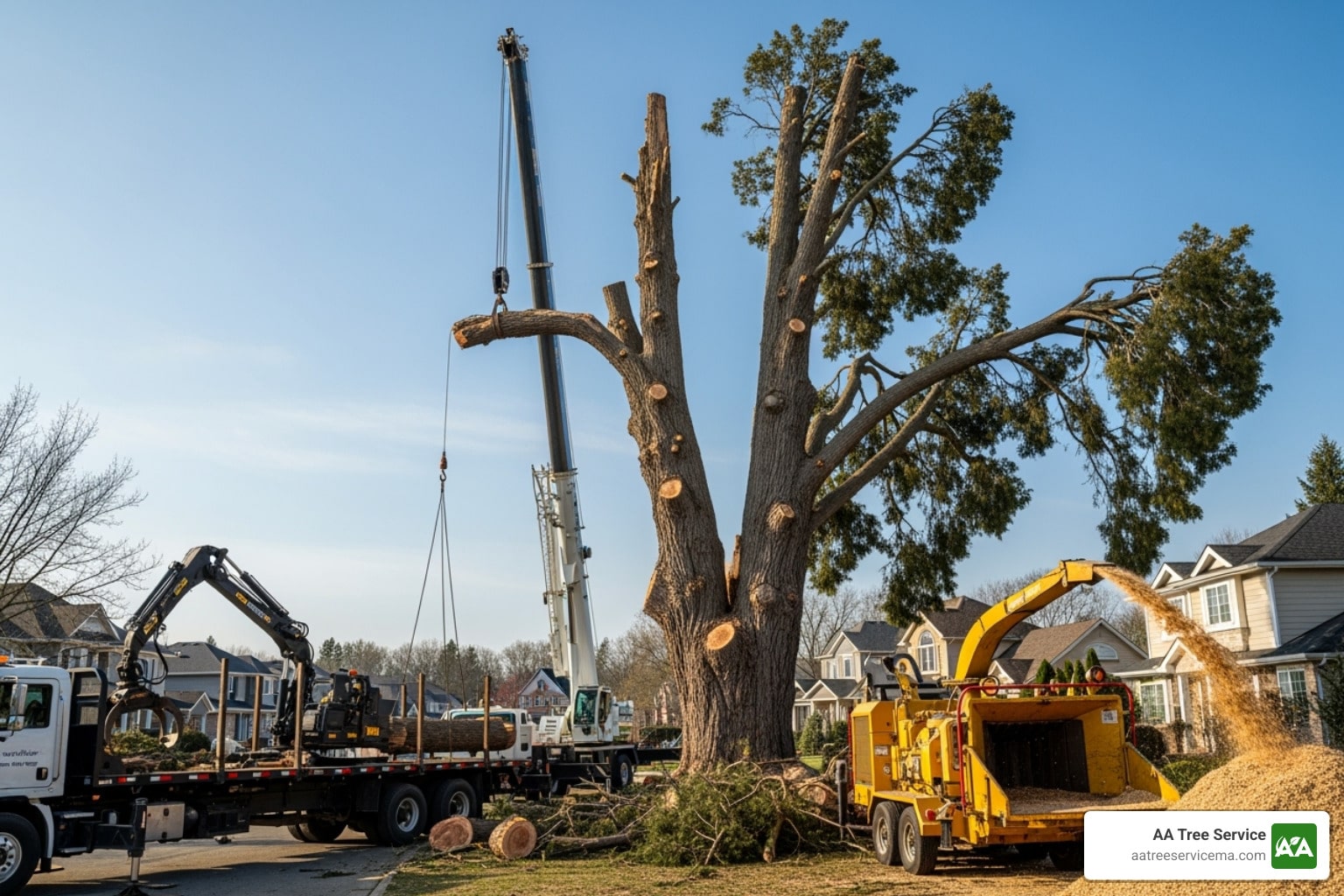
Safety is the primary factor driving these costs. Professional tree removal is a hazardous job that requires specialized equipment, extensive training, and proper insurance to protect you and your property. Crews must plan falling paths, protect nearby structures, and manage debris, often using cranes. Each of these elements influences the final bill.
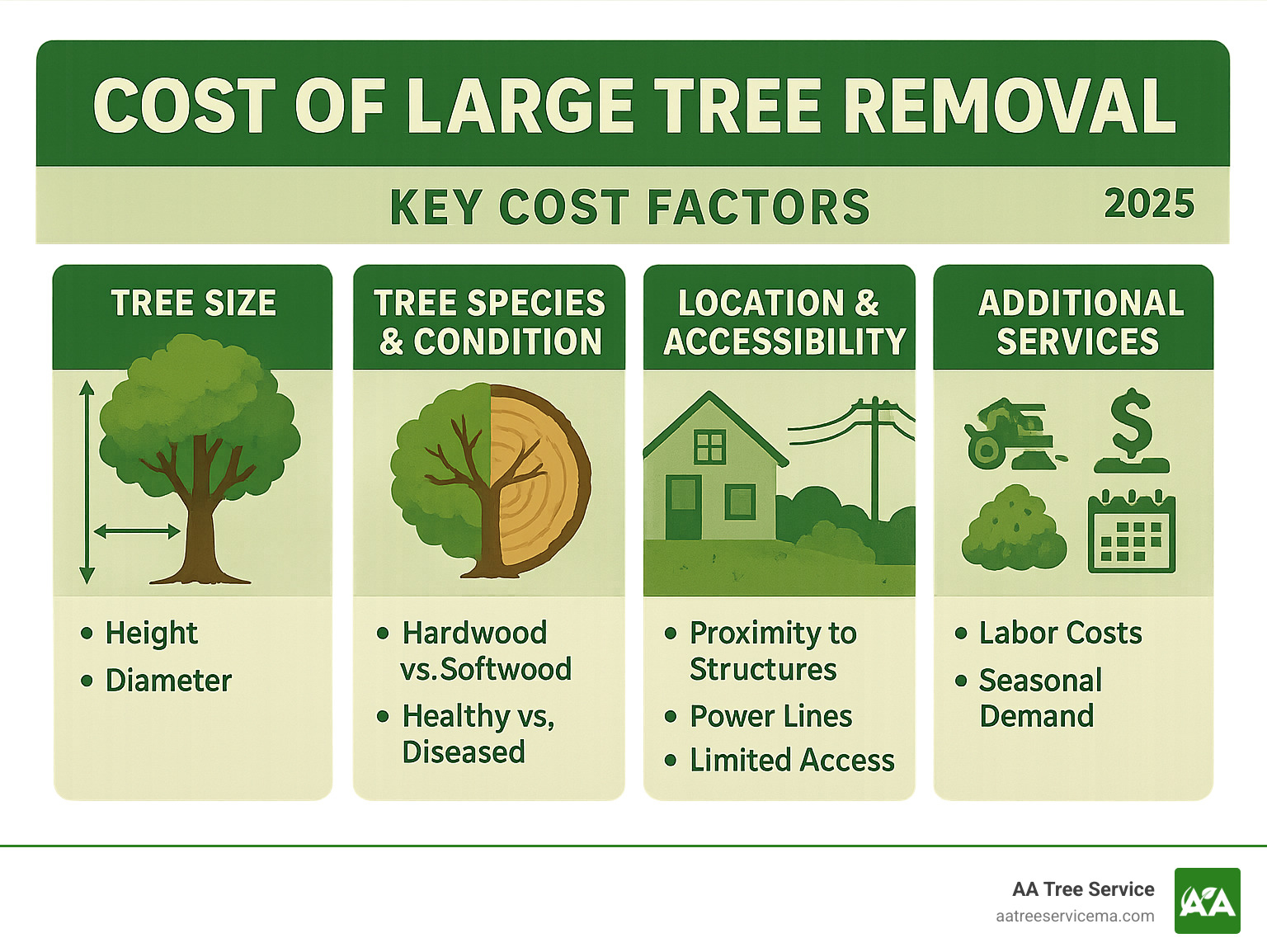
Cost of large tree removal word roundup:
The Ultimate Breakdown of Large Tree Removal Costs
When we provide a quote for the cost of large tree removal, we’re assessing multiple factors to determine the time, equipment, and expertise required. All prices mentioned are national averages for informational purposes; your quote will depend on your specific situation.
How Tree Size Dictates the Price
A tree’s height and trunk diameter are the primary cost drivers. Taller trees require more complex rigging and specialized equipment like bucket trucks or cranes, with most companies charging between $9.50 and $14.50 per foot of height.
- Small trees (under 30 ft): Averaging $255 to $600, these are manageable with standard equipment.
- Medium trees (30-60 ft): Ranging from $435 to $1,200, these often require bucket trucks and advanced rigging.
- Large trees (60-80 ft): Costing $870 to $2,000, these require careful planning to protect your property.
- Extra-large trees (over 80 ft): Prices start at $1,160 and can exceed $4,700, often requiring a crane.
A thick trunk diameter increases the work, as there’s more wood to cut and heavier sections to manage, especially for dense hardwoods like oak. For more details, see our tree removal services page.

The Impact of Tree Species and Condition
The tree’s species and health significantly affect the price.
- Hardwood vs. Softwood: Dense hardwoods like oaks and maples are more expensive to remove than softer pines due to their complex branch structures and weight. Oak tree removal can range from $250 to $2,500, while maple tree removal may cost $600 to $2,800. Pine tree removal is typically $200 to $1,600.
- Tree Health: A tree’s condition is crucial. Diseased trees may need special handling, increasing costs by 25-50%. Dead or decaying trees are unpredictable and dangerous, often requiring aerial lifts or cranes, with removal costs from $800 to $1,600. Leaning or damaged trees also pose a higher risk and require more complex work.
- Fallen Trees: If a tree is already on the ground in an accessible spot, removal can be much cheaper—sometimes as low as $75 to $150—as the most dangerous part of the job is already done. For urgent situations, learn about our emergency tree removal services.
Location, Location, Location: Accessibility and Risk Factors
A tree’s location is a critical cost factor. Expect to pay 25% to 50% more for a tree in a difficult-to-access or hazardous location.
- Proximity to Structures & Power Lines: Trees near homes, garages, or power lines require precise, controlled work to prevent damage. Working around electrical hazards can add 25-50% to the cost.
- Limited Access: If a tree is in a backyard with no vehicle access, crews must carry debris manually, which significantly increases labor time and can raise costs by 20-30%. Imagine a large oak in a fenced-in urban backyard; every piece must be carefully lowered and carried out through a narrow gate, a far more intensive process than felling a tree in an open field.
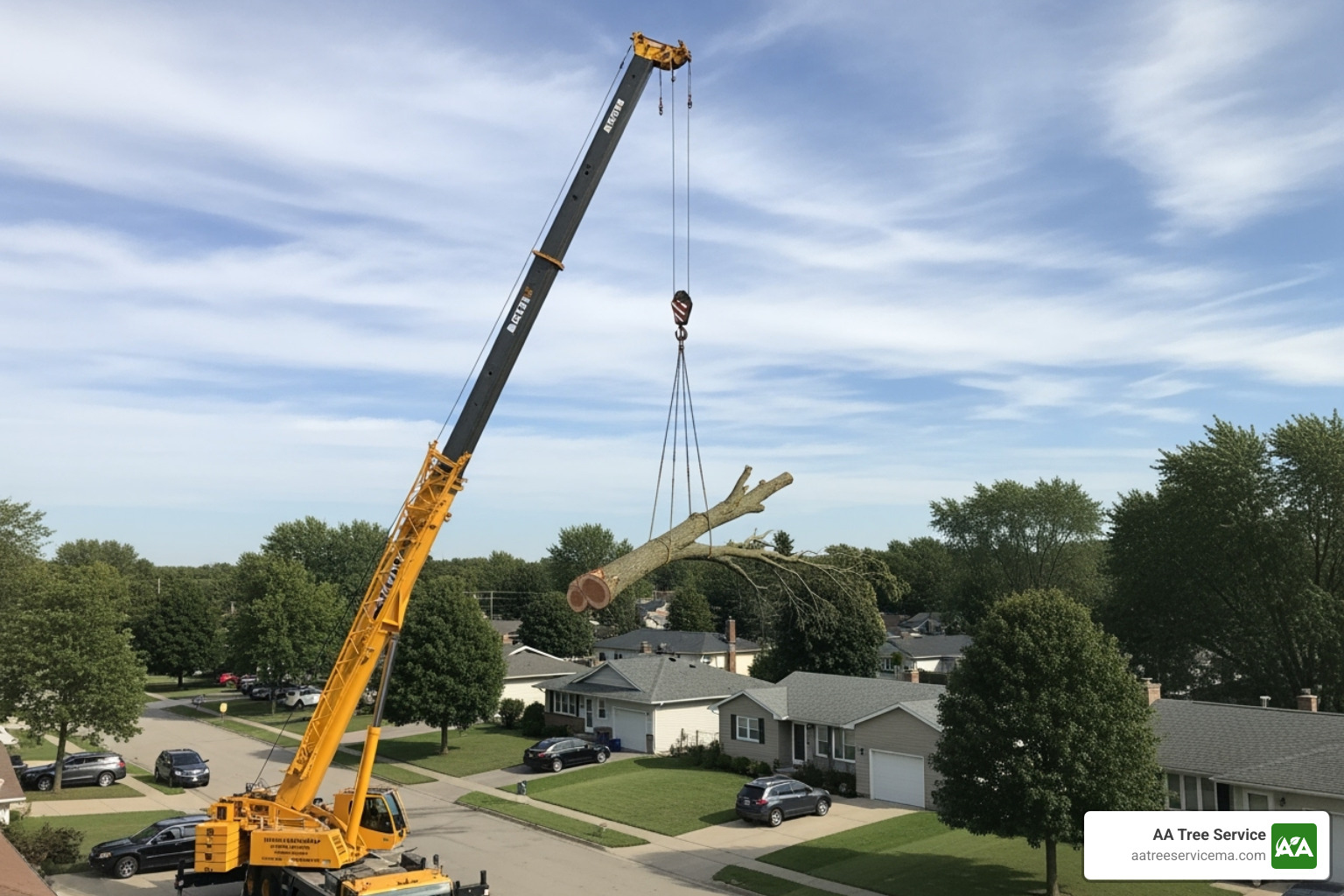
- Specialized Equipment: Trees over 80 feet or in high-risk locations often require a crane. Crane services can add $500 to $600 per day to the project cost but are essential for safely lifting large sections over obstacles. Learn more about our crane services here.
Seasonal and Regional Pricing Variations
The timing of your removal and your location in Massachusetts or New Hampshire can influence the final price.
- Seasonal Factors: Peak season runs from spring through fall. If your tree isn’t an emergency, scheduling removal in the winter (December-February) can sometimes save you 20-30%, as the ground is frozen and visibility is better. The frozen ground protects your lawn from ruts caused by heavy equipment, and the lack of leaves on deciduous trees gives arborists a clearer view of the branch structure, allowing for safer and more efficient work.
- Regional Costs: Labor and operating costs are higher in major cities and affluent areas, which can increase prices. For example, costs in a busy town like Haverhill, MA may differ from those in a community like Salem, NH.
- Industry Trends: Rising labor costs and stricter safety regulations are expected to increase tree removal costs by about 10% from 2024 to 2025.
Beyond the Felling: Additional Services and Hidden Costs
An initial quote for the cost of large tree removal usually only covers cutting the tree down. Several common add-on services complete the job, each with its own price.
The Complete Cost of Large Tree Removal: Add-Ons and Fees
Once the tree is down, you’ll need to deal with the stump and debris.
- Stump Grinding: This is the most common add-on, grinding the stump below ground level. Based on internet data, this typically costs $100 to $400 for the first stump, with additional stumps costing less. The process uses a high-speed cutting wheel to shred the stump into small chips, usually to a depth of 6-12 inches below ground. Complete root excavation is more disruptive and can cost $200 to $600, as it involves digging out the entire root ball.
- Debris Removal: Hauling away branches and logs can add $50 to $1,000 to your bill, depending on the volume of material. Discuss your options with the crew; you can often reduce this cost by keeping the wood chips for mulch or having the trunk cut into firewood-length sections for a small additional fee.
- Log Splitting: For about $70 to $99, crews can cut the trunk into fireplace-ready logs.
- Wood Chipping: Some companies include this, while others charge around $75 to $150 per hour. You can often keep the wood chips for free mulch, saving on hauling fees.
For more details, visit our stump grinding page.
Permits, Reports, and Insurance Considerations
Administrative tasks can also affect your total cost. Many towns in Massachusetts and New Hampshire require permits for removing large or protected trees, typically costing $60 to $150. An arborist report to support a permit application may cost $150 to $450.
Homeowner’s insurance often covers removal if a healthy tree falls on an insured structure (house, fence, garage) due to a covered event like a storm. However, insurance typically will not cover removal if the tree was dead, diseased, or poorly maintained, as this is considered negligence. Some policies have limited coverage for a fallen tree blocking a driveway.
If a tree falls during a storm, contact your insurance company immediately and document the damage with photos before cleanup begins.
All pricing mentioned above represents average costs based on internet data and not actual costs for AA Tree Service.
DIY vs. Professional Removal: A Cost and Safety Analysis
While the temptation to DIY is understandable, the risks of large tree removal often far outweigh the potential savings.
| Feature | DIY Tree Removal | Professional Tree Removal |
|---|---|---|
| Costs | Low upfront (tools: $220-$360), High hidden (injury, property damage, fines) | Higher upfront (avg. $750 – $3,500 for large trees) |
| Equipment Needed | Chainsaw, ropes, ladder, safety gear (often inadequate for large trees) | Specialized chainsaws, rigging, harnesses, bucket trucks, cranes, chippers, safety gear |
| Time | Can take days or weeks for large trees, especially without proper tools | Typically 4-8 hours for mid-sized, 1-2 days for larger trees |
| Safety Risks | Extremely High: Falls, cuts, electrocution, property damage | Low (for homeowner): Pros are trained, insured, and use proper safety protocols |
| Expertise | Limited, often based on online videos | Trained professionals, some with credentials from organizations like the Tree Care Industry Association (TCIA) |
| Insurance | None for self-inflicted damage or damage to property | Full liability and worker’s compensation coverage |

- Hidden Costs of DIY: The real costs of DIY can be staggering. A single miscalculation can send a multi-ton limb crashing into your roof, leading to tens of thousands in repairs that your insurance may not cover. Medical bills from a fall or chainsaw injury can be life-altering. Furthermore, many towns impose fines of over $1,000 for removing a protected tree without a permit, a regulation many homeowners are unaware of.
- When to Call a Professional: We strongly advise against DIY removal for any tree over 9 feet tall or any tree that cannot be worked on safely from the ground. For large trees in Massachusetts or New Hampshire, the risk isn’t worth it. Professionals have the experience, equipment, and insurance to do the job safely. Sometimes, a full removal isn’t needed; regular tree pruning and trimming can maintain a tree’s health.
Smart Ways to Save Money on Your Project
While professional removal is an investment, you can reduce the cost:
- Get Multiple Quotes: We recommend getting at least three bids from reputable specialists. When comparing, ensure each quote covers the same scope of work—including stump grinding and debris removal. A suspiciously low bid may indicate a lack of proper insurance. Always ask for proof of both general liability and worker’s compensation coverage to protect yourself.
- Schedule Off-Season: If it’s not an emergency, scheduling for winter (December-February) can often yield 20-30% discounts.
- Clear the Work Area: Move patio furniture, vehicles, and other obstacles to reduce labor time.
- Handle Debris Yourself: Offer to keep the logs for firewood or the chips for mulch to save on hauling fees (often $70-$100 per tree).
- Bundle Jobs: Ask for a bulk discount if you have several trees that need to be removed at once.
Is It Time to Say Goodbye? Signs Your Large Tree Needs Removal
As tree care professionals in Massachusetts and New Hampshire for over 20 years, we understand that removing a mature tree is a difficult decision. However, keeping a hazardous tree is far riskier than removing it. The cost of large tree removal is minimal compared to the potential damage from a falling tree.
Trees don’t always show obvious signs of trouble. Some can look healthy while rotting from the inside, posing a hidden danger.
Key Warning Signs of a Hazardous Tree
Here are the red flags that indicate a tree may be a hazard:
- Dead or Hanging Branches: Known as “widow-makers,” these can fall without warning.
- Trunk Decay or Cavities: Large holes, soft spots, or missing bark revealing rotten wood are signs of compromised structural integrity.
- Fungi at the Base: Mushrooms growing on or around the tree’s base often signal internal root rot.
- Significant Leaning: A sudden or worsening lean indicates instability, especially after a storm.
- Root Damage: Damaged or diseased roots from construction or decay can destabilize the entire tree.
- Proximity to Home: Branches touching your roof or roots threatening your foundation are serious concerns.
- Pest Infestations: Some infestations, like the emerald ash borer, are a death sentence for a tree and require removal to prevent spreading.
If you’re clearing land for a new project, learn about our land clearing services.
When to Trim vs. When to Remove
Many homeowners ask if trimming is an option instead of removal.
Trimming is ideal for healthy trees to improve their shape, remove problematic branches, and keep them clear of structures and power lines. Saving a healthy tree is always our first choice.
Removal is necessary when a tree is dead, dying, or so diseased that it cannot be saved. The same applies to trees with severe structural damage or roots that are damaging your foundation. If a tree poses an immediate safety risk, the cost of large tree removal is an investment in your peace of mind.
A professional assessment is the smartest move when you’re unsure. Our team can evaluate your tree’s health and give you an honest recommendation. If you’re nervous about a tree, it’s worth getting it checked.
Frequently Asked Questions about Large Tree Removal
It’s a big decision, so it’s natural to have questions about large tree removal. With over 20 years of experience in Massachusetts and New Hampshire, we’ve answered them all. Here are the most common ones.
What is the average cost to remove a large tree?
The cost depends entirely on your specific situation. For large trees (60-80 feet), the price typically ranges from $870 to $2,000. For extra-large trees (over 80 feet), costs can range from $1,160 to $4,700 or more, especially if a crane is needed. The final price is determined by the tree’s size, health, species, and accessibility. These are average costs based on internet data and not actual costs for AA Tree Service. The only way to know for sure is to get a quote.
How long does it take to remove a large tree?
Timeframes vary based on complexity.
- Mid-sized trees (30-60 feet): Typically 4 to 8 hours.
- Large trees (60-80 feet): Often a full day, sometimes longer if the location is tricky.
- Extra-large trees (over 80 feet): Can take 1-2 full days or more for the most complex jobs.
Adding services like stump grinding will add another 1-2 hours. We work efficiently but always prioritize safety over speed.
Will my homeowner’s insurance pay for tree removal?
The answer is “sometimes.” Insurance typically covers removal under specific conditions.
- When it’s usually covered: If a healthy tree falls on an insured structure (your house, garage, fence) due to a covered event like a windstorm or heavy snow, your policy will likely pay for the removal and repairs. Some policies also have limited coverage if a fallen tree blocks your driveway.
- When it’s not covered: Insurance will not pay for the cost of large tree removal if the tree was dead, diseased, or poorly maintained before it fell. This is considered a preventable issue and the homeowner’s responsibility.
Our advice: If a tree falls on your property, call your insurance agent first. Document the scene with photos before any cleanup begins to support your claim.
Conclusion
When removing a large tree from your Massachusetts or New Hampshire property, understanding the cost of large tree removal is key. As we’ve seen, the final price depends on a unique story told by your tree’s size, species, health, and location. Factors like stump grinding and debris hauling also play a role, explaining why a quote for an 80-foot oak near power lines can be $4,000 while a similar tree in an open yard is closer to $1,500.
What never changes is the value of safety and professional expertise. A DIY attempt can lead to injury, property damage, or fines, making the upfront cost of a professional service a wise investment. Professional removal isn’t just about having cranes and rigging; it’s about the experience to handle the job safely and the insurance to protect you completely.
Whether you’re dealing with storm damage or a tree that has become a constant worry, our team is here to help. With over 20 years of serving homeowners in Massachusetts and New Hampshire, we understand the local challenges and are ready to provide a safe solution.
Ready for peace of mind? We offer free, same-day quotes and 24/7 emergency services.
Contact us for your tree removal needs and let our experienced team help you write the next chapter safely.