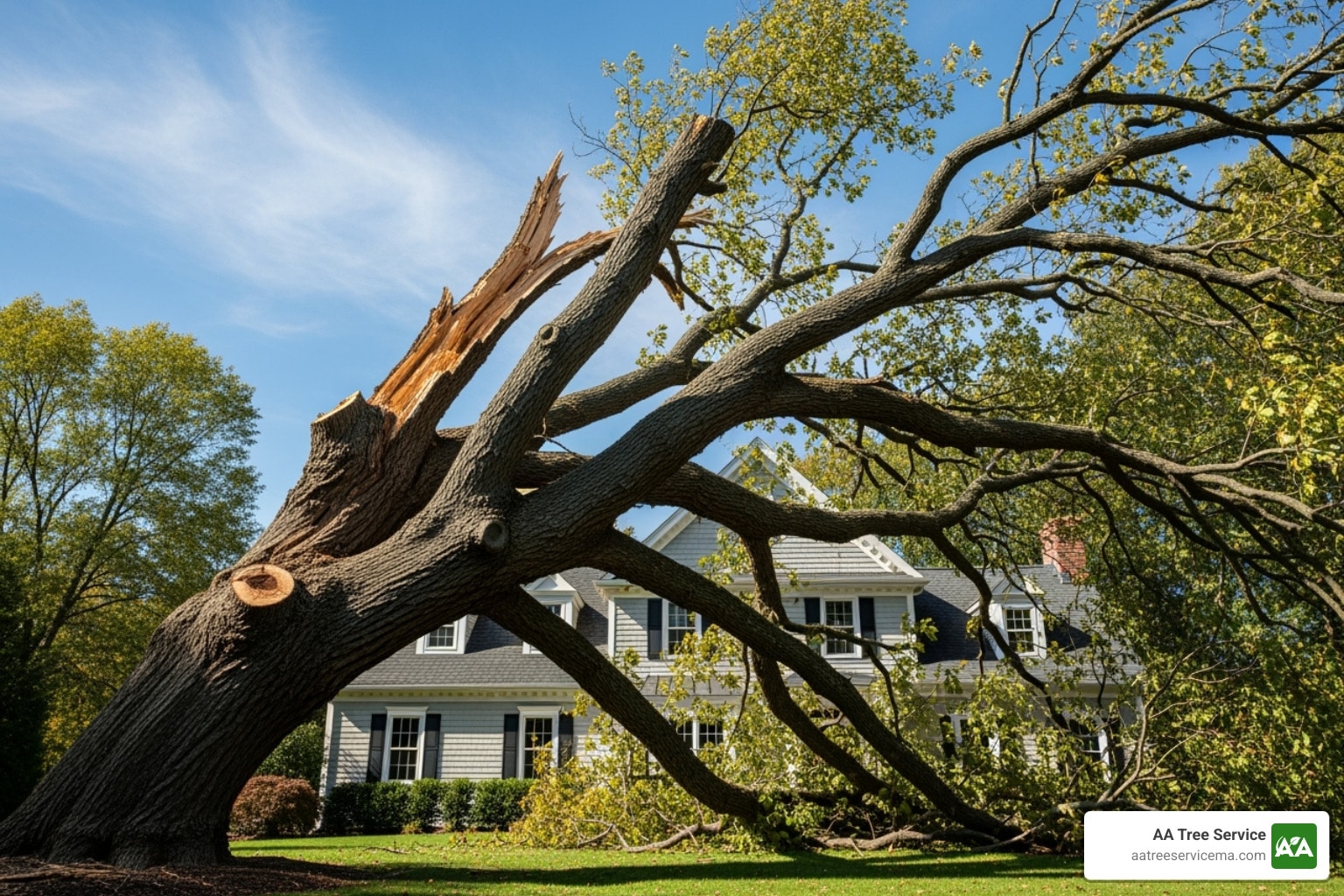
Why Property Owners Need Hazardous Tree Removal Experts
Hazardous tree removal experts are certified professionals who safely remove trees that pose a danger to people or property. These specialists possess the training, equipment, and insurance to handle high-risk removals, preventing serious injury or costly damage. Attempting this work without qualifications is extremely dangerous.
Key qualifications for a professional service include:
- ISA Certified Arborist credentials
- Comprehensive liability and worker’s compensation insurance
- Access to specialized equipment like cranes and rigging systems
- Transparent pricing with written estimates
Trees become hazardous due to structural defects like cracks, decay, or root damage, often caused by storms, disease, or age. In Massachusetts and New Hampshire, severe weather can turn even healthy-looking trees into sudden dangers. The risks of DIY removal are severe, ranging from electrocution and crushing injuries to catastrophic property damage. Professionals use systematic approaches to assess and safely dismantle dangerous trees, controlling every section as it comes down.
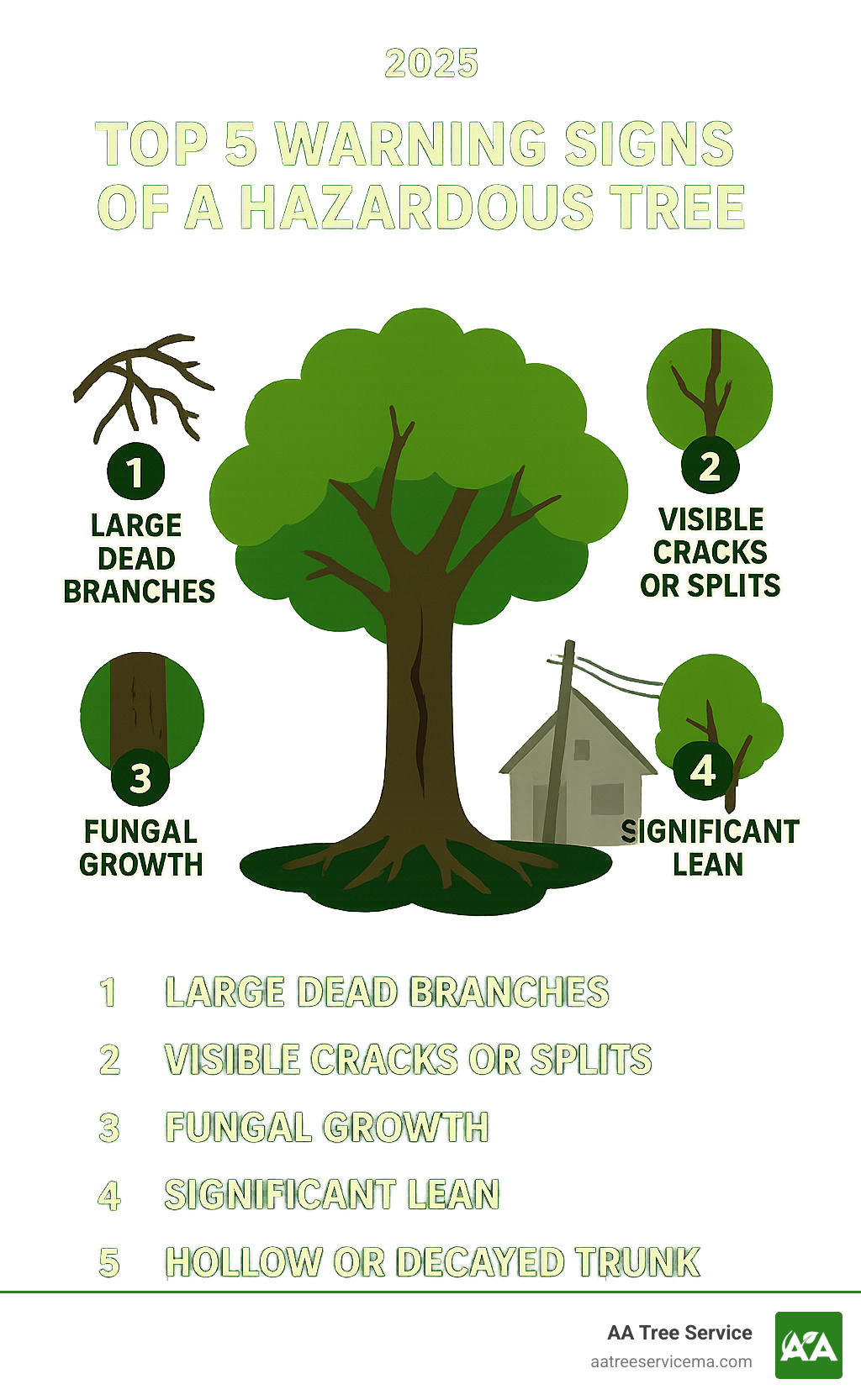
Basic Hazardous tree removal experts glossary:
Identifying a Ticking Time Bomb: Signs Your Tree is a Hazard
Even strong-looking trees can hide problems that make them a danger. As hazardous tree removal experts, we know that spotting these hidden dangers involves checking a tree’s health, structural integrity, and proximity to potential targets like your home or power lines.
Key warning signs of a hazardous tree include:
- Significant cracks or splits in the trunk, which indicate a weak main support system.
- A hollow trunk or visible decay, sometimes accompanied by fungi growth like mushrooms at the base.
- Numerous dead or hanging branches, often called “widowmakers” because they can fall without warning.
- A new or worsening lean, which suggests root problems.
- Unseasonal foliage changes, such as discoloration or leaf loss, which can signal disease.
- Close proximity to your house, garage, or power lines.
For a professional evaluation, learn more about our More info about Tree Hazard Assessment.
Structural Defects and Disease Indicators
Some issues weaken a tree over time. These structural defects and disease indicators can turn a tree into a hazard without obvious signs.
Common problems include included bark, where bark is pinched between two close-growing trunks, creating a weak point. Similarly, co-dominant stems (twin trunks) can split apart if not strongly joined. Look for cankers (dead spots on bark) and signs of pest infestations, like the Emerald Ash Borer common in Massachusetts and New Hampshire, which can make a tree brittle. Finally, branches with narrow, V-shaped connections, known as weak branch unions, are more likely to break than those with a strong, U-shaped angle.
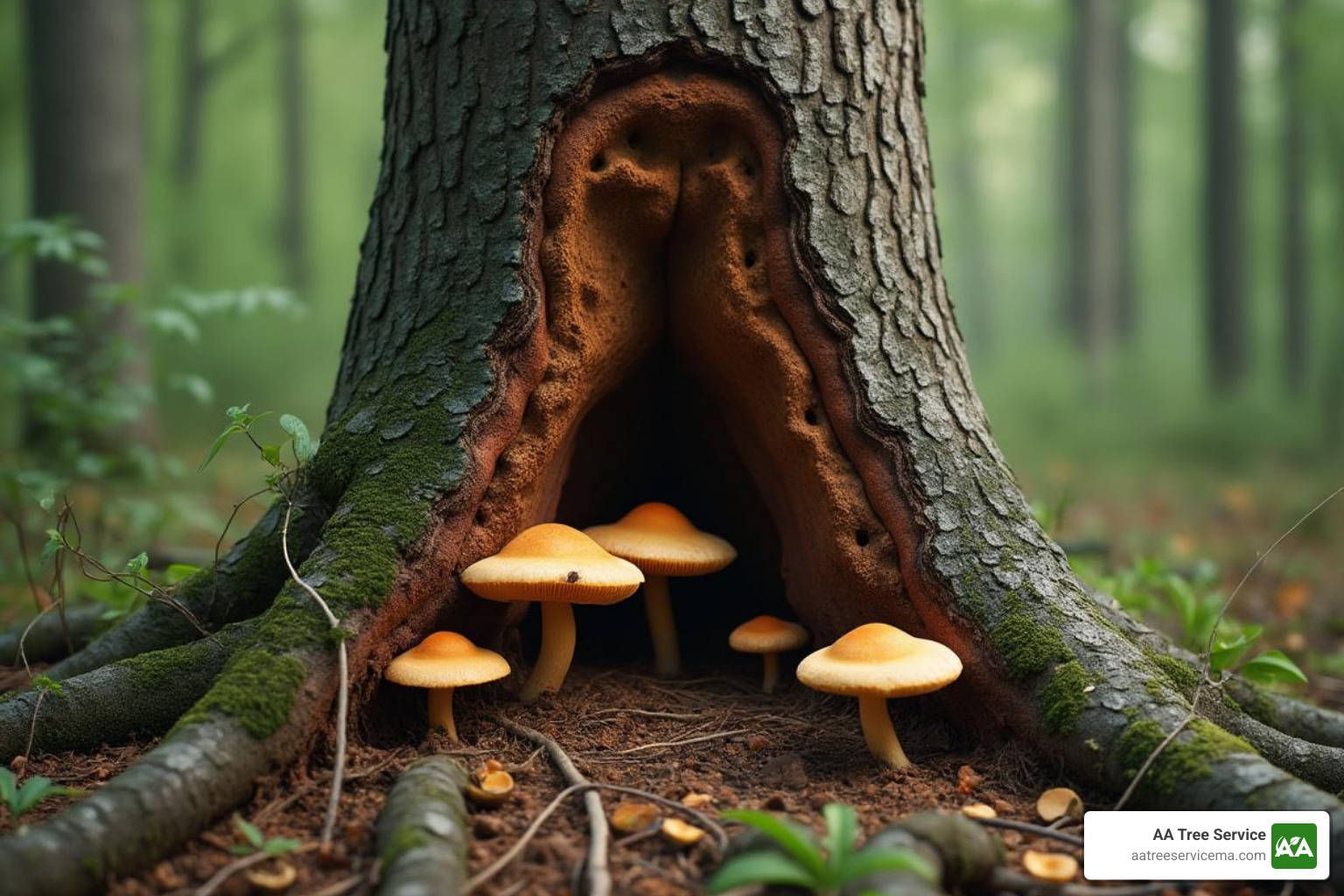
When Storms Create Hidden Dangers
In Massachusetts and New Hampshire, severe weather often leaves behind hidden tree dangers. High winds can create cracked limbs that may fall days later or partially uproot trees, making them unstable. Wind can also cause tiny, invisible wind-stressed trunks that lead to sudden failure. A lightning strike can split a tree or cause internal damage that weakens it over time.
Our region’s infamous ice storm effects add significant weight that snaps branches and splits trunks. This damage can also create entry points for disease and rot. After any major storm, a professional assessment is a wise precaution. If you need help after a storm, see our page on More info about Storm Damaged Tree Removal.
Don’t DIY Disaster: Why You Need Certified & Insured Professionals
While DIY projects can be satisfying, hazardous tree removal is a high-stakes task that can lead to severe injury, property damage, and legal liability. It is consistently ranked among the most dangerous professions and should not be attempted without professional training and equipment.
Risks of DIY tree removal include:
- Severe personal injury: Falls, chainsaw accidents, and strikes from falling limbs can be fatal.
- Catastrophic property damage: An uncontrolled fall can destroy your home, vehicle, or a neighbor’s property.
- Legal liability: You are responsible for any damage or injury that occurs on your property during a DIY attempt.
- Unpredictable tree behavior: Internal decay and hidden cracks can cause a tree to fall in an unexpected direction.
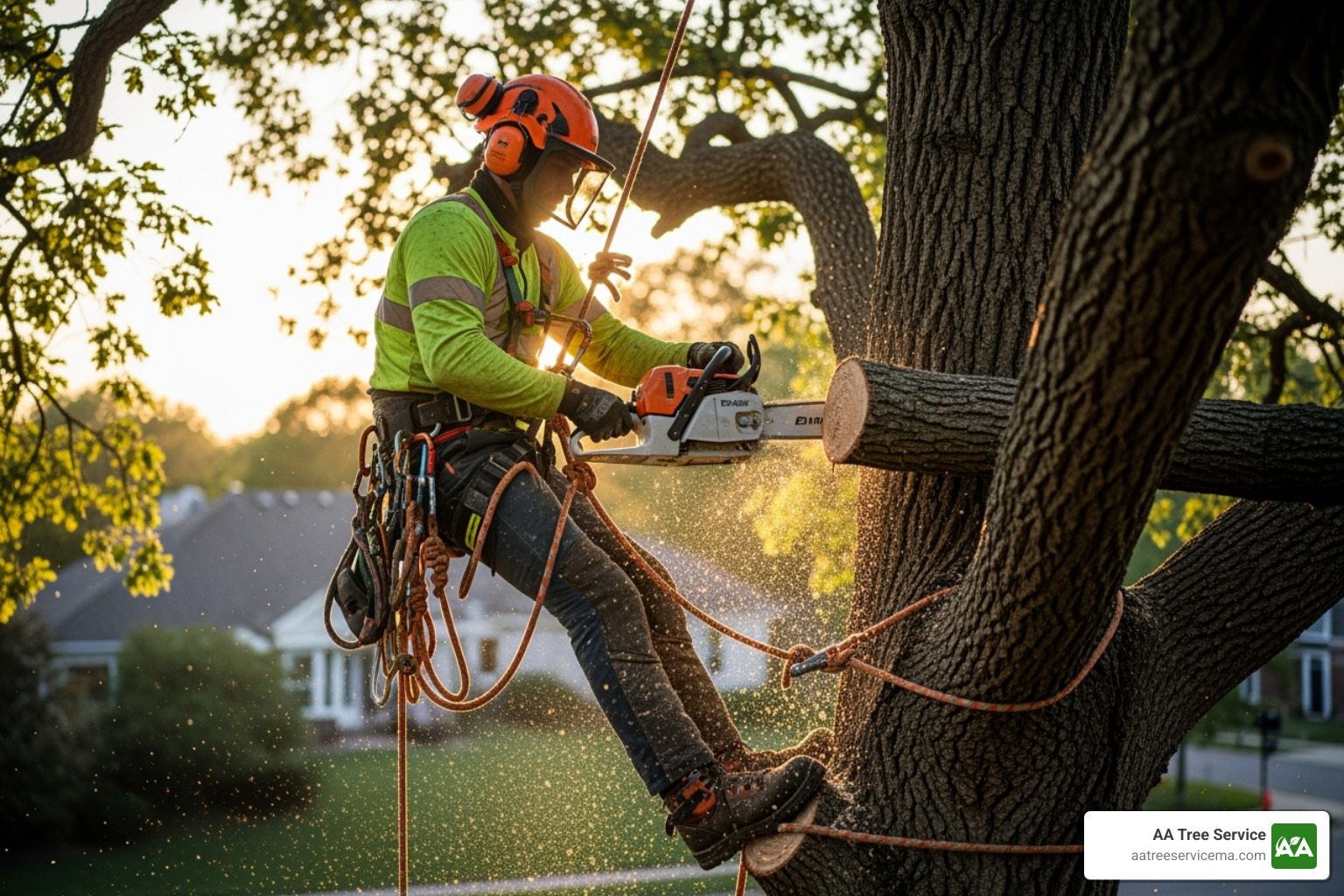
The Critical Role of Hazardous Tree Removal Experts
When you hire hazardous tree removal experts, you are investing in a team that understands the physics of tree removal and prioritizes safety. Our experienced team focuses on strict safety protocols, efficiency through state-of-the-art equipment, and risk mitigation by developing a detailed removal plan. We specialize in complex environments, safely removing trees near power lines and buildings in dense areas of Massachusetts and New Hampshire. Learn more about the benefits at More info about Arborist Tree Removal.
Qualifications to Look For: Certifications and Insurance
Choosing the right company is critical. Ensure they are qualified, professional, and fully covered. Here’s what to verify:
- ISA Certified Arborist: This certification is the industry’s gold standard, demonstrating a high level of knowledge in tree biology, risk assessment, and safe removal. You can Find a certified arborist via the International Society of Arboriculture.
- Liability Insurance: This protects your property from accidental damage. A professional company should carry substantial coverage, and you should always ask for proof.
- Worker’s Compensation: This protects you from liability if a worker is injured on your property. Ask for a clearance certificate.
- Licensing and Reputation: Ensure the company is licensed to operate in your area and check reviews and references for a proven track record.
AA Tree Service meets and exceeds these qualifications, providing peace of mind that your project is in the hands of insured professionals. Find out more at More info about Certified Arborist Tree Service Near Me.
The Anatomy of a Safe Takedown: The Professional Removal Process
Removing a hazardous tree is a precise operation that prioritizes safety and efficiency. The process begins with a free initial consultation and site assessment, where our certified arborists evaluate the tree’s condition, location, and accessibility to determine the safest removal strategy.
Next, we develop a strategic plan that outlines the removal method, equipment needed, and all safety protocols. Before work begins, we establish a clear safety perimeter to protect everyone in the vicinity. Most hazardous trees require sectional dismantling, where expert climbers use specialized rigging ropes and pulleys to carefully remove the tree in manageable pieces from the top down. Each section is lowered in a controlled manner while our ground crew manages debris, keeping the site safe and tidy.
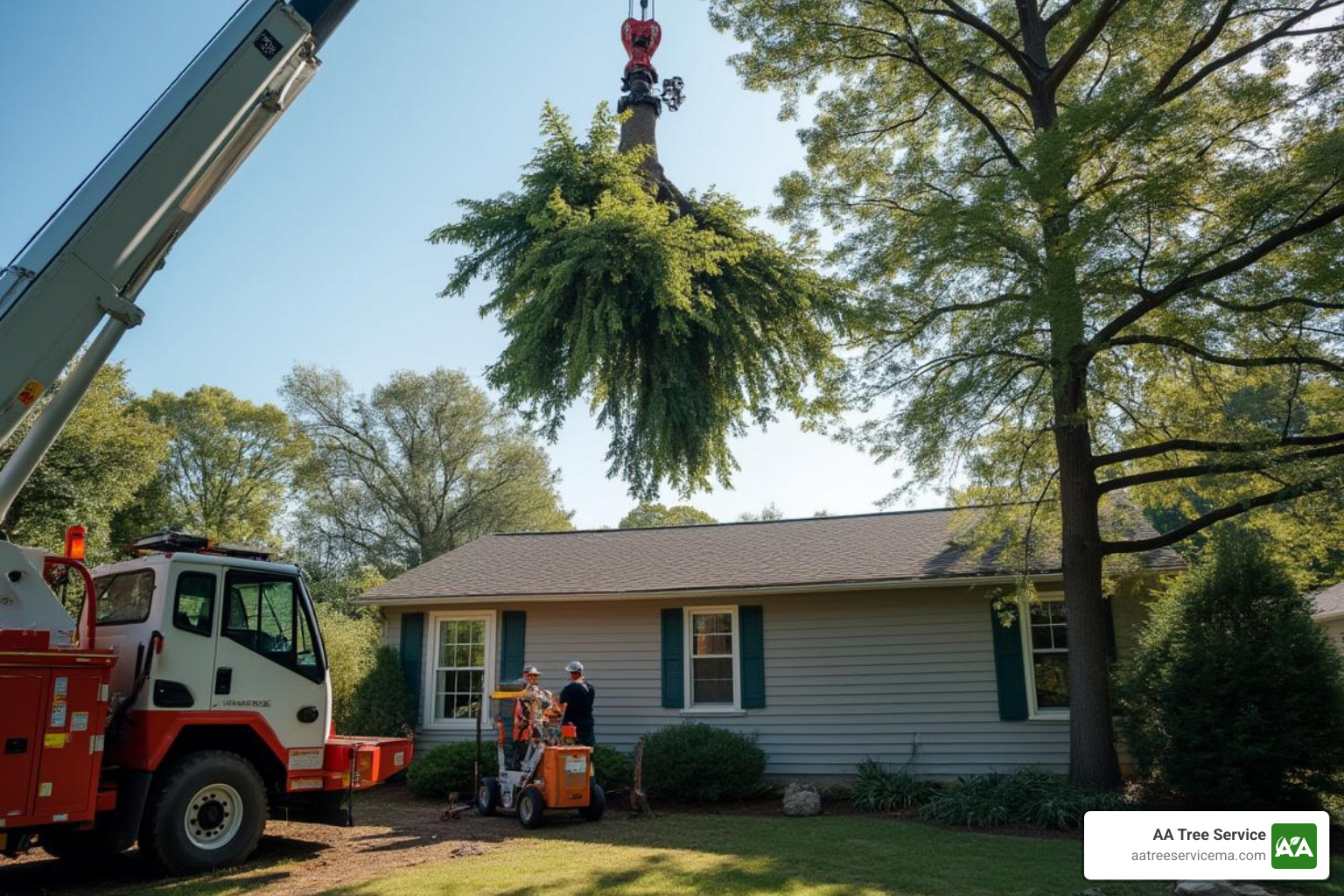
Specialized Equipment Used by Hazardous Tree Removal Experts
The right equipment is vital for a safe and efficient job. Our hazardous tree removal experts use a variety of specialized tools:
- Cranes are essential for large or inaccessible trees, allowing us to lift heavy sections over obstacles like your home. We offer a specialized crane tree removal service.
- Bucket trucks and spider lifts provide safe access to high branches, especially near power lines or on difficult terrain.
- Skid steers efficiently move logs and debris.
- Professional chainsaws, industrial-grade wood chippers, and stump grinders are used to process the tree and clear the site.
- Rigging ropes and pulleys ensure that every piece of the tree is lowered safely.
From Takedown to Cleanup: What to Expect
Our service includes a thorough cleanup. We perform branch removal and trunk sectioning, hauling away all wood and debris unless you’d like to keep it for firewood. Our crew conducts a meticulous site cleanup, raking and blowing away sawdust to leave your yard tidy. We finish with a final inspection with you to ensure your complete satisfaction. We also offer prompt fallen tree removal services for trees that have already come down.
Beyond Removal: Additional Arborist Services
Our expertise extends beyond removal. We offer a full range of services to keep your landscape safe and healthy:
- Stump grinding removes the leftover stump, freeing up yard space and eliminating a hazard.
- Land clearing prepares your property for new construction or landscaping.
- We provide arborist reports for permit applications and offer replanting recommendations to help you choose the right new tree for your property.
Explore our full range of tree care services to learn more.
Understanding the Investment: What Factors Influence Removal Costs?
The cost of hazardous tree removal is not one-size-fits-all; it depends on the unique details of your project. The price reflects the job’s complexity, the equipment required, and the expertise needed for a safe removal.
Our hazardous tree removal experts consider these key factors for your estimate:
- Tree size and species: Taller, wider trees or those with dense hardwood require more time and effort.
- Location & accessibility: Trees in tight spaces or near structures often require specialized equipment like cranes.
- Proximity to hazards: Trees leaning over power lines, homes, or septic systems demand highly specialized techniques and increase risk.
- Tree condition: A dead or decaying tree is more unpredictable and dangerous to remove.
- Equipment needs: The use of heavy machinery like cranes or bucket trucks will be reflected in the price.
- Permit requirements: Some towns in Massachusetts and New Hampshire require permits, which can add administrative fees.
Getting a Fair and Transparent Estimate
Always insist on a written, itemized estimate to understand what services are included. A reputable company will provide this and show proof of insurance. Please note: The following costs are average estimates based on general internet data and are not actual costs for AA Tree Service. For an accurate quote, we offer free same-day quotes.
| Factor | Small Hazardous Tree (up to 30 ft) | Medium Hazardous Tree (30-60 ft) | Large Hazardous Tree (over 60 ft) |
|---|---|---|---|
| Average Cost | $400 – $2,000 | $800 – $3,500 | $1,500 – $5,000+ |
| Complexity | Lower to moderate | Moderate | High |
| Equipment | Chainsaws, chipper, ropes | Bucket truck, larger chipper | Crane, specialized rigging |
| Crew Size | 2-3 people | 3-4 people | 4-5+ people |
Stump grinding is typically an optional add-on service, generally starting around $250. For a precise estimate, contact us for a Get a free Tree Removal Cost Estimate.
Navigating Local Regulations in MA & NH
Many towns in Massachusetts and New Hampshire have specific bylaws for tree removal, often requiring permits for trees over a certain size or in protected areas. As the homeowner, you are responsible for ensuring compliance. Our team is familiar with these regulations and can assist with the process. We always recommend checking with your local town hall for specific ordinances.
When Disaster Strikes: 24/7 Emergency Response
Severe storms can turn a healthy tree into an immediate hazard without warning. When disaster strikes, you need hazardous tree removal experts who can respond quickly and safely. Our team is equipped to handle critical situations around the clock.
We respond to urgent threats such as:
- Widespread storm damage with broken or hanging limbs.
- Uprooted trees that are unstable.
- Trees that have fallen onto structures or blocked access.
- Imminent threats from severely leaning or split trees.
Our emergency services are available 24/7 because we understand that every minute counts. Our first priority is securing the site to prevent further harm, followed by swift damage mitigation. We can also assist with insurance claims documentation during this stressful time. With over 20 years of experience in Massachusetts and New Hampshire, our team is ready to respond day or night. For immediate help, learn more about our More info about 24 Hour Emergency Tree Removal.
Frequently Asked Questions about Hazardous Tree Removal
Here are answers to some common questions about identifying and dealing with hazardous trees.
What makes a tree “hazardous” versus just old or dying?
A tree is considered “hazardous” when it has two things: a structural defect that could cause it to fail (like decay or a deep crack) and a “target” that would be hit if it fell (like a house, car, or person). A dying tree in an empty field isn’t a hazard, but one leaning over your driveway is. As hazardous tree removal experts, we assess both factors to determine the true risk.
How can I be sure the company I hire is legitimate?
To ensure a company is legitimate, ask for proof of current liability insurance and worker’s compensation. This protects you from financial liability. Also, verify their credentials, such as an ISA Certified Arborist certification. A professional company will gladly provide these documents, along with a detailed written estimate. Checking online reviews and asking for local references is also a good practice.
Is stump removal included with tree removal?
No, stump removal (stump grinding) is typically a separate service. When we remove a tree, we cut the trunk as low to the ground as possible, but the stump and root system remain. We highly recommend adding stump grinding to eliminate a tripping hazard, prevent pest infestations (like termites and carpenter ants), and clear the area for new landscaping.
Your Partner in Property Safety
As homeowners in Massachusetts and New Hampshire, we know your property’s safety is a top priority. A tree showing signs of trouble can be a major source of worry. You shouldn’t have to live with the nagging thought of a precarious branch or a leaning trunk.
That’s where hazardous tree removal experts come in. At AA Tree Service, we are your partners in property safety. With over two decades of experience across MA and NH, we bring deep knowledge, state-of-the-art equipment, and a commitment to every job. Proactive tree care is an investment in the safety of your family and home.
We make it easy with free same-day quotes and 24/7 emergency services. If a tree is causing you concern, don’t wait. Let’s tackle it together. Reach out today for a consultation and gain the peace of mind that comes from knowing your property is safe. Contact the best tree removal services for a consultation – we’re ready to respond.