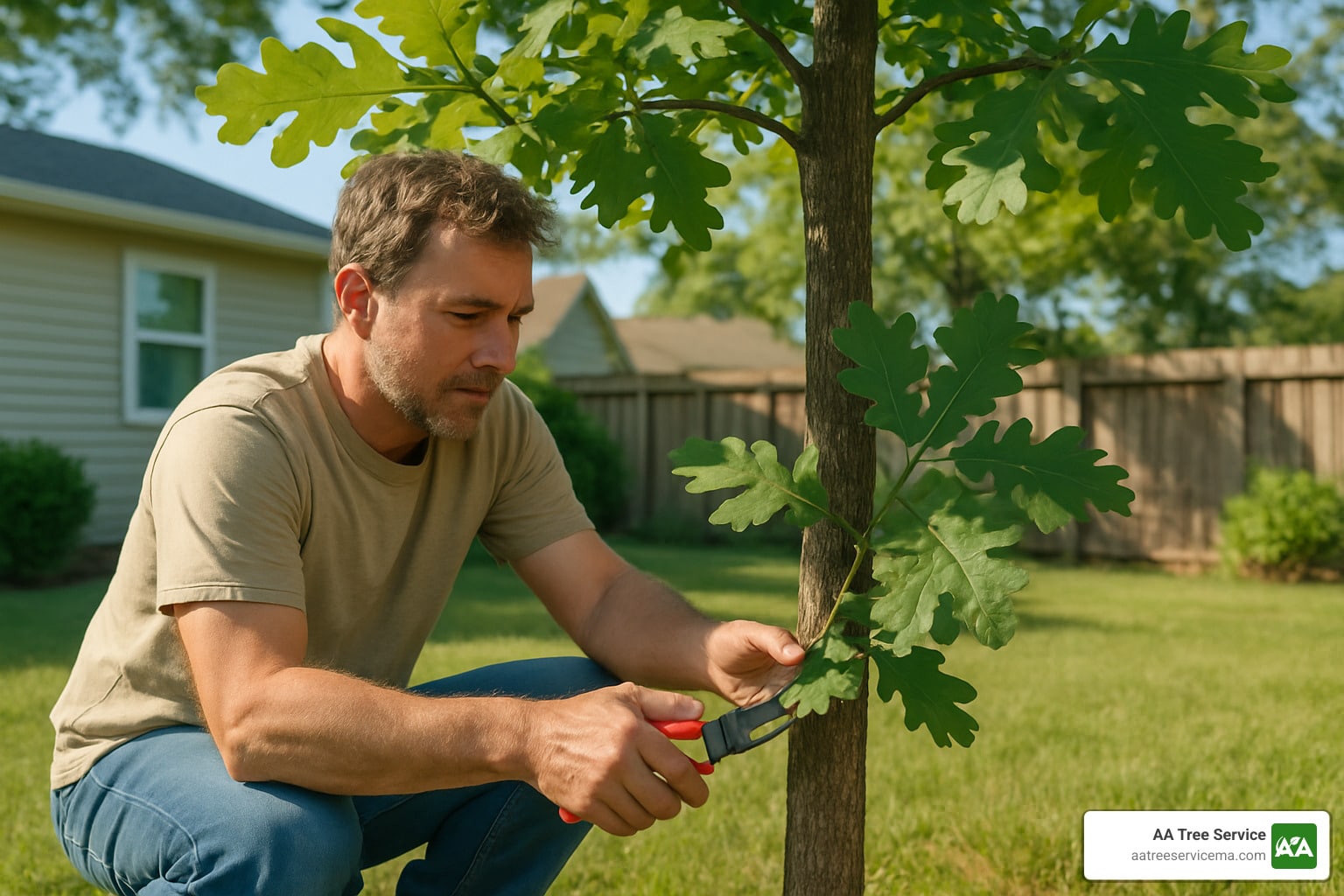
The Reality of Keeping Your Oak Tree Small Through Pruning
Pruning an oak tree to keep it small is possible, but it requires understanding oak biology, proper timing, and realistic expectations. Many homeowners in Massachusetts and New Hampshire plant oaks without realizing these majestic trees can grow 70-200 feet tall naturally.
Quick Answer: Can You Keep an Oak Small?
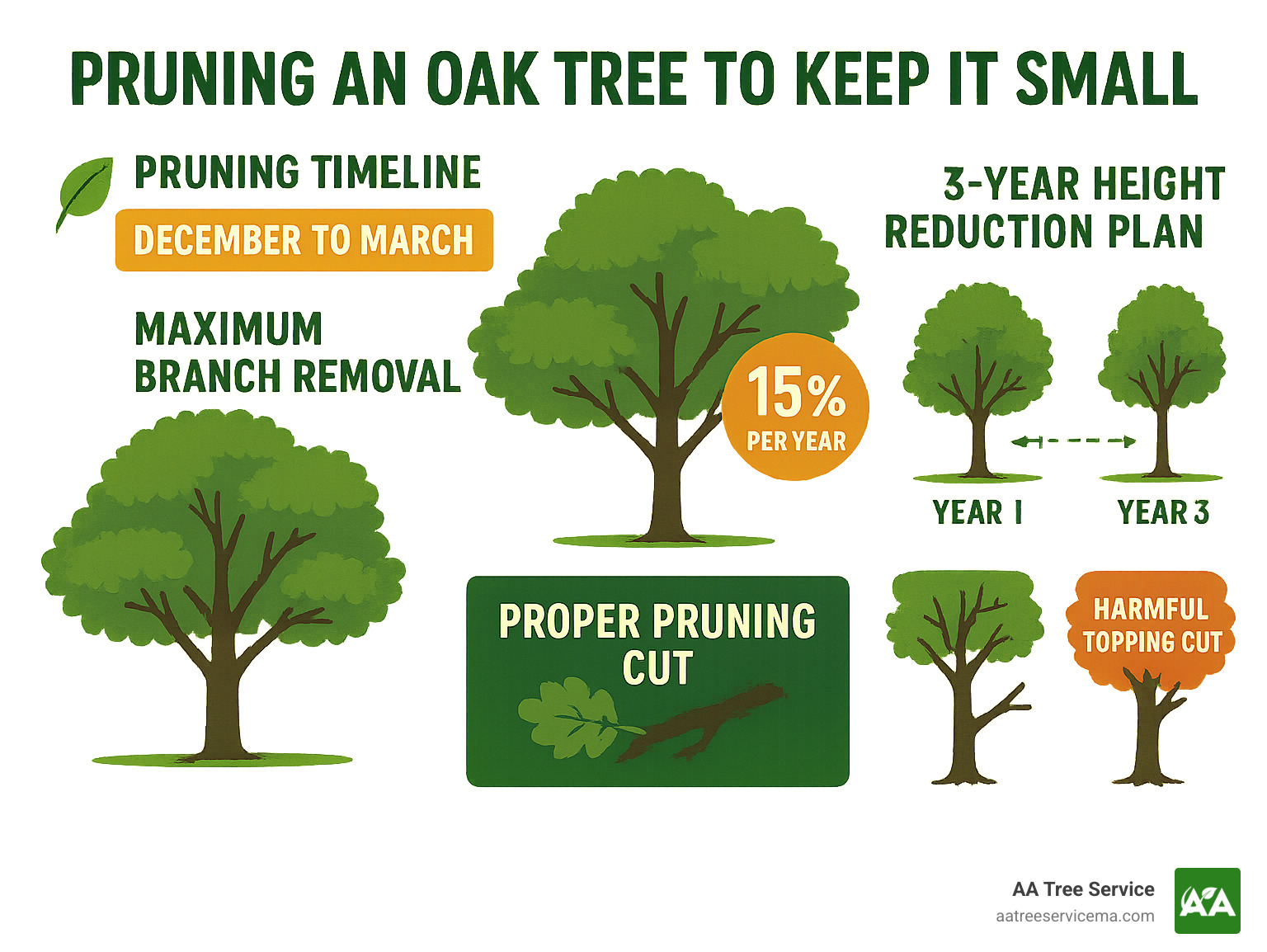
– Yes, but with limits – You can reduce height by 20-30% through proper pruning
– Start young – Easier to control size on trees under 10 years old
– Winter pruning only – December through March to avoid oak wilt disease
– Remove max 15% annually – Never more than 15% of live branches per year
– 3-year reduction plans – Gradual height reduction (2 feet per year) works best
– Consider alternatives – Root restriction, growth regulators, or smaller oak species
The challenge isn’t just cutting branches. Oaks are genetically programmed to reach towering heights, and they’ll keep pushing upward no matter how often you prune. As one arborist noted: “Pruning to reduce tree height is always going to be an uphill battle.”
In New England, timing matters even more. Oak wilt – a deadly fungal disease – spreads through fresh pruning wounds when beetles are active from April through October. This narrow winter pruning window makes size control more complex than with other trees.
The good news? With the right approach, you can maintain a smaller oak that stays healthy for decades. The key is working with the tree’s biology, not against it.
Pruning an oak tree to keep it small further reading:
– tree pruning services
– dogwood bush pruning
– trimming a dogwood tree
Understanding Oak Growth Habits in New England
Think of an oak tree as nature’s skyscraper – it’s literally built to reach for the clouds. Before you start pruning an oak tree to keep it small, you need to understand what you’re up against. These aren’t naturally petite trees that happen to grow tall; they’re genetically programmed giants with millions of years of “grow big or get shaded out” hardwired into their DNA.
Oaks Are Hardwired for Height
Every oak tree has what arborists call apical dominance – a fancy way of saying the main trunk is the boss and it wants to keep growing straight up. This central leader grows faster than side branches, constantly pushing your oak toward its destiny of becoming a forest giant. When you cut the top off, the tree doesn’t think “oh, I guess I’ll stay small now.” Instead, it panics and sends up multiple new shoots, often creating a weak, multi-stemmed mess.
Growth Spurts Keep Coming
Here’s something that surprises many homeowners: oaks don’t just grow once in spring and call it good. These trees can produce multiple growth flushes throughout the growing season whenever conditions are right. That means your carefully pruned “small” oak might shoot up several feet in a single summer if Mother Nature provides plenty of rain and warmth.
New England’s Oak Lineup
In Massachusetts and New Hampshire, we’re mainly dealing with three oak species. White oaks (those with the rounded leaf lobes) typically reach 60-80 feet and handle pruning better than their cousins. Red oaks (the ones with pointed, bristly leaves) grow fast to 60-75 feet but are more finicky about diseases. Pin oaks stay a bit smaller at 50-60 feet and naturally grow in that classic Christmas tree shape.
The Oak Wilt Reality Check
Now here’s where things get serious for us in New England. Oak wilt disease is like the boogeyman of the oak world – it kills trees fast and spreads easily through fresh pruning wounds. The fungus hitches rides on beetles that are drawn to the sweet sap from fresh cuts, and these beetles are active from April clear through October.
Once oak wilt gets into a tree, it’s often game over. Red oaks typically die within weeks, while white oaks might hang on longer but still suffer badly. The disease also spreads underground through root grafts between neighboring oaks – sometimes reaching 50-60 feet away. This is why timing your pruning perfectly matters so much.
The “Right Tree, Right Place” Truth
Here’s some tough love: the easiest way to have a small oak is to not plant a big oak in the first place. If you need something under 30 feet, consider dwarf oak cultivars like the narrow-growing Quercus robur ‘Fastigiata’, or go with naturally smaller species like our native Scrub Oak. Sometimes the best size control happens at the nursery, not with pruning shears.
For detailed information about oak wilt timing and prevention strategies, check out this scientific research on oak wilt timing from university extension services.
Pruning an Oak Tree to Keep It Small: Step-By-Step Game Plan
Here’s where the rubber meets the road. Pruning an oak tree to keep it small isn’t just about grabbing your loppers and going to town – it’s a careful dance between your size goals and the tree’s natural instincts.
Getting Your Tools Ready
Before you make your first cut, gather the right equipment. You’ll need sharp, clean pruning shears for branches up to 2 inches, lopping shears for the 2-4 inch branches, and a pruning saw for anything larger. Don’t forget your safety gear – gloves, eye protection, and a hard hat if you’re working overhead.
Here’s the crucial part: tool sterilization. Mix up a solution of 9 parts water to 1 part bleach, and wipe your tools between cuts. It sounds tedious, but oak wilt spreads through contaminated tools faster than gossip in a small town.
The Three-Cut Method That Actually Works
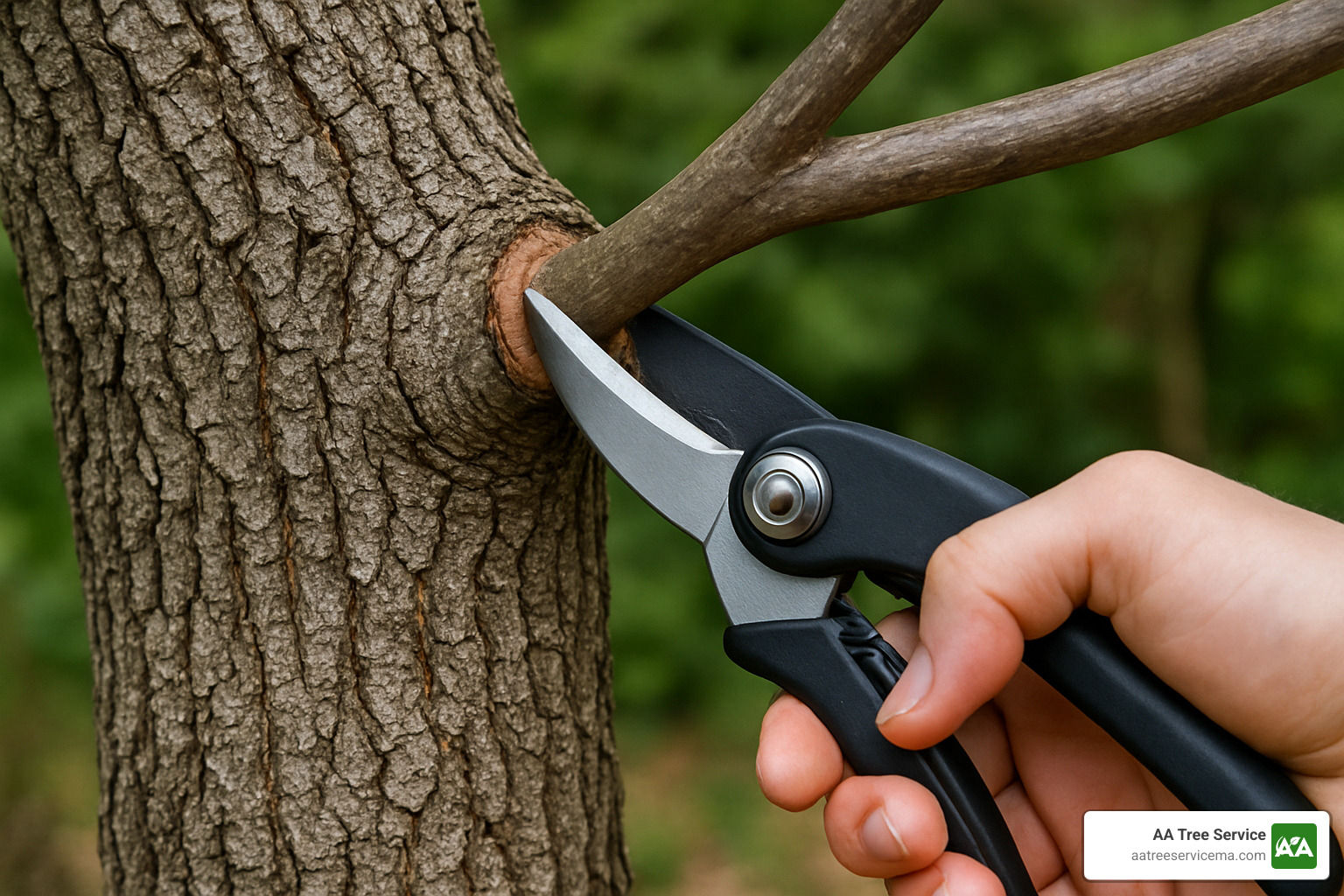
For branches thicker than your thumb, use the three-cut method. First, make a shallow undercut about 1-2 inches from the branch collar on the bottom side. Next, cut from the top, 2-4 inches further out from the collar. Finally, remove the remaining stub with a clean cut just outside the branch collar.
Why all this fuss? Because bark tears from improper cuts create highways for disease. The branch collar – that slightly swollen area where the branch meets the trunk – contains special cells that help seal wounds naturally.
Working Within the 15% Rule
Here’s your golden rule: never remove more than 15% of live branches in a single pruning session. This isn’t arbitrary – it’s based on decades of research showing that trees need enough foliage to produce energy through photosynthesis.
Branch subordination is your secret weapon for size control. Instead of completely removing a competing branch, cut it back to a smaller side branch. This reduces its vigor while keeping some foliage – it’s like turning down the volume instead of hitting the mute button.
For complex pruning projects that require professional expertise, our Tree Pruning Services can help you develop a long-term size management plan.
Best Time for Pruning an Oak Tree to Keep It Small in MA & NH
In Massachusetts and New Hampshire, pruning an oak tree to keep it small comes with a non-negotiable deadline: December through March only. This isn’t just a suggestion – it’s a matter of life and death for your tree.
The oak wilt beetles that spread the deadly fungal disease become dormant when temperatures consistently drop below freezing. This gives you a reliable window from about December 15th through March 1st.
During this dormant period, your oak is basically hibernating. It’s conserving energy, wounds heal more slowly (which is actually good – less attractive to pests), and the tree experiences minimal stress from pruning.
Safe Amounts to Remove When Pruning an Oak Tree to Keep It Small
The 15% live wood limit isn’t just a number we pulled from thin air – it’s backed by solid research. Remove more than this, and you’re asking for trouble in the form of water sprouts, stress responses, and increased disease susceptibility.
For significant size reduction, patience pays off with a three-year stagger system. In year one, focus on the tallest branches while staying within your 15% limit. Year two continues the height reduction and addresses any competing leaders. By year three, you’re fine-tuning the shape and cleaning up any water sprouts that emerged.
Watch for stress signals that tell you when you’ve pushed too hard. Excessive water sprout production is your tree’s way of saying “Help! I need more leaves!” Other warning signs include leaf scorch, early fall color, or reduced growth the following season.
First Ten Years: Structural, Directive & Corrective Cuts
Young oaks are like teenagers – full of potential but prone to making questionable decisions about their structure. The first decade is your chance to guide them toward good choices.
Establishing central leader dominance means picking one main trunk and sticking with it. Young oaks often develop co-dominant stems – two leaders of equal size competing for dominance. Remove or subordinate these early, because weak branch unions that form between competing leaders can fail catastrophically later.
Lower limb management requires a gradual approach. Don’t strip all the lower branches at once, thinking you’re helping with size control. This actually backfires by forcing all the tree’s energy into upper growth, making your oak taller faster.
Annual Mini-Prunes After Year Ten
Once your oak hits its teenage years (tree-wise), switch to lighter, more frequent maintenance. Think of it as regular haircuts instead of major makeovers.
Water sprout control becomes your primary focus. These vigorous vertical shoots pop up from the trunk and main branches like the tree is trying to replace lost canopy. They create weak, crowded growth that defeats your size-control efforts.
Canopy thinning involves selectively removing branches to improve air circulation and light penetration. Focus on crossing branches, inward-growing limbs, and any weak or damaged wood that’s cluttering up the canopy.
The key to long-term success with pruning an oak tree to keep it small is consistency. Small, regular adjustments work better than dramatic interventions – both for the tree’s health and your back.
Health Impacts, Risks & How to Avoid Them
Let’s be honest – pruning an oak tree to keep it small isn’t without consequences. Every cut you make changes the tree’s biology, and understanding these impacts helps you prune smarter, not harder.
When Trees Run Out of Gas
Think of your oak’s leaves as tiny solar panels powering the entire tree. When you remove branches, you’re essentially unplugging part of that power system. The tree stores energy in its wood and roots like a battery, but excessive pruning forces it to drain those reserves to grow new foliage.
This energy depletion weakens the tree’s ability to fight off diseases, survive drought, or prepare for New England’s harsh winters.
The Water Sprout Problem
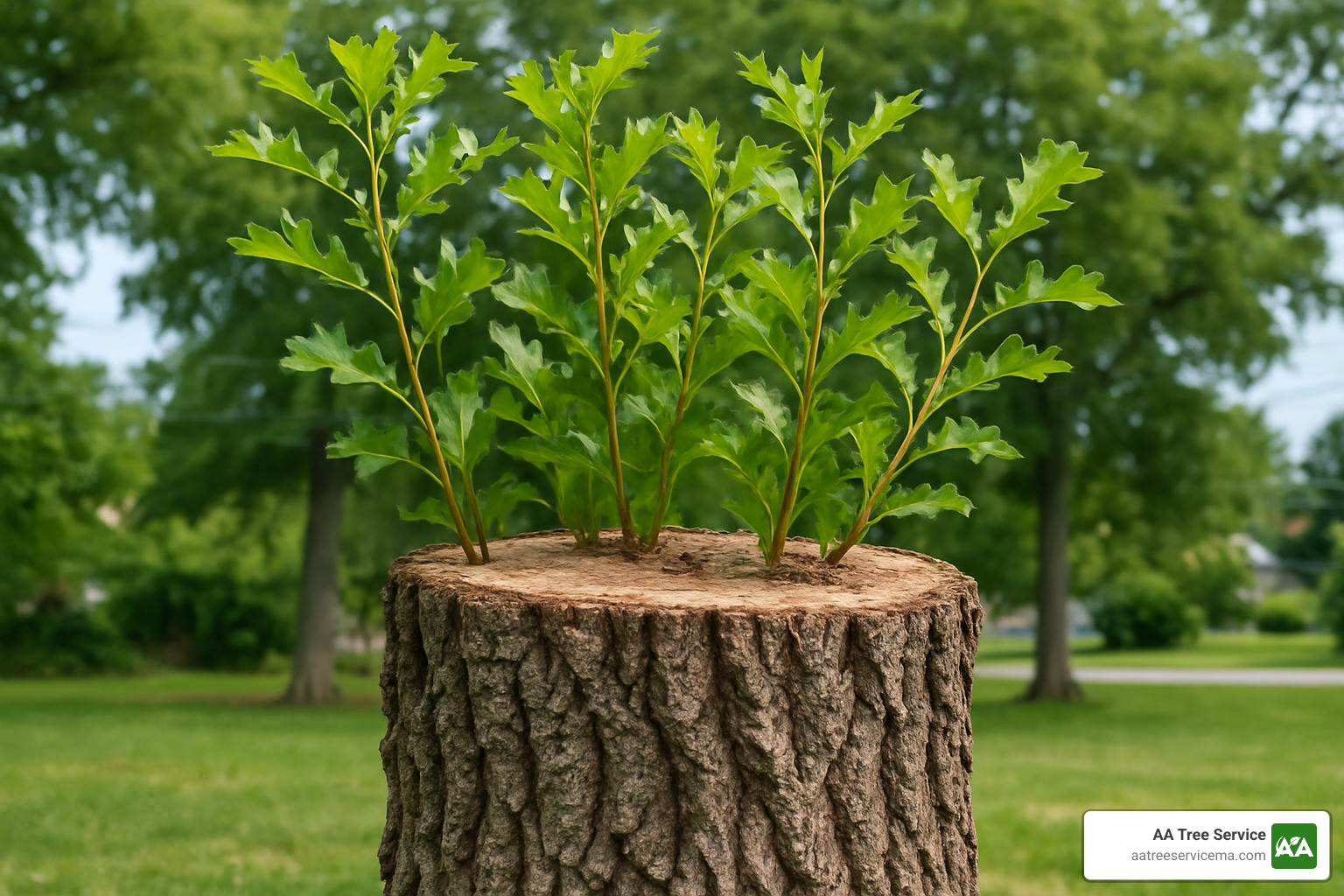
Here’s where oak biology works against your size-control goals. Remove a large branch, and the tree often responds with an explosion of water sprouts – those weak, vertical shoots that seem to appear overnight. These fast-growing branches have poor attachment points and break easily during storms.
Worse yet, water sprouts defeat your pruning efforts by quickly replacing the canopy you just removed. It’s like playing whack-a-mole with branches.
Disease and Decay Risks
Every pruning cut creates a wound, and wounds are potential doorways for decay fungi and diseases. Poor cutting technique – like leaving stubs or making flush cuts – significantly increases this risk. Even properly made cuts can become problematic if your tools carry pathogens from other trees.
In Massachusetts and New Hampshire, oak wilt remains the biggest threat. This deadly fungal disease spreads through fresh wounds when beetles are active, which is why our pruning window is so narrow.
Sunscald and Structural Weakness
When you remove large branches, previously shaded bark suddenly gets exposed to intense sunlight. This can cause sunscald damage – essentially a sunburn that weakens the bark and creates entry points for insects and diseases.
The water sprouts that follow often form weak unions with the main trunk. These attachment points are structurally inferior and prone to failure during ice storms or high winds.
Proper Tool Sterilization
Between each tree – and ideally between major cuts on diseased trees – sterilize your tools with 70% isopropyl alcohol or a 10% bleach solution. This simple step prevents spreading pathogens from tree to tree.
Many homeowners skip this step, but it’s like a surgeon using dirty instruments. The few extra minutes spent cleaning tools can save your trees from preventable infections.
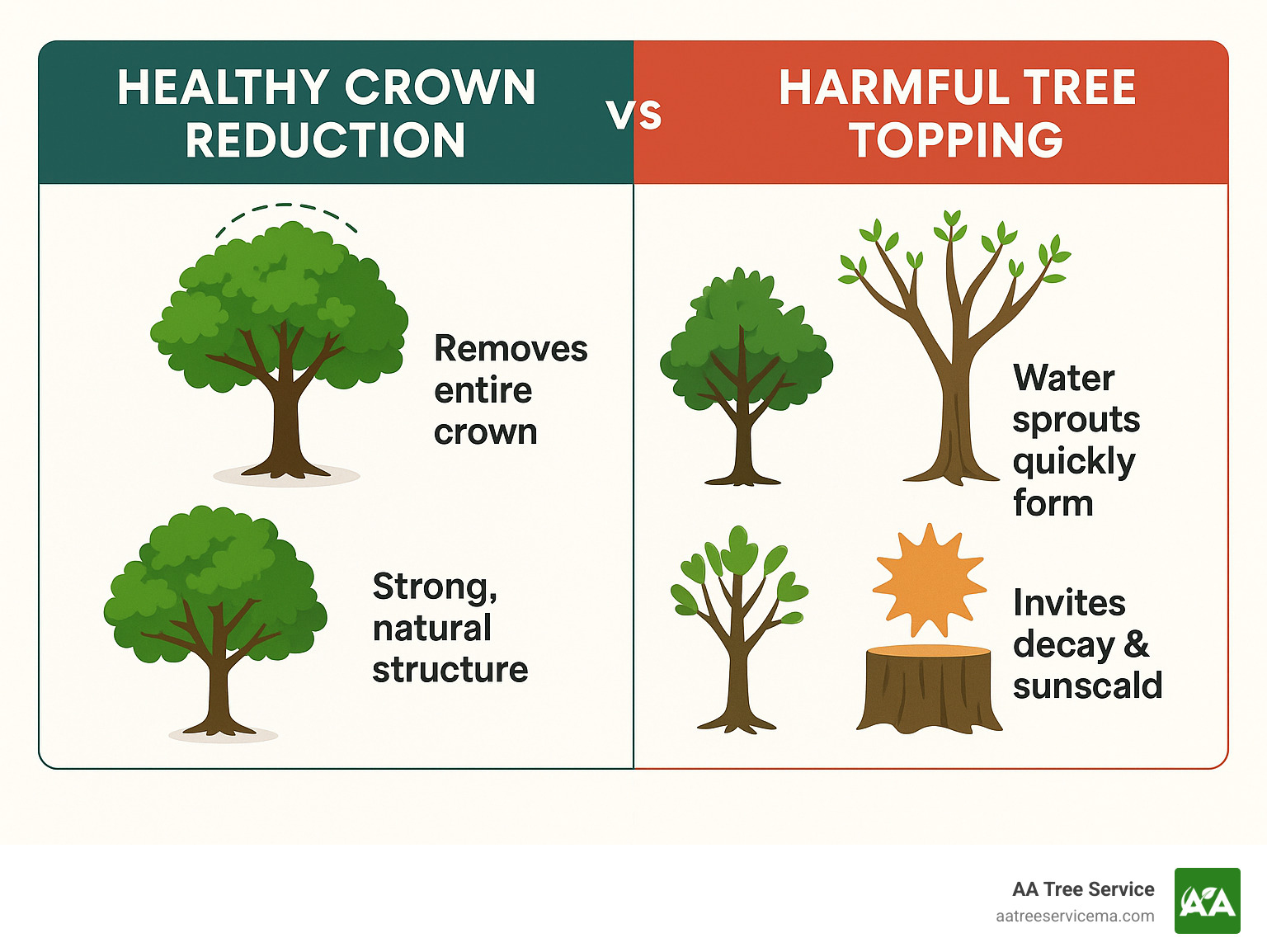
The Topping Trap
The biggest mistake homeowners make is topping – cutting branches back to stubs or removing the entire top of the tree. This practice, while tempting for quick height reduction, is essentially tree torture.
Topped trees become hazardous, with multiple weak leaders competing for dominance. They’re more susceptible to storm damage, disease, and often die within a few years. The comparison table above shows why proper crown reduction is always preferable to topping, even though it takes longer to achieve your size goals.
Alternative & Supplemental Size-Control Methods
Sometimes pruning an oak tree to keep it small feels like trying to keep a teenager from growing taller. The tree has other plans! Fortunately, there are several clever alternatives that can work alongside or instead of traditional pruning.
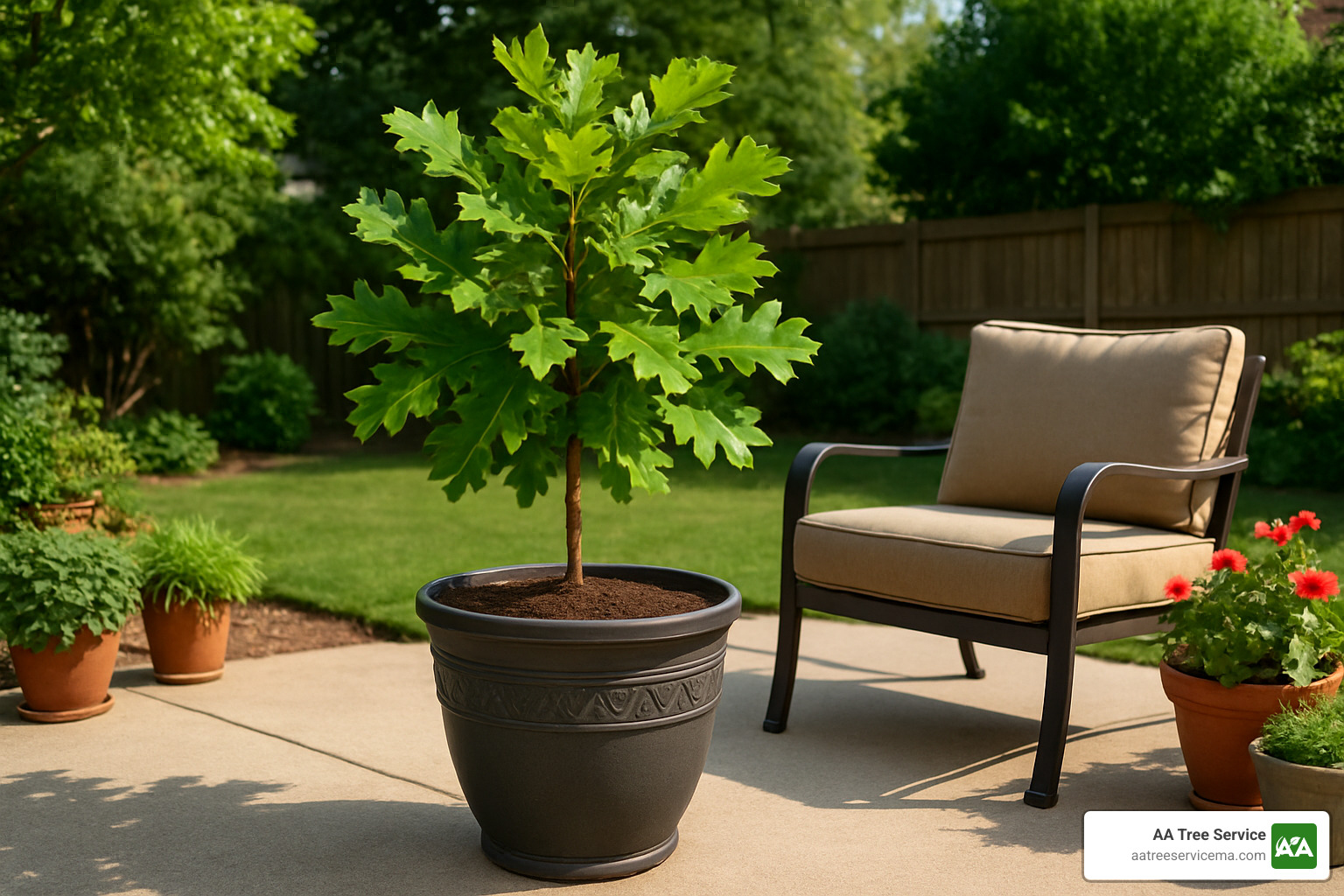
Root restriction offers one of the most effective approaches. Think of it as putting your oak on a controlled diet. Container growing works beautifully for patios and small spaces – just make sure you’re using a container of at least 100 gallons for long-term tree health.
For in-ground trees, root barriers installed around the planting area can limit how far roots spread to gather nutrients and water. This naturally slows the tree’s overall growth. Some homeowners also use periodic root pruning – carefully cutting select roots every few years to keep the tree’s energy focused on a smaller area.
Bonsai techniques might sound exotic, but they’re surprisingly practical for larger landscape trees. Leaf pruning during mid-summer removes mature leaves, encouraging the tree to produce smaller replacement foliage. Wire training helps guide branches into more compact, horizontal growth patterns rather than reaching skyward.
Growth regulators represent the high-tech approach to size control. Paclobutrazol applied as a soil drench can slow vertical growth for 2-3 years, while Flurprimidol works as a foliar spray with shorter-lasting effects. These chemicals require professional application and aren’t right for every situation, but they can be game-changers for the right circumstances.
Sometimes the simplest approaches work best. Nitrogen limitation slows growth by avoiding high-nitrogen fertilizers that encourage rapid vertical growth. Your oak still gets the phosphorus and potassium it needs for health, but without the growth-boosting nitrogen punch.
Hedge training might surprise you as an option for oaks. English Oak has been used for formal hedging in Europe for centuries, requiring regular shearing every 6-8 weeks during the growing season.
The smartest approach might be choosing small-stature oak species from the start. Chinkapin Oak tops out around 40-50 feet, Post Oak stays in the 30-40 foot range, and Blackjack Oak rarely exceeds 30 feet. Columnar English Oak grows tall but stays narrow, perfect for tight spaces.
For comprehensive guidance on growth management and other tree care needs in Massachusetts and New Hampshire, check out our Tree Care Services.
Frequently Asked Questions about Keeping Oaks Small
Will constant pruning shorten my oak’s life?
Here’s the honest truth: it depends entirely on how you approach the pruning. I’ve seen homeowners accidentally harm their beloved oaks with good intentions, and I’ve also seen properly managed trees thrive for decades while staying smaller than nature intended.
Proper pruning can actually extend your oak’s life by removing diseased branches, preventing storm damage, and maintaining good structure. The secret lies in following a few critical rules that work with your tree’s biology rather than against it.
The factors that make the difference include staying under that crucial 15% canopy removal per year, timing your cuts during the December-March dormant window, making clean cuts at the branch collar, and keeping your tools sanitized between cuts.
Where things go wrong is when homeowners get aggressive. Trees that get “topped” or lose more than 25% of their canopy often develop serious problems – weak branch unions, disease susceptibility, and significantly shortened lifespans. But oaks that receive thoughtful, gradual size reduction can live healthy lives for decades while staying much smaller than their genetic programming would normally allow.
Think of it like a fitness routine for your tree. Gentle, consistent maintenance keeps it healthy. Extreme crash dieting (or in this case, extreme pruning) causes more harm than good.
Can I keep a mature 30-foot oak under 6 feet?
The short answer is no – at least not without essentially torturing the tree. This question comes up surprisingly often, and I understand the appeal. You’ve got this beautiful mature oak, but now it’s just too big for your space.
Here’s why this doesn’t work: that 30-foot oak has spent years developing an extensive root system designed to support a large canopy. Cutting it back to 6 feet would remove over 90% of its photosynthetic capacity – imagine trying to run your household on 10% of your normal income.
The tree would respond by desperately sending up water sprouts everywhere, creating a maintenance nightmare that would require cutting new growth every few weeks during the growing season. You’d essentially be turning your majestic oak into a constantly stressed, perpetually wounded shrub.
Better alternatives exist if you’re dealing with an oversized oak. Complete removal and replanting with a smaller species often makes more sense long-term. If you’re attached to the existing tree, gradual reduction to 15-20 feet over several years is still stressful but more survivable than drastic cutting.
You might also consider crown lifting (removing lower branches while maintaining height) or selective thinning to reduce the tree’s visual mass without changing its overall size dramatically.
How often should I schedule professional pruning?
The timing depends on your oak’s age and your specific goals. Young trees need more frequent attention to develop good structure, while mature trees can go longer between major pruning sessions.
For young oaks under 15 years old, plan on professional structural pruning every 3-5 years. These sessions focus on establishing a strong central leader, removing competing stems, and creating good branch spacing. You might also do lighter corrective work annually if needed.
Mature trees over 15 years old typically need professional attention every 5-10 years for general maintenance, plus emergency calls after major storms or when branches start interfering with power lines or buildings.
When you’re actively working on size control, the schedule intensifies a bit. Annual light pruning during the dormant season helps maintain your desired size, with mid-season water sprout removal as needed. More significant reductions should happen every 2-3 years to avoid stressing the tree.
Watch for these signs that it’s time to call a professional: dead or diseased branches, branches touching structures or utilities, competing leaders creating weak unions, excessive water sprout production, or any storm damage.
In Massachusetts and New Hampshire, all significant oak work needs to happen between December and March due to oak wilt concerns. Professional arborists understand this critical timing and can help you develop a realistic long-term management plan that keeps your oak healthy while meeting your size goals.
Conclusion
The journey of pruning an oak tree to keep it small isn’t always straightforward, but it’s absolutely achievable when you understand what you’re working with. Think of it as a long-term partnership with your tree rather than a quick fix.
The most important lesson? Your oak isn’t trying to be difficult – it’s just following millions of years of genetic programming that says “grow tall, reach for the sun.” Your job is to gently redirect that energy while keeping the tree healthy and happy.
The winter pruning window in Massachusetts and New Hampshire might feel restrictive, but it’s actually a blessing in disguise. Having those quiet months to plan and execute your pruning strategy means you’re working when the tree is resting and the dangerous oak wilt beetles are nowhere to be found.
Starting young makes all the difference. A 5-year-old oak that’s getting a bit too ambitious is much easier to guide than a 20-foot teenager that’s already set in its ways. But even mature trees can be successfully managed with patience and the right approach.
The 15% rule isn’t just about tree health – it’s about working smarter, not harder. Trees that get gradually reduced over time actually cooperate better than those that get shocked with heavy pruning. Less water sprouts, better healing, and a more natural appearance.
Sometimes the best solution isn’t pruning at all. Root restriction, growth regulators, or simply choosing a different tree species can save you decades of maintenance headaches. There’s no shame in admitting that maybe a 100-foot oak wasn’t the right choice for that spot near your house.
Professional help becomes essential when you’re dealing with oak wilt risks, large branches, or complex reduction projects. The narrow timing window, specialized knowledge requirements, and safety concerns make this one area where DIY efforts often backfire.
At AA Tree Service, we’ve spent over 20 years helping homeowners in Massachusetts and New Hampshire steer these exact challenges. Our certified arborists understand that every oak situation is unique – some trees respond beautifully to size control, while others are better candidates for removal and replacement.
We offer free same-day quotes because we know you need realistic expectations before committing to a multi-year management plan. Sometimes we’ll tell you that your goals aren’t realistic for that particular tree – that’s not us trying to sell you a removal, that’s us saving you years of frustration and expense.
The best oak pruning projects are the ones where homeowner and tree both win. You get the manageable size you need, and the oak gets to live a long, healthy life in your landscape. That’s the kind of outcome that makes this work rewarding.
For expert guidance on your specific situation and to explore all your options, visit our Tree Pruning and Trimming services page. Whether your oak needs gentle guidance or a complete management overhaul, we’ll help you create a plan that works for both you and your tree.