Why Littleton Homeowners Need Reliable Tree Removal Services
Tree removal services littleton ma are an essential component of responsible homeownership in this uniquely beautiful and historic Massachusetts town. Littleton’s landscape is characterized by a proud blend of colonial-era homes and modern developments, all shaded by a canopy of mature native trees like majestic oaks, vibrant maples, and towering white pines. While these trees contribute immense aesthetic and property value, they also pose significant risks when they become diseased, damaged, or grow too large for their location. The New England climate, with its cyclical threats of heavy snow, destructive ice storms, summer microbursts, and powerful nor’easters, makes proactive tree management not just a good idea, but a critical necessity for protecting your home and family.
Whether you are facing the immediate aftermath of a storm that has left a tree precariously leaning over your roof, or you are planning a home expansion that requires clearing a section of your property, the need for professional tree care is paramount. Attempting to handle tree work without the proper training and equipment is incredibly dangerous. This is where a qualified and experienced company like AA Tree Service becomes an invaluable partner. With over two decades of hands-on experience in the region, a dedicated 24/7 emergency response team, and comprehensive licensing and insurance, we are equipped to manage any tree-related challenge safely and efficiently.
This comprehensive guide is designed to empower Littleton homeowners with the knowledge needed to make informed decisions about their trees. We will delve into the critical signs that indicate a tree needs removal, break down the factors that influence cost, explain how to select a reputable and insured company, and help you navigate local regulations. A deeper understanding of these topics will help you protect your property, your financial investment, and the safety of your household.
Why and When to Consider Tree Removal for Your Littleton Property
Recognizing the moment a tree transitions from a landscape asset to a significant liability is the most important step in safeguarding your home, family, and finances. The decision to remove a tree is never taken lightly, but it is often a necessary measure for a variety of compelling reasons that prioritize safety and property preservation.
- Dead or Dying Trees: This is the most straightforward reason for removal. A tree that fails to produce leaves in the spring, has extensive bare branches throughout its canopy, or shows large patches of peeling or falling bark is a clear and present danger. As the wood dries out, it becomes extremely brittle and loses its structural integrity, making it highly susceptible to breaking apart and falling during a storm, or even on a calm day.
- Advanced Disease and Pest Infestation: The health of your trees is constantly under threat from various diseases and invasive pests. Fungal growth (like mushrooms at the base), significant holes in the bark, sawdust-like material (frass) at the base of the tree, or branches that appear to be dying from the inside out are all serious warning signs. In Massachusetts, pests like the Emerald Ash Borer (which devastates ash trees) and the Asian Longhorned Beetle (which attacks maples and other hardwoods) can kill a tree and spread to others on your property. You can learn more about these specific threats from the Massachusetts Introduced Pests Outreach Project. In such cases, professional tree removal services littleton ma are often the only way to contain the infestation and protect your remaining landscape.
- Significant Storm Damage: New England weather is unforgiving. After a severe thunderstorm, ice storm, or nor’easter, it’s crucial to inspect your trees. A tree with a split trunk, major broken limbs, or one that has been partially uprooted needs an immediate professional assessment. Even if it appears partially healthy, its internal structure may be compromised, making it a ticking time bomb for future failure.
- Dangerous Leaning: While many trees have a natural lean towards sunlight, a sudden or progressively worsening lean is a major red flag. This often indicates a failing or damaged root system that can no longer support the tree’s weight. A lean towards your house, garage, driveway, or public utility lines constitutes a serious and urgent hazard.
- Proximity to Structures and Utility Lines: Trees planted too close to buildings can cause a host of problems. Their root systems can invade and crack foundations, driveways, and septic systems over time. Overhanging branches can scrape and damage roofing materials, clog gutters with debris, and provide a convenient highway for pests like squirrels, raccoons, and ants to access your home. Trees growing near or into utility lines are a significant fire and power outage risk that must be addressed by professionals.
- Construction, Landscaping, and View Obstruction: Sometimes a perfectly healthy tree must be removed because it’s in the way. Home improvement projects like a new deck, a driveway expansion, a home addition, or the installation of a pool often require tree removal to create the necessary space. In other cases, a tree may be blocking a desirable view or casting too much shade, preventing lawn growth.
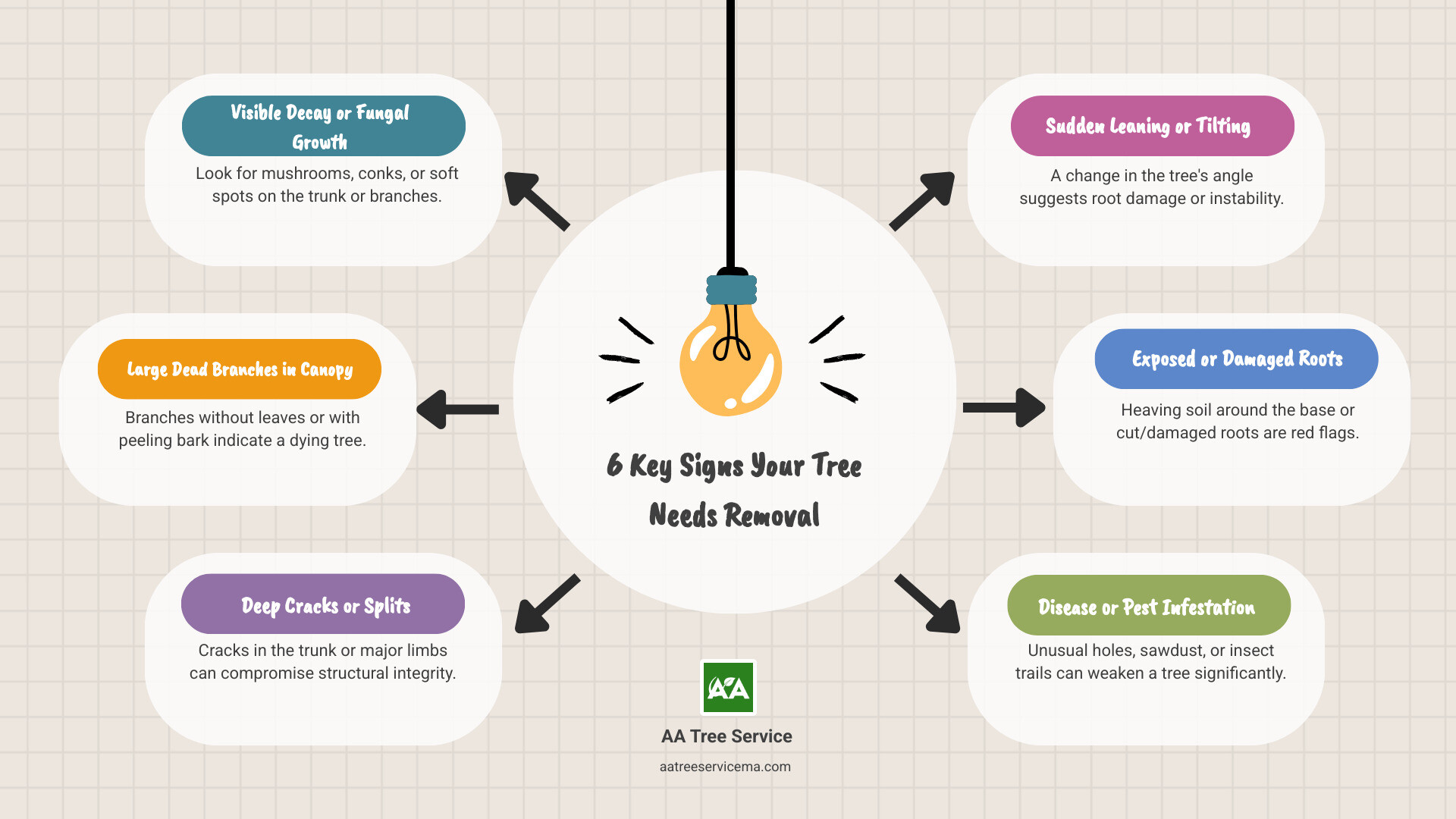
How to Spot a Hazardous Tree: A Homeowner’s Checklist
While a certified arborist’s evaluation is the definitive way to assess a tree’s health and risk, homeowners can and should be vigilant for these common warning signs:
- Decay and Fungi: Actively look for cavities, hollows, or soft, spongy wood on the trunk and major branches. The presence of fungi, especially shelf-like conks or clusters of mushrooms growing on the trunk or at the root flare (where the trunk meets the ground), is a strong indicator of significant internal rot.
- Large Dead Branches (Widow Makers): Scan the upper canopy of the tree. Large branches that are leafless, have peeling bark, or are visibly brittle are known as “widow makers” for a reason. They can snap and fall without warning, posing a serious threat to anyone or anything below.
- Cracks and Splits in the Trunk: Deep vertical splits or seams are structural defects that compromise the tree’s stability. These cracks can allow decay to penetrate deep into the tree and can cause it to fail during high winds, heavy snow, or ice loading.
- Sudden Leaning & Heaving Soil: A tree that begins to lean, or an existing lean that becomes more pronounced, points to a critical root problem. Walk around the base of the tree and look for heaving or cracked soil on the side opposite the lean—this is a sign that the root plate is lifting out of the ground.
- Root System Damage: The health of a tree’s root system is paramount to its stability. Visible damage to major roots from recent digging or construction, decay at the root flare, or roots that have been buried under new pavement or soil can all destabilize a tree and lead to its decline.
If you observe any of these signs, it is imperative to contact an expert for a professional risk assessment.
The Critical Choice: Proactive vs. Reactive Removal
When it comes to hazardous trees, it is always safer, cheaper, and less stressful to be proactive rather than reactive.
Proactive removal involves identifying and removing a declining, diseased, or poorly placed tree on your own schedule. This allows you to gather multiple quotes, schedule the work at a convenient time, and control the cost. It is the most responsible way to manage your property and prepare for New England’s notoriously unpredictable weather, preventing the chaos and expense of property damage and emergency services.
Reactive removal is the emergency call you have to make after a tree has already failed and fallen, often during a storm and at the most inconvenient time. These emergency situations are stressful, more expensive due to the urgent demand, and often involve complex insurance claims. Our team is always ready to respond 24/7 when disaster strikes. You can learn more about our rapid response capabilities on our emergency tree removal page. While we are always here to help in a crisis, proactive removal will always save you significant stress, time, and money in the long run.
Understanding the Process and Costs
Understanding the components of a professional tree removal and the factors that determine its price demystifies the process and helps you budget effectively. No two tree removal jobs are the same, and a professional quote will reflect the unique complexities and risks of your specific situation.
What Factors Influence the Cost of tree removal services littleton ma?
The final price on your estimate is a calculation based on the labor, equipment, and risk involved. Here’s a detailed breakdown of the primary cost factors:
- Tree Size (Height and Diameter): This is the single most significant factor. A tall, wide tree with a thick trunk requires more time, a larger crew, and more extensive equipment to dismantle safely than a small ornamental tree. Arborists often refer to a tree’s DBH (Diameter at Breast Height) to gauge its size and the amount of wood that needs to be processed.
- Accessibility: Where is the tree located? A tree in an open front yard with easy street access is far less costly to remove than the same-sized tree in a tight backyard, fenced in with no access for heavy equipment. Difficult access requires more manual labor, complex rigging, and more time, all of which increase the cost.
- Proximity to Hazards: This is a major risk and cost driver. A tree standing in an open field is simple. A tree with branches overhanging your house, a neighbor’s property, a garage, a deck, or entangled in power lines requires meticulous, piece-by-piece removal using specialized rigging techniques to carefully lower every piece to the ground. This precision work is time-consuming and requires a high level of skill, which is reflected in the price.
- Tree’s Condition: A healthy, strong tree is predictable. A dead, decaying, or storm-damaged tree is not. Brittle limbs can snap unexpectedly, and hollow trunks can be unstable, making the job significantly more dangerous for the crew. Extra safety precautions and potentially different removal strategies are needed, which can increase the cost.
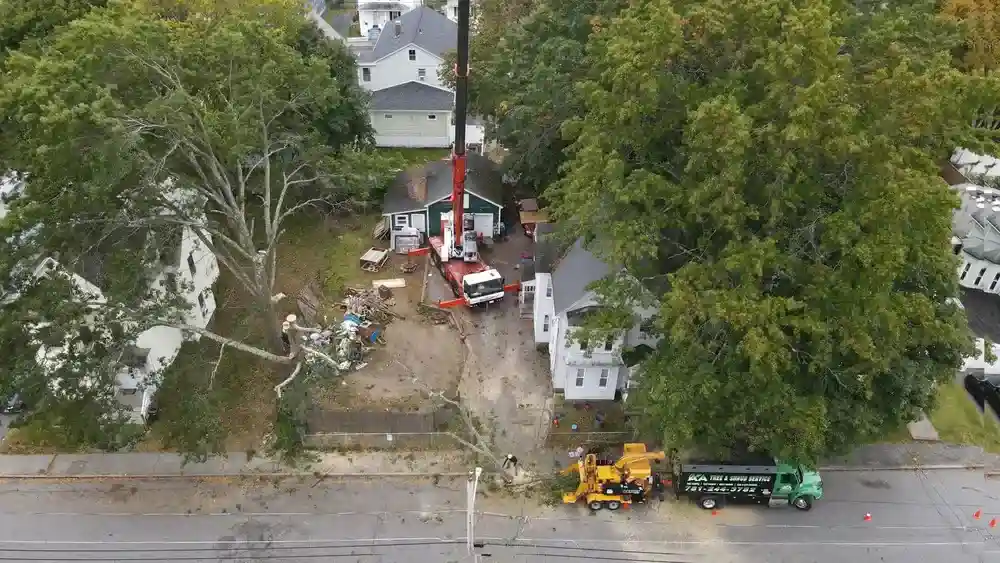
- Special Equipment Needs (Cranes): For very large trees, or trees in locations where falling debris could cause immense damage, a crane is the safest and most efficient tool. Crane-assisted removal involves lifting large sections of the tree up and away from the property to a safe drop zone. While using a crane adds a significant cost to the job, it often reduces the total time required and dramatically increases safety. Learn more on our crane services page.
- Cleanup and Debris Hauling: A standard professional estimate should include the complete cleanup of the work area. This involves chipping all the branches and smaller wood, cutting the larger trunk wood into manageable logs, and hauling everything away. The estimate should clearly state the level of cleanup. Some homeowners may opt to keep the wood chips for mulch or the larger logs for firewood, which can sometimes slightly reduce the cost.
A Step-by-Step Look at the Removal Process
- Arrival and Site Prep: The crew leader will walk the property with you to confirm the scope of work and identify any potential obstacles like septic tanks, sprinkler heads, or delicate landscaping to protect. The team will then establish a safe work zone.
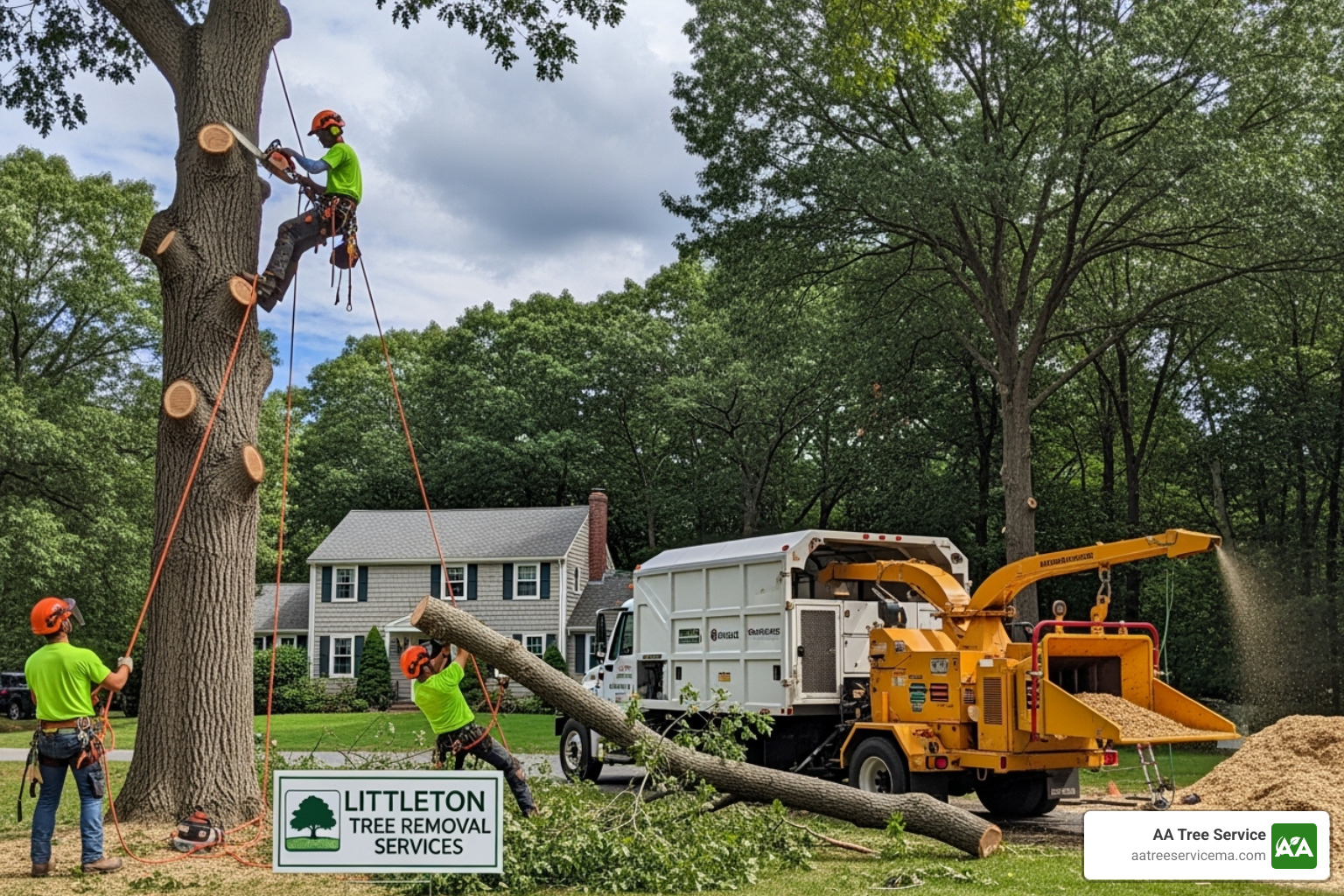
- The Climb and Cut: A skilled climber will ascend the tree, using ropes and a safety harness. They will begin to systematically dismantle the tree from the top down, or from the outer limbs inward.
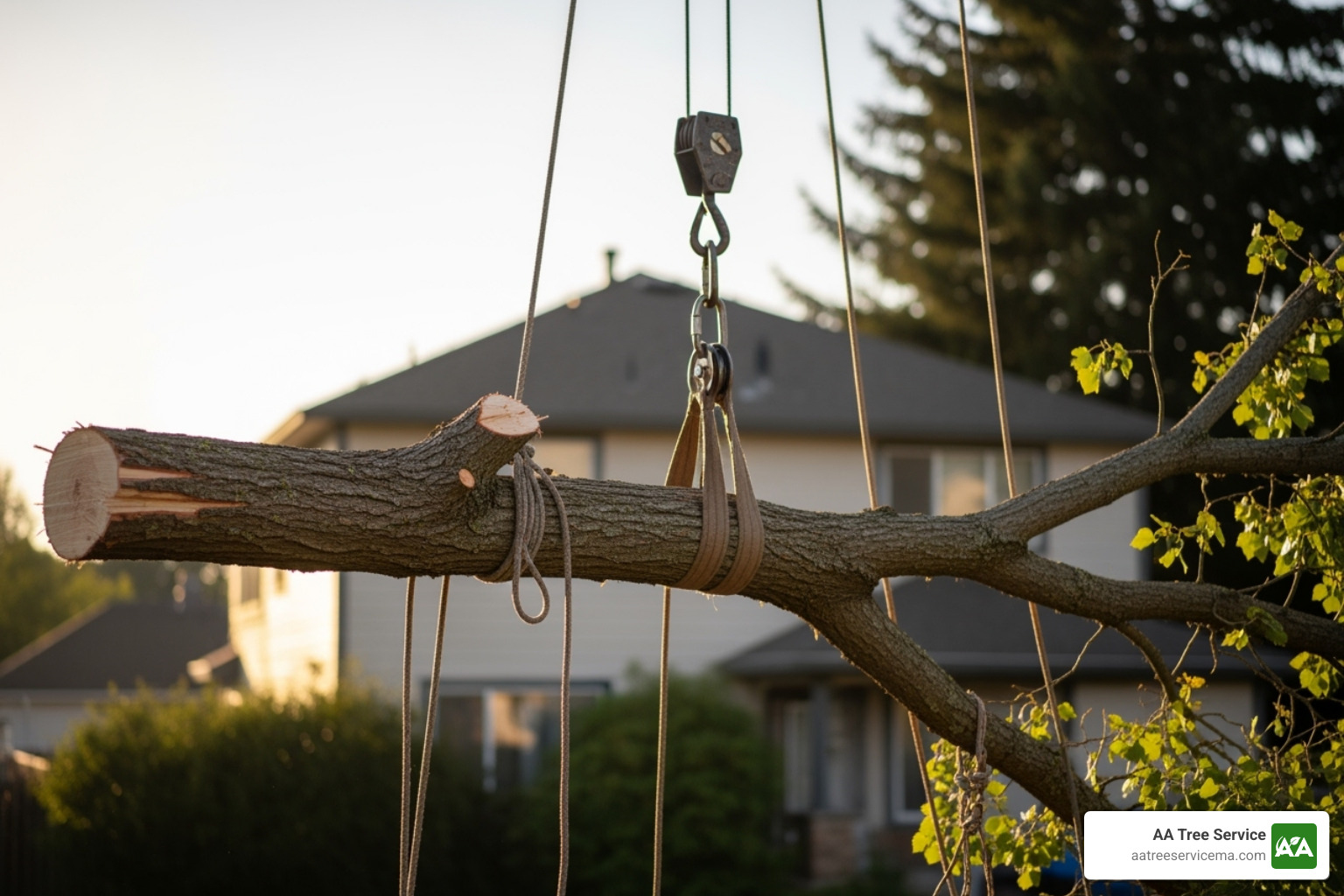
- Rigging and Lowering: For branches over structures, the crew uses a system of ropes and pulleys (rigging) to securely tie off sections before cutting them. The ground crew then carefully lowers the pieces to a designated safe area, preventing any damage to your property.
- Felling the Trunk: Once the tree is delimbed, the remaining trunk will be cut down in manageable sections. If space allows, the final portion of the trunk may be directionally felled.
- Cleanup: All branches and brush are fed into a powerful wood chipper, creating mulch. The larger trunk wood is cut into rounds. The crew then rakes, blows, and clears the entire area of sawdust and debris, leaving your property clean.
Average Costs in Massachusetts
We always provide free, detailed estimates tailored to your specific job, as this is the only way to provide an accurate price. However, to help you budget, here are some general industry-wide averages for Massachusetts. These are not our specific prices, but they can give you a preliminary idea.
| Tree Size Category | Average Industry Cost Range in Massachusetts |
|---|---|
| Small (under 30 ft) | $300 – $1,000 |
| Medium (30-60 ft) | $500 – $2,500 |
| Large (60-80 ft) | $1,000 – $4,500 |
| Complex (>80 ft or hazardous) | $2,500 – $9,000+ |
These figures typically cover the complete removal and hauling of all debris. Stump grinding is almost always quoted as a separate line item. We strongly recommend this service to eliminate the tripping hazard and unsightly stump left behind. Stump grinding in Massachusetts generally costs between $150 and $600, depending on the stump’s diameter, accessibility, and how deep it needs to be ground.
How to Prepare Your Property for a Tree Crew
A little preparation on your part helps the job go faster and safer:
- Clear the Work Zone: Remove any movable items from the area around the tree. This includes patio furniture, garden decorations, potted plants, grills, hoses, and children’s toys.
- Move All Vehicles: Park cars on the street or in the garage, ensuring the driveway is clear for the company’s large trucks and equipment.
- Inform Your Neighbors: Giving your neighbors a heads-up is a simple courtesy. Let them know when the work is scheduled, especially if the tree is near a property line or if access is shared. The work can be loud.
- Secure Pets and Children: For their own safety, it is essential to keep all pets and children indoors and away from the work area for the entire duration of the job.
- Confirm the Plan: Before the chainsaws start, have a final quick chat with the crew leader. Reconfirm the exact tree(s) to be removed and point out any specific concerns you have, like a sensitive garden bed or underground sprinkler heads.
How to Choose the Best Tree Removal Services in Littleton, MA
Choosing a tree removal company is a decision that has significant implications for your safety, property, and finances. Tree removal is an inherently dangerous profession that requires extensive training, an understanding of tree physics, specialized equipment, and a deep respect for safety protocols. It is absolutely not a DIY project. A reputable professional tree removal services littleton ma company is an investment in a job done right, protecting their crew, your family, and your home from harm.
The Extreme Dangers of DIY Tree Removal
Many homeowners with a chainsaw might be tempted to save money by tackling a tree themselves. This is almost always a catastrophic mistake. The risks are immense and include:
- Chainsaw Injuries: Chainsaws are powerful tools that can cause severe lacerations in an instant. Kickback, where the saw unexpectedly jerks back at the operator, is a common cause of injury.
- Electrocution: Power lines running through a tree’s canopy can be hidden by leaves and branches. Contacting a live wire is often fatal.
- Unpredictable Falls: Without understanding how to properly notch and fell a tree, you have little control over where it will land. A miscalculation can send tons of wood crashing onto your home, car, or a neighbor’s property.
- Gravity and Weight: Even small limbs are deceptively heavy. A falling branch can cause serious injury or property damage. Professionals use complex rigging to control the descent of every piece.
A professional company mitigates these risks through training, experience, and proper safety gear (PPE). For more guidance on selecting a trustworthy partner, visit our page on how to find a reliable littleton ma tree removal company.
Verifying Credentials: The Non-Negotiables
This is the most critical step in protecting yourself as a homeowner. Before you even consider a quote, you must verify that the company has two key types of insurance:
- General Liability Insurance: This policy covers any damage the company might cause to your property or a neighboring property during the job. If they drop a limb on your roof and don’t have this insurance, you could be left paying for the repairs yourself.
- Workers’ Compensation Insurance: This is vital. It covers the medical bills and lost wages of any crew member who gets injured while working on your property. Without it, you, the homeowner, could be held personally liable in a lawsuit for those costs.
Do not just take their word for it. Always ask for a certificate of insurance (COI) to be sent to you directly from their insurance agency. This ensures the policy is current and legitimate. A certificate provided by the contractor could be fraudulent or expired. Additionally, look for professional certifications. Credentials from the International Society of Arboriculture (ISA) or accreditation from the Tree Care Industry Association (TCIA) demonstrate a commitment to ongoing education and industry best practices.
Key Questions to Ask Your tree removal services littleton ma Provider
A true professional will be happy to answer your questions and provide detailed information. Use this list to vet potential companies:
- Can I get a detailed, written estimate? A verbal quote is not enough. The estimate should be a formal document that itemizes all services, including tree removal, debris hauling, cleanup, and stump grinding, to prevent any surprise charges.
- Can you provide a copy of your insurance certificates? As mentioned above, this is a must-ask. A refusal or hesitation is a major red flag.
- What is your timeline for the project? This helps you understand how long your property will be a work zone.
- What does your cleanup process entail? Clarify if they will be raking, using a leaf blower, and hauling away all wood and chips. A professional job ends with a tidy property.
- Do you have experience with a job exactly like mine? This is especially important for large, hazardous, or crane-assisted removals.
- What safety protocols and equipment do you use? Look for answers that mention ANSI Z133 standards (the industry’s safety guidelines), personal protective equipment (PPE) like helmets and chainsaw chaps, and daily equipment checks.
- Can you provide local references? Speaking to past customers in the Littleton area can give you great insight into their professionalism and quality of work.
- What specific equipment will you bring for this job? Their answer will tell you if they are properly prepared. If they plan to remove a giant oak with just a pickup truck and a chainsaw, that’s a problem.
- What are your payment terms? Reputable companies will typically not ask for full payment upfront. A deposit may be required for very large jobs, but final payment should only be due upon satisfactory completion of the work.
Confident, transparent answers to these questions are the hallmark of a trustworthy professional. If a company is evasive, pushy, or offers a suspiciously low price, it’s wise to walk away.
Beyond Removal: A Full Spectrum of Tree Care
Exceptional tree care extends far beyond simply removing a problem tree. A truly professional service offers a holistic approach to managing the health, safety, and beauty of your entire landscape. While removal is sometimes the only option, a comprehensive suite of services can help you maintain your valuable trees, prevent future problems, and enhance your property for years to come.
Comprehensive tree services in littleton ma
To keep your property safe, vibrant, and attractive, consider these essential services:
- Tree Pruning and Trimming: This is the most important proactive maintenance you can perform for your trees. Proper pruning does more than just improve appearance. It involves strategic cuts to remove dead, diseased, or crossing branches (crown cleaning), improve the tree’s structure, and promote healthy, vigorous growth. It can also be used to thin the canopy to allow more sunlight and air circulation, or to raise the lower limbs for clearance over driveways and walkways. Learn more about our expert techniques on our tree pruning and trimming page.
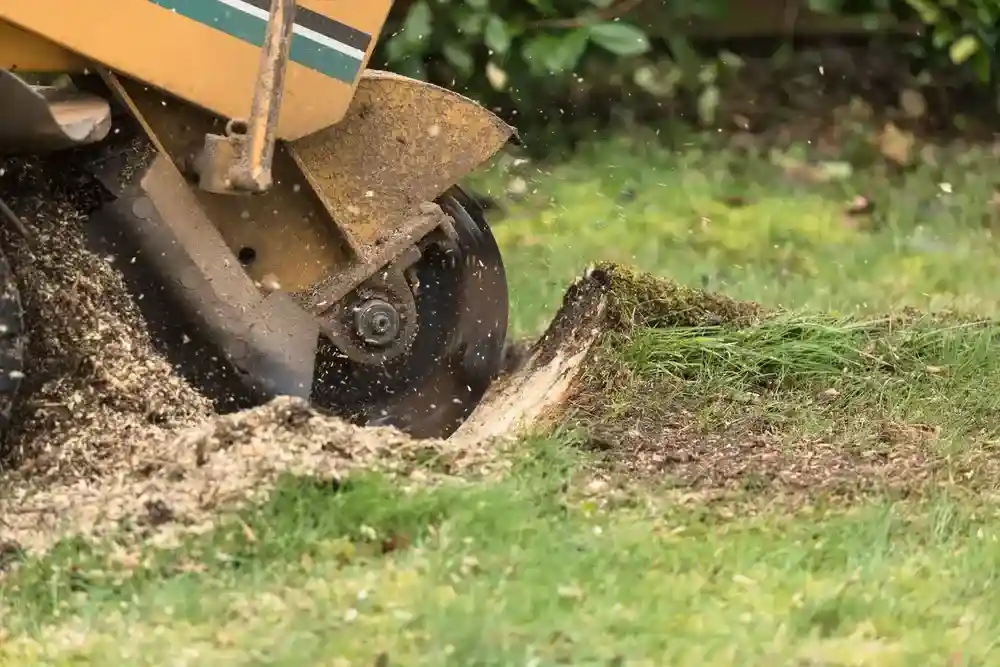
- Stump Grinding: After a tree is removed, the stump remains. A leftover stump is not only an unsightly blemish on your lawn but also a serious tripping hazard. It can also attract pests like termites and ants, and can continue to sprout new, unwanted growth for years. Stump grinding is the solution. We use a powerful machine to pulverize the stump and major roots to well below ground level, turning it into a pile of wood chips and soil. This reclaims your yard space, allowing you to immediately plant grass, shrubs, or a new tree in its place. See the process in action on our stump grinding page.
- Land Clearing: For larger-scale projects, such as preparing a lot for new construction, installing a pool, or creating a large garden or expanded lawn, land clearing services are required. This process is more extensive than single-tree removal and involves the efficient removal of multiple trees, stumps, and dense brush to give you a clean, graded slate for your project.
- Plant Health Care (PHC) and Assessments: A proactive approach to tree wellness can often prevent the need for removal. Our PHC programs involve regular inspections by a knowledgeable arborist to identify early signs of disease, pest infestation, or nutrient deficiencies. Based on this assessment, we can recommend targeted treatments like fertilization, pest control applications, or corrective pruning to restore a tree’s health and vitality before it becomes a hazard.
What to Do if a Tree Falls on Your Property
If a storm or high winds bring a tree down on your property, it can be a shocking and stressful event. Stay calm and follow these critical steps:
- Prioritize Safety Above All Else: Your first action is to ensure everyone, including family and pets, is safe and accounted for. Keep everyone far away from the fallen tree, as it could be unstable and shift further. Do not attempt to climb on the tree or assess the damage up close.
- IMMEDIATELY Check for Downed Power Lines: This is the most critical step. If the fallen tree is touching or has brought down any utility wires, assume they are live and extremely dangerous. Do not go anywhere near them. Call 911 and your utility company (e.g., National Grid) immediately to report the hazard.
- Document the Damage (Safely): Once you are sure there is no electrical hazard, take extensive photos and videos of the scene from a safe distance. Capture images of the fallen tree, the point of failure, and all damage to your home (roof, windows, walls), vehicles, fences, or other structures. This documentation will be essential for your insurance claim.
- Contact Your Homeowner’s Insurance Company: Report the damage to your insurance agent as soon as possible. They will walk you through the claims process and explain your coverage. Most standard policies cover the cost of removal if the tree has fallen on a covered structure, like your house or garage.
- Call for Professional Emergency Service: A fallen tree, especially one resting on your home, is a complex and dangerous situation that requires experts. Our 24/7 emergency team has the specialized equipment (including cranes) and the training to safely secure the site and remove the tree without causing further damage. When you call, be prepared to describe the situation: the size of the tree, what it has fallen on, and if any power lines are involved.
Navigating Littleton’s Local Tree Regulations
Before embarking on any tree removal project, particularly for large, mature trees or those located near property lines or sensitive environmental areas, it is crucial to understand and comply with the Town of Littleton’s local regulations. Navigating bylaws and permit requirements is a key part of a professional tree service’s job. Ignoring these rules can result in stop-work orders, fines, and other legal complications.
Are Permits Required for Tree Removal in Littleton, MA?
For the most part, homeowners in Littleton, MA, do not need a permit to remove trees located on their own private property. However, this general rule comes with several very important exceptions that require careful attention. A permit or special permission is often required in the following situations:
- Trees Within Wetland Buffer Zones or Resource Areas: The Littleton Conservation Commission has jurisdiction over activities that could impact wetlands, rivers, ponds, and other protected resource areas. If a tree you wish to remove is located within a designated wetland or its surrounding buffer zone (typically 100 feet), you will almost certainly need to get approval from the Commission. This usually involves filing a formal application, such as a Request for Determination of Applicability (RDA) or a more detailed Notice of Intent (NOI). These regulations are in place to protect water quality, wildlife habitats, and flood control, making any work in these areas subject to strict review.
- Public Shade Trees: Any tree whose trunk stands wholly or partially within a public right-of-way is considered a “public shade tree.” This often includes trees along the street, even if they appear to be in your front yard. These trees are protected under Massachusetts General Law and are under the care and control of the town’s Tree Warden (often part of the Department of Public Works). You cannot remove or even significantly prune these trees without a public hearing and written permission from the Tree Warden. The process involves a formal request, a posted public notice, and a hearing to ensure the tree’s removal is necessary and in the public’s interest.
- Trees Protected by Specific Bylaws or Easements: While less common for typical residential properties, some areas may have specific bylaws protecting “significant” or “historic” trees based on their size, age, or species. Additionally, a conservation easement or other deed restriction on your property might include specific rules about tree removal. It is always a good practice to be aware of any such restrictions tied to your property.
The Importance of Due Diligence
The responsibility for compliance ultimately falls on the homeowner. Regulations can be updated, and specific site conditions can trigger different requirements. Therefore, we cannot overstate the importance of verifying the rules for your specific situation before any work begins. A quick, proactive call to the appropriate town department can save you from significant future headaches.
For questions about trees near wetlands, contact the Littleton Conservation Commission. Their website, available at https://www.littletonma.org/conservation-commission, is an excellent resource for maps, application forms, and contact information.
For questions about trees along the street or in the public right-of-way, contact the Littleton Tree Warden through the Department of Public Works.
A professional tree care company should be knowledgeable about these general rules, but confirming with the town directly ensures your project proceeds smoothly and legally.
Conclusion: Protecting Your Littleton Property with Professional Tree Care
Properly caring for the trees on your Littleton property is a fundamental aspect of responsible homeownership. It is a direct investment in the safety of your family, the protection of your home, and the long-term value and beauty of your landscape. Throughout this guide, we’ve explored the critical elements of tree management: from identifying the subtle signs of a hazardous tree and understanding the complex factors that influence removal costs, to the absolute necessity of choosing a qualified, fully insured professional and navigating local town regulations.
Making informed decisions at every step is the key to a successful and stress-free outcome. Remember that comprehensive tree care, including proactive pruning, plant health care, and professional stump grinding, is the best strategy for maintaining a healthy and safe property for years to come.
When you need a reliable, expert partner for this important work, AA Tree Service is ready to assist. With over 20 years of dedicated experience serving homeowners in Littleton and surrounding communities across Massachusetts and New Hampshire, we possess an intimate understanding of the unique challenges posed by New England’s trees and weather. Our entire operation is built on a foundation of unwavering commitment to safety, transparent and honest pricing, and a professional promise to leave your property in better condition than when we arrived.
We understand that tree care needs can be both planned and unexpected. That’s why we offer free, no-obligation, same-day quotes for planned projects and maintain a fully-equipped 24/7 emergency response team for when disaster strikes. Whether you are proactively managing your landscape or facing an urgent tree-related crisis, we have the expertise, equipment, and experience to handle the job correctly and safely.
For a free, detailed estimate on your tree removal or other tree care needs, contact our expert team today. Let us partner with you to keep your Littleton property safe, beautiful, and thriving.