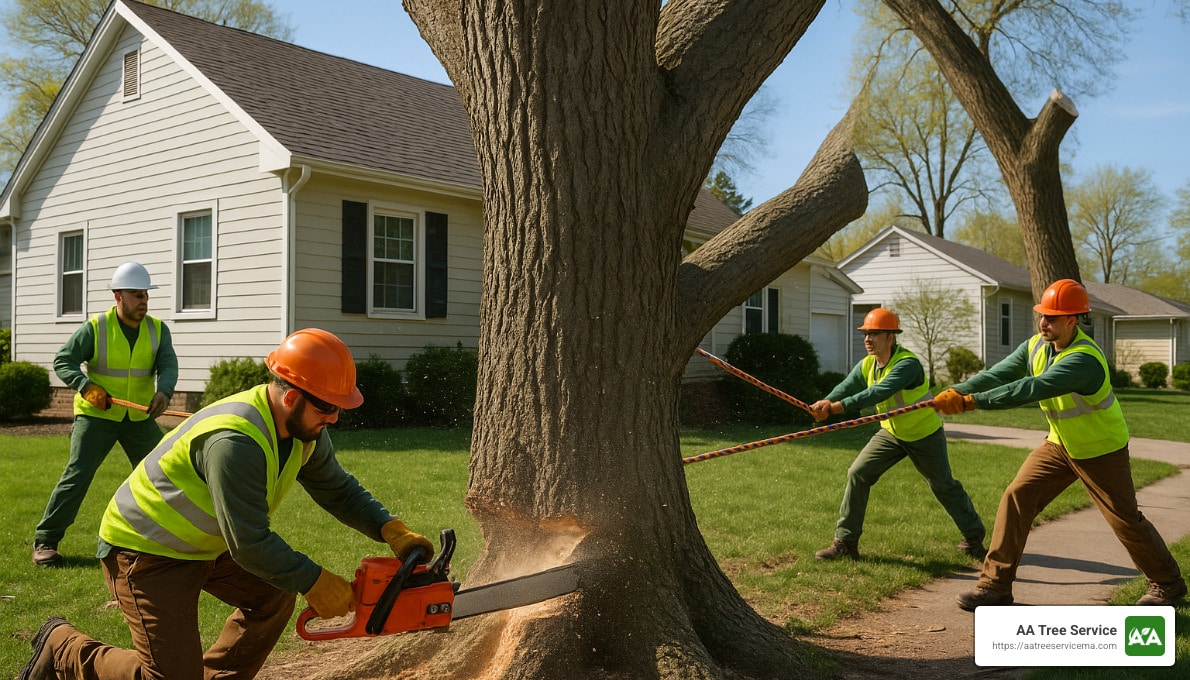
When to Call the Pros: Understanding Tree Removal Services
That magnificent maple that’s shaded your Massachusetts backyard for decades is suddenly looking worrisome. Perhaps it’s the way it leans after the last nor’easter, or those concerning dead branches hanging over your roof. Whatever the reason, you’re now facing a decision that many New England homeowners eventually confront: is it time for professional tree removal service?
For residents across Massachusetts and New Hampshire, tree removal isn’t just about clearing space or improving views—it’s often about protecting your family and property from genuine hazards. When that once-beautiful birch becomes a potential threat, knowing what to expect from professional removal can make all the difference.
“I’ve seen too many DIY disasters where homeowners thought they could handle a tree removal themselves,” shares a veteran arborist with over two decades of experience in New England. “What looks straightforward from the ground becomes incredibly complex—and dangerous—once the cutting begins.”
Most homeowners are surprised to learn that professional tree removal service typically costs between $200 and $2,000, with complex jobs potentially reaching $6,000 or more. This wide range reflects the incredible variety of factors involved: tree height and diameter, accessibility, proximity to structures, and whether special equipment like cranes is needed.
When should you consider removal? The signs are often clear: trees that are dead or diseased, developing dangerous leans, threatening foundations with aggressive roots, or growing dangerously close to power lines all warrant professional assessment. After severe weather—something we’re quite familiar with in New England—storm-damaged trees may pose immediate safety risks requiring prompt attention.
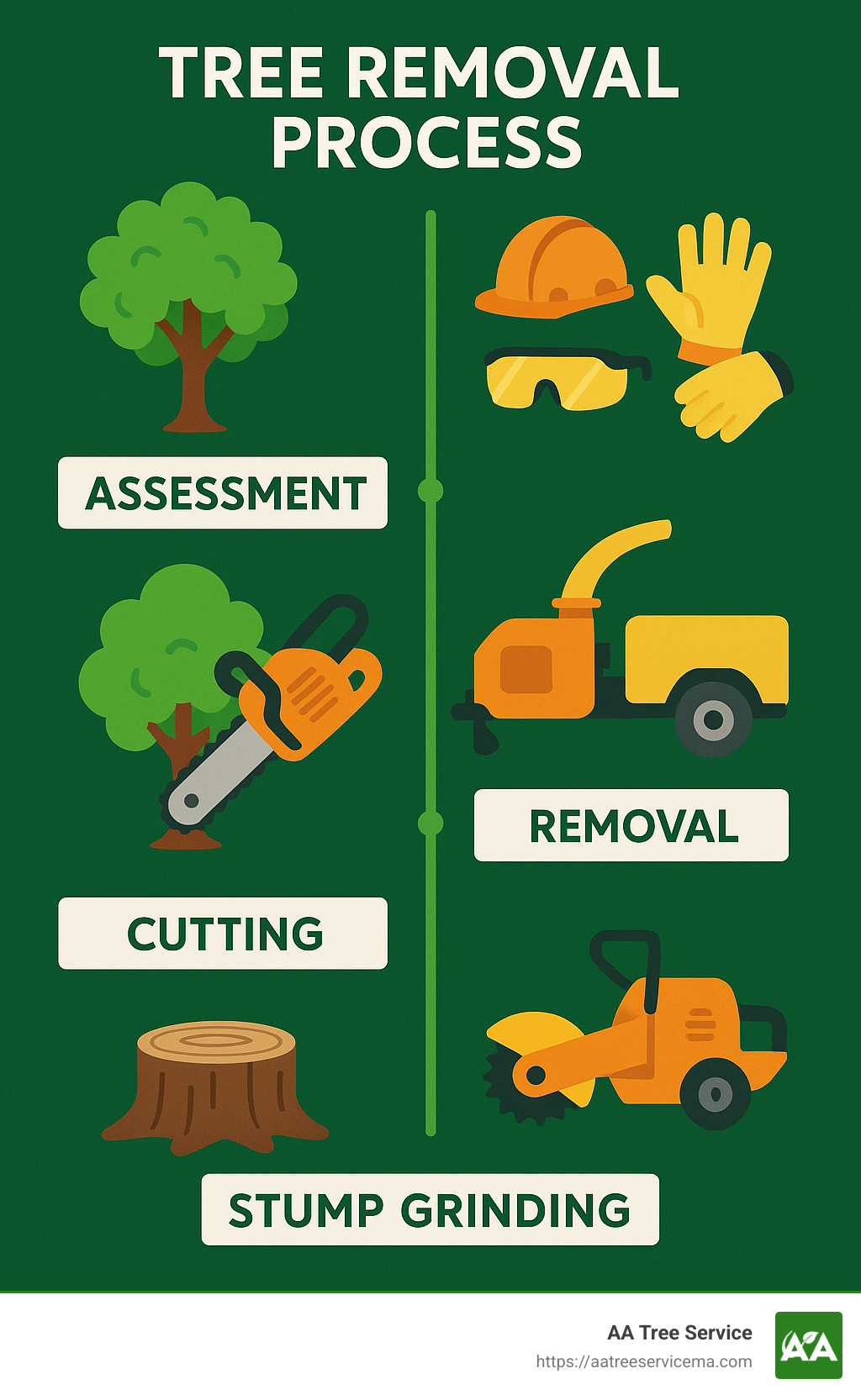
A standard professional removal typically includes cutting down the tree, chipping smaller branches, sectioning larger wood into manageable pieces, and basic cleanup. Stump grinding, where the remaining stump is mechanically reduced below ground level, is usually offered separately and costs between $100 and $205 for average stumps, with larger specimens potentially costing up to $600.
Before hiring any company, ensure they’re properly licensed and insured—this protects both their workers and your property. Reputable professionals will always provide a detailed assessment and free estimate before beginning work. The timeline for removal varies widely: a straightforward job might take just 2-8 hours, while complex removals involving large trees in tight spaces could require 1-2 days.
In many Massachusetts and New Hampshire communities, tree removal requires permits, especially for street trees or in conservation areas. A knowledgeable local service can guide you through these requirements, saving potential headaches and fines.
While we cherish our trees for their beauty, shade, and environmental benefits, sometimes removal becomes the responsible choice. When that time comes, working with certified professionals ensures the job is done safely, efficiently, and with proper respect for both your property and the environment.
Related services that might be helpful in your tree care journey include:
– Tree maintenance services for keeping healthy trees in top condition
– Tree trimming company services when removal isn’t necessary
– Stump removal service for complete landscape restoration
Tree Removal Service 101: What, When & Why
What Exactly Is a Tree Removal Service?
A tree removal service encompasses the complete process of safely taking down a tree, processing the resulting materials, and often addressing the remaining stump. Professional services employ certified arborists who assess, plan, and execute the removal using specialized equipment and techniques that prioritize safety and minimize property impact.
“An ounce of prevention is worth a pound of cure,” says a Massachusetts arborist with over 15 years of experience. This philosophy applies perfectly to tree care—early intervention through proper maintenance can sometimes prevent the need for complete removal.
When Is Tree Removal Necessary?
Knowing when to remove a tree isn’t always obvious. Those magnificent maples and oaks that have stood watch over your property for decades become almost like family members. However, certain situations make removal the only safe option.
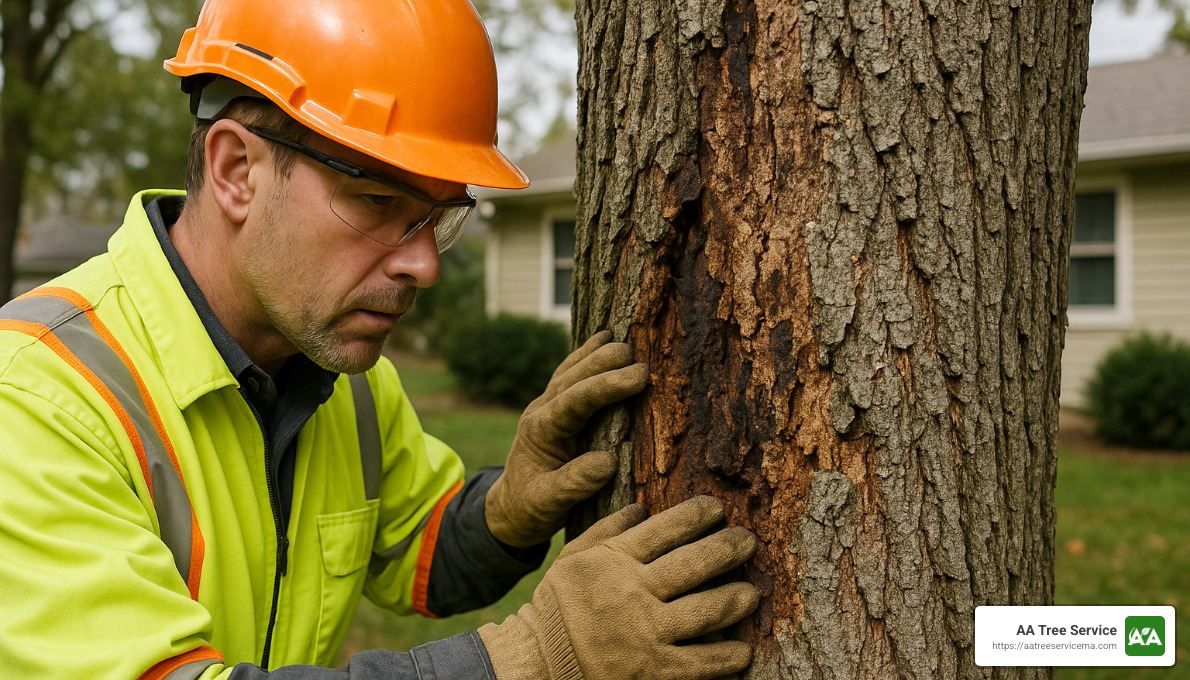
Dead or diseased trees pose significant risks to your property and loved ones. When more than half of a tree shows decay or disease symptoms, professionals typically recommend removal. Dead trees become increasingly brittle and unpredictable with each passing day.
Trees with structural defects like substantial trunk damage, where more than 25% of the bark is compromised, large splitting cracks, or hollow sections often can’t be saved. These weaknesses make the tree vulnerable to failure, especially during New England’s notorious wind and ice storms.
Have you noticed a sudden lean in one of your trees? While some trees naturally grow at angles, a new or changing lean often indicates root failure—essentially, your tree is slowly uprooting itself. This situation requires immediate attention.
Root damage or upheaval is another serious concern. Those exposed, damaged, or decaying roots aren’t just unsightly—they’re compromising your tree’s stability from the ground up. When significant root problems occur, the entire tree’s structural integrity becomes questionable.
Trees growing into or near power lines create dangerous fire hazards and potential outages. Utility companies often handle these removals, but homeowners should be proactive about identifying and addressing these situations before they become emergencies.
During property development or construction projects, sometimes healthy trees must be removed if they obstruct planned work or if their root systems threaten foundations or underground utilities. In these cases, consider replanting elsewhere on your property to maintain your green canopy.
Storm damage can sometimes be addressed with pruning and care, but when a tree suffers severe structural compromise after weather events, complete removal may be the only safe option.
The Permitting Process
Before removing trees in Massachusetts or New Hampshire, understanding local regulations is crucial. Many municipalities across both states require permits for removing trees above a certain diameter (typically 6-12 inches). Protected or heritage trees often have additional restrictions that must be steerd carefully.
Properties in conservation areas or wetlands face special considerations regarding tree removal. Additionally, coastal communities in Massachusetts tend to have stricter tree ordinances to protect against erosion and preserve natural barriers.
“Understanding local regulations is essential before any tree work begins,” explains an industry expert. “What’s permitted in one town may be prohibited just across the municipal line.”
The typical permit process involves submitting an application to your local conservation commission or building department, possibly hosting an inspection, and waiting for approval before work can begin. While this might sound daunting, quality tree removal services handle this paperwork as part of their comprehensive service, saving you time and potential headaches.
With our Tree Care Services, we handle all necessary permitting as part of our approach to tree removal. Our team stays current with the varying regulations across Massachusetts and New Hampshire communities.
For those interested in learning more about the science behind tree health and safety assessments, the International Society of Arboriculture offers excellent resources based on the latest scientific research on urban tree safety.
Professional Options Compared
When it comes to tree removal service options, you’ve got choices that fit different situations and budgets. The right approach depends on your specific tree’s size, location, and condition. Let’s walk through the main professional methods available to homeowners across Massachusetts and New Hampshire.
Standard Climb & Cut Method
The traditional approach to tree removal is a bit like watching a carefully choreographed dance. Skilled climbers ascend the tree using specialized gear, then methodically dismantle it from top to bottom.
This method shines when you need a more affordable option that’s gentle on your landscape. It’s perfect for those medium-sized trees where bringing in heavy equipment might do more harm than good.
The process starts with climbers securing themselves to the tree using harnesses and specialized ropes. They’ll remove branches systematically, often lowering them by rope to prevent damage to your property below. The trunk gets cut in sections from top to bottom, with each piece carefully controlled during its descent.
“I love watching the precision of a good climbing crew,” shared one New Hampshire homeowner. “They made taking down our 60-foot maple look effortless, even though I know it’s anything but.”
This approach requires extensive training and experience. Professional climbers understand rope physics, cutting techniques, and how trees respond when weight is removed during the process. It’s a skilled craft that combines physical ability with technical knowledge.
Crane-Assisted Removal
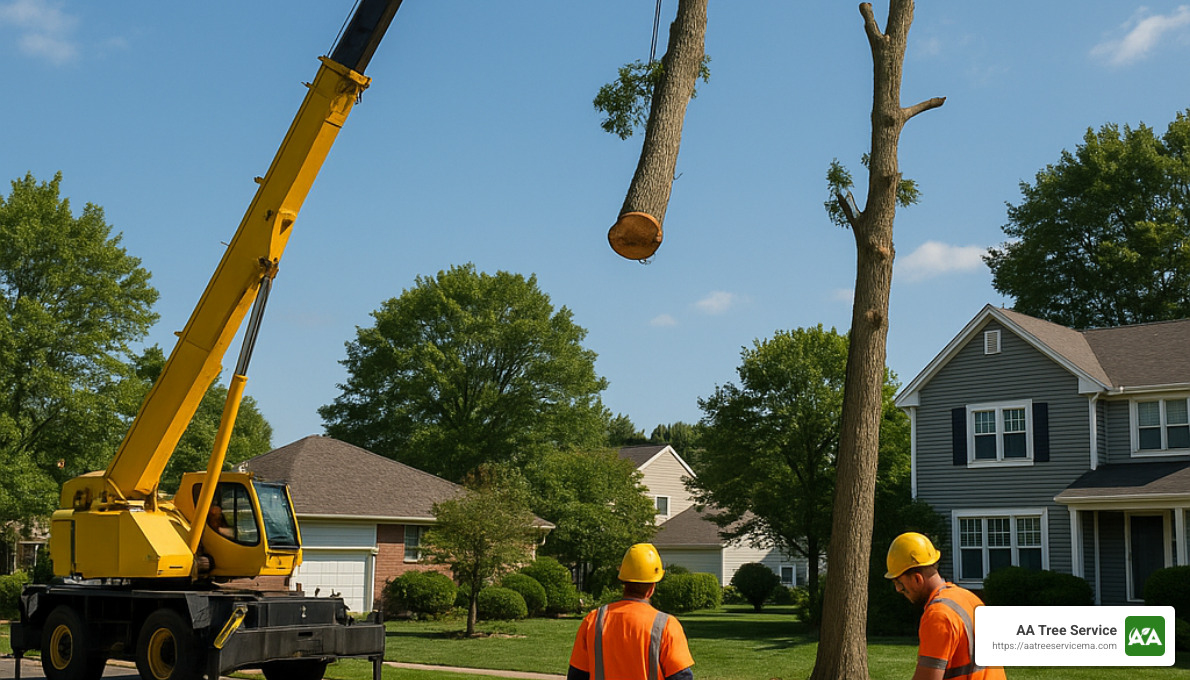
For those truly massive trees or situations where precision is paramount, crane-assisted removal offers significant advantages. This method is the superhero of the tree removal world – swooping in to handle jobs that would be dangerous or nearly impossible with traditional climbing techniques.
When a crane is brought in, the process becomes remarkably efficient. A crane operator positions the equipment strategically while an arborist attaches cables to sections of the tree. Each section is cut and immediately lifted away by the crane, continuing until the entire tree is removed.
This approach really shines in our densely populated Massachusetts neighborhoods, where homes sit close together and yard space comes at a premium. As one relieved customer in Lowell put it: “From crane setup to removing our massive oak to cleanup, your team made it like the tree was never there—except now we have sunshine on our patio for the first time in decades!”
While crane services add to the cost, they often reduce the overall time needed by 50-75%, meaning less disruption to your daily life. They’re also invaluable for removing hazardous trees that might be too dangerous for climbers to tackle safely.
Stump Grinding vs Full Stump Removal
After the tree is down, you’re left with a decision: what to do with that stubborn stump? Your choice typically comes down to your landscape plans and budget.
| Feature | Stump Grinding | Full Stump Removal |
|---|---|---|
| Cost | $100-$300 | $300-$900+ |
| Time Required | 30 min – 2 hours | 2-8 hours |
| Depth | 8-12 inches below grade | Complete root system (up to 6 ft) |
| Landscape Impact | Minimal | Significant hole remains |
| Replanting | Possible but not immediate | Immediate replanting possible |
| Equipment | Portable grinder | Excavation equipment |
Most homeowners opt for stump grinding, which converts the stump to mulch several inches below ground level. This prevents regrowth while allowing the root system to naturally decompose over time. It’s quick, affordable, and leaves your yard in usable condition almost immediately.
Full stump removal, though more expensive and disruptive, completely excavates the entire root system. You’ll be left with a significant hole that needs filling, but you’ll have the freedom to replant immediately or redesign that section of your landscape from scratch.
As one Massachusetts gardener told us after choosing complete removal: “It was worth the extra cost to get all those roots out. I was able to plant my new Japanese maple in the exact same spot, which was important for my garden design.”
Learn more about our approach to Stump Grinding as part of our comprehensive services.
DIY Tree Removal Service Risks
The temptation to save money with a DIY approach is understandable, but the risks often outweigh the potential savings. Tree removal ranks among the most dangerous home projects you could attempt.
Each year, over 36,000 chainsaw accidents occur in the US, many during amateur tree removal attempts. Falls from ladders, unpredictable tree behavior during cutting, and being struck by falling limbs add to the danger. As one emergency room doctor in New Hampshire grimly noted, “We see way too many weekend warriors who thought removing ‘just one tree’ would be simple.”
Beyond personal safety, DIY removal puts your property at risk. Damage to homes, vehicles, or neighboring properties is common when trees don’t fall as expected. Contact with power lines can cause outages or fires. And without proper knowledge, you might find yourself facing fines for removing trees without required permits.
Professional tree removal services carry specialized insurance, use proper safety equipment, and employ trained personnel who understand the physics of tree removal. For anything beyond a sapling, the experts are clear: leave it to the professionals.
24/7 Emergency Tree Removal Service
New England weather doesn’t check your calendar before sending a storm your way. When trees fall on homes, block driveways, or create dangerous situations, emergency services become essential.
“The massive nor’easter hit around 2 AM,” recalls a homeowner in Salem. “By sunrise, we had a 100-year-old oak leaning against our roof. I called in a panic, and the crew was there within the hour. They saved our home from what would have been catastrophic damage.”
Emergency tree removal addresses immediate hazards when trees fall on structures, limbs hang precariously after storms, or trees lean dangerously against power lines. The response process includes rapid assessment, securing the area, coordinating with utility companies when needed, and executing the safest removal method possible under challenging conditions.
The best emergency services arrive quickly, work efficiently, and provide temporary mitigation for property damage along with cleanup of immediate debris. They understand that in crisis situations, clear communication and fast action make all the difference.
For situations requiring immediate attention, our Emergency Tree Removal Service provides rapid response throughout Massachusetts and New Hampshire.
Costs, Permits & Disposal in MA & NH
Understanding what you’ll pay for a tree removal service can feel overwhelming at first. Let’s break it down into simple terms that make sense for homeowners in Massachusetts and New Hampshire.
Cost Factors for Tree Removal
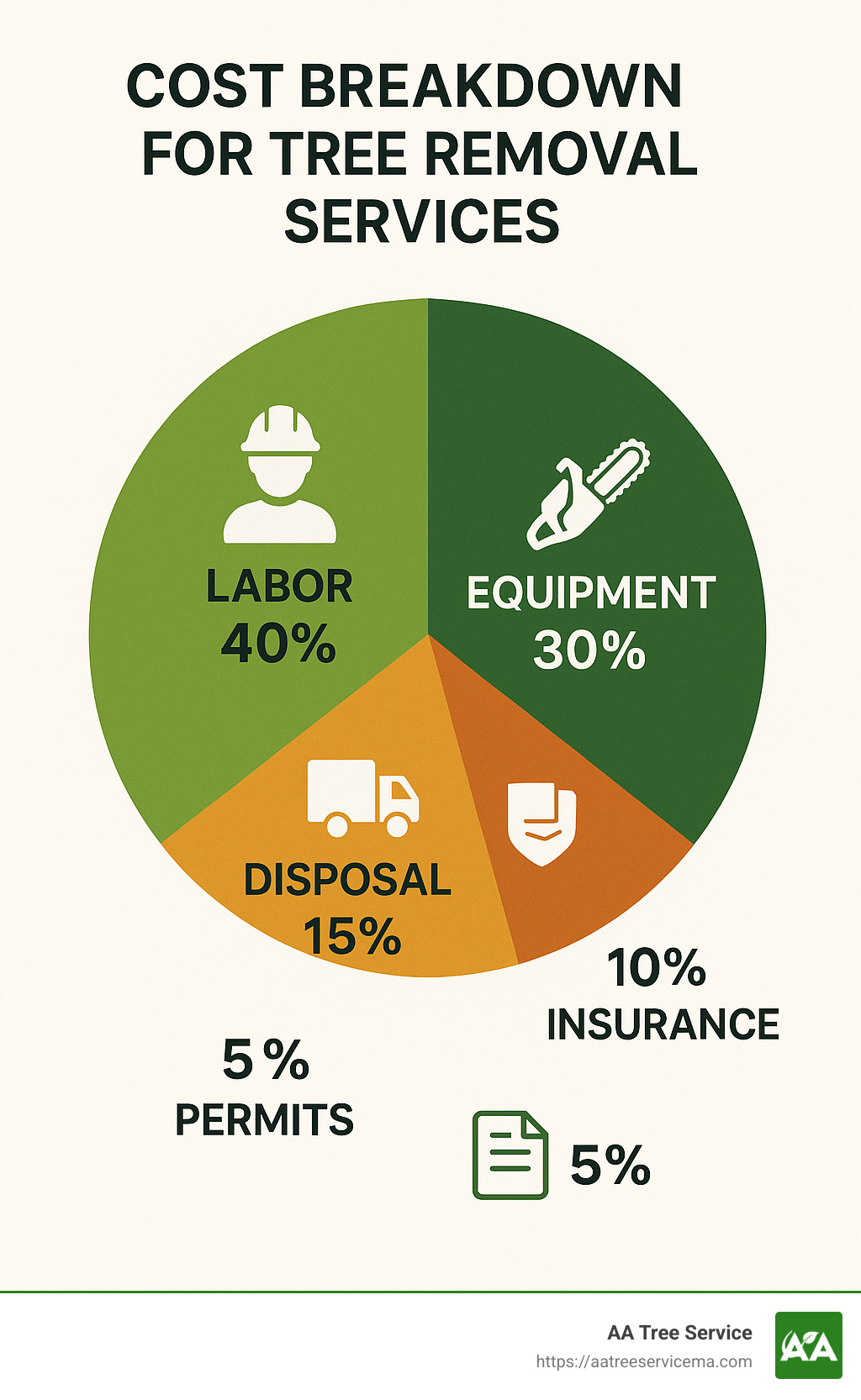
Tree removal prices typically range from $200 for a small backyard sapling to well over $2,000 for those towering oaks that have watched over your property for generations. Why such a wide range? It all comes down to a few key factors.
Size matters tremendously when it comes to tree removal. Those small trees under 30 feet might only set you back $200-$450, while medium-sized trees (30-60 feet) typically cost $450-$1,000. The price climbs significantly for large trees between 60-80 feet, ranging from $1,000-$1,500. And those truly massive specimens towering above 80 feet? Expect to pay $1,500-$6,000 or even more.
“I always tell homeowners to look at the trunk diameter, not just the height,” explains a veteran arborist. “A tree with a thick trunk and wide canopy requires more labor and specialized equipment than a slender tree of the same height.”
The condition of your tree also affects pricing. Dead trees often cost 25-50% more because they’re unpredictable and brittle, creating additional safety challenges. Diseased trees might require special handling to prevent spreading pathogens to healthy trees nearby.
Location plays a huge role too. That tree hanging over your garage? It’ll cost more than one standing alone in an open yard because of the precision work required. Limited access might mean bringing in specialized equipment, while steep slopes create additional safety considerations that increase labor costs.
Don’t forget about those extra services that might not be included in the base price. Stump grinding typically runs $100-$600 depending on diameter, while log splitting adds $75-$200. Hauling away all that debris? That’s another $100-$400 in most cases.
These figures represent average costs based on internet data and not actual costs for AA Tree Service. Actual prices may vary significantly based on specific circumstances.
Permitting Requirements
Massachusetts and New Hampshire both have their own unique approaches to tree removal permits, and they can vary dramatically from one town to the next.
In Massachusetts, cities like Boston and Cambridge maintain strict tree ordinances requiring permits for any tree over 8″ in diameter. If your property sits near wetlands, you’ll need Conservation Commission approval before a single branch comes down. Historic districts often have additional preservation requirements designed to maintain neighborhood character.
New Hampshire has its own set of rules, particularly through the Shoreland Water Quality Protection Act, which governs tree removal near lakes, ponds, and rivers. Local regulations vary widely – Portsmouth and Nashua have specific tree protection ordinances that might apply to your property.
Don’t forget to check with your HOA if you have one! Many have their own tree regulations that can be even stricter than municipal requirements.
The good news? Most reputable tree removal services handle all this paperwork headache for you, navigating the sometimes bewildering local regulations so you don’t have to become an overnight expert in municipal code.
Disposal and Recycling
What happens to your tree after it comes down? Modern approaches emphasize sustainability rather than simply hauling everything to the landfill.
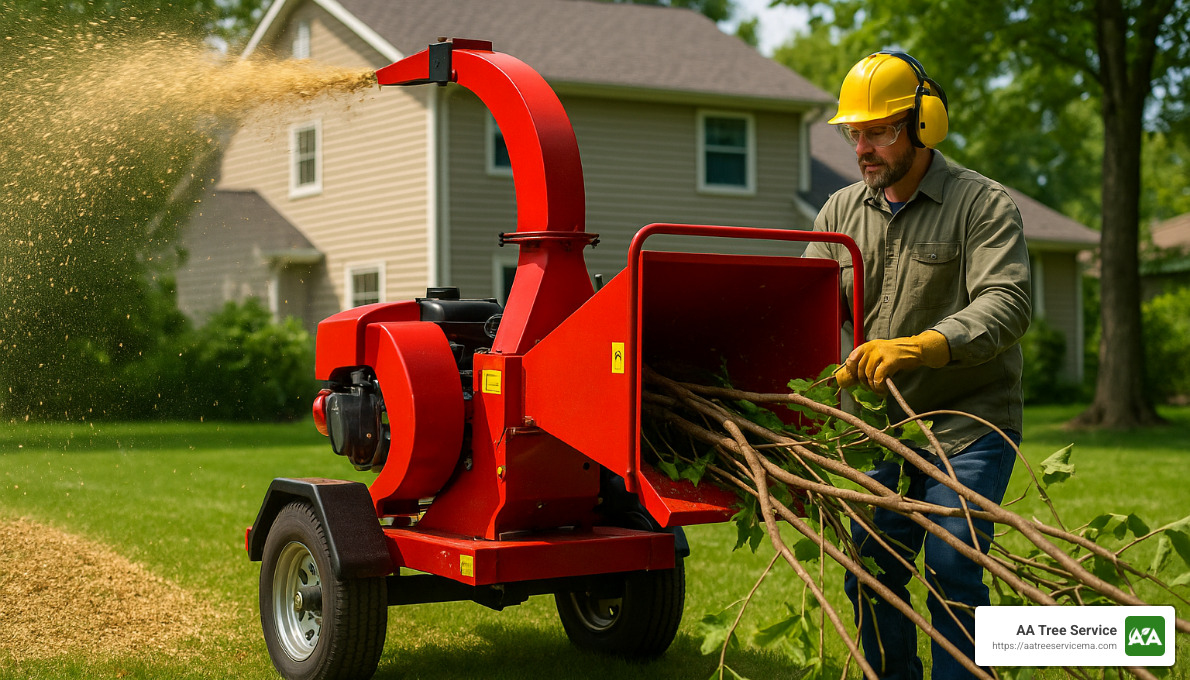
A standard tree removal service includes taking down the tree, chipping all the brush into mulch, cutting wood into manageable logs, and cutting stumps flush to the ground. But the story doesn’t end there.
The most environmentally responsible companies ensure your tree gets a second life. Branches and smaller limbs become nutrient-rich mulch for gardens. Larger sections become firewood to warm homes through those brutal New England winters. High-quality hardwoods might even be milled into lumber for construction or woodworking projects.
“We believe trees should continue to serve a purpose even after removal,” one local arborist shared. “There’s something deeply satisfying about seeing a removed maple tree become the mulch that helps a new garden thrive.”
Timeline Expectations
How long will your property be a work zone? It depends on the complexity of the job.
Small, straightforward removals often wrap up in just 2-4 hours – you might leave for work in the morning and come home to a completely different landscape. Medium-sized trees typically take 4-8 hours from start to finish. Those large or complex removals, especially near structures or power lines, might stretch into a 1-2 day project.
Emergency situations receive priority treatment, with response times measured in hours rather than days, though completion time varies depending on the complexity of the situation.
Adding stump grinding? That typically adds 30 minutes to 2 hours per stump, while full stump removal (roots and all) can extend the timeline by half a day or more.
The industry follows the latest guidance on safety standards set by professional organizations, ensuring that work proceeds efficiently without cutting corners on safety.
For comprehensive information about our approach to making your property safer and more beautiful, visit our Tree Removal page.
Frequently Asked Questions about Tree Removal Services
How long does a typical tree removal take?
When homeowners ask me about timing, I always smile and say, “It depends on whether we’re dealing with a sapling or a century-old oak!” The truth is, tree removal timelines vary dramatically based on several factors.
For most residential properties in Massachusetts and New Hampshire, you can expect:
- Small trees (under 30 feet): Usually wrapped up in 2-4 hours
- Medium trees (30-60 feet): Typically takes 4-8 hours
- Large trees (60+ feet): Often requires 8+ hours and sometimes multiple days
- Complex situations near homes or power lines: Add 50-100% more time
What makes timing so variable? Think about access to your property. If our crew needs to carry debris through a narrow side yard versus being able to back a truck right up to the tree, that makes a big difference. Weather conditions play a role too—we prioritize safety above all, so high winds might extend our timeline.
“Tree removal combines both scientific knowledge of tree biology and the art of aesthetic pruning,” as one of our veteran arborists puts it. “Each job is unique and requires a customized approach.”
When you get an estimate from a professional tree removal service, they should provide a realistic timeframe so you can plan accordingly. The good news? Most standard removals can be completed in a single day.
Does homeowner’s insurance cover tree removal?
This question comes up all the time, especially after storms roll through New England. The short answer: sometimes yes, sometimes no—it depends on the circumstances.
Your homeowner’s insurance typically covers tree removal service when:
Trees fall on covered structures like your home, garage, or shed due to wind, lightning, or other covered perils. Insurance companies understand that a tree crashing through your roof requires immediate attention!
However, your policy probably won’t cover:
Removing a healthy but threatening tree before it falls, trees that fall without damaging insured structures, or trees that decline due to disease or age. These situations are generally considered maintenance issues rather than sudden, accidental events.
“Insurance may cover removal if a tree falls due to certain natural causes; preventative removal is often out-of-pocket,” explains an industry professional who’s helped countless homeowners steer these situations.
Even when coverage applies, be aware of limits. Most standard policies pay between $500 and $1,000 per tree, with maximum benefits of $1,000 to $5,000 per incident. And yes, your deductible always applies.
Before assuming anything, I always recommend reviewing your specific policy and having a quick chat with your insurance agent. It’s better to understand your coverage before you need it!
What happens to the wood after removal?
“One person’s tree debris is another person’s treasure,” I like to tell homeowners who wonder about the afterlife of their trees. Modern tree removal services have become quite resourceful with tree materials.
Those branches and smaller limbs? They typically go through a chipper to create nutrient-rich mulch. Many homeowners love keeping this mulch for their gardens and landscaping—it’s like getting a bonus product from your project! If you don’t need it, reputable companies donate it to local farms or community gardens.
For the trunk and larger sections, we usually cut them into manageable 18-24 inch pieces. These make excellent firewood if you have a fireplace or wood stove. No need for firewood? Many companies will haul it away for processing into lumber or firewood products elsewhere.
Some trees, particularly hardwoods like oak, maple, and cherry, are quite valuable. I’ve seen beautiful tables and cutting boards made from urban trees that needed to be removed. Some companies maintain relationships with local craftspeople who can transform your tree into something special.
The stump and root system get special treatment too. When ground into mulch, this material naturally decomposes over time, enriching your soil. It’s nature’s way of completing the cycle.
“Tree stumps can be ground into mulch to improve lawn appearance and prevent pest infestations or unwanted regrowth,” notes a tree care specialist with decades of experience.
Environmentally conscious companies in Massachusetts and New Hampshire make sure very little ends up in landfills. Instead of waste, your tree becomes resources for other purposes—a much better outcome all around!
AA Tree Service is committed to sustainable practices in all our removals, ensuring your trees continue to provide value even after they’ve been removed from your property.
Conclusion
When it comes to tree removal service needs in Massachusetts and New Hampshire, finding the right balance between cost, safety, and long-term landscape goals is essential. While budget concerns are real for every homeowner, the potential risks of improper removal far outweigh any short-term savings you might find with cut-rate services.
Taking a preventive approach through regular tree maintenance can often extend the life of your trees and reduce the likelihood of needing emergency removal services. Professional arborists have the trained eye to spot early warning signs of disease or structural weakness that the average homeowner might miss. This early detection often allows for less invasive interventions like strategic pruning, cabling, or targeted treatments.
“The trees we save through preventive care often become the most beloved landscape features for our clients,” notes one experienced arborist. “That maple that provides perfect shade for your patio or the oak that’s been on your property for generations – these are worth preserving when possible.”
However, when removal becomes necessary, the value of working with certified professionals becomes crystal clear. Proper equipment, extensive training, and comprehensive insurance aren’t just nice-to-haves – they’re essential protections for your property and your liability exposure. The difference between amateur and professional tree removal is often measured not just in hours saved but in thousands of dollars of potential damage avoided.
After your tree is removed, consider the environmental impact of what happens next. Responsible wood recycling transforms your former shade tree into mulch for gardens, firewood for homes, or even lumber for beautiful furniture. Many communities throughout Massachusetts and New Hampshire offer tree replacement programs that help maintain our region’s vital tree canopy – something increasingly important as we face climate challenges.
The removal of a tree can actually improve your property value when done properly. Eliminating hazardous trees and replacing them with appropriate species can improve curb appeal while reducing insurance risks. The investment in professional removal often pays dividends in both property value and peace of mind.
At AA Tree Service, we’ve been serving communities throughout Massachusetts and New Hampshire for over 20 years with a focus on safety, efficiency, and customer satisfaction. Our team of certified arborists brings not just technical expertise but a genuine appreciation for the trees that define our New England landscape. With 24/7 emergency services and free same-day quotes, we’re ready to address your tree care needs with the attention they deserve.
For professional assessment of your tree removal needs or to learn more about our comprehensive services, visit our Tree Removal page. Whether you’re facing a storm-damaged tree or planning a property improvement project, our team brings the expertise and equipment necessary for safe, efficient tree removal that respects your property and the environment.
Trees add remarkable value to your property—both financially and in quality of life. When removal becomes necessary, partnering with experienced professionals ensures the process preserves your landscape’s integrity while protecting what matters most—your home, your family, and your investment in your property’s future.