

Tree Removal Permits in Massachusetts: Rules by Town
Can you cut down a tree on your own property in Massachusetts? Usually yes — but public shade trees, wetland buffers, and local bylaws change the answer fast. Here's how the rules work, what triggers a permit, and how to check your town before a chainsaw ever starts.
The short answer: Massachusetts has no statewide permit for removing a tree on your own private residential property. But that's only the starting point. Whether you actually need approval depends on where the tree stands — near the road, near a wetland, on a property line, or under a local ordinance — and getting it wrong can mean stop-work orders and heavy fines. This guide breaks down every trigger.
Do You Need a Permit? Start Here
Four questions decide it. If you answer "yes" to any, you likely need approval before removal:
- Is it a public shade tree? Any tree within the public way or on the boundary of a public road — even along your frontage — is public under MGL Chapter 87.
- Is it near a wetland? Within 100 ft of a wetland/pond or 200 ft of a river triggers Conservation Commission review.
- Is it on a scenic road or in a historic district? Many towns require a hearing and permit for these.
- Does a local bylaw or HOA apply? Some cities (e.g., Cambridge, Somerville) regulate certain private tree removals directly.
If all four are "no" and the tree is entirely on your land, away from the road, wetlands, and property lines, you can generally remove it without a permit.
Public Shade Trees & Chapter 87
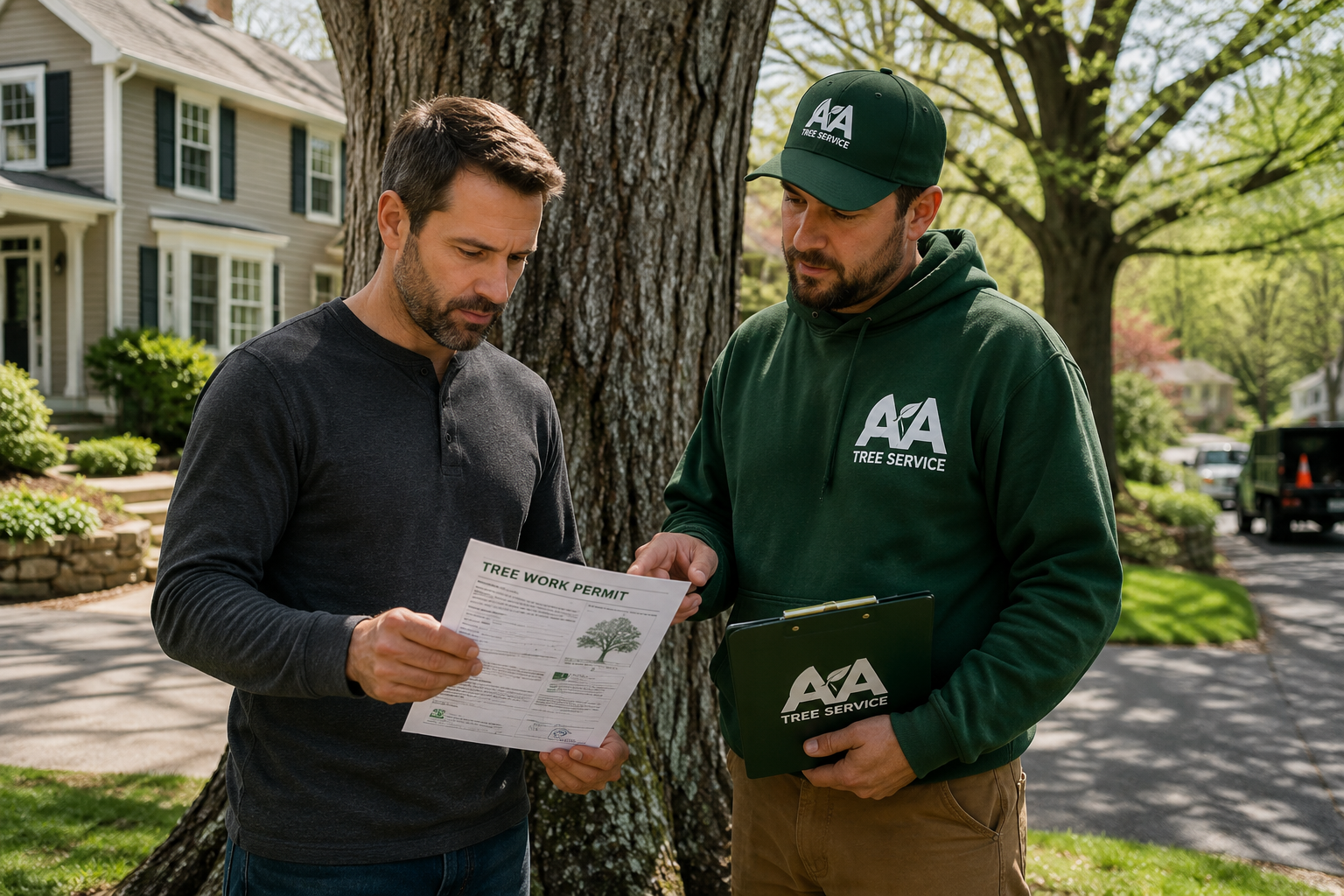
Under Massachusetts General Laws Chapter 87, any tree within a public way — including trees on the boundary line between private property and a public road — is a public shade tree. These fall under the authority of the town's Tree Warden. Removing, cutting, or even heavily trimming one requires written permission and, if any citizen objects after a posted notice, a formal public hearing. Cutting a public shade tree without that permit is illegal and carries significant municipal fines and civil liability.
Wetlands & the Conservation Commission
Under the Massachusetts Wetlands Protection Act, removing trees near protected resources needs local Conservation Commission approval when the work falls within:
- The 100-foot buffer zone around wetlands, ponds, marshes, bogs, and streams.
- The 200-foot riverfront area along perennial rivers and streams.
- A town's stricter No-Disturb Zone — often the first 25 feet nearest the resource.
For minor work you file a Request for Determination of Applicability (RDA); larger projects need a Notice of Intent (NOI). Some towns let conservation staff administratively approve small removals (e.g., up to five trees) with no lawn expansion. Skipping this can bring stop-work orders, fines, and mandatory environmental restoration.
How the Rules Break Down
| Where the tree is | Permit needed? | Who approves it |
|---|---|---|
| Entirely on private land, away from road & wetlands | Usually no | — |
| Public shade tree (public way / road boundary) | Yes — written permit, possible hearing | Tree Warden (MGL Ch. 87) |
| Within 100 ft of wetland / 200 ft of river | Yes — RDA or Notice of Intent | Conservation Commission |
| Along a designated scenic road | Yes — public hearing + permit | Planning Board / Tree Warden |
| On the property line (boundary tree) | Neighbor's consent required | Shared owners |
| Local ordinance towns (e.g., Cambridge, Somerville) | Sometimes — for certain private trees | City tree/ordinance dept. |
| Dead / hazardous, imminent danger | Often exempt with arborist certification | Town + certified arborist |
Local rules change and vary town to town — always confirm with your municipality before removal. This is general guidance, not legal advice.
Town Spotlight: Reading, MA
In Reading, you need approval if the tree is a public shade tree or sits near a wetland or protected water body. Public shade trees fall under MGL Chapter 87 — the Tree Warden must hold a hearing and issue a permit before removal.
Not sure whether a tree is yours or the town's? Contact the Reading Department of Public Works at (781) 942-9092.
If the tree is within 100 ft of a wetland/pond or 200 ft of a river, you must get permission from the Reading Conservation Commission — (781) 942-6616. You'll typically submit the tree's size (DBH), species, and photos, and may owe a replacement-tree ratio or a contribution to the Shade Tree Fund (about $250–$500 for homeowners). Conservation applications go through the town's OpenGov portal.
Serving other MA and NH towns? The categories above apply everywhere, but contacts and fees differ — we'll help you confirm your town's process. New Hampshire also protects roadside and public trees, so check locally there too.
Let Your Tree Service Handle the Permitting
An experienced local crew deals with this every week — confirming whether a tree is public or private, pulling the right permit, and providing the certified arborist assessment a town needs to approve an emergency or conservation-area removal. AA Tree Service navigates MA and NH municipal requirements as part of the job, so you're never the one facing a stop-work order. See our permit overview, tree removal, and land clearing services.
Not Sure If You Need a Permit? We'll Find Out.
Free same-day estimates across Massachusetts & New Hampshire. We confirm the tree's status and handle the permitting so removal is done right.
Why Choose AA Tree Service?
Choose AA Tree Service for expert care, professionalism, and dependable service. We know the local permitting landscape across MA & NH and keep every removal compliant — no fines, no stop-work orders.
With experienced technicians, advanced equipment, and a commitment to safety, we deliver high-quality results on every project.
REQUEST A FREE ESTIMATELicensed & Insured
A fully licensed and insured company.
Permit Assistance
We handle municipal requirements.
Over 20 Years' Experience
Two decades serving MA & NH.
Locally Owned
We know the local rules.
Certified Arborists
Assessments towns will accept.
Free Same-Day Quotes
Know where you stand fast.