

Tree Preservation During Construction in Massachusetts & New Hampshire
Construction projects kill more mature trees than most homeowners realize — not through chain saws, but through soil compaction, root cutting, and grade changes that show up years later as slow decline. Here's how to protect the trees you're paying to keep.
Why Trees Die After Construction — and How to Prevent It
A tree that looks perfectly healthy the day a construction project ends can be dead within two to five years. The damage happens underground and invisibly — compacted soil cutting off oxygen to roots, grade changes smothering the root system, utility trenches severing feeder roots — and by the time the symptoms show above ground, recovery is rarely possible.
The most effective tree preservation strategy is the one that starts before equipment arrives on the property. Once a bulldozer has compacted the root zone or a trench has cut through 40% of the root system, the options shift from preservation to damage management. Planning early — ideally with a certified arborist walk-through before the project begins — is the difference between a tree that survives construction and one that declines for years before it finally fails.
The Critical Protection Zone — What It Is and Why It Matters
Every tree has a Critical Protection Zone (CPZ) — the root zone area that must be kept free of construction activity to give the tree a reasonable chance of surviving the project. The standard calculation is roughly one foot of radius per inch of trunk diameter, measured at chest height.
A 20-inch diameter oak, for example, has a Critical Protection Zone extending 20 feet in every direction from the trunk. Inside that zone, no equipment, no soil storage, no vehicle parking, no trenching, and no grade changes should occur. Violations don't kill trees immediately — they cause compaction, root damage, and vascular stress that shows up as slow decline years after the project is complete.
- Install tree fencing at the CPZ boundary before any equipment arrives on site — not after
- No soil storage inside the CPZ — piled soil smothers roots even for short periods
- No equipment parking or staging — a single pass from a loaded concrete truck can compact soil beyond recovery
- Hand-dig any trenches within the CPZ — mechanical excavation severs roots without the precision to avoid critical ones
- No concrete washout near trees — highly alkaline waste water raises soil pH and kills feeder roots
- Use plywood or ground matting for any temporary equipment access across root zones
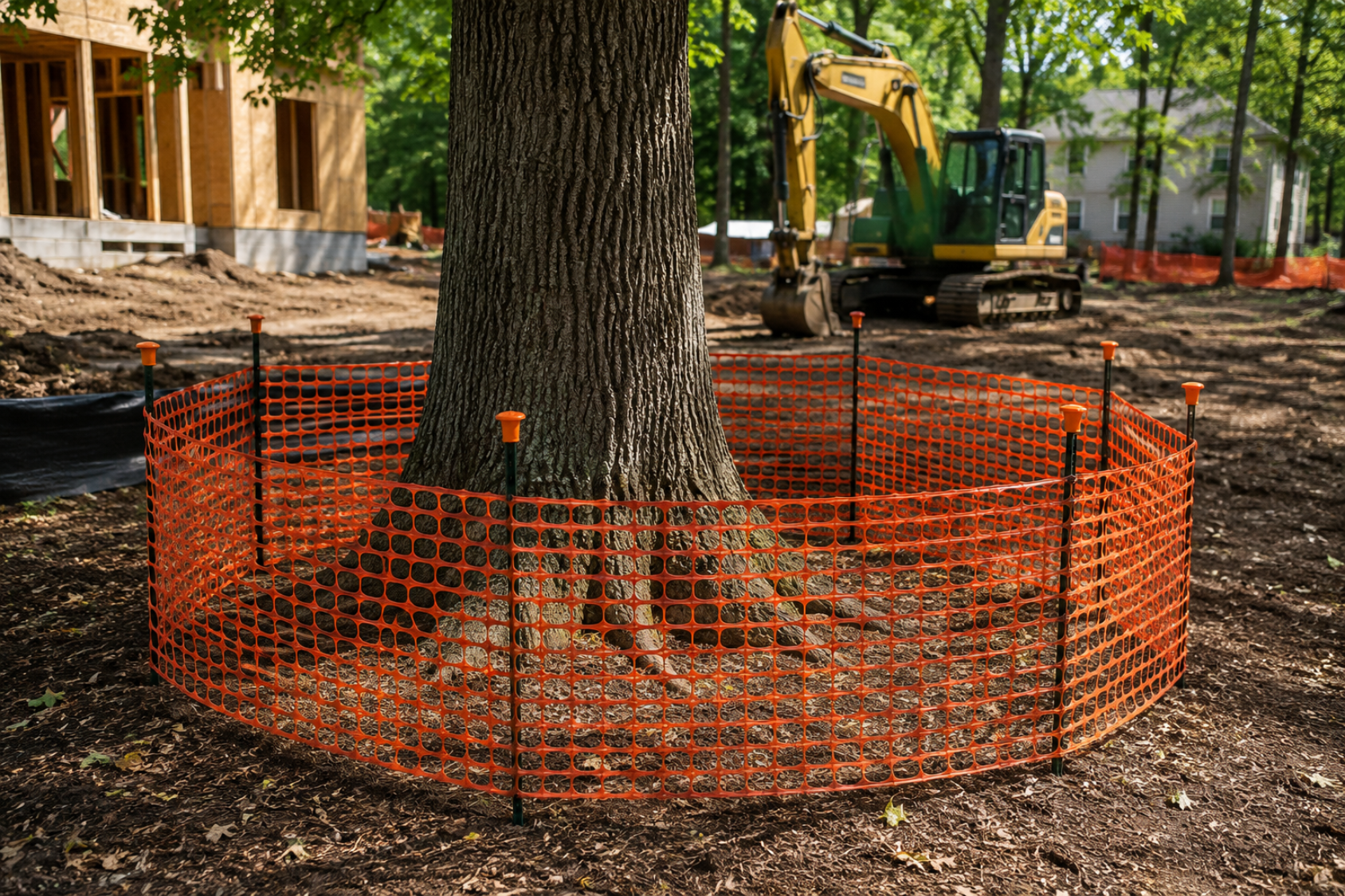
The Four Biggest Construction Threats to Trees
Understanding what actually damages trees during construction helps you catch problems before they become permanent:
- Soil compaction — heavy equipment crushes the air pockets in soil that roots depend on for oxygen. Compacted soil drains poorly, holds less water, and creates an environment roots cannot penetrate. The damage is invisible and essentially permanent without costly aeration and amendment work.
- Grade changes — adding soil over roots (fill) smothers them by cutting off oxygen. Removing soil (cut) exposes roots that evolved to live at a specific depth. Even 4–6 inches of grade change within the root zone can be enough to cause significant long-term damage to a mature tree.
- Root cutting — trenching for utilities, driveways, foundations, or drainage systems severs feeder roots and structural roots. Trees can tolerate losing some root mass, but cutting more than 20–25% of the root system on one side creates structural instability and long-term vascular stress.
- Trunk and bark damage — equipment strikes that wound the bark create entry points for disease, fungi, and insects. Even minor bark wounds that heal visually can allow pathogens to establish in the cambium layer beneath.
For a pre-construction arborist consultation or tree protection plan, contact us for a free estimate. AA Tree Service works with homeowners and contractors across Massachusetts and New Hampshire.
How to Protect Trees During Construction — MA & NH Homeowner Guide
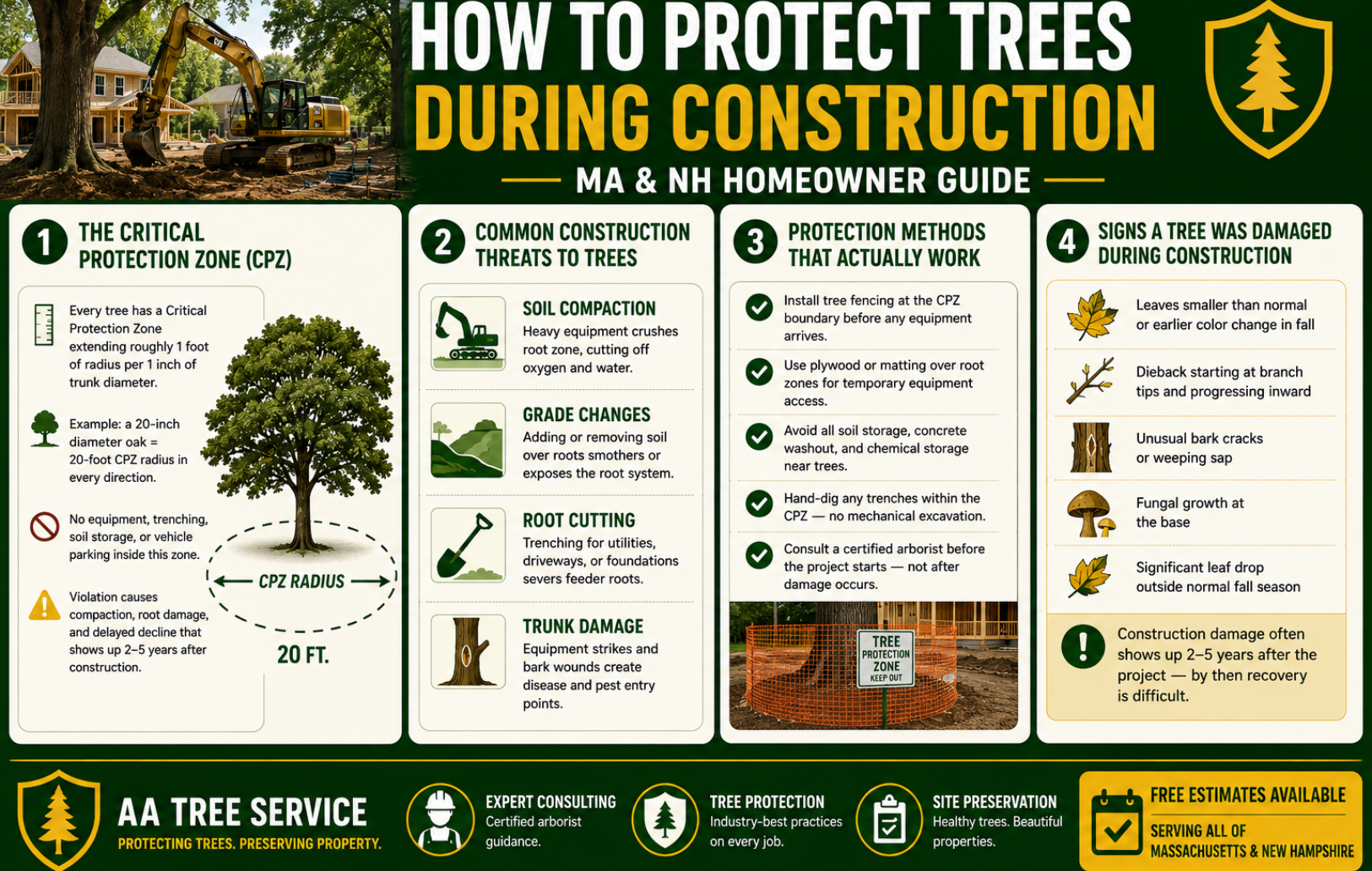
Signs a Tree Was Damaged During Construction
Construction damage rarely looks dramatic right away. These are the warning signs that often appear one to five years after the project ends:
Canopy Dieback & Early Color Change
Leaves smaller than normal, earlier fall color change, dieback starting at branch tips and progressing inward toward the trunk. These are classic signs of a stressed root system that can no longer deliver adequate water and nutrients to the canopy.
Fungal Growth & Bark Changes
Fungal brackets or shelf fungi appearing at the base of the trunk, unusual bark cracks, weeping sap from wound sites, or significant bark peeling. These indicate internal decay that typically follows root damage or trunk wounds from equipment contact.
Structural Instability
Leaning that wasn't present before construction, exposed surface roots on the side away from a lean, or soil heaving near the base during wind events. Root cutting during trenching can compromise a tree's structural anchoring without affecting canopy appearance for several growing seasons.
How AA Tree Service Approaches Tree Preservation
Our tree preservation consulting starts with an on-site walk-through before the project begins. We identify every tree worth protecting, calculate the Critical Protection Zone for each, mark boundaries, and provide documentation the contractor can use to coordinate equipment staging and access routes.
Where protection fencing is needed, we install it. Where root zone treatments are required before or after construction, we perform them. And where a post-construction health assessment reveals damage, we advise on the realistic recovery options — including whether the tree can be saved or whether removal and replacement is the better long-term decision for the property.
- Pre-construction arborist walk-through and CPZ mapping
- Tree protection fencing installation and monitoring
- Contractor coordination and protection plan documentation
- Post-construction health assessment and recovery recommendations
- Soil aeration and root zone treatment for compaction recovery
For related services, see our tree preservation during construction guide, certified arborist consultations, tree hazard assessments, and how to protect trees during construction.
Tree Preservation During Construction — Frequently Asked Questions
What is tree preservation during construction and why does it matter?
What is the Critical Protection Zone and how is it calculated?
How does soil compaction during construction damage trees?
Do I need a permit to protect or remove trees during construction in Massachusetts?
Can a tree recover after construction damage?
How far in advance should I consult an arborist before a construction project?
Protect Your Trees Before Construction Begins
Free on-site consultations across Massachusetts and New Hampshire. We walk the property, identify every tree worth protecting, and give you a clear plan before any equipment arrives.

Why Choose AA Tree Service?
Over 20 years working with Massachusetts and New Hampshire homeowners and contractors to protect mature trees during construction. We provide pre-construction planning, physical protection, and post-construction recovery — all under one licensed, insured team.
The best time to call us is before the project starts. The second best time is now.
REQUEST A FREE CONSULTATIONLicensed & Insured
Full coverage on every consultation and job.
Pre-Construction Planning
CPZ mapping and contractor coordination before work begins.
20+ Years' Experience
Two decades protecting trees across MA & NH.
Locally Owned
A proud MA & NH business, not a franchise.
Satisfaction Guarantee
We stand behind every recommendation we make.
Free On-Site Consultations
We assess the property before we quote.