Enhancing Your Property: The Complete Guide to Tree and Landscaping Services
If you’re looking for tree and landscaping services in Massachusetts or New Hampshire, here’s what you need to know:
- Tree Care Services: removal, pruning, trimming, stump grinding, hazard assessment
- Landscaping Services: design, installation, maintenance, soil preparation, mulching
- Professional Qualifications: certified arborists, insurance, proper equipment
- When to Call Professionals: dead trees, storm damage, overgrown landscapes, new property development
- Benefits: safety, property value increase (up to 20%), aesthetic improvement, environmental health
Trees are one of nature’s greatest gifts, but they require proper care to thrive safely on your property. Professional tree and landscaping services combine science and artistry to maintain, improve, and sometimes remove these natural assets when necessary. Homeowners in Massachusetts and New Hampshire face unique challenges with our region’s weather patterns, soil conditions, and native species that require specialized knowledge.
“We approach your lawn and landscape care holistically and with the same care and expertise you have come to expect from all of our local professionals,” notes one industry expert, highlighting why DIY approaches often fall short of professional results.
When properly maintained, trees can increase your property value by up to 20%, while neglected trees pose significant safety risks to people and structures. A certified arborist can quickly identify issues that might escape an untrained eye—from internal decay to pest infestations that threaten not just one tree but potentially your entire landscape.
Today’s tree care goes far beyond simply cutting down troublesome trees. Modern arborists use techniques like crown thinning, vista pruning, and integrated pest management to preserve trees whenever possible, only recommending removal as a last resort.
Whether you’re dealing with storm damage, planning a landscape renovation, or simply maintaining your property’s health and beauty, understanding the full spectrum of available services helps you make informed decisions about your outdoor spaces.
Find more about tree and landscaping services:
– stump removal service
– tree maintenance services
– tree trimming company
Understanding Tree and Landscaping Services in MA & NH
When it comes to caring for your outdoor spaces in Massachusetts and New Hampshire, tree and landscaping services cover a remarkable range of specialized care options. Our unique New England climate—with its snowy winters, humid summers, and everything in between—creates specific challenges and opportunities for your trees and landscape.
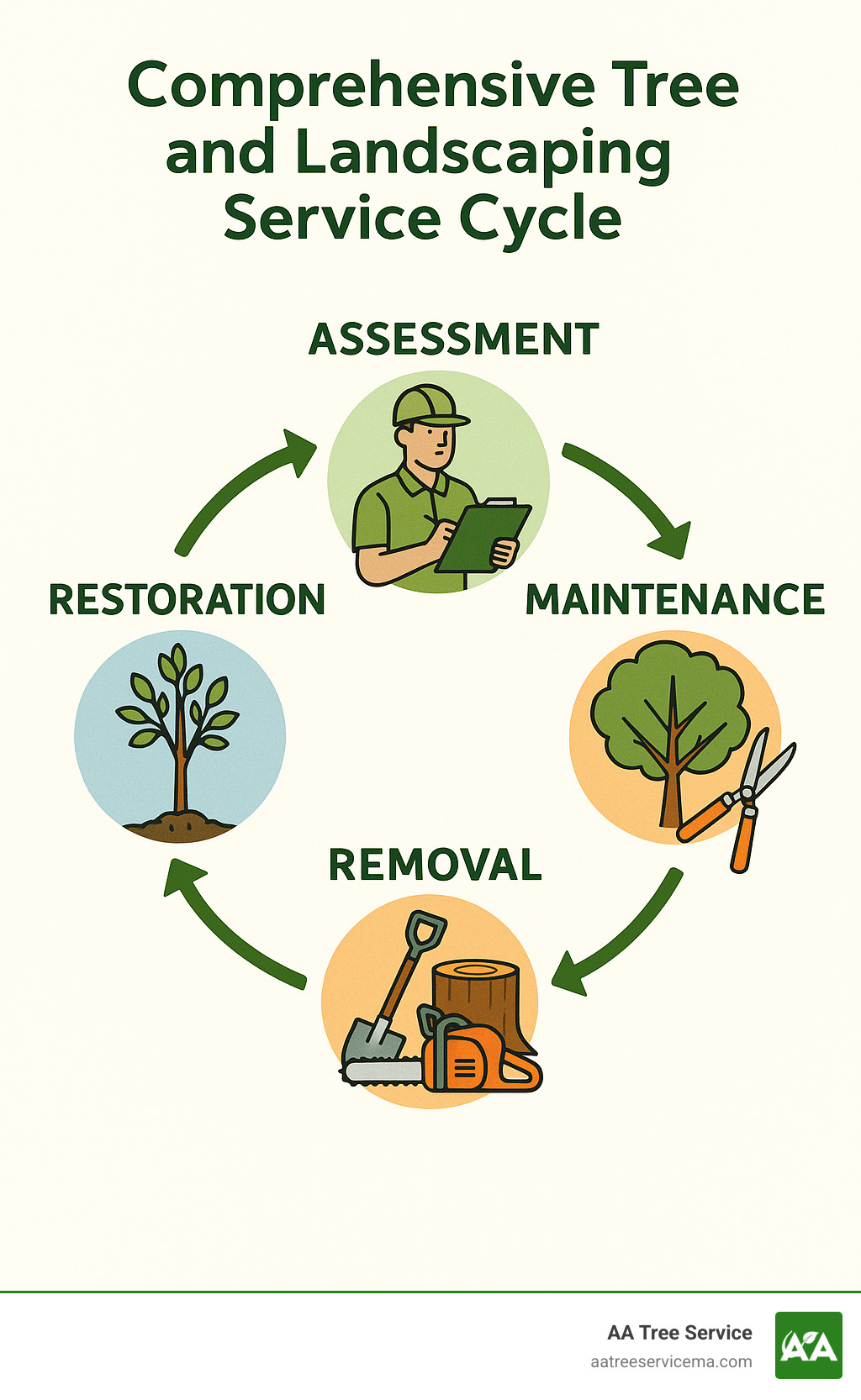
The heart of what we do includes tree removal for those hazardous or unwanted trees, expert pruning to improve both beauty and health, land clearing when you’re ready for a fresh start, and stump grinding to reclaim your yard space after a tree is gone. But that’s just the beginning. We also spring into action with emergency storm response when Mother Nature flexes her muscles, provide comprehensive lawn care to keep your green spaces lush, and create beautiful hardscaping elements that complement your natural landscape.
Most of our clients at AA Tree Service reach out with clear goals in mind. Some are concerned primarily with safety—and rightfully so. As one of our certified arborists often explains, “Dead or hazardous trees dramatically increase the risk of property damage and personal injury. Addressing these issues isn’t just about aesthetics—it’s about protecting what matters most.” Others focus on curb appeal, knowing that a well-maintained landscape can transform a property’s appearance. Many clients are increasingly interested in the ecological benefits, supporting wildlife and improving their local environment.
| Pruning vs. Full Removal: Decision Factors |
|---|
| Consider Pruning When: |
| – Branch damage is limited |
| – Tree is structurally sound |
| – Disease is localized |
| – Clearance issues are minor |
| – Tree provides valuable benefits |
Understanding when to save a tree through pruning versus when removal is necessary isn’t always obvious to the untrained eye. This decision point is where professional expertise truly shines—potentially saving you thousands of dollars while preserving valuable landscape assets whenever possible.
Residential vs. Commercial Tree and Landscaping Services
While we use many of the same techniques across all properties, tree and landscaping services for homes and businesses have distinct differences in both approach and execution.
For residential properties, we focus on individual tree care that improves your personal outdoor space. We bring equipment sized appropriately for tighter residential areas, offer weekend and evening appointments that work around your schedule, and provide personalized consultations directly with you as the homeowner. Many of our residential clients prioritize privacy screening and creating shaded outdoor living spaces.
Commercial properties, on the other hand, typically require larger-scale maintenance programs with special attention to safety and liability concerns. We understand the importance of minimizing disruption to your business operations and ensuring compliance with commercial property regulations. The curb appeal we create directly impacts your business success—attractive landscapes draw customers and create positive first impressions.
Office parks, HOAs, and utility corridors present unique challenges that benefit from our customized approach. As our landscape specialist often points out, “Overgrown trees can block up to 90% of sunlight from reaching lawns, devastating grass health below.” This matters tremendously for commercial properties where appearances directly impact the bottom line.
Seasonal Service Calendar for Tree and Landscaping Services
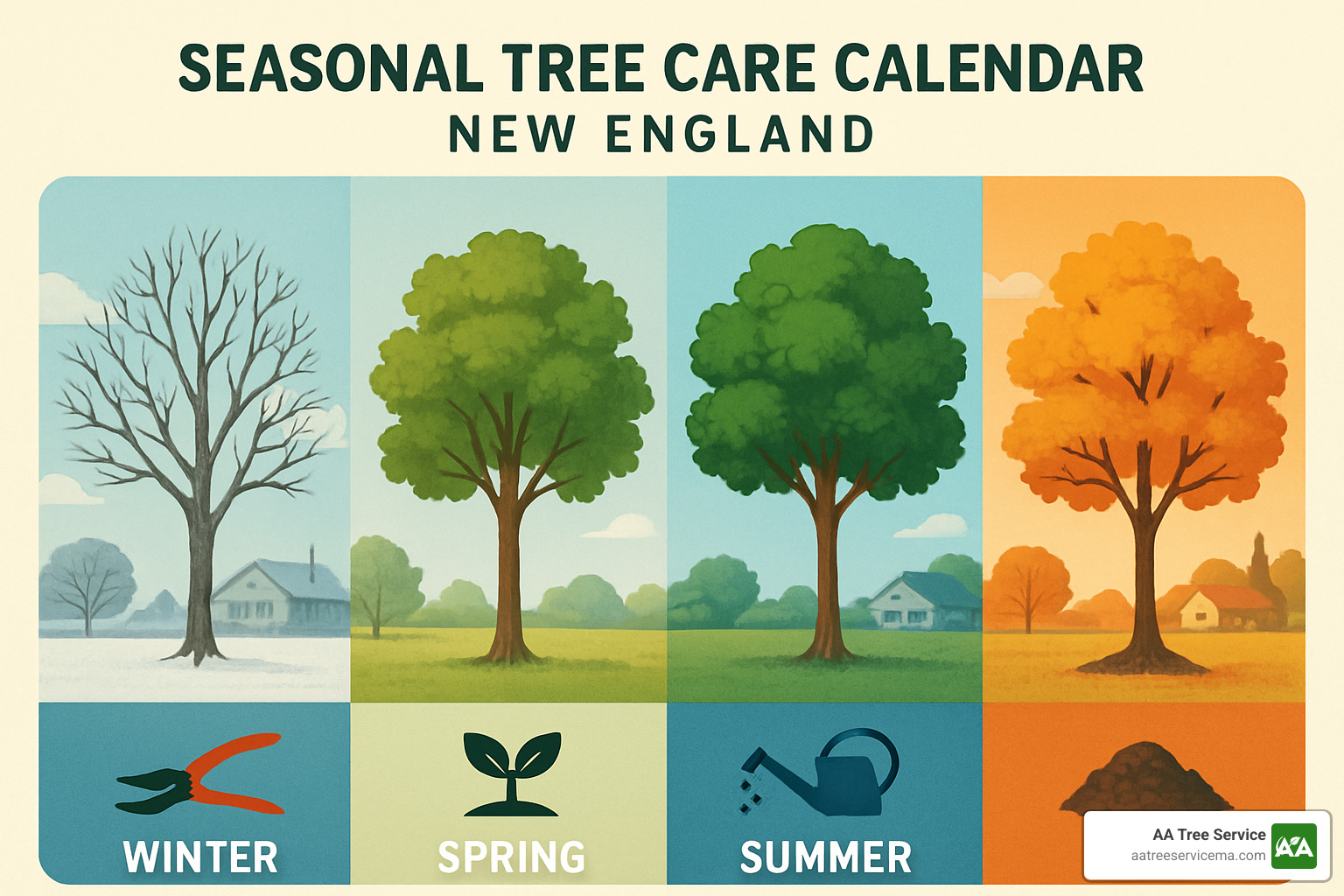
Here in New England, timing is everything when it comes to tree and landscaping services. Our region’s distinct seasons create a natural rhythm for optimal tree care:
During winter months (December-February), we focus on dormant-season pruning when trees are at rest. This is also an ideal time for removing hazardous trees since frozen ground minimizes landscape damage. The absence of leaves gives us perfect visibility for structural assessments, and it’s the best time to plan your spring projects.
Spring (March-May) brings opportunities for fertilization and soil amendments as trees awaken. We implement early disease and pest prevention strategies, plant new trees, and assess any damage left behind by winter storms.
Summer (June-August) is when we perform selective pruning to address clearance issues, monitor and treat for pests, provide critical watering during drought periods, and respond quickly to summer storm emergencies.
Fall (September-November) offers the ideal window for planting new trees, conducting pre-winter hazard assessments, completing fall cleanup with proper mulching, and providing root zone fertilization before the ground freezes.
“Pruning in winter promotes better flowering and budding in spring,” our senior arborist often tells clients. This biological insight guides our recommendations throughout the year, ensuring your landscape receives the right care at exactly the right time.
Keep Them Thriving: Maintenance, Pruning, and Disease Management
When it comes to your trees, prevention truly is better than cure. At AA Tree Service, we’ve seen how regular maintenance saves our Massachusetts and New Hampshire customers thousands in potential damage and removal costs.
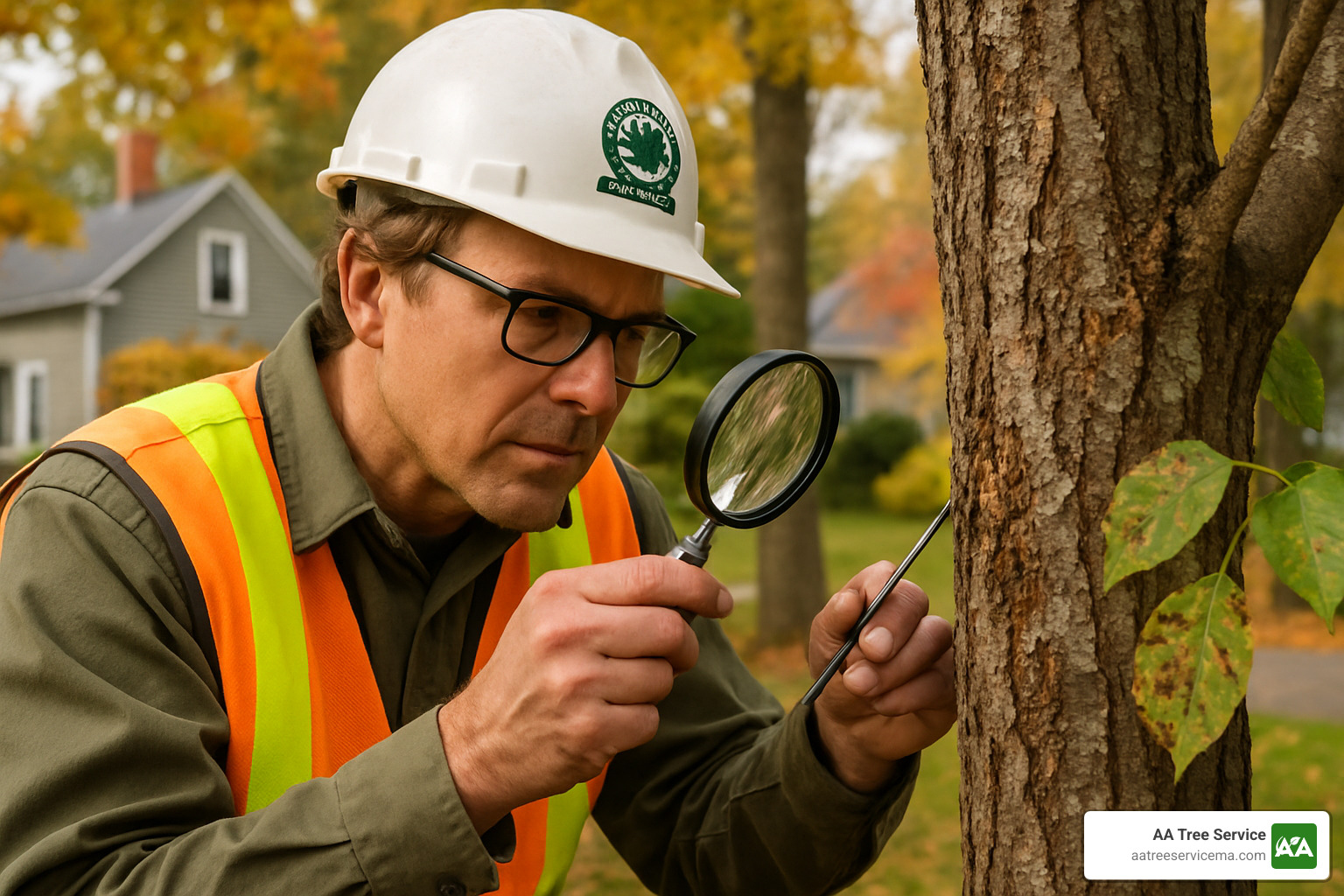
Think of routine inspections as wellness checks for your trees. Our certified arborists examine everything from root health to branch structure, catching small issues before they become major headaches.
“I’ve seen countless cases where a simple pruning could have prevented a $3,000 removal,” shares one of our senior arborists. “Regular maintenance isn’t just cost-effective—it preserves these incredible living assets for generations.”
Professional pruning techniques like crown thinning selectively remove small branches to improve light penetration and reduce wind resistance—critical during New England’s notorious nor’easters. Crown raising removes lower branches to improve clearance for mowing, walking, or driving, while structural pruning guides young trees to develop strong branch architecture that will serve them well for decades.
For trees facing structural challenges, we offer cable and bracing systems that provide support while allowing natural movement. These mechanical supports can extend a beloved tree’s life by decades when properly installed and maintained.
Beneath the surface, soil health forms the foundation of tree vitality. Compacted soil from construction, foot traffic, or even age can suffocate roots and limit nutrient uptake. Our soil amendment services restore proper structure and biological activity that feed your trees naturally.
During our region’s increasingly hot summers, drought mitigation strategies become essential. Proper mulching (2-4 inches deep, kept away from the trunk) conserves moisture while strategic irrigation encourages deep root growth rather than vulnerable surface roots.
More info about pruning services
According to the Scientific research on urban tree benefits, well-maintained trees provide remarkable returns: they can reduce summer cooling costs by up to 30%, capture thousands of gallons of stormwater annually, and even increase property values by 15-20%. They’re not just beautiful—they’re working 24/7 for your property.
Common Pruning Techniques & Their Purposes
At AA Tree Service, we believe every cut should serve a purpose. Our arborists match pruning techniques to your specific trees and goals:
Vista pruning carefully opens selective “windows” through foliage to reveal beautiful views of lakes, mountains, or gardens without compromising tree health. Perfect for New Hampshire lakefront properties or Massachusetts homes with scenic landscapes.
Dead-wooding removes what we call the “three Ds”—dead, diseased, and dying branches—improving both safety and appearance while closing potential entry points for destructive pests and diseases. Think of it as removing vulnerabilities before they can spread.
Clearance pruning creates safe space between trees and structures, power lines, driveways, or walkways. This preventive approach eliminates potential hazards and friction points before damage occurs.
When storms threaten (and in New England, they always do), proper pruning becomes your first line of defense. Our storm-damage prevention techniques identify and remove potential failure points before high winds exploit them. We’ve seen properly pruned trees stand strong through conditions that toppled their untended neighbors.
For fruit tree owners, specialized pruning dramatically improves both yield and quality. “A well-pruned apple tree can produce three times the usable fruit of a neglected one,” notes our orchard specialist. “And the fruit quality is night-and-day different.”
Preventing & Managing Tree Diseases and Pests
New England’s trees face an increasing array of threats, from native pests to invasive newcomers. Early identification and smart management make all the difference.
The emerald ash borer has devastated ash populations across Massachusetts and New Hampshire. This metallic green beetle can kill even healthy ash trees in 2-4 years once infested. Early treatment of valuable ash trees is essential—once symptoms are visible, it’s often too late.
Oak wilt poses a serious threat to our region’s iconic oak trees, particularly red oaks which can die within weeks of infection. This fungal disease spreads both underground through root grafts and above ground via beetles, making community-wide management crucial.
From carpenter ants to scale insects, pests often indicate underlying issues with tree health. Our integrated pest management approach addresses root causes rather than just symptoms, creating sustainable solutions that protect both your trees and the broader ecosystem.
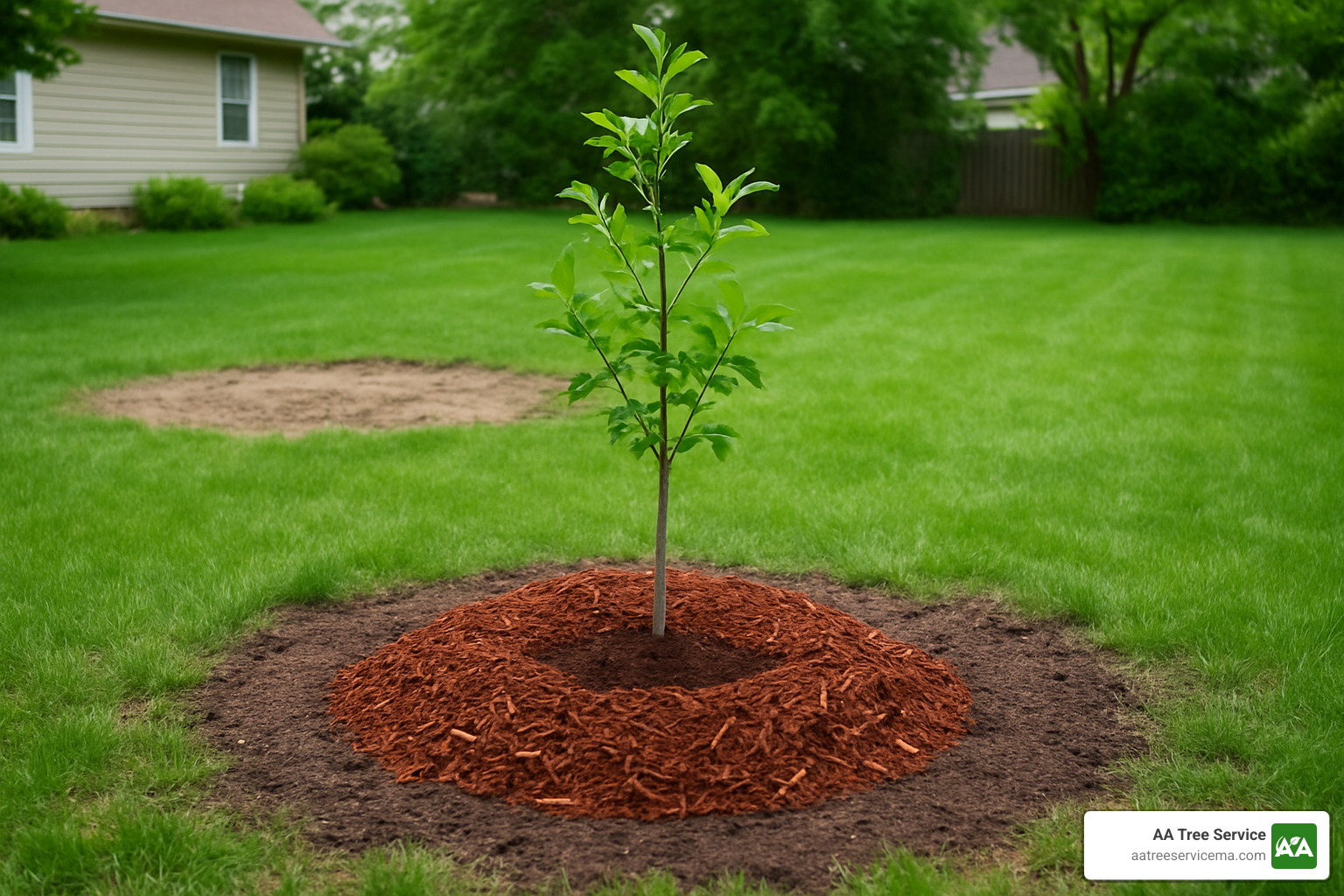
Proper mulching practices create an environment where trees thrive and many pests struggle. We recommend a 2-4 inch layer kept several inches away from the trunk—”no mulch volcanoes!” as our crews like to say. This simple practice improves soil biology, conserves moisture, and creates habitat for beneficial organisms that keep many pests in check.
Healthy trees naturally resist most pests and diseases. Our holistic approach to tree and landscaping services focuses on building vitality from the roots up, creating resilient landscapes that thrive through New England’s challenging conditions.
Safety Starts with the Pros: Choosing Certified & Insured Services
When it comes to caring for the trees on your property, safety isn’t just a priority—it’s the foundation of everything we do. Tree work ranks among the most hazardous professions out there, which is exactly why hiring certified, insured professionals makes all the difference.
At AA Tree Service, we’ve built our reputation on putting safety first—protecting both our team members and your property. Every job we tackle comes with the peace of mind that only proper credentials can provide.
“The tree care industry is considered one of the most hazardous professions,” our safety director often reminds our crews. “Professional equipment and training dramatically reduce the risks associated with tree work.”
What sets professional arborists apart? It starts with serious credentials:
ISA certification from the International Society of Arboriculture means our arborists have demonstrated professional knowledge through rigorous testing. Our TCIA membership (Tree Care Industry Association) keeps us connected to the latest safety protocols and best practices. And perhaps most importantly for you, our comprehensive liability insurance and workers’ compensation coverage protect everyone involved if the unexpected happens.
Behind every successful tree project is specialized equipment that makes dangerous work safer. Our teams arrive with aerial lifts for accessing tall trees without unsafe climbing, advanced rigging gear that allows for controlled limb removal, and crane assistance for safely managing hazardous trees near your home or structures. Every crew member wears appropriate personal protective equipment (PPE) without exception.
Before the first cut is made, we conduct a thorough on-site risk assessment. This critical step identifies potential hazards specific to your property and establishes the safety protocols needed for your unique situation.
More info about Professional Tree Service Massachusetts
Key Questions to Ask Before Hiring for Tree and Landscaping Services
Before you hand over your hard-earned money to any tree and landscaping services provider, protect yourself by asking these essential questions:
“Nothing is more frustrating than paying for a service and not being satisfied when the work is done,” our customer service manager often tells clients. That’s why we encourage you to dig deeper with potential tree services.
Start by verifying credentials—ask “Are you certified and by whom?” Look specifically for ISA Certified Arborists who have proven their knowledge. Then request proof of insurance with actual certificates for both liability and workers’ compensation. Don’t just take their word for it!
Understanding the technical approach matters too. Ask “What equipment will you use for my job?” The answer reveals their capabilities and whether they’re properly equipped. Always get a detailed written estimate that spells out the scope, timeline, and costs—verbal agreements leave too much room for misunderstanding.
Don’t forget about the aftermath. A professional service includes a thorough cleanup plan for handling debris. Ask about emergency availability—especially important in New England where storms can create urgent situations. Finally, request references from similar jobs in your area—experienced professionals will have plenty to share.
The lowest bid often comes with hidden costs—inadequate insurance, untrained workers, or substandard equipment. Quality tree care is an investment in both safety and property value.
Why Regular Tree Maintenance Is a Sound Investment
Thinking of professional tree care as an expense? Think again. Regular maintenance delivers measurable returns that benefit both your wallet and your community.
From a financial perspective, well-maintained trees can increase your property value by up to 20%. That’s a significant return on investment! Strategic tree placement and proper pruning can reduce your cooling costs by 15-35% during hot summer months. Regular inspections and maintenance also provide liability reduction by eliminating hazards before they cause costly damage or lead to insurance claims.
Perhaps most impressive is how professional care can double or triple the lifespan of your valuable landscape trees. A mature oak that might live 60 years with neglect could thrive for 150+ years with proper care.
The benefits extend beyond your property line too. Healthy mature trees are powerful tools for carbon sequestration, actively pulling carbon dioxide from the atmosphere. They significantly improve air quality by filtering particulates and producing oxygen. Properly maintained trees support local wildlife by preserving natural habitats. They even help with stormwater management by reducing runoff and preventing erosion during heavy New England rain events.
“We aren’t happy unless you are happy!” This simple philosophy guides our approach to customer satisfaction. By investing in proper tree maintenance now, you’re securing both immediate benefits and long-term value that serves you, your property, and your community.

From Removal to Renewal: Process, Stump Grinding, and Landscape Restoration
When a tree needs to come down, it’s not just about cutting and clearing – it’s about changing your landscape. At AA Tree Service, we’ve developed a thoughtful, comprehensive approach that takes you from problem to possibility with care and expertise.
Our removal process begins with a thorough hazard evaluation. We carefully assess not just the tree itself, but everything around it – your home, power lines, favorite garden features – to develop a removal plan that protects what matters most. We’ll also check if permits are required in your Massachusetts or New Hampshire community, saving you the headache of unexpected compliance issues.
“The difference between amateur tree removal and professional service isn’t just about cutting – it’s about control,” explains our removal specialist. “When we dismantle a tree, each piece comes down exactly where we intend it to.”
This controlled dismantling uses advanced rigging techniques that allow us to work safely around obstacles. We’re also committed to environmental responsibility, which is why we recycle removed wood into useful products like mulch, firewood, or even lumber when possible.
But removal is just the beginning. That stump left behind? It’s not just an eyesore.
“Tree stumps left in the ground can attract pests such as carpenter ants and termites, increasing the risk of infestation in nearby structures,” our specialist warns. This is why stump grinding is strongly recommended after any tree removal.
Our powerful stump grinders can remove stumps 8-12 inches below grade, eliminating both the visible portion and the major root crown. This thorough approach prevents regrowth and creates a clean slate for whatever comes next in your landscape vision.
More info about Stump Grinding
Step-by-Step Tree Removal Workflow
Every successful tree removal begins with a pre-cut briefing. Our crew reviews the plan together, identifies potential hazards, and assigns specific roles to ensure everyone works in perfect coordination. Safety isn’t just a priority – it’s our foundation.
Site preparation follows, where we establish clear drop zones, protect your landscape features, and set up safety perimeters. For straightforward removals away from structures, we use precise notch and back cuts to control the direction of fall with predictable accuracy.
When trees are near homes, power lines, or in tight spaces, we switch to section rigging – the art of removing a tree piece by piece with controlled lowering of each section. It’s like disassembling a giant puzzle from the top down, with each piece carefully managed.
“We treat your property like our own,” our operations manager often reminds the team. That principle extends to our cleanup process too. After processing debris through our chipper and cutting logs to manageable sizes, we perform a final sweep that often leaves your property looking better than when we arrived.
For particularly challenging removals, we don’t hesitate to bring in specialized equipment like cranes, which can lift sections directly from their standing position without risking surrounding structures. It might seem like overkill until you see how effortlessly and safely it removes what otherwise might be a dangerous situation.
Post-Removal Landscape Revival
The space left after tree removal isn’t an ending – it’s a beginning. This blank canvas offers exciting possibilities for landscape improvement, and we’re here to help you make the most of it.
Soil quality is our first concern. After stump grinding, the resulting area often needs amendment to support healthy new growth. We can incorporate rich compost, balanced fertilizers, and pH adjustments based on soil testing to create the perfect foundation for what comes next.
If you’re planning to plant a replacement tree, choosing the right species is critical. We consider factors like mature size and growth rate to ensure your new tree won’t outgrow its space. Site conditions including sun exposure, soil characteristics, and moisture levels help us recommend trees that will thrive in your specific location. Pest and disease resistance is equally important, especially for long-term landscape investments.
We’re particularly fond of recommending native Massachusetts and New Hampshire species. These hometown heroes require less maintenance and water, naturally support local wildlife and pollinators, and have evolved to resist regional pests and diseases. They’re simply built for success in our New England climate.
For areas returning to lawn, proper grading ensures good drainage, while quality topsoil provides the foundation for lush growth. We’ll help select the right seed mix for your specific light conditions and provide initial watering recommendations to get your new lawn off to a strong start.
“Site analysis evaluating soil, moisture, sunlight, and space before planting is like getting a personalized roadmap to success,” notes our landscape specialist. “Skip this step, and you’re essentially driving blindfolded.”
With our thorough approach to landscape revival, your property won’t just recover after tree removal – it will flourish with new purpose and beauty.
Sustainable Landscaping, Costs, and FAQs
When we talk about tree and landscaping services, sustainability isn’t just a buzzword—it’s a commitment to your property’s long-term health and our shared environment. At AA Tree Service, we see each project as an opportunity to make positive ecological contributions while enhancing your property’s beauty and value.
Those majestic trees in your yard? They’re quietly working as carbon capture machines, pulling CO2 from the atmosphere and storing it away. That’s why whenever we need to remove a tree, we often suggest thoughtful replacements that maintain this natural climate benefit while better suiting your landscape needs.
“A beautiful, healthy landscape is one of your most valuable assets,” our design specialist often reminds clients. “When we design with nature, everyone wins—including your property value.”
Beyond carbon benefits, sustainable landscaping creates havens for pollinators like bees and butterflies that are essential for our food systems. Strategic plant choices and maintenance practices support these tiny but mighty ecosystem workers. Meanwhile, thoughtfully designed landscapes naturally manage stormwater, reducing erosion and protecting water quality in local Massachusetts and New Hampshire waterways.
We’re particularly proud of our wood recycling practices. That tree we removed from your yard? It might return as beneficial mulch for your garden beds, completing nature’s cycle and reducing waste. This approach represents landscape stewardship at its finest.
Looking for inspiration on how sustainable practices can transform spaces? View project inspiration to see possibilities for your own property.
Average Costs for Tree and Landscaping Services in New England
When budgeting for tree and landscaping services, it helps to understand typical price ranges. While every property presents unique challenges, these general guidelines can help you plan. These figures represent average costs based on internet data, not AA Tree Service pricing.
For tree removal, size makes all the difference. Small trees under 30 feet typically range from $400–$800, while medium trees (30-60 feet) usually cost between $800–$1,500. Large trees between 60-80 feet can run $1,500–$3,000, and those towering specimens over 80 feet might cost $3,000–$5,000 or more, especially if they’re near structures or power lines.
Stump grinding costs reflect both diameter and accessibility. Small stumps under 12 inches across typically range from $250–$400, medium stumps (12-24 inches) average $400–$600, and large stumps exceeding 24 inches in diameter generally cost $600–$1,000+.
Pruning services follow similar size-based pricing. Small tree pruning typically runs $200–$400, medium trees average $400–$800, and large trees generally cost $800–$1,200 or more for professional care.
Land clearing prices vary dramatically based on density and terrain. Light clearing might cost $1,000–$2,000 per acre, medium density runs $2,000–$3,500 per acre, and heavily wooded areas can reach $3,500–$5,000+ per acre.
For lawn renovation, expect to invest between $0.10–$0.20 per square foot for simple overseeding, while comprehensive renovation might range from $0.40–$0.75 per square foot.
Several factors can influence these baseline prices, including emergency service needs, difficult access requiring specialized equipment, hazardous conditions like power lines, or local permit requirements in certain Massachusetts and New Hampshire communities.
For the most accurate assessment, we always recommend scheduling a free on-site consultation where we can evaluate your specific situation.
FAQs: Tree and Landscaping Services Explained
Over our years serving Massachusetts and New Hampshire, we’ve fielded countless questions about trees and landscapes. Here are answers to some of the most common:
Q: How can I tell if my tree is dead or just dormant?
A: New England winters make this a frequent question! During dormancy, healthy trees maintain flexible twigs and visible buds. Dead trees, by contrast, have brittle branches, peeling bark, and no buds. Try the simple “scratch test” on small branches—green tissue underneath means the tree is alive. Still uncertain? A certified arborist can provide definitive answers.
Q: When is the best time to prune my trees?
A: While light maintenance pruning can happen year-round, major pruning is ideally done during the dormant season (late winter to early spring) before new growth begins. Important regional note: avoid pruning oak trees during their high-risk disease transmission period (April-July in New England). For flowering trees, wait until after they’ve bloomed to preserve those beautiful flowers.
Q: Do I need a permit to remove trees on my property?
A: It depends on your specific location in Massachusetts or New Hampshire. Many communities require permits for removing trees above certain sizes, particularly in conservation areas, wetland buffer zones, or historically designated neighborhoods. We’re happy to help steer these requirements for your specific situation.
How do I know a tree should be removed rather than pruned?
This question touches on the heart of responsible tree care. Several warning signs suggest removal might be the safer option:
A tree leaning more than 15 degrees from vertical, especially with visible soil mounding at the base, indicates serious stability issues. Similarly, exposed, severed, or decaying roots compromise a tree’s anchoring system. Trunk cavities exceeding 30% of the diameter point to significant structural weakness, while vertical cracks or seams often signal internal failure.
When more than half the crown is dead, recovery becomes unlikely. As our assessment specialist notes, “Dead or dying trees can attract pests and spread disease to other plants.” The tree’s location matters too—hazardous trees near homes, play areas, or parking spaces pose greater risks than those in remote areas.
A professional inspection can determine whether targeted pruning might salvage the tree or if removal represents the safest course of action.
Do I need to grind the stump?
While technically optional, stump grinding offers several compelling benefits that make it worth considering.
First, there’s pest prevention. “Rotting stumps are attractive to wood-eating pests and can lead to termite invasion,” explains our stump grinding specialist. These unwelcome visitors rarely stay confined to the stump and may migrate to nearby structures—including your home.
Many tree species, particularly maples and oaks common in Massachusetts, will send up persistent sprouts from remaining stumps. These “zombie trees” create ongoing maintenance headaches and draw nutrients away from your desired plants.
Aesthetically, stumps are eyesores that detract from your landscape’s appearance and potentially your property value. From a practical standpoint, they create tripping hazards, interfere with mowing, prevent landscape redesign, and can damage lawn equipment.
Our grinding typically removes stumps 8-12 inches below grade, creating space for soil backfill and new plantings or lawn establishment—truly turning an obstacle into an opportunity.
What safety gear is mandatory on a professional crew?
Safety in tree care isn’t negotiable. Professional arborists use comprehensive protective equipment that reflects the industry’s inherent risks.
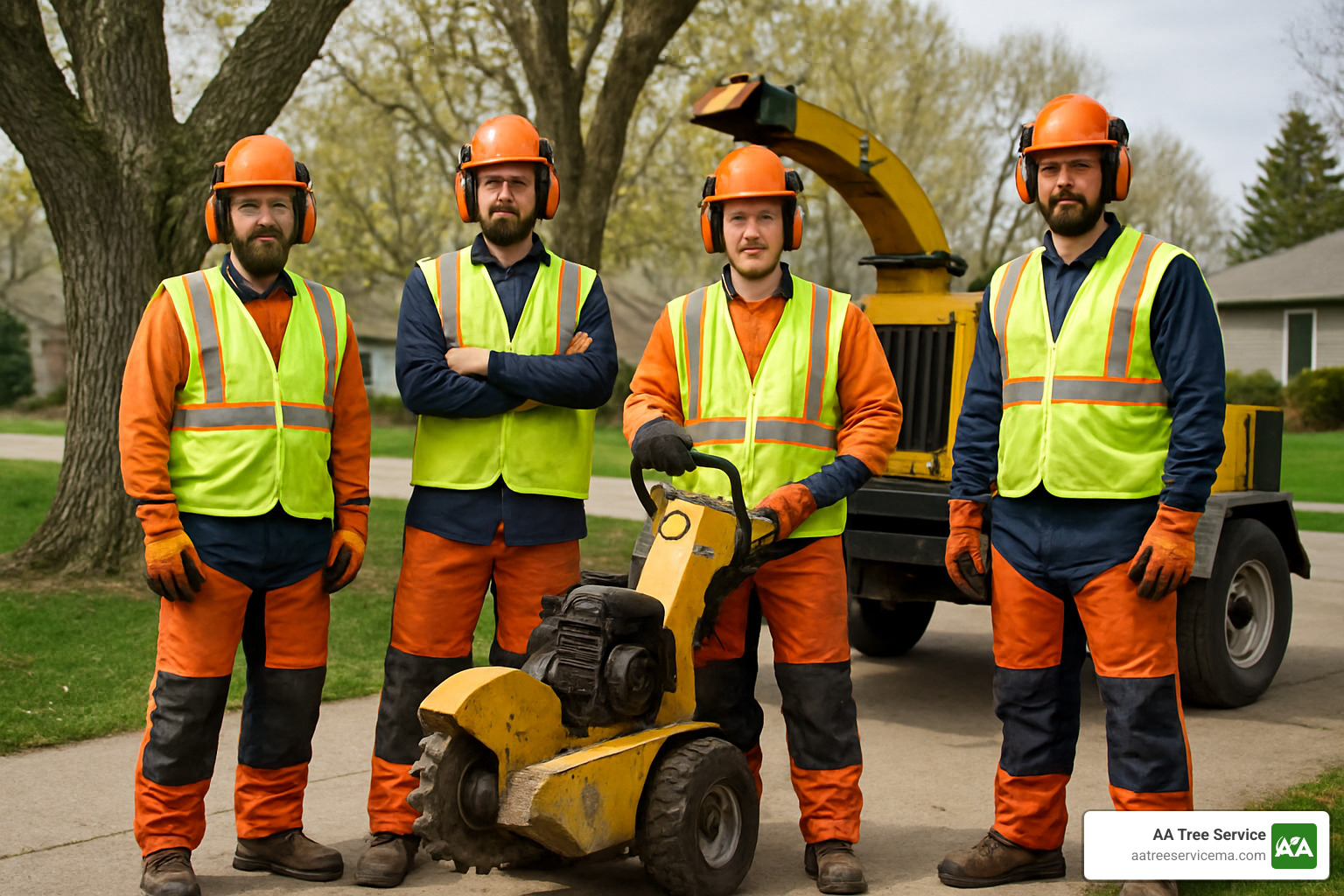
Personal protection starts with helmets or hard hats with face shields, hearing protection to guard against equipment noise, and eye protection to prevent debris injuries. Cut-resistant chainsaw chaps or pants prevent devastating leg injuries, while steel-toed or composite-toe boots protect feet from falling wood and equipment. High-visibility clothing ensures crew members can always see each other, and task-appropriate gloves protect hands during various operations.
For aerial work, ANSI-approved climbing harnesses, properly rated climbing ropes and hardware, and fall arrest systems for lift operations are essential. Ground operations require reliable communication systems between crew members, traffic control devices when working near roadways, and readily accessible first aid kits.
“The tree care industry is considered one of the most hazardous professions,” our safety director reminds us. “This equipment isn’t optional—it’s essential for protecting both workers and property.”
At AA Tree Service, we exceed industry safety standards and regularly update our equipment and training to incorporate the latest safety advancements. When you see our crews in action, their comprehensive safety gear reflects our commitment to doing things right.
Conclusion
There’s something truly special about a property with healthy, thriving trees and thoughtfully designed landscaping. Beyond just looking beautiful, a well-maintained landscape creates a safer environment for your family while significantly boosting your property’s value. When you invest in professional tree and landscaping services, you’re not just improving your immediate surroundings—you’re contributing to a more sustainable future for our New England communities.
From those routine seasonal pruning visits to middle-of-the-night emergency removals after a nor’easter, professional care makes all the difference. The science of arboriculture isn’t something you can learn overnight. It takes years of training and experience to properly diagnose tree issues, safely remove hazardous trees, and create landscape plans that will thrive for decades to come.
By choosing a single-source provider like AA Tree Service, you gain a partner who understands the complete picture of your property’s needs. Our team knows the unique challenges that Massachusetts and New Hampshire properties face—from our distinctive soil conditions to the specific diseases that target our native species. We don’t just address symptoms; we provide comprehensive solutions based on scientific best practices.
“We treat your trees like members of our own family,” is more than just a saying around our office. With over 20 years of experience serving communities throughout MA and NH, we’ve built our reputation on attention to detail and genuine care for our clients’ properties. That’s why we offer 24/7 emergency response when storms strike and free same-day quotes when you’re planning your next landscape project.
Proper tree care is truly an investment that pays you back many times over. Those mature trees that provide cooling shade in summer and windbreaks in winter can increase your property value by up to 20%. The strategic pruning that keeps branches away from your roof prevents thousands in potential damage. Even the peace of mind that comes from knowing your yard is safe for children to play in has immeasurable value.
When you partner with professionals who understand the full lifecycle of trees and landscapes, you’re making a choice that benefits not just your property but your entire neighborhood ecosystem. Healthy trees improve air quality, support local wildlife, and create the kind of community character that makes New England special.
Ready to transform your landscape with expert care? AA Tree Service is here to help with all your tree and landscaping services needs throughout Massachusetts and New Hampshire—just a phone call away, in any season, any weather.