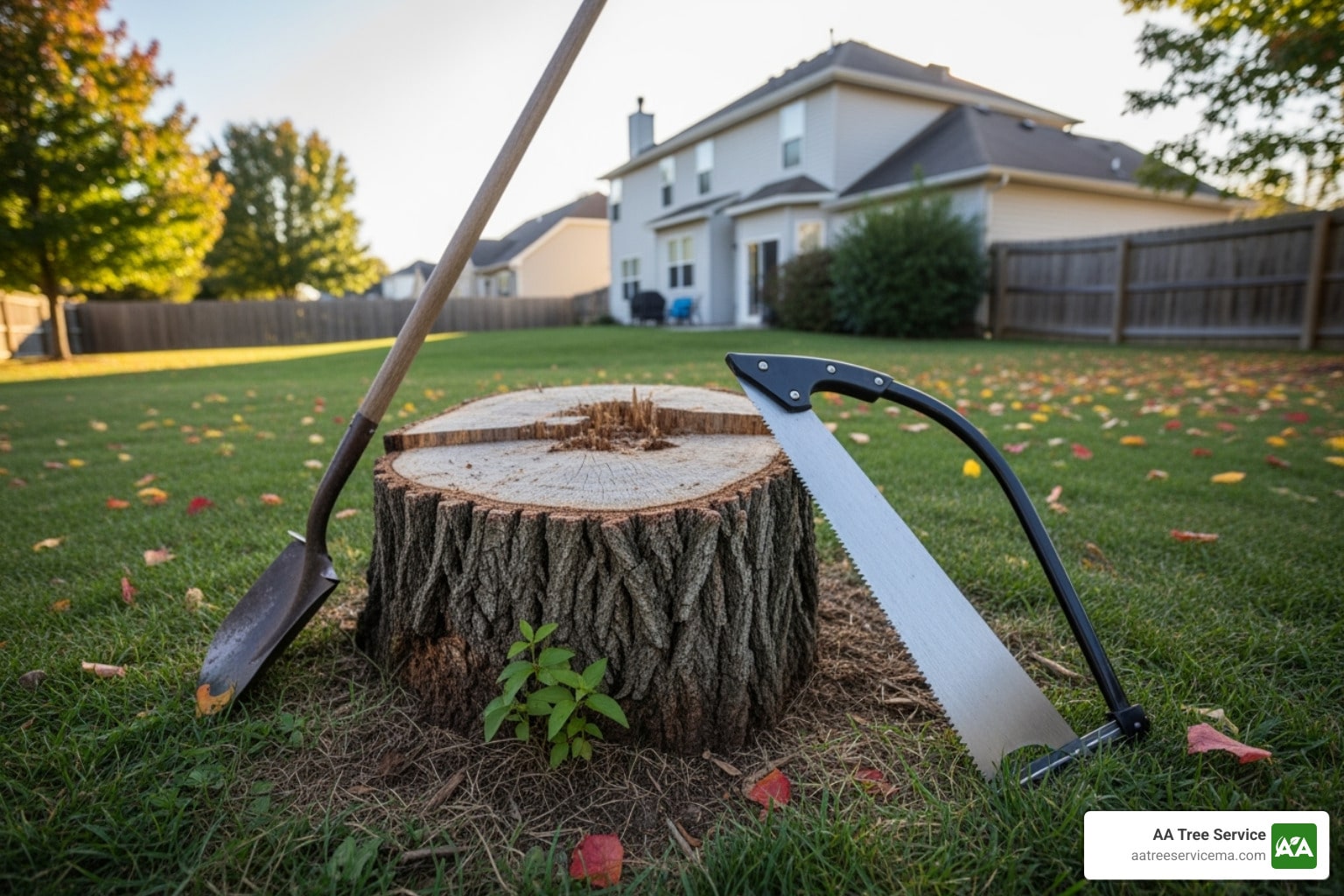
d
Is DIY Tree Removal Right for You?
Small tree removal can be a manageable DIY project for homeowners with the right preparation and safety measures. Here’s what you need to know:
Quick Answer for Small Tree Removal:
- Small tree definition: Under 15 feet tall and 6 inches in diameter
- DIY suitable when: Tree has clear fall space, no power lines nearby, healthy condition
- Essential tools: Chainsaw or axe, safety gear, rope, shovel
- Call professionals if: Tree is near structures, diseased, or you lack experience
- Average DIY cost: $50-$300 (based on internet data, not AA Tree Service pricing)
Whether you’re dealing with an unwanted sapling in your Massachusetts backyard or a small pine too close to your New Hampshire home, removing it yourself can save money. But it’s not always the right choice.
A small tree is generally one less than 15 feet tall with a trunk diameter of 6 inches or less. These are the only trees most homeowners should consider tackling without professional help.
The key question isn’t if you can remove it, but if you should. DIY tree removal has real risks, from chainsaw injuries to property damage. Even small trees can weigh hundreds of pounds and cause serious harm if they fall incorrectly.
Before you start, honestly assess your skill level, the tree’s condition and location, and whether the potential savings justify the risks.
Planning Your Project: Safety, Tools, and Regulations
Even a small tree can become a big problem without proper planning. The difference between a successful DIY project and a trip to the emergency room often comes down to preparation.
The reality check: Trees under 15 feet can still weigh several hundred pounds, enough to cause serious injury or property damage. The biggest risks are underestimating the job or skipping safety steps. Chainsaw kickback, where the saw’s guide bar is thrown back toward the operator, is a major danger that can happen in a fraction of a second. It’s often caused by the tip of the bar hitting an object. Property damage is also common, with small trees falling on cars, windows, fences, or roofs because the fall direction was misjudged. If your tree is anywhere near power lines, stop and call a professional. Electricity can arc from the line to your tools or the tree itself, even without direct contact, creating a deadly electrocution risk.
Before you cut, check local regulations. Massachusetts and New Hampshire have tree removal laws that vary by town. Some municipalities require permits for removing trees over a certain size or diameter, even on your own property. Don’t forget to check with your Homeowner’s Association (HOA) if you have one, as they often have their own strict rules. A quick call to your town’s planning department or a review of your HOA bylaws can save you from a hefty fine and a stop-work order.
Essential Tools and Safety Gear for Small Tree Removal
Think of your safety gear as personal armor. It’s non-negotiable and worth every penny.
Your essential tool lineup:
- Chainsaw: Sized for the job (bar length should be at least the tree’s diameter). Ensure the chain is sharp; a dull chain is more likely to kick back.
- Axe & Pruning Saw: For smaller work, making precise cuts, and severing roots.
- Loppers & Shovel: For clearing small branches and digging around the stump.
- Rope: To help guide the tree’s fall and secure it if necessary.
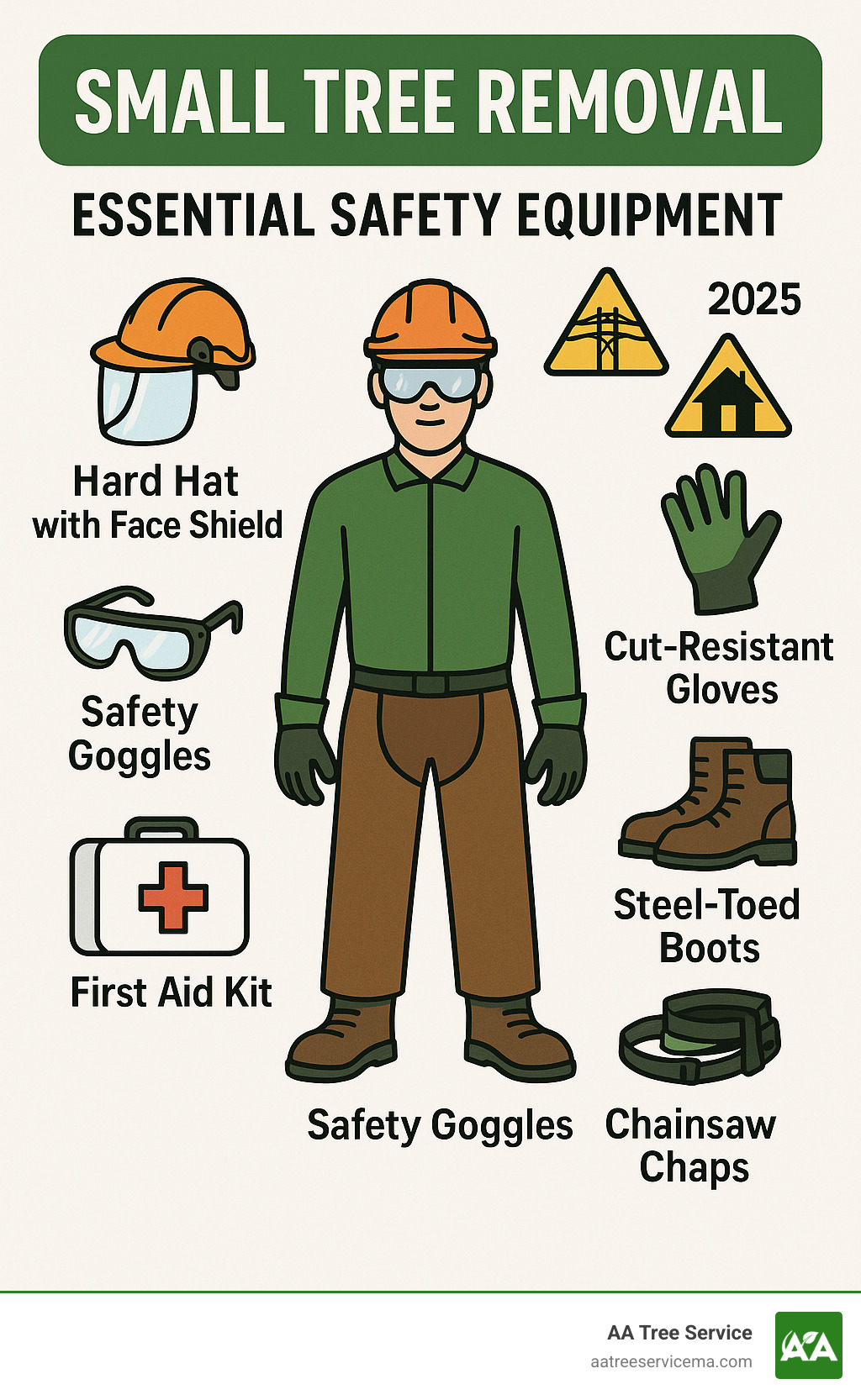
Your essential safety gear:
- Helmet with face shield and safety goggles: Protects your head from falling branches and your eyes and face from flying debris.
- Steel-toed boots and heavy-duty, cut-resistant gloves: Provide a stable footing and protect your hands from cuts and splinters.
- Chainsaw chaps: These contain special fibers designed to instantly clog and stop a chainsaw’s chain on contact, potentially saving your leg from a devastating injury.
- Long sleeves and pants and ear protection: Protects your skin from scratches and your hearing from the loud noise of a chainsaw.
- A first aid kit nearby: Be prepared for minor cuts and scrapes.
Skipping any of this gear is a gamble with your safety.
Assessing the Tree and Clearing the Fall Zone
Now for the detective work. Assess the tree’s natural lean—it’s easier to work with gravity than against it. Check for dead branches (known as “widow makers”), which can fall unexpectedly during the cutting process. Look for signs of disease, rot, or large cracks in the trunk that could make the fall unpredictable.
Next, survey your fall zone. Clear a circle around the tree with a radius equal to its height, plus a few extra feet for safety. This area must be completely free of cars, sheds, play structures, people, and pets.
Finally, plan at least two escape routes leading away from the tree at 45-degree angles from the fall direction. When the tree starts to fall, you need to move fast without thinking. Clear these paths of any trip hazards. It’s also a good courtesy to give your neighbors a heads-up, especially if you’re working near property lines.
For more complex situations, chainsaw safety information can offer guidance, but there’s no shame in calling for professional help.
Your Step-by-Step Guide to Small Tree Removal
With your safety gear on and plan in place, it’s time to tackle the small tree removal. The process involves three phases: felling (bringing it down), de-limbing (removing branches), and bucking (cutting the trunk into pieces). Precision and patience matter more than speed.
Sometimes, a tree just needs maintenance. Our Tree Pruning Services can help you explore alternatives to removal.
Step 1: Making the Directional Notch Cut
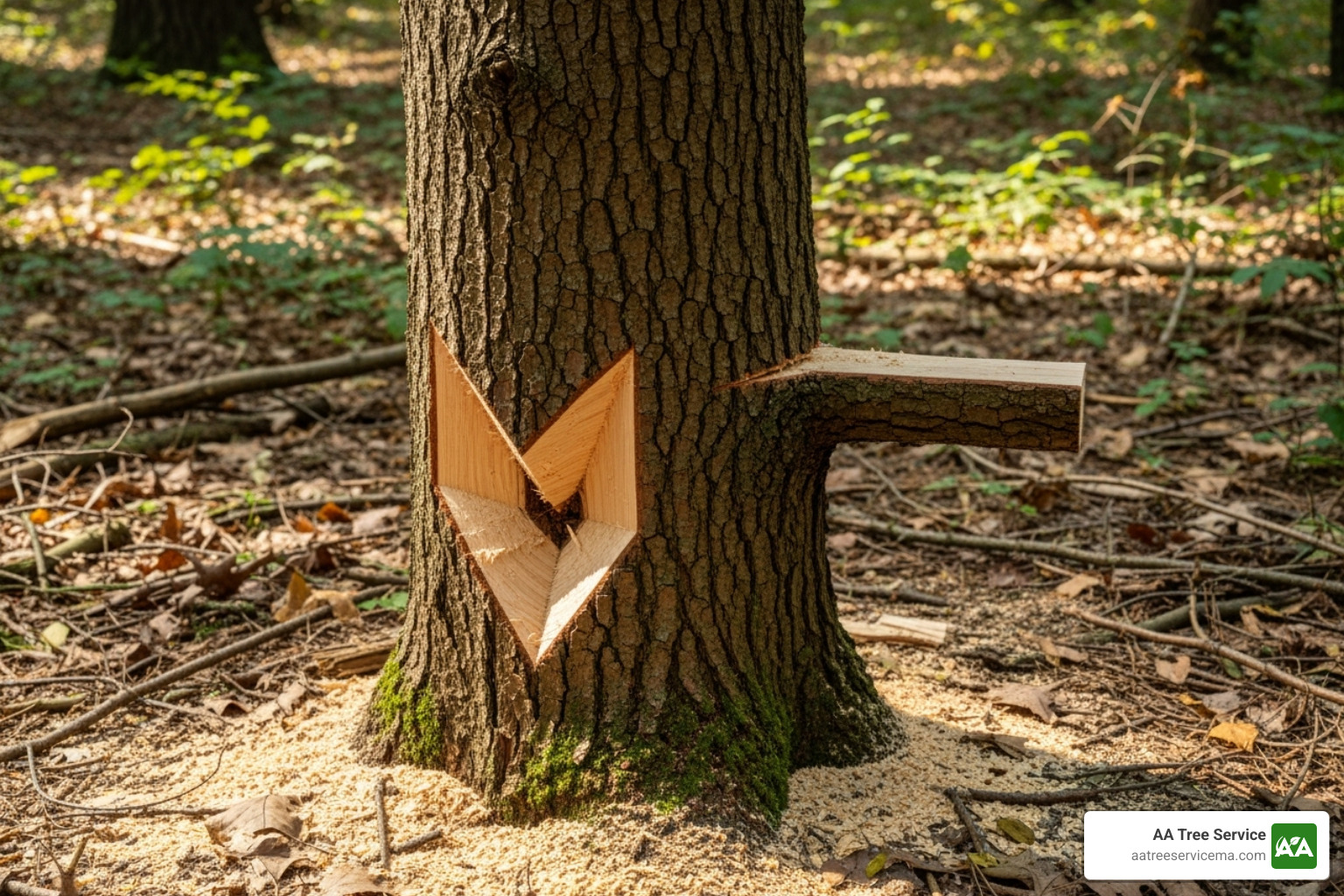
This first cut tells the tree where to fall. It’s the most critical step for controlling the fall. On the side of the tree facing your fall direction, create a V-shaped notch. For DIYers, a conventional notch is standard: make a horizontal top cut about one-quarter of the way through the trunk. Then, make a downward diagonal cut at about a 70-degree angle to meet the end of the first cut. The resulting wedge should pop out easily, leaving a clean notch pointing exactly where you want the tree to land. A clean, well-aimed notch is the foundation of a safe felling operation. For more on technique, see this Chainsaw safety information.
Step 2: The Felling Back Cut
This cut brings the tree down. Move to the opposite side of the tree from your notch. Make a horizontal cut about one to two inches above the bottom corner of your notch. Cut slowly and steadily toward the notch, but do not let the cuts meet. The uncut strip of wood between the back cut and the notch is the hinge wood. It should be about one-tenth of the tree’s diameter. This hinge is critical; it acts as a pivot, preventing the tree from twisting and guiding it safely to the ground. If the hinge is too thin, you lose control; if it’s too thick, the tree may not fall. As you cut, listen for cracking sounds and watch the top of the tree. When it starts to lean, yell “Timber!” as a clear warning. Immediately turn off the saw, set it down, and use your pre-planned escape route. Don’t wait to watch it fall.
Step 3: Limbing and Bucking the Fallen Tree
Congratulations, the tree is down. Now, turn it into manageable pieces. De-limbing is removing the branches. Always stand on the uphill side of the trunk if you’re on a slope. Start at the base and work toward the top. Use a pruning saw for small branches and a chainsaw for larger ones. For safety, always keep the trunk of the tree between you and the branch you’re cutting. Be extremely cautious with branches that are bent and under tension, as they can snap back with violent force when cut. Cut these from the inside of the bend (the compression side) first, then finish the cut from the outside (the tension side).
Once de-limbed, it’s time for bucking—cutting the trunk into sections you can comfortably lift and carry. After cutting, clean up all debris, including twigs and sawdust. For larger jobs, our Tree Clearing Services can handle the heavy lifting.
After the Fall: How to Remove the Stump and Roots
Congratulations, the tree is down! But your small tree removal project isn’t finished. The stump left behind can cause more problems than you think.
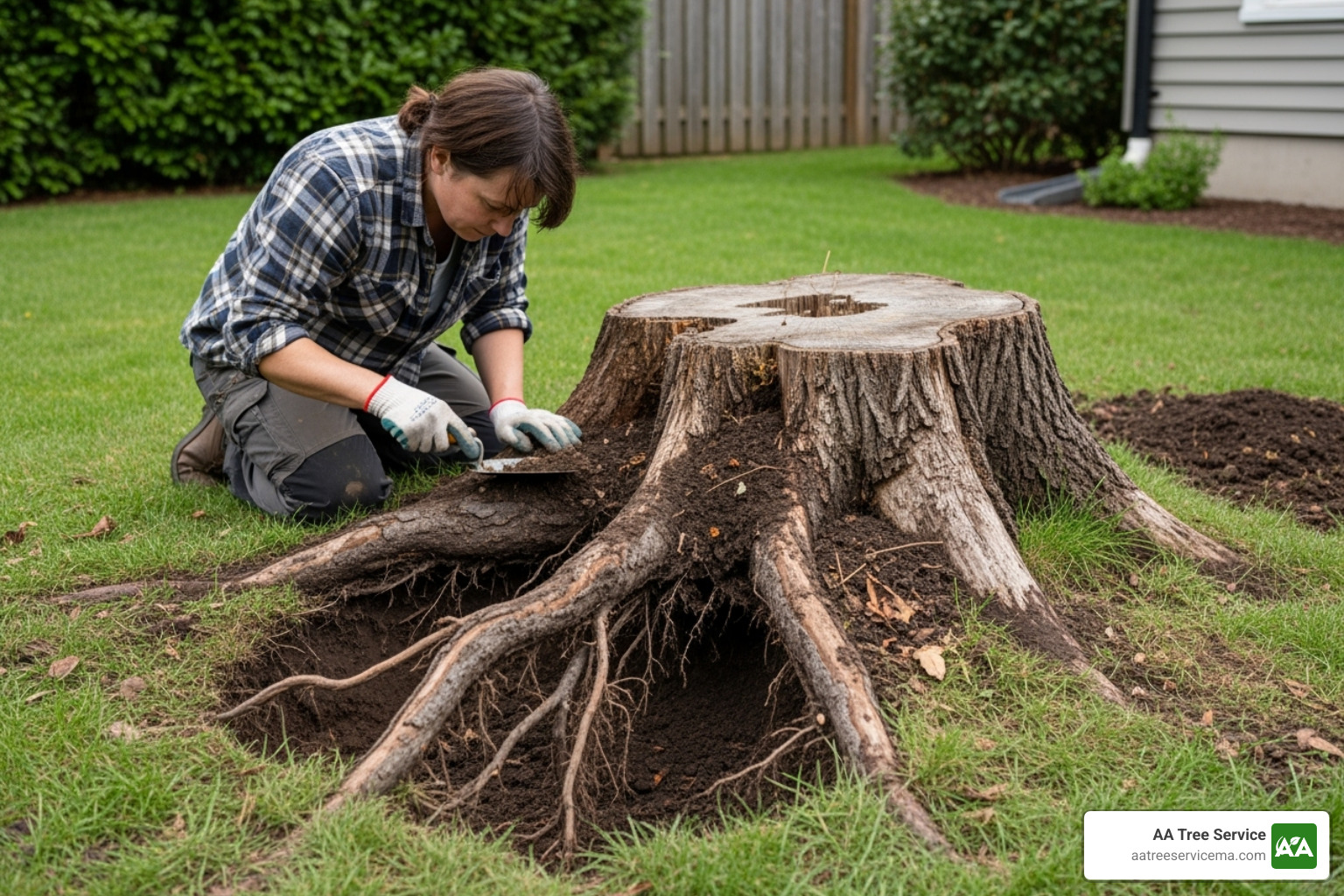
Leaving a stump can lead to a host of issues. It can attract pests like termites, carpenter ants, and beetles, which can eventually migrate from the rotting wood to your home. A stump can also lead to unwanted regrowth, with new sprouts constantly needing to be cut back. It creates a tripping hazard for children and adults alike and makes lawn care a chore. Finally, as the large root system decays, it can deplete soil nutrients and create a sunken spot in your yard. It’s always best to remove it.
Manual Stump and Root Removal
For small stumps (6 inches in diameter or less), manual removal is doable, if strenuous. Start by watering the area thoroughly the day before to soften the soil. Then, use a shovel and mattock to dig a wide trench around the stump, exposing the main lateral roots. Cut the exposed roots with an axe, loppers, or a pruning saw. For thick roots, you may need the chainsaw again—use an old chain as hitting dirt will dull it quickly. With most roots severed, use a long, sturdy pry bar to create leverage and rock the stump back and forth. This will help break the final taproot. For very stubborn stumps, a high-lift jack can provide extra force, but be sure to brace it on a solid, level board to prevent it from slipping or sinking.
Alternative Stump Removal Methods
If manual removal seems like too much work, you have other options. Chemical stump removers (typically potassium nitrate) can be used to accelerate the rotting process. This involves drilling several deep holes into the stump and filling them with the chemical granules and water. This method is not a quick fix; it can take several months to a year for the stump to become soft enough to break apart with an axe.
For a fast and complete solution, professional stump grinding is the most efficient method. A grinder makes quick work of the stump and its main roots, turning them into a pile of wood chips in minutes. This method is faster, less physically demanding, and allows you to immediately use the space for new grass, a garden, or another tree.
While manual removal is possible for small stumps, professional grinding often makes more sense when you factor in time and energy. For comprehensive care of your remaining landscape, consider our Tree and Shrub Service.
DIY vs. Professional: A Cost and Risk Comparison
Deciding between DIY small tree removal and hiring a professional comes down to balancing cost, risk, and convenience. The table below gives a quick overview.
| Factor | DIY Small Tree Removal | Professional Small Tree Removal |
|---|---|---|
| Cost | $50-$300 (average costs based on internet data, not AA Tree Service pricing) | $300-$900+ (average costs based on internet data, not AA Tree Service pricing) |
| Risk Level | Higher personal injury risk, potential property damage | Minimal risk with proper insurance and training |
| Time Commitment | Full weekend project or more | Completed in hours |
| Equipment Needed | Must purchase or rent all tools and safety gear | Professional-grade equipment included |
| Final Result | Variable quality depending on skill level | Professional finish with complete cleanup |
The numbers tell part of the story, but there’s more to consider than just upfront costs.
The Potential Costs of a DIY Project
Budgeting for DIY removal involves more than you might think. Tool purchase or rental costs can add up quickly (a decent chainsaw is $200+, essential safety gear $100+, a stump grinder rental $200+/day). You may also face disposal fees from your local transfer station. The average DIY cost of $50-$300 (average costs based on internet data, not AA Tree Service pricing) assumes you already own basic equipment. Starting from scratch can easily double or triple that cost. This doesn’t even factor in the hidden costs: the value of your weekend, potential damage to your lawn from falling limbs, or the catastrophic cost of an accident causing property damage or personal injury.
Comparing the Costs of DIY vs. Professional Small Tree Removal
Professional removal typically ranges from $300-$900+ (average costs based on internet data, not AA Tree Service pricing). This price includes much more than just labor. It includes comprehensive insurance coverage, which is crucial. A reputable service carries both liability insurance (to cover any damage to your property) and worker’s compensation (to cover their employees if they get hurt). This protects you, the homeowner, from being held financially responsible for accidents. The price also includes the use of specialized, professional-grade equipment, years of training, and efficient disposal. The peace of mind that comes from knowing the job is done safely and correctly is often worth the price difference. To see how it compares for your project, Get a Tree Removal Cost Estimate.
When is it Absolutely Necessary to Call a Professional Instead of Attempting DIY Tree Removal?
Even for a seasoned DIYer, some jobs require an expert. The risks of removing certain trees are too great, potentially leading to severe injury, catastrophic property damage, or even death. Recognizing your limits is the most important safety tool you have.
Here are the red flags that signal it’s time to call a professional for small tree removal or any tree removal project:
- Tree Size Exceeds Definition: If the tree is taller than 15 feet or has a trunk diameter over 6 inches, it’s too large for DIY removal. The weight and force of larger trees are extremely dangerous and unforgiving for an untrained person to handle.
- Proximity to Homes or Power Lines: A good rule of thumb: if the tree is close enough that it could hit any structure, fence, or utility line when it falls, it requires a professional. For power lines, the danger is extreme; electricity can arc to tools and people, so even working near them is a job for a certified arborist with utility line clearance training.
- Diseased or Dead Trees: These trees are structurally unsound and highly unpredictable. Look for signs like mushrooms growing at the base (a sign of root rot), deep cracks or splits in the trunk, large areas of missing bark, or numerous dead branches in the canopy (widow makers). Their internal decay means a standard hinge cut may fail, causing the tree to split or fall in an unintended direction.
- Steep Slopes or Uneven Terrain: Working on unstable or uneven ground significantly increases the risk of falls and makes controlling the tree’s descent much harder. Professionals have techniques and equipment to work safely in these conditions.
- Lack of Experience or Discomfort: If you are uncomfortable with the tools, have never used a chainsaw, or simply feel the project is beyond your skill level, trust your instincts. Watching online videos is not a substitute for hands-on training. Your safety is paramount. When in doubt, always call a professional tree care service.
- Storm-Damaged Trees: Trees damaged in a storm can have broken limbs hung up in the canopy, a compromised root system, or hidden tension in the wood, making them exceptionally hazardous. For these situations, our Emergency Tree Removal services are available 24/7 in Massachusetts and New Hampshire.
Frequently Asked Questions about Removing Small Trees
When it comes to small tree removal, homeowners often have the same questions. Here are the most common ones, answered.
What is the best tool for removing small trees?
There’s no single best tool; it depends on the tree’s size and the specific task.
- Axe or Mattock: Best for tiny saplings with trunks less than 2-3 inches in diameter and for chopping through roots in the ground.
- Chainsaw: The most efficient tool for felling and bucking trees up to 6 inches in diameter, but it requires experience and full safety gear to operate safely.
- Reciprocating Saw (with a pruning blade): A great, often safer, alternative to a chainsaw for limbing and cutting roots in tight spaces.
- Pruning Saw: Excellent for precise cuts, de-limbing smaller branches, and cutting roots where a power tool is unsafe or impractical.
- Loppers: Ideal for clearing small branches and root suckers to create a safe working area before you begin.
Do I need a permit to remove a small tree in Massachusetts or New Hampshire?
It’s complicated, as rules vary dramatically from town to town. Always check your local municipal website or call the planning or conservation department before cutting. For example, some towns in Massachusetts have bylaws protecting any tree over a certain diameter, while others only regulate trees in historic districts or near wetlands. In New Hampshire, state laws like the Shoreland Water Quality Protection Act may apply near bodies of water. A quick check can save you from hefty fines and legal trouble.
What are the consequences of leaving a tree stump?
Leaving a stump can cause several problems. They attract pests like termites and carpenter ants, which can then move to your house. They can sprout new, messy growth for years. They create a significant tripping and mowing hazard, especially as grass grows over them. Finally, the fungi that grow on rotting stumps can sometimes spread to other healthy plants in your garden. A stump can take 5 to 20 years to rot away naturally, creating an eyesore and obstacle the entire time.
What’s the best way to dispose of the tree debris?
Disposal is a key part of the plan. Check with your town’s public works department. Many offer curbside pickup of branches (cut to specific lengths and bundled) on certain days. Others have a designated drop-off area at the local transfer station, though fees may apply. Renting a wood chipper is another option, which turns branches into valuable mulch for your garden beds. Larger logs can be cut, split, and seasoned for firewood.
Your Next Step for a Clear and Safe Yard
We’ve covered the journey of small tree removal, from planning and felling to the crucial step of stump removal. It can be a rewarding DIY project with the right tree, conditions, and a safety-first mindset.
The key takeaways are simple but non-negotiable: always wear proper safety gear, never work near power lines or structures, and be honest about your skill level. A chainsaw demands respect and proper technique every time.
DIY is possible for a small tree (under 15 feet, clear fall zone, not diseased), but there’s no shame in knowing your limits. Recognizing when a job is too big shows wisdom.
Professional help ensures safety and efficiency. Experienced tree professionals spot hidden problems, carry insurance, and have the specialized training to get the job done right. The goal is to get the tree down safely and completely, without turning a weekend project into a costly disaster.
For any tree removal needs in Massachusetts or New Hampshire, from a small sapling to a large, complex tree, trust the team at AA Tree Service. With over 20 years of experience, we provide free estimates to help you make the best decision. Learn more about our comprehensive Tree Removal Services and let us help you find the safest approach for your yard.