Why Saltpeter is the Smart DIY Solution for Stubborn Stumps
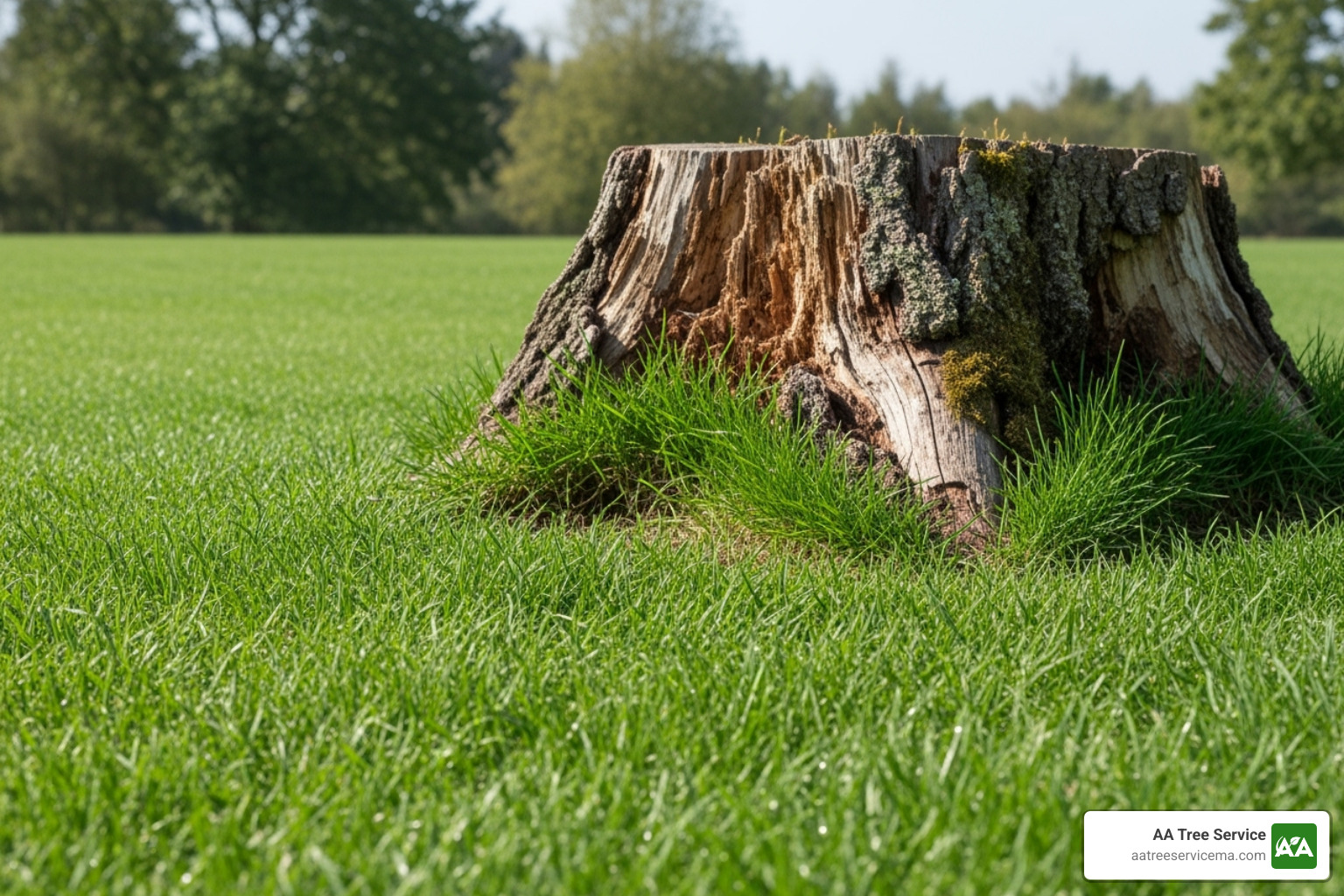
That unsightly tree stump squatting in your yard is more than just an eyesore; it’s a persistent obstacle to the perfect lawn. It’s the reason you have to swerve awkwardly with the lawnmower, a potential tripping hazard for kids and guests, and an open invitation for pests like termites, carpenter ants, and beetles to set up camp. For homeowners in Massachusetts and New Hampshire, saltpeter for stump removal offers an intelligent, affordable, and low-effort path to reclaiming your landscape without the expense and disruption of heavy machinery.
This proven chemical method relies on potassium nitrate (KNO3), a compound that dramatically accelerates the natural process of wood decomposition. Instead of waiting a decade or more for nature to take its course, saltpeter turns a rock-hard stump into a soft, spongy mass that can be easily broken apart and removed with basic garden tools in a matter of months.
Quick Answer for Saltpeter Stump Removal:
- What it is: Potassium nitrate (KNO3), a powerful oxidizing agent that boosts the fungi and bacteria responsible for wood decay.
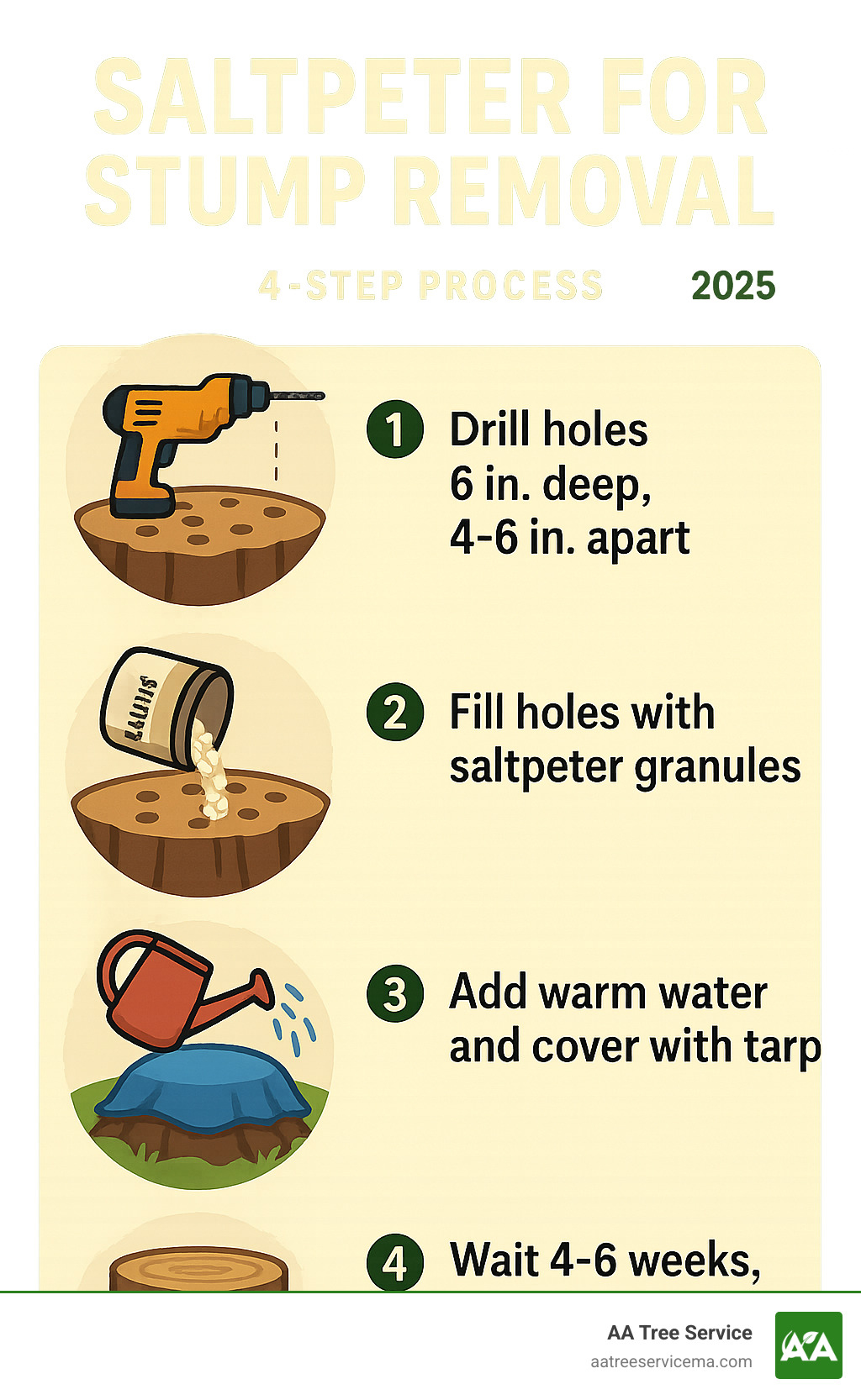
- How to use: Drill a series of deep, wide holes into the stump, fill them with saltpeter granules, add warm water to create a solution, and cover the stump to retain moisture.
- Timeline: Initial softening can be observed in as little as 4-6 weeks, but full decomposition for easy removal typically takes several months to a year, depending on stump size and wood type.
- Cost: Extremely budget-friendly, with 1-5 pound containers costing between $8 and $28, a fraction of professional services.
- Best for: Patient DIYers with small to medium-sized stumps who prefer a hands-off approach.
- Safety Note: Always use gloves and eye protection. The treated stump should never be burned, as the potassium nitrate can cause it to burn with extreme, uncontrollable heat.
That stubborn stump in your yard doesn’t have to be a permanent fixture. Whether it’s a tripping hazard on your lawn in Lowell, MA, or an insect magnet in your Nashua, NH garden, taking matters into your own hands can save you a significant amount of money. Professional stump grinding, while fast, can cost anywhere from $75 to $400 per stump, with larger or less accessible stumps commanding even higher prices. The saltpeter method, in contrast, often costs less than $30 in materials.
The magic of this method lies in its simplicity and its partnership with nature. As one satisfied DIYer on a local gardening forum noted, “Potassium nitrate does a bang-up job with very little effort. I drilled the holes, filled them up, and mostly forgot about it until the next spring when I could break it apart with an axe.” The chemical acts as an oxidizer, delivering a blast of oxygen deep into the wood’s core. This, combined with the nitrogen it provides, creates the perfect environment for decomposition microbes to thrive, turning your stump removal project from a battle against nature into a collaboration.
Relevant articles related to saltpeter for stump removal:
What is Saltpeter and How Does It Work on Tree Stumps?
When homeowners search for saltpeter for stump removal, they’re actually looking for its active ingredient: potassium nitrate. This is a simple, naturally occurring mineral salt with the chemical formula KNO3. While its scientific name might sound imposing, this white, crystalline compound has a long and storied history, serving humanity for centuries in everything from food preservation (as a curing salt) and agriculture (as a fertilizer) to its more explosive role in early gunpowder and fireworks. You can explore the deep history of potassium nitrate to appreciate its versatility.
For the purpose of eliminating a stubborn stump, however, its most important property is this: potassium nitrate is a powerful oxidizing agent. Think of it as a turbo-charger for the natural process of decay. A stump left to its own devices might take 7 to 10 years, or even longer, to fully decompose. Saltpeter dramatically shortens this timeline by providing two crucial elements that are often in short supply within dense wood: oxygen and nitrogen.
The Science of Accelerated Decay
To understand how saltpeter works, you need to know what’s already happening inside that stump. It’s a battleground for microscopic organisms. Your stump is made primarily of two complex organic polymers:
- Cellulose: Long chains of sugar molecules that give wood its fibrous structure.
- Lignin: A tough, rigid polymer that acts like a glue, binding the cellulose fibers together and giving wood its strength and resistance to rot.
Decomposer organisms, primarily fungi and bacteria, are already present and trying to break down these components. However, their progress is incredibly slow because the dense, packed-in wood is an oxygen-poor environment. These microbes need oxygen for respiration to efficiently break down the wood for energy.
When you introduce potassium nitrate dissolved in water into the stump, you’re essentially force-feeding these microorganisms. The potassium nitrate provides a rich source of both nitrogen, a vital nutrient that fungi need to build proteins and multiply, and oxygen. As an oxidizer, it releases oxygen atoms directly into the wood fibers, creating a highly favorable environment for the decomposers. The fungi, particularly white-rot fungi which are experts at breaking down lignin, go into overdrive. They multiply rapidly and begin aggressively digesting the lignin that gives the stump its structural integrity.
As the lignin ‘glue’ is broken down, the cellulose fibers are exposed and begin to crumble. The entire structure weakens from the inside out. What was once rock-hard, resilient wood transforms into a soft, porous, and spongy material that you can often break apart with a simple shovel or axe.
This accelerated decomposition process is not an unnatural attack on the wood; it’s simply giving nature a significant boost. You are creating the ideal conditions for decay, condensing years of natural processes into a matter of months. This preparation for removal is the key benefit, turning a monumental physical task into a manageable one for any homeowner with a little patience.
Top Features to Look for in a Saltpeter Stump Remover
Navigating the garden center aisle for saltpeter for stump removal can be confusing, but understanding a few key features will ensure you buy the right product for your project. While most commercial stump removers are based on potassium nitrate, variations in form, purity, and packaging can impact ease of use and overall effectiveness.
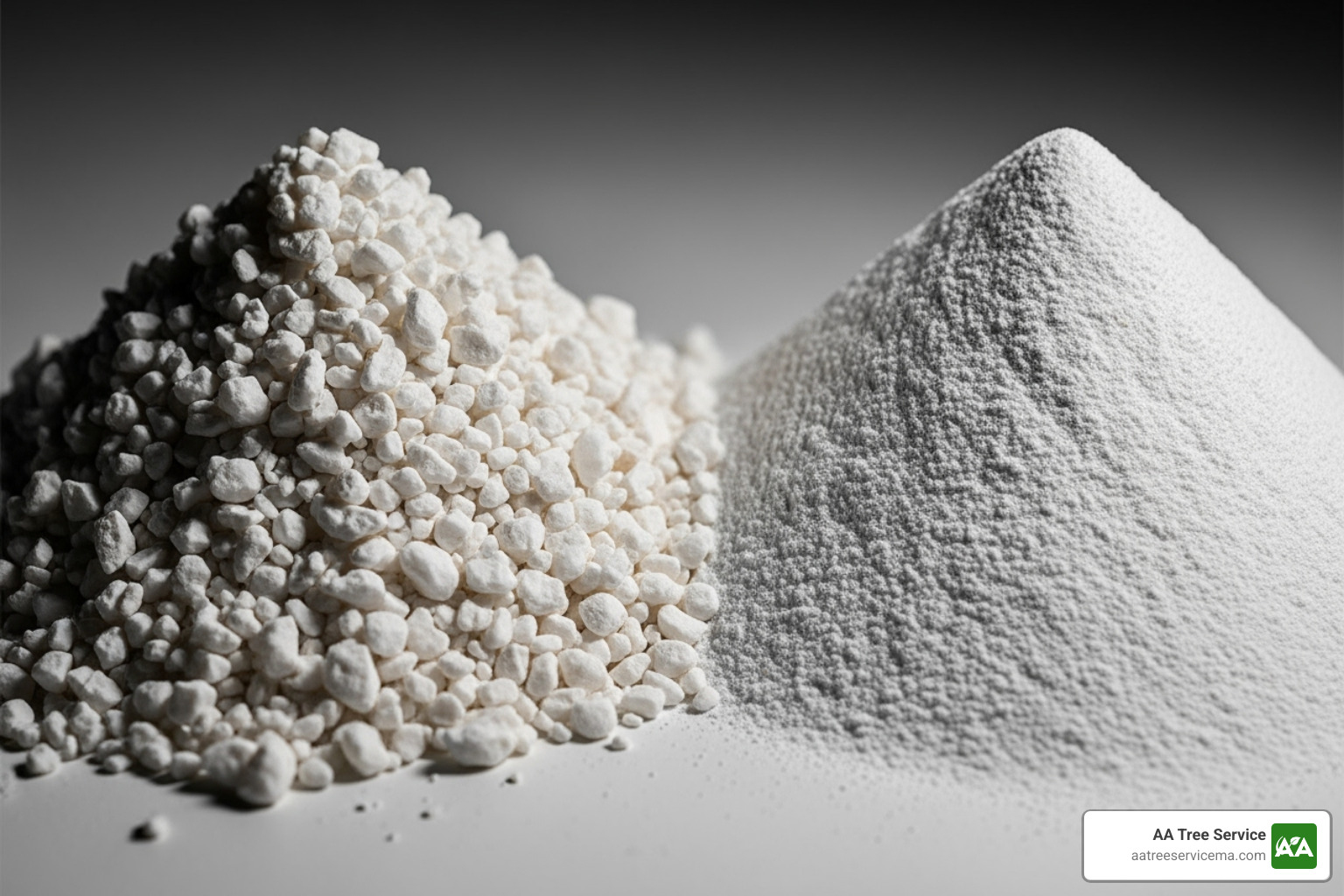
Product Form: Granules vs. Powder
The most significant choice you’ll make is between granular and powdered saltpeter.
- Granular Saltpeter: This form, which resembles small pellets or coarse salt, is the most user-friendly option for homeowners. The granules are easy to pour directly from the container into the drilled holes with minimal mess. They are less likely to be blown away by a gust of wind on a classic New England afternoon. Granules also dissolve more slowly, providing a steady, time-released source of nitrogen and oxygen to the stump’s core, which can be beneficial for long-term decomposition.
- Powder Saltpeter: This finely milled form dissolves almost instantly upon contact with water. This can lead to faster initial absorption into the wood fibers. However, the powder is notoriously difficult to handle. It’s dusty, requiring a mask to avoid inhalation, and can easily be scattered by the wind, leading to waste and mess. It’s better suited for controlled applications where rapid saturation is the primary goal.
Purity Levels and Additives
For stump removal, you don’t need laboratory-grade potassium nitrate. Standard commercial-grade products, often labeled as “Stump Remover,” are perfectly sufficient. These products are typically over 90% potassium nitrate, with the remaining percentage consisting of inert anti-caking agents that don’t affect performance. Spending extra on high-purity (99%+) saltpeter from a chemical supplier won’t make your stump disappear any faster and is not a cost-effective choice for this application. Some brands may include secondary ingredients, but pure potassium nitrate is the workhorse.
Package Size and Instructions
Consider the scale of your project. A single, small pine stump might only require a 1-pound container. However, if you’re tackling a large oak stump or several stumps on your property, purchasing a 5-pound or even 10-pound bag is far more economical. Buying in larger quantities significantly reduces the cost per pound. Always look for products with clear, detailed instructions. The best brands provide guidance on drill bit size, hole depth and spacing, and the amount of water to use, taking the guesswork out of the process.
| Feature | Granular Saltpeter | Powder Saltpeter |
|---|---|---|
| Application | Easy to pour, minimal dust, low wind drift | Messy, dusty, easily scattered by wind |
| Dissolution | Slower, provides a time-released effect | Instant, allows for rapid absorption |
| Best Use Cases | General DIY use, windy conditions, patient application | Controlled environments, when fast saturation is key |
| Handling | Requires gloves and eye protection | Requires gloves, eye protection, and a dust mask |
For the vast majority of homeowners in Massachusetts and New Hampshire, a granular product like Bonide Stump-Out or Spectracide Stump Remover offers the ideal combination of effectiveness, safety, and ease of use. For more options, see our guide to Tree Stump Removal Chemicals.
A Guide to Applying Saltpeter for Stump Removal
Ready to tackle that stubborn stump? Applying saltpeter for stump removal is a straightforward process that requires more patience than muscle. Follow these detailed steps to ensure you get the best results, changing that solid block of wood into a crumbly, removable mass.
Step 1: Stump Preparation
Proper preparation is crucial for success. The process works best on seasoned stumps that have been dead for at least a year. A freshly cut stump still contains a lot of sap and moisture, which can resist the chemical treatment and may even try to send up new sprouts. If you must treat a fresh stump, be prepared for a longer timeline.
Using a chainsaw or handsaw, cut the stump as low to the ground as possible, ideally flush with the soil line or just an inch or two above. Every vertical inch you remove is less wood the saltpeter has to decompose, which significantly speeds up the project. Ensure the top surface is relatively flat to make drilling easier and safer.
Step 2: Gather Your Safety Gear
Safety should always be your first priority. Even though this is a chemical process, the main risks come from the preparation phase. Before you begin, equip yourself with:
- Safety Glasses or Goggles: Essential to protect your eyes from flying wood chips during drilling.
- Chemical-Resistant Gloves: Nitrile or heavy-duty rubber gloves will protect your skin from irritation when handling the potassium nitrate.
- Dust Mask: A simple N95 mask is highly recommended, especially if you are using powdered saltpeter, to prevent inhaling fine particles.
- Long Sleeves and Pants: Protect your skin from wood chips and any accidental chemical spills.
Step 3: Drilling the Holes
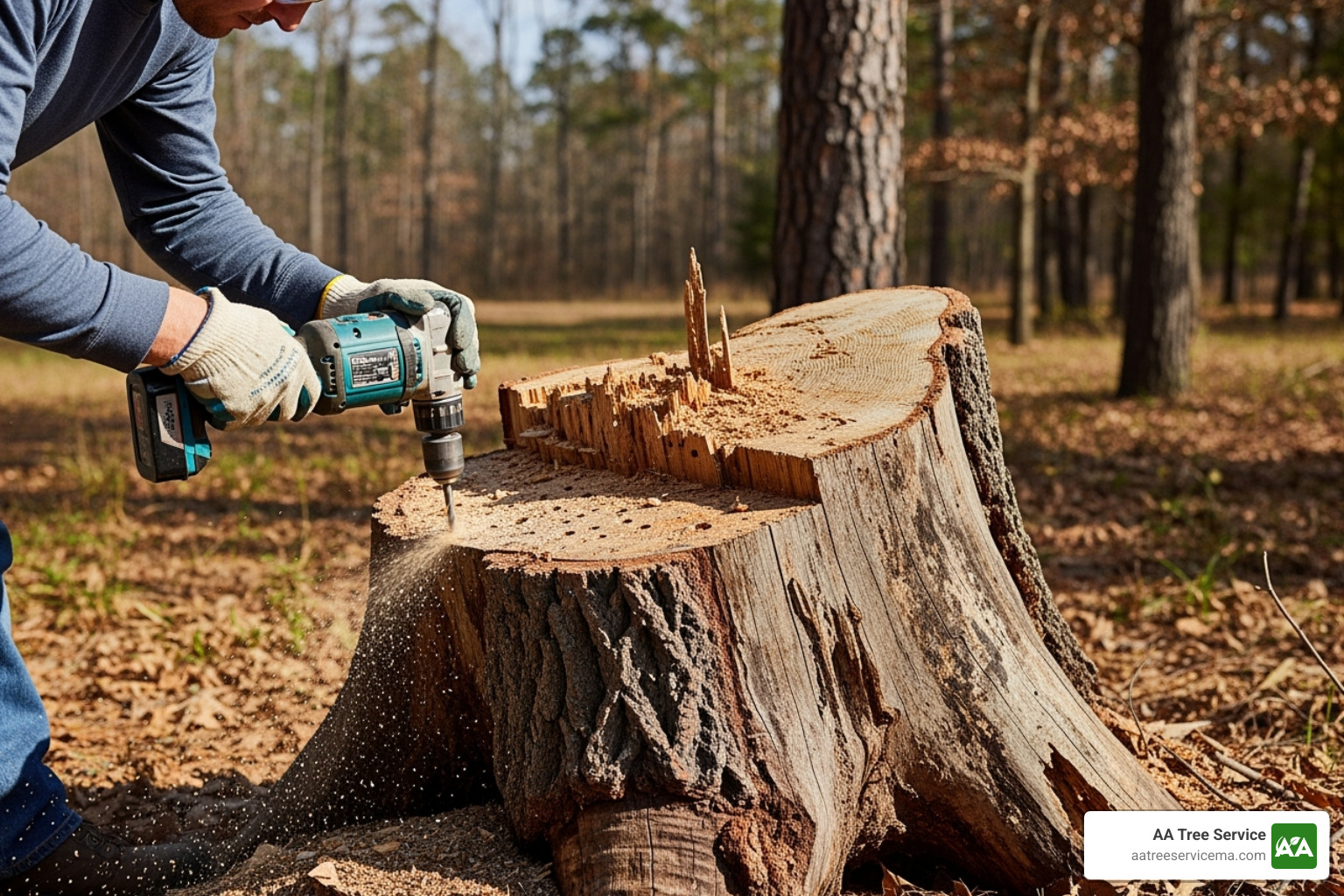
The holes you drill are the delivery system for the saltpeter. Use a power drill with a long spade bit or auger bit, 1/2 inch to 1 inch in diameter. Wider and deeper holes hold more product and allow for better penetration.
- Depth: Drill vertical holes 8 to 12 inches deep into the top of the stump. If the stump is shorter, drill as deep as you can without going through the bottom.
- Spacing: Space the holes approximately 3 to 4 inches apart from each other, in a grid pattern across the entire surface.
- Angled Holes: For larger stumps (over 15 inches in diameter), drill additional holes into the sides of the stump at a 45-degree downward angle. These should also be 8-12 inches deep and aim toward the center of the stump, creating a network of channels for the chemical to saturate.
After drilling, use a shop vac or brush to clean all wood shavings out of the holes. You need direct contact between the saltpeter and the raw wood.
Step 4: Filling the Holes
Now it’s time to apply the chemical. Carefully fill each hole about 3/4 full with the saltpeter granules or powder. Avoid overfilling, as you need space to add water. A small funnel can make this process cleaner and more efficient.
Step 5: Adding Warm Water
This step activates the saltpeter. Use warm water, as it will dissolve the potassium nitrate much more effectively than cold water. Slowly pour the warm water into each hole until it is full. The saltpeter will dissolve and form a concentrated solution. You may see the water level drop as it soaks into the dry wood; top off the holes with more water as needed until they remain full.
Step 6: Covering the Stump
To maximize effectiveness, you must keep the stump moist. Cover the entire stump with a heavy-duty plastic tarp or sheet of black plastic. Black plastic is ideal as it absorbs sunlight, warming the stump and further accelerating microbial activity. Secure the cover tightly with rocks, bricks, or stakes to prevent it from blowing away and to keep rainwater from washing the chemical solution away. For an extra boost, you can add a thick layer of organic mulch (like wood chips or compost) over the stump before placing the tarp to improve moisture retention.
Step 7: The Waiting Game (Decomposition Timeline)
This is where patience becomes your most important tool. Check the stump every 4-6 weeks. If the holes appear dry, add more warm water. The stump should feel noticeably softer and spongy within 4 to 6 weeks. Full decomposition, where the wood is soft enough to be broken apart with an axe or shovel, can take anywhere from 6 months to over a year. The exact timeline depends heavily on:
- Wood Density: Softwoods like pine will rot much faster than hardwoods like oak or maple.
- Stump Size: A larger stump has more mass to break down and will take longer.
- Moisture Levels: A consistently moist stump will decompose faster. This is why covering is critical, especially during dry New England summers.
- Climate: The process will be most active during the warm, humid months and will slow down or stop completely during cold winters.
Where to Buy Saltpeter and What to Expect to Pay
Finding saltpeter for stump removal is easier than you might think, and it’s one of the most budget-friendly solutions available. You can readily purchase potassium nitrate-based stump removers at a variety of locations throughout Massachusetts and New Hampshire, as well as from numerous online sources.
Where to Shop
- Home Improvement Stores: Large chains like Home Depot and Lowe’s are often the first stop for DIYers. Look in the lawn and garden section, typically near pesticides and fertilizers. You’ll find popular, pre-packaged brands like Spectracide Stump Remover and Bonide Stump-Out Granules.
- Garden Centers and Nurseries: Local garden centers and nurseries are excellent resources. The staff often possess practical, regional knowledge and can offer advice custom to New England’s climate and common tree types. They may also carry different brands than the big-box stores.
- Hardware Stores: Don’t overlook local hardware stores like Ace Hardware or True Value. They frequently stock essential lawn care chemicals and can be a convenient option.
- Online Retailers: For the broadest selection and competitive pricing, online marketplaces like Amazon and eBay are invaluable. You can find everything from standard 1-pound containers to bulk bags. Furthermore, specialized online chemical suppliers like Ecoxall, ESKS, or Duda Energy sell potassium nitrate in various grades and quantities, which can be highly cost-effective if you are treating multiple stumps.
Please note: The prices mentioned below are estimates based on market research and are not direct quotes from AA Tree Service. Prices fluctuate based on brand, retailer, and market demand, so always confirm the current cost before purchasing.
Cost Analysis: DIY vs. Professional
The primary appeal of the saltpeter method is its incredible cost-effectiveness. Let’s break down the expected costs:
- One-Pound Containers: These are suitable for one or two small stumps and typically cost between $8 and $28. For instance, a 1 lb container of Bonide Stump-Out often retails for around $8-$10, while a 1.5 lb container of Spectracide Stump Remover is usually priced between $9 and $12.
- Five-Pound Products: If you have a large stump or multiple stumps, buying in a larger size is more economical. A 5-pound bag of prilled potassium nitrate from an online supplier might cost between $25 and $45, bringing the per-pound cost down significantly.
Let’s create a hypothetical scenario for a 12-inch diameter oak stump in a Massachusetts yard:
- DIY Saltpeter Method Cost:
- 1 lb Bonide Stump-Out Granules: ~$9
- 1-inch x 12-inch Auger Drill Bit (if you don’t own one): ~$15
- Total DIY Project Cost: ~$24
- Professional Stump Grinding Cost:
- Average cost per diameter inch: $3 – $5
- Estimated cost for a 12-inch stump (12 x $4): $48
- Minimum service call fee (most companies have one): ~$100 – $150
- Total Professional Cost: ~$100 – $150
In this common scenario, the DIY approach saves you over $100. The savings become even more substantial with larger or multiple stumps. While the saltpeter method requires a significant time investment, the financial benefit is undeniable. Of course, for those who value their time or are facing a more challenging removal, our Affordable Stump Grinding services provide a fast and efficient alternative.
Frequently Asked Questions about Saltpeter
Homeowners across Massachusetts and New Hampshire often have questions about using saltpeter for stump removal. It’s a method that seems almost too good to be true. Here, we address the most common inquiries to help you make an informed decision for your yard.
What Are the Main Benefits of Using Saltpeter?
The advantages of the saltpeter method are significant, especially for the budget-conscious DIYer.
- Low Physical Effort: Beyond the initial drilling, the process is passive. There’s no back-breaking digging, chopping, or wrestling with heavy equipment.
- Cost-Effectiveness: As detailed previously, the material cost is minimal, often under $30, compared to professional services that can run into hundreds of dollars.
- No Landscape Damage: Stump grinders are heavy and can tear up your lawn. The saltpeter method is precise and contained within the stump, leaving your surrounding grass, garden beds, and tree roots untouched.
- Works with Nature: It’s a form of natural decomposition accelerator. You’re not introducing a harsh, foreign poison but rather enhancing a natural process, making it a more eco-friendly choice than some other chemical options.
Is Saltpeter Safe for My Lawn, Garden, and Pets?
This is a critical and common concern. When used as directed, saltpeter is relatively safe for the surrounding environment. The key is targeted application. By pouring the chemical directly into drilled holes, you contain it within the stump. The tarp cover further prevents it from being washed into the surrounding soil by rain. Should a small amount spill, it’s unlikely to cause harm. Potassium nitrate is composed of potassium and nitrogen, two of the three primary macronutrients in fertilizer. A minor spill, when diluted with water, may actually provide a slight nutritional boost to nearby grass. However, it is a chemical and should be handled with care. Keep pets and children away from the treated area during application and while the stump is uncovered. Once covered, it poses minimal risk.
How Long Does Saltpeter for Stump Removal Really Take?
Patience is paramount. This is not an instant solution. You should see the stump begin to soften and feel spongy in 4 to 6 weeks. However, for the wood to become soft enough for easy manual removal with an axe or shovel, you should plan on a timeline of 6 to 12 months. Several factors influence this timeline: wood density (pine is fast, oak is slow), stump diameter, and ambient conditions (moisture and warmth accelerate the process). The process is fastest during the warm, wet months of a New England spring and summer.
Can I Burn the Stump After Treating It with Saltpeter?
Absolutely not. This is extremely dangerous. Potassium nitrate is a powerful oxidizer, a key ingredient in gunpowder and rocket propellant for a reason. Soaking a stump in it and then setting it on fire will not result in a controlled burn. It will cause the wood to burn incredibly hot, fast, and unpredictably. It can lead to flare-ups, smoldering that is difficult to extinguish, and a significant fire hazard. It is also illegal in most municipalities. Never attempt to burn a stump treated with saltpeter.
What’s the Difference Between Saltpeter and Epsom Salt for Stump Removal?
Though sometimes confused, they work in completely different ways. Saltpeter (potassium nitrate) works by accelerating decomposition. Epsom salt (magnesium sulfate) works by desiccation—it draws moisture out of the stump, drying it out and killing it. While Epsom salt can kill a stump and its roots, it does not significantly speed up the rotting process. Saltpeter is the superior choice for breaking down the wood itself.
What Do I Do With the Rotted Wood Afterwards?
Once the stump is soft and spongy, it’s time for the final, satisfying step. Use a mattock, axe, or sturdy shovel to break apart and pry out the rotted wood. The softened material should come out in chunks. You can then dig out any remaining larger roots. The rotted wood can be added to a compost pile (in moderation) or disposed of with your regular yard waste.
When a DIY Project Becomes a Job for the Pros
While saltpeter for stump removal is an excellent method for many homeowners, it’s not a universal solution. Recognizing when a project is beyond the scope of a DIY approach is key to saving time, frustration, and ensuring safety. There are several scenarios where calling in a professional service like AA Tree Service is the smarter choice.
When to Call for Professional Stump Grinding
- Very Large Stumps: If you’re dealing with a massive stump, particularly from a mature hardwood like an oak or maple (e.g., over 24 inches in diameter), the saltpeter method can take years to show results. A professional grinder can obliterate a stump of this size in under an hour.
- Multiple Stumps: If a property clearing has left you with a “stump graveyard” of five, ten, or more stumps, the DIY approach becomes impractical. The time required to drill, fill, and manage each stump individually is immense. A professional crew with a hydraulic grinder can clear an entire yard in a single visit.
- Urgent Time Constraints: The saltpeter method requires months of patience. If you need the stump gone now—because you’re selling your home, installing a patio, planting a new tree, or preparing for a backyard event—professional grinding is the only viable option. It provides immediate results.
- Stumps Near Structures or Utilities: If a stump is located very close to your home’s foundation, a driveway, a sidewalk, or, most importantly, near known underground utility lines (gas, water, electric), a DIY approach is risky. Professionals are experienced in working in these tight quarters and are insured against accidental damage.
- Concerns About Sprawling Root Systems: Saltpeter primarily decomposes the main stump body. It has limited effect on the extensive lateral root system that can continue to be a landscaping nuisance. Professional stump grinding can often chase and remove large surface roots, providing a cleaner final result.
- Diseased Wood: If the tree was removed due to a disease like Dutch elm disease or oak wilt, it’s crucial to have a professional handle the stump. Improper disposal of the wood chips can spread the pathogen to other healthy trees in your yard or neighborhood.
The Burning Question: A Final Warning
It bears repeating: some online sources dangerously suggest burning the stump after applying saltpeter. This is a significant safety hazard. The potassium nitrate infuses the wood, turning it into a highly combustible material that will burn with intense, uncontrollable heat. In the dry conditions of a Massachusetts or New Hampshire summer, this creates an unacceptable risk of starting a larger fire. Professional services eliminate this temptation and risk entirely.
At AA Tree Service, we’ve provided expert tree care and Stump Grinding services to New England communities for over 20 years. We understand the satisfaction of a DIY project, but we also know the value of professional efficiency and safety. If your stump situation falls into any of the categories above, or if you simply want the problem solved quickly and completely, contact us for a free, same-day quote.