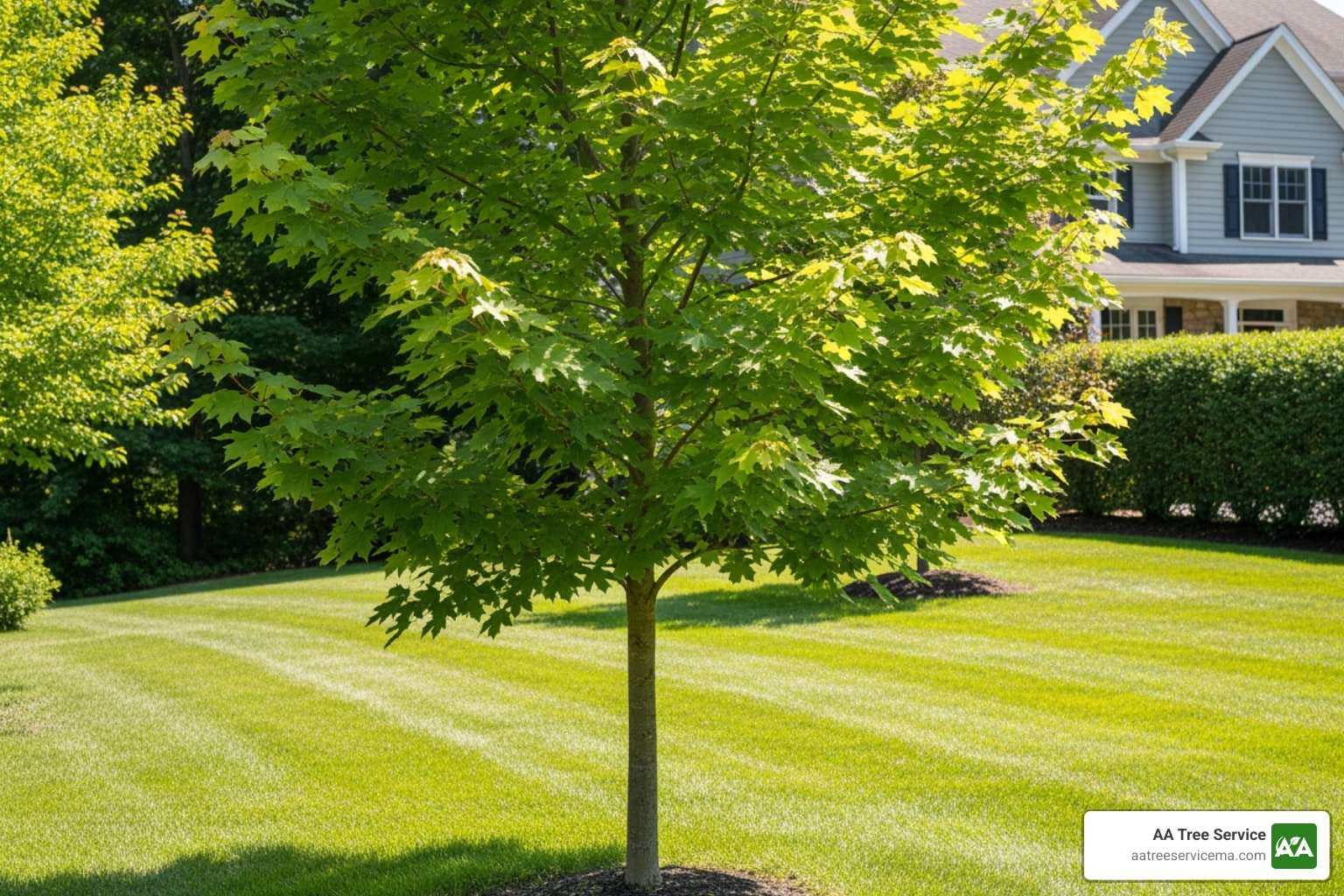
Why Pruning Young Maple Trees Sets the Stage for Decades of Strength
Pruning young maple trees is one of the most crucial investments a homeowner can make to ensure a tree grows into a healthy, structurally sound giant. The small, deliberate cuts you make in the first few years of a maple’s life will fundamentally shape its future for decades, preventing serious structural problems that become expensive, hazardous, and often impossible to correct later on. Without this early guidance, a young maple can develop weak, competing trunks or poorly attached branches that are destined to fail under the weight of snow, ice, or high winds.
Quick Answer: How to Prune Young Maple Trees
- When to Prune: The ideal window is during the dormant summer period, from mid-July to early August. This is when sap flow is at its lowest, minimizing stress and “bleeding.”
- When to Start: Begin structural pruning in the third year after planting. Before that, only remove dead or broken branches. Continue light pruning every other year until the tree is about 10 years old.
- Essential Tools: You’ll need sharp, clean hand bypass pruners for small twigs, loppers for medium branches, and a pruning saw for anything larger. A pole saw is useful for higher branches.
- What to Remove: Prioritize removing dead, diseased, or damaged branches first. Then, focus on structural corrections like subordinating co-dominant leaders, removing branches with narrow crotch angles, and eliminating crossing or rubbing limbs.
- How Much to Prune: A cardinal rule is to never remove more than 25-30% of the tree’s live foliage in a single year. Over-pruning can severely stress or even kill a young tree.
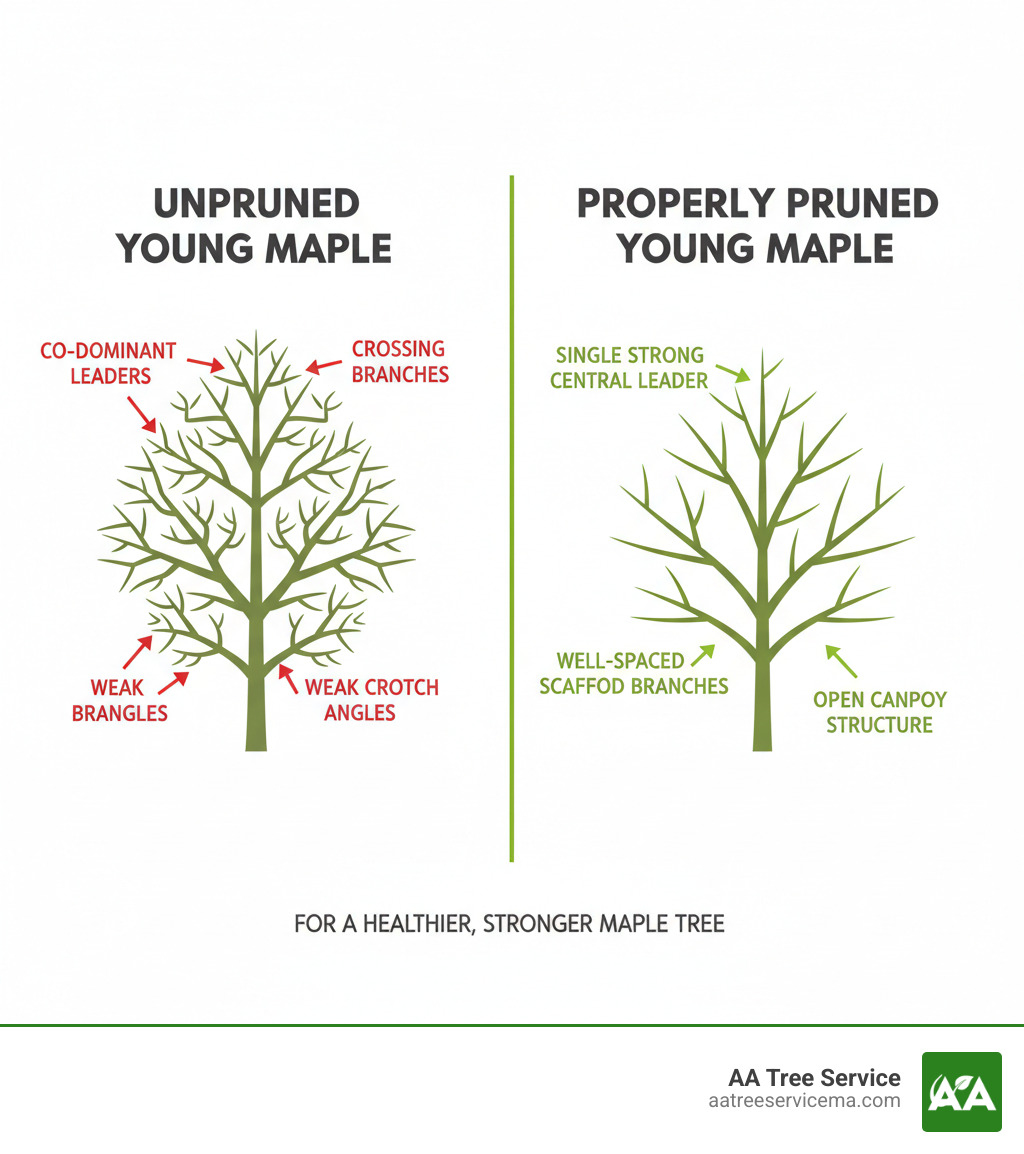
- The Primary Goal: The main objective is to establish a single, strong central leader (trunk) and develop a framework of well-spaced scaffold branches with strong, wide attachments to that leader.
Think of early pruning as establishing a strong and resilient foundation. A young maple left to its own devices often develops weak branch attachments with included bark, competing trunks that form a weak V-shape, or a dense, lopsided canopy that is susceptible to disease and storm damage. Young trees are remarkably forgiving; their tissues are vigorous, they heal faster, and they respond well to training. A few strategic cuts on small branches today can prevent the need for major, high-risk surgery to remove entire limbs tomorrow.
For homeowners in Massachusetts and New Hampshire, where maples like the Sugar, Red, and Silver Maple are landscape staples, this early tree care is a matter of safety, long-term property value, and creating beautiful, resilient shade trees that will last for generations. Whether you have a new sapling or a three-year-old tree just ready for its first structural pruning, the principles are the same: every cut should have a clear purpose aimed at building a better tree for the future.
Pruning young maple trees definitions:
The “Why” and “When”: Timing Your Pruning for Optimal Health
Pruning a small, healthy-looking maple might seem counterintuitive, but it’s the most effective way to guarantee its long-term structural integrity. The primary goals of pruning young maple trees are to develop a strong central leader (the main, dominant trunk) and to encourage wide, U-shaped branch angles. A single leader ensures the tree’s energy is directed upward, creating a strong, stable core. This prevents the development of weak points where the tree could split apart during a New England ice storm or high winds. Likewise, wide branch angles are biomechanically much stronger than narrow, V-shaped attachments.
These tight V-shapes often trap bark between the branch and the trunk, creating a zone of weakness known as “included bark.” This area never properly fuses, acting like a wedge that pushes the joint apart as the tree grows, making it a ticking time bomb for failure.
Proper pruning also significantly improves air circulation and sunlight penetration through the canopy. By thinning out crowded or crossing branches, you allow light and air to reach the inner parts of the tree. This creates a less humid, more open environment that is far less inviting for common maple fungal diseases like anthracnose, tar spot, and powdery mildew. Furthermore, promptly removing any dead, damaged, or broken branches closes off potential entry points for wood-boring insects and decay-causing pathogens, further reducing overall disease and pest risk.
When is the Best Time to Prune Young Maple Trees?
Maples are famous for their high volume of sap, which flows under pressure, especially in late winter and early spring as the tree prepares for new growth. If you prune during this period (roughly February to May), the tree will “bleed” profusely from the cuts. This sap is essentially sugar water, and while this sap loss won’t typically kill a healthy, mature tree, it can put significant stress on a young, developing one. It also creates a sticky, unsightly mess that can attract insects.
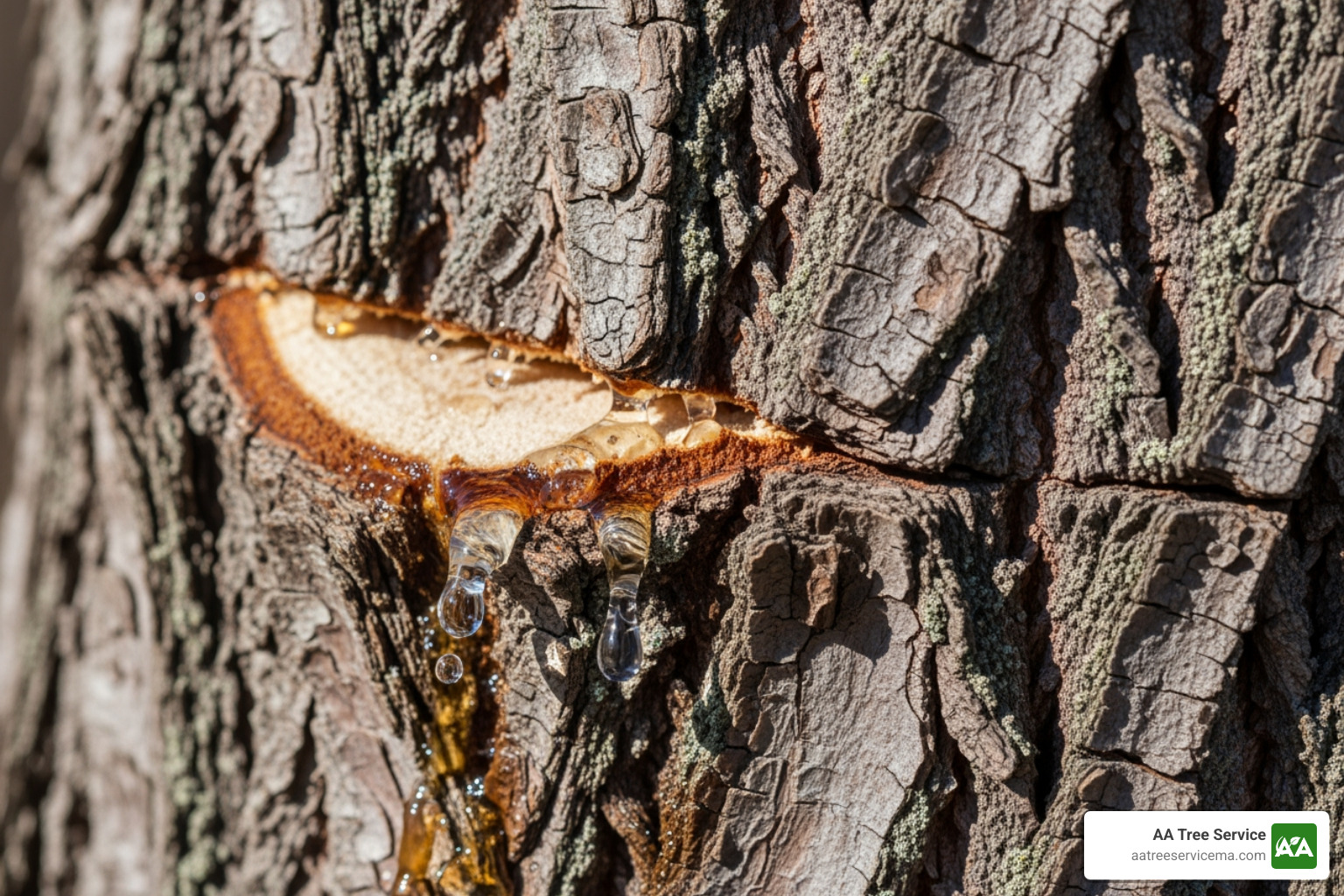
That’s why the ideal window for pruning young maple trees is mid-July to early August. During this summer period, the tree has fully leafed out and completed its initial spring growth surge. Sap pressure is at its lowest, so bleeding is minimal. More importantly, the tree is at the peak of its photosynthetic activity and can immediately begin the process of compartmentalizing and healing the pruning wounds. This rapid response seals off the cut from infection and decay far more effectively than a cut made at any other time of year.
There is one major exception to this rule: dead, damaged, or diseased branches should be removed immediately, regardless of the season. These issues pose a greater and more immediate threat to your tree’s health than a bit of sap bleeding or pruning at a suboptimal time.
For ongoing care to maintain the health of your young maples, our Tree Maintenance Services team helps homeowners across Massachusetts and New Hampshire keep their trees in top shape.
Gearing Up: Essential Tools for Pruning Young Maple Trees
Using the right tools for pruning young maple trees is non-negotiable. The goal is to make clean, precise cuts that heal quickly, rather than ragged, crushing wounds that invite disease and decay. For most young trees, a small, high-quality arsenal is all you need.
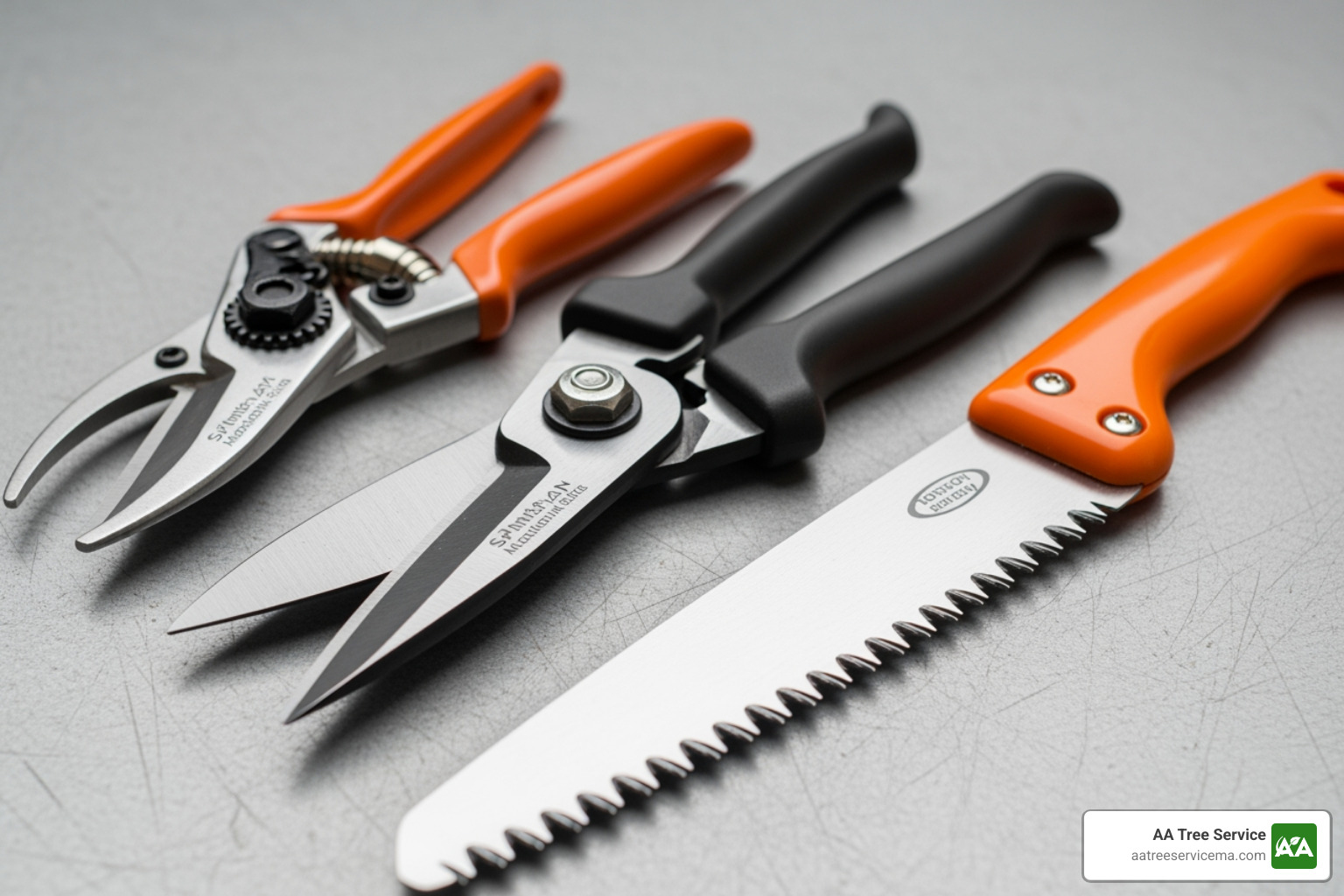
- Hand Bypass Pruners: These function like sharp scissors, with one blade bypassing the other to make a clean slice. They are the go-to tool for branches up to 3/4 inch in diameter. Always choose a bypass style over an anvil pruner, as anvil pruners have a single blade that crushes the branch against a flat surface, damaging the plant tissue.
- Lopping Shears (Loppers): Essentially long-handled bypass pruners, loppers provide the leverage needed to cut through branches up to 2 inches in diameter. Look for models with lightweight composite or aluminum handles to reduce fatigue. Some feature geared or ratcheting mechanisms that multiply your cutting power, making large cuts easier.
- Pruning Saw: For branches between 2 and 5 inches thick, a pruning saw is necessary. These saws are designed with aggressive teeth to cut efficiently on the pull stroke, which is safer and requires less effort. A curved blade can be helpful for getting into tight spaces.
- Pole Saw: This is a pruning saw on an extendable pole, allowing you to safely prune higher branches from the ground. It’s a much safer alternative to climbing a ladder with a saw, a common cause of homeowner injuries.
Tool Maintenance and Safety
Beyond selecting the right tools, two practices are paramount: keeping them sharp and keeping them clean. A dull blade tears and crushes wood fibers, leaving a jagged wound that heals slowly and is highly susceptible to infection. Before each pruning session, check your blades. A sharp blade will slice cleanly through a piece of paper.
Just as importantly, you must sterilize your tools. Clean your blades between each tree (and even between cuts on a tree known to be diseased) by wiping them down with a cloth soaked in 70% isopropyl alcohol or a 10% bleach solution. This simple, quick step is the best defense against accidentally spreading fungal spores, bacteria, or viruses from one plant to another.
Finally, always prioritize your own safety. Wear puncture-resistant gloves to protect your hands and safety glasses to shield your eyes from sawdust, twigs, and debris. For any work involving a saw or branches overhead, a hard hat is a wise investment. Sturdy, closed-toe footwear will provide stable footing. Quality tools and proper safety gear are a small investment that pays huge dividends in the health of your tree and your own well-being. For more guidance on pruning fundamentals, the University of Minnesota Extension has a helpful pruning guide.
The How-To: A Step-by-Step Guide to Pruning Young Maple Trees
With the right timing and properly prepared tools, you’re ready to begin the hands-on process of pruning young maple trees. Remember, this is a deliberate process about making purposeful cuts to guide the tree toward a strong, balanced, and healthy structure for the long term.
Step 1: Assess the Tree’s Structure from Top to Bottom
Before a single cut is made, take a few minutes to walk around the tree and observe its overall form from multiple angles. Your goal is to develop a mental blueprint of its future structure and identify any current or potential problems. Look for these specific elements:
- The Central Leader: Identify the single, strongest, most vertical stem at the very top of the tree. This is the trunk in-the-making, and your primary goal is to keep it dominant.
- Co-dominant Leaders: Look for competing leaders—stems of similar size and vigor that grow alongside the central leader, often forming a tight, weak “V” shape at the top. One of these will need to be shortened or removed.
- Branch Angles and Spacing: Examine where branches attach to the trunk. Prioritize keeping branches with wide, U-shaped angles (ideally 45 to 60 degrees from the trunk). Look for narrow, V-shaped crotches, which are inherent weak points. Also, assess branch spacing; ideal scaffold branches should be spaced at least 8-12 inches apart vertically along the trunk and arranged in a spiral, not clustered at the same level.
- Problem Branches: Systematically locate any wood that is clearly Dead, Damaged, or Diseased (the “Three D’s”). Also, find branches that cross over or rub against each other, as this friction creates wounds. Identify any branches that grow inward toward the trunk instead of outward.
- Oversized Branches: Note any side branches that are growing too vigorously and are more than half the diameter of the trunk at the point of attachment. These can compete with the leader and should be shortened or removed.
This thorough assessment creates your plan of action. Pruning is permanent, so planning your cuts before you start is the most critical step.
Step 2: Making the Right Cuts for Pruning Young Maple Trees
A proper pruning cut is made just outside the branch collar—the slightly swollen ring of trunk tissue where a branch joins the main stem. This collar contains specialized cells that rapidly grow over and seal the wound. Cutting into the collar creates a much larger wound and damages the tree’s healing mechanism. Conversely, leaving a long stub outside the collar prevents it from healing, as the stub will die and become an entry point for decay.
- For small branches (under 3/4 inch), a single, clean cut with hand pruners at a slight downward angle, just outside the branch collar, is all that’s needed.
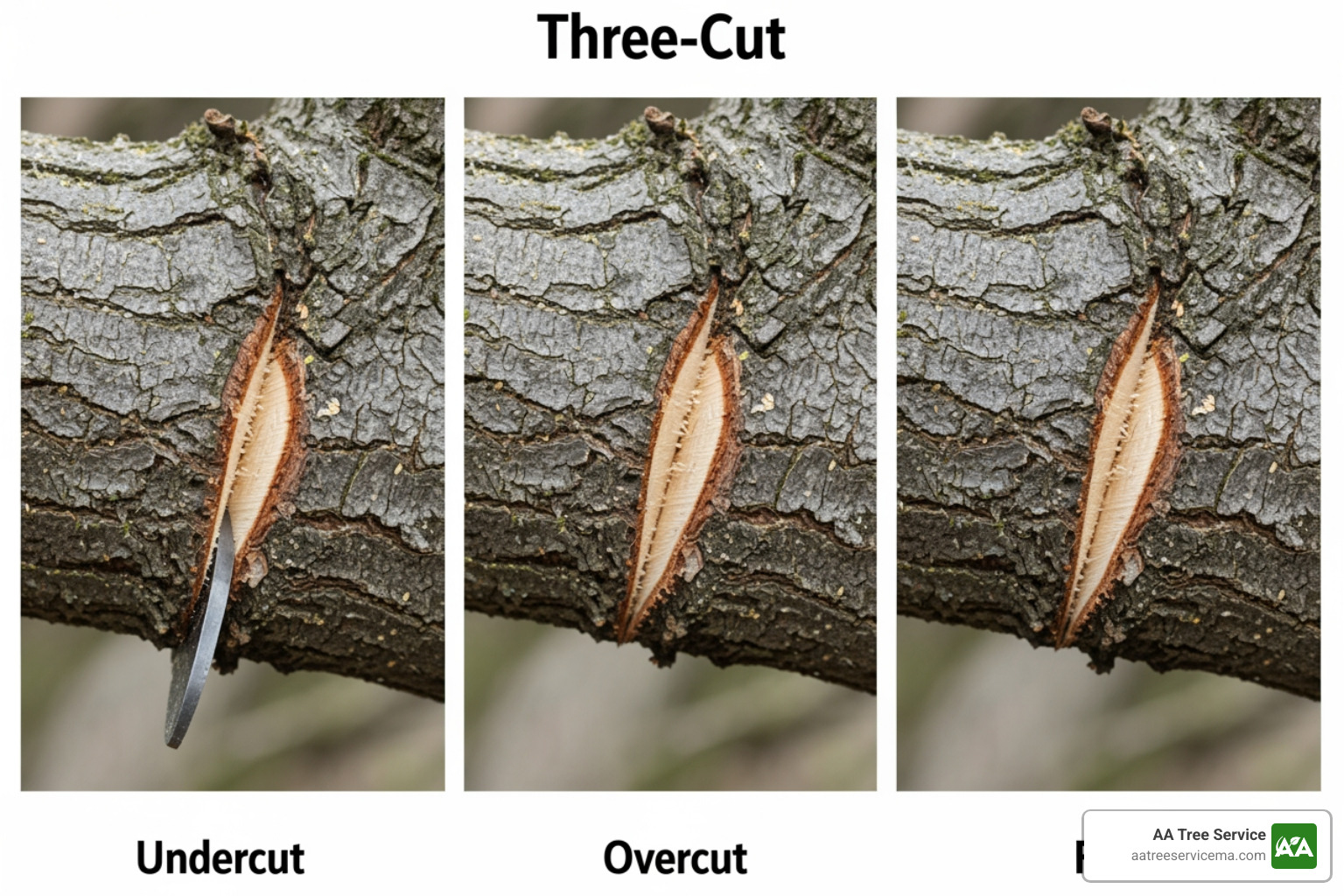
- For larger branches (over 1.25 inches), you must use the three-cut method to prevent the weight of the branch from tearing a strip of bark down the trunk:
- First Cut (Undercut): About 10-12 inches away from the trunk, make a cut from the bottom of the branch upward, going about one-third of the way through. This cut stops a tear from running down the trunk.
- Second Cut (Relief Cut): Move a few inches out from the first cut (further from the trunk) and saw from the top down. The branch will break away cleanly between the two cuts.
- Final Cut: You are now left with a manageable, lightweight stub. Remove this stub with a careful, precise cut just outside the branch collar.
Throughout the year, you should also remove suckers (vigorous shoots that emerge from the tree’s base or roots) and water sprouts (fast-growing, vertical shoots that erupt from the trunk or older branches). These growths are not structurally sound and drain valuable energy from the main canopy. Cut them off flush with their point of origin as soon as you see them.
Each cut is a controlled injury, so making it correctly is vital for the tree’s ability to defend itself. For expert help, consider our Tree Pruning and Trimming services in Massachusetts and New Hampshire.
Step 3: How Much is Too Much? Following the 25% Rule
It’s easy to get carried away with pruning, but removing too much at once can severely stress a young tree, hindering its growth and making it vulnerable. The golden rule for pruning young maple trees is to never remove more than 25-30% of the tree’s total live foliage in a single year. Leaves are the tree’s food factories, and it needs a full canopy to produce the energy required for growth and wound healing.
- Years 1-2 After Planting: Pruning should be minimal. Only remove branches that are broken, dead, or clearly damaged. The tree’s primary focus is on establishing its root system, and it needs all its leaves to power that process.
- Starting in Year 3: Begin light structural pruning. Focus on making just a few key cuts to establish the leader and remove any immediate problems. Plan to prune every other year until the tree is about 10 years old. This gradual, patient approach guides growth without causing shock.
- After Age 10: By this point, the maple’s primary structure will be well-established. Pruning will become less frequent (every 3-5 years) and will focus more on maintenance—removing deadwood and maintaining clearance.
When pruning, prioritize your cuts in this order: 1) Dead or damaged wood. 2) Structural problems like co-dominant leaders and weak branch angles. 3) Crossing branches and inward-growing stems. If you need to raise the crown for clearance over a sidewalk or lawn, do so gradually over several years, removing only the lowest one or two limbs at a time. Patience is essential; it’s always better to prune less and come back next season than to remove too much at once.
Common Pruning Mistakes and How to Avoid Them
Good intentions can easily lead to harmful mistakes when pruning young maple trees. Knowing what not to do is just as important as knowing the right techniques. Here are the most common and damaging errors we see homeowners make in Massachusetts and New Hampshire.
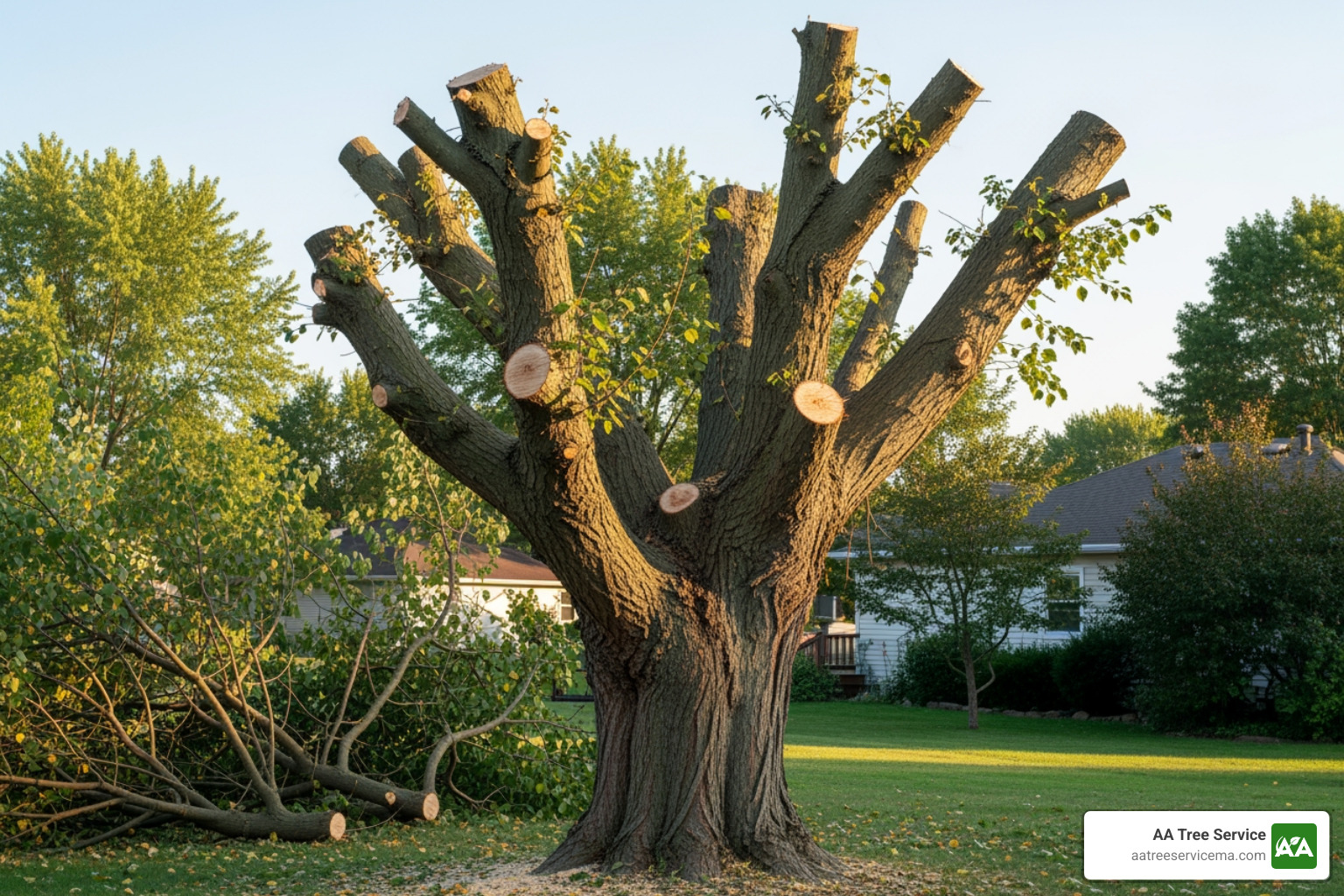
- Topping: This is by far the most destructive practice. It involves indiscriminately cutting large branches and the main trunk back to stubs to reduce a tree’s height. Topping ruins the tree’s natural form, creates large, ugly wounds that cannot heal and invite decay deep into the tree, and triggers a stress response of weak, poorly attached shoots (water sprouts) that are prone to breaking. A topped tree is a permanently disfigured and hazardous tree. Never top a tree.
- Leaving Stubs (Stub Cutting): When you make a cut too far from the trunk, you leave a short stub of the branch. The tree cannot seal over this dead wood, as the healing tissue (branch collar) is too far away. This stub will die, rot, and become a superhighway for pests and fungi to enter the main trunk.
- Flush Cutting: This is the opposite mistake—cutting into or completely removing the branch collar. This damages the tree’s natural healing mechanism (a process called compartmentalization, or CODIT), creating an unnecessarily large wound that is far more vulnerable to infection and takes much longer to seal, if it can at all.
- Over-pruning: Removing more than 25-30% of a tree’s live canopy in one year is like taking away a third of its food supply. This starves the tree of the energy it needs to grow, defend itself, and heal the pruning wounds. It leads to stress, weakness, and increased vulnerability to pests and disease. It can also cause sunscald on bark that was previously shaded.
- Using Wound Dressings: Decades ago, it was common practice to apply tree paint or tar-like dressings to pruning cuts. However, extensive research has shown that these products do more harm than good. They do not stop decay and can trap moisture against the wound, creating an ideal environment for fungal growth. They also interfere with the tree’s natural ability to form callus tissue and seal off the injury. A clean, proper cut left exposed to the air is the best treatment.
- Ignoring the Tree’s Natural Form: Trying to force a maple with a naturally spreading habit into a narrow, upright form (or vice versa) is a losing battle. While you can guide a tree’s growth, you should work with its inherent genetic tendencies. Fighting its natural form leads to constant, heavy pruning and a stressed, unattractive tree.
If you’re ever uncertain about a pruning job, our Professional Tree Pruning Services can help you avoid these costly mistakes and ensure your young maple gets the expert start it needs to thrive.
Frequently Asked Questions about Pruning Young Maples
Homeowners in Massachusetts and New Hampshire often have excellent questions about the specifics of pruning young maple trees. Here are detailed answers to some of the most common queries we receive.
Should I prune a maple tree in its first year after planting?
No, it’s best to wait. For the first two to three years after being planted, a young maple is dedicating almost all of its energy to establishing a strong, expansive root system. This is the foundation for its entire life. During this critical establishment period, your focus should be on consistent watering and mulching. The only exception is to use clean pruners to remove any branches that were clearly broken or damaged during shipping or the planting process itself. Save any structural pruning for the third year, once the tree is well-established and showing vigorous new growth.
My young maple has two main trunks. What should I do?
This is a very common structural issue known as co-dominant leaders. It creates a weak point where the two trunks meet, often with included bark, making the tree highly susceptible to splitting apart in a storm as it gets older and heavier. To fix this, you must establish a single leader. First, choose the strongest, most central, and most upright trunk to be the permanent leader.
Then, instead of removing the competing leader all at once (which could be too much for the tree), you should subordinate it. Reduce its length by about one-third to one-half, making sure to cut back to a lateral branch. This slows its growth and signals to the tree that the other trunk is dominant. You can gradually reduce it further or remove it entirely over the next couple of pruning seasons.
How do I choose the main ‘scaffold’ branches?
Scaffold branches are the large, permanent limbs that will form the primary structure of the tree’s canopy. Selecting them is a key part of early pruning. The ideal scaffold branches have a wide, strong attachment angle (45-60 degrees) and are well-spaced. Aim for vertical spacing of at least 8-12 inches between branches on the same side of the trunk. You also want good radial spacing, meaning the branches should emerge from the trunk in a spiral pattern, like a staircase, not all from the same side.
This distributes weight evenly and allows light to reach all parts of the canopy. In each pruning session, identify 3-5 promising young branches that fit this description and remove others that are too close, have poor angles, or are weak.
What if my maple is several years old and has never been pruned?
It’s not too late, but you’ll need to be more patient. A 5- to 7-year-old unpruned maple will likely have several structural issues, such as co-dominant leaders and clusters of poorly attached branches. The key is to correct these issues gradually over several years. Start by removing any dead or damaged wood. Then, in the first year of corrective pruning, identify the most significant structural flaw—usually a co-dominant stem—and subordinate it as described above.
You might also remove one or two branches with the worst attachment angles. Then, wait until the next pruning cycle (a year or two later) to address the next set of issues. Trying to fix everything at once would require removing too much of the canopy and would severely stress the tree.
Is pruning a Japanese Maple the same as a Sugar Maple?
While the fundamental techniques are similar, the goals are often very different. The core principles—making clean cuts outside the branch collar, removing dead wood, and not over-pruning—apply to all maples. However, this guide focuses on structural pruning for large landscape maples like Sugar, Red, and Norway Maples, where the primary goal is creating a strong, safe, and durable framework.
Japanese Maple Tree Pruning, in contrast, is often more about aesthetics and art. These smaller, ornamental trees are valued for their unique, graceful, and often weeping or multi-stemmed forms. Pruning a Japanese Maple may involve enhancing its natural cascading shape or thinning out the canopy to reveal its intricate branch structure, rather than forcing a single central leader. While good structure is still important for health, the artistic form often takes higher priority.
Conclusion: Nurturing Your Maple for a Lifetime of Beauty
Pruning young maple trees is one of the most impactful and long-lasting investments you can make in your landscape. It is a proactive dialogue with your tree, guiding it toward a future of strength, health, and enduring beauty. The careful, purposeful cuts you make today will create a landmark that could provide shade, value, and enjoyment for generations.
A tree that receives proper structural pruning in its youth grows into a fundamentally healthier, stronger, and safer asset. It will be far more resistant to the heavy snow and ice loads of a New England winter and better able to withstand high winds from summer thunderstorms.
A well-structured tree is also less prone to disease and pest infestations and is far less likely to require expensive, high-risk corrective work or emergency removal in its maturity. For maple lovers in Massachusetts and New Hampshire, this early care is the key to developing the classic, graceful, and resilient shade trees we all admire.
Think of it as setting your tree up for success. You are building a framework that will support decades of growth and prevent predictable failures. Of course, knowing when to call for help is also a sign of smart tree stewardship. If you’re uncertain about making the right cuts, feel the job is too complex, or simply want the peace of mind that comes with professional expertise, our team at AA Tree Service is ready to assist.
With over 20 years of experience, we approach each young tree with its long-term health and your long-term satisfaction as our top priorities. Explore our Expert Tree Pruning and Trimming services to learn how we can help your maples reach their full, magnificent potential.