Understanding Summer Pruning for Japanese Maples
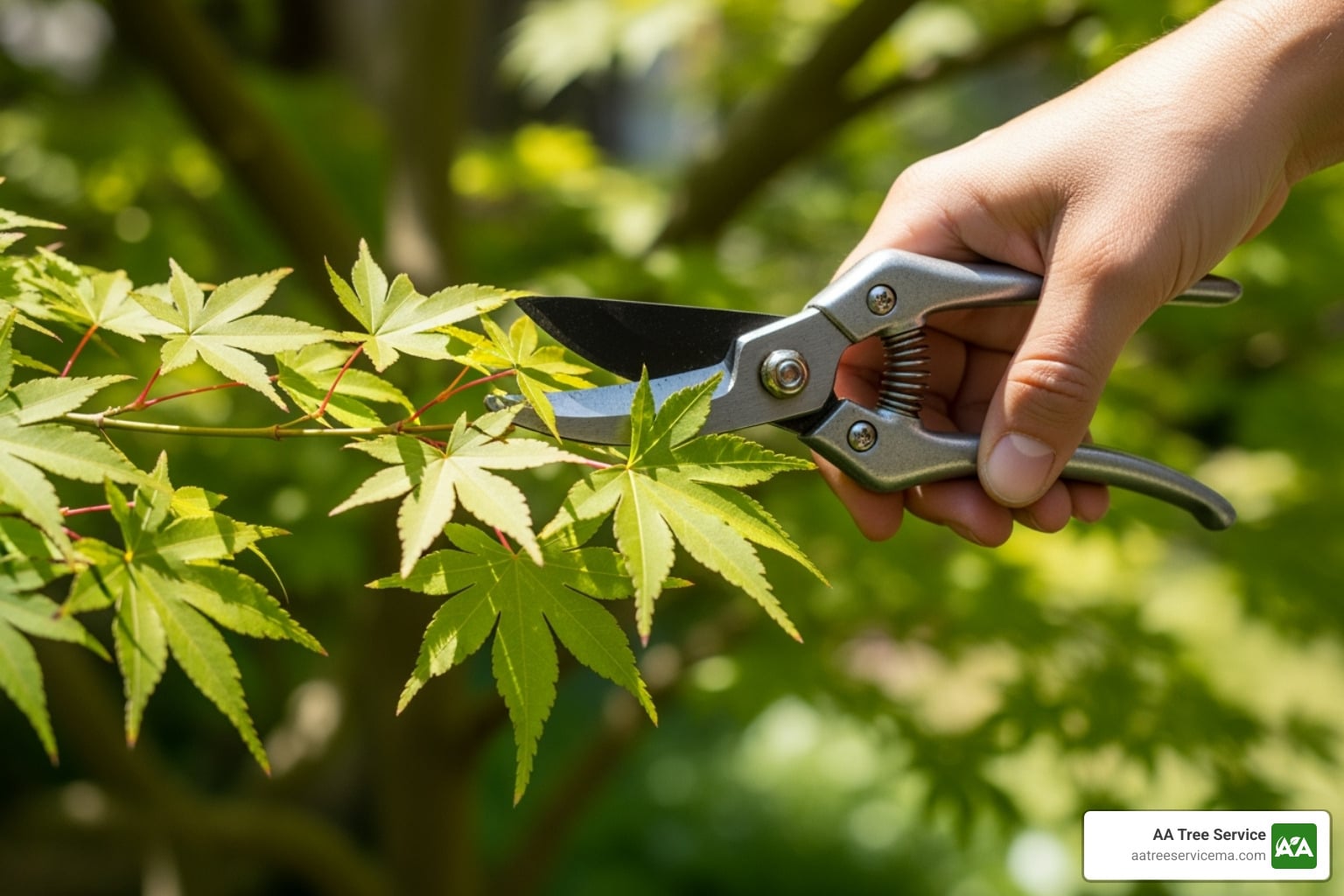
Pruning japanese maple in summer is a delicate, highly specialized maintenance task. It is not about major removal but about light, strategic thinning to enhance the tree’s health, beauty, and structure during its active growing season. Unlike the heavy structural work done in winter, summer pruning is a minimalist art form focused on removing water sprouts, dead twigs, and selectively thinning dense areas to improve airflow and light penetration. This careful approach keeps the tree healthy and vibrant without inducing the stress that heavy pruning would cause during the summer months.
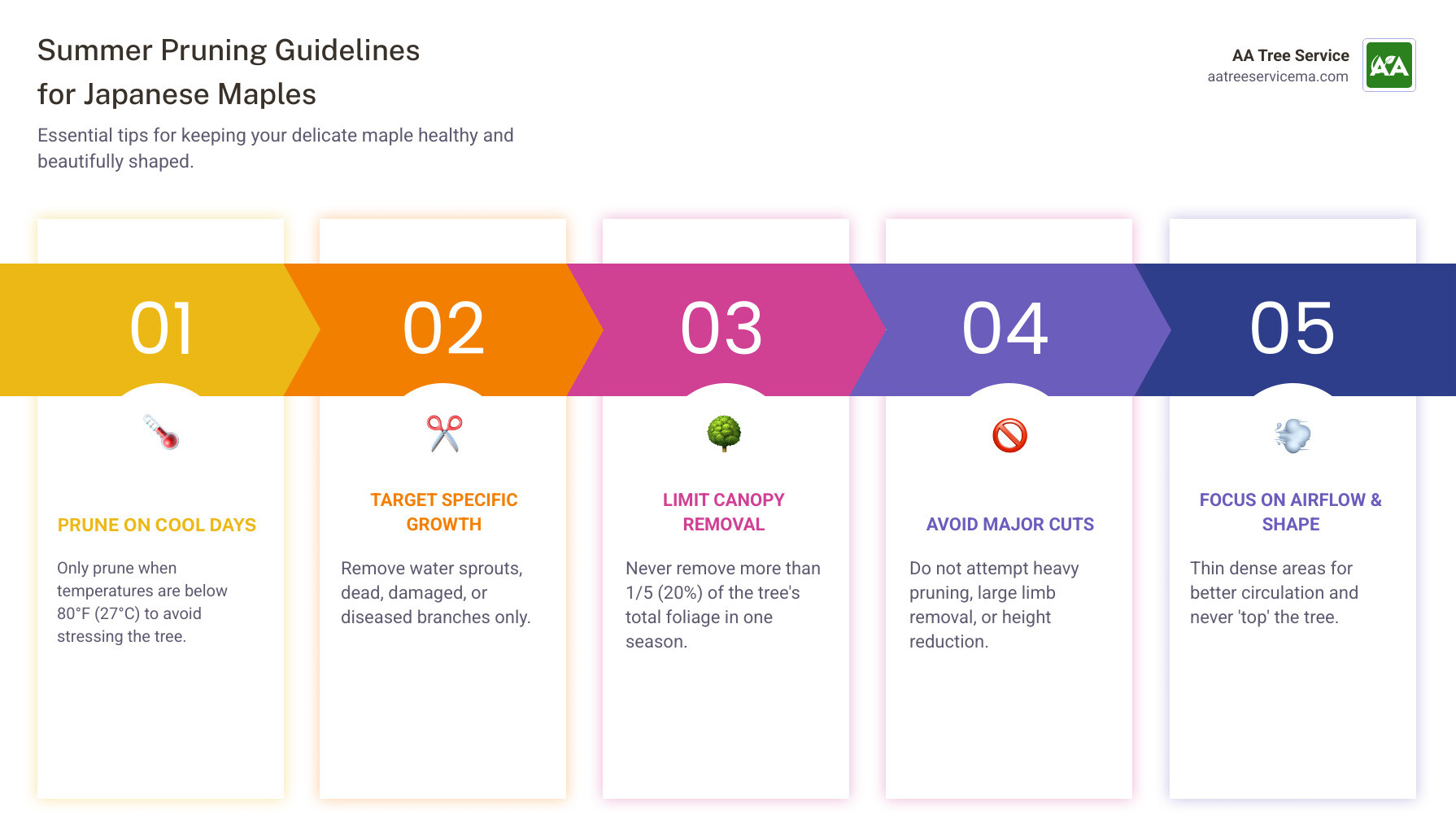
Quick Answer: Can You Prune Japanese Maples in Summer?
Yes, but it must be done with extreme caution and a clear understanding of the tree’s needs. Here’s a more detailed breakdown of what you need to know:
- Best for: Light, corrective work. This includes removing vigorous, upright water sprouts that disrupt the tree’s form, snipping out small dead or diseased twigs, and minor thinning of congested areas to let light and air through. Think of it as a touch-up, not a transformation.
- Avoid: Any major structural changes. This means no large cuts (thicker than your finger), no heavy canopy reduction, and absolutely no pruning in temperatures above 80°F. Pruning in high heat adds significant stress to a tree that is already working hard to stay cool and hydrated.
- Limit: Remove no more than 1/5 (20%) of the total canopy. The leaves are the tree’s energy factories; removing too many during the growing season can starve the tree and severely weaken it.
- Goal: The primary objectives are to improve airflow to reduce the risk of fungal diseases, manage unwanted growth to maintain the tree’s natural, graceful shape, and make small aesthetic refinements that are only visible when the tree is in full leaf.
- When NOT to prune: Never prune during periods of extreme heat, drought, or if the tree is showing any signs of stress (wilting, discolored leaves). A stressed tree needs all its resources to survive, not to heal pruning wounds.
Japanese maples are the jewels of many landscapes in Massachusetts and New Hampshire, prized for their delicate, intricate leaves and elegant, sculptural branches. This very delicacy—thin bark susceptible to sunscald, a fine root system sensitive to stress—demands a thoughtful and gentle approach to any maintenance, especially summer pruning. The region’s often humid summers and potential for sudden heatwaves make this task even more critical to perform correctly.
While risky if done improperly, summer pruning offers unique advantages. With the tree fully leafed out, an experienced eye can easily identify the exact density of the canopy, spot branches that are crossing and rubbing, and pinpoint areas with poor airflow that are invisible in winter. This allows for incredibly precise corrections. Furthermore, summer pruning stimulates significantly less regrowth compared to winter pruning. This means your careful work will last longer, and the tree will remain open and airy without immediately trying to fill the gaps with new, often weak, shoots.
However, the risks of summer pruning cannot be overstated. The intense New England summer sun can easily scorch newly exposed bark, a condition known as sunscald. Because the tree is in its active growth phase, every cut requires precious energy to heal, diverting resources from root development and defense against pests and diseases. The key to success lies in a deep understanding of what to prune, the perfect time to do it, and, most importantly, when to put the pruners down.
Terms related to pruning japanese maple in summer:
Why Prune a Japanese Maple in Summer?
Pruning japanese maple in summer is akin to a gentle haircut, not a dramatic makeover. It’s a process of thoughtful refinement and minor corrections performed while the tree is in full leaf, allowing for immediate aesthetic feedback. One of the most significant benefits of this timing is that it stimulates slower, more controlled regrowth compared to dormant-season pruning.
When you prune in winter, the tree responds in spring with a vigorous burst of new shoots to replace what was lost. In contrast, summer pruning removes foliage that is actively photosynthesizing, which tempers the tree’s growth response. This means your work lasts longer, and the tree remains open and airy without sending up a forest of new shoots to fill every gap.
Improve Airflow and Reduce Disease Risk
A dense, thick canopy might appear lush from a distance, but on the inside, it can create a microclimate of high humidity and stagnant air. This is the perfect breeding ground for a host of fungal diseases, such as powdery mildew, anthracnose, and botrytis.
By selectively thinning these dense areas during the summer, you dramatically improve airflow and allow sunlight to penetrate the interior of the tree. This helps leaves dry more quickly after rain or morning dew, significantly reducing the risk of fungal spores taking hold. Furthermore, this improved environment is less hospitable to common pests like aphids, spider mites, and scale, which thrive in crowded, sheltered conditions. In essence, you are giving your tree the space it needs to breathe and naturally defend itself.
Refine Shape and Manage Unwanted Growth
Summer is the ideal time for aesthetic fine-tuning precisely because you can see the tree’s true shape and volume with all its leaves. It is the best season to identify and remove aggressive water sprouts—the fast-growing, vertical shoots that often erupt from the trunk or main branches. These sprouts are not only unsightly, disrupting the tree’s graceful lines, but they are also structurally weak and steal vital energy from the more desirable parts of the tree.
You can also easily spot and correct crossing branches that rub against each other, creating wounds in the bark that serve as entry points for disease and decay. The goal of summer pruning is to reveal and enhance the tree’s natural, elegant form by simplifying its structure and directing its energy toward healthy, well-placed growth.
Assess the Tree in Full Leaf
The single greatest advantage of summer pruning is the ability to see the complete picture. With its full complement of foliage, the tree reveals its secrets: which areas are too crowded, which branches are competing for the same space, and how light filters through the canopy. This allows for what is known as “real-time shaping.”
You can make a small cut, step back, and immediately assess its impact on the tree’s overall form and balance. There is no guesswork involved, which is crucial when working with such a valuable specimen. This approach is central to the philosophy of Aesthetic Pruning, a practice that focuses on revealing a tree’s essence by simplifying its structure and creating harmony. Your cuts become more intentional and artistic when you can evaluate their full effect instantly, ensuring the result is a healthier and more beautiful tree.
The “How-To” of Pruning Japanese Maple in Summer
When pruning japanese maple in summer, the guiding principle must always be a light touch. Approach the task not as a chore, but as a collaboration with the tree, like a sculptor carefully revealing the natural beauty hidden within the stone. These famously delicate trees respond best to a minimalist, “less is more” philosophy.
The goal is to make a series of small, precise cuts that improve the tree’s structure and health without causing undue stress. Before you even pick up a tool, take the time to understand your tree’s unique personality—whether it’s a weeping, upright, or dwarf variety, and whether its natural tendency is to be airy or dense—and commit to working with, not against, its existing form.
Essential Tools for the Job
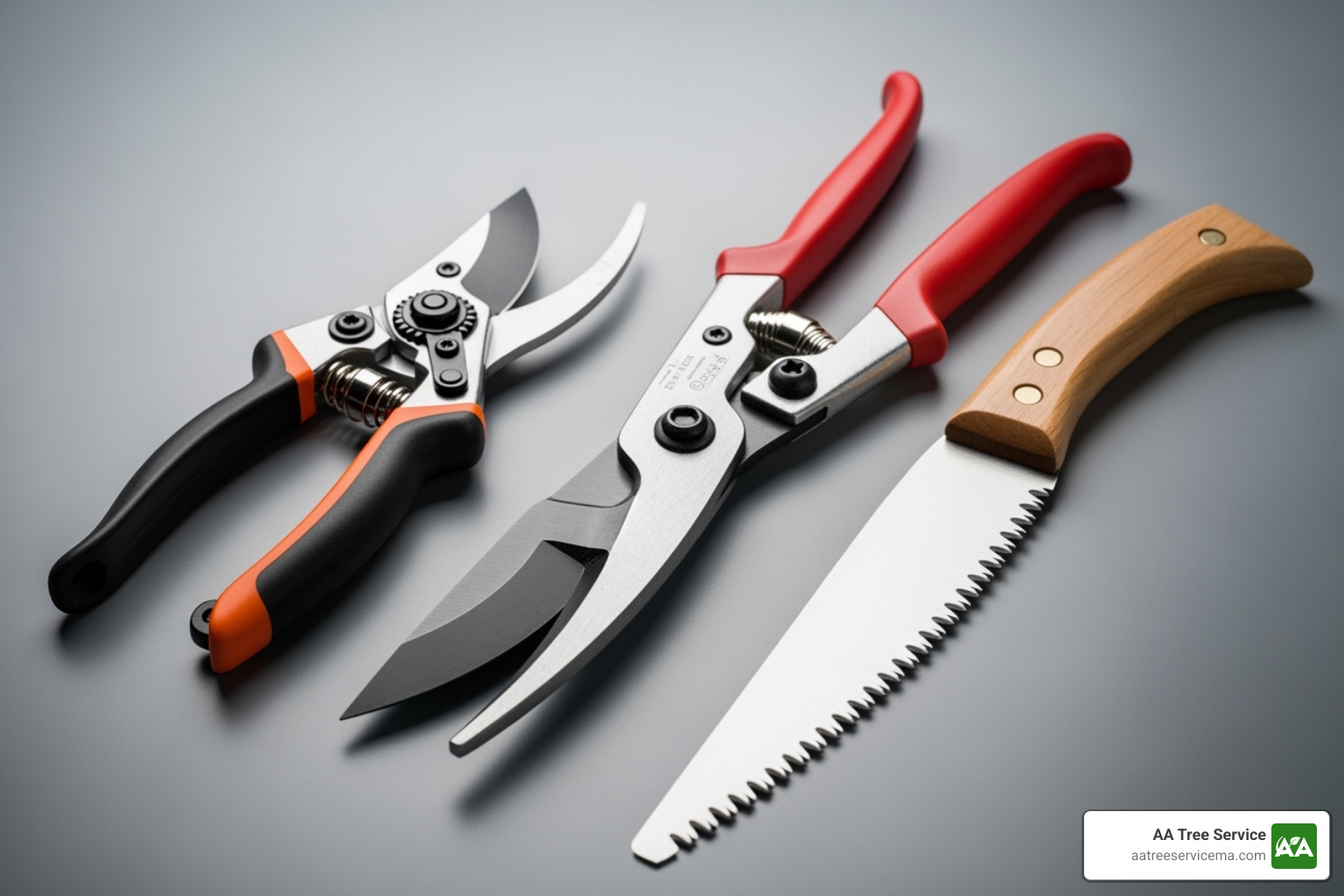
Using the right tools is non-negotiable, and they must be impeccably clean and razor-sharp. Dull tools crush and tear delicate branches, creating ragged wounds that heal slowly and invite disease. For most summer pruning tasks on a Japanese maple, you will only need a few key items:
- Bypass Hand Pruners: This will be your primary tool. Unlike anvil pruners that crush stems, bypass pruners work like scissors, making a clean cut that is essential for small branches up to the size of a pencil.
- Concave Cutters: A tool borrowed from the world of bonsai, these are ideal for making perfectly flush cuts when removing small branches from the trunk or a larger limb, resulting in a wound that heals quickly and cleanly.
- Loppers: Use these for any branches that are too thick for hand pruners, generally up to the diameter of your thumb. Again, ensure they are the bypass type.
- Small Folding Saw: For the occasional dead branch that is slightly larger, a small pruning saw can be useful. Use it with care to avoid damaging nearby branches.
A critical rule of plant hygiene: disinfect your tools with rubbing alcohol or a 10% bleach solution before you start and between each tree. If you are removing any branches that show signs of disease, disinfect the blade after every single cut to prevent spreading pathogens to healthy parts of the tree.
What to Target: The Pruning Checklist
Don’t snip randomly. Your pruning should be targeted and purposeful. Focus on removing branches that are detrimental to the tree’s health, structure, or appearance.
- The 4 D’s: Always begin by removing branches that are Dead, Diseased, Damaged, or Dying. These are not contributing to the tree’s health, drain its energy, and can be a source of infection.
- Crossing or Rubbing Limbs: Identify any two branches that are touching or rubbing against each other. The friction wears away the bark, creating wounds. Select the weaker or less well-placed of the two and remove it.
- Water Sprouts: These are weak, fast-growing vertical shoots that erupt from the trunk and main branches. They are structurally unsound and disrupt the tree’s elegant form. Cut them away cleanly at their point of origin.
- Inward-Growing Branches: Prune any branches that grow back toward the center of the tree. They contribute to congestion, block airflow, and create a tangled, messy appearance.
Step-by-Step Guide to Pruning Japanese Maple in Summer
1. Assess the Tree from All Angles: Before making a single cut, walk around the tree several times. Observe its natural shape, its balance, and its structure. Look up through the canopy from underneath. If you can’t see patches of sky (what pruners call “windows of light”), it likely needs thinning to improve light penetration and airflow.
2. Start with the Obvious Problems: Begin your work by cleaning out the 4 D’s (dead, diseased, damaged, dying). Next, remove any obvious structural faults like rubbing branches, inward-growing stems, and water sprouts. This initial cleanup often makes a significant difference and helps you see the tree’s underlying structure more clearly.
3. Thin the Canopy Thoughtfully: Now, shift your focus to thinning. The goal is to create an airy, layered effect that allows light and air to circulate freely. Instead of shearing the outside, reach into the canopy and selectively remove small branches at their point of origin. This opens up the structure without changing the tree’s overall size and shape. Remember that summer thinning results in less regrowth, so your work will have a lasting impact.
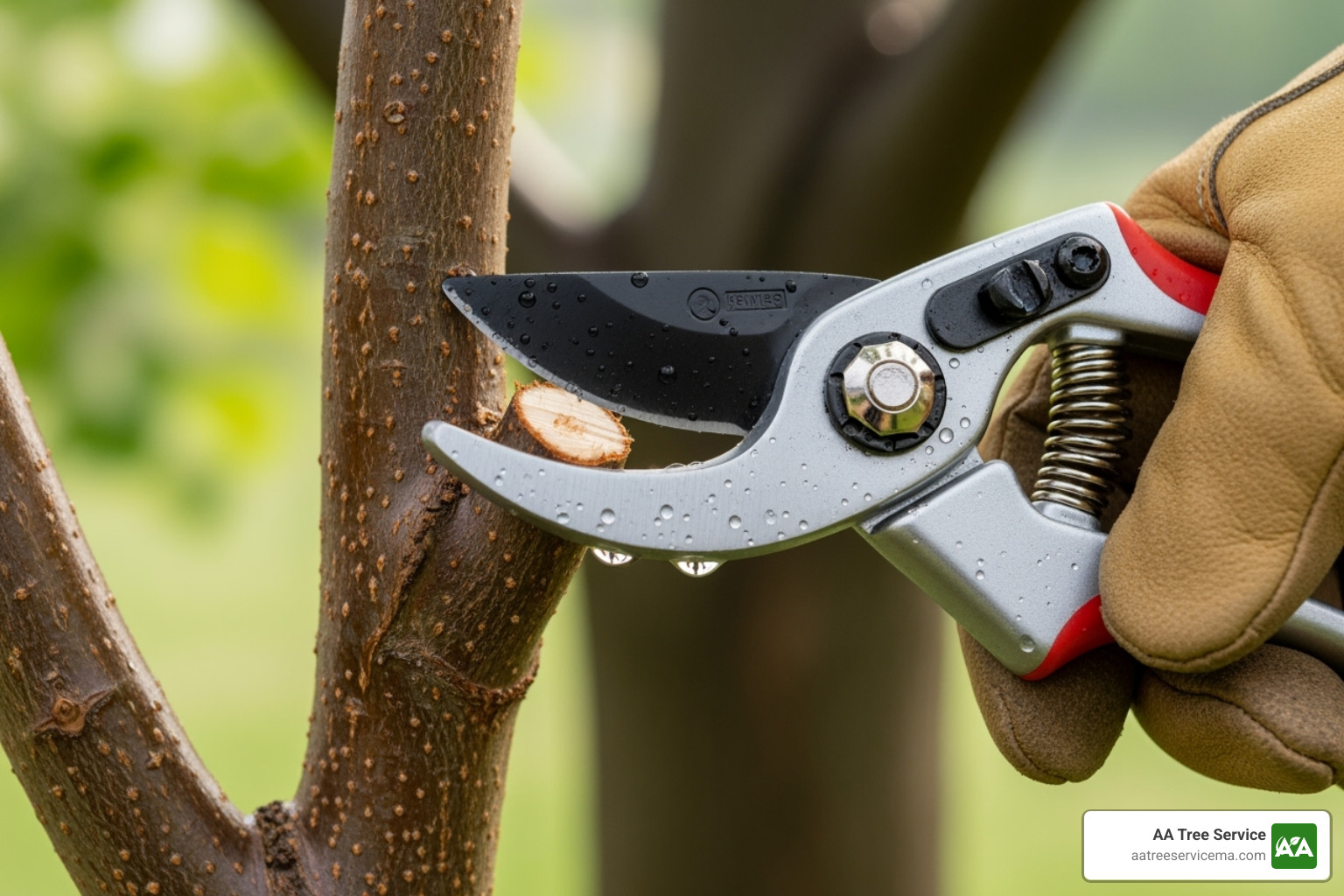
4. Make Clean, Proper Cuts: Every cut matters. When removing a branch, cut just outside the branch collar—the slightly swollen, wrinkled area where the branch joins a larger one. This collar contains specialized cells that will quickly grow over and seal the wound. Avoid leaving a stub, which will decay, and avoid cutting flush into the collar, which creates a larger wound that is difficult for the tree to heal.
5. Step Back and Evaluate Constantly: After every few cuts, put down your tools, step back, and walk around the tree again. It is incredibly easy to get carried away and remove too much. Frequent evaluation helps prevent over-pruning. Remember the golden rule: you can always remove more later, but you can never put a branch back on.
For any large, dead, or potentially hazardous branches, especially those that are high up or near structures, do not attempt to remove them yourself. DIY removal of large limbs is dangerous and can cause serious injury or property damage. Our emergency tree removal services are available 24/7 throughout Massachusetts and New Hampshire for situations that require expert handling and specialized equipment for maximum safety.
Summer vs. Winter Pruning: A Seasonal Comparison
Proper, year-round care for a Japanese maple hinges on understanding the profound difference between summer and winter pruning. These two practices are not interchangeable; they serve distinct purposes and elicit different responses from the tree. The simplest analogy is to think of winter pruning as major, structural surgery and pruning japanese maple in summer as a gentle, preventative check-up and tune-up. Each season’s work is guided by a unique set of goals for the tree’s long-term health and aesthetics.
| Feature | Summer Pruning (Active Season) | Winter Pruning (Dormant Season) |
|---|---|---|
| Timing | When tree is in full leaf (June-August in New England) | During dormancy (late fall to early spring) |
| Primary Goal | Light maintenance, thinning for airflow, shape refinement, reducing growth, disease prevention | Major structural work, correcting framework, large limb removal, stimulating vigorous spring growth |
| Tree Response | Stimulates very little new growth, slows overall vigor, directs energy to roots and storage | Promotes a strong flush of vigorous new growth in the spring as hormones surge |
| Visibility | Full canopy clearly shows leaf density, light penetration, and aesthetic balance | Bare branches provide a clear, unobstructed view of the tree’s structural framework |
| Risk | High risk of sunscald, heat/drought stress, and disease entry through fresh cuts | Minimal stress on the tree, faster healing for large cuts before spring growth begins |
| Types of Cuts | Small, selective cuts on branches pencil-thick or smaller; water sprouts, dead/diseased wood, minor thinning | Can include large cuts to remove major structural branches, significant height/width reduction |
Key Goals for Pruning Japanese Maple in Summer
The primary objectives for pruning japanese maple in summer are maintenance and refinement. This is the time for subtlety. The work involves thinning overly dense areas of the canopy to improve air circulation, removing unsightly water sprouts, and making minor adjustments to the tree’s shape that are only apparent when it’s fully leafed out. A key strategic benefit of summer pruning is that it slows down new growth. Because the tree is actively photosynthesizing and has less stored energy reserves than in winter, removing foliage tempers its vigor.
This is incredibly useful for managing the size of maples in small gardens, containers, or tight spaces where you want to keep the tree compact without resorting to harmful topping. The full canopy also acts as a perfect guide, allowing you to easily spot and correct problems like poor airflow or crowded branches that would be invisible on a bare winter tree.
Why Winter is for Major Structural Work
If your Japanese maple requires more than a light touch-up—for instance, if it has major structural flaws, is significantly overgrown, or has large, poorly placed limbs—then winter is the only appropriate time for the job. During its dormancy (from late fall to early spring in MA and NH), the tree is essentially asleep. It is not actively growing, so the shock of major pruning is minimized, and it can dedicate its stored energy reserves to healing the wounds once spring arrives. The bare branches provide crystal-clear visibility of the tree’s entire framework.
This is absolutely crucial for making informed decisions about removing large limbs or correcting fundamental structural problems. You can see the architecture of the tree without the distraction of leaves. Furthermore, winter pruning stimulates vigorous spring growth. The removal of branch tips breaks apical dominance, triggering a hormonal response that results in a strong flush of new shoots in the spring, which is perfect for filling in bare spots or rejuvenating an older tree. Always save any major reshaping or any cuts on branches thicker than your thumb for the winter dormant season.
The Risks of Summer Pruning and How to Avoid Them
While beneficial when done correctly, pruning japanese maple in summer is a high-stakes activity that carries significant risks not present during winter dormancy. The primary concerns for any homeowner in Massachusetts and New Hampshire are inducing severe tree stress, causing irreparable sunscald damage, and the all-too-common mistake of over-pruning. The combination of active growth, summer heat, and open wounds can be a dangerous cocktail for a delicate tree. Fortunately, a conservative, well-timed, and knowledgeable approach can help you avoid these common pitfalls and ensure your pruning helps, rather than harms.
Mitigating Sunscald on Bark and Leaves
Sunscald is one of the most immediate and damaging risks of improper summer pruning. The inner branches and leaves of a dense Japanese maple have spent their entire lives in the shade, protected by the outer canopy. When you prune away that protective layer, this tender tissue is suddenly exposed to the full intensity of the summer sun. The result is akin to a severe sunburn: the bark can become discolored, cracked, and killed, appearing brown and scorched, while newly exposed leaves can look bleached and crispy. This damage is not just cosmetic; it creates dead spots on the bark that become permanent entry points for boring insects and fungal diseases.
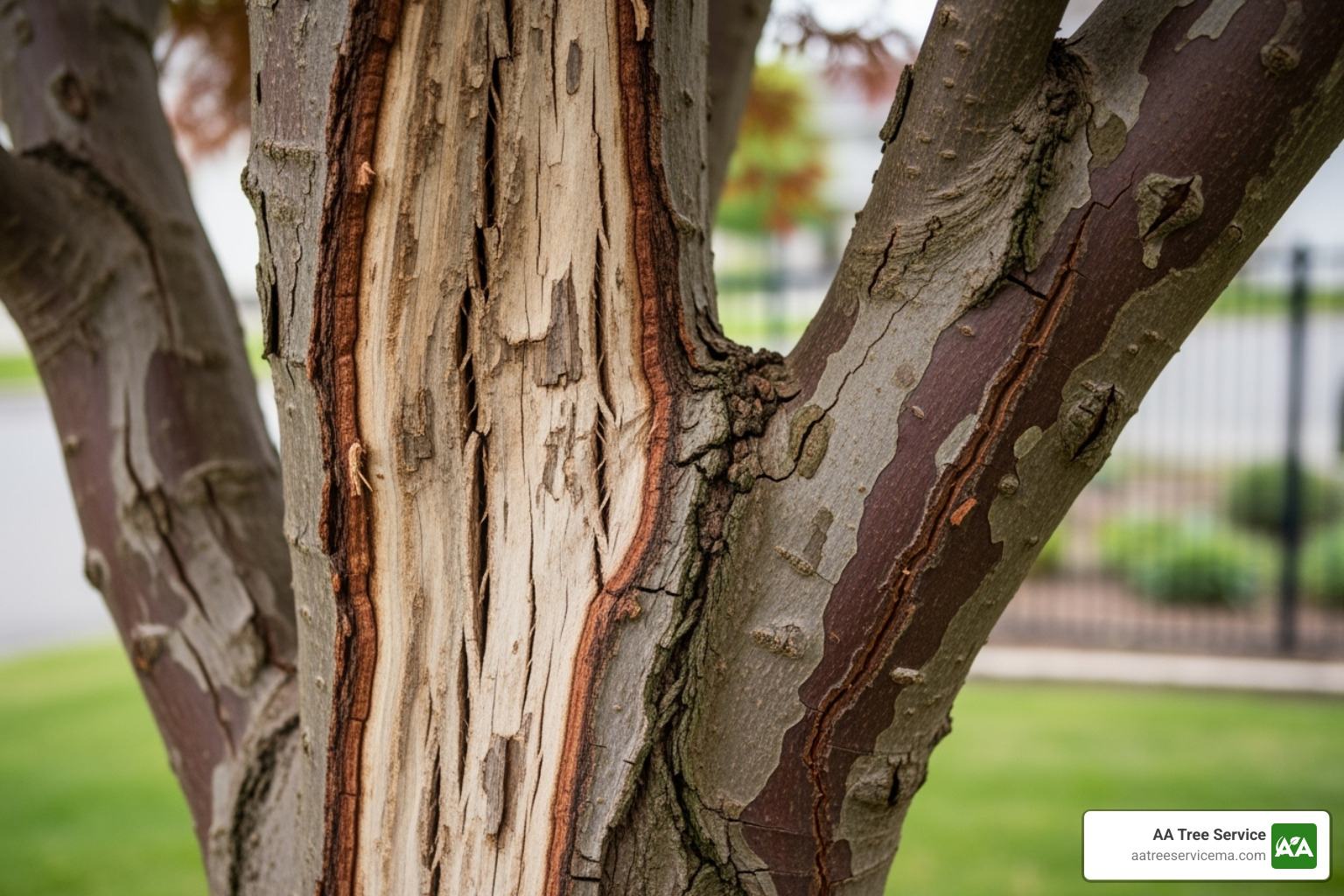
To prevent sunscald, timing and restraint are everything. Never prune on a hot, sunny day, especially when temperatures are forecasted to be above 80°F. Wait for a cooler, overcast day to reduce the intensity of the sun on the freshly exposed tissues. The most important golden rule is to never remove more than one-fifth (20%) of the tree’s total canopy in a single summer season. The outer foliage is the tree’s natural sunscreen; removing too much leaves the sensitive inner tree completely vulnerable.
Preventing Over-Pruning and Physiological Stress
Over-pruning is perhaps the most common mistake made by enthusiastic but inexperienced gardeners. It’s easy to get carried away, taking a little here and a little there, until you’ve removed a shocking amount of foliage. This sends the tree into a state of shock. It drastically reduces the tree’s ability to photosynthesize and produce the energy it needs for survival, forcing it to rely on limited stored reserves. An over-pruned tree will exhibit clear signs of stress, including wilting leaves (even when watered), sudden branch dieback, or a general lack of vigor for the rest of the season and even into the next year.
To avoid this, focus exclusively on making small, targeted cuts on branches that are pencil-thick or smaller. Summer is not the time for major structural work or size reduction. If you are thinning the canopy, do it gradually over several years, not all at once. You can always prune more next year, but you can’t undo an overzealous cut.
Before you even consider pruning, assess the tree’s current health. Look for signs of pre-existing stress like discolored or drooping leaves, signs of insect infestation, or drought damage. If the tree is already struggling, do not prune it. Postpone any trimming until the tree has fully recovered. A stressed tree needs to conserve all its energy for healing and defense, not for dealing with the additional trauma of new wounds. When it comes to summer pruning, less is always more.
Is Your Japanese Maple a Candidate for Summer Pruning?
Not every Japanese maple needs, or should have, a summer trim. The decision to begin pruning japanese maple in summer should be a thoughtful one, based on a careful assessment of the tree’s age, current health, specific variety, and its growth habits. A young, recently planted tree may need no intervention at all as it establishes its root system, while a dense, mature specimen might greatly benefit from a selective thinning. The key is to move beyond a one-size-fits-all approach and learn to read your individual tree’s signals.
Signs Your Maple Needs a Summer Trim
How can you tell if your maple is asking for a light summer prune? Get up close and observe it carefully. Look for these specific clues:
- Dense, Impenetrable Canopy: Look up through the branches from underneath the tree. If you cannot see distinct patches of blue sky or light, the canopy is likely too dense. This restricts essential light and air from reaching the inner parts of the tree.
- Lack of Interior Foliage: A related sign is when the interior of the tree is completely bare of leaves and small twigs. This indicates that the outer canopy is so thick that it’s shading out and killing all growth on the inside.
- Poor Airflow: After a rain shower, do the leaves in the center of the tree stay wet for hours? Does the air inside the canopy feel stagnant and humid? This is a major red flag for potential fungal diseases. Good air circulation is vital for a healthy tree.
- Crossing or Rubbing Branches: While the tree is in full leaf, it’s easy to spot branches that are growing into each other and rubbing. This friction creates wounds in the bark, which are open doors for pests and disease.
- Abundant Water Sprouts: If your tree has numerous vigorous, upright shoots growing from the trunk or main limbs, summer is the perfect time to remove these energy-draining and unsightly growths.
- Dead Twigs: Any small dead branches that weren’t obvious in winter but are now clearly visible amidst the green foliage can and should be removed.
Varieties and Their Sensitivity
Different Japanese maple varieties have distinct growth habits and, therefore, different pruning needs. Understanding your specific cultivar is crucial.
- Weeping Varieties (e.g., ‘Tamukeyama’, ‘Inaba Shidare’, ‘Ryusen’): These graceful, cascading forms benefit greatly from light summer thinning. The goal is to reduce congestion and untangle overlapping branches to reveal and enhance their elegant, weeping structure. This prevents them from becoming a dense, tangled mass.
- Upright Varieties (e.g., ‘Bloodgood’, ‘Emperor I’, ‘Sango Kaku’): These tend to be more vigorous growers and can quickly develop overly dense canopies. They are often excellent candidates for summer thinning to improve health, structure, and appearance. For a variety like ‘Sango Kaku’ (Coral Bark Maple), selective pruning can also help to feature the brightly colored stems for winter interest.
- Dwarf Varieties (e.g., ‘Mikawa Yatsubusa’, ‘Shishigashira’): These compact growers naturally require less pruning overall. However, they can be gently shaped in summer with very minor cuts to maintain their tight, unique form and remove any errant shoots.
- Variegated Varieties (e.g., ‘Oridono Nishiki’, ‘Butterfly’): Be extra cautious with these cultivars. Their variegated leaves are often more sensitive to sun, and opening up the canopy too much can easily lead to leaf scorch.
Regardless of the variety, you should always avoid pruning japanese maple in summer during periods of extreme heat and drought, which are common in Massachusetts and New Hampshire. Every tree is an individual; observe how yours responds to its environment and always be conservative in your approach.
Frequently Asked Questions about Pruning Japanese Maples in Summer
How much can I safely prune from my Japanese maple in summer?
The absolute golden rule is to never remove more than one-fifth (20%) of the tree’s total foliage in one season. For a delicate tree like a Japanese maple, even this can be too much, so it’s often better to aim for 10-15%. Removing too many leaves severely limits the tree’s ability to photosynthesize and produce the energy it needs to survive the summer and prepare for winter, causing significant stress.
Focus exclusively on making small, selective cuts on branches less than a finger’s width in diameter. Prioritize removing dead, damaged, or clearly problematic growth like water sprouts and crossing limbs. A good guideline is that the pile of pruned branches on the ground should look surprisingly small. This conservative approach is the key to keeping the tree healthy. You can always prune a little more next year, but you can’t put branches back.
Can I prune to reduce the height of my Japanese maple in summer?
No, this is strongly discouraged. Attempting to reduce the height or overall size of a Japanese maple in summer through “topping” or indiscriminate cutting is one of the most harmful things you can do. It causes extreme stress and triggers a panic response from the tree: a flush of weak, unattractive, vertical sprouts (a “hydra effect”) that grow rapidly from the site of the cuts.
These new shoots are poorly attached, prone to breaking, and completely ruin the tree’s natural, graceful form. If significant size reduction is absolutely necessary, you must wait until the tree is fully dormant in winter. The tree is better equipped to handle major cuts during dormancy, and the subsequent spring growth will be healthier and more structured. For any pruning japanese maple in summer, stick strictly to light thinning and minor shaping only.
What if I see a large dead or broken branch in the summer?
Yes, this is an exception to the “no large cuts in summer” rule. Large dead or broken branches are considered hazards and should be removed immediately, regardless of the season. They pose a significant risk, as they can fall unexpectedly and cause serious injury or property damage. While removing large branches in summer is not ideal for the tree’s health (as the wound is larger and more susceptible to pests and disease), safety must always come first.
If the branch is large, high up, near power lines, or otherwise difficult to reach safely, do not attempt a DIY removal. This is a job that requires a trained professional with the right safety gear and equipment. Call for professional tree services to handle hazardous limbs safely and efficiently. We offer 24/7 emergency service for these exact situations.
Should I apply wound paint or sealant to the cuts?
No, you should not. This is an outdated practice that has been proven to be ineffective and often harmful. Modern arboricultural research has shown that for the small cuts appropriate for summer pruning, wound dressings are unnecessary. A healthy tree has its own highly effective mechanisms for sealing off wounds (a process called compartmentalization). Applying sealant can actually trap moisture and pathogens against the wood, inhibiting this natural healing process and potentially promoting decay. It’s far more important to make a clean, proper cut just outside the branch collar and let the tree heal itself.
Trust the Experts with Your Delicate Maple
Pruning japanese maple in summer is not a simple task of trimming branches; it is a delicate art form that requires a trained eye, a deep understanding of tree biology, and years of hands-on experience. While this guide covers the fundamental principles, flawlessly executing them on a valuable, mature tree is another matter entirely.
Japanese maples are widely considered among the most difficult trees to prune well due to their intricate structure and sensitivity to stress. A single misplaced cut by an amateur can cause lasting harm, leading to sunscald, a flush of weak and ugly regrowth, or a permanently unbalanced and unnatural shape. In many cases, half-done or improper trimming can be far worse for the tree’s health and appearance than no trimming at all.
That’s where professional care from a certified arborist makes all the difference. The team at AA Tree Service brings over 20 years of specialized experience working with these delicate ornamental trees across Massachusetts and New Hampshire. We understand the immense restraint and precision that summer pruning demands. Our approach is not about removal, but about enhancement. We know exactly what to look for, when to make a cut, and—most importantly—when to leave well enough alone to protect the tree’s vitality.
A professional consultation involves more than just a quick look. We conduct a thorough assessment of your tree’s specific variety, its location in your landscape, its sun exposure, and its overall health before we even consider making a cut. This allows us to create a tailored pruning plan that serves as a long-term healthcare strategy for your landscape’s most valuable asset.
We make the process seamless and worry-free, with free same-day quotes and 24/7 emergency services for any hazardous branches that pose a risk. Your Japanese maple is a significant investment in your property’s beauty and value, and we treat it with the expert care it deserves. For peace of mind and results that enhance your tree for years to come, consider a professional tree pruning and trimming service from the fully insured and certified experts at AA Tree Service.