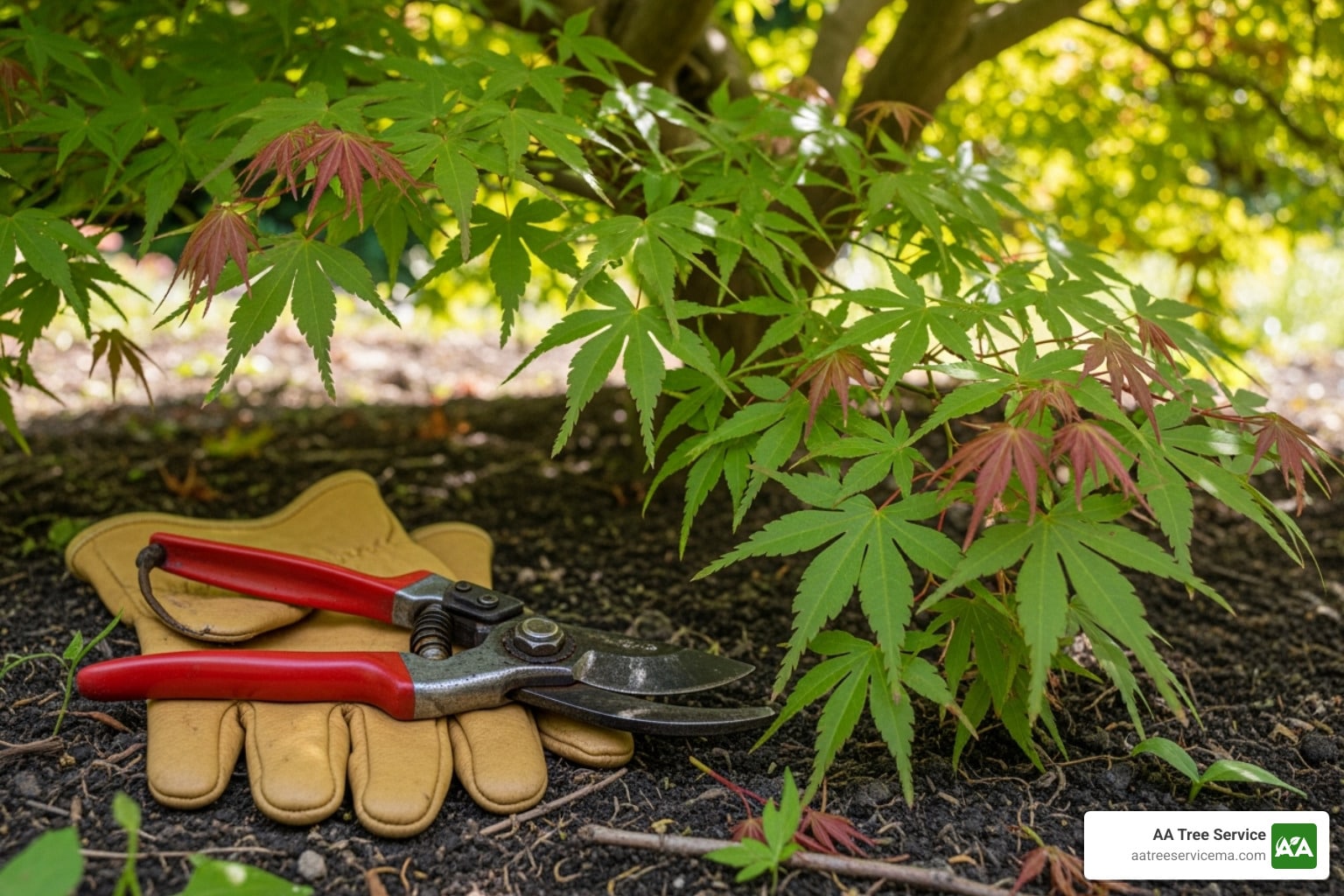
Understanding the Spring Pruning Window for Your Japanese Maple
Pruning Japanese maple in spring is a delicate task that focuses on light shaping and cleanup rather than major structural changes. Here’s what you need to know:
- Best Timing: Late spring, after leaves have fully emerged and hardened (typically May in Massachusetts and New Hampshire)
- Primary Goals: Remove winter damage, thin crowded branches, improve the tree’s natural form
- Key Limitation: Avoid heavy pruning – remove no more than 20-25% of the canopy
- Main Risk: Sap bleeding if pruned too early; new growth is tender and tears easily
- Best For: Fine-tuning shape, improving air circulation, cleaning out dead wood
Japanese maples are among the most rewarding trees to prune because of their neat branch structure and diverse forms. As research from Pacific Horticulture notes, these trees have “delicate leaves, fine fall color, and the loveliest branch patterns in the world.” But that beauty requires careful timing and technique.
Spring presents a unique pruning window. Unlike the dormant winter season when arborists make major structural cuts, spring pruning is about refinement. The leaves have emerged, allowing you to see exactly which branches are crowding the canopy and which ones improve the tree’s natural grace.
The challenge? Spring is also when maples are most vulnerable. The bark is tender and tears easily. Sap flows vigorously, causing cuts to “bleed” (though this rarely harms the tree). And the tree is channeling energy into new growth, making heavy pruning potentially stressful.
For homeowners in Massachusetts and New Hampshire, understanding why and when to prune in spring – versus winter or summer – makes all the difference between enhancing your tree’s beauty and accidentally damaging it.
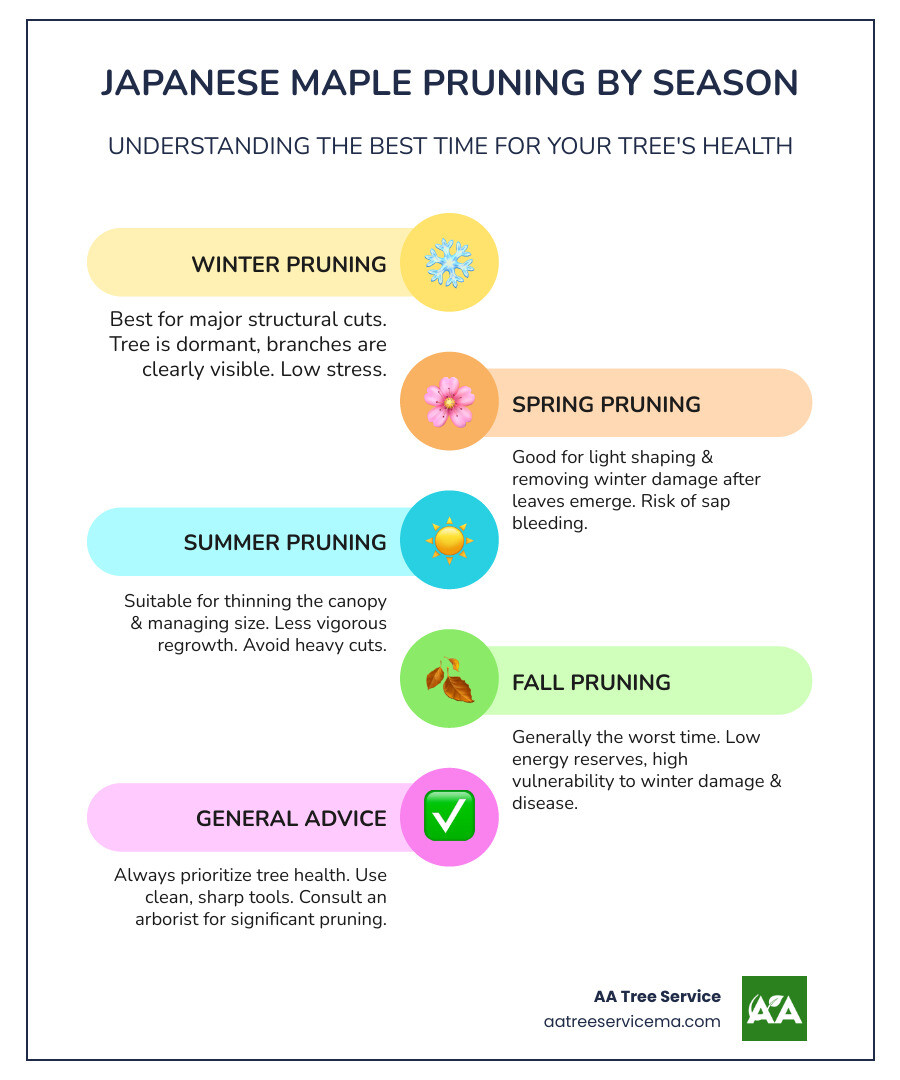
Simple pruning Japanese maple in spring glossary:
Why Prune a Japanese Maple in Spring?
While major structural work is best reserved for the dormant winter season, spring offers a unique opportunity to refine your Japanese maple. Think of pruning Japanese maple in spring as touching up a masterpiece. With the leaves emerged, you can see exactly where the tree needs help to look its best for the growing season.
Spring pruning goals are focused and gentle:
- Remove Winter Damage: Our harsh New England winters are tough on delicate trees. Snow and ice accumulation can snap branches, and rapid freeze-thaw cycles can cause bark to crack. In spring, it’s crucial to carefully inspect for and remove any branches that are broken, splintered, or clearly dead. This isn’t just for looks; these damaged areas are open invitations for wood-boring insects and decay fungi to enter the tree. A clean cut on healthy wood allows the tree to properly seal the wound and defend itself.
- Light Shaping and Refinement: Once the tree is in full leaf, you can see its true form. This is the time for subtle adjustments that improve the tree’s natural grace and what Pacific Horticulture calls the “lacy, leaves-dancing-in-the-wind look.” You’re not making major changes, but rather small, precise cuts to enhance the existing structure.
- Improve Air Circulation: A dense, crowded canopy traps humidity, creating a perfect breeding ground for fungal diseases like powdery mildew, anthracnose, and Verticillium wilt, which can be particularly troublesome for Japanese maples. By selectively thinning out small, interior branches, you allow air and sunlight to penetrate the canopy. This helps leaves dry faster after rain, significantly reducing disease pressure and promoting healthier foliage throughout the tree. It also makes the tree more resilient to strong winds, as air can pass through the branches rather than pushing against a solid wall of leaves.
- Improve Seasonal Beauty: You’re preparing your tree to be a stunning focal point in your landscape all season long. A well-pruned tree will have better color, a more elegant shape, and a healthier overall appearance.
This approach is fundamentally different from dormant winter pruning, where we make significant structural changes. For a deeper dive into year-round care, see our Ornamental Tree Pruning Complete Guide.
The Risks of Spring Pruning and How to Mitigate Them
Spring pruning requires care. Understanding the risks helps you avoid them:
- Sap Bleeding: Cutting a maple in early spring, when the sap is rising, will cause it to “bleed” a watery fluid. This can be alarming to see, but it’s important to understand that this is not like a person bleeding. The sap is primarily water with some sugars and minerals, and the tree has plenty of reserves. It is not a sign of injury or distress. While the sticky sap can attract insects, it rarely causes long-term harm to a healthy tree. The best way to mitigate this is simply to time your pruning for late spring, after the leaves have fully developed and the sap pressure has subsided.
- Tree Stress: Pruning removes living, energy-producing tissue. Heavy pruning during the active spring growth period forces the tree to divert energy from growing roots and leaves to sealing wounds, which can stress the tree. The solution is restraint: focus only on what’s necessary, like dead or damaged wood, and never remove more than a quarter of the canopy. Save major reshaping for winter.
- Disease Entry: Spring’s tender new growth and thin bark tear easily, creating wounds that can invite pathogens. Fungal spores are also more active in the damp, mild weather of spring. To mitigate this, always use exceptionally sharp, clean tools. Sterilize your blades with rubbing alcohol or a bleach solution between cuts, especially if you suspect any disease. Making proper cuts just outside the branch collar is also crucial, as this promotes the quickest possible healing.
When in Spring is Best?
The ideal time for pruning japanese maple in spring depends on your goal.
- Early Spring (March-April): This window is best reserved for essential corrective pruning only. Before the leaves emerge, it’s easy to spot and remove any dead, broken, or damaged wood from winter. The tree’s structure is clearly visible. However, be prepared for significant (though harmless) sap bleeding from any cuts into live wood.
- Late Spring (May): This is the preferred time for all aesthetic shaping and thinning. The leaves are fully out, showing you exactly how the canopy looks and where it’s too dense. Sap bleeding is minimal, and the bark is tougher than in early spring. This timing is ideal for our Massachusetts and New Hampshire climate, as the risk of a late frost has usually passed.
For essential corrective cuts, we work from late winter into early spring. For the artful shaping that makes a Japanese maple stunning, we wait until late spring when the leaves are fully hardened. Watch your tree—its budding and leafing schedule is your best guide.
The Right Approach to Pruning Japanese Maple in Spring
Pruning Japanese maple in spring is a thoughtful process of revealing the tree’s natural beauty. It’s a conversation with your tree, not a battle. Before making any cuts, walk around the tree and observe its shape, identifying branches that detract from its graceful silhouette. This initial assessment ensures every cut has a purpose.

Essential Tools and Preparation
Using the right tools is non-negotiable for the health of your Japanese maple. Clean cuts heal faster and reduce the risk of disease.
- Bypass Pruners: For small branches up to 3/4 inch thick.
- Loppers: For branches between 1.5 and 2.5 inches, providing extra leverage.
- Pruning Saw: For any branches too thick for loppers.
- Pole Pruner: To safely reach high branches from the ground.
Your blades must be sharp to cut cleanly without crushing tissue. Before you start, and between cuts on different trees, sterilize your tools with rubbing alcohol or a 10% bleach solution to prevent spreading diseases. This simple step is critical insurance for your tree’s health.
Identifying What to Prune When pruning Japanese maple in spring
With your tools ready, follow this hierarchy to decide what to remove:
- The 3 D’s—Dead, Damaged, and Diseased Wood: This is always the first priority. Dead wood is brittle, often gray, and will show dry, brown tissue if you scratch the bark. Damaged branches have obvious breaks or wounds. Diseased wood may have cankers or discoloration. Remove these immediately.
- Crossing and Rubbing Branches: When two branches rub, they create wounds that invite pests and disease. Remove the weaker or less well-placed of the two.
- Inward-Growing Branches: Branches that grow back toward the center of the tree block light and air. Removing them opens up the canopy and showcases the tree’s beautiful internal structure.
- Thinning for Light Penetration: Selectively remove small branches to allow dappled light to filter through the canopy. This promotes healthy inner growth and improves the tree’s layered appearance.
Our Ornamental Tree Pruning Complete Guide offers more detailed techniques for caring for specimen trees.
Best Practices for Making Pruning Cuts
How you cut is as important as what you cut. A proper cut promotes rapid healing.
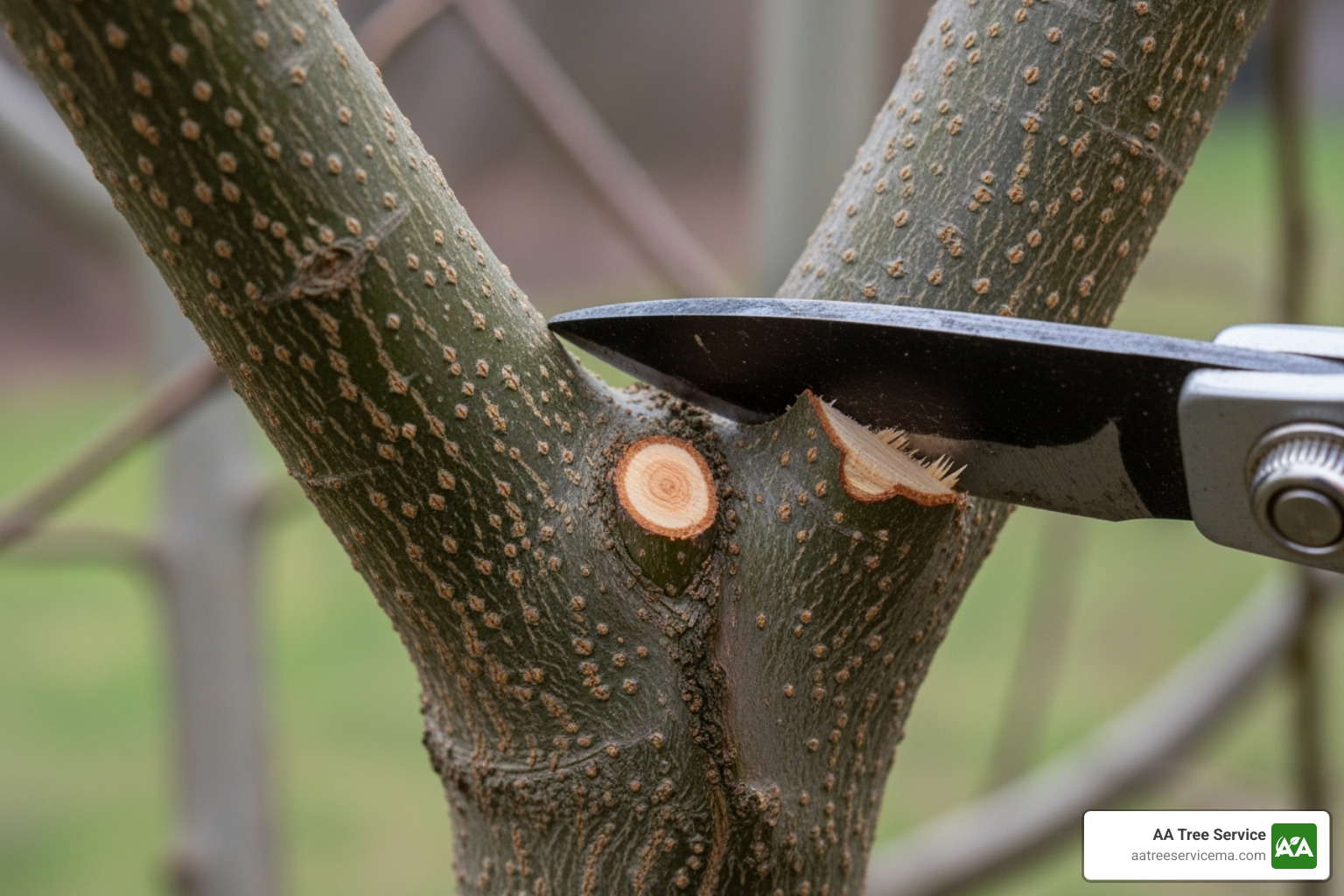
Always locate the branch collar, the slightly swollen area where a branch joins a larger limb. This area contains specialized cells that seal wounds. Your cut should be made just outside this collar.
- Avoid Flush Cuts: Cutting flat against the trunk removes the collar and creates a large wound that is slow to heal and invites decay.
- Avoid Stubs: Leaving a long stub prevents the wound from sealing and the stub will die back, inviting pests.
For branches thicker than an inch, use the three-cut method to prevent the bark from tearing:
- Make a shallow undercut 6-12 inches from the collar.
- Make a second cut from the top, an inch or two further out from the undercut. The branch will break off cleanly.
- Remove the remaining stub with a final, precise cut just outside the branch collar.
This visual guide to proper pruning cuts on an Upright Japanese maple clearly shows the correct technique. Take your time—precision is key.
The Art of Aesthetic Pruning for Different Maple Types
Pruning Japanese maple in spring is about sculpting living art. The goal is to reveal the tree’s natural character, not force it into an unnatural shape. This approach is deeply rooted in the Japanese horticultural art of niwaki, which involves training trees to create an idealized representation of a mature tree in nature.
The goal isn’t to create a perfectly symmetrical lollipop shape, but to evoke a sense of character, age, and harmony with the surrounding landscape. It’s about finding the ‘essence’ of the tree and using pruning to highlight its best features, like its elegant branch structure or graceful form. A well-pruned Japanese maple looks as if it grew that way on its own, with balanced proportions and light filtering through its canopy.
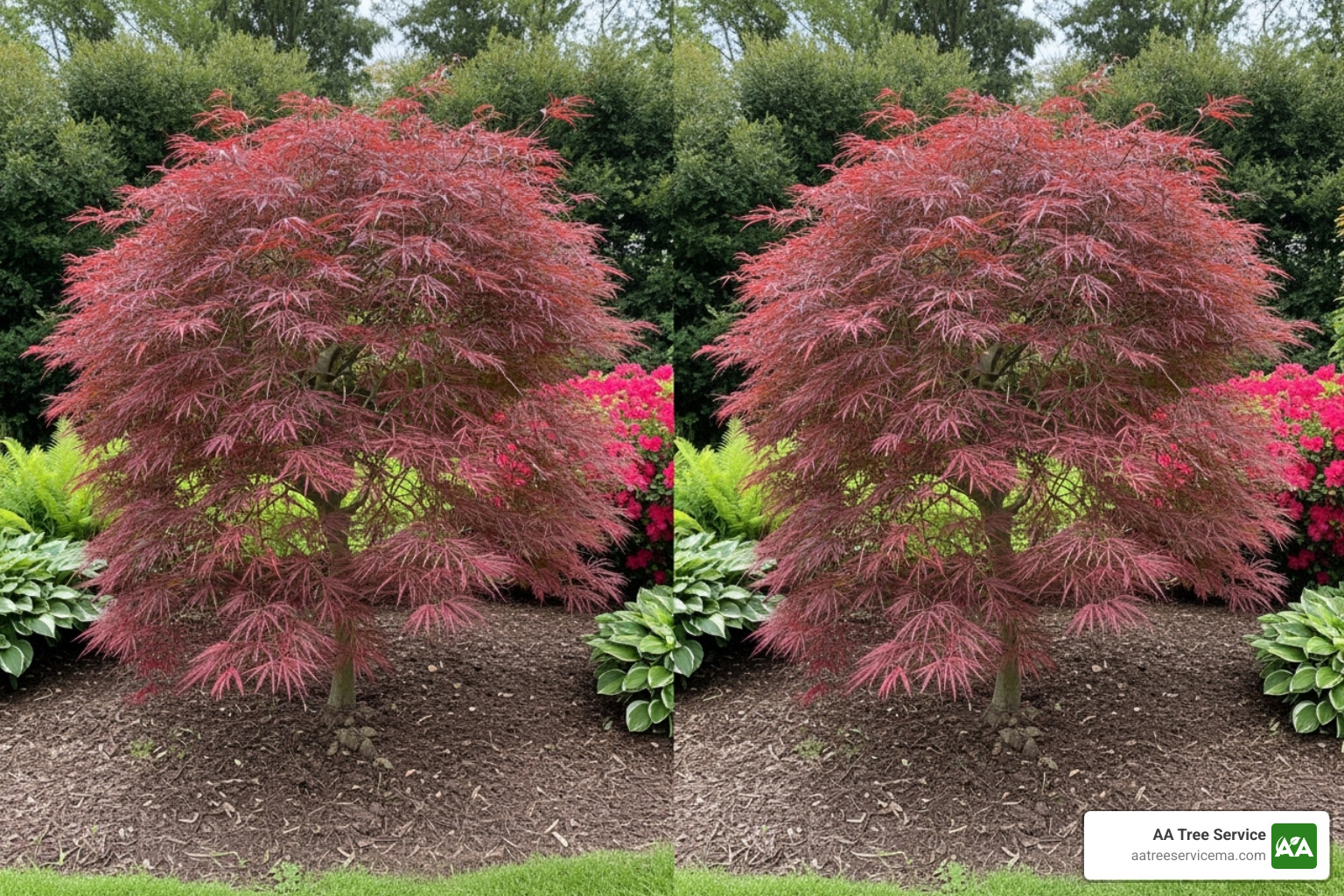
Crucially, not all Japanese maples are the same. Upright varieties have a different structure than weeping laceleaf types, and each requires a unique approach. For more on professional ornamental tree care in Massachusetts and New Hampshire, visit our Ornamental Tree Pruning Near Me page.
Shaping Upright Japanese Maples
Upright varieties like ‘Bloodgood’ or ‘Sango-kaku’ naturally grow in a vase or rounded shape. Spring pruning helps guide this tendency and maintain health and beauty.
- Encourage a Strong Central Leader: Especially on younger trees, it’s important to establish a strong framework. If there are two competing main trunks (co-dominant leaders), it’s often best to remove the weaker one to prevent future structural problems like splitting.
- Space Scaffold Branches: The main structural limbs, or scaffold branches, should be well-spaced both vertically and radially around the trunk. Thin smaller branches that crowd these main limbs to improve air circulation and showcase the tree’s powerful architecture.
- Improve the Vase Shape: Stand back and look at the tree’s overall silhouette. Remove branches that cross back through the center of the tree or grow in awkward directions. The goal is to create an open, uncluttered form that lets the tree’s inherent grace shine through.
- Remove Lower Limbs for Clearance: If the tree is near a walkway or patio, you may need to carefully remove the lowest branches to create space. This is called “limbing up” or crown raising. Do this gradually over several years to avoid stressing the tree.
Techniques for Laceleaf (Weeping) Cultivars
Laceleaf maples like ‘Crimson Queen’ or ‘Viridis’ are known for their cascading branches. Without pruning, they can become dense, shapeless mounds that hide their beautiful structure. The goal is to maintain their weeping habit while revealing the artistry within.
- Embrace the Philosophy of ‘Ma’ (Negative Space): Before you even pick up your pruners, look into the tree, not just at it. The goal is to create “ma,” or negative space, which allows the eye to appreciate the intricate branching within. This is the essence of shell pruning. You are selectively removing small, interior branches to create windows that reveal the gnarled, twisting limbs that are the true soul of a laceleaf maple. This creates a sense of depth and age, transforming a dense blob into a living sculpture.
- Thin the Outer Canopy for a ‘Lacy’ Effect: The outer layer of a weeping maple should not be a solid, impenetrable curtain. It should be delicate and lacy, allowing dappled light to filter through. To achieve this, selectively remove some of the fine, twiggy growth at the very ends of the weeping branches. This lightens the overall appearance and reinforces the tree’s graceful, cascading nature. Avoid shearing the tree like a hedge, as this will destroy its natural form and encourage a thick, ugly shell of growth.
- Preserve the Weeping Habit: Your cuts should reinforce the tree’s natural downward flow. Remove any branches that grow straight up or stick out horizontally at odd angles, as they disrupt the cascading effect.
- Define and Separate the Layers: A mature laceleaf maple should have distinct, overlapping layers, like a series of gentle waterfalls. Over time, branches from an upper layer can grow down and merge with the layer below, creating a muddled look. As Fine Gardening recommends, a key aesthetic technique is to prune these downward-hanging branches that touch or cross into lower layers to maintain a clear separation. This emphasizes the horizontal flow and creates a much more elegant and structured appearance.
Patience and a light touch are essential with laceleaf maples. You can always remove more later, but you can’t put branches back. The philosophy of Aesthetic Pruning is about revealing, not just removing.
Avoiding Common Mistakes and Ensuring a Healthy Recovery
It’s easy to get carried away with pruners in hand, but with Japanese maples, restraint is key. Most pruning mistakes are preventable with a little knowledge. For more general tree care tips, see our Routine Tree Maintenance guide.
How Much is Too Much for pruning japanese maple in spring?
The golden rule for pruning Japanese maple in spring is that less is more. Stick to the one-quarter rule: never remove more than 20-25% of the tree’s canopy in a single year. Removing too much foliage at once forces the tree into a state of stress.
Signs of over-pruning include:
- Excessive Watersprouts: These are vigorous, vertical shoots that emerge from the trunk or main branches. It’s the tree’s panic response to replace lost leaves.
- Sunscald on Bark: Suddenly exposing thin bark to intense sun can cause cracking and permanent damage, a real risk in New England summers.
- Stunted Growth: The tree diverts all its energy to healing large wounds instead of producing healthy new growth.
Aggressive pruning can ruin the delicate, layered structure of a laceleaf maple or the graceful vase shape of an upright. Always err on the side of caution.
Aftercare for a Healthy Recovery
After you’ve put the pruners away, a little aftercare will help your tree recover quickly and thrive.
- Do NOT Use Pruning Sealants: Wound dressings or pruning paint can trap moisture and create an ideal environment for fungi and bacteria. Trees have their own natural mechanisms to seal wounds; let them do their job.
- Ensure Adequate Water: Healing requires energy and water. During dry spells in late spring and summer, give your maple a deep, slow watering once or twice a week to keep the soil moist.
- Apply Mulch: A 2-4 inch layer of organic mulch around the tree’s base (kept a few inches from the trunk) helps retain soil moisture, regulate root temperature, and suppress weeds.
- Fertilize with Caution: Pruning stimulates new growth, so extra fertilizer is often unnecessary. If you do fertilize, wait until the tree has fully leafed out and use a balanced, low-nitrogen organic formula to avoid forcing weak, excessive growth.
Frequently Asked Questions about Pruning Japanese Maples
We get many questions from homeowners in Massachusetts and New Hampshire about pruning Japanese maple in spring. Here are answers to the most common concerns.
Can I prune a newly planted Japanese maple in the spring?
It’s best to wait at least 2-3 years before doing any significant aesthetic pruning. For the first few years, your only task should be to remove branches that are clearly dead, damaged, or crossing and rubbing against a more important branch. This waiting period is critical, as it allows the tree to dedicate all its energy to establishing a strong, healthy root system. A robust root system is the foundation for a long-lived, resilient tree. As MrMaple.com notes, young trees need time to mature and show their natural form before you begin any serious shaping.
Will spring pruning stop my Japanese maple from “bleeding” sap?
No, pruning any maple in late winter or early spring will cause it to “bleed” sap. This is a natural process driven by root pressure pushing water and sugars up the tree to fuel new growth. While this can look messy, it is not harmful to the tree’s health. The flow is temporary and will stop on its own as the leaves emerge and begin to draw water up through transpiration. To minimize the flow, perform only very light pruning after the leaves have fully hardened off in late spring (typically May). The tree’s wounds will seal naturally; do not apply any sealant.
Do different Japanese maple cultivars need different spring pruning?
Yes, absolutely. Pruning techniques must match the tree’s natural growth habit. You cannot and should not prune all cultivars the same way, as this will fight against the tree’s inherent character.
- Upright varieties (‘Bloodgood’, ‘Emperor I’) benefit from structural thinning that opens up the canopy, emphasizes their classic vase shape, and showcases their branch architecture.
- Weeping laceleaf types (‘Crimson Queen’, ‘Viridis’) require careful “shell pruning” to maintain their cascading layers, create an airy appearance, and prevent them from becoming dense, shapeless mounds that hide their beautiful internal structure.
- Dwarf and compact varieties (‘Mikawa yatsubusa’) often require very little pruning at all, other than removing dead twigs. Their natural form is typically dense and sculptural, and over-pruning can ruin their unique character.
Understanding your specific cultivar is key to enhancing its beauty. If you’re uncertain, our team at AA Tree Service has extensive experience with all types of Japanese maples. You can consult with a certified arborist or get a free quote for your professional tree pruning and trimming needs.
How do I control the size of my Japanese maple? It’s getting too big for its spot.
This is a very common concern, and the wrong approach can permanently damage the tree. The absolute worst thing you can do is “top” the tree—indiscriminately cutting off the top to reduce its height. This creates ugly, weak, and fast-growing watersprouts, ruins the tree’s natural form, and creates large wounds that are susceptible to disease and decay.
The best long-term solution is to choose a cultivar that matches the available space from the beginning. Japanese maples range from tiny dwarfs that never exceed 3 feet to large trees that can reach 25 feet or more.
If you have an established tree that is outgrowing its space, the correct approach is selective crown reduction, which should ideally be performed by a certified arborist. This is a slow, careful process, done over several seasons. It involves:
- Thinning Cuts: Instead of shearing, branches are carefully traced back to a suitable lateral branch. The cut is made to redirect growth to that smaller, outward-facing branch.
- Gradual Removal: No more than 20-25% of the canopy is removed in one year. The goal is to reduce the overall size and spread without changing the tree’s fundamental character.
- Focusing on the Outer Edges: The reduction is focused on the longest, most extended branches, bringing the tree’s silhouette back in a natural-looking way.
This methodical approach maintains the tree’s health and its graceful aesthetic, unlike the butchery of topping.
Conclusion
There’s something deeply satisfying about stepping back and seeing your Japanese maple transformed—more graceful, more open, more itself. Pruning Japanese maple in spring isn’t about imposing your will on the tree; it’s about helping it become the best version of what it naturally wants to be. It’s refinement over removal, a gentle conversation between you and your tree.
Throughout this guide, we’ve walked through the delicate timing of spring pruning, the importance of sharp, clean tools, and the techniques that bring out your tree’s inherent beauty. We’ve talked about the risks—sap bleeding, tender bark, the temptation to over-prune—and how to work around them. Most importantly, we’ve emphasized that less is more when it comes to Japanese maples. These trees reward patience and restraint.
Whether you’re thinning an upright ‘Bloodgood’ to reveal its neat branch structure or shell-pruning a laceleaf ‘Crimson Queen’ to maintain its cascading layers, the goal remains the same: to showcase the tree’s natural grace while keeping it healthy and vigorous.
That said, we know that pruning can feel intimidating, especially if you’re dealing with a mature or particularly valuable specimen. Sometimes the best decision is to bring in someone who works with these trees every day. If you’re ever uncertain about making that cut, or if your tree needs more than light spring shaping, we’re here to help.
Our team at AA Tree Service has spent over 20 years caring for trees throughout Massachusetts and New Hampshire. We understand the unique challenges of our climate—the late frosts, the humid summers, the harsh winters—and how they affect Japanese maples. We know these trees aren’t just landscaping; they’re living art pieces that deserve thoughtful, expert care.
We offer free same-day quotes and are available 24/7 for emergency tree services. Whether you need guidance on the best approach for your specific cultivar or want a professional to handle the pruning entirely, we’re ready to help. Consult with a Certified Arborist from our experienced team, or get a free quote for your professional tree pruning and trimming needs today.
Your Japanese maple has given you years of beauty. Let’s make sure it has many more years ahead.