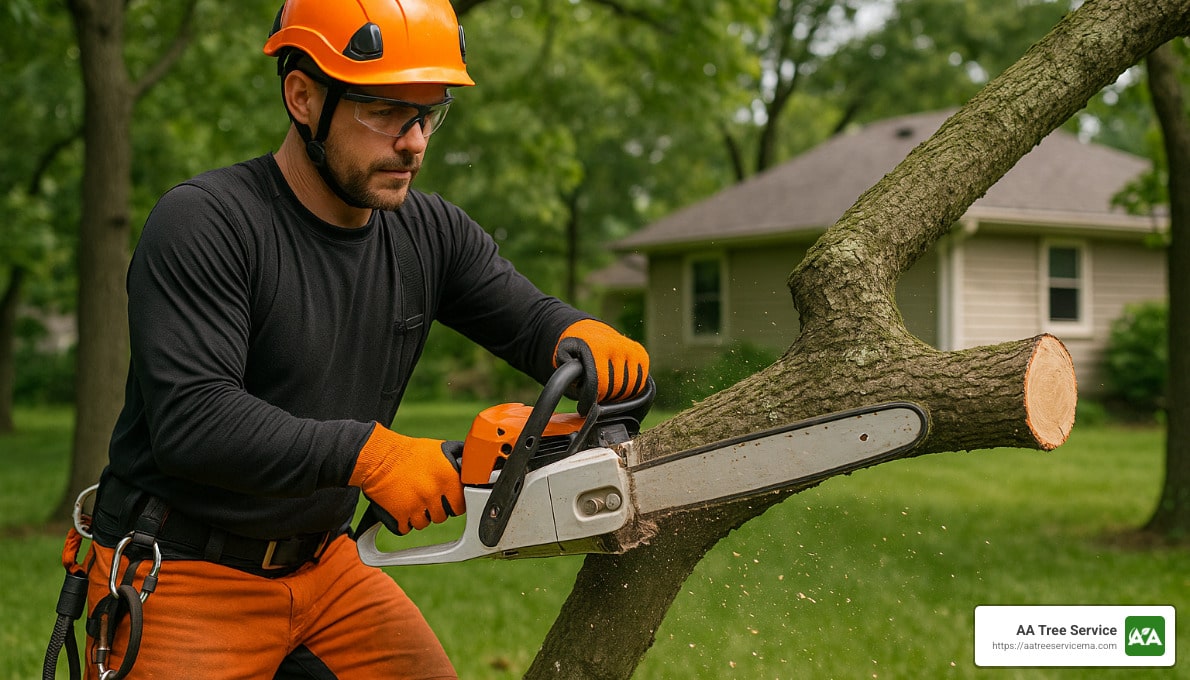
When You Need Professional Tree Care
Looking for local tree cutting services near you? Here’s a quick overview of what to consider:
| What to Look For | Why It Matters |
|---|---|
| Licensed & Insured | Protects your property from damage liability |
| Experience & Expertise | Ensures safe, proper tree removal techniques |
| Emergency Services | Critical for storm damage or hazardous situations |
| Proper Equipment | Professional equipment ensures efficient, safe work |
| Clean-up Services | Complete removal of debris after service |
Trees improve our properties with shade, improved air quality, and natural beauty. But when they become damaged, diseased, or pose safety risks, professional intervention becomes necessary. With the average cost of tree removal ranging from $200 to $2,000 depending on size and complexity, finding reliable local tree cutting services is a critical decision for Massachusetts and New Hampshire homeowners.
Professional arborists do more than just cut down trees. They assess tree health, identify hazards, and determine whether removal is truly necessary or if trimming and maintenance might save a treasured landscape feature. According to our research, companies like Parker Tree Service maintain impressive customer satisfaction ratings (4.7 out of 5 based on 246 reviews) by providing comprehensive services that include tree removal, pruning, stump grinding, and deep root fertilization.
When selecting a tree service provider, prioritize those with certified arborists, proper insurance, and specialized equipment to handle everything from routine trimming to emergency storm damage. The best time for tree removal is often during winter when visibility is better and there’s reduced risk of pest spread, though reputable services can work safely year-round.
“Professional and reliable… Prices were by far the best in the area. Communication was on point and I will be more than happy to recommend tree services to those in the community!” – Ervin W., satisfied customer
Investing in quality tree care not only ensures your immediate safety but also protects your property value and landscape aesthetics for years to come. For more information about tree care best practices, check out the International Society of Arboriculture resources for homeowners.
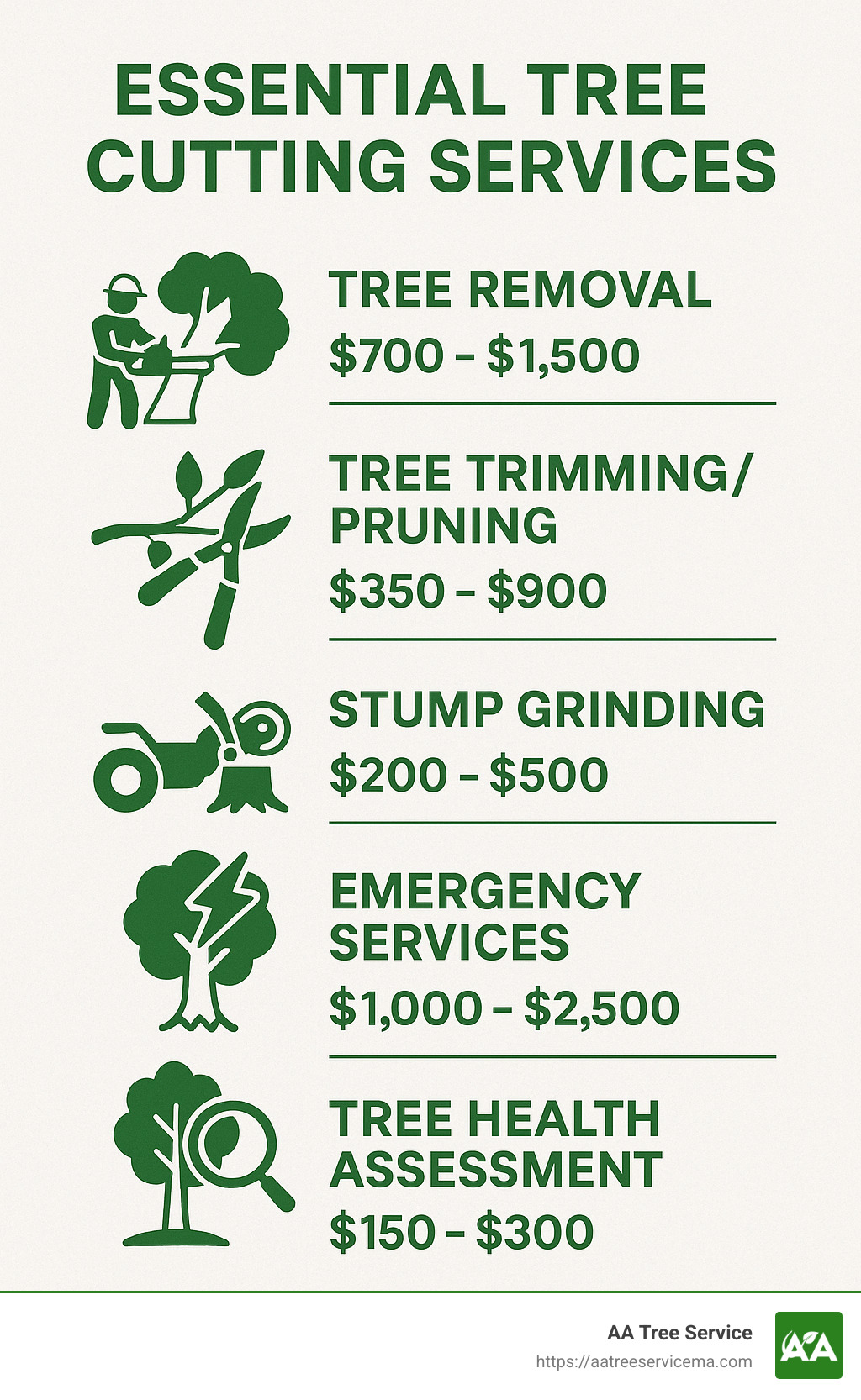
Local tree cutting services terms to learn:
How to Identify When You Need Tree Cutting Services
Signs Your Tree May Need Professional Attention
Trees add so much to our homes and landscapes, but they can’t always tell us when they’re in trouble. Learning to spot the warning signs can make all the difference between a simple maintenance call and a middle-of-the-night emergency. If you’re wondering whether it’s time to contact local tree cutting services, here are some clear indicators that your leafy friend might need professional help:
A suddenly leaning tree is never something to ignore. While some trees naturally grow at an angle, a new or worsening lean often signals root problems underneath. I’ve seen many Massachusetts homeowners dismiss a slight tilt, only to face a fallen tree after the next nor’easter. Arborists generally get concerned when a tree leans more than 15 degrees from vertical – that’s your cue to make a call.
Those dead or hanging branches aren’t just unsightly – they’re potentially dangerous. We call them “widow makers” in the industry for good reason. After heavy snow or a summer thunderstorm, these weakened limbs can come crashing down without warning. When you notice more than a quarter of a tree’s branches looking lifeless or damaged, it’s definitely time for a professional evaluation.
Take a close look at your tree’s trunk health. Significant cracks, large wounds, or multiple dead branch stubs tell a story of a tree in decline. The tree’s bark is essentially its skin – its protection against the outside world. When more than 25% of that protective layer is compromised, the tree’s structural integrity is likely at risk.
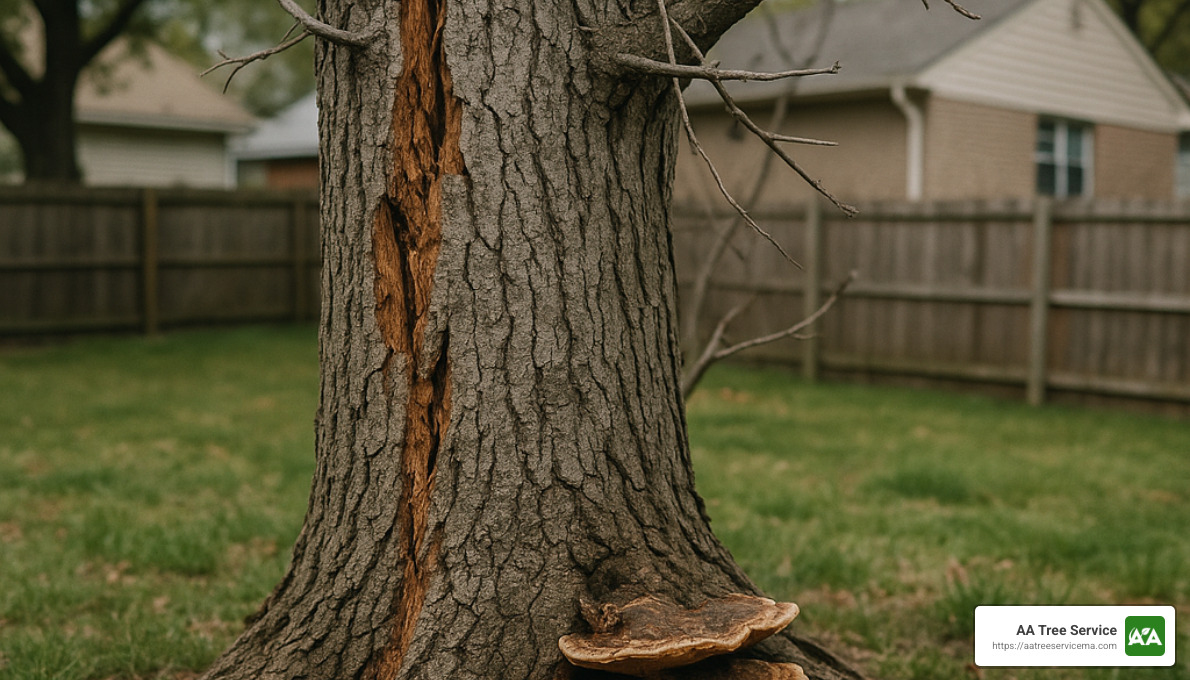
Root problems often go unnoticed until they’re severe. If you spot exposed roots that look decayed, damaged, or severed (often from construction or landscaping work), your tree may be losing its anchor to the earth. Similarly, fungal growth like mushrooms sprouting around the base of your tree isn’t just an interesting natural phenomenon – it’s often a red flag for internal decay that you can’t see.
Trees that grow too close to structures require special attention. That maple might have been perfectly positioned when planted 30 years ago, but now its branches reach precariously over your roof or toward power lines. Preventative pruning can often solve the problem, but sometimes removal is the safest option.
A New Hampshire homeowner recently shared with us: “After a major storm, I noticed our 40-year-old oak tree had developed a significant lean. I initially thought it might correct itself, but after consulting with AA Tree Service, we found the root system had been compromised. Their prompt removal prevented what could have been a disaster for our home.”
Seasonal Considerations for Tree Work
While local tree cutting services can tackle tree problems year-round in Massachusetts and New Hampshire, each season offers unique advantages for different types of tree work.
Winter might seem like an odd time for tree care, but it’s actually ideal for many removal projects. With the leaves gone, our arborists can fully assess a tree’s structure and spot problems that might be hidden during growing seasons. The frozen ground also means less impact on your lawn and garden beds from heavy equipment. Plus, many tree services offer competitive pricing during this slower season.
When spring arrives in New England, it’s the perfect time to identify health issues as trees wake up from dormancy. A tree that doesn’t leaf out properly often signals deeper problems. However, we’re always careful about nesting birds this time of year – sometimes a slight delay in non-emergency work is the kindest approach for our feathered neighbors.
The summer months provide excellent visibility for comprehensive tree health assessments. Those long, warm days also give our crews more daylight hours to complete your project. That said, the summer heat can make the work more demanding, and in extremely hot conditions, we might recommend morning work to keep both trees and workers at their best.
Fall brings ideal conditions for maintenance pruning after trees have finished their growing season. It’s also a smart time to remove hazardous trees before winter storms arrive. Many of our Massachusetts customers prefer fall work because it minimizes impact on summer outdoor activities while getting their property ready for winter.
At AA Tree Service, we don’t just look at the calendar when planning tree work. We consider the specific tree species, its current health, and your property’s unique characteristics to recommend the best approach for your trees in Massachusetts and New Hampshire. Sometimes, tree hazards simply can’t wait for the “ideal” season – and that’s why we’re ready to help year-round.
Comprehensive Services Offered by Professional Tree Cutting Companies
Tree Removal: When and Why It’s Necessary
Let’s face it—sometimes saying goodbye to a tree is the only safe option left. At AA Tree Service, we don’t take tree removal lightly. Each towering oak or graceful maple represents years of growth and natural beauty that we’d prefer to preserve whenever possible.
Complete tree removal typically becomes necessary when your tree is dead or dying, posing safety risks to your family or home, causing damage to foundations or driveways, battling a contagious disease, or simply standing in the way of your new patio plans.
“We believe that trees are treasures and we are their guardians,” is a philosophy we accept at AA Tree Service. Before recommending removal, our certified arborists always consider whether your tree might be saved through treatments, strategic pruning, or cabling techniques. We’ve seen many trees bounce back with the right care!
When removal becomes the only viable option, we don’t just show up with chainsaws blazing. Professional local tree cutting services like ours use controlled dismantling for trees in tight spaces—carefully removing sections to avoid damaging your home or landscape. For trees with enough clearance, we might use directional felling techniques to bring the tree down safely in one piece.
Based on industry data (not our specific pricing), tree removal in Massachusetts and New Hampshire can range from $200 for smaller trees to upwards of $2,000 for large, complex removals. Several factors influence this cost: the tree’s height and diameter, location accessibility, species and wood hardness, whether you want stump removal included, and if you need emergency service.
Tree Trimming and Pruning: Maintaining Tree Health and Safety
Regular trimming and pruning are like wellness check-ups for your trees—preventative care that often helps avoid the need for complete removal down the road. When our local tree cutting services team handles your tree trimming needs, we’re doing much more than making your yard look prettier.
Professional pruning removes dead or diseased branches, improves your tree’s structure to withstand those fierce New England storms, improves sunlight penetration, directs growth away from your home or power lines, boosts flower or fruit production, and maintains your property’s curb appeal and value.

At AA Tree Service, we don’t just hack away at branches. Our approach follows the standards set by the International Society of Arboriculture, ensuring every cut serves a purpose for your tree’s long-term health. Our certified arborists understand tree biology—how each species responds to different pruning techniques and when certain types of cuts might do more harm than good.
We believe in educating our customers too. As one industry expert advises, “When the job is done, tell the client when each tree should be pruned next time (write everything down for them too).” That’s why we’ll leave you with clear recommendations about your trees’ future care needs.
According to general industry figures, professional tree trimming in Massachusetts and New Hampshire typically ranges from $75 to $1,500, with factors like tree size, trimming complexity, and accessibility affecting where your project might fall within that spectrum.
Stump Grinding and Removal: Completing the Job
After we’ve removed a tree, that stubborn stump remains as a reminder of what once stood tall in your yard. While some homeowners don’t mind these woody remnants, there are compelling reasons to consider professional stump removal.
Beyond the obvious eyesore factor, stumps steal valuable yard space you could use for gardening or play areas. They create tripping hazards, especially when hidden by overgrown grass or winter snow. As they decay, stumps become magnets for termites, carpenter ants, and other pests that might eventually explore your home. Plus, some determined tree species continue sending up annoying new shoots from the stump for years.
At AA Tree Service, we offer two effective approaches to saying farewell to your stumps:
Our high-powered stump grinders can pulverize both the stump and its root system to approximately 20 inches below ground level—deep enough that you can plant grass or shallow-rooted plants over the area. This less invasive method allows the remaining root system to decompose naturally underground.
For situations requiring complete removal—like new construction projects—we can excavate the entire stump and major root system, though this approach involves more landscape disruption.
As one satisfied customer put it: “It’s never been easier to have a professional tree service come and take out that pesky stump! The team will be there on time with all the tools needed, ready for any situation.”
Industry averages suggest stump removal in Massachusetts and New Hampshire starts around $250 but can increase based on the stump’s diameter, location, and soil conditions. Many homeowners find bundling stump removal with their initial tree removal saves money compared to scheduling it separately.
Emergency Tree Services: Responding to Storm Damage
New England weather keeps us on our toes, doesn’t it? One minute it’s sunny, the next we’re battling nor’easters or summer thunderstorms. When severe weather strikes, damaged or fallen trees require immediate attention to prevent further property damage and ensure your family’s safety.
That’s why professional local tree cutting services like AA Tree Service offer 24/7 emergency response for those heart-stopping moments: trees crashed onto roofs or vehicles, massive limbs blocking your driveway, trees leaning precariously after wind damage, branches entangled with power lines, or partially uprooted trees threatening to fall at any moment.
Our emergency team arrives equipped with specialized machinery—including cranes when necessary—to safely handle even the most challenging emergency situations across Massachusetts and New Hampshire.
One Amesbury resident shared their winter storm experience: “A large branch from our maple tree had partially broken and was hanging directly over our roof. AA Tree Service responded within hours despite numerous emergency calls in the area. Their team carefully removed the hazard without any additional damage to our property. Their 24/7 availability gave us peace of mind during a stressful situation.”
Emergency services typically come at a premium compared to scheduled tree work, with costs potentially 25-50% higher than standard rates. However, when you’re staring at a massive oak leaning toward your bedroom window after a midnight storm, that immediate response and prevention of further damage is absolutely priceless.
For more information about how to prepare your trees for severe weather, visit the USDA Forest Service resource center.
How to Choose the Right Local Tree Cutting Service
Qualifications and Credentials to Look For
Finding the perfect local tree cutting service can feel like searching for a needle in a haystack, especially when every company claims to be the best. But knowing what credentials truly matter can make all the difference for Massachusetts and New Hampshire homeowners.
First and foremost, look for ISA Certified Arborists on staff. These tree care professionals have earned their stripes through at least three years of hands-on experience before even qualifying for certification. Think of them as the PhDs of the tree world – they understand tree biology, proper care techniques, and safety protocols that go far beyond simply knowing how to operate a chainsaw.
Proper licensing is non-negotiable. Any reputable tree service should hold appropriate state licenses for tree work in Massachusetts or New Hampshire. This ensures they’re operating legally and have met basic competency requirements.
Insurance coverage provides your safety net. Always – and we mean always – verify that the company carries both general liability insurance (protecting your property) and workers’ compensation (protecting their team). Don’t just take their word for it! Ask for proof and take a moment to call the insurance company to confirm the policy is active. This small step could save you from a nightmare scenario where an uninsured worker gets injured on your property, potentially leaving you liable.
Professional affiliations speak volumes about a company’s commitment to excellence. Membership in organizations like the Tree Care Industry Association (TCIA) shows they’re connected to industry best practices and continuing education. The gold standard is TCIA Accreditation, a voluntary program where companies undergo rigorous inspection and evaluation.
At AA Tree Service, we maintain all these essential qualifications because we believe Massachusetts and New Hampshire homeowners deserve nothing less than fully qualified professionals caring for their trees and property.
Questions to Ask Before Hiring
The conversation you have before hiring a local tree cutting service is just as important as the credentials they bring to the table. Here are some questions that can reveal whether a company deserves your business:
“How long have you been in business?” Experience matters tremendously in tree care, where each job presents unique challenges. At AA Tree Service, we bring over 20 years of experience to every property we service, which means we’ve likely encountered and successfully handled situations similar to yours.
“Can you provide references from similar jobs?” Any company worth their salt should happily share testimonials or connect you with previous customers who had similar work done. This gives you real-world insight into their reliability, quality, and customer service.
“What specific techniques will you use for my project?” Listen carefully to this answer. A professional should clearly explain their approach in terms you can understand, and more importantly, why that approach is best for your specific trees and property conditions. Vague responses might signal a lack of expertise.
“Will you provide a detailed written estimate?” Never proceed without getting all services, costs, and timelines in writing. This protects both you and the tree service by ensuring everyone has the same expectations. A proper estimate should break down costs by service and include information about cleanup and debris removal.
“How will you protect my property during the work?” Tree removal and pruning can impact more than just the trees. Professional services should have specific plans for protecting your lawn, gardens, driveways, and structures during the work.
“What cleanup is included?” There’s nothing worse than paying for tree work only to find your yard littered with branches and sawdust. Clarify exactly what the company will remove and what condition they’ll leave your property in.
“Do you offer any guarantees or warranties?” This question reveals a company’s confidence in their work and their commitment to customer satisfaction. At AA Tree Service, we stand behind our work and make it right if something doesn’t meet your expectations.
Red Flags to Watch Out For
While searching for local tree cutting services in Massachusetts or New Hampshire, certain warning signs should have you backing away faster than you would from a falling tree:
Be wary of door-to-door solicitation, especially after storms. Legitimate tree services are usually too busy after weather events to go door-knocking – these are often untrained opportunists looking to cash in on emergency situations.
If a quote seems significantly lower than others, your internal alarm bells should ring. Quality tree work requires proper equipment, insurance, and trained personnel – all of which cost money. As one customer wisely observed after a bad experience: “I learned the hard way that you get what you pay for with tree services.”
Watch out for companies demanding full payment upfront. Professional services typically request a deposit with the balance due upon completion. Anyone insisting on 100% payment before work begins might not intend to finish the job properly – or at all.
No written contracts or estimates? That’s a huge red flag. Reputable companies provide detailed paperwork that protects both parties and clearly outlines the scope of work.
Professional appearance matters in this business. As one customer colorfully put it, “Don’t show up at the client’s house looking like a bum who crawled out of the woods and has a truck that looks like it got rolled off a hill.” The care a company takes with their appearance and equipment often reflects the care they’ll take with your trees and property.
Poor online reviews or unresolved complaints tell an important story. While even good companies occasionally have unhappy customers, look for patterns in negative feedback and how the company responds to criticism.
Finally, be cautious of high-pressure tactics. Quality tree work deserves thoughtful consideration – any company rushing you to make an immediate decision likely doesn’t have your best interests at heart.
At AA Tree Service, we’ve built our reputation across Massachusetts and New Hampshire on transparency, detailed written estimates, and professional conduct from the first phone call to the final cleanup. We believe earning your trust is just as important as earning your business.
For more information about how to verify a tree service’s credentials, visit the Better Business Bureau to check ratings and any history of complaints.
The Tree Cutting Process: What to Expect
Pre-Service Assessment and Quotation
When you’re considering tree work, knowing what to expect helps ease concerns about the process. At AA Tree Service, we believe the journey to healthy, safe trees begins well before any equipment touches your property.
The first step with any local tree cutting services is a thorough assessment. When you reach out to us, we’ll start with a friendly conversation about your needs—whether it’s a concerning leaning tree or routine maintenance. While we might gather initial information by phone, we always conduct an in-person evaluation before finalizing any recommendations.
During our visit, our certified arborists do more than just glance at your trees. We carefully examine each tree’s health and structure, checking for disease signs, pest infestations, or structural weaknesses. We’ll assess potential hazards like proximity to your home or power lines, and evaluate site access to determine what equipment we’ll need.
“I was impressed that they didn’t just look at the obvious problem,” shared Maria from Andover. “They took time to explain how removing one tree might affect the surrounding landscape and even suggested ways to protect my garden during the work.”
After our evaluation, we’ll discuss options with you. Sometimes removal isn’t necessary—perhaps strategic pruning or cabling might save a beloved tree. We believe in preservation when it’s safe and practical.
You’ll receive a detailed written estimate outlining everything: the specific work we’ll perform, equipment we’ll use, timeline for completion, and total cost with no hidden fees. We’ll also explain our clean-up plans and address any permits needed for your Massachusetts or New Hampshire property.
Once you approve, we’ll schedule at your convenience, keeping weather conditions in mind for safety and optimal results.
Safety Protocols and Equipment Used
Safety isn’t just a priority for us—it’s the foundation of everything we do. Professional local tree cutting services understand that tree work ranks among the most hazardous professions, which is why we invest heavily in training and equipment.
Before each job begins, our crew conducts a detailed safety meeting to discuss specific challenges and strategies for your unique situation. We establish clear work zones to keep your family and pets safe, and implement traffic management when working near roadways.
Our team arrives equipped with professional-grade tools that homeowners typically don’t have access to:
For reaching heights safely: Bucket trucks and aerial lifts that provide stable platforms for our arborists, eliminating the dangers of ladder work.
For controlled removal: Professional rigging systems that allow us to safely lower heavy limbs without damaging your property—a stark contrast to the “cut and hope” approach that leads to so many DIY disasters.
For personal protection: Our teams wear specialized helmets, eye protection, cut-resistant clothing, and fall protection gear that meets or exceeds industry standards.
For larger projects, especially in confined spaces common in Massachusetts neighborhoods, we may bring in cranes that can lift entire sections of trees over houses or other obstacles—a technique that requires extensive training and coordination.
“Tree removal isn’t about having the biggest chainsaw,” explains our lead arborist. “It’s about understanding physics, using the right techniques, and having backup systems for when things don’t go exactly as planned.”
This comprehensive approach to safety explains why professional services like ours strongly discourage homeowners from attempting to remove any tree taller than 10 feet—the risks simply outweigh any potential cost savings.
Clean-up and Debris Management
The difference between amateur and professional local tree cutting services often becomes most apparent after the cutting stops. At AA Tree Service, we believe the job isn’t complete until your property looks better than when we arrived.
Unlike companies that leave piles of branches or sawdust behind, our comprehensive clean-up process ensures your property remains beautiful. Depending on your preferences, we can cut logs into usable firewood lengths for your winter warmth, or chip branches into mulch that you can use in your garden beds. If you prefer, we’ll remove all wood completely from your Massachusetts or New Hampshire property.
Our crews carefully rake and blow the entire work area, removing even the smallest debris. We use specialized equipment mats to protect your lawn from heavy machinery, preventing the ruts and damage that can take seasons to recover.
“I was genuinely surprised,” shared Tom from Nashua. “When they finished removing my damaged maple, my yard was actually cleaner than before they started. There was absolutely no sign that major tree work had just happened—except for the improved view and safety, of course.”
We’re also committed to environmental responsibility in our disposal practices. Wood is recycled as mulch or firewood whenever possible. If we remove diseased material, we handle it appropriately to prevent spreading issues to other trees. Green waste is composted when facilities are available, contributing to a more sustainable approach to tree care.
This attention to detail in the final phase of our work is why so many of our customers in Massachusetts and New Hampshire become repeat clients and refer their friends and neighbors to our services. We don’t just cut trees—we provide a complete experience that respects both your property and the environment.
Cost Considerations for Tree Cutting Services
Average Pricing for Common Tree Services in Massachusetts and New Hampshire
When budgeting for local tree cutting services, it helps to have a general idea of what to expect cost-wise. Based on our research of the Massachusetts and New Hampshire markets, here’s what homeowners typically pay for tree services:
Tree removal costs vary dramatically based on size. Small trees under 30 feet might cost between $200-$600, while medium-sized trees (30-60 feet) typically run $450-$1,200. For those larger specimens dominating your landscape, prices increase accordingly: large trees (60-80 feet) generally cost $900-$2,000, and very large trees exceeding 80 feet can range from $1,500 all the way up to $4,500.
Pruning and trimming services follow a similar pattern. Small tree trimming might start around $75 and go up to $450, medium trees typically cost $200-$800, and large tree pruning can range from $500-$1,500 depending on complexity.
After the tree is gone, you’ll likely want that unsightly stump removed too. Small stump removal (under 12 inches diameter) generally costs between $150-$300, medium stumps (12-24 inches) run $250-$500, and those large stumps exceeding 24 inches diameter typically cost $450-$900.
Additional services like wood chipping ($75-$300), log splitting ($100-$300), and debris hauling ($100-$400) add to the final bill but complete the job properly.
When emergencies strike, be prepared for premium pricing – typically 25-50% above standard rates, with after-hours or weekend services commanding even higher prices.
Note: These are average costs based on internet data and not actual costs for AA Tree Service. Prices vary widely based on specific circumstances of each job. We recommend getting a personalized quote for your specific needs.
Factors That Affect Pricing
When you receive quotes from local tree cutting services that seem to vary widely, it’s not that someone’s trying to pull a fast one. Several legitimate factors influence what you’ll pay for professional tree work.
Tree size is the most obvious factor – taller trees with wider trunks require more labor, time, and often specialized equipment to handle safely. That 80-foot oak will naturally cost more than the 15-foot ornamental cherry.
Location matters tremendously too. A tree that’s standing freely in your backyard is much easier to remove than one leaning over your garage or nestled between power lines. Limited access means more complex techniques and safety measures, driving up the cost accordingly.
The type of tree makes a difference as well. Those beautiful hardwoods like oak and maple that provide such nice shade? Their dense wood is significantly more difficult to cut than softer species like pine or spruce, often resulting in higher labor costs.
A tree’s condition plays a major role in pricing. Dead, diseased, or unstable trees pose additional hazards and require extra precautions during removal, which affects the bottom line.
Seasonal timing can work in your favor if you’re flexible. Many homeowners find better rates during winter months when demand typically drops, while prices often peak after major storms when services are in high demand.
At AA Tree Service, we believe in transparency. When we provide a quote, we’ll walk you through exactly how these factors affect your specific project so there are no surprises when the bill arrives.
Value of Professional Services vs. DIY Approaches
It’s tempting to look at tree service quotes and think, “I could probably handle this myself and save a bundle.” Before you fire up that chainsaw, though, let’s consider what you’re really paying for with local tree cutting services.
Professional arborists bring safety expertise that simply can’t be matched by weekend warriors. Tree work ranks among the most dangerous professions for good reason – it combines height, powerful cutting tools, unpredictable falling objects, and sometimes electrical hazards. Professionals train extensively in cutting techniques that minimize risk, wear proper safety equipment, and carry insurance that protects both them and your property.
The statistics tell a sobering story: DIY tree work contributes to thousands of injuries annually. As one industry expert bluntly puts it: “DIY tree removal is highly discouraged as it is dangerous and can cause damage to nearby structures or result in personal injury; professional services are strongly recommended.”
Beyond safety, professionals bring efficiency and expertise. What might take you an entire weekend (or longer) to complete, a professional crew can often finish in hours. They arrive with specialized equipment that most homeowners don’t own and would be costly to rent – bucket trucks, commercial-grade chippers, rigging systems, and professional stump grinders.
Perhaps most valuable is their assessment skills. A good arborist can tell whether that worrisome tree actually needs removal or might be saved with proper pruning or treatment. They understand how to cut in ways that protect remaining vegetation and can spot potential hazards that untrained eyes might miss.
While professional services certainly cost more upfront than DIY attempts, the value proposition becomes clearer when you consider the full picture: safety, efficiency, proper disposal, and the peace of mind that comes from knowing the job was done right. In tree care, as in many things, you truly get what you pay for.
After the Cut: What Happens Next?
Landscape Restoration Options
When the chainsaws fall silent and the tree service trucks drive away, many homeowners find themselves staring at a newly created blank space in their landscape. This transition moment offers exciting possibilities for reimagining your outdoor space.
At AA Tree Service, we don’t just remove trees and leave you wondering what to do next. We partner with homeowners across Massachusetts and New Hampshire to create thoughtful restoration plans that improve their property’s beauty and value.
Soil preparation is often the critical first step after stump grinding. That fresh patch of disturbed ground will likely settle over time as remaining underground roots decompose. We recommend enriching the area with quality topsoil and compost to create a stable foundation for whatever comes next. This simple step prevents future headaches like sunken areas that collect water or uneven spots in your lawn.
If you’re planning to plant a replacement tree, timing and selection matter tremendously. Our arborists can guide you toward species that will thrive in your specific location, considering factors like sun exposure, soil type, and available space. We’ll help you determine the proper distance from structures, utilities, and other trees to avoid future problems. As one customer in Salem told us, “Their advice on selecting a disease-resistant cherry tree to replace our lost maple has given us beautiful spring blossoms without the disease issues we experienced before.”
Not interested in another tree? The possibilities for alternative landscaping are endless. That sunny spot might become the perfect location for a vibrant garden bed, a cozy seating area, or even a water feature. Many of our New Hampshire customers have transformed former tree sites into native plant gardens that require less maintenance while supporting local pollinators and wildlife.
We’re particularly passionate about helping homeowners make environmentally responsible choices during this transition. Sometimes, we can repurpose materials from your removed tree as decorative mulch for other landscape areas. This approach reduces waste while creating a cohesive look throughout your property.
“Restoring the landscape after tree removal isn’t just about aesthetics—it’s about maintaining the ecological balance of your property,” explains one of our arborists. “A thoughtfully designed replacement plan can actually improve your property’s environmental value.”
Ongoing Tree Care and Maintenance Tips
The best protection against future tree problems is proactive care for your remaining trees. With proper maintenance, you can enjoy their beauty and benefits for generations while minimizing risks to your property.
Regular inspections serve as your first line of defense. We recommend examining your trees at least twice yearly—ideally in early spring before leaves emerge and in fall when leaf drop makes structural issues more visible. Look for dead or hanging branches, unusual growths on bark, changes in leaf appearance, and any signs of leaning or instability. Early detection of problems almost always leads to simpler, less expensive solutions.
Proper watering practices make an enormous difference in tree health, especially for newly planted specimens. Rather than frequent light sprinklings, trees benefit most from deep, infrequent watering that encourages roots to grow downward. During drought conditions, even established trees may need supplemental water. One Massachusetts customer shared: “Following AA Tree Service’s watering advice saved our remaining maples during last summer’s drought when many neighbors lost trees.”
Smart mulching is perhaps the most underrated aspect of tree care. A proper 2-4 inch layer of organic mulch helps retain soil moisture, moderate temperature extremes, and gradually add nutrients to the soil. Just remember to keep that mulch pulled back 3-6 inches from the trunk—”volcano mulching” that piles material against the bark creates perfect conditions for disease and pest problems.
Establishing a consistent pruning schedule prevents many common tree issues. Young trees benefit from structural pruning every 2-3 years to establish strong branch architecture, while mature trees generally need attention every 3-5 years to remove dead wood and maintain their form. Fruit trees require annual pruning to maximize production and maintain health. Our arborists can create a customized maintenance calendar for your specific landscape.
Fertilization should be approached thoughtfully, not automatically. We recommend soil testing to identify actual deficiencies rather than applying generic products on a fixed schedule. Many urban and suburban trees benefit from deep root fertilization that delivers nutrients directly to the root zone, bypassing compacted surface soils or competing lawn grasses.
At AA Tree Service, we’re committed to the long-term health of trees throughout Massachusetts and New Hampshire. That’s why we offer scheduled maintenance programs custom to your specific landscape needs. As one arborist on our team always says, “The best time to care for a tree was twenty years ago. The second best time is today.”
Conclusion: Making the Right Choice for Your Trees and Property
When it comes to the trees that grace your landscape, choosing the right local tree cutting service isn’t just about getting a job done—it’s about protecting your property’s beauty, safety, and value for years to come. Here in Massachusetts and New Hampshire, our unique blend of tree species and ever-changing weather patterns create specific challenges that require experienced professionals.
Throughout this guide, we’ve explored the many facets of professional tree care, from recognizing when a tree needs attention to understanding the comprehensive services that qualified arborists provide. We’ve discussed how to evaluate credentials, what questions to ask potential service providers, and why professional care often represents the wisest investment for your property.
At AA Tree Service, we’ve spent over two decades building relationships with homeowners across Massachusetts and New Hampshire who value both their trees and their peace of mind. Our team approaches each project with a commitment to excellence that goes beyond simply cutting branches—we aim to be true stewards of your landscape.
As you consider your tree care options, remember these essential points:
Safety should never be compromised. Professional arborists have the training, equipment, and insurance to manage hazardous situations safely. The risks of DIY tree work extend beyond personal injury to potential property damage and legal liability.
Expertise matters tremendously. Our certified arborists can often spot subtle signs of tree distress that untrained eyes might miss. This expertise can mean the difference between unnecessarily removing a tree and saving it through appropriate care.
Preventative care pays dividends. Regular maintenance by qualified professionals can prevent many emergency situations while extending the lifespan and beauty of your trees. Think of it as an investment in your property’s future.
The complete process matters. From thorough initial assessment through proper cleanup and landscape restoration advice, choose a service that handles every aspect with professionalism and care.
One of our long-time customers in Amesbury put it perfectly: “What impressed me most about AA Tree Service wasn’t just their skill with the chainsaw—it was their genuine concern for preserving the trees that could be saved and their honest recommendations about those that couldn’t. They treated my property as if it were their own.”
Whether you’re facing an emergency situation with a storm-damaged tree threatening your home, or simply planning routine maintenance to keep your landscape thriving, we invite you to experience the difference that comes with choosing a truly professional service. Contact us today for a free, same-day quote and find why so many of your neighbors throughout Massachusetts and New Hampshire have made AA Tree Service their trusted partner in tree care.
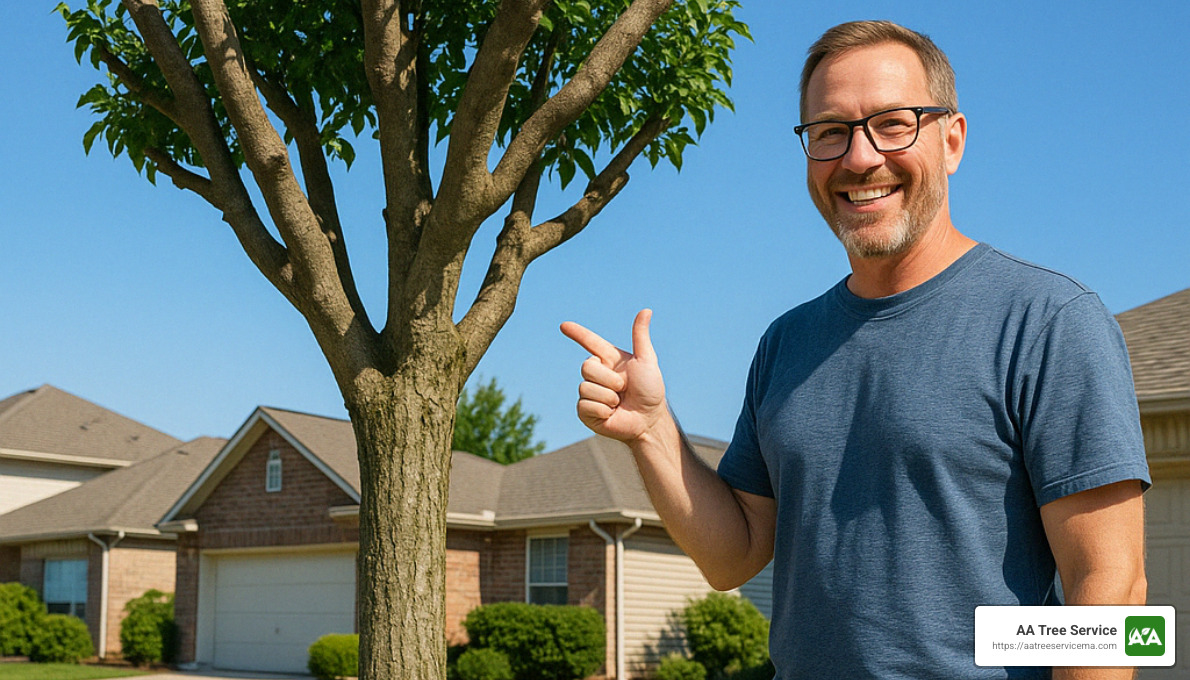
Local tree cutting services from AA Tree Service—because when it comes to the trees that improve your home’s beauty and value, only the best care will do.