The Value of Professional Tree Care For Your Property
Local tree care is essential for maintaining healthy, safe, and beautiful trees on your property. If you’re looking for tree care services in Massachusetts or New Hampshire, here’s what you need to know:
Quick Guide to Local Tree Care Services:
* Tree Removal: $200-$2,000+ depending on size and location
* Pruning/Trimming: Recommended every other year
* Emergency Services: Available 24/7 for storm damage
* Stump Grinding: Prevents pest infestations and trip hazards
* Health Treatments: Deep-root fertilization, pest management
* When to Call: Dead limbs, leaning, disease signs, or after storms
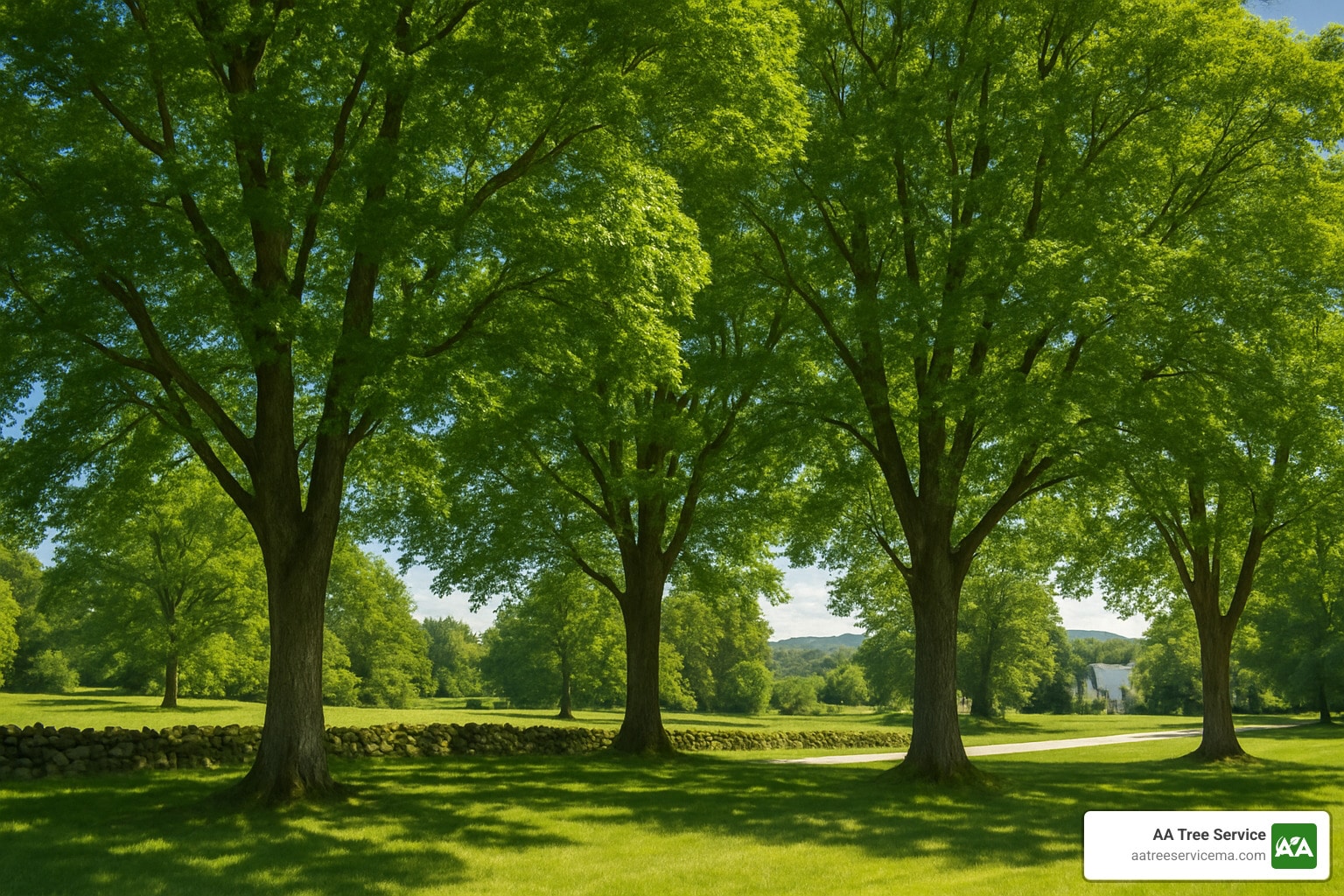
Trees are more than just landscape features—they’re valuable assets that improve your property’s beauty, provide shade, improve air quality, and increase your home’s value. But like any asset, they require proper care and maintenance to thrive, especially in New England’s challenging climate.
When trees are neglected, they can become hazardous during storms, develop diseases that spread to other plants, or simply fail to reach their full potential. That’s why professional local tree care is an investment that pays dividends in safety, aesthetics, and property value.
“For the beauty, health, and safety of your landscape’s greatest assets, your trees,” as one arborist puts it, regular maintenance from certified professionals ensures your trees remain in optimal condition year-round. Whether you’re dealing with winter storm damage, summer pests, or simply want to improve your landscape’s appearance, local tree care experts have the knowledge, equipment, and experience to help.
Local tree care further reading:
– local tree stump grinders
– local tree cutting services
– local tree trimmers in my area
The Importance of Local Tree Care
Imagine stepping outside on a sweltering summer day and feeling immediate relief under the cool shade of a maple tree. That’s just one small benefit of the quiet giants that grace our neighborhoods. Local tree care isn’t just about aesthetics—it’s about preserving these natural treasures that silently contribute to our daily lives in countless ways.
Trees are nature’s multitaskers. They purify our air by filtering out pollutants while providing fresh oxygen. They absorb rainfall, reducing flooding during heavy storms. They even act as nature’s sound barriers, muffling the noise of busy streets and neighboring activities.
When it comes to your property value, healthy trees are like money growing in your yard. Well-maintained trees can boost your home’s value by 5-15%, with the USDA Forest Service finding that mature trees add an average of 10% to property values. In New England’s sometimes harsh climate, that’s a return on investment worth protecting.
“From our first meeting with you to job completion, our priority is the safety of your property and the people on it,” shares a veteran arborist with decades of experience. This safety-first approach is especially crucial in Massachusetts and New Hampshire, where winter storms can transform neglected trees into serious hazards overnight.
Why Homeowners Benefit From Local Tree Care
The advantages of investing in local tree care extend far beyond curb appeal.
Properly maintained trees significantly reduce liability risks. That suspicious-looking branch hanging over your driveway? Professional care identifies and addresses these potential hazards before they come crashing down during the next storm.
Your wallet benefits too. Trees strategically positioned around your home can slash summer cooling costs by 15-35%. In winter, they serve as natural windbreaks, potentially reducing heating bills by 10-20%. Nature’s air conditioning at its finest!
And after a long day, there’s nothing like coming home to a peaceful environment. Trees with dense foliage can reduce neighborhood noise by up to 40%, creating your own quiet sanctuary.
As one relieved Massachusetts homeowner recently shared: “The cabling work we had done last fall saved our oak tree—and probably our roof—during that big nor’easter. It was the best money we’ve spent on home maintenance.”
How Communities Thrive With Local Tree Care
The benefits of local tree care reach far beyond individual yards, creating stronger, healthier communities.
A robust urban canopy doesn’t happen by accident. Communities that invest in professional tree management enjoy cleaner air, better stormwater management, and an improved quality of life for all residents. These green investments pay dividends for generations.
In urban areas where concrete and asphalt trap heat, trees are natural cooling systems. They can reduce surrounding temperatures by 2-9°F, decreasing heat-related illnesses and lowering energy consumption during hot summer months.
Supporting local tree care companies like AA Tree Service keeps your dollars working in your community. When you hire local experts, you’re not just investing in your trees—you’re supporting local families and businesses. These companies typically source materials locally and hire from within the community, creating a positive economic ripple effect.
“Supporting local businesses not only ensures better tree care but also strengthens community bonds,” notes an industry expert. “Local arborists understand regional challenges and are invested in maintaining the community’s green infrastructure.”
By choosing professional local tree care, you’re not just maintaining your property—you’re contributing to a healthier, safer, and more beautiful community for everyone to enjoy.
Common Tree Challenges in Massachusetts & New Hampshire
New England’s trees face unique challenges that make local tree care particularly important. The harsh seasons and evolving threats in our region create special needs for trees that homeowners should understand.
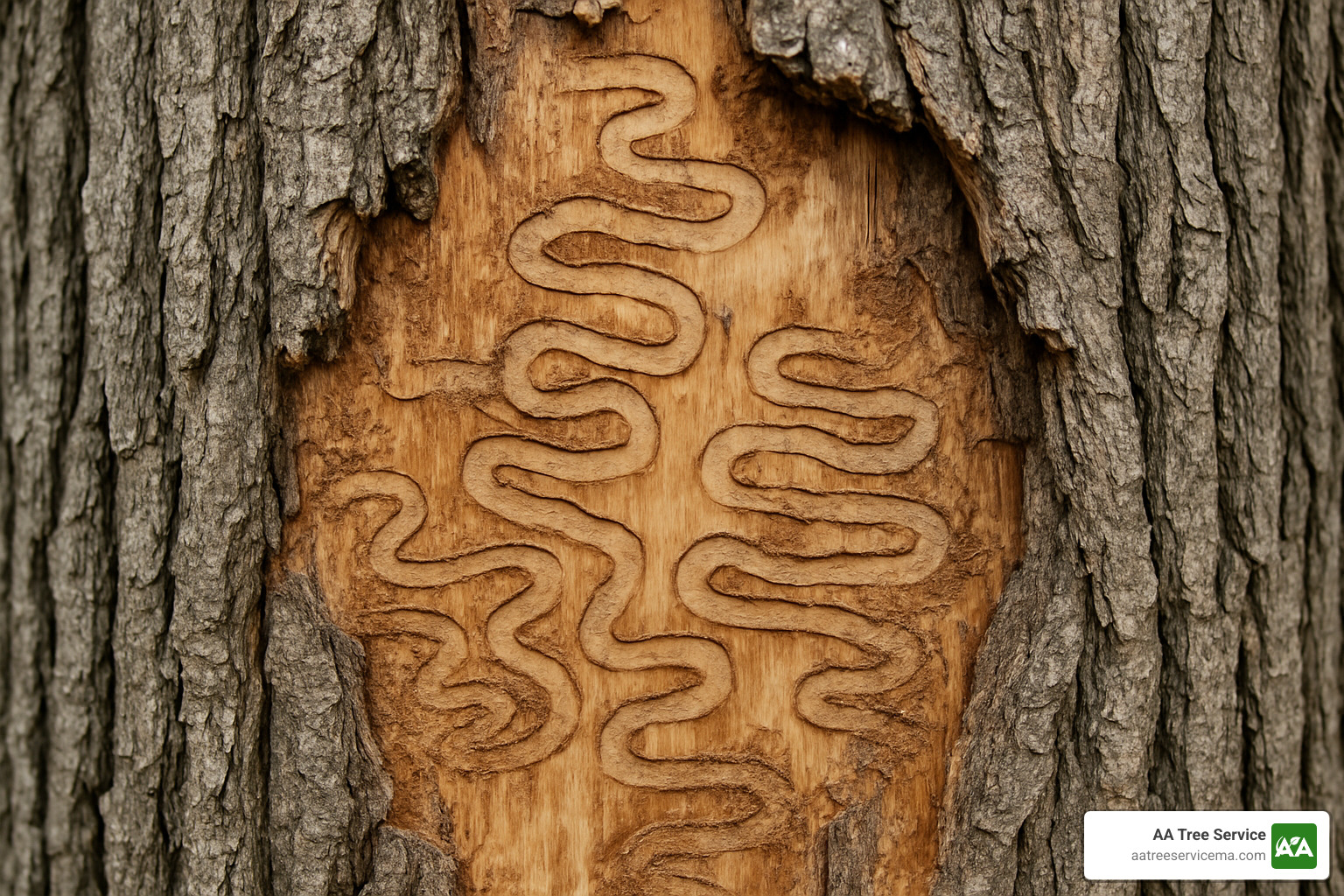
Those beautiful trees shading your Massachusetts or New Hampshire property battle invisible enemies every day. The emerald ash borer has devastated countless ash trees across the Northeast, leaving behind telltale D-shaped exit holes and serpentine tunnels beneath the bark. Without early detection and treatment, these magnificent trees can die within just 2-3 years of infestation.
Equally concerning is the hemlock woolly adelgid, a tiny pest causing enormous damage to our eastern hemlocks. You might notice what looks like cotton balls on the underside of hemlock branches – that’s the pest at work, slowly draining the life from these important forest components.
Winter brings its own set of challenges. Road salt damage affects trees along streets and driveways, causing browning needles and leaf scorch that weakens trees over time. And those picturesque ice storms we endure? They can snap branches and permanently disfigure trees that haven’t been properly maintained.
“I’ve seen trees that survived decades suddenly fail after one bad ice storm,” shares a local arborist. “Proper pruning before winter could have saved many of them.”
Despite our region’s typically moist climate, periodic drought stress weakens trees and makes them more vulnerable to insect attacks. The soil compaction common in our suburban neighborhoods restricts root growth, while various fungal blights thrive during our humid summers, particularly affecting maples, oaks, and other beloved native species.
Even our deer population contributes to tree troubles, with deer browse damaging young trees and preventing forest regeneration in many areas.
Signs Your Property Needs Local Tree Care
Trees don’t speak, but they do communicate through visual cues when they’re in trouble. Dieback in the crown – those dead branches or thinning foliage at the top – often signals root or trunk issues below. If you notice your tree suddenly leaning after a storm, that’s a red flag for potential root damage and requires immediate attention.
Mushroom conks appearing on the trunk aren’t just a curiosity – they’re often evidence of internal decay that could compromise the tree’s structural integrity. Similarly, root upheaval or damage exposes the tree’s foundation to further harm and instability.
Is your tree’s canopy looking unusually thin this year? This canopy thinning might indicate pest problems or nutrient deficiencies that require professional intervention.
“Not all tree problems announce themselves loudly,” cautions a certified arborist. “Some issues like internal decay or root damage may only be detected during a professional inspection. That’s why regular check-ups are so valuable.”
Prevention & Treatment Options
When it comes to local tree care, an ounce of prevention truly is worth a pound of cure. Integrated Pest Management (IPM) offers a sustainable approach that monitors and targets pests while minimizing environmental impact. Rather than blanket chemical applications, IPM uses the least toxic methods first, escalating only when necessary.
Deep-root fertilization delivers nutrients directly to where trees need them most, bypassing compacted surface soil to reach the critical root zone. This technique is particularly valuable for mature trees in urban and suburban settings where competition for nutrients is fierce.
Don’t underestimate the power of proper mulching. A 2-4 inch layer applied in a 3-foot radius (more for larger trees) conserves moisture, moderates soil temperature, and reduces competition from grass. Just remember to keep that mulch away from the trunk to prevent rot and pest problems.
During dry spells, appropriate watering becomes crucial. Water deeply but infrequently to encourage deep root growth rather than shallow, vulnerable root systems. A slow, deep soak once a week is far better than daily sprinkles.
“Healthy trees can tolerate some pest pressure without suffering permanent injury,” explains a tree care specialist. “This highlights why regular monitoring and maintenance make such a difference in the long run.”
For comprehensive information about all our treatment options, visit our Tree Care Services page where we outline our approach to maintaining tree health throughout Massachusetts and New Hampshire.
Essential Services Provided by Local Arborists
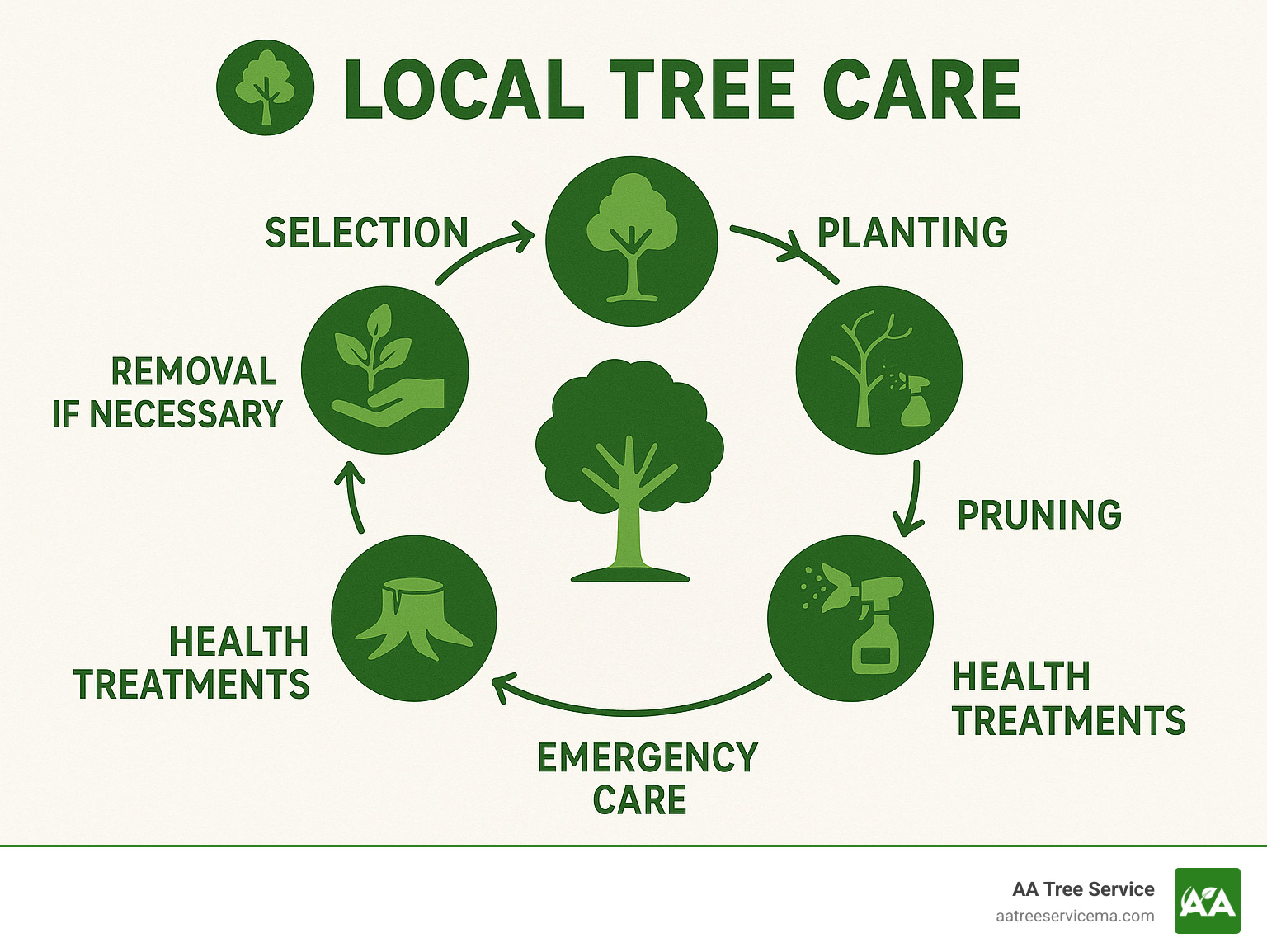
Professional local tree care offers much more than just cutting down trees. It’s about maintaining the health, safety, and beauty of your landscape through specialized services custom to New England’s unique challenges.
Pruning & Trimming Essentials
Think of pruning as preventative healthcare for your trees. Just as we need regular check-ups, your trees benefit immensely from skilled trimming that removes potential problems before they start.
Good pruning does three essential things: it improves structure by removing competing branches to create a stronger framework; it improves airflow through the canopy to reduce disease pressure; and it increases safety by eliminating dead or dangerous limbs before they can fall unexpectedly.
When our certified arborists approach your trees, they’re thinking about different levels of care. Class I Pruning involves light work to remove dead or diseased branches. Class II Pruning is more standard maintenance that improves the tree’s form and appearance. And Class III Pruning focuses primarily on hazard reduction when safety is the main concern.
“Having your trees professionally pruned every other year is like getting a regular dental cleaning,” says one of our arborists. “It’s much easier—and cheaper—to maintain health than to fix problems later.”
Young trees especially benefit from early professional attention. Early structural pruning sets them up for decades of healthy growth and can dramatically reduce future maintenance needs. Learn more about our approach on our Tree Pruning and Trimming page.
Safe & Strategic Tree Removal
Sometimes, despite our best preservation efforts, a tree needs to come down. This might be because it’s dead or dying, growing too close to your home, severely damaged by a storm, structurally compromised, or an invasive species threatening native plants.
Removing a tree safely requires specialized knowledge and equipment that most homeowners simply don’t have. For larger trees or those in tight spots between houses, we often use crane-assisted removal techniques to ensure everything comes down safely, piece by piece.
“The YouTube videos make it look simple, but tree removal is actually incredibly complex,” our safety director often reminds clients. “Each cut affects how the tree will react, and miscalculations can be disastrous.”
Tree removal costs vary depending on several factors, with industry averages ranging from $200-$600 for small trees under 30 feet to $1,500-$4,500+ for very large specimens over 80 feet. Medium trees (30-60 feet) typically run $600-$1,000, while large trees (60-80 feet) average $800-$1,800. These prices represent industry averages based on internet data and not actual costs for AA Tree Service.
Your final price depends on accessibility, proximity to structures, and whether you want stump grinding included. For more details about our professional removal approach, visit our Tree Removal page.
Soil & Health Care Treatments
Urban and suburban trees face unique challenges their forest cousins don’t—compacted soil, limited root space, pollution, and competition from lawns. Our soil and health treatments help them thrive despite these obstacles.
Deep-root fertilization is like a nutrient injection for your trees. We use specialized equipment to deliver essential nutrients below the soil surface, directly to the root zone where they’re most needed. This bypasses compacted surface layers that might otherwise block absorption.
For specific pest or disease issues, we offer tree injections that work similarly to vaccinations, delivering treatments directly into the tree’s vascular system. We also use bio-stimulants to improve root growth and improve your tree’s natural ability to handle environmental stress.
As one client put it after seeing her struggling maple recover: “It’s like the tree got a spa day and a multivitamin all at once. The difference by the following spring was remarkable.”
For expert evaluation of your trees’ health needs, reach out to our Certified Arborist Tree Service Near Me.
Emergency & Storm Services
New England weather doesn’t always cooperate with our plans. When nor’easters, ice storms, or other severe weather strikes, we’re ready to help with 24/7 emergency response throughout Massachusetts and New Hampshire.
Our storm response begins with thorough hazard assessment to identify immediate risks. We then prioritize emergency removal of trees threatening structures or safety, followed by limb removal from roofs, driveways, and yards. Once the immediate dangers are addressed, we handle complete debris cleanup, processing and removing fallen trees and branches so you can get back to normal.
“The hours after a storm are often when homeowners make the most dangerous decisions,” our emergency team leader notes. “Please don’t try to handle storm-damaged trees yourself, especially if power lines are involved. That’s what we’re here for.”
Our crews are specifically trained for post-storm scenarios and carry specialized equipment to handle even the most challenging situations safely. Learn more about how we can help when emergencies strike at our Emergency Tree Services page.
Choosing the Right Local Tree Care Provider
Selecting the right professional for your local tree care needs is crucial for both the health of your trees and the safety of your property.
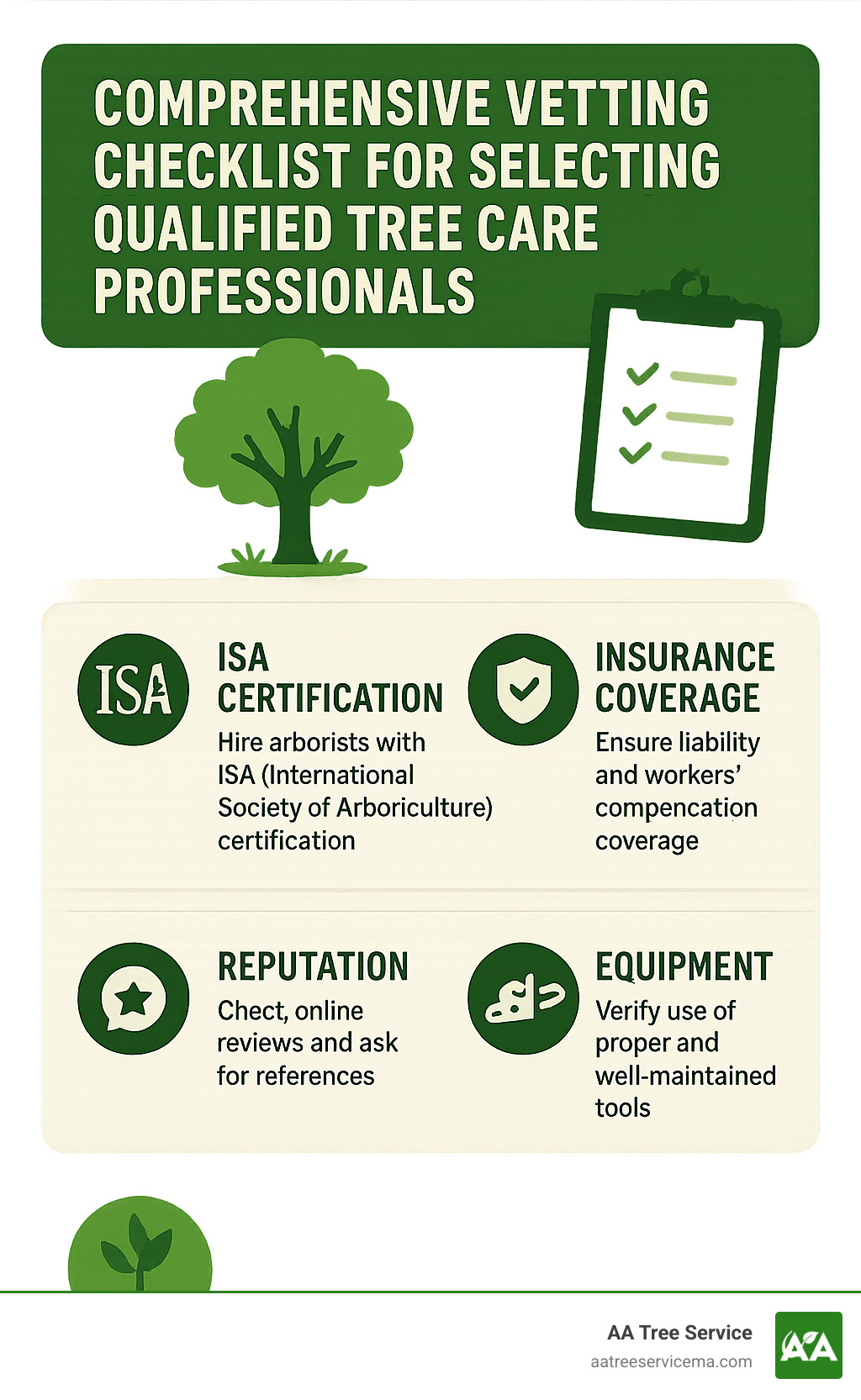
When I talk with homeowners across Massachusetts and New Hampshire, they often ask how to find a tree service they can trust. It’s a valid concern—your trees are valuable assets, and working with the wrong provider can lead to damaged property, injured trees, or worse.
The foundation of your search should be ISA Certification. This credential from the International Society of Arboriculture isn’t just a fancy title—it demonstrates that the arborist has invested time in mastering proper tree care techniques and stays current with industry standards. Think of it as the difference between seeing a general practitioner versus a specialist for a complex medical issue.
Equally important is comprehensive insurance coverage. Before any work begins, ask to see certificates for both liability insurance and workers’ compensation. As one homeowner in Concord told me after a close call: “I never realized how important checking insurance was until a neighbor had a tree fall on their garage during removal. The company’s insurance saved them thousands.”
The equipment and capabilities a company brings to your property tells you a lot about their professionalism. Modern, well-maintained equipment isn’t just about efficiency—it’s about safety. A reputable service will have the right tools for your specific job, whether that’s a crane for a tricky removal or specialized equipment for working near power lines.
When it comes to quotes, details matter. Detailed written estimates should clearly outline the scope of work, timeline, and costs. Be wary of vague proposals or companies reluctant to put things in writing. Your estimate should feel like a roadmap, not a mystery novel.
Don’t skip checking online reviews and references. While a few negative reviews are normal for any business, look for patterns in feedback. Better yet, ask for references from projects similar to yours. Most satisfied customers are happy to share their experiences.
Finally, value local knowledge. A provider familiar with Massachusetts and New Hampshire trees understands our unique challenges—from coastal salt exposure to mountain wind patterns. They’ll know which trees thrive in our Zone 5-6 climate and how to address regional pests like emerald ash borer or hemlock woolly adelgid.
How Often Should You Schedule Local Tree Care Visits?
Creating a rhythm for tree maintenance prevents small issues from becoming costly emergencies. For most properties in New England, the sweet spot is biennial pruning—every other year for mature trees. This timing allows enough growth between sessions to make the work worthwhile while preventing limbs from becoming hazardous.
An annual inspection by a certified arborist serves as your early warning system. These professionals spot subtle signs of trouble that untrained eyes might miss. As one arborist puts it, “I can often see a tree’s distress signals 1-2 years before the average homeowner notices something’s wrong.”
After those fierce nor’easters or ice storms that rattle our region, a post-storm assessment is worth every penny. Even trees that appear unscathed might have hidden damage that compromises their structural integrity.
Depending on your soil and species, seasonal fertilization might be recommended. Many New England soils lack essential nutrients, especially in developed areas where leaf litter (nature’s fertilizer) is regularly removed. Your arborist can test your soil and recommend the right feeding schedule—typically spring for growth support or fall for root development.
Budgeting & Pricing Factors
Tree care pricing in New England reflects our region’s unique challenges. When budgeting for services, several factors influence what you’ll pay.
Tree size naturally tops the list—larger trees require more time, more crew members, and often specialized equipment. A 20-foot ornamental cherry requires far less resources than a 100-foot white pine.
Accessibility can dramatically impact costs. That tree in your backyard, surrounded by gardens and fences, will cost more to service than one with clear access. As one crew leader told me, “The difference between an easy access job and a challenging one can double the time required.”
The risk level associated with your project affects pricing too. Trees entangled with power lines, leaning toward structures, or showing signs of instability require additional safety measures and expertise.
Some municipalities in Massachusetts and New Hampshire require permits for certain tree work, particularly for street trees or in conservation areas. These permissions add time and costs to your project.
Debris disposal is the final piece of the pricing puzzle. Will branches be chipped and removed? Is wood being cut to firewood length? Each handling step affects the bottom line.
Average costs in Massachusetts and New Hampshire can range widely. While basic pruning might start around $200 for a small tree, complex removals of large trees can reach $6,000 or more. For context, removing a medium-sized tree (30-60 feet) typically runs $600-$1,800 based on industry averages.
For specialized services like stump removal, which typically starts around $250 but can range up to $750+ for large or difficult stumps, visit our Stump Grinding page for more details.
Year-Round Maintenance Calendar for Local Tree Care
Just like your own health needs different care throughout the seasons, your trees have changing needs as the calendar turns. In Massachusetts and New Hampshire, effective local tree care follows nature’s rhythm, with specific tasks that align perfectly with each season’s conditions.
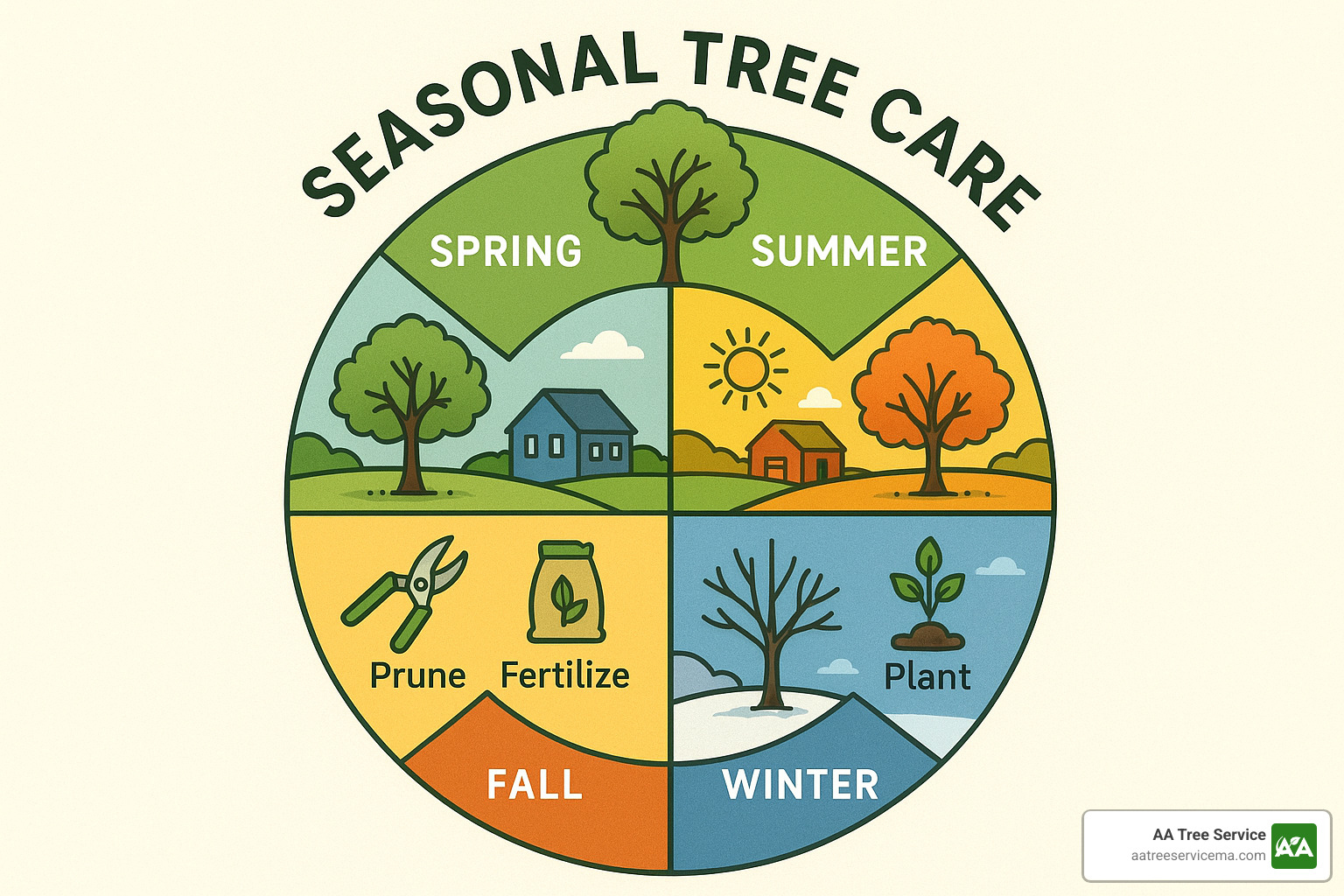
When spring arrives in New England (March-May), it’s time for your trees’ annual checkup. This is when you’ll want to conduct a thorough post-winter inspection to spot any damage from those tough winter months. It’s also the perfect time to apply treatments for early-season pests before they become problematic, fertilize trees as they wake from dormancy, and plant new additions to your landscape. Don’t forget to refresh the mulch around your trees to prepare them for summer’s heat!
Summer months (June-August) call for vigilance. Keep a watchful eye for any pest or disease issues that thrive in warm weather. Even in New England, dry spells happen, so water during these periods—especially those younger trees with less established root systems. Summer allows for light pruning if necessary, and prompt assessment of any storm damage after those summer thunderstorms roll through.
“I always tell my clients that summer is about monitoring and maintaining,” shares a Massachusetts arborist. “It’s like babysitting your landscape during its most active growth period.”
As fall colors begin to appear (September-November), it’s time for structural pruning once leaves start to drop, making branch architecture more visible. This is also when you’ll want to apply anti-desiccant sprays to evergreens to protect them from winter winds, plant new trees before the ground freezes, clear fallen leaves from root zones, and apply late-season fertilizer to give roots a boost before winter dormancy.
Winter (December-February) might seem quiet above ground, but it’s actually an ideal time for major tree work in Massachusetts and New Hampshire.
“Winter is actually an ideal time for many tree care operations,” notes a New England arborist. “The frozen ground allows better access to trees, leafless branches make structural issues more visible, and dormant trees respond well to pruning.”
This is when professional arborists perform major pruning on dormant trees, remove hazardous or dead trees safely, protect young trees from animals and salt damage, and help you plan for spring planting and treatments.
Preparing Trees for Nor’easters & Ice Storms
New England weather demands special preparation, and local tree care professionals understand exactly what your trees need to withstand our notorious nor’easters and ice storms.
Structural support through cabling and bracing helps reinforce weak unions or split trunks, preventing catastrophic failure during high winds or under the weight of ice. Think of it as giving your trees a supportive brace during their most vulnerable moments.
Selective thinning, when done by professionals, reduces wind resistance and ice accumulation while carefully preserving the tree’s natural form and beauty. This isn’t about drastically changing your tree’s appearance—it’s about strategic removal that increases resilience.
Root zone mulching insulates roots from temperature extremes and maintains soil moisture, improving overall tree health and storm resilience from the ground up.
“Install cabling after storm damage or on high-risk limbs to provide supplemental support and reduce movement,” recommends a tree risk assessment specialist. “Regularly reassess tension as the tree grows.”
Off-Season Planting & Native Species Selection
The foundation of successful local tree care begins with planting the right tree in the right place. This simple principle saves countless headaches and expenses down the road.
When selecting trees for your Massachusetts or New Hampshire property, consider the mature size, growth habit, and site conditions. That cute sapling might grow into a 60-foot giant that threatens your roof line or power lines if improperly placed!
Our region generally falls within USDA hardiness zones 5-6, which should guide your species selection. Planting trees rated for colder zones might leave you disappointed when they fail to thrive in our distinctive New England climate.
Native species offer tremendous advantages—they’re adapted to local conditions, generally require less maintenance, and provide better wildlife habitat. Some excellent native choices for our region include the vibrant Red Maple with its stunning fall color, majestic Eastern White Pine, sturdy Northern Red Oak, neat River Birch with its peeling bark, and the understated but beautiful American Hornbeam.
“Planting native trees not only ensures better survival rates but also supports local ecosystems,” explains a conservation arborist. “They’ve evolved alongside our local wildlife and form important links in the ecological chain.”
Want to see proper planting techniques in action? Watch our Planting Video for visual guidance that will help ensure your new trees get the right start.
Sustainability & Community Impact of Local Tree Care
When you choose professional local tree care, you’re doing more than just maintaining your property—you’re contributing to a healthier, more sustainable community for everyone.

The beauty of working with a dedicated local company like AA Tree Service is that the benefits ripple far beyond your yard. Take native replanting, for instance. When removal is necessary, responsible arborists don’t just leave a gap in the landscape—they help property owners select appropriate native species that will thrive in Massachusetts and New Hampshire conditions while supporting local wildlife.
Waste reduction is another significant environmental benefit. Rather than hauling tree debris to already-crowded landfills, professional tree care companies transform what might be considered “waste” into valuable resources. Those branches from your pruning project? They’re likely heading to a chipper to become nutrient-rich mulch that will nourish other trees and gardens throughout your community.
“The way I see it, every branch has a purpose,” shares one veteran arborist. “What comes from the community should give back to the community—whether that’s as mulch for public parks, firewood for local families, or even lumber for woodworking projects.”
The environmental impacts extend to pollinator support as well. By maintaining healthy, diverse tree canopies throughout Massachusetts and New Hampshire neighborhoods, we’re preserving crucial habitat for bees, butterflies, and other pollinators that our food systems depend on. A single mature oak tree can support hundreds of species of moths and butterflies, whose caterpillars in turn feed thousands of baby birds each spring.
Perhaps less obvious but equally important is the economic impact of choosing local tree care. When you hire a Massachusetts or New Hampshire-based company, those dollars stay in your community, supporting local families and businesses. These companies purchase supplies locally, hire local workers, and contribute to local taxes that fund schools, roads, and public services.
As one team member at AA Tree Service puts it: “Johnny also has a passion for preserving large old growth trees; he feels that they are relics of the past and hopes to preserve as much of the Urban Forest as possible.” This preservation mindset represents the heart of sustainable tree care—recognizing that these living monuments connect us to our past while ensuring a greener future.
By investing in professional local tree care, you’re not just maintaining trees—you’re nurturing your community’s green infrastructure, supporting local economies, and contributing to environmental resilience that will benefit generations to come.
Frequently Asked Questions About Local Tree Care
What safety measures do professionals follow?
When it comes to tree work, safety isn’t just a priority—it’s the foundation of everything we do. Professional arborists follow rigorous safety protocols that protect both workers and your property.
Before a single branch is cut, a comprehensive job site assessment identifies potential hazards. Crews arrive equipped with personal protective gear including helmets, safety glasses, ear protection, and specialized cut-resistant clothing that can save lives when working with powerful equipment.
Equipment maintenance might not be visible to homeowners, but it’s crucial—chainsaws, rigging equipment, and climbing gear undergo regular inspection to prevent failures. Specialized training in climbing techniques, proper rigging, and emergency response ensures crews can handle unexpected situations.
“From our first meeting with you to job completion, our priority is the safety of your property and the people on it,” emphasizes a safety-focused arborist with over 15 years in the field.
You’ll notice that professional crews establish clear work zones with signage and barriers—this isn’t just formality but essential protection for your family and passersby. They also maintain constant communication between ground workers and climbers, often using hand signals or headsets to coordinate complex operations safely.
How do storms and extreme weather affect local trees?
New England weather can be particularly brutal on trees, creating challenges that require specialized local tree care approaches.
Wind damage is perhaps the most visible threat, with strong gusts breaking branches, causing trees to fail completely, or leaving them leaning dangerously. After particularly violent storms, even trees that appear unharmed might have internal cracks that can worsen over time.
Ice loading presents a unique winter hazard in Massachusetts and New Hampshire. A mere quarter-inch of ice can add hundreds of pounds of weight to a tree’s canopy, causing branches to snap even on otherwise healthy specimens. The characteristic cracking sound during ice storms is often the sound of trees giving way under this immense pressure.
Excessive rainfall creates soil saturation problems by weakening root stability. When soil becomes waterlogged, roots lose their anchoring power, making trees more likely to topple even in moderate winds. This is especially common in areas with clay soils that drain poorly.
Lightning strikes might seem rare, but they affect more trees than you might think. Direct hits can split trunks instantly, while even nearby strikes can create entry points for disease and decay that might not become apparent for months or years.
Winter brings the additional challenge of salt exposure for trees near roadways and walkways. Road salt damages roots and can be carried by splash-up onto foliage, causing desiccation and tissue damage that weakens trees over time.
“First aid for trees after storms includes removing hanging or broken branches, proper pruning of damaged areas, and sometimes applying wound dressing for certain species,” advises a storm recovery specialist who’s helped hundreds of properties recover from nor’easters.
What should I look for in a tree care contract?
A well-written tree care contract protects both you and the service provider by establishing clear expectations. Before signing anything, make sure your agreement covers these essential elements:
A proper contract starts with a detailed scope of work that identifies specific trees and exactly what will be done to each one. Vague language like “trim trees in backyard” leaves too much room for misinterpretation—look for specifics like “remove dead wood and reduce canopy by 15% on maple tree near garage.”
Timeline information should clearly state when work will begin and when you can expect completion. This becomes especially important for large projects or when you’re coordinating multiple contractors.
The cost breakdown should itemize different services rather than providing just a lump sum. This transparency helps you understand exactly what you’re paying for and prevents surprises.
Payment terms outline when and how payment is expected—whether that’s a deposit upfront with balance due upon completion, or other arrangements. Clear payment expectations prevent misunderstandings later.
Legitimate tree care professionals will readily provide insurance information, including certificates for both liability and workers’ compensation coverage. This crucial protection shields you from liability if accidents occur on your property.
Don’t overlook cleanup details—will debris be removed completely, chipped on-site, or left in a specific location? The contract should spell out exactly how your property will be left when work is completed.
Any guarantees or warranties regarding work quality or tree survival should be explicitly stated in writing, as should responsibility for obtaining necessary permits from local authorities.
“Having a clear, detailed contract protects both the homeowner and the tree care company,” notes a business professional with decades in the industry. “It ensures everyone has the same expectations about the work to be performed, which is the foundation of a positive working relationship.”
When you’re ready for expert local tree care from professionals who prioritize safety, quality, and clear communication, AA Tree Service is your trusted partner throughout Massachusetts and New Hampshire.
Conclusion
Investing in local tree care isn’t just about maintaining your landscape—it’s about protecting your home, enhancing your property value, and contributing to a healthier community. When you understand the unique needs of trees in Massachusetts and New Hampshire’s challenging climate, you’re taking the first step toward a safer, more beautiful property.
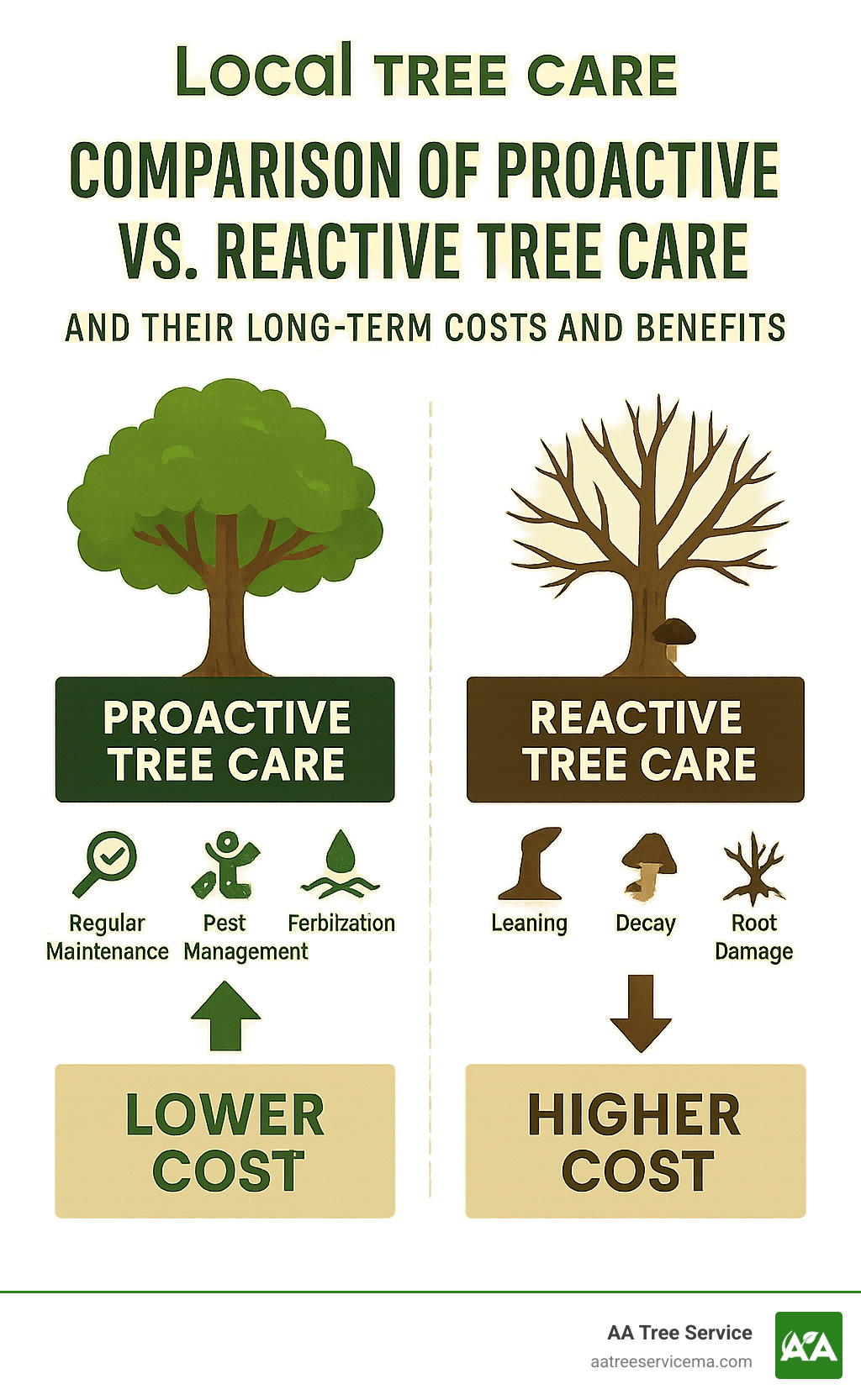
The benefits of being proactive about your trees speak for themselves. Regular maintenance dramatically improves safety by identifying and addressing potential hazards before they cause damage or injury. Your trees will live longer, grow stronger, and look more beautiful with professional care. And let’s not forget the environmental impact—healthy trees clean our air, provide homes for wildlife, and help fight climate change by capturing carbon.
From a practical standpoint, well-maintained trees can significantly boost your property value—often by thousands of dollars—while helping you avoid costly emergency removals after storms. As one homeowner told us, “The money I spent on preventive pruning saved me ten times that amount when that nor’easter hit last winter.”
At AA Tree Service, we’ve spent over two decades caring for trees throughout Massachusetts and New Hampshire. Our team doesn’t just work in your community—we live here too. We understand the unique challenges our region presents, from emerald ash borer infestations to ice-laden branches after winter storms.
We’re proud to offer comprehensive services that address all your tree care needs, backed by certified expertise and a genuine commitment to your satisfaction. And because tree emergencies don’t follow business hours, our 24/7 emergency response team is always ready when you need us most.
Whether you’re dealing with a hazardous tree that needs removal, seeking to improve your property’s appearance through strategic pruning, or simply want expert advice on maintaining your landscape’s health, we’re here to help with free same-day quotes and straightforward recommendations.
Local tree care isn’t just about today—it’s about preserving beauty and safety for years to come. The perfect time to start caring for your trees is now, before problems develop or storms strike. Your trees—and your property—will thank you.
For more information about how we can help with your tree care needs, please visit our professional tree removal services page or contact us today to schedule a consultation.