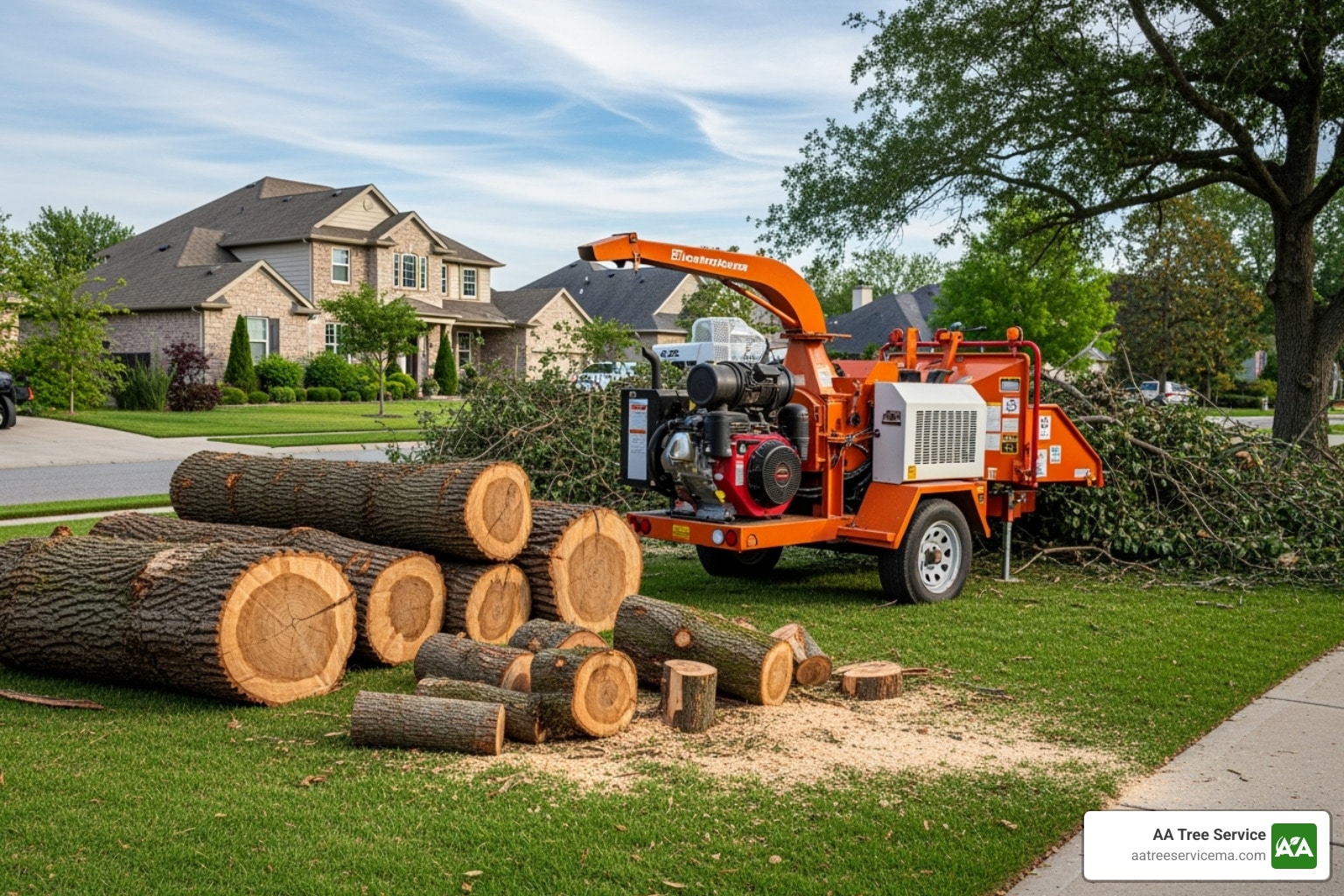
Why Licensed Tree Removal Service Near Me Is Essential for Your Property
Finding a licensed tree removal service near me is crucial when dangerous trees threaten your Massachusetts or New Hampshire property. Trees can become serious hazards after storms, disease, or simple aging – and removing them safely requires professional expertise, specialized equipment, and proper insurance coverage.
Key factors when choosing licensed tree removal services:
- State licensing – Verify business permits and certifications
- Full insurance coverage – General liability and workers’ compensation
- Local experience – Knowledge of MA/NH regulations and weather patterns
- Emergency availability – 24/7 storm response capabilities
- Written estimates – Detailed quotes with cleanup included
Tree removal is dangerous work that kills or injures hundreds of DIY homeowners every year. Professional tree services use cranes, bucket trucks, and specialized rigging techniques that cost $50,000+ to purchase. The average tree removal ranges from $200 to $2,000 based on internet data, but costs vary widely based on tree size, location, and complexity.
Licensed professionals also handle permits, utility coordination, and liability protection. A single mistake can cause tens of thousands in property damage or serious injury. The research shows that many tree removals are dangerous and complex – and mistakes can be costly.
Working with certified arborists protects both your property and your family. These experts can identify diseased trees, assess storm damage, and remove hazardous trees before they become emergencies.
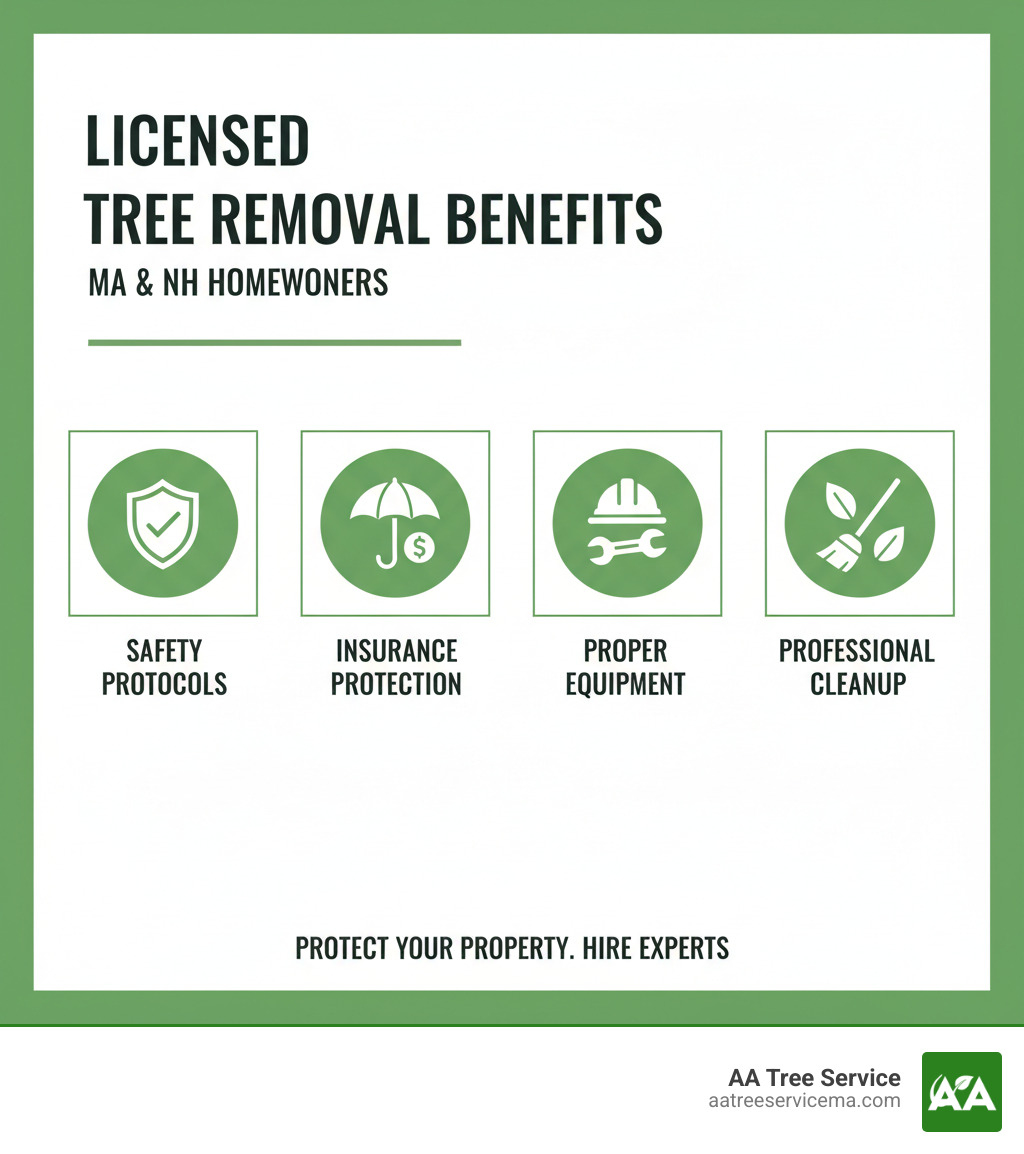
Licensed tree removal service near me word guide:
When Is Professional Tree Removal Necessary?
Sometimes, trees that once provided shade and curb appeal become serious hazards. Knowing when to call a licensed tree removal service near me can protect your family’s safety and your property’s value before disaster strikes. While some issues can be addressed with pruning, certain symptoms indicate that a tree has become a liability and complete removal is the only safe option.
Dead or Dying Trees: This is the most straightforward reason to call a professional. A tree that fails to produce leaves in the spring, has large sections of bare branches during the growing season, or shows peeling bark across most of its trunk is likely dead or in severe decline. These trees are not just an eyesore; they are ticking time bombs. Dead wood loses its moisture content, becoming extremely brittle and losing its ability to flex in the wind. A strong gust, a heavy snowfall, or even its own weight can cause it to snap and fall unexpectedly, posing a direct threat to anything or anyone below.
Significant Storm Damage: Massachusetts and New Hampshire are no strangers to severe weather. After a nor’easters, hurricane, or ice storm, it’s critical to inspect your trees. Look for major broken limbs, especially those still hanging in the canopy (known in the industry as “widowmakers”). A tree that has been struck by lightning may have a long, vertical crack down its trunk, indicating severe internal damage. Any tree that has lost a significant portion of its crown (more than 50%) may not be able to survive and could become unstable. A massive branch dangling over your driveway or roof won’t fix itself and requires immediate, professional attention.
A Sudden or Worsening Lean: While some trees naturally grow with a slight lean, a sudden change in angle is a major red flag. If a tree starts leaning more, especially after a storm or period of heavy rain, it often indicates root failure or a compromised trunk. You might see the ground heaving or soil cracking on the side opposite the lean. This is a sign that the tree’s anchor is failing, and it could topple over completely. A tree leaning towards your home, a neighbor’s property, or power lines is an emergency that requires an immediate call to a licensed tree removal service near me.
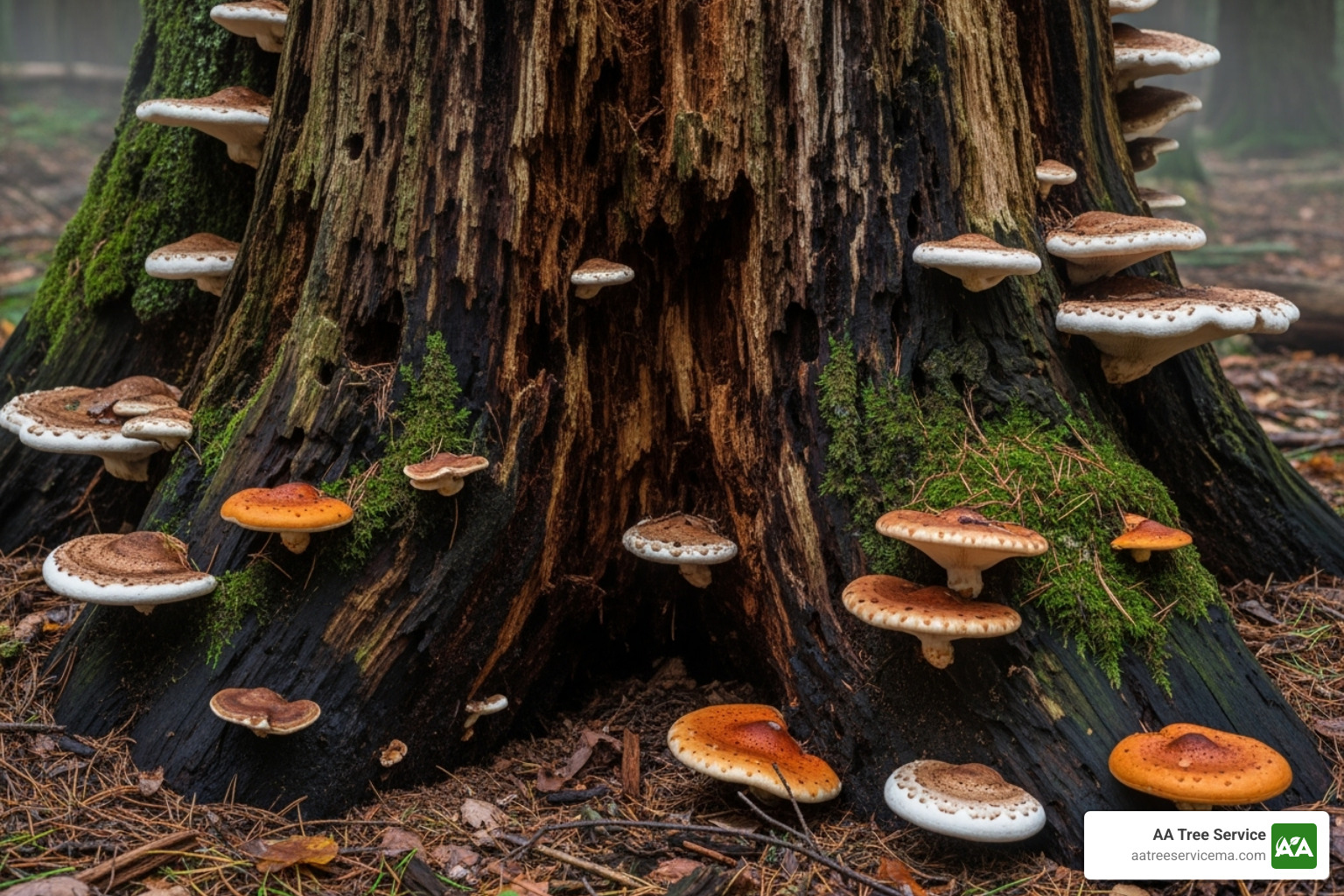
Disease and Pest Infestations: Many diseases and pests can weaken a tree from the inside out, making it appear healthy until it’s too late. In our region, be vigilant for signs of Emerald Ash Borer, which has decimated ash populations, or Hemlock Woolly Adelgid. Fungal growth is another major warning sign. Large mushrooms, or conks, growing on the trunk or at the base of the tree are the fruiting bodies of an internal decay fungus. By the time you see them, the internal wood is often already soft and rotten, severely compromising the tree’s structural integrity.
Cracked Trunks and Major Cavities: Deep vertical cracks, especially those that run through the entire trunk, are a sign of extreme stress and potential failure. These cracks can allow decay to penetrate deep into the tree. Large hollow sections or cavities, whether from old wounds or internal rot, also create significant weak points. A tree with these issues is at a higher risk of splitting apart or collapsing, a dangerous phenomenon known as a “barber chair.”
Visible Root System Problems: The root system is a tree’s foundation. If you see roots that are cracked, broken, or showing signs of decay or fungus, the tree’s stability is in question. Recent construction near a tree can sever major anchor roots, even if the damage isn’t immediately visible. Heaving soil around the base of the tree is another critical sign that the roots are losing their grip and the tree could be on the verge of uprooting.
Trees Growing Too Close to Structures or Utilities: Sometimes a perfectly healthy tree needs to be removed simply because of its location. Branches that scrape against your roof can wear away shingles and create entry points for water and pests. An expanding root system can crack foundations, sidewalks, and driveways, leading to expensive repairs. Most critically, any tree or limb growing into or over power lines is an extreme electrocution hazard. Never attempt to prune these trees yourself. Only a qualified professional working in coordination with the utility company can safely handle this work.
Here are 5 clear signs a tree needs removal:
- Dead leaves appearing outside of autumn – indicates severe health issues or death.
- Falling branches without apparent cause – signals internal weakness and decay.
- Holes in the trunk or large cavities – often from disease or pests compromising structure.
- Rot or fungus on bark or roots – clear indicators of advanced decay.
- Extensive fungi at the trunk base – a critical sign of root and trunk rot that compromises the entire tree’s stability.
The bottom line: if you’re questioning whether a tree needs to come down, get a professional opinion. For Massachusetts and New Hampshire homeowners, quick action on storm-damaged trees prevents further damage. Learn about our emergency tree removal services for storm-damaged trees.
Why You Must Hire a Licensed Tree Removal Service Near Me
You might be tempted to grab a chainsaw and tackle a problem tree yourself, but tree removal is one of the most dangerous jobs in America. For homeowners in Massachusetts or New Hampshire, hiring a licensed tree removal service near me isn’t about convenience—it’s about survival and financial solvency.
The Dangers of DIY Tree Removal
Attempting tree removal without training leads to countless injuries and fatalities every year. The risks are severe and multifaceted, going far beyond a simple cut.
- Chainsaw Kickback and Other Mishaps: A chainsaw is an incredibly powerful and unforgiving tool. Kickback occurs when the tip of the chainsaw bar hits an object, causing the saw to violently kick up and back towards the operator. This can happen in a fraction of a second, leading to severe or fatal injuries to the head, neck, and chest. Professionals are not only trained to anticipate and prevent kickback but also wear specialized personal protective equipment (PPE) like chainsaw chaps, which are designed to stop a moving chain on contact. Beyond kickback, there’s the risk of the chain breaking, the saw slipping on wet bark, or simply losing control of the heavy, vibrating machine.
- Falling from Ladders or Trees: This is one of the most common causes of injury for DIYers. Placing a ladder on uneven ground is inherently unstable, and the forces involved in cutting a branch can easily cause it to shift or kick out. Climbing the tree itself is even more dangerous, as a decaying tree can have branches that appear solid but are rotten and weak. Professionals use specialized climbing gear, ropes, and often aerial lifts or bucket trucks to maintain secure positioning.
- Unpredictable Tree Behavior and Gravity: Felling a tree is a science. Professionals calculate the tree’s lean, weight distribution, and any decay to make precise cuts (the notch and back cut) that guide its fall. An amateur might misjudge these factors, causing the tree to fall in the wrong direction, get hung up in another tree, or even “barber chair”—where the trunk splits vertically and violently springs back. The immense weight of a tree means that even a small miscalculation can lead to catastrophic damage to homes, vehicles, fences, and utility lines, turning a DIY project into a multi-thousand-dollar disaster.
- Electrocution from Power Lines: This is the deadliest risk. Electricity can arc from a power line to a tool or a branch—and then to you—without direct contact. Even if a branch falls and hits a line, it can energize the entire tree and the ground around it, creating a lethal hazard. This work requires specialized training and coordination with utility companies that only qualified professionals can manage.
- Lack of Proper Safety and Rigging Gear: Professionals use thousands of dollars in specialized equipment. This includes not just PPE but also a complex system of ropes, pulleys, and friction devices for safely rigging and lowering heavy sections of wood. Attempting to simply “cut and drop” large limbs over a house is a recipe for disaster. Without the right gear, you have no control over the immense forces you’re unleashing.
- Underestimating a Tree’s Weight and Physics: A 20-foot log that is 10 inches in diameter can weigh over 200 pounds. A large oak tree can weigh many tons. Homeowners consistently underestimate this weight and the incredible potential energy stored in a tree. When that energy is released incorrectly, it is uncontrollable and devastating.
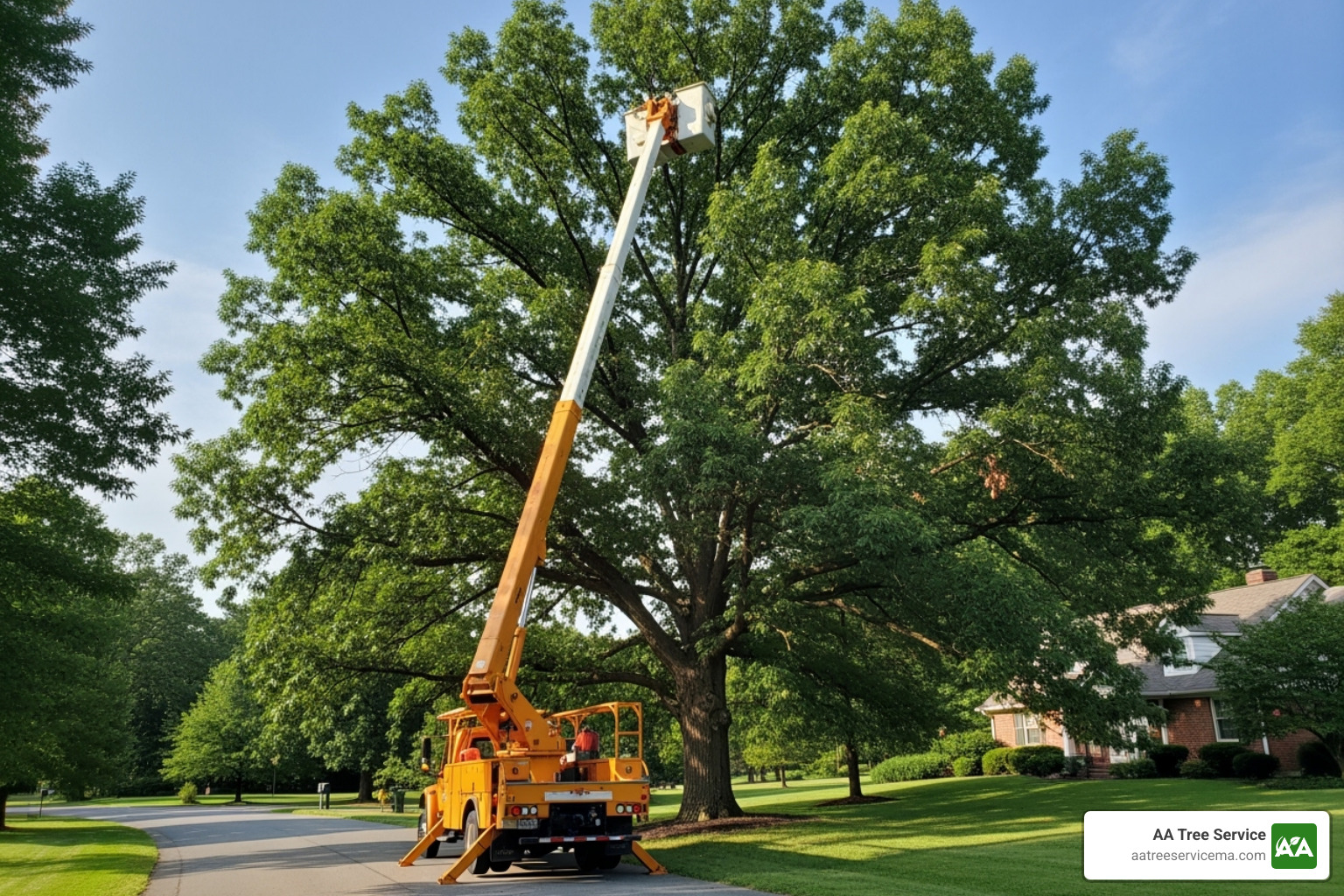
Understanding Qualifications: What “Licensed and Insured” Really Means
When you search for a licensed tree removal service near me, these words are your financial and legal lifeline. Here’s a deeper look at what they protect you from:
- State and Local Business Licenses: This confirms the company is a legitimate entity registered to do business in Massachusetts or New Hampshire. It means they are accountable to state regulations and pay taxes. An unlicensed operator is a ghost—if something goes wrong, they can simply disappear, leaving you with the mess.
- General Liability Insurance: This is your primary shield against financial ruin from property damage. Imagine a large limb is being lowered and the rope snaps, sending it crashing through your roof or onto your neighbor’s brand-new car. Without adequate general liability insurance held by the tree service, the financial responsibility for those repairs falls squarely on you, the homeowner. A legitimate company will carry a policy of at least $1 million, and they should be able to provide you with a certificate of insurance that you can verify directly with their insurance agent. Never accept a simple verbal confirmation that they are “insured.”
- Worker’s Compensation Insurance: This is arguably the most critical protection for a homeowner. Tree work is inherently dangerous, and accidents happen even to the most experienced crews. If a worker falls from a tree or is injured by equipment on your property and their employer does not have worker’s compensation insurance, you could be held personally liable. This means you could be sued and forced to pay for their medical bills, lost wages, and long-term disability. This is a massive financial risk that can lead to bankruptcy. Always insist on seeing a valid certificate of worker’s compensation insurance before any work begins.
- Professional Training and Certifications: Beyond licenses, look for certifications from groups like the International Society of Arboriculture (ISA). An ISA Certified Arborist has passed a comprehensive exam covering all facets of arboriculture and must maintain their certification with ongoing education. This demonstrates a professional commitment to knowledge and best practices in tree care and safety.
- Industry Accreditations: Company-level accreditations, such as from the Tree Care Industry Association (TCIA), are another strong indicator of professionalism. TCIA-accredited companies undergo a rigorous audit of their business practices, safety protocols, and training procedures. This is the gold standard in the industry.
Hiring a fully licensed and insured company with certified professionals is essential protection for your property, your finances, and your peace of mind. The money you might save with a cheap, unlicensed operator is a gamble that could cost you tens or even hundreds of thousands in damages, medical bills, or legal fees.
The Professional Tree Removal Process: From Quote to Cleanup
Wondering what happens when you call a licensed tree removal service near me? At AA Tree Service, we’ve refined our process over 20+ years to make it as smooth as possible for Massachusetts and New Hampshire homeowners. It starts with a friendly conversation and a free on-site estimate.
What to Expect in Your Free On-Site Estimate
When our team arrives, we conduct a thorough assessment to provide an accurate quote. This includes:
- Tree Health and Hazard Evaluation: We check for disease, decay, and pest problems. We then assess the tree’s structural integrity and proximity to your house, garage, or power lines.
- Discussion of Your Goals: We listen to your needs, whether you’re dealing with an emergency, planning a project, or just worried about an old tree.
- Equipment and Access Planning: We determine the safest, most efficient removal method, figuring out if we can get trucks close or if a crane is needed.
- Clear Breakdown of Costs and Timeline: You’ll receive a transparent quote with no hidden fees, detailing all costs for removal, cleanup, and other services. We also provide a proposed timeline for the work.
This expert consultation is completely free, with no obligation, so you can make an informed decision.
Comprehensive Services Offered by a licensed tree removal service near me
Beyond tree felling (the complete removal of problematic trees), we offer a full range of services:
- Tree Pruning and Trimming: Keeps healthy trees looking their best and prevents future problems.
- Stump Grinding: Eliminates unsightly stumps below ground level, making your yard safer.
- Land Clearing: Prepares your property for new construction or landscaping projects.
- Crane Services for large or complex removals: Provides the safest solution for large trees near buildings. These jobs often exceed $1,500 but protect your property from catastrophic damage.
Once you approve the detailed written quote, we schedule the work. On job day, our crew secures the area, uses proven felling and dismantling techniques, and chips all debris. If you’ve opted for stump grinding, we handle that too. We finish with a final site cleanup, raking and removing all debris to leave your property cleaner than we found it.
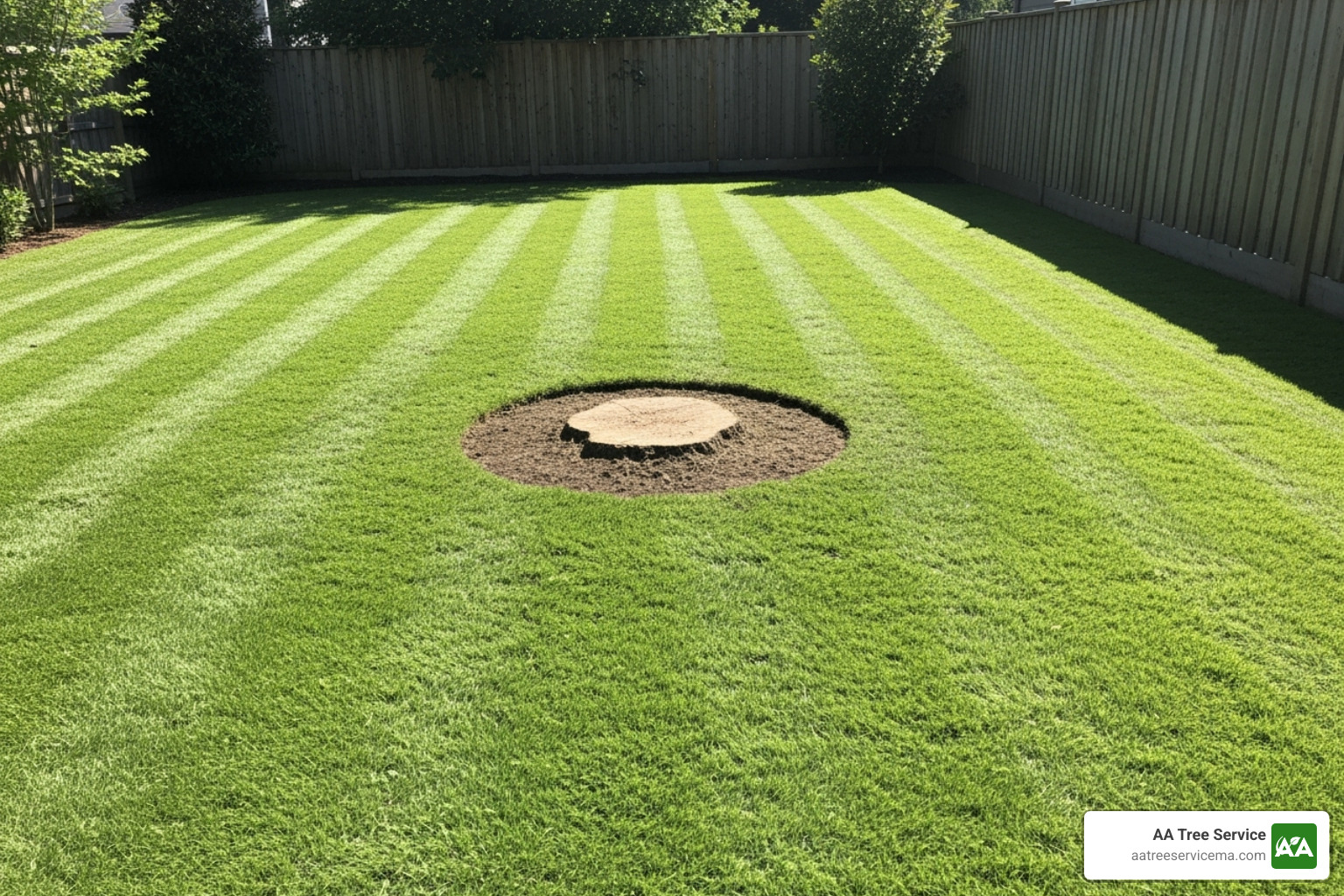
Our goal is simple: when we’re done, the only sign we were there is the missing tree and your peace of mind.
Understanding the Cost of Tree Removal
When you’re dealing with a problematic tree, one of the first thoughts that crosses your mind is probably, “What’s this going to cost me?” It’s a completely reasonable question, but here’s the thing – tree removal pricing isn’t like buying a gallon of milk. Every tree, every property, and every situation is unique.
Important note: The costs we’ll discuss here are average estimates based on internet research and general industry trends. These aren’t our actual prices at AA Tree Service – we provide customized quotes for every job because no two tree removals in Massachusetts and New Hampshire are exactly alike.
Think of tree removal pricing like a puzzle with multiple pieces. The final cost depends on how all these pieces fit together for your specific situation.
Factors Influencing Price
Tree size and height is usually the biggest factor in determining cost. A towering 80-foot oak requires completely different equipment, crew size, and time commitment than a 20-foot dogwood. Smaller trees might cost as little as $8 per foot to remove, while those giants over 80 feet can run $15 per foot or more – and that’s before factoring in crane rental.
Tree condition and health plays a surprising role in pricing. You might think a dead tree would be cheaper to remove, but it’s often the opposite. Dead trees are unpredictable – they’re brittle, branches can snap unexpectedly, and they don’t fall where you’d expect them to. A healthy tree, ironically, is often easier and safer to remove in a controlled manner.
Accessibility can make or break your budget. Is your tree standing proudly in the middle of an open yard, or is it squeezed between your house and your neighbor’s fence with barely enough room for a ladder? That cramped backyard tree will require more manual labor, specialized rigging, and careful planning – all of which add to the cost.
Proximity to hazards like your home, power lines, or that brand-new car in the driveway means our crew needs to work with surgical precision. Every cut has to be perfect, every piece lowered carefully. This level of precision and safety requires more time and specialized techniques.
Cleanup and debris removal preferences also affect your final bill. Some homeowners want everything chipped and hauled away for a completely clean slate. Others prefer to keep some logs for firewood or mulch. The more cleanup required, the higher the cost.
Don’t forget about stump removal – it’s typically a separate service from tree removal. Most tree removal quotes don’t include grinding that stump down to ground level, so factor that into your budget planning.
Average Tree Removal Costs
Based on internet research, tree removal costs across the country average around $750, with most jobs falling between $200 and $2,000. However, complex jobs can easily exceed this range. If you’re dealing with a fallen tree, you might pay anywhere from $100 to $500, depending on the size and location.
Here’s how costs typically break down by tree size:
| Tree Size | Height Range | Average Cost Range | Typical Complexity | Time Required |
|---|---|---|---|---|
| Small Trees | Under 30 feet | $150 – $500 | Low complexity | 1-2 hours |
| Medium Trees | 30-60 feet | $400 – $1,000 | Moderate complexity | 2-4 hours |
| Large Trees | 60-80 feet | $800 – $1,500 | High complexity | 4-8 hours |
| Very Large Trees | Over 80 feet | $1,500 – $4,500+ | Very high (often requires crane) | 1-2+ days |
| Fallen Trees | Any size | $100 – $500 | Varies by size and location | 1-3 hours |
These are general industry estimates. Your actual cost in Massachusetts or New Hampshire could vary significantly based on your specific tree, property conditions, and local factors.
The key takeaway? Every licensed tree removal service near me should provide a detailed, written estimate after evaluating your specific situation. Be wary of anyone giving you a price over the phone without seeing the tree – that’s usually a red flag.
How to Verify and Choose the Right Tree Service in MA & NH
Finding the right licensed tree removal service near me in Massachusetts or New Hampshire can feel overwhelming, but a few key steps can help you choose a professional who will protect your property.
Verify License and Insurance
Any reputable company will gladly provide their credentials. If they hesitate, consider it a red flag.
- Ask for a current business license for operation in MA or NH. This confirms they are legally permitted to work in your area.
- Request certificates for general liability and worker’s compensation insurance. Check the expiration dates to ensure the policies are active.
- Call the insurance provider directly. This is a crucial step many homeowners skip. Use the phone number on the certificate to confirm the policy is valid and check the coverage limits. This protects you from liability for accidents or property damage.
Check Reputation and Get Referrals
- Read online reviews on sites like the Better Business Bureau (BBB), Google, and Yelp. Look for patterns in feedback regarding professionalism, cleanup, and communication. Check a business’s reputation with the BBB to see their rating.
- Ask for local referrals. Word-of-mouth recommendations from friends, family, or neighbors in your community are powerful. A company with a good local track record should have plenty of satisfied customers.
Getting Multiple Written Quotes
Always get at least three written quotes to understand fair market pricing and compare services. Pay close attention to the details: is complete cleanup included? Is stump grinding a separate charge? Be cautious of quotes that seem too good to be true, as they often indicate a lack of proper insurance or cut corners.
Red Flags to Avoid
Be wary of these warning signs:
- Cash-only deals: Legitimate businesses accept checks and credit cards.
- Door-to-door solicitations: Reputable companies don’t need to chase down customers, especially after storms.
- High-pressure sales tactics: A professional service will give you time to consider your decision.
- No written contract: Always demand a detailed contract outlining the scope of work, timeline, and total costs.
Your Final Checklist
Before hiring, confirm the following:
- The company has a strong local presence in your MA or NH area. We’re proud to be serving communities across New Hampshire and Massachusetts, from Boston to Portsmouth.
- Cleanup and debris removal are included in the written contract.
- They offer 24/7 emergency availability for storm damage.
- You have a detailed, written contract protecting both parties.
Taking these steps is your best protection against costly mistakes and safety hazards. A true professional licensed tree removal service near me will welcome your due diligence.
Conclusion: Protect Your Property with a Trusted Local Expert
When you’re facing a dangerous tree on your Massachusetts or New Hampshire property, the choice is clear: take a massive risk with DIY removal, or invest in professional expertise that protects everything you’ve worked hard to build.
The risks we’ve covered throughout this guide aren’t just scary stories – they’re real dangers that injure hundreds of homeowners every year. Chainsaw accidents, falling from heights, unpredictable tree falls, and electrocution are just some of the hazards that make tree removal one of the most dangerous home maintenance tasks you could attempt.
By choosing a licensed tree removal service near me, you’re not just buying a service – you’re buying peace of mind. You’re ensuring that trained professionals with decades of experience handle the dangerous work while you stay safe on the ground.
The benefits extend far beyond safety. Professional tree removal protects your property value by preventing damage to your home, driveway, or landscaping. It eliminates liability concerns if a tree were to fall on a neighbor’s property. And it ensures the job is done right the first time, with proper cleanup that leaves your yard looking better than before.
Licensed and insured professionals bring specialized equipment worth tens of thousands of dollars – cranes, bucket trucks, and safety gear that most homeowners will never own. They understand the physics of tree removal, how to read weather conditions, and how to coordinate with utility companies when power lines are involved.
At AA Tree Service, we’ve been protecting properties across Massachusetts and New Hampshire for over 20 years. We understand the unique challenges of New England weather – from nor’easters that bring down massive trees to ice storms that leave branches hanging precariously over your home.
Our commitment goes beyond just removing trees. We offer 24/7 emergency service because tree emergencies don’t wait for convenient times. We provide free same-day quotes so you can make informed decisions quickly. And we stand behind our work with full licensing and insurance coverage that protects both our crew and your property.
Your family’s safety and your property’s value are too important to gamble with. Don’t let a dangerous tree become a disaster waiting to happen. Professional tree removal is an investment in your peace of mind and your property’s long-term health.
Contact us today for a free, no-obligation quote on your tree removal needs!