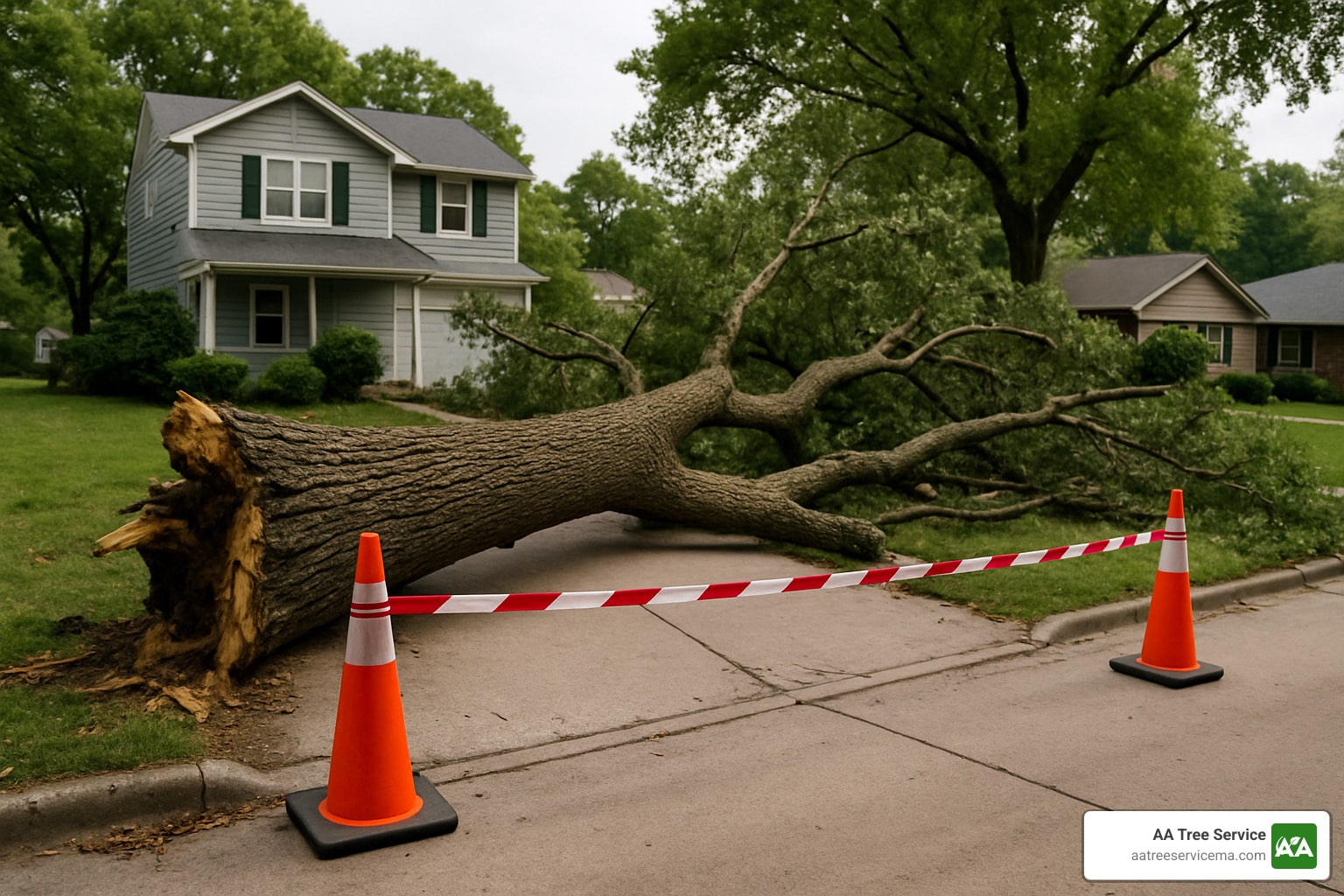
When Disaster Strikes: What To Do About Downed Trees
Downed trees near me require immediate attention. If you’re facing this emergency in Massachusetts or New Hampshire, here’s what to do right now:
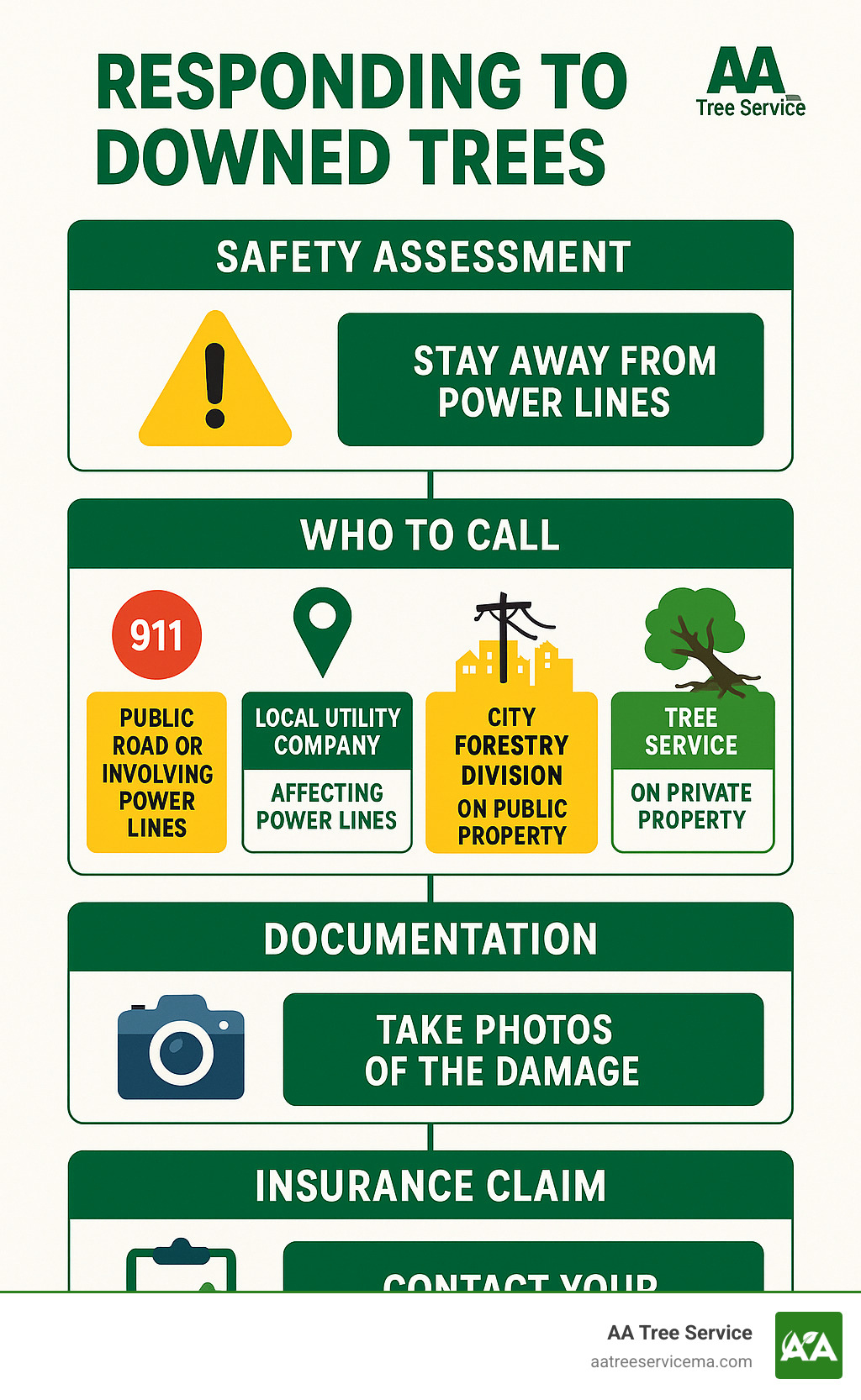
Quick Action Guide for Downed Trees:
1. Safety first – Stay away from any fallen trees touching power lines
2. Call 911 if the tree is blocking a public road or involves power lines
3. Contact your local utility company for trees affecting power lines
4. Call your city’s forestry division (311 in many areas) for trees on public property
5. Reach out to a professional tree service—AA Tree Service offers 24/7 emergency help for trees on private property
When powerful storms sweep through New England, they often leave a trail of fallen trees and broken limbs in their wake. These aren’t just inconveniences – they can create serious safety hazards and property damage risks that demand quick action.
“Fallen trees and branches are one of the primary causes of electric power outages,” according to utility company reports. During major storms in Massachusetts and New Hampshire, thousands of residents can lose power due to these downed trees.
Knowing exactly what to do when you find a downed tree near your home can save lives, prevent further damage, and speed up recovery. The right response depends on several factors:
- Where the tree has fallen (public road vs. private property)
- Whether power lines are involved
- If structures or vehicles are damaged
- Who owns the tree (you, a neighbor, or the municipality)
The responsibility for removal varies based on these circumstances. For trees on public property or in the right-of-way, your local government typically handles removal. For trees on private property, the homeowner is usually responsible – though insurance may cover costs depending on the situation.
After ensuring everyone’s safety, your next steps should include documenting the damage with photos and contacting the appropriate parties for removal. Proper documentation will be essential if you need to file an insurance claim later.
Downed trees near me terms explained:
– storm cleanup services
– broken trees
– emergency tree branch removal
Downed Trees Near Me: Immediate Safety Checklist
Finding a downed tree near me can be alarming, especially after a storm. Your first instinct might be to rush over and assess the damage, but safety must come first. As Jim Connelly, a safety expert, wisely puts it, “evacuate immediately if a tree falls on your house to avoid potential structural collapse.” This isn’t being overly cautious—it’s being smart.
Before you do anything else, take a deep breath and carefully check for power lines. Those innocent-looking wires tangled in branches can be deadly. Next, give your home a quick once-over for structural damage—is your roof sagging? Are there new cracks in your walls? Make sure everyone has a clear path to get away from the area if needed.
If you absolutely must approach the fallen tree, don’t do it in flip-flops and a t-shirt. Sturdy boots, gloves, and even a hard hat can protect you from sharp branches and shifting debris. And please, keep the kids and furry friends far away—their curiosity could put them in danger.

During major storms in Massachusetts and New Hampshire, tree service companies can see emergency removal requests skyrocket by up to 300%. This means you might be waiting longer than usual for professional help, making your initial safety steps even more important.
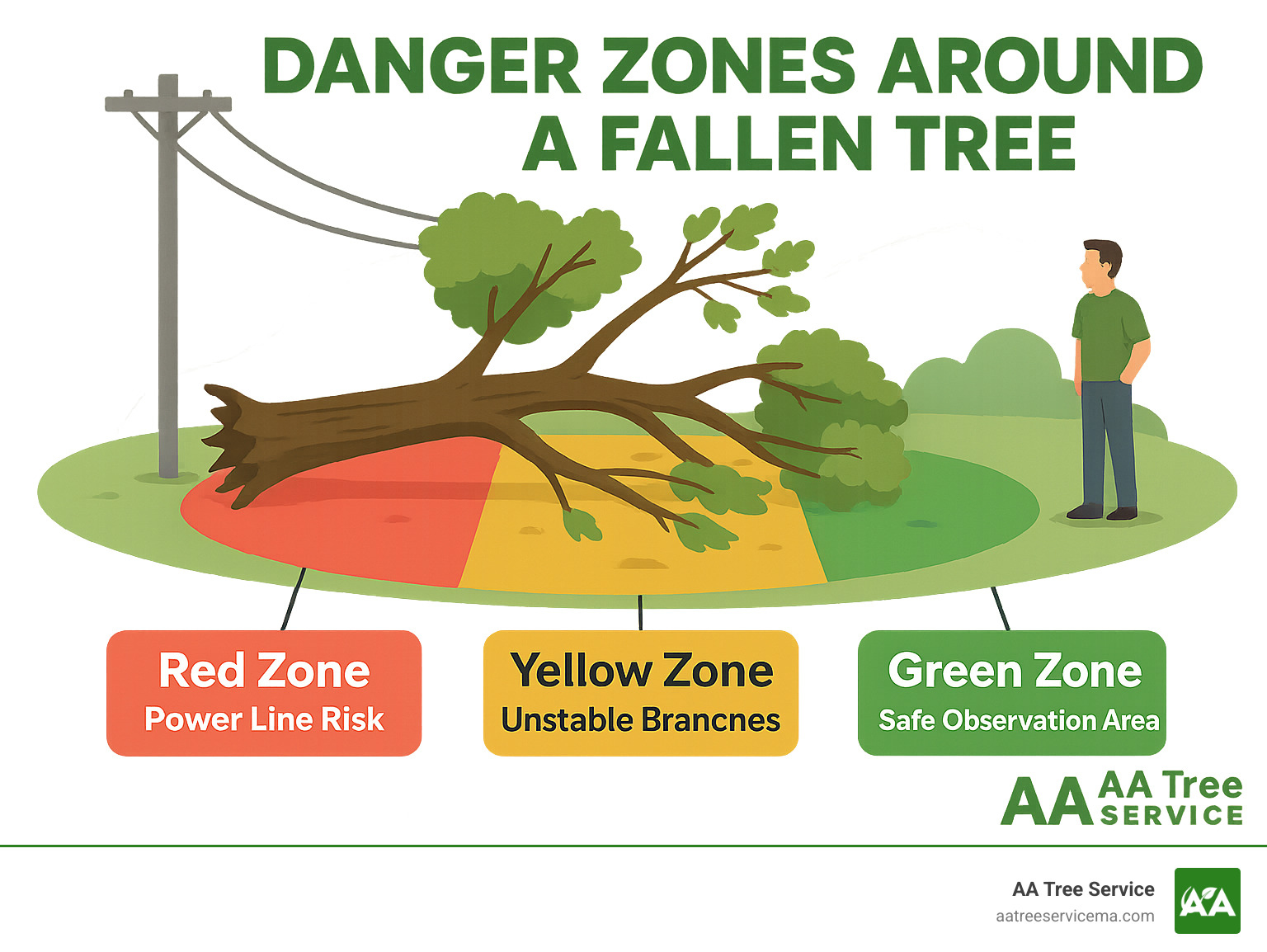
Stay Back From Power Lines!
The most dangerous situation with a downed tree near me involves power lines. Even professional arborists maintain at least 10 feet of distance from high-voltage lines—and they’re trained for this!
If you spot a tree touching power lines, resist the urge to play hero. Electricity doesn’t care about your good intentions, and it can travel through wood, especially when wet. Call 911 right away, and while waiting, warn your neighbors to stay clear. Even lines that appear “dead” can suddenly become energized when repair crews start working.
As utility companies consistently remind us, “Only qualified line clearance tree contractors certified by the International Society of Arboriculture can work within 10 feet of higher-voltage lines.” This isn’t just bureaucratic red tape—it’s a life-saving standard.
Shut Off Utilities & Document Damage
When a downed tree near me damages your home, taking the right steps quickly can prevent further problems:
First, trust your nose. If you smell gas, don’t hesitate—shut off the gas line immediately, get everyone out, and call your gas company from a safe distance. Similarly, if water is getting into electrical systems, turn off the main breaker before you have a shocking experience.
Once immediate dangers are addressed, become a documentary filmmaker. Take detailed photos and videos from every safe angle. Enable the timestamp feature on your camera, or include something in the shot that shows the date (like today’s newspaper). Measure and note the damage where possible.
An insurance expert I spoke with put it perfectly: “Take photos before removal for insurance claims.” Once emergency cleanup begins, that crucial evidence of what happened will be gone forever. These images are your proof when filing claims, helping ensure you get the coverage you deserve.
When dealing with a downed tree near me in Massachusetts or New Hampshire, your safety and the safety of your family always comes first. Everything else—even that beautiful maple that’s been in your yard for decades—can be replaced.
Who Is Responsible? Public vs. Private Property Rules in MA & NH
When you find a downed tree near me after a storm, figuring out who’s responsible can be as challenging as dealing with the tree itself. In Massachusetts and New Hampshire, responsibility typically follows clear guidelines based on where the tree has fallen.
The public right-of-way includes both the paved street and that buffer area between the pavement and your property line. In many MA and NH communities, this buffer zone extends about 10 feet from the curb – and trees in this area are usually the municipality’s responsibility.
| Location of Downed Tree | Responsible Party | How to Report/Address |
|---|---|---|
| Public street/road | City/Town | Call 911 (if blocking traffic) or 311 |
| Public park | Parks Department | Call city/town parks division |
| Public right-of-way | City Forestry Division | Report via 311 or town website |
| Private property | Property owner | Contact homeowner’s insurance & tree service |
| Neighbor’s tree on your property | Usually your responsibility* | Contact your insurance company |
| Tree on power lines | Utility company | Call utility emergency line |
*Unless negligence can be proven (see below)
City-Owned Trees (Streets & Parks)
When you spot a downed tree near me on public property, taking the right steps ensures a quicker response:
First, report the issue through your city’s 311 service or call your town’s public works department directly. Be ready with specific location details – the nearest address or intersection helps crews find the tree quickly. Clearly describe what you’re seeing, especially noting any immediate hazards like blocked roads or sidewalks.
Always ask for a service request ID number. This little number is your golden ticket to follow up if needed. And speaking of follow-up – don’t hesitate to check back if the situation hasn’t been addressed within a reasonable timeframe.
“The City Forestry Division handles trees in the right-of-way, which includes the paved street and the area between the pavement and adjoining property,” as one municipal forestry department confirms. The good news? These services typically come at no cost to residents – your tax dollars already cover this work.
After major storms, patience becomes essential as crews work through dozens or even hundreds of reports, prioritizing based on safety risks.
Private Property & “Whose Tree Is It?”
For downed trees near me on private property, ownership questions often arise – especially with boundary trees.
Start by checking your property survey or deed to confirm exact boundary lines. Most MA and NH towns offer online municipal parcel viewers that can help verify property boundaries when you’re in doubt. The general rule is that the property where the trunk grows from the ground determines ownership, though trees growing directly on boundary lines can be more complicated.
For those tricky boundary trees, consider discussing shared costs with your neighbor. A collaborative approach often works best, especially when you’ll continue living next door to each other long after the tree is gone.
In Massachusetts and New Hampshire, property owners are generally responsible for maintaining trees on their land and addressing any damage those trees cause when they fall – including removal costs and potential liability for damage to others’ property.
What If My Neighbor’s Tree Falls on My Yard?
It’s a scenario that tests neighborly relations: you wake up to find your neighbor’s massive maple sprawled across your yard. What now?
First, document everything. Take plenty of photos and detailed notes about the damage before anything gets moved or cleaned up. Then contact your homeowner’s insurance – in most cases, they’ll cover the removal and damage regardless of where the tree originated.
Massachusetts tree law follows what’s known as the “Massachusetts Rule,” which holds that property owners are only responsible for damage caused by their trees if they were negligent in maintaining them. A healthy tree falling during a storm typically doesn’t constitute negligence.
However, if you can prove your neighbor knew their tree was diseased or dangerous and ignored the problem, their insurance may be liable instead. As one legal expert notes, “Preexisting knowledge of a tree’s risk of failure can make a homeowner legally liable for damage.”
This is why sending friendly notice letters before problems occur can be valuable. If you spot a neighbor’s tree looking hazardous, a documented warning establishes a paper trail of negligence if it later falls and causes damage.
The best approach? Talk to your neighbor before storms hit. A friendly conversation about potentially dangerous trees can prevent both property damage and relationship damage down the road.
Reporting & Emergency Contacts for Roads, Sidewalks, and Power Lines
When you spot downed trees near me affecting roads or power lines, knowing exactly who to call can make all the difference. After a big storm rolls through Massachusetts or New Hampshire, those first few hours are critical – and having the right contacts at your fingertips helps ensure a faster response.
“The first five minutes after finding a fallen tree can determine whether the situation stays manageable or becomes dangerous,” notes a local emergency management official. “Knowing who to call first is essential.”
For immediate dangers, 911 should always be your first call – especially when trees block roadways or have taken down power lines. For less urgent situations, 2-1-1 provides helpful referrals to local services that can assist with cleanup and removal.
Most utility companies maintain dedicated vegetation hotlines specifically for reporting trees threatening power infrastructure. If you notice a leaning tree near power lines before it falls, this proactive reporting can prevent outages during the next storm.
For non-emergency tree issues on public property, your town’s 311 portal (where available) or municipal services desk can dispatch the appropriate department. And don’t forget about the State Department of Transportation for trees affecting state highways rather than local roads.
During major storms in Massachusetts and New Hampshire, emergency services create a triage system – addressing traffic hazards and school bus routes first, followed by less critical situations. Patience may be necessary, but rest assured your report is in the queue.
Downed Trees Near Me: Who to Call First
When a tree blocks a public road in your neighborhood, your response should match the severity of the situation. For complete blockages creating immediate hazards, call 911 without hesitation. The dispatcher will coordinate with police, fire, and utility companies as needed.
For partial blockages where traffic can still pass safely, contact local police on their non-emergency line. They can set up temporary traffic control until removal crews arrive.
“For public roads, call 911 and your local utility if power lines are involved,” advises an emergency response expert. “Never attempt to move branches or debris near downed lines – what looks safe rarely is.”
The fire department should be alerted if the fallen tree threatens structures or blocks emergency access routes to your neighborhood. And for trees down in less critical areas like parks or side streets, reporting to public works ensures they’ll be addressed when more urgent situations are resolved.
Power Lines & Service Drops
When downed trees near me involve electrical lines, extra caution becomes absolutely essential. Massachusetts and New Hampshire residents should immediately call their utility provider – whether that’s Eversource, National Grid, or another company serving your area.
If you need to work near power lines (though we strongly advise against it), request emergency service disconnection first by calling the utility’s emergency number (800.552.7583 for some providers). Only certified line-clearance arborists should work within 10 feet of power lines – this specialized training isn’t something regular tree services typically have.
It’s also important to understand service drop responsibility. While main power lines are the utility company’s domain, trees affecting the service drop to your home often fall under the homeowner’s responsibility to address.
“Trees like silver maples, willows and sycamores require frequent trimming under lines, which can accelerate decay,” notes a utility arborist. These fast-growing species tend to be the first casualties during storms – and the most likely to take power lines down with them.
Using City Apps & Websites
The digital age has made reporting downed trees near me easier than ever before. Many Massachusetts and New Hampshire communities now offer smartphone apps and online portals specifically designed for non-emergency service requests.
Start by downloading your town’s official app if one exists. Many communities use platforms like SeeClickFix, which allows you to submit reports complete with photos and precise GPS locations. These visual details help crews arrive prepared with the right equipment.
When submitting reports, be thorough but concise – include the exact location, the approximate size of the tree, whether it’s blocking access, and any visible hazards. Most systems provide a reference number so you can track progress and receive updates when crews have been dispatched.
If you don’t see activity within the expected timeframe, a polite follow-up is appropriate – especially after major storms when systems may be overwhelmed. These digital reporting tools help municipal workers prioritize their response effectively, ensuring the most critical situations are addressed first.
For more guidance on working with certified professionals who understand proper safety protocols, check out the latest research on utility tree safety.
Hiring a Professional Tree Removal Service in Your Area
When a storm leaves you dealing with downed trees near me on your Massachusetts or New Hampshire property, finding qualified professionals becomes your top priority. At AA Tree Service, we’ve seen how proper training and equipment make all the difference between a safe removal and a potentially dangerous situation.
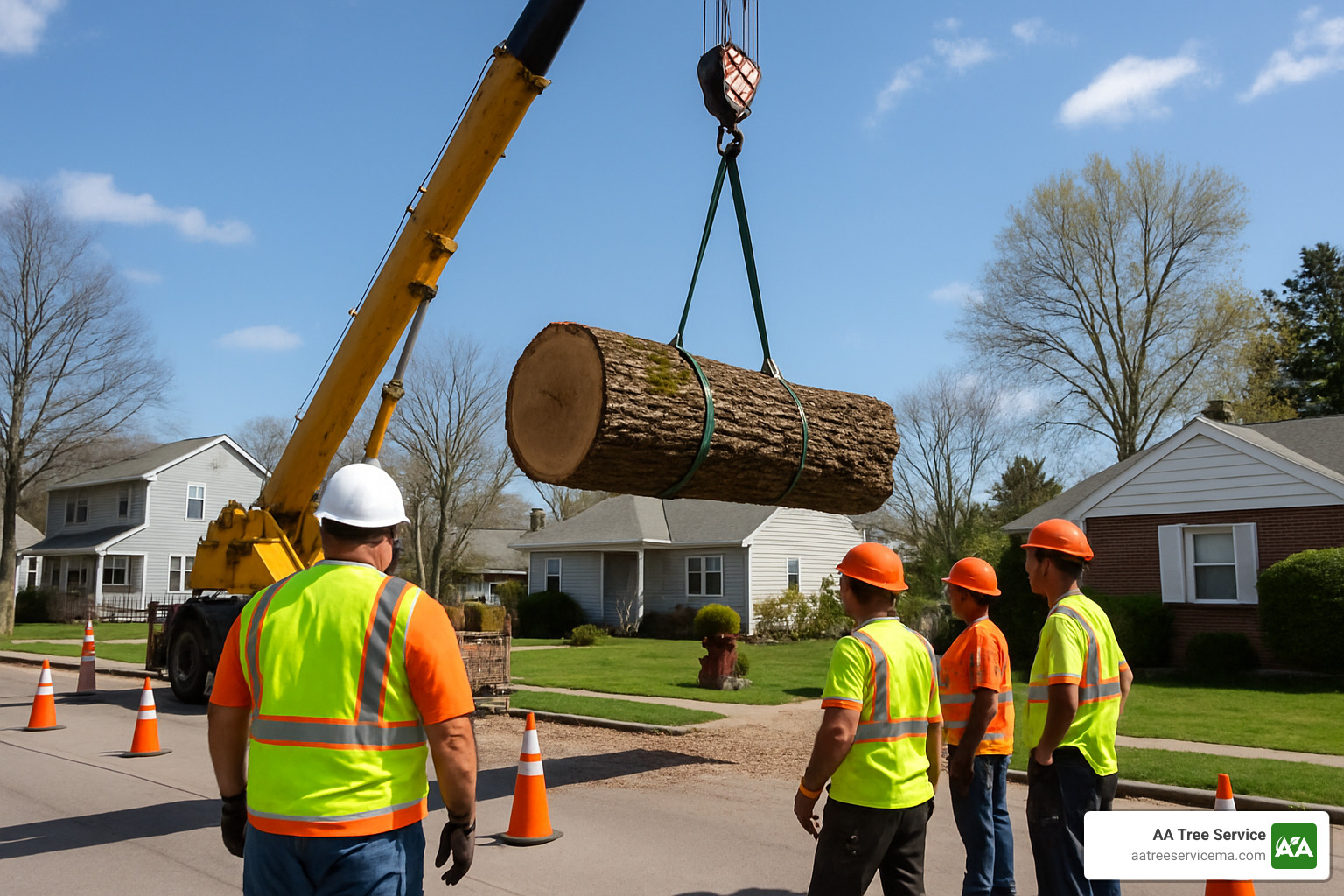
The aftermath of a storm is no time to cut corners. When selecting a tree service for emergency removal, start by verifying their credentials – look specifically for ISA (International Society of Arboriculture) certification, which indicates a professional level of knowledge and training. Always confirm insurance coverage by requesting certificates of liability and workers’ compensation insurance. This protects you from potential liability if something goes wrong during the removal process.
Before committing, make sure to get a detailed written quote that clearly outlines exactly what services are included. During emergencies, it’s also important to ask about emergency surcharges since many companies charge premium rates for after-hours or weekend service – perfectly reasonable, but something you should know upfront. And don’t forget to check availability, as wait times during major storms can stretch from days to weeks, especially with reputable companies.
For immediate assistance with Downed Tree Removal Near Me or Emergency Tree Removal Service, AA Tree Service prioritizes rapid response with 24/7 availability throughout Massachusetts and New Hampshire.
Downed Trees Near Me: How to Pick the Right Crew
Not all tree services are created equal, especially when dealing with hazardous situations. Massachusetts requires tree professionals to be licensed through the Massachusetts Certified Arborist Program, so always check licensing first. Don’t hesitate to ask for references from previous emergency removal clients – reputable companies will be happy to provide them.
Take time to review their safety records and ask about training protocols. A company’s commitment to safety speaks volumes about their professionalism. Also evaluate their equipment – professional services should have specialized tools like cranes, bucket trucks, and chippers to handle complex removals efficiently. And remember, experience matters – look for companies with at least 5-10 years of emergency tree removal experience in New England conditions.
As one of our industry colleagues often says, “Going with the lowest bidder may end up costing you more in the long run.” Quality work from experienced professionals typically commands higher rates but delivers better results and significantly reduces risks to your property and family.
Questions to Ask Before Signing
Before hiring anyone to handle your downed trees near me situation, have a conversation about the specifics. Start by clarifying the full scope of work – ensure they specify exactly what will be removed and how thoroughly. Ask about debris handling – will they remove it completely, chip it on-site, or simply stack it for you?
Be direct about potential hidden fees that might apply, such as additional charges for difficult access or extra-large trees. Get a firm commitment on timeline expectations – when will work begin and end? Understand if they offer any guarantees on their work, and don’t forget to ask if stump removal is included or if that’s a separate service with additional costs.
A consumer protection guide we recommend to our clients suggests: “Ask about their experience, included services, hauling and debris removal, safety measures, and equipment used.” These questions help ensure you receive comprehensive service without unwelcome surprises when the bill arrives.
The Hiring Process Step-by-Step
Handling downed trees near me efficiently starts with requesting an on-site evaluation – most reputable companies like AA Tree Service offer these assessments for free. If you have multiple damaged trees, consider bundling them together for removal, as many companies offer meaningful discounts for removing several trees at once.
Always get the quote in writing with all services and costs clearly documented. Take time to review the contract carefully, checking payment terms, timeline, and scope of work before signing. When you’re ready to schedule the removal, during busy post-storm periods, a bit of flexibility on your part may help secure faster service.
Before the crew arrives, prepare the site by clearing access routes and moving vehicles or outdoor furniture if possible. This small step can make a big difference in how quickly and safely the work progresses.
“Bundling multiple tree removal jobs can reduce your overall cost by 15-20%,” notes one of our experienced crew leaders. This approach is particularly effective if you can coordinate with neighbors who also need tree work after a storm – something we’ve seen create both cost savings and stronger community bonds in Massachusetts neighborhoods after major weather events.
Costs, Insurance Coverage & Permits Explained
When a storm leaves downed trees near me scattered across your Massachusetts or New Hampshire property, understanding the financial side of cleanup becomes crucial. The price tag for removing that maple crushing your fence or the oak leaning precariously over your garage can vary dramatically.
Tree removal costs in our region depend on several key factors that every homeowner should understand. Larger trees naturally require more labor, equipment, and time to remove safely. A towering 80-foot oak presents far more challenges than a 20-foot ornamental cherry. Location matters tremendously too – that tree wedged between your house and your neighbor’s garage will cost significantly more than one standing alone in an open yard.
Based on internet data (not AA Tree Service pricing), Massachusetts and New Hampshire homeowners can expect to pay anywhere from $400 for a straightforward small tree removal to well over $3,000 for large, complex situations. Emergency situations typically command premium pricing, often 1.5 to 3 times standard rates. Stump grinding adds another $150–$900 depending on size and accessibility, while permit fees in some communities range from $0–$150.
“After the big nor’easter last year, we couldn’t keep up with calls,” shares one local arborist. “When everyone needs help at once, it’s like trying to find a snowplow during the first blizzard of winter – high demand means longer waits and sometimes higher prices.”
Will My Homeowner’s Policy Pay?
That fallen pine crushing your deck has you immediately wondering about insurance coverage. Most standard homeowners policies do cover tree removal, but with important caveats that many Massachusetts and New Hampshire residents don’t realize until they’re filing a claim.
The key distinction? Damage to insured structures. If that downed tree near me smashed through your roof or crushed your fence, your policy will likely cover both the property damage and tree removal. However, if the same tree merely fell across your lawn without hitting anything, you’ll probably be paying out-of-pocket for removal.
Insurance companies also look closely at why the tree fell. A healthy maple toppled by hurricane-force winds? Typically covered. That dying elm you’ve been meaning to remove for years? Your claim might be denied due to negligence.
Before the cleanup crew arrives, document everything thoroughly with photos and videos from multiple angles. This visual evidence becomes invaluable during the claims process. And remember to consider your deductible – if tree removal costs $1,000 but your deductible is $500, filing a claim for the remaining $500 might not be worthwhile when you consider potential premium increases.
“Take those photos before anyone touches the tree,” advises an insurance adjuster with 20 years of experience. “Once cleanup begins, you’ve lost your evidence of what actually happened.”
City & Conservation Permits
Even in emergency situations, Massachusetts and New Hampshire municipalities often require permits before removing downed trees near me. This regulatory layer surprises many homeowners who assume that storm cleanup exempts them from the usual red tape.
Historic districts in towns like Salem, MA and Portsmouth, NH maintain particularly strict requirements – even for hazardous trees. Properties near wetlands face additional scrutiny, with conservation commissions often needing to approve removals within buffer zones. Many communities establish size thresholds, regulating only trees above certain diameters (typically 6-12 inches).
The good news? Many localities do offer emergency exceptions after major storms. These temporary waivers help streamline the cleanup process when public safety is at risk. However, what constitutes an “emergency” varies by municipality, so a quick call to your town office can save headaches later.
“We had a client in Concord who removed three storm-damaged trees without permits,” recalls a local arborist. “The conservation commission fined them $1,200 – more than the actual tree work cost.”
When in doubt, reach out to your local building department or conservation commission before removing any trees, even after storms. Most Massachusetts and New Hampshire towns have straightforward processes for emergency approvals that can be handled quickly when public safety is concerned.
What to Do With Debris & Wood After Removal
Once you’ve handled those downed trees near me, you’re likely staring at a surprising amount of debris scattered across your yard. Don’t worry – there are plenty of practical (and even creative) ways to deal with all that wood.
After a storm cleanup, many homeowners are surprised to find that tree debris can actually become a valuable resource rather than just waste. Quality hardwoods like oak, maple, and cherry can be transformed into beautiful firewood that will keep you warm through those harsh New England winters. Or consider turning that maple into a stunning piece of furniture that tells a story of survival.

Most Massachusetts and New Hampshire towns maintain municipal compost centers where you can drop off yard waste after storms. “Staff weigh tree debris 48 hours after a storm,” reports one municipal compost center, using this assessment to determine when to open for storm debris drop-offs. These facilities provide a responsible disposal option when you’re overwhelmed with branches and smaller debris.
For those looking to improve their landscaping, consider requesting wood chip delivery. Many utilities and tree services (including AA Tree Service) offer free wood chips to local residents – a win-win that helps them dispose of materials while providing you with excellent mulch for gardens and pathways.
Don’t need all that wood? Local woodworkers or artisans often value certain species for their projects. That fallen cherry or walnut tree might become someone’s next masterpiece! For large volumes that exceed what you can handle or what municipal collection will take, professional debris haulers can remove everything quickly and efficiently.
For comprehensive Storm Cleanup Services, AA Tree Service handles the entire process from removal through debris management, taking the stress out of post-storm recovery.
Recycling & Re-Use Options
That pile of downed trees near me doesn’t have to end up in a landfill. There are plenty of earth-friendly ways to give that wood new purpose.
Free wood chips can transform your landscaping. Simply email local tree services (including AA Tree Service) to be added to their delivery list. These chips make excellent mulch for garden beds, pathways, and play areas – saving you money while putting storm debris to good use.
For larger logs with good quality wood, portable sawmills can be a game-changer. These services come to your property and transform quality hardwoods into usable lumber for your next building project. Imagine telling guests that your new dining table came from the maple that once stood in your backyard!
Community gardens throughout Massachusetts and New Hampshire often welcome donations of chipped wood for their pathways and mulching needs. “Wood chips produced from line maintenance are offered free for use in walking trails, mulching, or parking areas,” notes one utility company serving the region.
Creating wildlife habitat with strategically placed logs can support beneficial insects, small animals, and improve your property’s biodiversity. Even in suburban areas, these “habitat logs” can become home to everything from beneficial beetles to salamanders.
Local craftspeople and artists frequently seek unique wood pieces for their work. That oddly shaped burl or distinctive grain pattern might become someone’s next artistic creation – much better than ending up in a chipper!
Hiring Debris Haulers vs. DIY
When deciding how to handle debris from downed trees near me, consider both the scope of the job and your personal capabilities.
For small amounts of debris, municipal collection programs in most Massachusetts and New Hampshire towns will handle branches and small logs. However, these programs typically have strict limits on size and volume, so check your local guidelines before dragging everything to the curb.
Renting a chipper for larger projects can be cost-effective if you have multiple trees down. These machines transform branches into useful mulch in minutes, though they require proper safety precautions and some physical effort to operate.
Always review municipal rules before disposal. “After Forestry staff assess damage 48 hours post-storm, the compost center opens for residents to drop off storm debris,” explains one municipal guide. These facilities typically accept branches and trunks up to certain diameters, but regulations vary widely between towns.
When calculating total costs of DIY debris management, don’t forget to factor in equipment rental, personal time, disposal fees, and transportation. These expenses can add up quickly, making professional hauling services look more attractive.
Professional debris removal services often offer surprisingly competitive rates, especially when you consider the time and effort they save you. After dealing with the stress of fallen trees, letting experts handle the cleanup can be well worth the investment.
Proper debris management isn’t just about convenience – it’s about safety and responsibility. Improperly disposed tree waste can create fire hazards, attract pests, or violate local regulations. When in doubt, consult with professionals who understand both the practical and regulatory aspects of storm cleanup in Massachusetts and New Hampshire.
Preventing Future Tree Hazards
After dealing with a downed trees near me situation, the last thing you want is to face the same problem again. The good news? A little prevention goes a long way toward keeping your trees standing strong through New England’s unpredictable weather.
Think of tree maintenance like regular health check-ups – it’s always easier (and cheaper) to prevent problems than fix them after disaster strikes. At AA Tree Service, we’ve seen countless storm emergencies that could have been avoided with some basic preventive care.
Annual inspections are your first line of defense. Having a certified arborist walk your property once a year can reveal subtle warning signs that untrained eyes might miss. These professionals can spot weakened branches, disease symptoms, and structural issues before they become hazards.
Regular pruning isn’t just about aesthetics – it’s a safety essential. Removing dead or weakened limbs reduces the “sail effect” during high winds, dramatically decreasing the chances of failure during storms. Most mature trees benefit from professional pruning every 3-5 years, though some fast-growing species may need more frequent attention.
For particularly valuable trees with structural issues, cabling and bracing systems can provide critical support. “Cabling and bracing reduce structural failure by correcting defects and stabilizing the tree,” explains an arborist we work with. These systems can add decades of life to otherwise healthy trees with structural weaknesses.
Smart species selection plays a huge role in preventing future problems. That fast-growing silver maple might seem appealing now, but its weak wood structure makes it particularly prone to storm damage. Native species adapted to Massachusetts and New Hampshire conditions typically offer the best combination of beauty and resilience.
Don’t overlook the importance of soil health. Trees with strong, extensive root systems withstand storms better, and those roots depend on proper soil conditions. Compacted soil, improper drainage, or nutrient deficiencies can all compromise a tree’s stability from below.
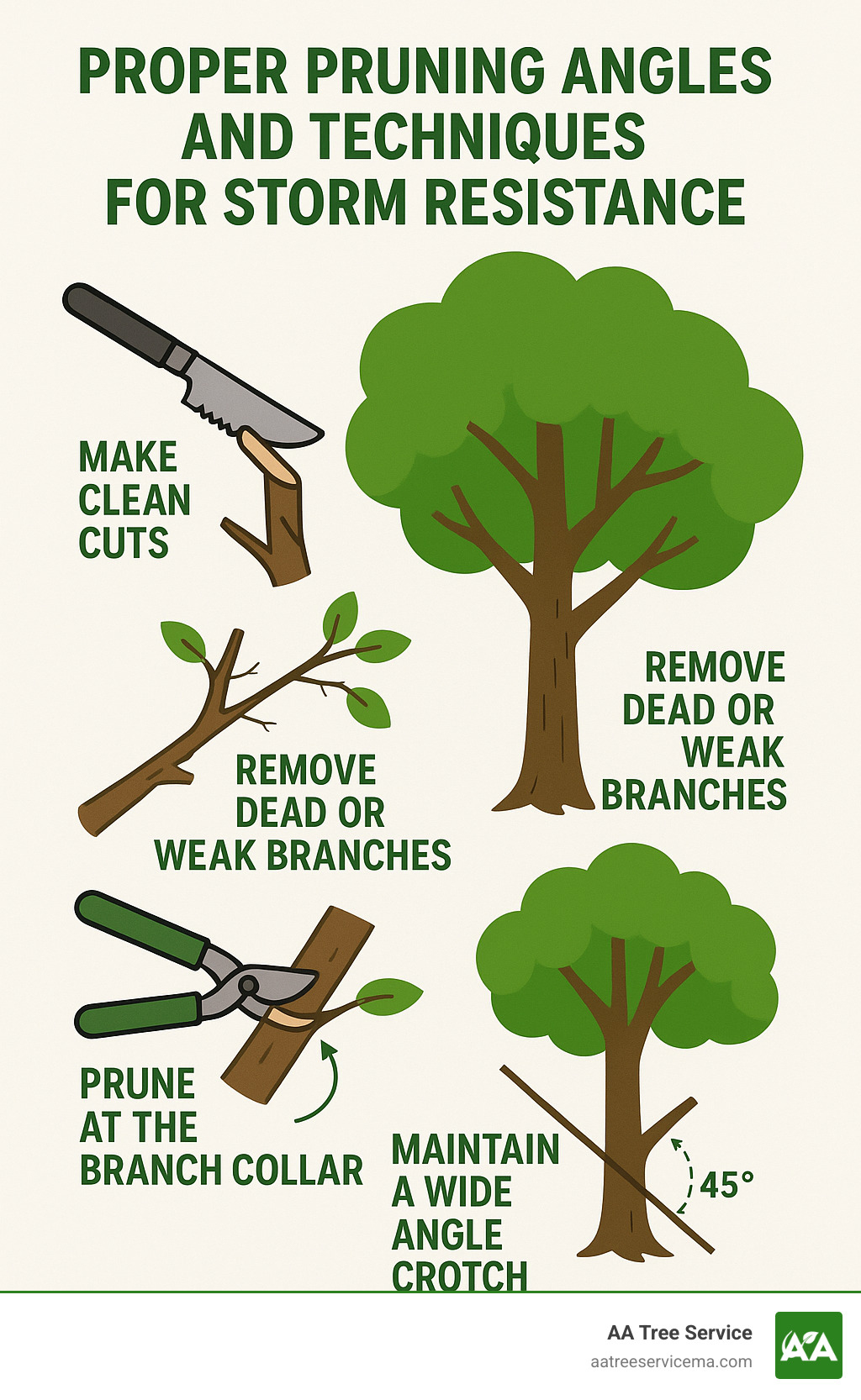
For help addressing Broken Trees or developing a preventive care plan, professional assessment can identify which trees might benefit from intervention before they create emergency situations.
DIY Visual Checks
Between professional visits, you can keep an eye out for warning signs yourself. Take a slow walk around your property after storms or seasonally, looking for these red flags:
New or worsening leans should always raise concern, especially when accompanied by soil mounding on the opposite side of the lean. This often indicates the root plate is failing – a serious warning sign that shouldn’t be ignored.
Vertical cracks in trunks or major branches compromise a tree’s structural integrity. While small surface cracks might be normal on some species, deep splits that penetrate into the wood signal serious problems.
Root plate heaving – when soil lifts around the base of a tree – suggests the anchoring system is compromised. This is particularly dangerous because the tree could fall with little additional warning.
Dead branches, especially in the upper canopy, indicate declining health. While some dieback is normal as trees age, extensive dead wood increases risk during storms and may signal deeper problems.
Mushrooms or conks growing on the trunk or near major roots often indicate internal decay. As one arborist puts it, “When you see fungal fruiting bodies, they’re just the tip of the iceberg – the invisible decay inside is typically much more extensive.”
Hollow areas in trunks or major branches mean the tree has lost structural wood. While trees can survive with some hollowing, extensive cavities dramatically increase failure risk.
As one utility arborist warns, “Fast-growing trees repeatedly pruned under power lines become more susceptible to disease and decay.” This highlights why proper species selection and placement matter so much for long-term tree health.
When to Call an Arborist for Preventive Care
While DIY monitoring is valuable, certain situations call for professional expertise. Don’t hesitate to contact a certified arborist when you notice:
Disease signs like unusual leaf drop, discoloration, or deformity often require expert diagnosis. Many tree diseases can be effectively treated if caught early, but proper identification is critical.
Storm-damaged limbs that are hanging or partially attached create unpredictable hazards. These “widow-makers” should be addressed promptly by professionals with proper equipment and training.
Pest infestations – whether boring insects creating tunnels or defoliating pests stripping leaves – can seriously compromise tree health. Professional treatment options are typically more effective than consumer-grade alternatives.
Root disturbance from construction, grade changes, or soil compaction can destabilize even healthy-looking trees. If you’ve had recent landscape work near valuable trees, a professional assessment can identify potential problems before symptoms appear.
Multiple risk factors appearing simultaneously should trigger immediate professional evaluation. When a tree shows several warning signs at once, the cumulative risk is often greater than the sum of its parts.
“Professional pruning improves aesthetics and promotes tree health when done correctly by certified arborists,” notes one tree care professional. This expertise is particularly valuable for preserving trees that might otherwise become hazards.
With proper preventive care, many trees can thrive for generations, providing beauty, shade, and environmental benefits without becoming dangerous liabilities during storms. The investment in prevention is almost always less than the cost of emergency removal and property damage repair after a tree fails.
Frequently Asked Questions about Downed Trees Near Me
Who pays if a healthy tree blows over in a storm?
Storm damage can create confusing situations, especially when it comes to figuring out who’s responsible for the cleanup costs. If you’re in Massachusetts or New Hampshire and a healthy tree falls during a storm, here’s what typically happens with insurance coverage.
Your homeowner’s insurance generally covers damage to insured structures—your house, garage, or shed—minus your deductible. The key word here is “structures.” If that maple tree crashed through your roof, insurance should help. But if it simply fell in your yard without hitting anything? That removal cost usually falls to you as the homeowner.
What about when your neighbor’s perfectly healthy oak comes crashing into your yard during high winds? In most cases, your insurance covers damage to your structures. This follows what insurers call the “act of God” principle—no one was negligent; it was simply bad luck and bad weather.
“Homeowners insurance typically covers wind-caused damage by healthy trees but excludes losses from rotting or poorly maintained trees,” explains one insurance expert I spoke with recently. This is why taking dated photos of your trees when they’re healthy can be so valuable if disputes arise later.
What should I do if the tree is blocking only my driveway?
When you find a downed tree near me situation where only your private driveway is blocked, the responsibility typically falls to you as the property owner. While this might seem unfair (especially if it wasn’t your tree!), it’s the standard practice in Massachusetts and New Hampshire.
First, contact your homeowner’s insurance to check if they’ll help with driveway clearing. Many policies don’t cover this unless a covered structure was also damaged, but it’s always worth asking.
For safety reasons, hiring professionals like AA Tree Service is usually your best bet, especially if the tree is large. Attempting DIY removal of substantial trees can lead to injury or additional property damage.
If you’re facing a medical emergency and can’t exit your property due to the blockage, don’t hesitate to call 911. Emergency services can help create access in urgent situations.
One government resource notes, “If downed trees do not affect the access to your home, you may not qualify for FEMA financial assistance.” However, there’s an exception—in federally declared disaster areas, you might receive help if the tree completely blocks your only way in or out of your property.
Are there free services for senior homeowners after storms?
Seniors in Massachusetts and New Hampshire facing fallen trees after storms do have potential resources for assistance. While free services aren’t universally available, several options exist that might help ease the financial burden.
Your first call should be to 2-1-1, the information and referral service that can connect seniors with available assistance programs in your specific community. Local senior services departments in many MA and NH towns maintain emergency assistance funds specifically for situations like storm cleanup.
Religious organizations often step up after storms, organizing volunteer cleanup crews to help vulnerable community members. I’ve seen church groups tackle everything from small branches to substantial tree removals for elderly neighbors.
For major weather events, explore FEMA assistance options. During federally declared disasters, special programs may become available that prioritize helping seniors and those with limited mobility.
Don’t overlook municipal senior programs either. Some towns in Massachusetts and New Hampshire offer priority service to senior residents after storms, recognizing that older homeowners may have both physical and financial limitations in addressing fallen trees.
While these resources vary by location, “Local agencies that provide debris removal services” can often be located through 2-1-1 referrals. These connections are particularly valuable for seniors on fixed incomes who suddenly face unexpected removal costs after a nor’easter or summer thunderstorm.
Conclusion
When Mother Nature leaves downed trees near me scattered across your Massachusetts or New Hampshire property, knowing how to respond makes all the difference. Throughout this guide, we’ve walked through the journey from that first moment of findy to the final cleanup – each step requiring thoughtful action and often a helping hand from professionals.
Here at AA Tree Service, we’ve spent over two decades helping New England homeowners steer the chaos that fallen trees create. We’ve seen how quickly a beautiful maple can transform from shade provider to home wrecker during those notorious nor’easters that sweep through our region.
The aftermath of a storm can feel overwhelming, but you don’t have to face it alone. Our team is ready with:
- 24/7 emergency response when danger can’t wait until morning
- Free same-day quotes to help you make informed decisions
- Complete removal and cleanup that leaves your property better than we found it
- Certified arborist expertise for even the most complex situations
- Comprehensive insurance coverage that protects your investment
Your safety always comes first when confronting storm damage. Those dangling branches, partially uprooted trunks, and especially anything near power lines demand professional attention – this isn’t the time for DIY heroics, no matter how handy you might be with a chainsaw.
The steps we’ve outlined – from immediate safety assessments to working with insurance and selecting the right removal service – are designed to guide you through what can be a stressful experience with confidence and clarity. Whether the tree fell on public property or your own backyard, you now have the knowledge to take appropriate action.
When professional help becomes necessary (and with larger trees, it almost always is), we’re standing by to respond with the right equipment and experienced crews who understand the unique challenges of New England properties. From tight urban lots in Boston suburbs to sprawling rural homesteads in New Hampshire, we’ve seen and solved it all.
For more detailed information about our emergency response capabilities or to schedule a no-obligation assessment, our emergency removals page provides additional resources. Or simply give us a call – we’re real people ready to help real neighbors through challenging situations.
When downed trees near me becomes your urgent search query, know that experienced help is just a phone call away. We’ve helped thousands of Massachusetts and New Hampshire homeowners turn disaster back into beautiful, safe landscapes – and we’re ready to do the same for you.