

Common Tree Diseases & Pests in Massachusetts & New Hampshire
From the emerald ash borer to winter moth and beech leaf disease, New England's trees face real threats. Here's how to spot the warning signs early — while your tree can still be saved.
How to Tell If Your Tree Is Sick
A tree rarely fails overnight. Most diseases and infestations announce themselves months or even years in advance — if you know what to look for. Catching the signs early is the difference between a treatable problem and a removal.
- ✓Canopy dieback — dead branches starting at the top or outer tips and working inward, or a canopy that's noticeably thinner than neighboring trees.
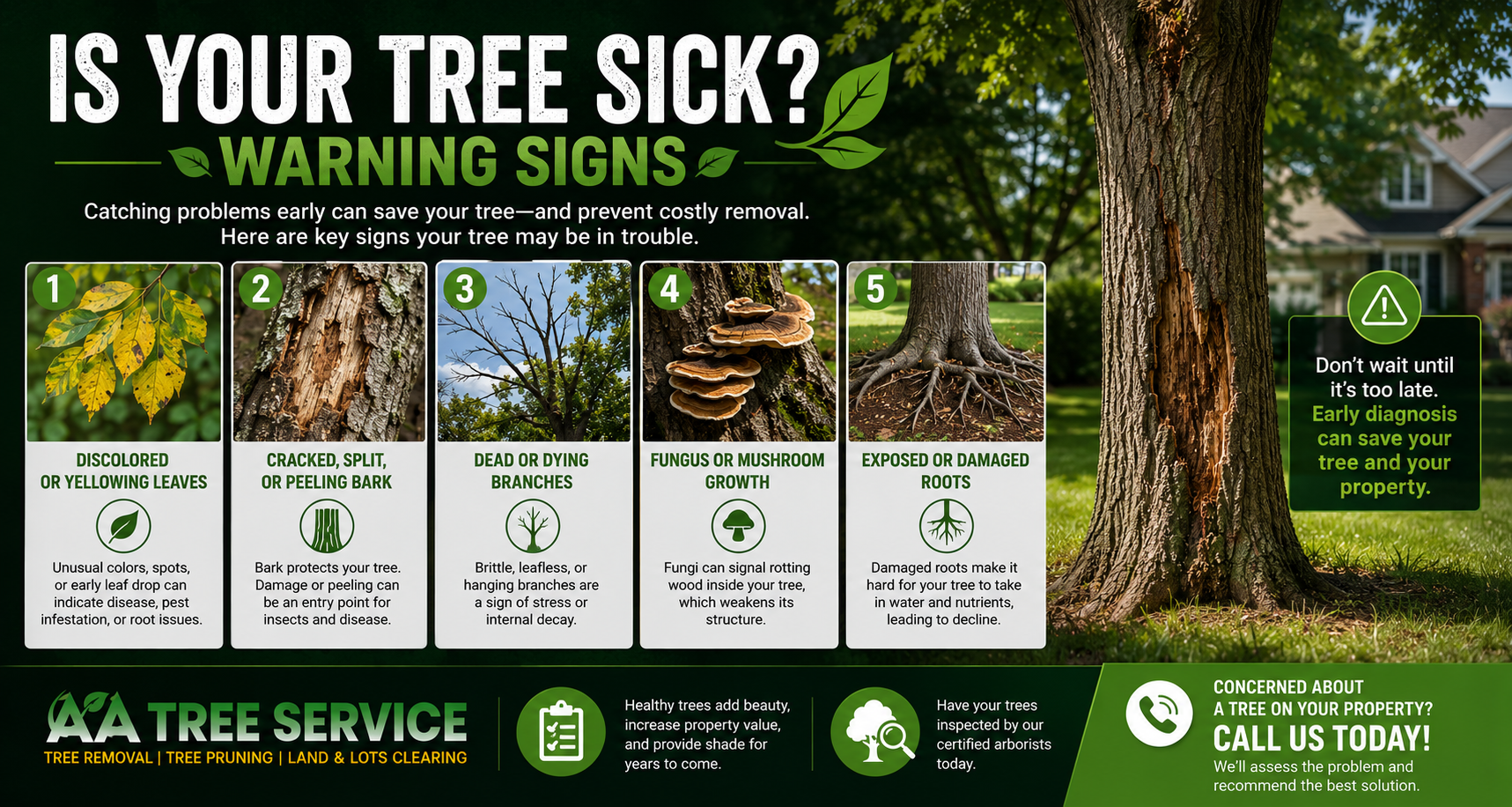
- ✓Discolored or early-dropping leaves — yellowing, browning, spotting, or fall color arriving weeks ahead of schedule.
- ✓Bark changes & cankers — cracks, oozing sap, sunken dead patches, or peeling bark.
- ✓Fungal growth — mushrooms or shelf fungi at the base or on the trunk, a classic sign of internal decay.
- ✓Boreholes & sawdust — small exit holes, tunneling under the bark, or fine sawdust ("frass") at the base — telltale insect activity.
- ✓Defoliation — leaves chewed away in late spring or early summer, often a caterpillar or moth infestation.
The Insect Pests Threatening MA & NH Trees
A handful of invasive and native insects do the most damage across Massachusetts and New Hampshire:
Emerald Ash Borer
A metallic-green beetle whose larvae tunnel beneath the bark and cut off an ash tree's ability to move water. It's now established across the region and is nearly always fatal to untreated ash. Watch for canopy thinning, D-shaped exit holes, and woodpecker activity.
Winter Moth
Especially common in eastern and coastal Massachusetts, winter moth caterpillars defoliate oaks, maples, and fruit trees in spring. Repeated years of defoliation weaken and eventually kill otherwise healthy trees.
Spongy Moth (formerly Gypsy Moth)
Periodic outbreaks strip whole stands of oak and other hardwoods bare in early summer. A single season rarely kills a healthy tree, but back-to-back years — especially combined with drought — can.
Asian Longhorned Beetle
A serious threat to maples and other hardwoods, tied to an active quarantine in central Massachusetts. Look for round exit holes about the width of a pencil and shallow oval scars where eggs were laid.
Hemlock Woolly Adelgid
Tiny insects that coat the undersides of hemlock needles in white, cottony masses, slowly starving the tree. Widespread on hemlocks throughout the region.
Not Sure What You're Seeing?
Correct identification drives the right response. A certified arborist can diagnose the pest, judge how far it's progressed, and tell you whether treatment or removal is the smarter call.
Common Tree Diseases in New England
Fungal and bacterial diseases are just as damaging as insects, and several are widespread here:
- ✓Dutch elm disease — a fungus spread by bark beetles that has devastated American elms; rapid wilting and yellowing of the crown is the classic sign.
- ✓Beech leaf disease — an emerging threat across New England, showing as dark banding between leaf veins and thinning canopies in beech trees.
- ✓Anthracnose — a fungal disease of oaks, maples, sycamores, and dogwoods causing leaf spots, curling, and early leaf drop in cool, wet springs.
- ✓Apple scab & cedar-apple rust — common on crabapples and ornamentals, causing spotting, distortion, and premature defoliation.
- ✓Needle cast & blights — fungal diseases of spruces, pines, and other evergreens that brown and drop needles from the inside out.
- ✓Root & butt rot — decay fungi that hollow the base and roots, often signaled by fungal brackets and a growing risk of failure.
A diseased tree near a home, driveway, or walkway can become a structural hazard. If you're worried about failure risk, a tree hazard assessment is the place to start.
Trusted With Trees Across MA & NH
Real Google reviews from homeowners we've helped.
"The men are very hard workers, showed up on time and worked all day! My land and everything they trimmed and cut looks beautiful — cut back and shaped my Red Maple, birches, and Cherry tree. They cleaned to perfection!"
"I would highly recommend AA Tree Service to anyone looking to have any work done. They were professional and went well above and beyond the scope of work we had talked about, all while keeping the estimate intact. Highly recommend!"
"The company owner, Alfredo, was very nice and friendly. We have hired this company to do two big tree projects in recent years. They have done fantastic jobs each time. The crew were wonderful and cleaned up nicely afterwards."
What to Do About a Diseased or Infested Tree
The right move depends entirely on the problem and how far it's progressed — which is why diagnosis comes first. In many cases, early-stage pests and diseases can be managed and the tree kept healthy. In others, the damage is too advanced and removal is the safest option to protect people, property, and the healthy trees nearby.
- ✓Get an accurate diagnosis first — a certified arborist identifies the pest or disease and how far it's spread before anything is done.
- ✓Act early when the tree can be saved — timely pruning of affected limbs and proper care can stop many problems from spreading.
- ✓Remove when it becomes a hazard — a tree with advanced decay, root rot, or a fatal infestation near your home should be assessed for removal.
- ✓Protect the trees nearby — some diseases and pests spread; prompt action helps safeguard the rest of your landscape.
Worried about a specific tree? Request a free estimate and we'll take a look.
Is Your Tree Sick? Warning Signs at a Glance
Related Tree-Health Services & Guides
Explore related services across MA & NH:
Tree Diseases & Pests — Frequently Asked Questions
What are the most common tree pests in Massachusetts and New Hampshire?
How can I tell if my tree is dying versus just stressed?
Can a diseased or infested tree be saved?
Is a diseased tree a safety hazard?
Will one tree's disease spread to my other trees?
Worried About a Tree? Let's Take a Look.
Free, no-obligation assessments across Massachusetts & New Hampshire. We'll diagnose the problem and give you honest options — treat or remove.

Why Choose AA Tree Service?
For 20+ years, homeowners across MA & NH have trusted us to assess ailing trees honestly — and recommend the right care, not just removal.
Request a Free EstimateLicensed & Insured
Fully licensed and insured on every visit.
Knowledgeable Team
We identify the problem before recommending a fix.
Over 20 Years' Experience
Two decades caring for New England trees.
Locally Owned
We know the pests and diseases specific to our region.
Honest Recommendations
Treat when we can, remove only when we must.
Free Same-Day Quotes
Fast, transparent estimates with no obligation.
Our Complete Tree Care Services
Whatever your tree needs, we're here for it across MA & NH: