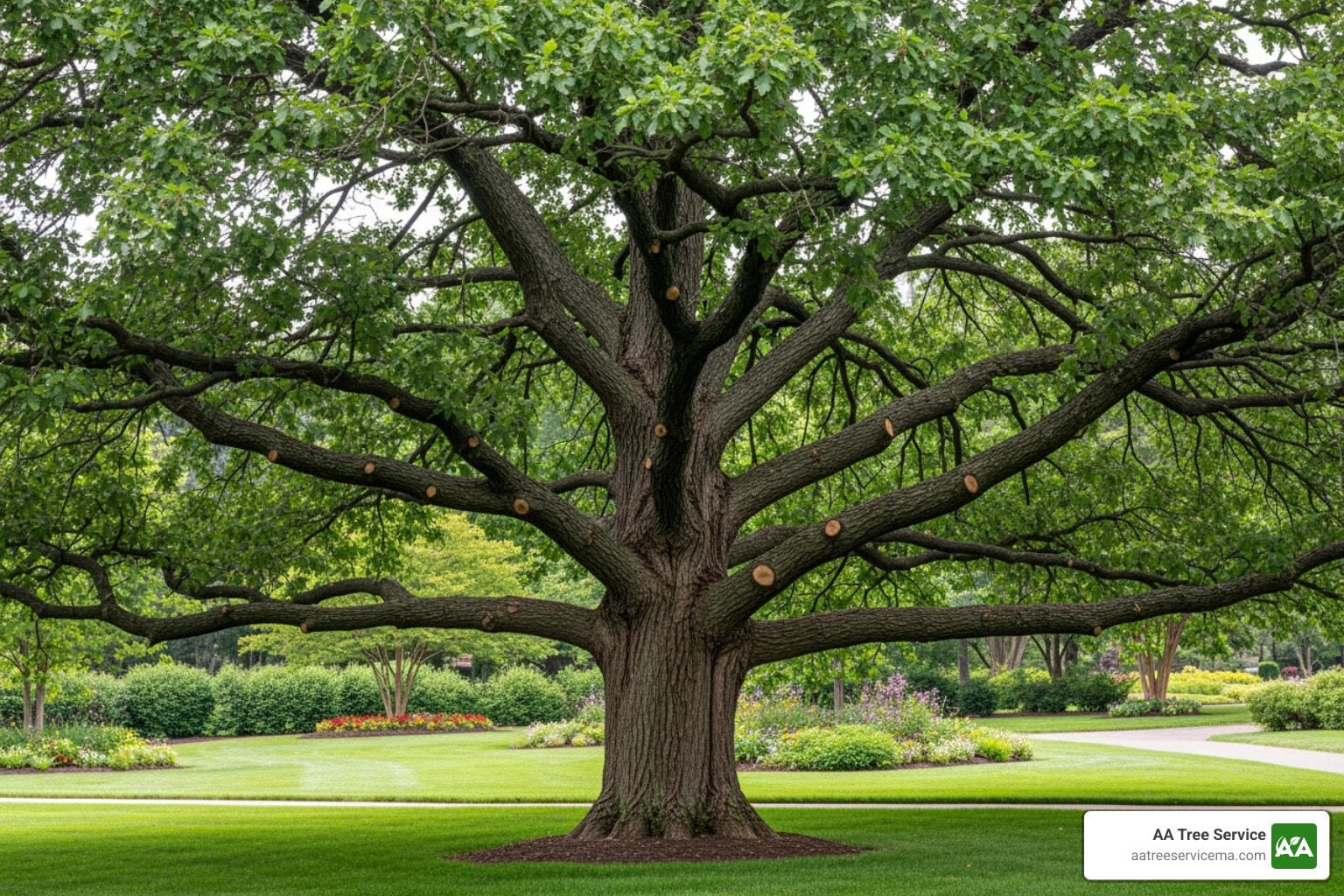
Why Your Trees Need a Certified Professional
Finding a certified arborist near me is one of the most important decisions a homeowner can make for the long-term health, safety, and value of their property. In Massachusetts and New Hampshire, where historic landscapes and mature trees are common, the need for professional expertise is even more pronounced. Your trees are not just passive elements of your landscape; they are living, breathing assets that require specialized care to thrive.
Quick Answer: The Homeowner’s Checklist for Finding a Certified Arborist Near You:
- Use the ISA “Find an Arborist” Tool: Start your search at the official source, TreesAreGood.org. This database, maintained by the International Society of Arboriculture (ISA), only lists professionals who currently hold valid credentials. It’s the most reliable way to avoid companies falsely claiming certification.
- Verify Credentials Independently: Once you have a name or company, use the ISA’s credential verification system. This simple step confirms that their certification is active and not expired, giving you peace of mind that their knowledge is up-to-date.
- Check for Comprehensive Insurance: This is non-negotiable. A professional arborist must carry both general liability insurance (to cover any damage to your property) and worker’s compensation insurance (to cover their employees if they are injured on your property). Without worker’s comp, you could be held liable for medical costs.
- Ask for Local References: A reputable arborist will be proud to share references from satisfied clients in your area. Speaking to past customers can give you insight into their professionalism, communication, and the quality of their work.
- Request Detailed, Written Estimates: Never rely on a verbal quote. Request written estimates from at least two or three certified professionals. The estimate should clearly detail the scope of work, the techniques to be used, and the total cost, ensuring there are no surprises.
- Confirm Adherence to Safety Standards: Ask if they follow the ANSI Z133 safety standards for arboricultural operations. This is the industry’s safety benchmark, and their adherence demonstrates a commitment to protecting their crew, your family, and your property.
Your trees are a significant investment. A mature, healthy tree can increase your property’s value by anywhere from 7% to 19%, according to studies from the University of Washington. Beyond monetary value, they provide immense environmental benefits: they reduce summer air conditioning costs by up to 30%, intercept thousands of gallons of stormwater runoff, produce oxygen, and create a habitat for wildlife. But when these valuable assets become diseased, damaged by storms, or pose a safety risk, you need expertise that goes far beyond what a general landscaper or handyman can offer.
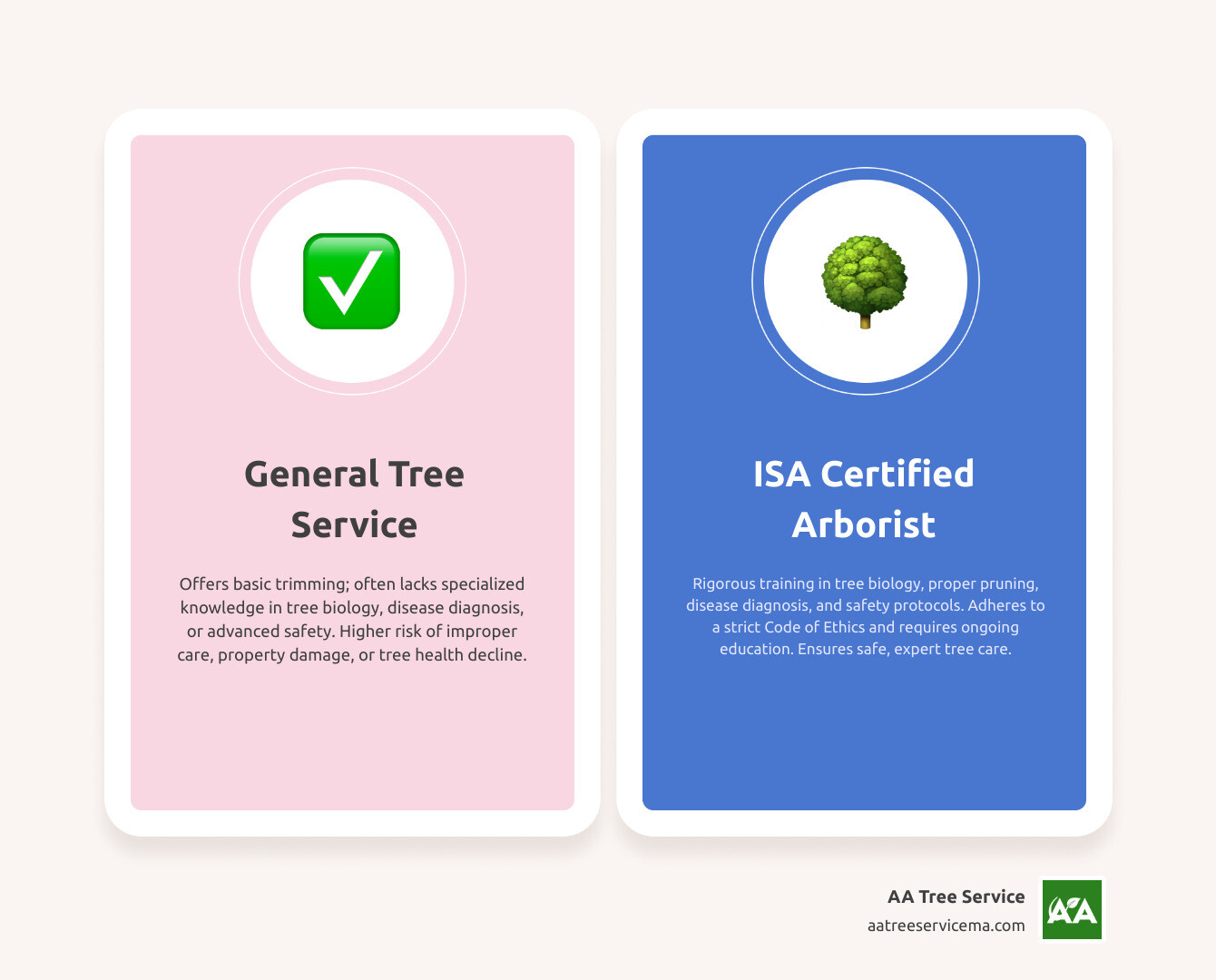
The difference between a general tree service and a certified arborist is a chasm of knowledge and professionalism. An ISA Certified Arborist has undergone extensive training and passed a comprehensive exam covering everything from tree biology and soil science to advanced pruning techniques, disease diagnosis, and industry-mandated safety protocols. They are bound by a strict Code of Ethics and are required to earn continuing education credits every three years to maintain their certification, ensuring they remain current with the latest arboricultural science.
Whether you’re concerned about a leaning tree after a Nor’easter, noticing strange spots on leaves, or simply want to ensure the long-term vitality of your landscape, partnering with a certified professional is the only way to guarantee the job is done safely, correctly, and in the best interest of your trees. The wrong approach to tree care—such as aggressive topping, improper pruning cuts, or failing to spot a critical structural defect—can lead to catastrophic property damage, serious personal injury, or the irreversible decline and death of a tree that took decades to grow.
Certified arborist near me terms simplified:
What is a Certified Arborist and Why Does Certification Matter?
When you begin searching for a certified arborist near me in Massachusetts or New Hampshire, you are seeking a professional who operates at the intersection of science, art, and safety. A certified arborist is not merely a “tree cutter”; they are a tree doctor—a highly trained specialist dedicated to the health, preservation, and management of trees through a deep understanding of arboriculture.
Consider the analogy: you wouldn’t allow someone without a medical degree to perform surgery, so why would you entrust your valuable, often irreplaceable, trees to an untrained individual? A single mature oak or maple on your property can be an asset worth thousands of dollars. Improper care, such as incorrect pruning or a missed disease diagnosis, can not only kill the tree but also create a significant liability, posing a danger to your home, vehicles, and family.
What truly sets certified arborists apart is their scientific, evidence-based approach. While a general landscaper might offer basic pruning, a certified arborist understands the complex biology of a tree. They can identify specific species and know their unique growth habits, vulnerabilities, and needs. They diagnose diseases not just by looking at leaves, but by understanding the entire ecosystem of the tree, from its root system to the surrounding soil conditions. Most critically, they perform all work according to stringent safety standards designed to protect everyone and everything on the property.
The undisputed gold standard for professional credentialing in the tree care industry comes from the International Society of Arboriculture (ISA). When you hire an ISA Certified Arborist, you are engaging a professional who has demonstrated a high level of knowledge through rigorous testing and who is committed to staying current with the evolving science of tree care.
To even sit for the ISA Certified Arborist exam, a candidate must have a minimum of three years of full-time, practical experience in the tree care industry or a combination of relevant education (such as a degree in forestry, horticulture, or landscape architecture) and experience. The exam itself is a formidable test of knowledge, covering critical domains like tree biology, soil science, disease diagnosis, pest management, safe work practices, and proper pruning techniques.
Furthermore, certification is not a one-time achievement. To maintain their credentials, ISA Certified Arborists must adhere to a strict Code of Ethics and earn a specific number of Continuing Education Units (CEUs) every three years. This commitment ensures they are constantly refining their skills and knowledge base with the latest research, techniques, and safety protocols. You can learn More on ISA credentials and their various specializations directly from the ISA website.
The Role of the International Society of Arboriculture (ISA)
The ISA is far more than a simple credentialing body; it is the global authority on the science and practice of arboriculture. Established in 1924, the ISA has grown into a worldwide network of professionals dedicated to promoting the benefits of trees and advancing the scientific understanding of how to care for them. Its mission is to foster a greater appreciation for trees and to ensure their proper care and preservation for future generations.
The ISA’s commitment to research and education is paramount. The organization funds and publishes cutting-edge research in its scientific journal, Arboriculture & Urban Forestry. This research explores everything from developing more effective treatments for invasive pests like the Emerald Ash Borer to understanding how urban soil conditions affect root growth. This science-backed knowledge is then passed down to certified arborists, ensuring that the care your trees receive is based on proven methods, not guesswork.
Beyond the basic Certified Arborist credential, the ISA offers several advanced and specialized qualifications, including:
- ISA Board Certified Master Arborist (BCMA): This is the highest level of certification offered by the ISA, recognizing arborists who have reached the pinnacle of their profession through extensive experience and a deep, comprehensive understanding of arboriculture.
- ISA Certified Arborist Utility Specialist: For professionals who manage vegetation near power lines, this certification denotes expertise in the specialized pruning techniques and safety protocols required for utility work.
- ISA Certified Arborist Municipal Specialist: These arborists have proven expertise in managing public urban trees and forests, dealing with the unique challenges of municipal parks, street trees, and public spaces.
- Tree Risk Assessment Qualification (TRAQ): This is a separate qualification that trains arborists in a standardized, systematic process for evaluating tree risk to ensure safety.
By providing these rigorous, internationally recognized credentials, the ISA gives you, the consumer, a reliable benchmark for competence and professionalism.
The Path to Certification
Becoming an ISA Certified Arborist is a demanding process that requires significant dedication and a passion for trees. The journey is designed to ensure that only knowledgeable and experienced individuals earn the title.
First, candidates must meet the stringent experience prerequisite: three years of full-time work in arboriculture or a relevant two- or four-year degree plus one or two years of experience, respectively. This hands-on experience must be comprehensive, covering areas like pruning, removal, planting, diagnostics, and safety procedures.
Next, they must pass the comprehensive exam, which covers ten distinct domains:
- Tree Biology: Deep knowledge of tree anatomy, physiology (photosynthesis, respiration), and how trees respond to stress and wounding.
- Soil Management: Understanding soil science, root-soil interactions, managing soil compaction, and proper fertilization and mulching techniques.
- Identification & Selection: The ability to accurately identify tree species and recommend appropriate trees for specific planting sites (“right tree, right place”).
- Installation & Establishment: Proper techniques for planting and providing early care to ensure a tree’s long-term success.
- Pruning: Mastery of different pruning types (e.g., crown cleaning, thinning, raising, reduction) and making proper cuts that align with ANSI A300 standards.
- Tree Support & Lightning Protection: Knowledge of installing cables, braces, and lightning protection systems to preserve structurally weak but valuable trees.
- Diagnosis & Treatment: A systematic approach to identifying biotic (pests, diseases) and abiotic (environmental) problems and recommending appropriate, effective treatments.
- Urban Forestry: Understanding the management of trees as a collective ecosystem in urban and suburban environments.
- Tree Risk Management: The ability to assess tree structure, identify defects, and evaluate the potential risk to people and property.
- Safe Work Practices: A thorough understanding of industry safety standards, including personal protective equipment (PPE), electrical hazard awareness, and safe equipment operation, as defined by ANSI Z133.
Finally, recertification every three years through continuing education ensures that an arborist’s knowledge doesn’t become stagnant. They must actively participate in workshops, attend conferences, and read scientific literature to stay at the forefront of the industry. This commitment to lifelong learning is a core principle of what it means to be a certified professional.
The Best Benefits of Hiring a Professional
When faced with a tree-related issue, the temptation to hire a cheaper, uncertified tree service or attempt a dangerous DIY project can be strong. However, investing in a certified arborist near me is an investment that yields substantial returns in the form of improved tree health, a safer property, and invaluable peace of mind.
The distinction between a certified professional and a basic tree cutter is stark, as illustrated below:
| Feature | Certified Arborist | General Tree Service |
|---|---|---|
| Knowledge | ISA certification, deep understanding of tree biology, soil science, and advanced diagnostics. | Often limited to basic cutting techniques with little to no formal training in arboriculture. |
| Safety Protocols | Adheres strictly to ANSI Z133 safety standards, including electrical hazard awareness and proper PPE. | Safety practices can be inconsistent, outdated, or nonexistent, posing a risk to people and property. |
| Techniques | Uses science-based pruning (ANSI A300 standards) and Integrated Pest Management (IPM). | May use harmful practices like topping, over-pruning, or indiscriminate pesticide application. |
| Services Offered | Comprehensive tree care: health assessments, preservation plans, soil management, cabling, and risk assessment. | Primarily focused on cutting, trimming, and removal, often without a long-term health perspective. |
| Insurance/Liability | Carries full general liability and worker’s compensation insurance, protecting the homeowner. | Coverage is often inadequate or completely absent, placing all liability on the homeowner. |
The expertise of a certified arborist is transformative. They don’t just see a tree; they see a complex biological system. They can identify the subtle, early signs of stress or disease that an untrained eye would miss, such as slight changes in leaf color, the presence of specific fungal bodies, or minor structural defects. This allows them to recommend proactive, scientific solutions—like soil amendments or targeted pest treatments—rather than reactive, and often more expensive, interventions. For example, a proper Tree Hazard Assessment can identify a critical risk before a storm turns it into a disaster.
Safety is arguably the most critical advantage. Arboriculture is consistently ranked among the most dangerous professions. Certified arborists are rigorously trained to manage these risks. They understand how to work safely around electrical conductors, how to properly rig and lower heavy sections of wood, and how to operate powerful equipment like chainsaws, chippers, and aerial lifts without endangering your property or family.
Perhaps the most profound benefit is the holistic, long-term vision a certified arborist brings to your landscape. While a general tree service might focus on the immediate task of cutting a branch, a certified arborist develops a strategy for your trees’ entire lifespan. They consider how today’s pruning will affect growth in ten years, how the soil health will impact drought resistance, and how to foster a strong structure that will withstand New England’s harsh weather for decades. This proactive stewardship not only prevents costly emergency removals but also cultivates a legacy of healthy, beautiful trees that significantly appreciate your property’s value.
Enhancing Tree Health and Longevity
Viewing a certified arborist as your tree’s personal physician is the most accurate analogy. Their care is rooted in a scientific understanding of tree physiology, ensuring every action promotes health and vitality.
Proper pruning techniques are a cornerstone of this expertise. A certified arborist will never “top” a tree—an outdated and destructive practice of indiscriminately cutting the top of a tree’s crown. Topping creates a host of problems: it starves the tree by removing too much leaf surface, the resulting fast-growing sprouts are weakly attached and prone to failure, and the large, improper wounds invite decay and disease. Instead, an arborist uses techniques like crown reduction, which selectively shortens branches back to appropriate lateral limbs, maintaining the tree’s structural integrity and natural form.
Soil and root care is another area where professional knowledge is vital. The health of a tree is built from the ground up. Arborists understand the critical importance of the root zone. They can diagnose and treat problems like soil compaction—common in urban and suburban lawns—using tools like an AirSpade to carefully decompact soil without damaging roots. They also preach the gospel of proper mulching, applying a wide, even layer of organic mulch to conserve moisture and improve soil structure, while warning against the harmful practice of “volcano mulching,” where mulch is piled against the trunk, promoting decay and girdling roots.
Disease and pest prevention is handled with a modern, sophisticated approach. Certified arborists are practitioners of Integrated Pest Management (IPM), an environmentally sensitive strategy that focuses on long-term prevention. IPM involves regular monitoring, identifying pests accurately, and using biological or cultural controls first. Chemical treatments are used only as a last resort and are targeted specifically to the problem, minimizing impact on beneficial insects and the surrounding environment. This is a far cry from the indiscriminate spraying often employed by untrained services.
This commitment to proactive, science-based Routine Tree Maintenance means that problems are identified and managed when they are small and manageable, saving you money and preserving the health and beauty of your trees for years to come.
Ensuring Safety and Reducing Risk
Tree work is inherently dangerous, and the consequences of an accident can be devastating. When you hire a certified arborist near me, you are investing in a culture of safety that protects your family, your property, and the workers themselves.
Advanced hazard identification is a skill honed over years of training and experience. A certified arborist can spot risks that are invisible to a homeowner. They can identify codominant stems with included bark—a weak structural flaw prone to splitting—or recognize the subtle signs of internal decay, sometimes using advanced diagnostic tools like a resistograph (which measures decay with a tiny drill bit) or sonic tomography to create a virtual map of a trunk’s interior. They understand how different species fail under wind load and how root system damage from construction can compromise a tree’s stability years later.
Comprehensive insurance coverage is your financial shield. This cannot be overstated. A professional arborist will provide you with certificates proving they have General Liability insurance (in case a limb damages your roof) and Worker’s Compensation insurance. If you hire a company without worker’s comp and one of their employees is injured on your property, you could be sued and held personally liable for their medical bills and lost wages. Always verify insurance.
Many top-tier professionals also hold the ISA Tree Risk Assessment Qualification (TRAQ). This qualification provides arborists with a standardized, systematic methodology for analyzing tree risk. The TRAQ process involves evaluating three key components: the likelihood of a tree or branch failing, the likelihood of that part impacting a target (like a house or a walkway), and the consequences of that impact. This structured approach transforms risk assessment from a subjective guess into a defensible, data-informed analysis, allowing for more effective and responsible management recommendations.