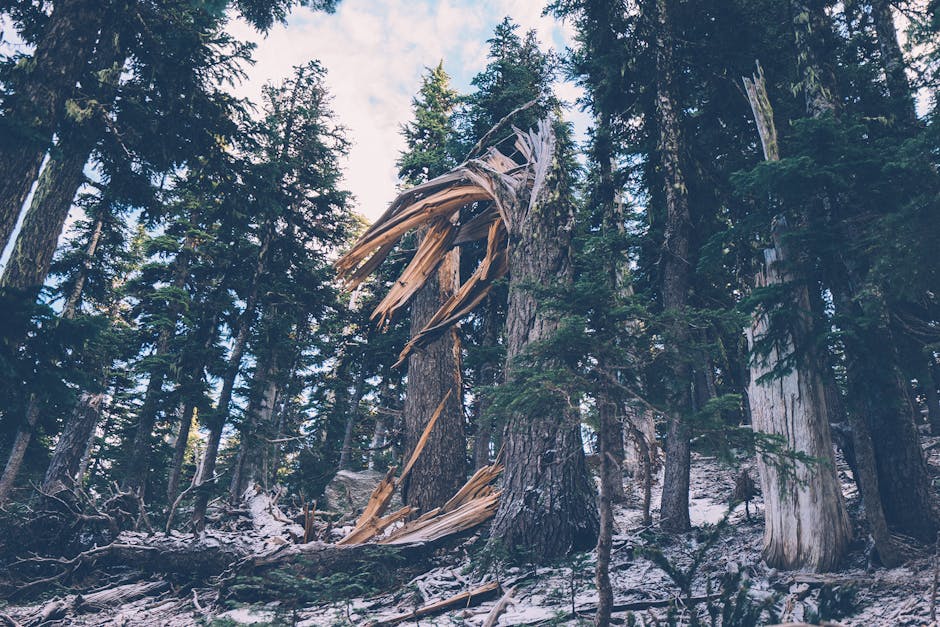
When Nature Breaks: Understanding Tree Damage
Broken trees can pose serious hazards to your property and family after storms or accidents. If you’re facing this situation, here’s what you need to know:
- Immediate Action: Remove any hazardous hanging limbs and clear broken branches
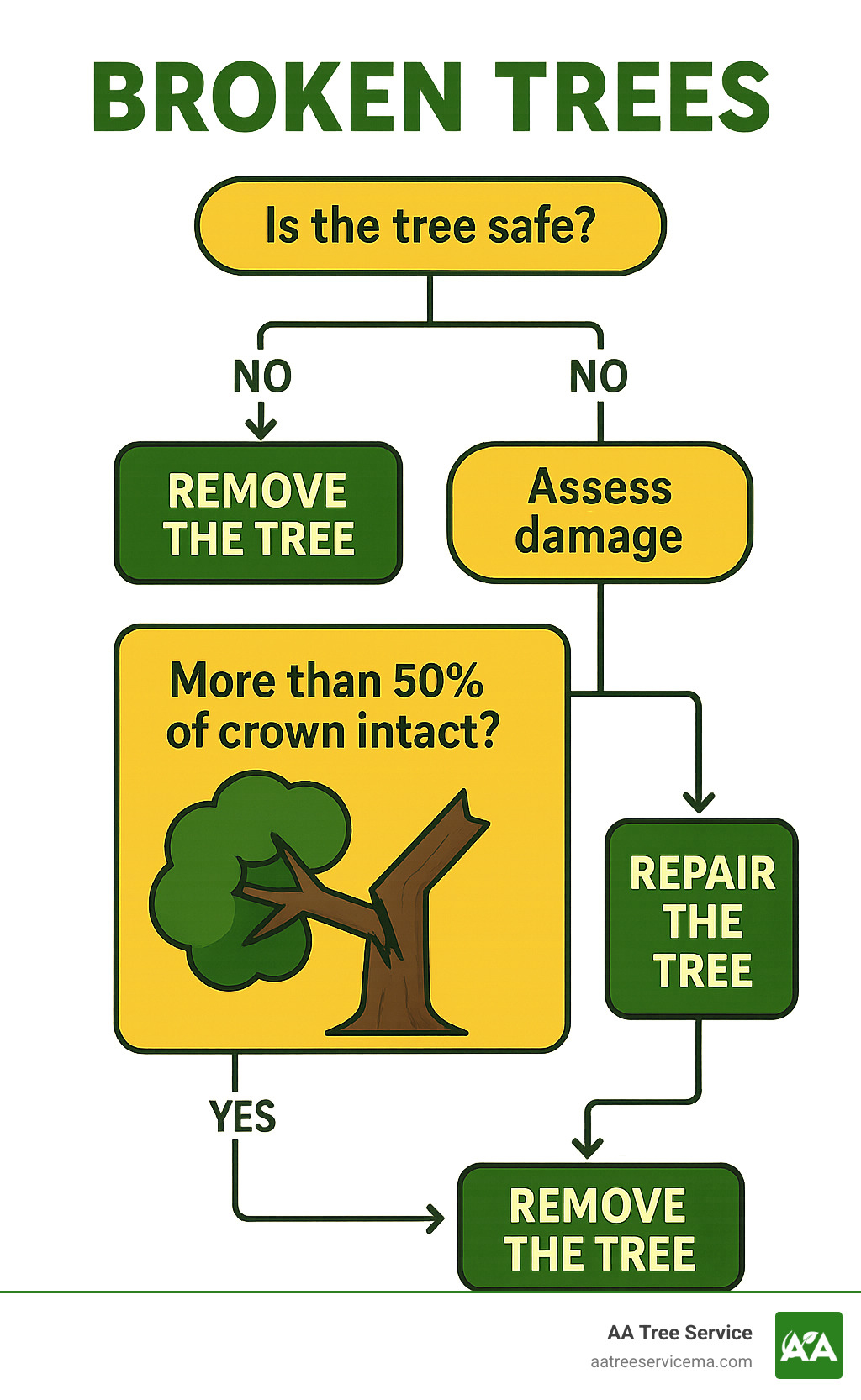
- Assessment Guide: A tree with more than 50% crown remaining has good chances of survival
- Professional Help: Call an arborist for trees with split trunks, severe leaning, or damage near structures
- DIY Repairs: Minor branch damage can be pruned using clean, proper cuts at the branch collar
- When to Remove: Trees with split trunks, severe lean, or less than 50% crown remaining usually can’t be saved
When a powerful storm tears through Massachusetts or New Hampshire, the aftermath often includes broken, damaged trees that transform from landscape assets to potential liabilities in minutes.
These silent victims stand as a testament to nature’s force – some with cracked limbs hanging precariously, others split down their trunks, and some completely uprooted. For homeowners, these damaged trees create an urgent situation requiring careful assessment and timely action.
The good news? Many broken trees can recover with proper care. Trees have remarkable healing abilities, though they don’t “heal” in the human sense – they compartmentalize damage and grow new tissue around wounds. Understanding whether your tree can be saved or needs removal is the critical first step.
As arborists serving Massachusetts and New Hampshire for over two decades, we’ve seen countless trees recover from severe storm damage when given proper care. The key is acting quickly while prioritizing safety.
In this guide, we’ll walk you through exactly what to do when facing broken trees on your property – from immediate safety measures to long-term recovery strategies.
Easy broken trees glossary:
– storm cleanup services
– emergency tree branch removal
– fallen tree removal
Why Do Trees Break? Understanding the Culprits
That magnificent maple in your yard didn’t just decide to split during last night’s storm. Tree failures typically happen for specific reasons, and understanding these can help you both respond to current damage and prevent future heartbreak.
In our 20+ years helping Massachusetts and New Hampshire homeowners, we’ve seen countless broken trees with similar stories behind their failures.
The most common culprits we encounter include severe weather events like the nor’easters that regularly pummel New England. These windstorms generate powerful gusts that can snap branches or topple entire trees in seconds. Winter brings its own challenges, as heavy ice and snow accumulation places enormous weight on branches – sometimes exceeding their natural load-bearing capacity by 30 times or more.
Below the surface, root decay silently compromises a tree’s anchoring system long before any visible symptoms appear. Similarly, insect infestations such as the devastating Emerald Ash Borer weaken wood structure from within, while bacterial and fungal diseases gradually degrade wood strength.
Human factors play a role too. Poor pruning creates entry points for decay and structural weaknesses. We often see fruit trees collapse under excessive production weight when they haven’t been properly thinned. Even soil compaction from vehicles or foot traffic restricts root growth and reduces stability.
As research from the Texas Forest Service confirms, “Trees have an uncanny ability to recover from storm damage,” but success largely depends on damage severity and how quickly proper care begins.
Hidden Stress Factors That Precede Failure
Many so-called “sudden” tree failures aren’t truly sudden at all. They’re actually the culmination of long-term stressors that gradually weaken the tree until a final event causes visible breakage.
Construction damage represents one of the most insidious culprits we encounter in suburban Massachusetts. When heavy equipment compacts soil or severs roots during nearby building projects, trees often don’t show symptoms for 3-5 years. By then, homeowners rarely connect the decline to that addition they built half a decade earlier.
Girdling roots present another hidden danger, especially in landscape trees. These roots wrap around the trunk rather than growing outward, slowly strangling the tree like an invisible python. Extended drought periods, increasingly common across New England, steadily deplete trees’ energy reserves and compromise their structural integrity.
“Property owners often don’t notice internal damage until an external force causes failure,” explains our head arborist. “By then, what looks like storm damage is actually the final chapter in a much longer story.”
Even seemingly harmless decorative vines can become killers. Invasive species like bittersweet add substantial weight while competing for precious sunlight, gradually weakening trees until they can no longer support themselves.
When Storms Strike: Immediate Mechanical Forces
The dramatic failures we witness after storms result from specific mechanical forces that overcome a tree’s natural defenses:
Straight-line winds create pushing and pulling forces that can snap trunks or branches, especially when they come from unusual directions. Lightning strikes can instantly shatter trunks by superheating moisture inside the tree, causing explosive pressure.
Ice accretion is particularly devastating in our Massachusetts and New Hampshire service area. Even a quarter-inch coating can increase branch weight dramatically, while saturated soils reduce root anchoring strength, making trees more susceptible to toppling over entirely.
Late fall nor’easters cause some of the worst damage we respond to, as trees may still have leaves when early snow or ice arrives. This dramatically increases the weight load, turning what might have been a manageable winter storm into a landscape-altering event.
Understanding these forces helps explain why that seemingly healthy tree suddenly failed – and more importantly, how you might protect your remaining trees from similar fate with proper preventative care.
Assessing Damage: Can Broken Trees Be Saved?
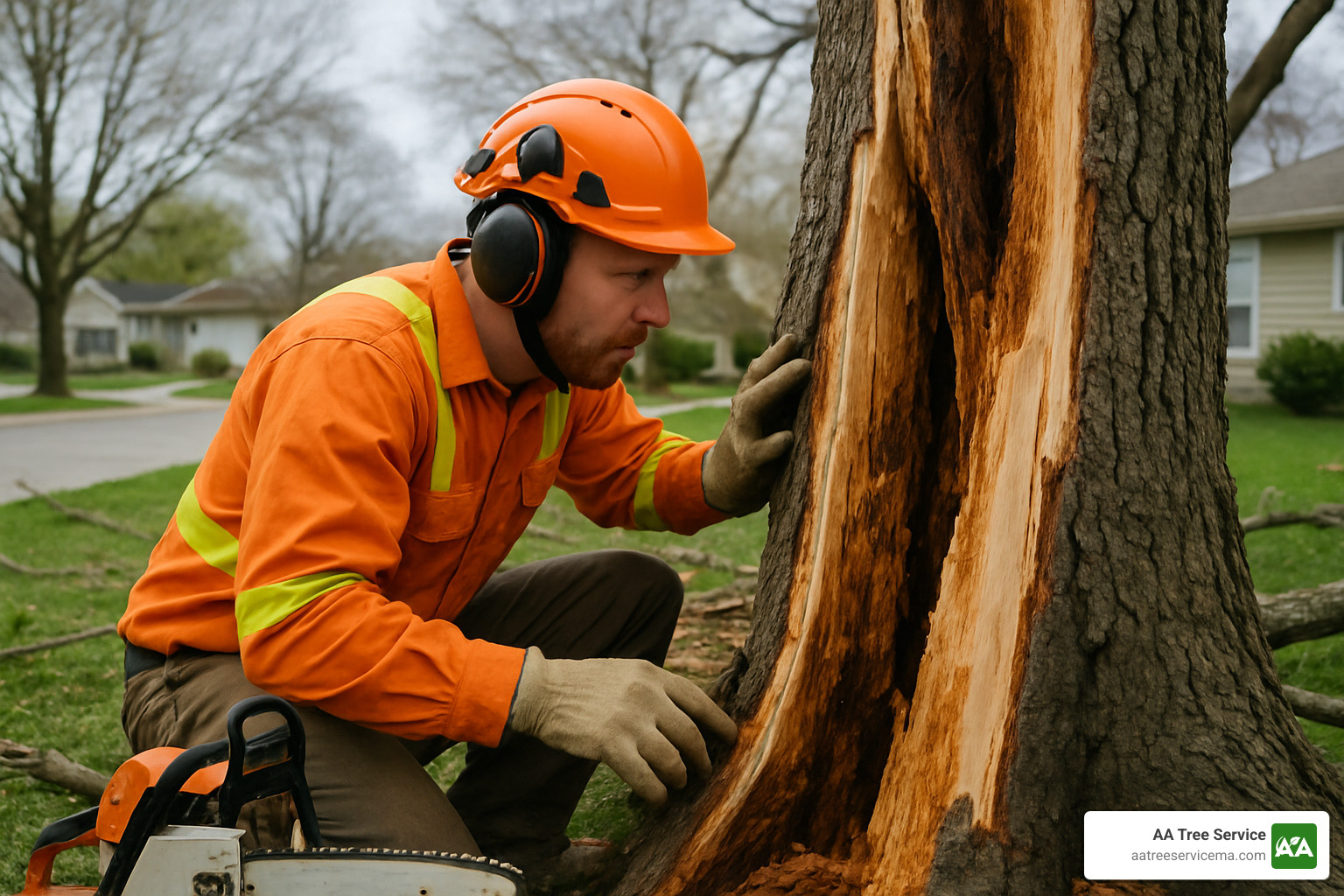
That feeling in your stomach when you look at your once-majestic maple now bent and broken after last night’s storm – I get it. But before you make any hasty decisions, take a deep breath. What looks like a disaster might actually be salvageable with the right approach.
When assessing broken trees, it’s crucial to set emotions aside and look at the situation objectively. I’ve seen trees that looked absolutely devastated come back stronger than ever with proper care, while others with seemingly minor damage ended up becoming serious hazards.
Let’s walk through how to determine if your beloved tree deserves another chance:
First, examine the crown percentage remaining. Your tree needs enough leaves to feed itself through photosynthesis – think of it as the tree’s solar panel system. If less than 50% of the crown remains intact, recovery becomes an uphill battle. The tree simply won’t have enough “food factories” to sustain itself and heal.
Next, check the leader status – that’s the central, upright stem that guides the tree’s growth pattern. If this main leader is still intact, especially on younger trees, you’ve got good reason for optimism. Trees with damaged side branches but intact leaders often make remarkable recoveries in Massachusetts and New Hampshire.
Take a good look at the trunk itself. A split or broken trunk represents one of the most serious injuries a tree can suffer. As one seasoned forestry expert put it to me, “Trees with split trunks or rotten cores are usually hopeless cases – those wounds are simply too extensive to ever properly heal.”
Don’t forget to look up for hanging limbs – what arborists ominously call “widow makers.” These partially attached branches can fall without warning and pose immediate dangers requiring professional removal.
Lastly, consider your tree’s species. Some New England natives bounce back better than others after storm damage. Maple, oak, and elm tend to show impressive resilience, while birch and pine often struggle more with recovery in our climate.
| Damage Level | Keep | Wait & See | Remove |
|---|---|---|---|
| Minor | Less than 25% crown damage, small broken branches | – | – |
| Moderate | – | 25-50% crown damage, one major limb lost, bark wounds | – |
| Severe | – | – | More than 50% crown lost, split trunk, multiple major limbs broken, severe lean |
Quick Safety Checklist Around Broken Trees
Before you even think about assessing or cleaning up around damaged trees, safety must come first. I can’t stress this enough – storm-damaged trees are unpredictable and potentially dangerous.
Always wear proper protective gear – hard hat, safety glasses, gloves, and sturdy boots at minimum. If you spot any branches touching or near power lines, stay at least 50 feet away and call your utility company immediately. Those situations require specialized training and equipment.
Create a clear “drop zone” around the damaged tree where no people or pets should enter during your inspection or work. And remember to constantly scan upward – those partially attached branches can come down without warning, even on seemingly calm days.
As the New York Department of Environmental Conservation bluntly reminds us, “You are responsible for your own safety and for the safety of those around you.” When in doubt, our storm cleanup services can handle the situation safely throughout Massachusetts and New Hampshire.
The 50% Crown Rule: Should You Say Goodbye?
The “50% crown rule” isn’t just arborist folklore – it’s based on solid tree biology. Trees are remarkably efficient systems, but they have limits.
Think of your tree’s crown as both its lungs and its kitchen. The leaves capture sunlight and carbon dioxide to produce the sugars the tree needs for energy. When a significant portion of that crown disappears, the tree must rely on stored energy reserves to survive and generate new growth.
A tree that’s lost more than half its crown faces a serious energy deficit. It’s like trying to run a marathon while fasting – technically possible for some, but extremely challenging and likely to cause long-term damage. The remaining leaves simply can’t produce enough food to sustain normal growth while also healing extensive wounds.
While some particularly vigorous species might defy the odds, most trees with less than 50% crown remaining after storm damage face a difficult future in our New England climate. They often decline slowly over several seasons, becoming increasingly vulnerable to pests, diseases, and future storm damage.
Split vs. Broken Trunk—Hope or Hazard?
When it comes to trunk damage, the details matter enormously. A split trunk represents one of the most serious injuries, but not all splits are created equal.
Look carefully at how the split pieces align. If they fit back together like puzzle pieces with good bark-to-bark contact, some trees can be saved with proper splinting techniques. The key is whether the tree’s vascular system – which runs just beneath the bark – remains partially intact. If even a small strip of connected bark remains (around 2-3 inches wide), it may maintain enough sap flow for the tree to survive while healing.
Young trees typically respond better to splinting than mature ones. Their tissues are more flexible and regenerative, and the wounds are proportionally smaller compared to the tree’s overall size. I’ve seen incredible recoveries in younger trees that were properly splinted within days of damage.
However, if the split reveals internal decay or hollow sections, your tree was likely compromised before the storm even hit. As research from the New York Department of Environmental Conservation indicates, “If more than 40% of a tree’s cross-section is missing, it should be removed,” as the structural integrity is compromised beyond safe recovery.
Monitoring Broken Trees Through the Seasons
Recovery from severe damage isn’t a quick process – it unfolds over multiple growing seasons, and requires patience and attention.
Schedule regular check-ins with your healing tree: once or twice in the first couple weeks after the damage, monthly during the growing season, and after any subsequent storms. What you’re looking for is progress – signs that the tree is actively responding to its injuries.
Healthy trees will begin forming callus tissue around wounds – a ridge of new growth that slowly expands inward. This isn’t the tree “healing” in the human sense, but rather compartmentalizing the damage while generating new tissue. The presence of this callus formation is one of the best indicators that your tree is on the road to recovery.
Keep a watchful eye for uninvited guests, too. Injured trees often attract secondary pests and diseases that can compound the original damage. Carpenter ants, bark beetles, and various fungi see wounded trees as prime real estate. Early intervention can make all the difference.
“After a major storm, the impulse is to clear everything immediately, but hasty decisions often lead to removing trees that could have been saved,” shared one of our Massachusetts arborists with over 20 years of experience. “Carefully prune the broken branches and give the tree some time to show you what it can do. Nature is remarkably resilient when given a chance.”
First Aid for Broken Trees: Step-by-Step Repairs
When Mother Nature leaves you with broken trees in your Massachusetts or New Hampshire yard, quick action can make the difference between saving or losing your leafy friend. Think of it as tree first aid – the sooner you start treatment, the better the chances of recovery.
Pruning Broken Branches the Right Way
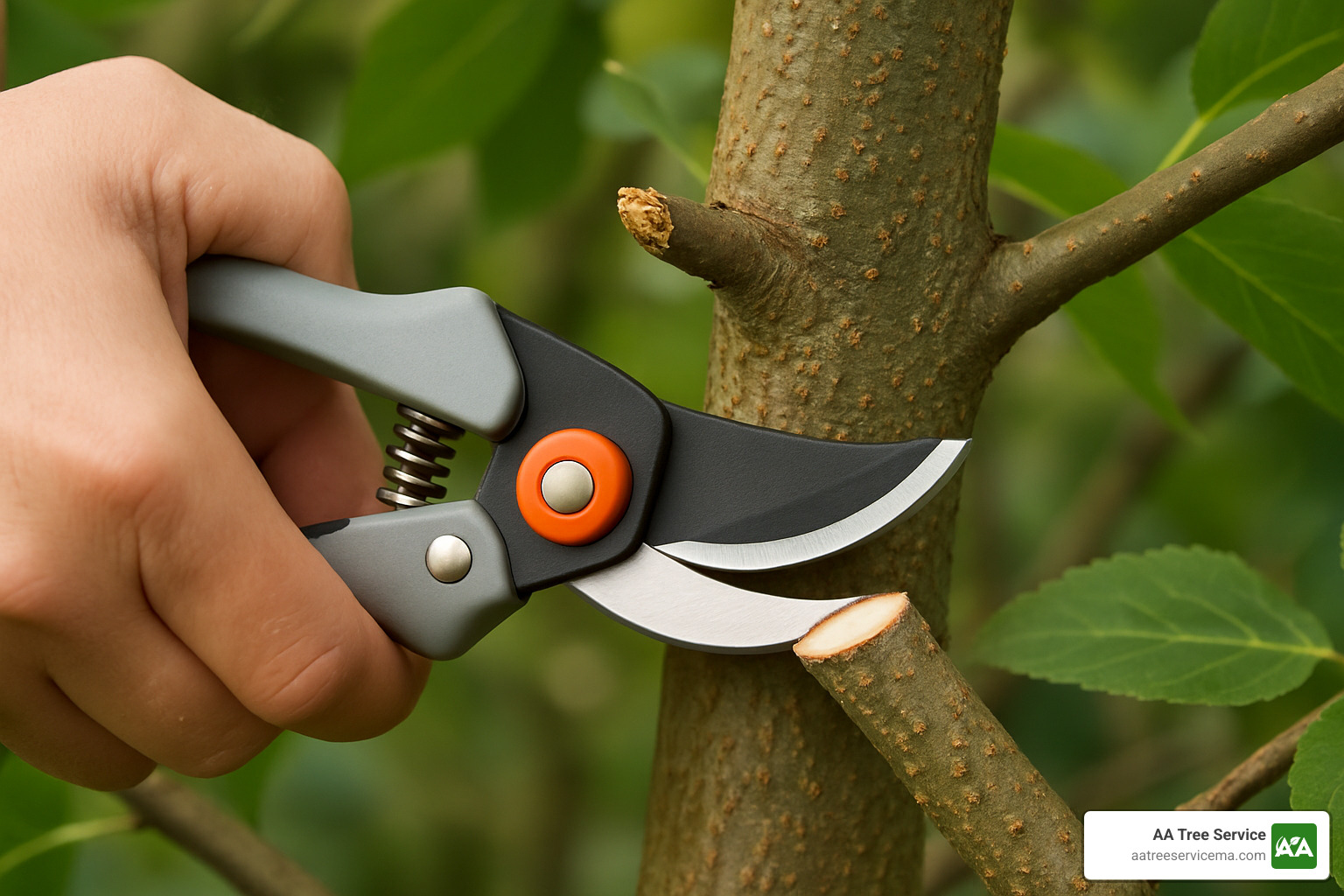
That jagged, torn branch isn’t just unsightly – it’s an open wound inviting disease and pests into your tree. Proper pruning creates a clean cut that helps your tree heal faster.
The key to success is finding the branch collar – that slightly swollen ring where the branch connects to the trunk. This collar contains specialized cells that help seal wounds naturally. Cut too close (a flush cut), and you’ll remove this healing tissue. Leave too much (a stub), and you’ll create a highway for decay.
For larger branches, the three-cut method prevents bark tearing and additional damage. Make your first cut underneath the branch about a foot from the trunk, then a second cut from above slightly further out to remove the branch’s weight. Your final cut should preserve the branch collar while removing any remaining stub.
“I always tell homeowners to put away the black tar,” says one of our arborists. “Those wound paints your grandfather used actually trap moisture and can slow healing.” Modern research shows trees have their own natural sealing mechanisms that work best without interference.
For branches too large to handle safely or those hanging precariously, our emergency tree branch removal team can help before the situation worsens.
Splinting and Cabling a Split Trunk
Finding your beloved maple with a split trunk after a nor’easter can feel devastating, but don’t give up hope too quickly. Some splits can be mended if addressed promptly.
Think of splinting a tree like setting a broken bone. The key is getting those separated pieces aligned so the living tissue can reconnect. If the broken sections fit together like puzzle pieces with good bark-to-bark contact, you’ve got a fighting chance.
Start by gently repositioning the split sections. Drive a sturdy metal stake beside the trunk as a splint – for a medium-sized tree, an 8-foot length works well. Secure the trunk to this support using stretchy materials that won’t cut into the bark as the tree grows. Hardware store rope is too rigid; instead, use specialized tree straps or even old bicycle inner tubes in a pinch.
“The worst thing you can do is use wire or regular rope,” explains our tree care specialist. “As the tree grows, these materials can girdle the trunk and cause more harm than the original split.”
For major splits, you’ll also want to reduce the weight load by pruning back 30-40% of the crown. This balances the tree’s reduced ability to transport water and nutrients through that damaged trunk. Check and adjust your splint system every few months to prevent it from becoming too tight as the tree grows.
Caring for Broken Trees After Repairs
Your tree’s recovery journey has just begun after those initial repairs. Like any patient, it needs ongoing care to regain its strength.
Deep watering becomes especially important for damaged trees. Their injured vascular systems struggle to transport moisture efficiently, so providing consistent soil moisture helps reduce stress. Aim for the equivalent of 1-2 inches of rainfall per week, delivered slowly to allow absorption. A soaker hose works beautifully for this purpose.
While you might be tempted to fertilize heavily to “help” recovery, restraint is better. Wait until the following growing season, then apply a light, balanced fertilizer. Heavy nitrogen can actually worsen stress by forcing rapid growth the damaged tree can’t support.
Create a mulch ring around your tree (keeping it away from the trunk itself) to retain moisture and reduce competition from grass and weeds. Two to three inches of mulch creates an ideal environment for healing roots.
Keep a watchful eye for unwelcome visitors. Damaged trees release stress chemicals that actually attract certain insects, like opportunistic borers. Regular inspections help catch these secondary attackers before they compound the damage.
“Young trees are surprisingly resilient,” our arborist notes with a smile. “I’ve seen saplings bounce back from damage that would have doomed their older relatives. They have more energy and fewer responsibilities – kind of like kids versus adults.”
For trees that need more extensive help than DIY methods can provide, our team at AA Tree Service has been helping Massachusetts and New Hampshire homeowners save their treasured trees for over two decades. Sometimes professional intervention makes all the difference between saying goodbye to a beloved tree and watching it recover to provide decades more of shade and beauty.
When to Call the Pros for Broken Trees
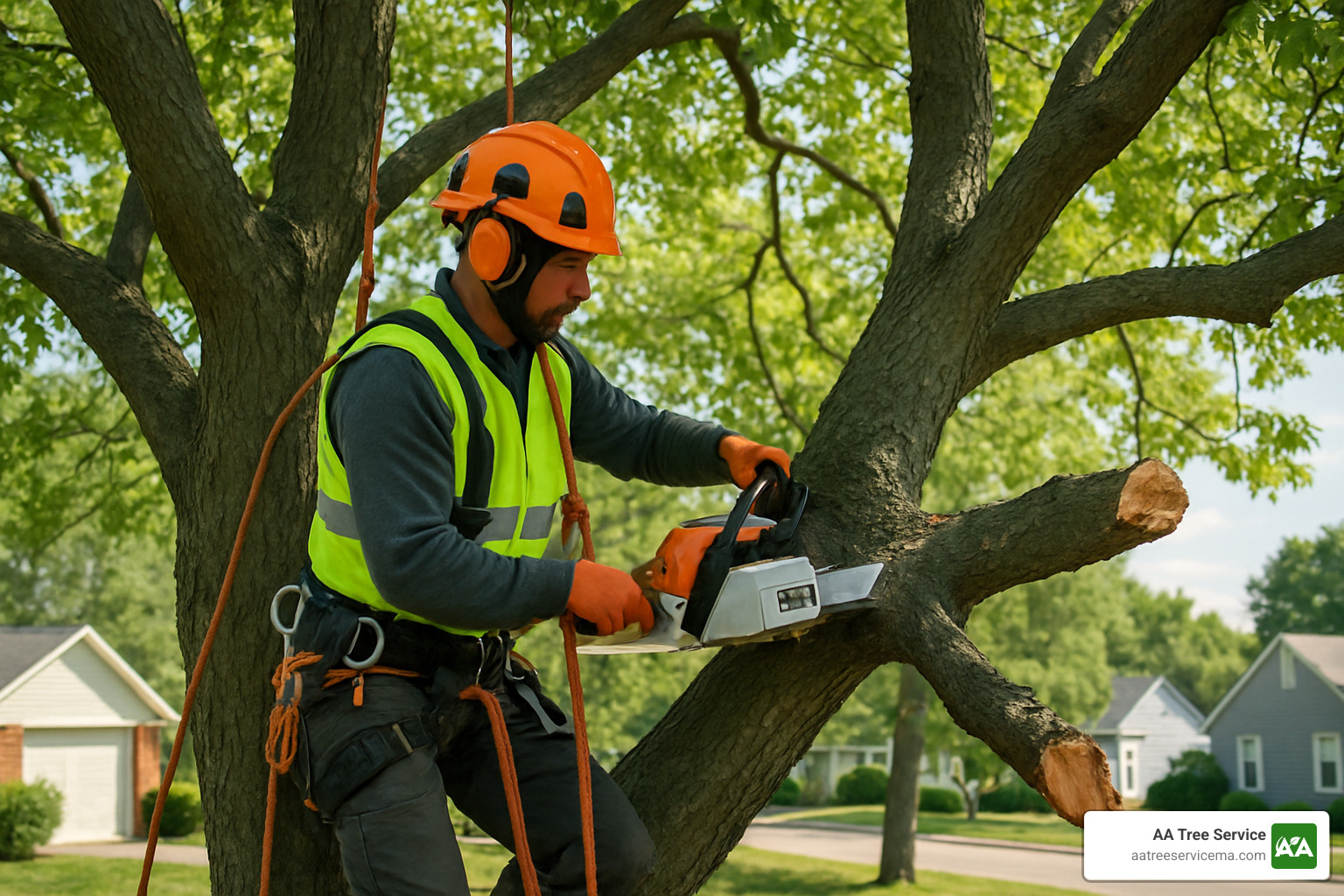
Let’s face it – there’s a certain satisfaction in handling property issues yourself. But when it comes to broken trees, knowing when to step back and call a professional can save you from serious injury or costly mistakes.
As much as we admire DIY spirit, certain situations simply demand expert hands. You should call a certified arborist when dealing with any branch larger than 4 inches in diameter, as these heavy limbs can cause serious injury when they unexpectedly shift during cutting. Height is another crucial factor – if the damage requires ladder work or climbing, the risk multiplies dramatically.
“Time is on your side—carefully prune broken branches and give the tree some time to recover,” notes one experienced arborist. However, this patience doesn’t apply to dangerous hanging limbs, which industry professionals ominously call “widow-makers” for good reason.
Structural threats demand immediate professional attention too. When limbs hang precariously over your home, garage, or vehicles, proper removal techniques become critical to prevent additional damage. And remember – any branch within 10 feet of power lines is an absolute no-go zone for homeowners. Power companies and certified arborists have specialized training for these hazardous situations.
Trunk damage presents another scenario where professional assessment is invaluable. Split or cracked trunks, especially those compromised by more than 25%, require expert evaluation to determine if the tree can be saved or poses a falling risk. Similarly, trees that have shifted from their original position (often showing raised soil on one side) need immediate professional attention.
If you spot significant interior decay – exceeding 40% of the trunk diameter – this hidden weakness dramatically increases failure risk, even in seemingly mild weather conditions.
At AA Tree Service, we provide 24/7 emergency response throughout Massachusetts and New Hampshire. Our emergency tree removal team can quickly assess damage and take appropriate action to protect your property and family.
Cost Snapshot for Professional Help in MA & NH
After storm damage, budget concerns naturally arise. While every situation is unique, understanding typical costs can help you plan accordingly.
In Massachusetts and New Hampshire, professional pruning of damaged limbs typically ranges from $200 for smaller trees to $1,500 for large or complex specimens. The wide range reflects the tremendous variation in difficulty, access issues, and time required.
For trees that can be saved but need structural support, cabling and bracing services generally run between $300 and $1,200. These specialized techniques can extend a valuable tree’s life by decades when properly installed.
When removal becomes necessary, costs typically range from $400 for smaller trees to $4,000 or more for large specimens or those in difficult locations. Emergency services – those middle-of-the-night calls after a storm – may include a surcharge of 1.5 to 3 times standard rates, reflecting the additional hazards of working in post-storm conditions.
If you opt for complete removal, stump grinding is usually an additional service, ranging from $100 to $500 depending on size and accessibility.
These figures represent industry averages based on internet data and not actual costs for AA Tree Service. Your specific situation may vary considerably based on tree size, location, and complexity.
An important consideration often overlooked: some municipalities in Massachusetts and New Hampshire require permits for tree work, especially for street trees or those in conservation areas. Professional services steer these requirements daily and can help ensure your project complies with local regulations.
Risks of DIY on Large Broken Trees
That chainsaw in your garage can be tempting when you see broken limbs after a storm – but proceed with extreme caution.
According to the CDC, approximately 36,000 people receive emergency treatment annually for chainsaw injuries, with many of these accidents occurring during post-storm cleanup. These powerful tools require proper training and safety equipment, both of which professional arborists maintain.
Perhaps the most dangerous aspect of DIY tree work is hidden tension wood. Broken limbs can contain tremendous stored energy that, when cut, releases suddenly and violently – like a spring under pressure. Even experienced arborists approach storm-damaged trees with extreme caution for this very reason.
Your homeowner’s insurance adds another dimension to consider. Many policies won’t cover injuries sustained during DIY tree work, potentially leaving you with substantial medical bills on top of property damage.
Improper removal techniques frequently cause additional property damage, from crushed landscaping to more serious structural impacts. What might save a few hundred dollars upfront can quickly become thousands in repair costs.
Partially removed trees create their own hazards. What seems stable today may fail in the next storm, creating what arborists call “secondary failures” – often more dangerous than the original damage.
“Even those of us with decades of experience treat storm-damaged trees with tremendous respect,” explains a certified arborist with over 20 years of experience working throughout New England. “The forces involved are simply too unpredictable for casual handling.”
When facing broken trees after a storm, sometimes the wisest DIY decision is picking up the phone instead of the chainsaw.
Preventing Future Breakage
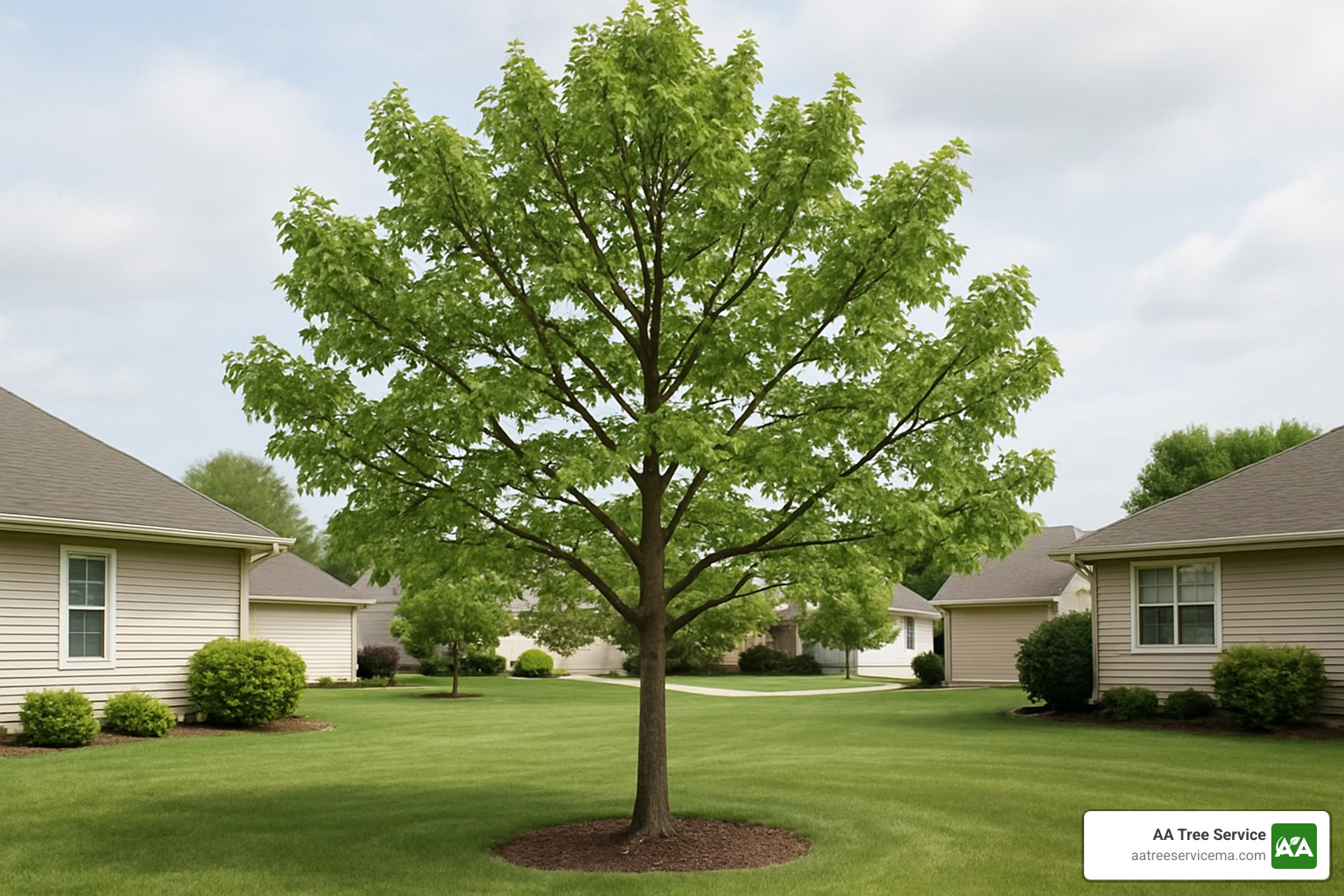
After witnessing the heartbreak of storm damage, many homeowners ask us, “How can I make sure this doesn’t happen again?” The good news is that many tree failures are preventable with the right approach.
The strongest defense against broken trees starts long before storm clouds gather. Think of it as preventative healthcare for your landscape—regular checkups and good habits that build resilience over time.
Early intervention makes all the difference. Structural pruning for young trees is like orthodontic work—a little guidance now prevents major problems later. By establishing a strong central leader and well-spaced branches early on, you’re literally shaping your tree’s ability to withstand future storms.
The principle of right tree, right place cannot be overstated for New England properties. That beautiful weeping willow might look perfect in your yard today, but its shallow roots and brittle wood could spell disaster during our notorious nor’easters. Our arborists can help identify species that will thrive in your specific Massachusetts or New Hampshire microclimate.
Healthy soil creates healthy trees. Just like humans need good nutrition, trees need proper soil structure and fertility to develop strong root systems. Simple practices like mulching (keeping it away from the trunk!) and avoiding soil compaction go a surprisingly long way toward preventing tree failure.
For those with fruit trees, thinning developing fruit serves double duty—it not only improves the quality of your harvest but significantly reduces the weight stress on branches. I’ve seen countless apple and pear trees split under the weight of an overabundant crop that could have been prevented with 15 minutes of spring thinning.
Our tree pruning and trimming service can address these preventative measures, establishing proper structure before problems develop.
Building Wind-Resilient Canopies
Wind is the most common culprit behind broken trees in Massachusetts and New Hampshire. Creating wind-resilient canopies is part science, part artistry.
Trees with a dominant leader (a single, strong central trunk) distribute force more effectively during high winds. Think of it as the tree’s backbone—when it’s strong and straight, everything else aligns properly. During our assessments, we often identify and correct competing leaders while trees are young, preventing those devastating V-shaped splits years later.
A balanced crown acts like a well-adjusted sail rather than a wind trap. Through selective pruning, we can help your trees develop evenly distributed branches that reduce the wind-sail effect. This doesn’t mean removing all interior branches—quite the opposite. A thoughtfully thinned canopy allows wind to pass through rather than pushing against a dense wall of foliage.
Proper branch spacing might seem like an aesthetic concern, but it’s actually crucial for structural integrity. Branches that are too close together compete for space and resources, often resulting in weak attachments. During one recent job in Nashua, we identified and corrected this issue for a homeowner whose maple had already lost three major limbs to moderate winds.
The elimination of co-dominant stems (competing leaders of similar size) is perhaps the single most important preventative measure for young trees. These V-shaped unions are inherently weak and almost inevitably lead to splitting as the tree matures. I’ve seen 30-year-old oaks split right down the middle during storms because this simple issue wasn’t addressed when the tree was young.
Site Planning for Storm-Smart Landscapes
The best time to prevent tree damage is before planting, when you have the opportunity to create a storm-smart landscape from scratch.
Strategic placement matters enormously. Position new trees at least their mature height away from structures and power lines. That cute six-foot maple sapling might seem harmlessly distant from your house today, but fast-forward 30 years and you could have a 50-foot tree looming over your roof.
Always contact Dig Safe (811) before planting to locate underground utilities. This free service can save you from costly mistakes and potential hazards, particularly important in older New England communities where infrastructure mapping can be complex.
Species selection deserves careful consideration in our northeastern climate. Instead of brittle silver maples, consider the stronger red maple. Northern red oak provides magnificent shade with exceptional strength. American hornbeam offers a smaller but incredibly resilient option for tight spaces. River birch brings the beauty of birch without the structural weaknesses of paper birch.
Climate change has altered our planting considerations in Massachusetts and New Hampshire. Species once considered borderline hardy now thrive here, while some traditional favorites face new stresses. Our arborists stay current with these shifting patterns to recommend trees that will thrive not just today, but decades into the future.
The “the tree’s gotta go” reaction after storm damage is understandable but often avoidable with proper planning and preventative care. Healthy, structurally sound shade trees provide energy efficiency benefits that far outweigh their maintenance costs. With thoughtful selection, placement, and early training, your trees can become assets that appreciate in value year after year while standing strong against whatever weather comes their way.
Common Questions About Broken Trees
What immediate steps should I take after a storm?
When storms blow through Massachusetts or New Hampshire, your first priority must always be safety. Before rushing out to assess tree damage, take these essential steps:
First, stay well away from any downed power lines and report them immediately to your local utility company. Even lines that appear dead can become energized without warning. Check carefully for hanging branches – these “widow makers” can fall unexpectedly even on calm days after the storm has passed.
Before touching anything, take photos of the damage for insurance documentation. Many homeowners are surprised to learn that tree damage is often covered by insurance policies, especially if structures were impacted.
If it’s safe to do so, you can clear small debris from walkways to prevent trips and falls. However, leave larger material for professional assessment, particularly if it’s attached to standing trees.
Finally, contact a certified arborist for a proper evaluation of more significant damage. Their trained eye can spot hazards you might miss and determine which trees can be saved.
“After a storm, the impulse is to clear everything immediately,” notes one experienced New England arborist, “but rash decisions can lead to removing salvageable trees. Time is on your side—carefully prune broken branches and give the tree some time to recover.”
Can a broken branch be reattached?
Unfortunately, broken branches cannot be reattached to trees. Unlike human limbs that can sometimes be surgically reconnected, tree physiology doesn’t work this way. As one forestry expert explains, “Woody plants can’t heal damaged tissues; they compartmentalize wounds.”
Trees don’t regenerate damaged tissues the way animals do. Instead, they seal off injured areas and grow new tissue elsewhere. When a branch breaks, the vascular connection that transported water and nutrients is permanently severed.
The best approach is to make a clean cut at the proper location (the branch collar) to help the tree compartmentalize the wound effectively. This gives the tree its best chance of possibly growing a new branch from a nearby dormant bud. Think of it as helping the tree focus its energy on viable growth rather than trying to repair what can’t be fixed.
How long does it take a tree to recover?
Recovery time for broken trees varies significantly based on several factors. Fast-growing species like maples common in Massachusetts may show substantial recovery within 1-2 growing seasons, while slower-growing New Hampshire natives like oaks might require 3-5 years to fully bounce back.
Young trees have remarkable resilience and typically recover much faster than mature specimens. A 10-year-old tree might overcome significant damage in half the time needed by its 40-year-old counterpart. The extent of damage plays a crucial role too – minor branch damage might be overcome in a single season, while major structural damage requires multiple years of careful monitoring.
Growing conditions make a tremendous difference in recovery speed. Trees with optimal soil, water, and sunlight heal faster than those already stressed by poor conditions. “A small wound relative to limb diameter can seal over in a couple of years,” explains one forestry expert, “but larger wounds leave the tree vulnerable to pests and disease” for much longer periods.
Most trees will show signs of recovery – new growth, beginning wound closure, healthy leaf development – within one growing season if they’re going to survive. If your tree shows no signs of recovery after a full growing season following damage, its prognosis is unfortunately quite poor.
While trees don’t “heal” in the human sense, they are remarkably adaptable organisms that have evolved to withstand damage. With proper care and patience, many broken trees throughout Massachusetts and New Hampshire recover beautifully from even significant storm damage.
Conclusion
When storms tear through Massachusetts and New Hampshire, the sight of broken trees can be heartbreaking. That maple you’ve watched grow for decades, the oak that shades your children’s playground, or the ornamental cherry that bursts with spring blossoms – suddenly damaged and vulnerable.
But here’s the good news: with proper assessment and timely care, many damaged trees can recover their health and beauty. Through our 20+ years of helping New England homeowners steer these challenging situations, we’ve seen remarkable recoveries that might have seemed impossible at first glance.
Remember these critical takeaways as you assess your storm-damaged landscape:
Safety must always be your first priority when working around broken trees. Hanging limbs, leaning trunks, and branches near power lines demand professional attention – the risk simply isn’t worth taking.
The 50% crown rule provides a reliable guideline for salvageability. Trees that maintain at least half their leaf-bearing branches have substantially better odds of making a full recovery than those with more extensive crown loss.
Proper pruning techniques make all the difference in a tree’s healing process. Clean cuts at the branch collar allow the tree to compartmentalize damage and redirect energy to new growth, while improper cuts can introduce disease and decay.
When situations exceed your comfort level – like large broken limbs, split trunks, or hazards near structures – professional help isn’t just convenient, it’s essential. Our certified arborists bring specialized equipment, training, and experience to safely address complex damage.
Perhaps most importantly, preventative care remains your best defense against future storm damage. Strategic pruning, proper planting, and regular maintenance build resilience that pays dividends when severe weather strikes.
At AA Tree Service, we’ve dedicated over two decades to protecting and preserving the trees that make our Massachusetts and New Hampshire communities beautiful. From emergency response in the wake of devastating nor’easters to thoughtful preventative care that strengthens trees against future storms, our team understands the unique challenges of New England’s climate and landscape.
We offer comprehensive tree care services with 24/7 emergency response throughout MA and NH. Our certified arborists provide free same-day quotes and bring a commitment to safety and satisfaction with every service call. Whether you’re facing an immediate hazard or planning for long-term tree health, we’re here to help.
For immediate assistance with storm-damaged trees, visit our emergency tree removal page or call our 24-hour emergency line. Because when storms strike, prompt, professional care doesn’t just save trees – it protects what matters most: your family, home, and peace of mind.