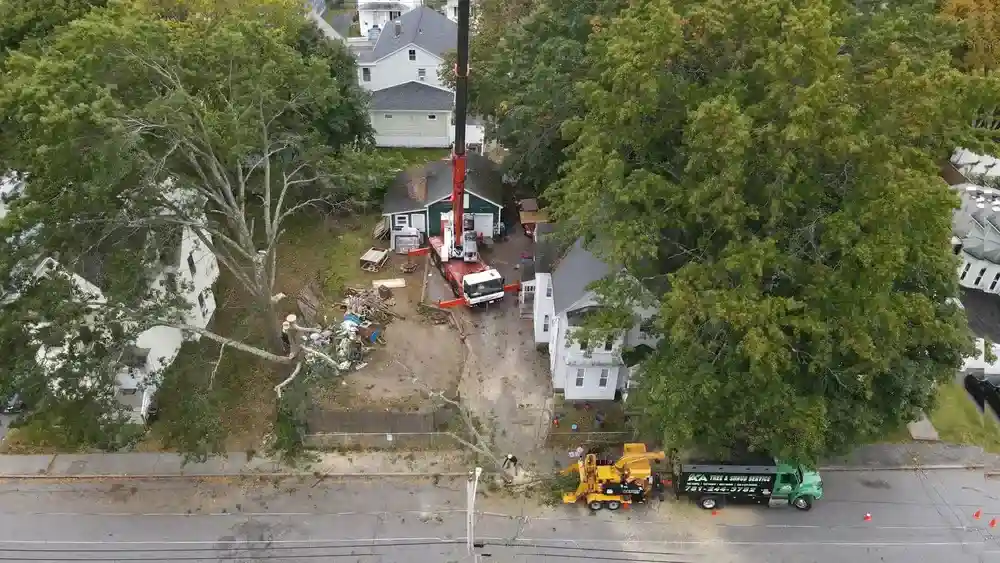
Understanding Tree Removal Services: What Every Homeowner Should Know
Tree Removal Services are professional solutions for safely cutting down and removing trees that pose risks to property or people. Understanding when removal is necessary, what the process involves, and how to hire qualified professionals helps homeowners make informed decisions about their property’s safety and appearance.
Quick Overview of Tree Removal Services:
- Standard Removal: Complete tree cutting, dismantling, and debris removal for dead, diseased, or unwanted trees
- Emergency Services: 24/7 response for fallen trees or hazardous situations after storms
- Crane-Assisted Removal: Specialized equipment for large trees or tight spaces near structures
- Stump Grinding: Removing the remaining stump after tree removal
- Average Cost Range: $200 to $2,000+ (based on internet data, varies by tree size and complexity)
Tree removal isn’t always the first solution. Sometimes pruning or trimming can address safety concerns while preserving the tree. But when a tree shows signs of serious decay, leans dangerously toward your home, or has suffered severe storm damage, professional removal becomes necessary.
The decision to remove a tree is permanent, which is why understanding your options matters. Many homeowners in Massachusetts and New Hampshire face this choice when dealing with aging trees, storm damage, or property renovations. According to research from professional tree care specialists, the cost can range from as little as $100 for a small fallen tree to over $1,500 for large trees requiring specialized equipment like cranes.
This guide breaks down everything you need to know about tree removal services—when removal is truly necessary, what different types of services exist, how much you should expect to pay, and how to find qualified professionals who prioritize safety and property protection.
When Is Tree Removal Absolutely Necessary?
Nobody wants to say goodbye to a tree that’s been part of their property for years. Trees provide shade, beauty, and even increase your home’s value. But sometimes, keeping a tree around becomes a serious safety risk, turning a beloved landscape feature into a liability.
Tree removal services become absolutely necessary when a tree threatens your property or the people around it. This isn’t about removing trees on a whim—it’s about proactive risk management and protecting what matters most. A professional assessment can distinguish between a tree that needs care and one that needs to go.
Dead or dying trees are the most obvious candidates for removal. When a tree stops drawing water and nutrients, its wood becomes brittle and unpredictable. These trees can drop large branches without warning, or worse, topple over entirely during a storm. Massachusetts and New Hampshire weather can be harsh, and a compromised tree won’t stand up to heavy snow loads or high winds.
In our region, we see specific threats that turn healthy trees into hazards. For example, Emerald Ash Borer (EAB) has decimated ash tree populations. Once infested, an ash tree’s structural integrity deteriorates rapidly, making it extremely dangerous to climb and remove. Similarly, Dutch Elm Disease and Hemlock Woolly Adelgid are other common culprits that lead to tree death and the need for professional removal.
Structural integrity issues are equally concerning. Trees with deep cracks in their trunks, significant cavities, or root decay have lost their ability to support their own weight. Think of it like a building with a cracked foundation—it might look fine today, but it’s only a matter of time before something gives. A common but often overlooked structural flaw is the presence of co-dominant stems with included bark. This occurs when two large stems grow too closely together, trapping bark between them and creating a weak union. This V-shaped crotch is highly susceptible to splitting apart during a storm, causing catastrophic failure.
Proximity to structures often tips the scales toward removal. A large tree leaning toward your house, with branches hanging over your roof, or roots pushing against your foundation creates constant risk. Even healthy trees positioned too close to power lines, driveways, or buildings may need to come down before they cause expensive damage. Roots can be especially destructive, cracking foundations, uplifting sidewalks, and interfering with septic systems over time.
Sometimes trees need removal for less dramatic reasons. Overcrowding can stunt the growth of other plants in your yard by competing for sunlight, water, and nutrients. Removing a less desirable tree can allow a more valuable one to thrive. Certain trees might also be obstructing views or planned construction, making removal a practical necessity for property improvement.
The key is having a professional tree health assessment to understand exactly what you’re dealing with. What looks like a simple problem might have an easy fix, while a seemingly healthy tree could be hiding serious internal decay. An arborist can use specialized tools to detect decay that isn’t visible to the naked eye.
Signs Your Tree is a Hazard
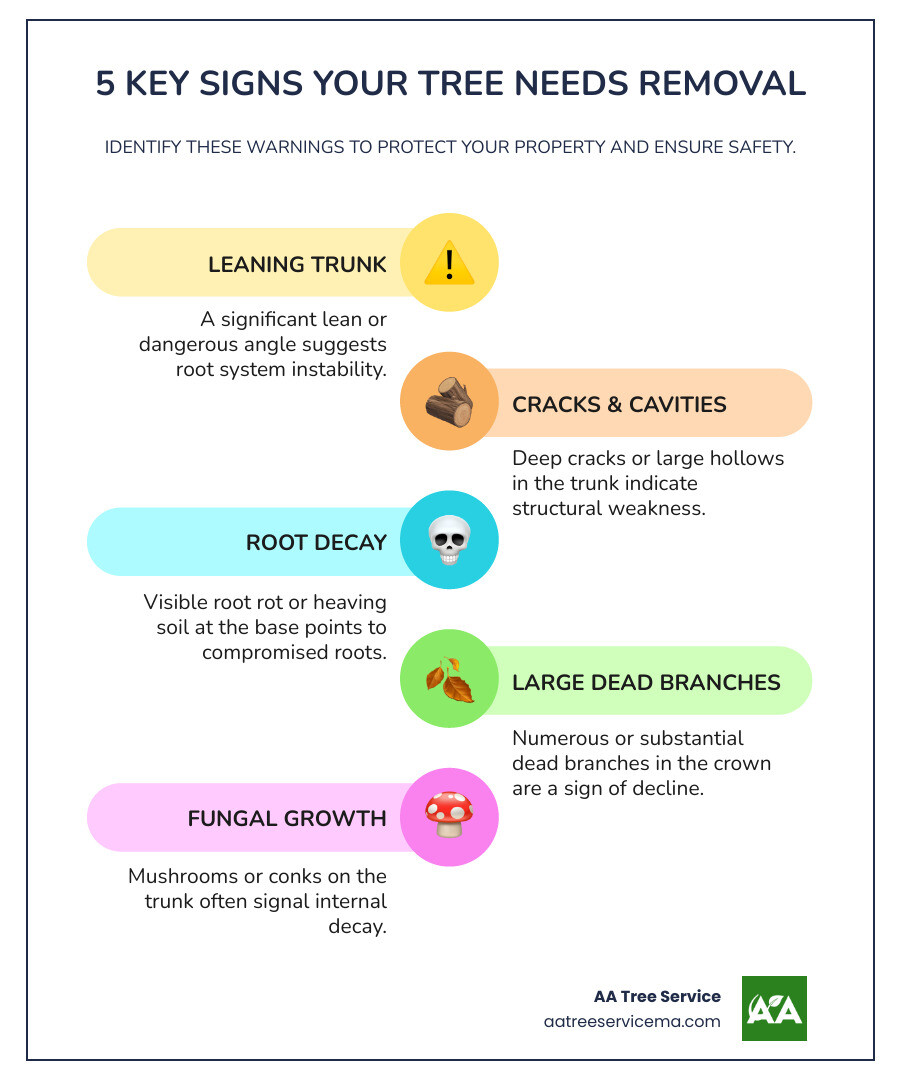
Learning to spot warning signs can save you from a middle-of-the-night emergency. Your tree might look fine from a distance, but certain red flags tell a different story.
A leaning trunk that wasn’t always tilted is your tree’s way of waving a red flag. Trees naturally grow at slight angles, but a sudden or progressive lean indicates the root system is failing. If you notice the soil heaving around the base—where the ground looks raised or cracked—the roots are literally losing their grip and the tree could uproot at any moment.
Deep cracks or cavities in the trunk expose the tree’s structural weakness. Small cracks might be manageable, but when you can see deep into the trunk or major branches, the tree has lost significant strength. According to research from industry experts like the International Society of Arboriculture, if more than 25% of a tree’s bark is damaged or missing around its circumference (a condition called girdling), it will likely not survive and will need professional removal.
Look for fungi growth at the base or on the trunk. Those mushrooms or shelf-like conks aren’t just unsightly—they’re the fruiting bodies of decay fungi feeding on wood inside your tree. Their presence is a definitive sign of internal rot. By the time fungi appear on the outside, significant decay has already developed internally, compromising the tree’s strength.
Large dead branches scattered throughout the crown signal declining health. One or two dead limbs might be normal aging, but numerous dead branches mean the tree is struggling to survive. These widow makers (as arborists call them) are brittle and can fall without warning, making them particularly dangerous to anyone or anything below.
Sudden leaf drop outside of normal fall timing, leaves that are smaller than usual, or premature browning all point to serious stress. This could be from disease, root problems, or a severe pest infestation. In Massachusetts and New Hampshire, defoliation from pests like gypsy moth caterpillars or winter moths can weaken a tree over several seasons, eventually leading to its death.
Root decay often happens out of sight, but you might notice soft, crumbling wood at the base, or areas where the bark has fallen away to reveal rotting wood underneath. Healthy roots are firm and resilient—decaying roots feel spongy or break apart easily. You can sometimes probe the soil around the base with a screwdriver to check for soft spots.
When Pruning or Trimming May Be Enough
Before you commit to removal, consider that many tree problems have less drastic solutions. We’ve saved countless trees that homeowners thought were goners.
Tree pruning can work wonders for a tree that’s basically healthy but has some problematic branches. Removing dead, diseased, or dangerously positioned limbs often eliminates the risk while keeping the tree alive. Strategic cuts can also improve air circulation and sunlight penetration, actually strengthening the tree’s overall health. This is often called ‘crown cleaning’ or ‘crown thinning’.
Tree trimming addresses overgrowth issues—branches touching your roof, blocking windows, or encroaching on power lines. Regular trimming keeps trees at a manageable size and prevents problems before they start. You can learn more about these options on our tree pruning and trimming services page.
For trees with structural weaknesses that aren’t yet critical, cabling and bracing provides extra support. This technique uses flexible steel cables in the upper canopy to support weak limbs or multi-trunked trees, helping them withstand wind and weather without splitting. Rods can also be installed lower down in the trunk to provide more rigid support.
Disease treatment can reverse declining health when caught early. Professional diagnosis identifies whether your tree is suffering from a fungal infection, pest infestation, or nutrient deficiency—all of which may be treatable with injections, sprays, or soil treatments.
Even root problems don’t always mean removal. When tree roots are causing minor issues near your home, careful root management can resolve the situation. However, this requires expertise—never cut roots wider than 2 inches in diameter, and never remove more than 15% of a tree’s root system at once, as this can destabilize the tree.
The bottom line? When you’re unsure whether your tree needs removal or just some professional care, get an expert opinion. We offer free same-day quotes and honest assessments. Sometimes the best tree service is the one that saves your tree rather than removing it.
Understanding the Types of Professional Tree Removal Services
Not every tree removal job is the same. A healthy oak standing in your open backyard requires a completely different approach than a storm-damaged maple leaning dangerously over your roof. That’s why tree removal services come in different forms, each designed to handle specific situations safely and efficiently.
When we arrive at your property in Massachusetts or New Hampshire, we perform a detailed assessment. We consider the tree’s size, species, and condition; its proximity to buildings, utility lines, and other landscape features; the accessibility of the site and the surrounding terrain; and finally, what combination of equipment and techniques will get the job done with maximum safety and minimal impact. Some removals are straightforward, while others are complex puzzles that only experienced professionals should attempt.
Understanding the different types of services available helps you know what to expect and why certain approaches cost more than others. Here’s how we handle different tree removal scenarios.
Standard Tree Removal
Standard tree removal is the most common service, but it can be performed in a few different ways. If a tree has enough open space around it—a ‘drop zone’—and isn’t threatening any structures, we can sometimes fell it in one piece from the base. This method is fast, efficient, and the most cost-effective approach.
However, in most residential settings, space is limited. That’s when we use sectional dismantling, a highly technical process. This involves a skilled arborist climbing the tree and carefully cutting it down piece by piece, starting from the top. This isn’t just random cutting; it’s a coordinated effort between the climber and the ground crew.
The climber uses specialized rigging—a system of ropes, pulleys, and friction devices—to control the descent of each cut section. The ground crew manages the ropes, ensuring each heavy piece of wood is lowered safely to a designated spot, preventing any damage to your garden, fence, or home. This method takes more time and expertise but is the gold standard for safe tree removal in populated areas.
Once the tree is down, our service includes comprehensive cleanup. We chip smaller branches and limbs into mulch, which can be left for your use or hauled away. We cut the larger trunk sections into manageable logs and haul them away. Our goal is to leave your property as clean as, or cleaner than, when we arrived. This type of removal often fits into broader property projects, like preparing land for construction or landscaping changes. If you’re planning something more extensive, our land clearing services might be exactly what you need.
Emergency Tree Removal Services
Storms don’t check the calendar before they hit. When a tree falls on your roof at 2 AM during a blizzard, or a massive branch crashes onto your car after an ice storm, you need help immediately—not next Tuesday. These situations are not only stressful but also extremely dangerous.
That’s why we offer 24/7 emergency tree removal services throughout Massachusetts and New Hampshire. We’ve seen it all: trees split in half by lightning, ice-laden branches tearing through power lines, and entire trees uprooted onto houses and driveways. Our emergency response team is trained to act fast and prioritize safety above all else. If a tree has fallen on your home or is blocking access, the first step is to ensure everyone is safe and away from the hazard. If power lines are involved, call your utility company immediately before calling anyone else. Once the area is secure, our team can come in.
Our first priority in an emergency is to stabilize the situation and prevent further damage. This might involve carefully removing limbs from a roof to reduce weight or securing a partially fallen tree to prevent it from shifting. We work quickly but methodically, as storm-damaged trees are often under extreme tension and can behave unpredictably. After the immediate hazard is removed, we can schedule a follow-up to complete the cleanup. Learn more about how we handle urgent situations on our emergency tree removal services page.
Crane-Assisted Removal
Some trees are just too big, too close to your house, or too unstable to remove using standard methods. That’s when we bring in the crane.
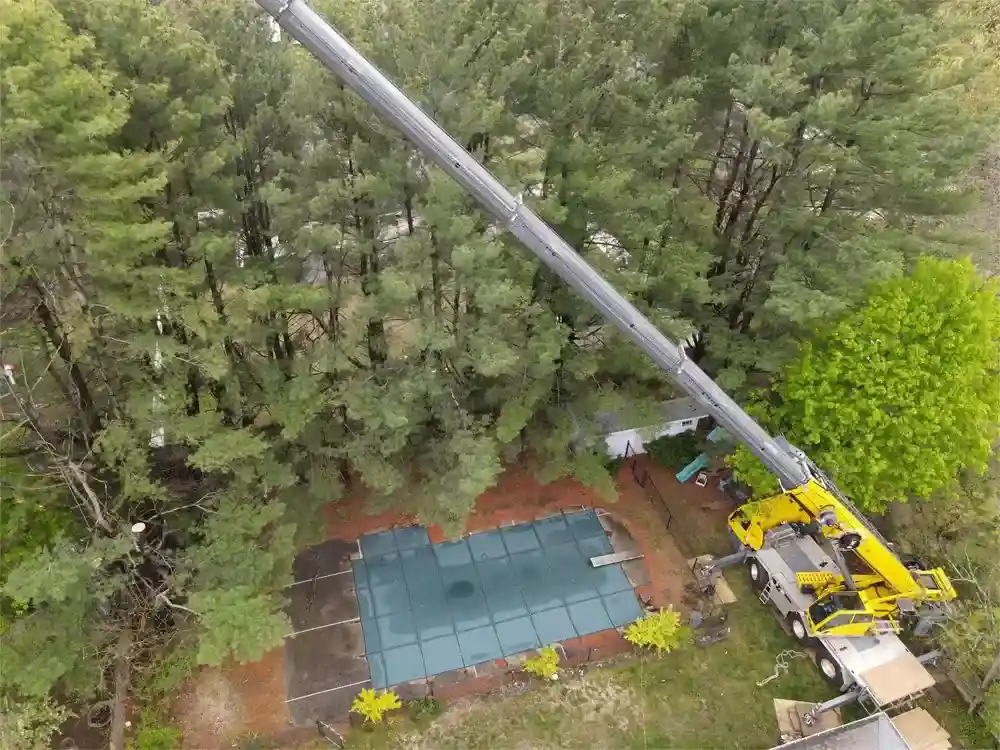
Crane-assisted removal is the safest and most efficient solution for the most challenging jobs: a hundred-foot pine wedged between two houses, a dying oak hovering over your garage, or a tree with so much decay that it’s unsafe for an arborist to climb. The process is a marvel of coordination. The crane is carefully positioned, often on the street or in a driveway, with outriggers to ensure stability.
An arborist then either climbs the tree or is lifted into position by the crane. They attach a heavy-duty strap from the crane to a large section of the tree. Only after the crane takes the full weight of the section does the arborist make the cut. The crane then lifts the massive piece straight up and over any obstacles—your house, your neighbor’s fence, your prized garden—and gently places it in a safe zone for processing.
While crane services are more expensive due to the specialized equipment and certified operator, they often save money in the long run by preventing property damage and dramatically reducing the time and labor required. A removal that might take a full day of risky, complex rigging can often be completed in just a few hours with a crane, with virtually no impact on your landscape. Check out our crane services page to see how this specialized equipment makes seemingly impossible removals routine.
Breaking Down the Cost of Tree Removal
Let’s talk about money—because we know that’s one of the first questions on your mind when you’re considering tree removal services. The truth is, tree removal is a specialized job that requires trained professionals, extensive safety protocols, and often some serious equipment. So what should you expect to pay?
Important note: The cost ranges we’re sharing here are based on general internet research and industry averages, not actual AA Tree Service pricing. Every tree and property is unique, which is why we offer free, same-day quotes custom to your specific situation in Massachusetts or New Hampshire.
Based on internet data, most tree removals fall somewhere between $200 and $2,000, with many homeowners paying around $750. But here’s where it gets interesting—that range can swing dramatically based on your specific circumstances. A small fallen tree that’s already on the ground? That might only set you back $100 to $500. But a towering oak over 80 feet tall that’s leaning toward your house and needs crane assistance? You’re looking at $1,500 or more, potentially reaching $5,000 or higher for extremely complex jobs.
Tree height plays a big role in pricing too. Smaller trees might cost as little as $8 per foot to remove, while those giants over 80 feet typically run at least $15 per foot or more. The complexity of the job matters just as much as the size.
We always provide a formal written estimate before any work begins, so there are no surprises when the job is done. You’ll know exactly what you’re paying for and why.
Key Factors Influencing the Price
So what makes one tree removal cost $300 and another cost $3,000? Several factors come together to determine your final price.
Tree size is the most obvious factor—both height and trunk diameter matter. A 30-foot maple with a 12-inch trunk is a completely different job than an 80-foot oak with a 4-foot diameter. Bigger trees mean more wood to process, more time, more equipment, and more crew members to safely bring them down.
Location and accessibility can make or break a budget. Is your tree in an open backyard with plenty of room to work? Great—that’s straightforward. Is it wedged between your house and your neighbor’s fence, with power lines overhead and a swimming pool below? That’s a different story. Trees on steep slopes, behind fences, or in tight spaces require extra care, specialized techniques, and more time, all of which increase the cost.
Equipment needs vary dramatically from job to job. A standard removal might only require chainsaws, ropes, and a wood chipper. But a hazardous tree near your home might need a bucket truck for access or a crane for lifting, which adds significantly to the cost. You can learn more about when specialized equipment becomes necessary on our crane services page.
Crew size scales with job complexity. A simple removal might only need two or three experienced professionals. A large, risky job could require five or six crew members working together—a climber, a crane operator, and several ground personnel—to ensure everything goes smoothly and safely.
Safety and risk considerations directly impact pricing. A dead tree with brittle branches hanging over your roof poses a much higher risk than a healthy tree in an open field. Higher risk means more careful planning, additional safety measures, and higher insurance costs for the company—all of which factor into your quote.
Debris Hauling and Disposal: What happens to the tree after it’s cut down? This is a key part of the quote. A full-service job includes chipping all the branches and hauling away all the wood. However, you may have other options. You could ask to have the wood cut into firewood-length rounds and left on your property, or you could keep the wood chips to use as mulch in your garden beds. These choices can sometimes reduce the final cost.
Permits: Depending on where you live in Massachusetts or New Hampshire, your town or city might require a permit before you can remove a tree. Some municipalities have specific rules about protected species, ‘heritage’ trees, or trees over a certain size. We can help guide you through these requirements, but permit fees and processing time can add to your overall cost and timeline.
The Role of Insurance and Liability
When getting quotes for tree removal, it can be tempting to go with the lowest bidder. However, this is one area where you cannot afford to cut corners. The single most important factor to verify before hiring any tree service is that they are fully insured. This is non-negotiable. An uninsured or underinsured company puts you, the homeowner, at enormous financial risk.
A reputable tree company must carry two types of insurance: General Liability and Worker’s Compensation.
- General Liability Insurance protects your property. If a mistake happens and a limb crashes through your roof or damages your neighbor’s fence, this policy covers the cost of repairs. Without it, you would be left to file a claim on your own homeowner’s insurance, which could lead to higher premiums and a lot of headaches.
- Worker’s Compensation Insurance protects the crew working on your property. Tree work is inherently dangerous. If a worker gets injured on your property and their employer does not have worker’s comp, you could be held liable for their medical bills and lost wages. This can lead to devastating lawsuits.
Before hiring, always ask for a certificate of insurance and call the insurance agency directly to verify that the policies are active and provide adequate coverage for tree work. A professional company will be happy to provide this information.
Tree Removal vs. Stump Grinding: What’s the Difference?
Once your tree is down, you’re left with one more decision: what to do about that stump sitting in your yard. This is where understanding the difference between stump grinding and full stump removal becomes important. So, is it better to grind a stump or remove it entirely?
The answer depends entirely on your plans for that spot. Here’s how the two options compare:
| Feature | Stump Grinding | Full Stump Removal |
|---|---|---|
| Process | A specialized machine grinds the stump down 6-12 inches below ground level, turning it into wood chips | The entire stump and root ball are excavated from the ground, leaving a large hole |
| Cost | Generally more affordable, often $75-$400 per stump based on internet data | More expensive, potentially $300-$1,200+ per stump based on internet data, due to heavy equipment and labor |
| Aesthetic Result | Leaves wood chips that can be used as mulch; area can be covered with topsoil and grass seed | Leaves a large hole that must be filled with soil; requires more extensive landscaping work |
| Future Land Use | Great for lawns, gardens, or landscaping; roots decay naturally underground over time | Best if you’re building a structure or need complete root removal; provides immediate clear ground |
Stump grinding is the most popular choice for homeowners. It’s efficient, cost-effective, and leaves your yard looking clean. The grinding process turns the visible stump into a pile of wood chips and soil. You can use these chips as natural mulch in your garden beds or have us haul them away. The area can then be easily covered with topsoil and seeded for grass. The major roots are left underground to decay naturally over several years, which is perfectly fine for most landscaping purposes.
Full stump removal, on the other hand, is a much more invasive and expensive process. It involves using heavy machinery like a backhoe or excavator to dig out the entire stump and its main root ball. This is only necessary if you plan to build a structure (like a foundation, deck footing, or swimming pool) in that exact spot, or if you are regrading the entire area. Be prepared for a significant hole that will need to be filled with new soil (backfill), and potential damage to the surrounding lawn from the heavy equipment.
Most of our clients in Massachusetts and New Hampshire opt for stump grinding because it strikes the right balance between cost, convenience, and results. Want to learn more about your stump removal options? Visit our stump grinding services page for detailed information about how we can help you finish the job and reclaim your yard.