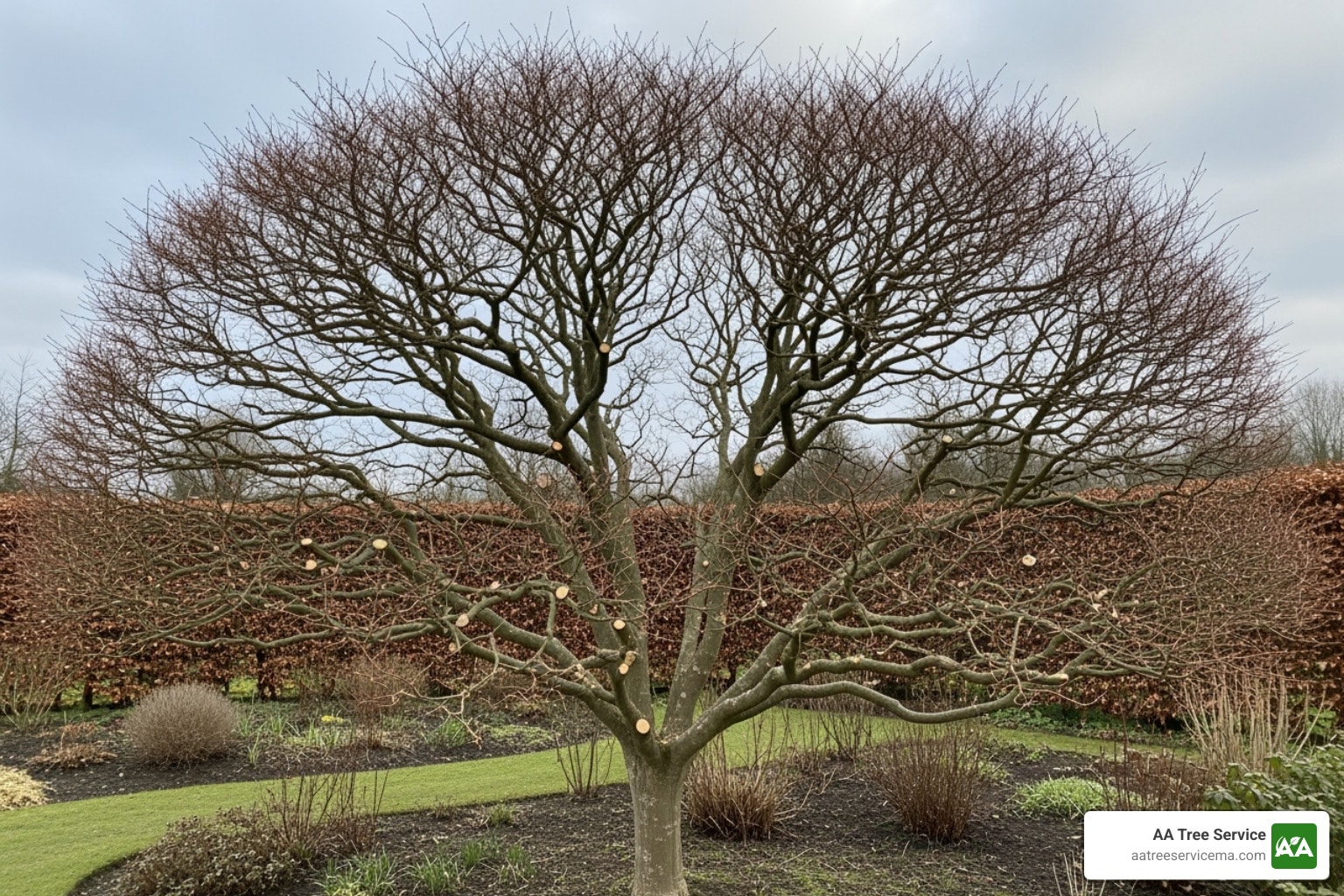
The Art and Science of Pruning Japanese Maples
Japanese maple tree pruning is essential for maintaining your tree’s health, shape, and stunning natural beauty. Whether you have an upright variety or a delicate weeping laceleaf, proper pruning removes dead wood, improves air circulation, and reveals the neat branching structure that makes these trees so prized in Massachusetts and New Hampshire landscapes.
Quick Guide to Pruning Your Japanese Maple:
- Best Time: Late winter (dormant season) for structural pruning; late spring/early summer for shaping
- Essential Tools: Sharp hand pruners, loppers, and pruning saw (all disinfected)
- What to Remove: Dead, diseased, or damaged branches first; then crossing or crowded branches
- How Much: Never remove more than 1/3 of the tree’s canopy in one session
- Key Technique: Cut at the branch collar (the slight swelling where branch meets trunk) – don’t leave stubs
- After Care: Water adequately, apply mulch, avoid excessive fertilization
Japanese maples are beloved in New England gardens for their delicate leaves and graceful forms. However, these prized trees require thoughtful care. Unlike many trees, Japanese maples are sensitive and demand a lighter touch. Improper timing or technique can cause stress, sap bleeding, or disease. Pruning at the wrong time can even kill the tree.
Fortunately, with the right knowledge, pruning your Japanese maple is manageable. This guide covers everything from the best time of year to the precise cuts that promote health and beauty.
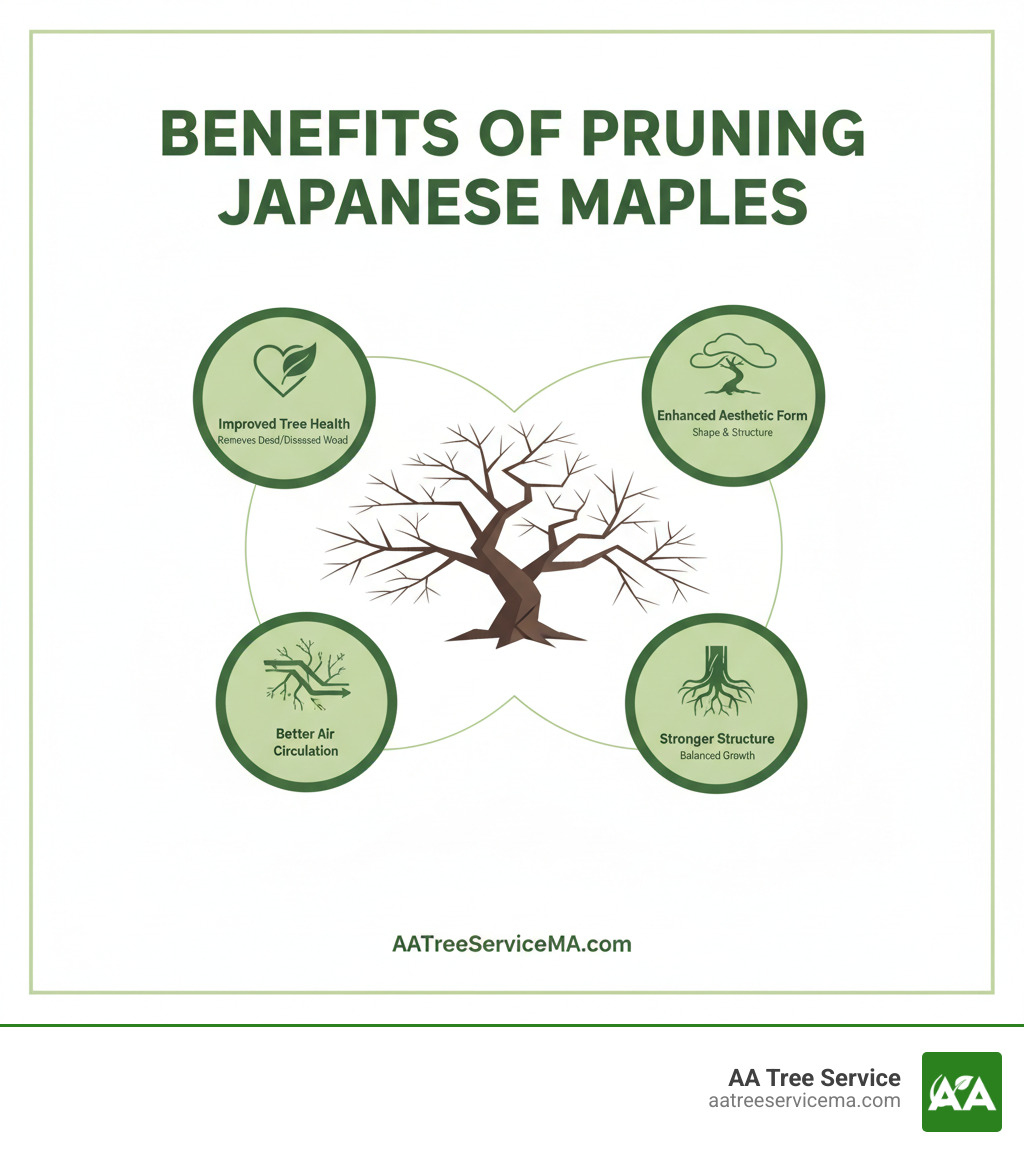
Quick japanese maple tree pruning definitions:
Getting Started: When to Prune and What You’ll Need
Before you make that first cut, let’s talk timing and tools. Getting these two things right makes all the difference between a healthy, beautiful Japanese maple and a stressed tree struggling to recover. Once you understand the rhythm of your tree’s growing season, choosing the right time becomes second nature.
When is the Best Time to Prune?
Your tree will tell you when it’s ready for japanese maple tree pruning, but you need to know what to look for.
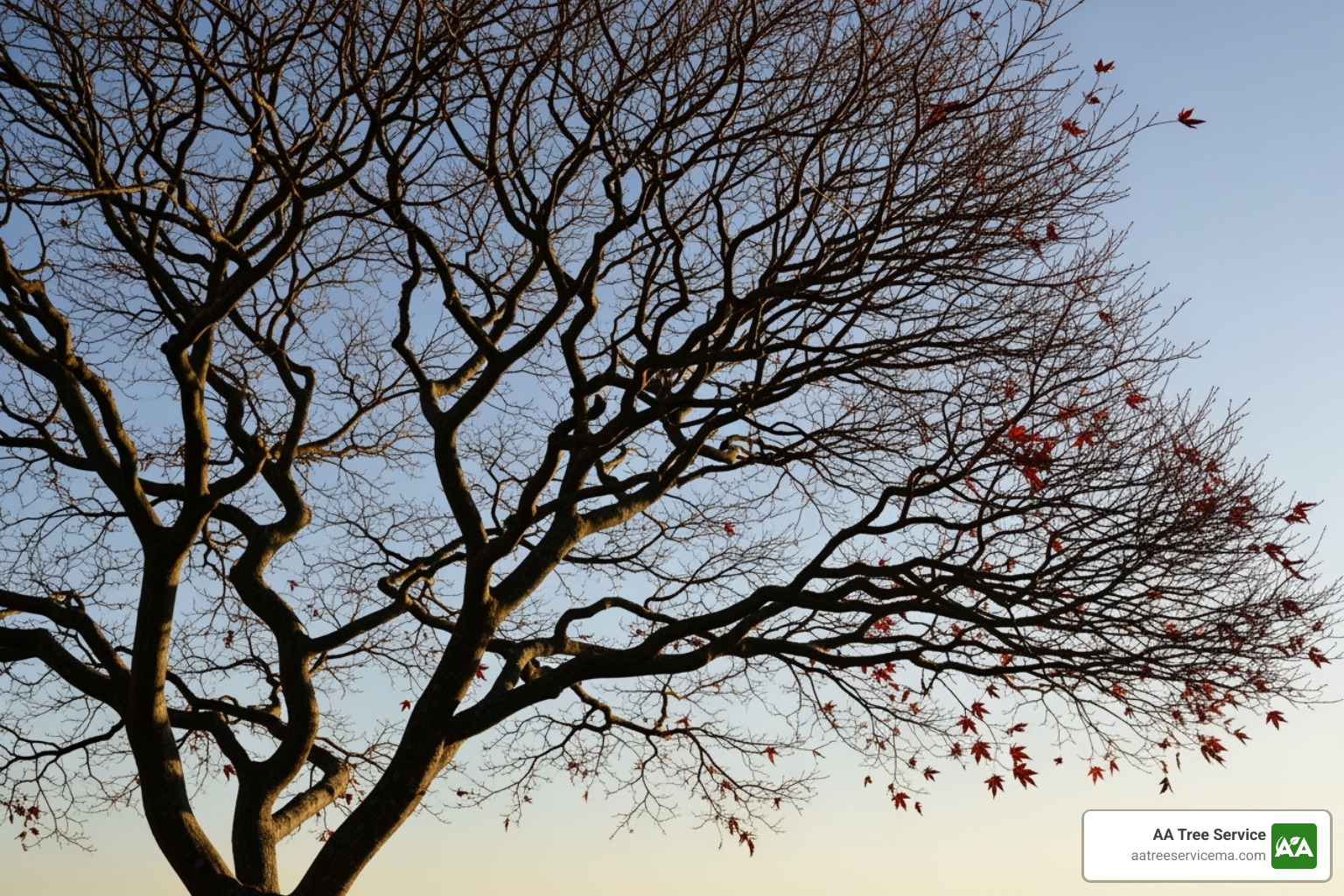
Late winter (dormant season) is the best time for major structural work. In Massachusetts and New Hampshire, this is typically late November through February. With the leaves gone, the tree’s structure is fully visible, allowing for more precise and thoughtful cuts. Pruning during dormancy minimizes stress and sap bleeding. This is critical because excessive sap flow, or “bleeding,” drains the tree of valuable sugars and energy reserves it needs for the spring growth flush. This wasted energy can weaken the tree and make it more susceptible to pests and diseases.
Late spring to early summer is ideal for fine-tuning and shaping. Once the new leaves have fully developed and “hardened off” (usually by late May or June), you can perform light pruning to thin the canopy, improve its airy appearance, or remove any small branches you missed in winter. Some tree care experts prefer summer pruning for removing certain larger branches because the tree is actively growing and can begin the process of compartmentalizing and sealing wounds very quickly. However, the downside is that the full canopy can obscure the branch structure, making it harder to see what you’re doing. There is also a slightly higher risk of sunscald on bark that is suddenly exposed to intense summer sun.
Avoid pruning in early spring as new leaves emerge. During this period, the bark is tender and tears easily, and the tree is investing all its energy into producing new foliage. Also, skip major pruning during peak summer heat (above 80°F) and during the brief periods in autumn when leaves are emerging or dropping, as the tree’s energy is low. Pruning at the wrong time can cause serious, lasting damage.
The Right Tools for the Job
Using the right equipment is crucial for the health of your Japanese maple. Your tools must be sharp to make clean cuts and sanitized to prevent the spread of disease. Dull tools crush and tear bark, leaving ragged wounds that heal slowly and invite pests and decay.
- Hand Pruners: Always choose bypass-style pruners for live wood. They work like scissors, with one blade passing by the other to make a clean slice. Anvil pruners, which have a single blade that closes onto a flat surface, can crush delicate Japanese maple stems and should be reserved for deadwood only. Use hand pruners for branches up to 3/4 inch in diameter.
- Loppers: For branches between 3/4 inch and 2 inches, bypass loppers provide the necessary leverage for a clean cut without straining your hands or the tool.
- Pruning Saw: A curved, pull-stroke saw with fine teeth is needed for anything over 2 inches. The pull-stroke design means the saw cuts as you pull it toward you, giving you more control and a smoother cut on the delicate bark of a Japanese maple.
- Personal Protective Equipment: Don’t forget safety glasses to protect your eyes from flying debris and sturdy gloves to protect your hands.
Tool sanitation is non-negotiable. Before you start and between cuts on different trees, wipe your blades with 90% rubbing alcohol or a 10% bleach solution (one part bleach to nine parts water). This simple step prevents the spread of fungal and bacterial diseases from one branch or tree to another.
The Core Techniques of Japanese Maple Tree Pruning
Now that we understand timing and tools, let’s explore the actual techniques. Good japanese maple tree pruning starts with making intentional cuts in the right place. Never leave a stub; always cut back to a lateral branch or bud.
The key is to locate the branch collar—the slightly swollen area where a branch joins a larger branch or the trunk. This collar contains specialized cells that rapidly grow over and seal the wound. Look for the raised ring of bark at the branch’s base; on some branches, you may also see a ridge of bark, called the branch bark ridge, in the upper crotch. Make your cut just outside this collar, angling away from the trunk. Preserving the collar is the single most important factor in helping the tree heal quickly. Cutting into the collar (a flush cut) creates a larger wound that the tree struggles to close, while leaving a long stub invites decay that can travel back into the trunk. Proper pruning also improves air circulation to prevent fungal disease and ensures good weight distribution to prevent breakage, especially under heavy New England snow.
For a deeper dive into ornamental tree care principles, our Ornamental Tree Pruning Complete Guide offers additional context.
First Cuts: Removing Dead, Diseased, and Damaged Wood
Always begin by addressing the tree’s health. This means removing the “Three D’s”: Dead, Diseased, and Damaged wood.
- Dead branches are brittle, dry, and often lack buds. They may be a different color (grey or dark brown) than healthy branches. Scratch the bark with a thumbnail; healthy wood is green or white underneath, while dead wood is brown all the way through. If you’re uncertain, this guide on testing branches can help.
- Diseased wood may show signs of wilting, cankers (sunken, dead areas of bark), unusual fungal growth, or dieback. Common diseases in our area include Pseudomonas blight, which causes blackening of new shoots, and Verticillium wilt, which causes sudden wilting of entire branches. For blight, cut back well into healthy tissue, at least 6-8 inches below the visible infection. For Verticillium, a soil-borne fungus, pruning cannot cure the tree, but removing the dead branches improves its appearance and removes wood that could host other pests. Crucially, sanitize your tools with alcohol or a bleach solution after every single cut into diseased wood to avoid spreading pathogens to healthy parts of the tree.
- Damaged branches from storms, animal activity, or accidents should be cleanly cut back to a healthy lateral branch or the branch collar to prevent further tearing and create a wound that can heal properly.
Removing these problem branches immediately improves the tree’s health and allows it to direct energy toward healthy growth.
Shaping Your Masterpiece: Pruning Upright vs. Weeping Varieties
Pruning techniques for japanese maple tree pruning diverge significantly depending on the tree’s form. Your job is to enhance its natural beauty, not fight it.
Upright Japanese maples (Acer palmatum) naturally grow in a vase or rounded shape. Your goal is to improve this upward and outward habit.
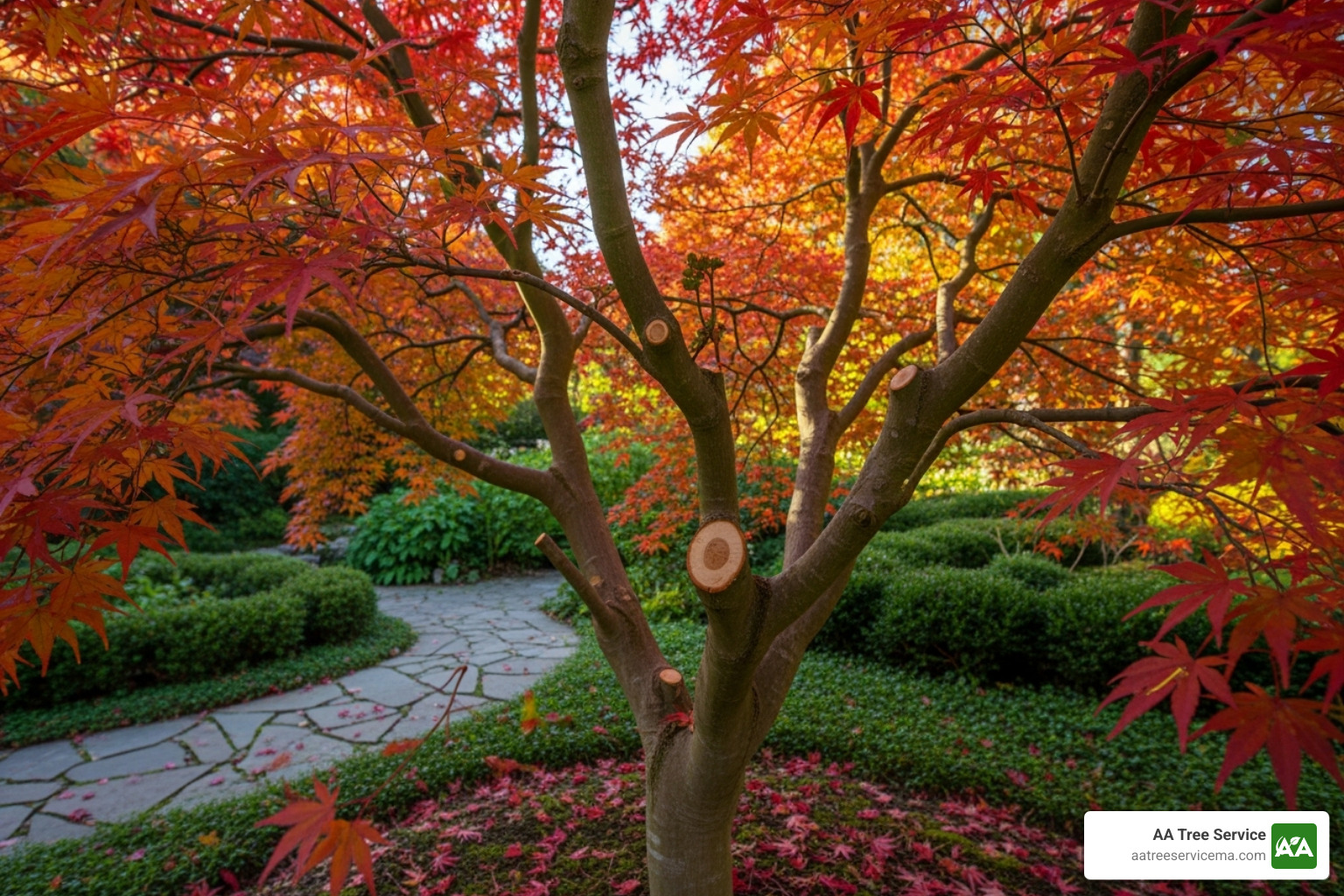
- Establish a strong leader: If two branches compete to be the main trunk (co-dominant leaders), they form a weak, V-shaped junction. Choose the stronger, better-placed branch and remove or shorten the other to prevent splitting under snow or ice load.
- Remove crossing branches: Branches that rub together create open wounds that invite disease. Remove the weaker or poorly positioned branch entirely.
- Thin the interior: Remove small branches growing inward toward the trunk. This opens the canopy, allowing light and air to penetrate to the center of the tree, which reduces the risk of fungal diseases and encourages healthy interior foliage.
- Create negative space: Don’t just thin the inside. Selectively remove some secondary branches to create “windows” in the canopy. This highlights the elegant branch structure and gives the tree a more mature, three-dimensional quality.
Weeping Japanese maples (Acer palmatum var. dissectum) require a more sculptural approach to accentuate their cascading form.
- Create distinct layers: The goal is to create horizontal “shelves” or “clouds” of foliage. This gives the tree its signature airy, delicate appearance. Work from the bottom up, defining each layer.
- Maintain an umbrella shape: Prune back any branches that grow awkwardly upward, fighting the weeping habit. Trim branches that cascade too far down, especially if they touch the ground, which can lead to rot and disease. This creates the classic “mushroom” silhouette. This technique is sometimes called “shell pruning,” as you are thinning the outer shell of foliage to reveal the structure beneath.
- Remove inward-growing branches: This is critical for weeping forms. Branches growing back toward the center disrupt the cascading flow and create dense, moisture-trapping tangles that can kill off interior foliage and hide the beautiful structure.
An Introduction to Aesthetic Japanese Maple Tree Pruning
Aesthetic japanese maple tree pruning is an art form that reveals the tree’s unique character. It’s about enhancing its natural tendencies, not forcing it into an artificial shape. This philosophy is deeply connected to Japanese garden design principles.
- Reveal the tree’s “essence”: Aesthetic pruning is about understanding and working with your tree’s natural character, whether it’s bold and upright or spreading and horizontal. The goal is to reveal the “bones” of the tree.
- Achieve natural taper: Branches should look balanced, transitioning smoothly from thick at the base to fine at the tips. Pruning helps guide this development over time.
- Create negative space (Ma): In Japanese art, Ma refers to the artistic interpretation of empty space. In pruning, this means selectively thinning the canopy to create “windows” that let in light, frame views, and showcase the beautiful branch architecture. The space around the branches is just as important as the branches themselves.
The goal is a tree that looks perfectly natural and balanced, as if it grew that way without any intervention. A well-pruned Japanese maple shouldn’t look “pruned” at all. For help with this specialized approach, learn more about our services at Ornamental Tree Pruning Near Me.
Pruning for Size Control and What to Avoid
If your Japanese maple is getting too large for its space, japanese maple tree pruning can help manage its size, but it requires a gentle, patient approach. The goal is reduction, not butchery. Instead of hacking off the top (a harmful practice called “topping”), use reduction cuts. This involves selectively pruning longer branches back to a healthy, outward-facing lateral branch. To be successful, the lateral branch you cut back to should be at least one-third (and ideally one-half) the diameter of the branch you are removing. This ensures the lateral is strong enough to take over as the new leader for that part of the tree, which prevents dieback and maintains a natural form.
The golden rule is to never remove more than one-third of the tree’s live canopy in a single year. Over-pruning is a major shock to the tree’s system. It can trigger a panic response, causing the tree to produce a flush of weak, unattractive, fast-growing vertical shoots called water sprouts. These sprouts are poorly attached to the parent branch, disrupt the tree’s graceful form, and will require even more pruning in the future. You end up with more work and a less attractive tree.
Be especially patient with young trees (under 10-15 years old). Their long, thin “buggy whip” branches are normal and will fill out over time. Heavy pruning on young trees will only encourage more of this weak, lanky growth and delay the development of a strong, mature structure.
Also, be aware that removing a lot of foliage at once can expose previously shaded bark to intense sun, causing sunscald. This damage appears as discolored, cracked, or peeling bark on the trunk and main branches, creating an entry point for boring insects and disease. If significant size reduction is needed, it is always best to spread the work over two to three years. For larger trees needing crown reduction, our Tree Crown Reduction service can help Massachusetts and New Hampshire homeowners tackle these jobs safely and effectively.
The Dos and Don’ts of Pruning
Following these guidelines will keep your tree healthy and beautiful for decades.
DO:
- Start with the 3 D’s: Always remove Dead, Diseased, and Damaged branches first to protect the tree’s health.
- Use clean, sharp tools: Sharp bypass blades make clean cuts that heal faster. Clean blades prevent disease.
- Step back frequently: Pruning is a process of removal. Step back after every few cuts to assess the tree’s overall shape and balance from multiple angles.
- Cut outside the branch collar: Preserve the swollen area where the branch meets the trunk to promote proper healing.
- Thin crowded areas: Removing entire small branches is often better than just shortening them, as it improves air circulation and light penetration.
- Work with the tree’s natural form: Enhance the tree’s natural shape, whether it’s upright or weeping. Don’t try to turn a weeper into an upright tree.
DON’T:
- Remove more than one-third of the canopy: When in doubt, prune less. You can always take more off next year, but you can’t put a branch back on.
- Leave stubs: Stubs die back and become entry points for decay. Always cut back to a lateral branch or the collar.
- “Top” your tree: Indiscriminately cutting the top of a tree is destructive. It ruins the form, creates weak regrowth, and is the mark of an amateur.
- Use hedge shears: Never use hedge shears on a Japanese maple. They make indiscriminate cuts that shred leaves and create a dense, unnatural outer shell, ruining the tree’s delicate structure.
- Rush the process with young trees: Allow young trees to establish their structure with only the lightest pruning to remove poorly placed or crossing branches.
- Use wound sealants: Trees heal best on their own. Sealants can trap moisture and hinder the natural compartmentalization process.
- Prune a stressed tree: Wait until a tree suffering from drought, transplant shock, or disease has fully recovered before performing anything other than removing dead wood.
- For weeping varieties, don’t remove all the lower branches unless you need clearance. Those cascading branches are part of the tree’s natural beauty.
After the Cut: Post-Pruning Care
Your work isn’t finished once the pruning is done. Proper aftercare helps your tree recover from the stress of japanese maple tree pruning and bounce back strong.
- Water Adequately: Consistent moisture is crucial for recovery. Water deeply to reach the entire root zone, especially if conditions are dry.
- Apply Mulch: A 2-4 inch layer of organic mulch (like shredded bark) around the base helps retain soil moisture and regulate temperature. Keep mulch a few inches away from the trunk to prevent rot.
- Avoid Fertilizer: It’s tempting to feed a pruned tree, but this can force weak, vulnerable growth. A healthy tree in good soil rarely needs fertilizer after pruning.
- Monitor Your Tree: Keep an eye out for signs of stress, like wilting or discoloration. A little sap weeping can be normal, but if you notice persistent issues, it may be time to consult a tree care professional.
- Skip Wound Sealants: Trees have a natural ability to wall off wounds. Sealing products can trap moisture and pathogens, doing more harm than good.
This kind of thoughtful care is part of the Routine Tree Maintenance that keeps your landscape looking its best.
Frequently Asked Questions about Pruning Japanese Maples
Can I severely cut back an overgrown Japanese maple?
Yes, but it must be done with great care. Major size reduction should be done gradually over several years, not all at once. Focus on structural pruning during the dormant season (late winter) and never remove more than one-third of the live canopy in a single year. This patient approach prevents shocking the tree and triggering a flush of weak growth.
For significantly overgrown trees, we strongly recommend consulting with Professional Tree Pruning Services. An experienced tree professional can create a safe, multi-year plan to refresh the tree without causing harm.
Why are my young maple’s branches long and skinny like whips?
This is called “buggy whip” growth and is completely normal for young Japanese maples (under 15 years old). These thin shoots are the tree’s way of establishing its initial framework. The best course of action is patience. Resist the urge to prune them, as this will only encourage more of the same weak growth. Over time, these whips will naturally thicken and develop into a strong branch structure. Knowing when not to prune is a key part of japanese maple tree pruning!
Should I remove the lower branches of my Japanese maple?
This depends on your aesthetic goal and the tree’s type. Removing lower branches (“limbing up”) can beautifully showcase the trunk’s structure and is practical for creating clearance over walkways. For weeping varieties, selectively removing the lowest branches can prevent a dense, shapeless “Cousin It” look and improve the cascading layers.
One crucial exception: always remove any shoots (suckers) growing from below the graft union on a grafted tree. These are from the rootstock and will not match the desired variety. Since branches don’t grow back, think carefully before you cut. When in doubt, remove less rather than more.
Conclusion: Nurturing Your Japanese Maple for Years to Come
As we’ve seen, proper japanese maple tree pruning is a blend of science and art. By understanding the right time to prune, how to make clean cuts, and how to work with your tree’s natural form, you can ensure its health and improve its graceful beauty. A well-cared-for Japanese maple will only grow more magnificent with each passing year, becoming a treasured focal point in your landscape.
But while many homeowners can handle basic pruning, Japanese maples are sensitive, valuable trees. Their complex structure and dramatic response to improper pruning mean that mistakes can be costly and permanent.
For complex or large Japanese maples in Massachusetts or New Hampshire, the skilled team at AA Tree Service can help. With over two decades of experience caring for ornamental trees throughout the region, we understand what these special trees need. We know when to prune conservatively and when more significant intervention is appropriate.
Whether your Japanese maple needs careful restoration, thoughtful size reduction, or expert aesthetic pruning to reveal its full potential, our team has the knowledge and tools to do the job right. Trust our Tree Pruning Services to improve the health and beauty of your prized trees, ensuring they continue to be stunning focal points in your landscape for generations to come.
Your Japanese maple is an investment in beauty that grows more valuable with time. Give it the care it deserves, and it will reward you with decades of breathtaking displays.