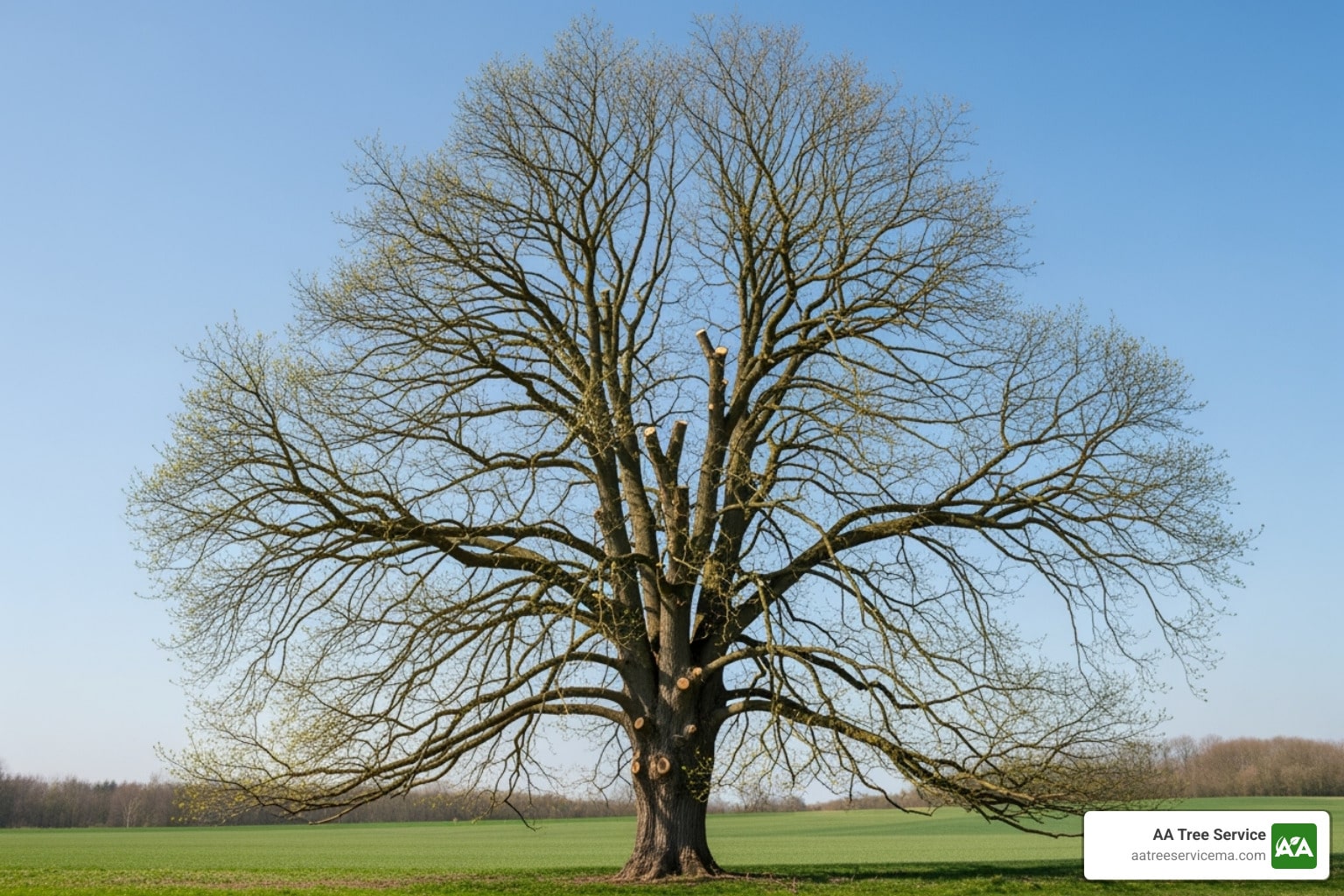
Understanding Tree Crown Reduction: More Than Just a Trim
Tree crown reduction cost typically ranges from $250 to $2,200+ per tree, with most homeowners paying between $350 and $1,300 based on average internet data (not AA Tree Service pricing). Here’s what you can expect:
Quick Cost Breakdown:
- Small trees (under 30 ft): $250 – $700
- Medium trees (30-60 ft): $400 – $1,200
- Large trees (over 60 ft): $600 – $2,200+
- Certified arborist rates: $100 – $250 per hour
Note: These are average costs based on internet research and may not reflect AA Tree Service’s actual pricing.
Tree crown reduction is much more than just cutting branches. It’s a precise pruning technique that reduces a tree’s height and spread while maintaining its natural shape and health.
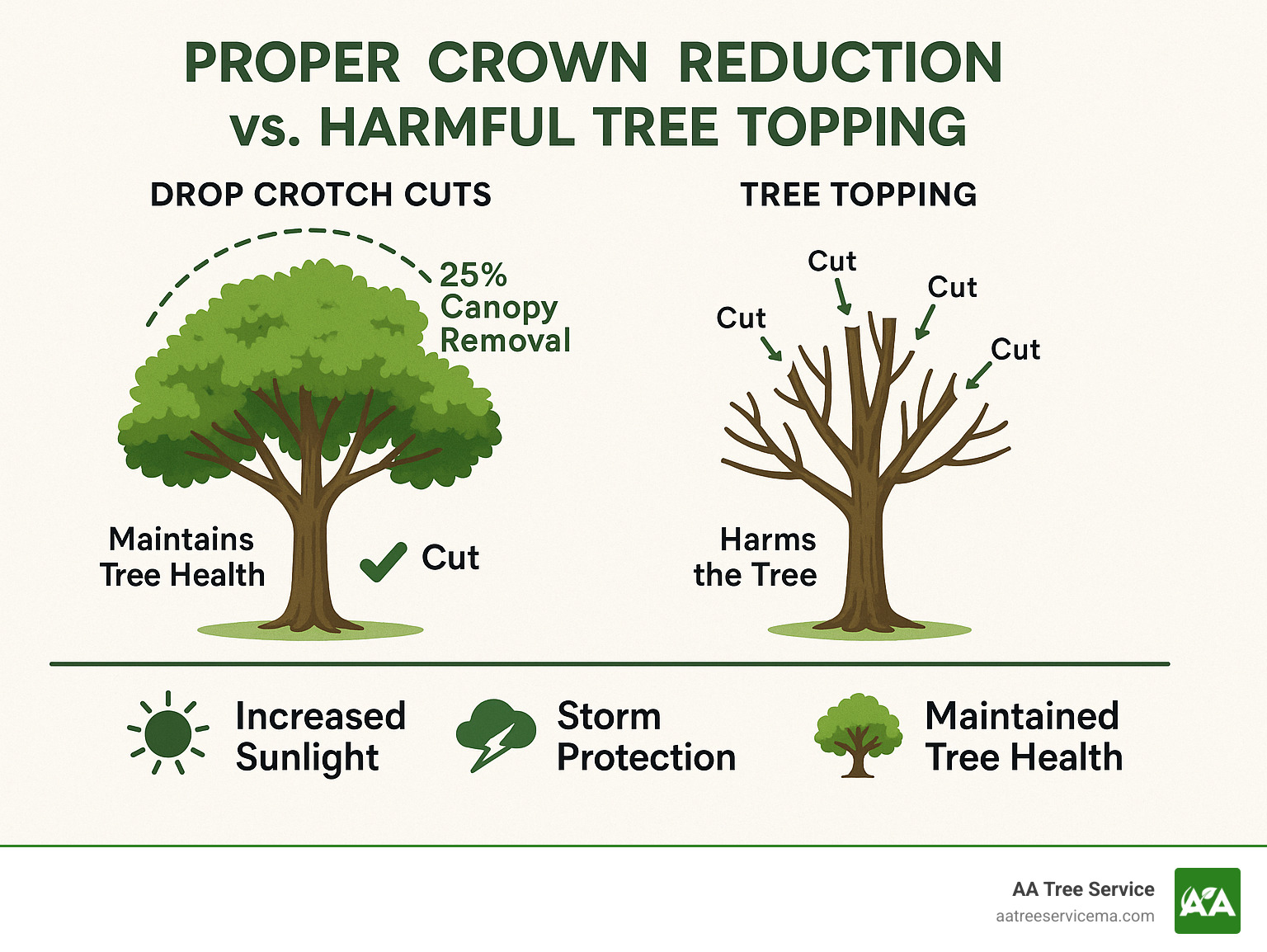
Unlike harmful “tree topping” that cuts branches at random points, proper crown reduction uses drop crotch pruning. This means cutting branches back to lateral branches that are at least one-third the diameter of the removed branch.
The golden rule? Never remove more than 25% of a tree’s canopy at one time.
When done correctly, crown reduction offers several key benefits:
- Increased sunlight reaching your property
- Storm damage prevention by reducing wind resistance
- Improved tree aesthetics while preserving natural form
- Reduced stress on heavy branches
The Ultimate Guide to Tree Crown Reduction Cost
Let’s be honest – when most homeowners first hear about tree crown reduction cost, they’re often surprised by the wide range of prices they encounter. Based on national averages from across the internet, you might pay anywhere from $250 for a small tree to well over $2,200 for a massive oak or maple. That’s quite a spread, isn’t it?
The truth is, there’s no simple answer to “How much will this cost?” Most homeowners end up paying somewhere between $350 and $1,300, but your specific situation could fall anywhere within that range – or even outside it.
When you hire a certified arborist (and you absolutely should for this type of work), their hourly rates typically run $100 to $250 per hour. However, most professionals will give you a flat rate for the entire job rather than charging by the hour. This way, you know exactly what you’re paying upfront.
Important note: These figures represent average costs we’ve gathered from various online sources and do not reflect AA Tree Service’s actual pricing. Every tree and every property is unique, which is why we always provide free, personalized consultations for homeowners in Massachusetts and New Hampshire.
For detailed information about our approach to tree care, check out our Tree Pruning Services page.
Estimated Tree Crown Reduction Cost by Tree Size
Here’s where things get interesting – and where the biggest cost differences come into play. Think of it like buying a car: a compact model costs less than a full-size truck, and the same logic applies to trees.
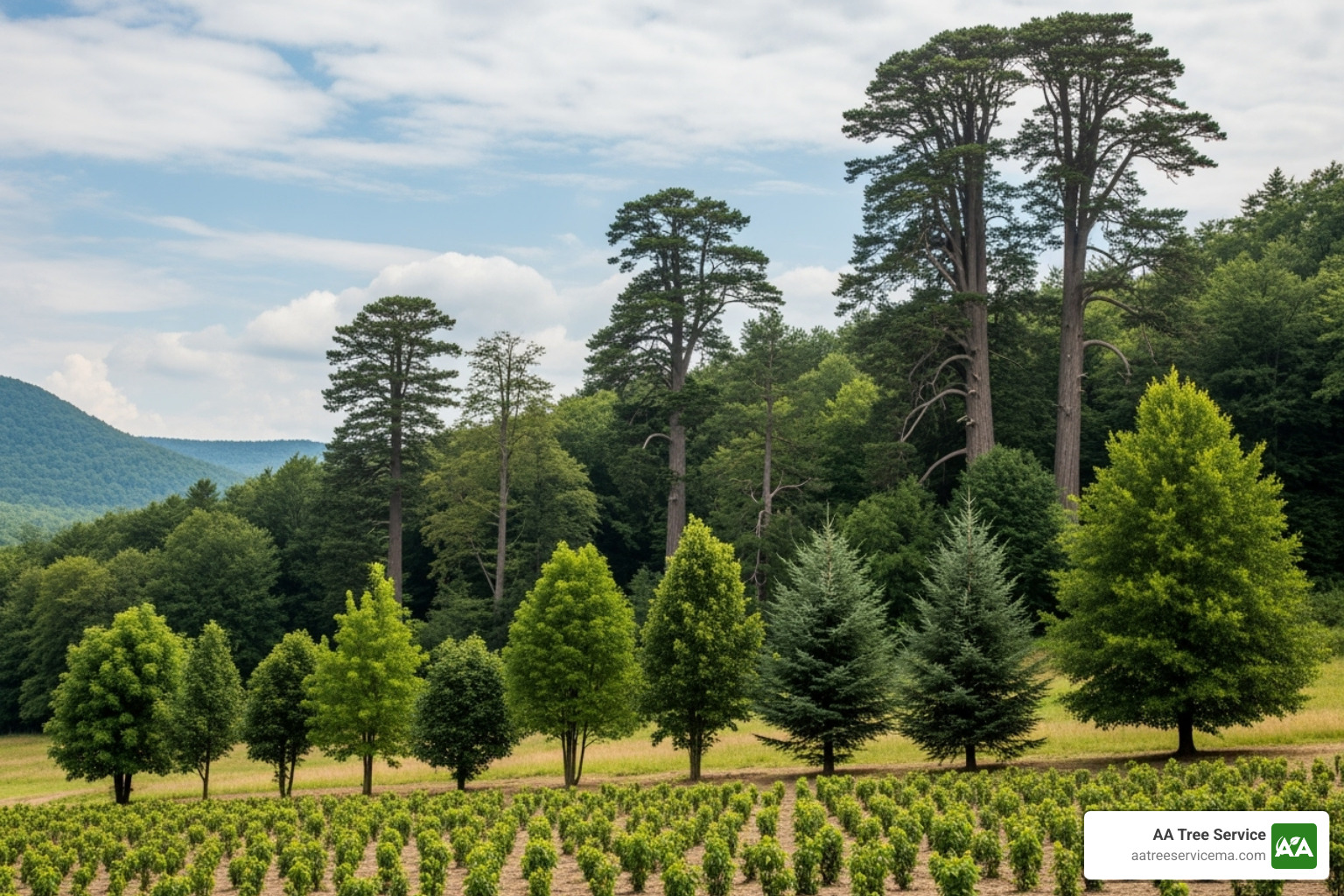
Small trees under 30 feet are the most budget-friendly option. These might be ornamental trees in your front yard like a Dogwood or Japanese Maple, or younger specimens that haven’t reached their full size yet. You’re looking at roughly $250 to $700 for crown reduction on these smaller trees.
Medium trees between 30 and 60 feet represent what most homeowners are dealing with – mature maples, oaks, or pines that have been growing for decades. The work becomes significantly more complex here, often requiring specialized climbing equipment or bucket trucks. Expect costs to range from $400 to $1,200 for these mid-sized trees.
Large trees over 60 feet are where crown reduction becomes a serious undertaking. We’re talking about established giants that might tower over your house, such as a mature White Oak or a towering Pine. The safety requirements, specialized equipment, and sheer amount of work involved can push costs from $600 to $2,200 or more.
Extra-large trees over 100 feet are in a category all their own. These magnificent specimens often require cranes, multiple crew members, and extreme safety precautions. Costs can easily exceed $2,500 for these towering beauties.
Key Factors That Influence Your Final Price
While tree size is the biggest factor in determining tree crown reduction cost, it’s far from the only one. When we visit your property for a consultation, we’re looking at several important details that will affect your final quote.
Tree species plays a bigger role than most people realize. Some trees, like certain oaks or hickories, have incredibly dense hardwood and complex branching patterns that require more time, precision, and powerful equipment. Softer woods, like a Silver Maple or a Bradford Pear, might be faster to cut but are often more prone to splitting, demanding extra caution. The tree’s natural growth habit also dictates the strategy; a sprawling oak requires a different approach than an upright maple.
Tree health and condition can significantly impact both the complexity and cost of the work. Trees that are pest-infested or diseased present additional challenges. For example, if we identify signs of Emerald Ash Borer, the wood may need to be handled and disposed of according to specific quarantine regulations. A tree with significant internal decay or large dead sections requires advanced rigging techniques, as compromised limbs are unpredictable and cannot be trusted to support a climber’s weight.
Accessibility is often the factor that surprises homeowners most. Can our crew and equipment easily reach your tree? A tree in the front yard with open access is straightforward. But is your tree tucked in a tight backyard with no gate for a bucket truck? Is it located on a steep, unstable slope that requires complex anchoring? Is it surrounded by delicate landscaping, a swimming pool, or a septic system that we need to protect? These challenges can add $1,000 to $1,200 or more to your total cost because every step, from setup to cleanup, takes longer and requires more meticulous planning and labor.
Proximity to power lines or structures immediately raises the complexity and risk level. Working near your house, garage, or overhead utility lines is a zero-error-margin situation. Every cut must be carefully planned and executed using specialized rigging techniques to lower branches with absolute control. This precision work is more time-consuming and requires a higher level of skill, which is reflected in the cost.
The number of trees you need reduced can sometimes work in your favor. While each tree is priced individually based on its own merits, having multiple trees serviced during the same visit can often reduce the per-tree cost. This is because our crew, travel time, and heavy equipment are already on-site, creating an economy of scale that we can pass on to you.
Debris removal is typically included in professional quotes, but it’s always worth confirming. After crown reduction, you’ll have a substantial amount of branches and wood that needs to be chipped, hauled away, or processed. A comprehensive quote will clearly state that all cleanup is included in the price.
For more information about how these factors apply to other tree services, visit our Tree Trimming Services page.
Are There Additional Costs to Consider?
Beyond the core tree crown reduction cost, several additional services might add to your final bill. We believe in complete transparency, so let’s talk about what these extras might include.
Wood chipping is popular with homeowners who want the removed branches turned into mulch for their gardens. This typically adds $50 to $100 to your bill but gives you valuable, organic mulch for your landscaping beds.
Log splitting might be relevant if larger branches or trunk sections are removed during the reduction process. If you have a fireplace or fire pit, we can cut the wood into manageable logs for you. This service generally costs between $35 and $100 and leaves you with a ready supply of firewood.
Emergency service fees apply when you need urgent crown reduction due to storm damage or immediate safety concerns. Our 24/7 emergency services are available when you need them most, but this priority response typically carries additional charges of $150 to $250 per hour above standard rates due to the immediate mobilization of our crew and equipment, often outside of normal business hours.
Specialized equipment requirements can significantly impact costs. A standard bucket truck might add $1,500 to $2,000 to your project cost for a full day’s work. For extremely challenging situations, such as a tree in a fenced-in backyard or on sensitive terrain, a compact “spider lift” may be needed. For the largest and most hazardous jobs, crane-assisted work can add $500 to $2,500 per day. This cost includes the crane itself, a certified operator, and the complex setup involved. A crane is non-negotiable when large limbs overhanging a house must be lifted up and away, rather than dropped, to ensure no damage to your property.
Understanding these potential additions helps you budget more effectively for your tree care project. For comprehensive information about related services and their costs, please see our Tree Removal Cost Estimate guide.
Crown Reduction vs. Other Pruning Methods: Making the Right Choice
Understanding the difference between proper tree care and harmful practices can save you both money and heartache. When you’re researching tree crown reduction cost, it’s crucial to know what you’re actually paying for – and what you should never accept.
The world of tree pruning isn’t just about cutting branches. It’s about making informed decisions that will benefit your tree for decades to come. Think of it like choosing between a skilled surgeon and someone with a hacksaw – the price difference might seem appealing, but the long-term consequences are dramatically different.
Tree Crown Reduction vs. The Dangers of Tree Topping
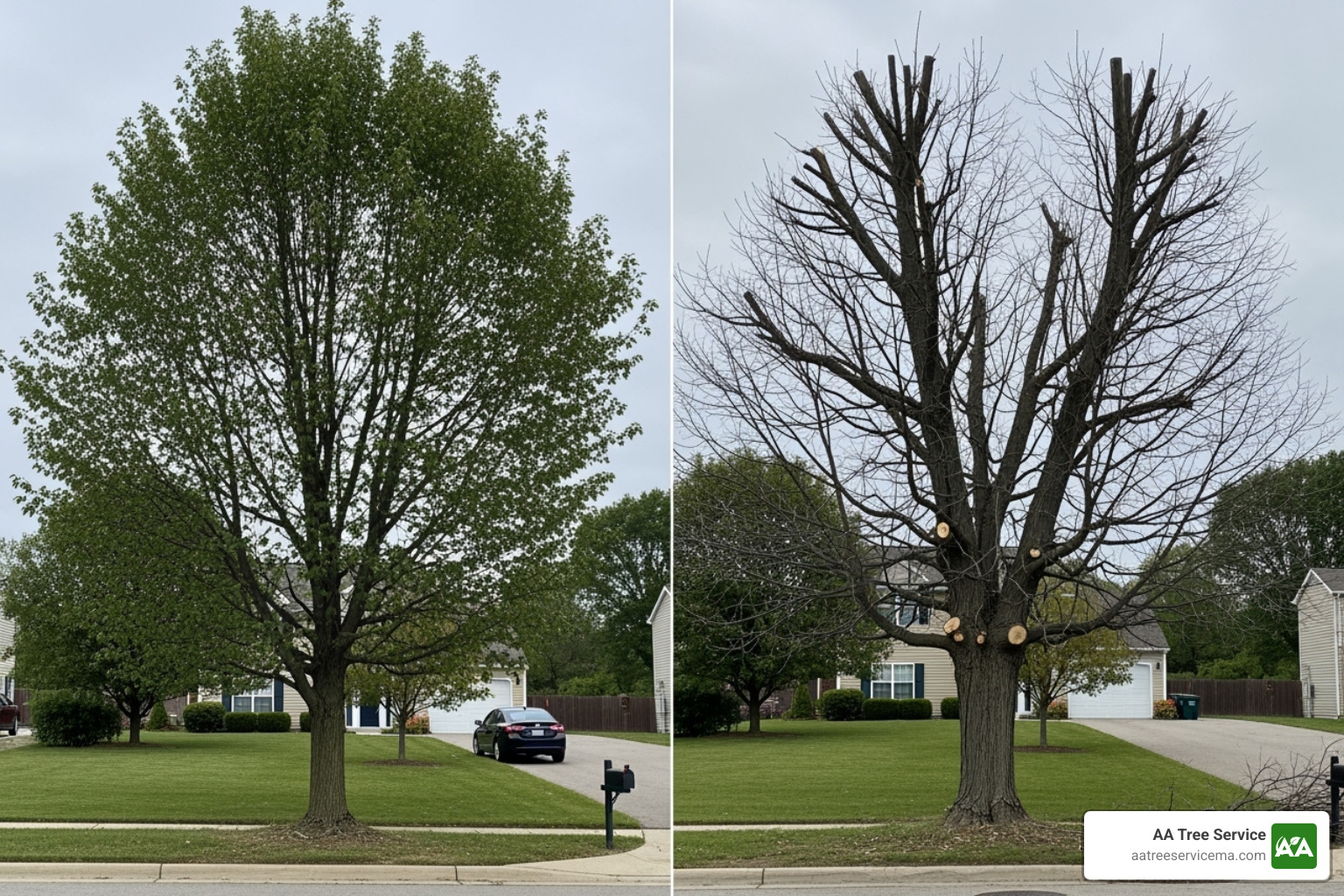
Here’s something that might surprise you: that bargain tree service offering to “top” your trees for a fraction of the tree crown reduction cost isn’t doing you any favors. Tree topping, sometimes called “hat-racking,” is like giving your tree a buzz cut with a chainsaw – it looks terrible and causes serious damage.
Tree topping involves cutting main branches back to stubs, often removing 50% or more of the tree’s height in one brutal session. While it might seem like a quick fix for an overgrown tree, it’s actually an outdated practice that most certified arborists refuse to do.
The damage from topping is both immediate and long-lasting. Your tree goes into shock when you suddenly remove most of its energy-producing leaves. Imagine trying to function after losing half your lungs – that’s essentially what happens to a topped tree.
Those large, open wounds left by topping cuts become perfect entry points for decay, pests, and diseases. The tree simply can’t heal these massive wounds effectively, leading to rot that spreads throughout the trunk and branches.
What’s particularly frustrating is how topped trees respond to this trauma. They desperately try to replace their lost canopy by producing numerous weak, vertical shoots called “water sprouts.” These shoots grow incredibly fast but are poorly attached to the trunk. They’re essentially ticking time bombs waiting for the next storm to break them off – often causing more damage than the original overgrown branches ever would have.
And let’s be honest about aesthetics – topped trees look absolutely terrible. They lose their natural grace and beauty, resembling skeletal hat racks rather than the majestic living sculptures they once were.
The financial impact is equally devastating. While topping might cost less upfront (typically $100-$1,800 based on internet averages), you’ll likely face much higher costs down the road. Many topped trees eventually need complete removal due to decay, or they require repeated expensive maintenance to manage the weak regrowth.
Crown reduction, on the other hand, works with your tree’s natural biology. By making precise cuts to lateral branches and following the 25% rule, we maintain the tree’s structural integrity while achieving your size reduction goals. It’s the difference between a thoughtful renovation and demolition.
| Feature | Crown Reduction | Tree Topping |
|---|---|---|
| Technique | Precise cuts to lateral branches (drop crotch) | Indiscriminate cuts to main branches, leaving stubs |
| Amount Removed | Max 25% of canopy (typically 20-30%) | Often 50% or more of tree’s height |
| Tree Health | Promotes health, maintains structure | Causes severe stress, decay, disease, weak growth |
| Appearance | Maintains natural shape and aesthetics | Disfigures tree, leads to “hat-racking” |
| Safety | Reduces risk, promotes stronger growth | Creates hazardous weak regrowth, increases future risk |
| Professional Stance | Recommended by Certified Arborists | Outdated, banned in many areas, frowned upon by arborists |
How Reduction Compares to Other Professional Pruning
Crown reduction is just one technique in a professional arborist’s toolkit, and understanding the differences helps you make the best choice for your specific situation. Each method serves a unique purpose, and sometimes your tree might benefit from a combination of approaches.
Crown thinning takes a different approach entirely. Instead of reducing the tree’s overall size, we selectively remove smaller branches from throughout the canopy. This technique is perfect when you want to improve light penetration and air circulation without changing your tree’s height or basic shape. It’s particularly effective for trees that have become too dense, blocking sunlight from your garden or making your property feel closed in.
When you need clearance underneath your tree, crown raising (sometimes called crown lifting) is the answer. This involves removing lower branches to create space for vehicles, pedestrians, or to keep branches away from your roof. It’s a common request for trees near driveways or walkways where hanging branches have become a nuisance.
Crown cleaning is the most basic but essential form of tree care. Think of it as your tree’s regular health checkup – we remove dead, dying, diseased, broken, or weakly attached branches from throughout the canopy. This isn’t about changing your tree’s size or shape; it’s about keeping it healthy and safe.
Deadwooding is a specialized form of crown cleaning that focuses exclusively on removing dead or dying limbs. It’s crucial for preventing disease spread and eliminating falling hazards. Dead branches are unpredictable – they can fall without warning, potentially causing injury or property damage.
The beauty of working with experienced arborists is that we can assess your tree’s specific needs and recommend the most appropriate technique. Sometimes a tree needs crown reduction to manage its size, combined with crown cleaning to remove hazardous dead wood. Other times, simple crown thinning might solve your light and airflow issues without any size reduction.
For comprehensive information about all these techniques and how they might benefit your Massachusetts or New Hampshire property, visit our Tree Pruning and Trimming page.
Hiring a Professional for Crown Reduction in MA & NH
When it comes to your trees’ health and your family’s safety, tree crown reduction cost should never be the only factor in your decision. In Massachusetts and New Hampshire, where our beautiful old oaks and maples can tower over 80 feet tall, attempting DIY crown reduction is like playing Russian roulette with a chainsaw.
Trust me, I’ve seen too many weekend warriors end up in the emergency room because they thought they could save a few bucks by doing it themselves.
Why You Should Always Hire a Certified Arborist
Here’s the thing about crown reduction: it looks deceptively simple from the ground. You might think, “How hard can it be to cut some branches?” But the reality is far more complex and dangerous than most homeowners realize.
Safety is the biggest concern. Working 40, 60, or even 80 feet up in a tree with a running chainsaw requires specialized training, proper equipment, and years of experience. Professional arborists spend countless hours learning advanced climbing techniques, rope work, and rigging systems. They know how to safely lower heavy branches without damaging your property or injuring themselves.
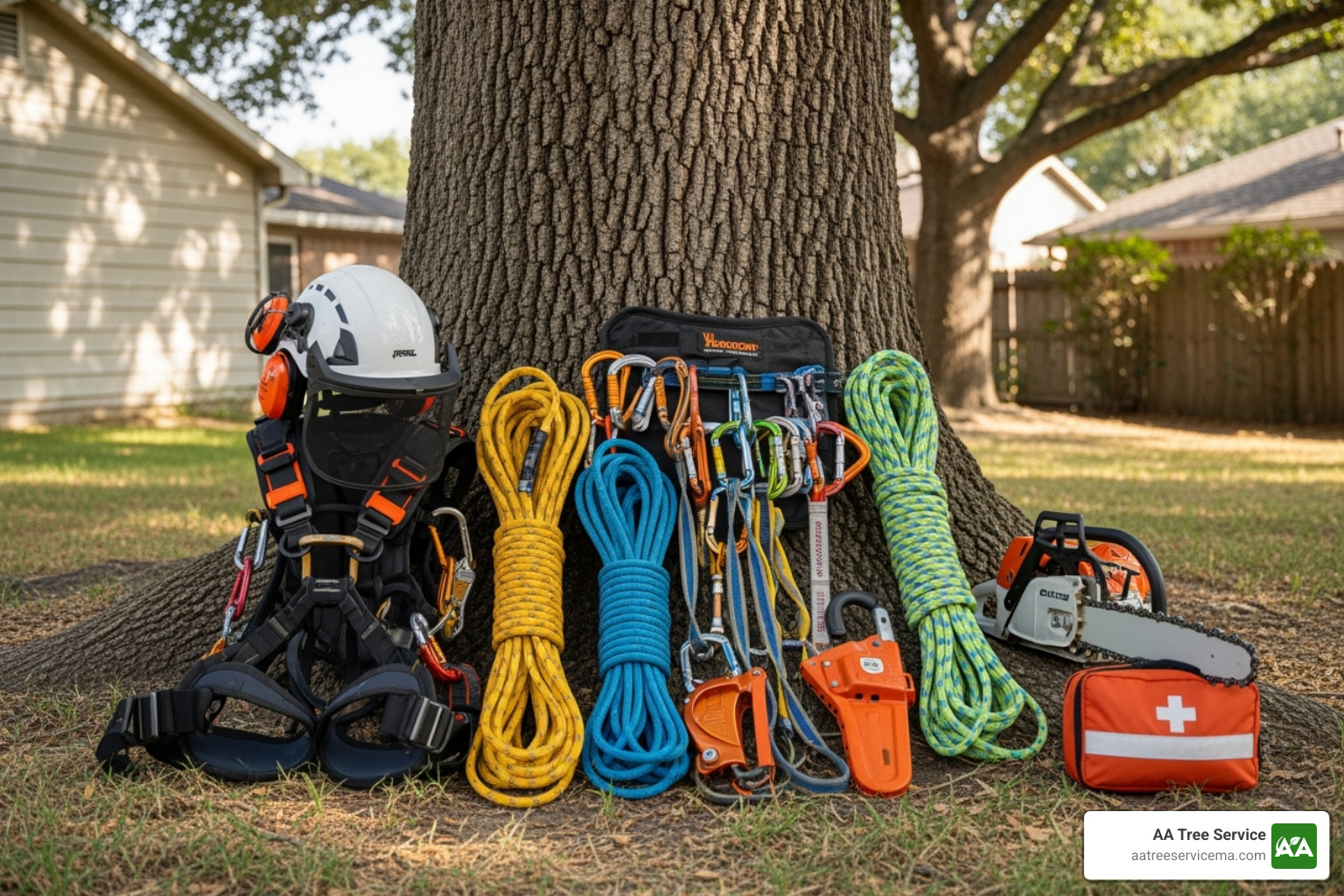
Proper equipment makes all the difference. At AA Tree Service, we invest heavily in specialized gear that most homeowners simply don’t have access to. We’re talking about professional climbing harnesses, rigging ropes, bucket trucks, wood chippers, and sometimes even cranes for the really big jobs. This equipment isn’t just convenient—it’s essential for safe, efficient work.
Insurance and liability protection is something many homeowners don’t consider until it’s too late. When you hire a reputable tree service, their comprehensive liability insurance and workers’ compensation coverage protects you from financial disaster if something goes wrong. Imagine if an uninsured worker gets hurt on your property or a branch damages your neighbor’s roof. That could cost you tens of thousands of dollars.
Tree biology expertise separates certified arborists from weekend warriors with chainsaws. We understand how trees grow, how they respond to different types of cuts, and which branches to remove to maintain the tree’s health and structural integrity. This knowledge, combined with adherence to ANSI standards, ensures that your crown reduction actually benefits your tree rather than harming it.
Preventing long-term damage is where professional expertise really pays off. Improper cuts can lead to decay, disease, and hazardous regrowth that creates bigger problems down the road. A certified arborist performs crown reduction in a way that promotes healing and healthy growth patterns.
For comprehensive tree care throughout Massachusetts and New Hampshire, our Tree Care Services ensure your trees get the professional attention they deserve.
What to Look For When Hiring a Tree Service
To ensure you’re hiring a true professional, not just someone with a truck and a chainsaw, look for these key qualifications:
- ISA Certification: Ask if they have an ISA (International Society of Arboriculture) Certified Arborist on staff. This certification means they have passed a comprehensive exam and must complete ongoing education to stay current with the latest arboricultural practices.
- Proof of Insurance: Don’t just take their word for it. Ask for a certificate of insurance that shows both general liability (to cover property damage) and workers’ compensation (to cover injuries). A legitimate company will have no problem providing this.
- Written Estimates: A professional quote should be detailed in writing. It should clearly outline the exact work to be done, the total cost, and the plan for cleanup and debris removal. Vague, verbal agreements are a major red flag.
- References and Reputation: Check their online reviews on platforms like Google and Yelp. Ask for references from recent local jobs so you can see their work and speak to previous customers.
- Adherence to Safety Standards: Observe their crew. Do they use proper personal protective equipment (PPE) like helmets, safety glasses, and chainsaw-resistant chaps? A commitment to safety protects you, your property, and their workers.
When is the Best Time for Crown Reduction?
Timing can make a significant difference in how well your tree responds to crown reduction. While we can safely perform this service year-round when necessary, there’s definitely an optimal window that gives your tree the best chance to recover and thrive.
The dormant season—late fall through winter—is generally the sweet spot for crown reduction in Massachusetts and New Hampshire. Once the leaves have dropped but before spring’s new growth begins, your tree is essentially “sleeping.” During this time, the tree’s energy is stored safely in its root system. Pruning during dormancy allows the tree to dedicate its stored energy to healing the cuts and preparing for vigorous spring growth, rather than diverting resources from active leaf and shoot production.
Dormant season pruning offers several key biological advantages. Your tree experiences significantly less stress. There’s also a much lower risk of disease transmission since many harmful fungi and pests are inactive during colder months. From a practical standpoint, the bare canopy allows us to better assess the tree’s structure and make more precise, effective cuts.
Oak trees deserve special mention here in New England. The devastating Oak Wilt disease is transmitted by beetles that are attracted to fresh wounds and are active in warmer months. To prevent infection, we strongly recommend pruning oaks only during the dormant season (typically November through April). This simple timing consideration can literally save your oak’s life.
Maple trees have their own quirk—they tend to “bleed” sap heavily if pruned in late winter or early spring as temperatures rise. While this sap flow is harmless to the tree, it can be messy and alarming for homeowners. Pruning in the heart of winter minimizes this.
Emergency situations are the obvious exception to these timing guidelines. If a storm damages your tree or it poses an immediate safety hazard, we’ll respond regardless of the season. Our 24/7 emergency services exist precisely for these critical situations where waiting simply isn’t an option.
The bottom line? While we can perform safe, effective crown reduction any time of year, choosing the dormant season gives your tree the best opportunity to heal quickly and continue thriving for decades to come.
Frequently Asked Questions about Tree Crown Reduction
We get lots of questions about crown reduction from homeowners in Massachusetts and New Hampshire. After 20 years in the tree care business, we’ve heard just about everything! Let’s tackle some of the most common concerns people have about this specialized pruning technique.
Can crown reduction kill a tree?
This is probably the question that worries homeowners most, and honestly, it’s a smart thing to ask. The short answer? Crown reduction can absolutely kill a tree – but only when it’s done wrong.
Here’s what can go terribly wrong: Some people think they can save money by doing it themselves or hiring the cheapest crew they find. They end up making improper cuts that leave stubs instead of clean cuts to lateral branches. Even worse, they might remove way too much of the tree at once, a practice that borders on tree topping.
The 25% rule exists for a good reason. A tree’s leaves are its food source, creating energy through photosynthesis. When someone removes more than 25% of a tree’s canopy in one session, they’re essentially starving the tree. The tree goes into shock, becomes vulnerable to disease and pests, and often enters a spiral of decline from which it may never recover.
But here’s the good news: When a certified arborist performs crown reduction using proper techniques, it’s actually beneficial for your tree’s health and longevity. We know exactly where to make cuts to promote healing, how much to remove to avoid stress, and when to do the work for the best results.
How often does a tree need crown reduction?
The timing really depends on your specific tree and what you’re trying to achieve. Tree growth rate plays a huge role here – some trees are like teenagers going through a growth spurt, while others take their sweet time.
For mature trees, you’re typically looking at a crown reduction cycle of every 3 to 5 years. These established trees have settled into their growth patterns and don’t need frequent intervention. This interval gives them ample time to recover and put energy back into healthy, stable new growth after reduction.
Younger, more vigorous trees are a different story. They might benefit from crown reduction every 2 to 3 years. This helps establish good structure early on and keeps them from outgrowing their space too quickly, preventing more drastic measures later in life.
Tree species matters too. Fast-growing varieties like Silver Maples or Willows might need attention more often, while slow-growing species like White Oaks or Sugar Maples can go longer between reductions. That’s why we always recommend having a professional assess your specific trees rather than following a one-size-fits-all schedule.
Is crown reduction the same as pruning?
This is where things get a bit technical, but it’s important to understand the difference. Crown reduction is not the same as pruning – think of pruning as the big umbrella term for all tree cutting, and crown reduction as one specific, highly skilled technique underneath it.
Pruning is the general practice of removing parts of a tree to achieve a specific goal. It includes everything from crown cleaning (removing dead branches), to crown thinning (improving light penetration), to crown raising (lifting the canopy for clearance).
Crown reduction is much more specific. It’s a precise technique focused on reducing the overall height and/or spread of the tree while maintaining its natural shape and structural integrity. It involves making careful cuts back to lateral branches that are large enough to assume the terminal role, a method known as drop-crotch pruning.
When you call us for an assessment, we’ll look at your tree’s specific needs and recommend the right approach. Sometimes that’s crown reduction, sometimes it’s a combination of different pruning methods. The tree crown reduction cost might be part of a larger tree health plan that includes other pruning techniques.
Will crown reduction make my tree look ugly or unnatural?
This is a fantastic question, as the aesthetic impact is a major concern for homeowners. The answer lies in the difference between professional crown reduction and amateurish tree topping. Tree topping leaves ugly stubs and a disfigured, unnatural shape. Proper crown reduction, however, is designed to preserve the tree’s natural form. Our arborists are trained to visualize what the tree will look like after the work is done. The goal is to make the tree look like a smaller, well-proportioned version of its original self. When done correctly, a casual observer might not even notice the tree was pruned—they’ll just see a healthier, more shapely tree.
How long does a typical crown reduction job take?
The duration of a crown reduction project varies greatly depending on the same factors that influence cost. For a small ornamental tree (under 30 feet) with easy access, the job might take 2-4 hours. For a medium, mature tree (30-60 feet), it’s common for the work to take a half-day to a full day (4-8 hours). For large, complex trees over 60 feet, especially those near structures or requiring specialized equipment like a crane, the project could easily span a full day or even multiple days.
Do I need a permit for tree crown reduction in Massachusetts or New Hampshire?
For routine pruning on private property, including crown reduction, a permit is usually not required in most towns and cities in Massachusetts and New Hampshire. However, there are important exceptions to be aware of. Some municipalities have ordinances protecting “heritage” or “historic” trees, or trees of a certain size or species. Additionally, if your property is within a designated conservation area, wetland buffer zone, or governed by a homeowners’ association (HOA), there may be specific rules about tree work. A reputable local tree service will be familiar with these regulations, but it’s always a wise practice for the homeowner to double-check with their local city hall or conservation commission if they have any doubts.
Conclusion: Investing in Your Tree’s Health and Safety
When you’re looking at the tree crown reduction cost, it’s easy to see just the dollar signs. But we encourage you to reframe this perspective: this isn’t an expense. It’s one of the smartest investments you can make in the safety, beauty, and value of your property.
Consider a simple scenario. Two neighbors have similar large maple trees near their homes. One homeowner invests in a professional crown reduction, making their tree more resilient to wind. The other decides to save the money. When a powerful nor’easter rolls through, the unpruned tree loses a massive limb, crashing through the roof and causing tens of thousands of dollars in damage. The properly maintained tree weathers the storm, its reduced canopy allowing the wind to pass through safely. The initial investment in proactive care pays for itself many times over by preventing a single catastrophe.
Proper crown reduction does so much more than just make your tree smaller. It reduces storm damage risk, improves sunlight for your lawn and garden, and improves your home’s curb appeal by maintaining the tree’s natural form. A well-maintained tree can also live decades longer, becoming a legacy feature of your property.
The safety benefits alone make crown reduction worthwhile. Beyond storm damage, it eliminates the hazard of dead or weak branches falling unexpectedly, protecting your family, guests, and property.
And let’s not forget about property value. Healthy, majestic trees are a significant asset that can add 5-15% to your home’s value. In contrast, overgrown, hazardous trees are a liability that can deter potential buyers and lower your property’s appeal.
Here in Massachusetts and New Hampshire, where we cherish our historic landscapes but also face extreme weather, professional tree maintenance isn’t a luxury—it’s an essential part of responsible homeownership.
At AA Tree Service, we’ve been helping homeowners make these smart investments for over 20 years. We understand that every tree and every situation is unique, which is why we offer free same-day quotes and are available 24/7 for emergencies. Our goal isn’t just to reduce your tree’s crown; it’s to partner with you to ensure the long-term health of your trees and give you complete peace of mind.
Ready to invest in your property’s future? Request a Quote from us today. Your trees, and your peace of mind, will thank you.