Why Choosing the Right Tree Company Matters
Finding the right Tree Company is crucial for protecting your property, enhancing your landscape’s beauty, and ensuring the long-term health of your green assets. It’s a decision that extends far beyond simple aesthetics; it’s about safety, investment protection, and responsible environmental stewardship. Here’s what professional tree companies typically offer:
Essential Services:
- Tree removal and land clearing
- Pruning and trimming for health and structure
- Emergency storm response and cleanup
- Stump grinding and removal
- Tree health assessments and disease diagnosis
- Cabling and bracing for structural support
Key Qualifications to Look For:
- ISA-Certified Arborists on staff
- Comprehensive licensing and full insurance coverage (Liability and Worker’s Comp)
- A proven track record with 15+ years of local experience
- 24/7 emergency availability for urgent situations
Trees add tremendous value to your property—mature trees can increase home values by 15% or more. But they also pose serious risks when damaged, diseased, or poorly maintained. The volatile New England weather, with its heavy snow, ice storms, and powerful nor’easters, is particularly unforgiving to weakened trees, making professional care not just a luxury, but an essential service.
The stakes are high. A single falling limb can cause thousands of dollars in damage to your roof, vehicles, or fences. Worse, it can cause serious injury to family members, guests, or pets. This is why homeowners across Massachusetts and New Hampshire are increasingly turning to certified professionals rather than attempting risky DIY tree work. The potential for disaster is simply too great.
Professional tree companies bring an arsenal of specialized equipment, highly trained crews, and the critical insurance protection that homeowners simply can’t match. From routine health maintenance that prevents problems before they start, to emergency storm cleanup that restores safety and order, the right tree service provider becomes a trusted partner in protecting your most valuable investment: your home.

Tree Company vocab to learn:
What Services Do Professional Tree Companies Offer?
When you’re looking for a professional Tree Company, you’re not just hiring someone to cut down trees. You’re partnering with landscape stewards who offer a complete suite of services designed to keep your property safe, beautiful, and valuable. A top-tier company functions as a long-term consultant for the living components of your landscape.
Think of it this way: your trees are like the green guardians of your property. Sometimes they need a little TLC, sometimes they need major help, and occasionally—well, sometimes they need to make their final bow. A quality tree company handles all of these scenarios with expertise, precision, and care, tailoring their approach to the specific needs of each client.
- Residential clients have diverse needs, from pruning a cherished ornamental tree to removing a hazardous oak leaning over the house. They require a company that respects their property, communicates clearly, and performs work with minimal disruption to their daily lives.
- Commercial properties, such as office parks, retail centers, and apartment complexes, often require larger-scale maintenance programs. Their focus is on safety, liability reduction, and maintaining a pristine appearance to attract tenants and customers. This can involve regular inspections, large-scale pruning, and efficient land clearing for expansion.
- Municipal clients, including towns and cities, rely on professional tree companies for public safety and infrastructure maintenance. This includes park maintenance, clearing trees from public rights-of-way, and ensuring utility line clearance to prevent power outages.
The beauty of working with an experienced company is that they understand the unique challenges of New England weather. Massachusetts and New Hampshire trees face everything from nor’easters and blizzards to ice storms and summer microbursts. Professional arborists know exactly how to prepare for and respond to these challenges, protecting both the trees and the property they adorn.
For a complete overview of what’s available, you can explore our tree care services page.
Essential Tree Removal and Land Clearing
Sometimes saying goodbye to a tree is the kindest and safest thing you can do—for your property, your family, and sometimes even for the surrounding ecosystem. Hazardous tree removal becomes necessary when trees are dead, dying, diseased, or structurally compromised by storm damage. Picture this: you’ve got a massive oak that’s been leaning a little more each year, or maybe last winter’s ice storm left your favorite maple with dangerous hanging branches, known as “widow-makers.” These situations aren’t just eyesores; they’re genuine safety hazards that can threaten your home, vehicles, or loved ones.
Dead or diseased trees are particularly tricky because they can look fine from the ground while being completely rotten inside. An arborist can identify subtle signs of decay, like fungal growth at the base or canopy dieback. Storm-damaged trees often have hidden structural damage that makes them unpredictable and prone to failure in the next bout of high winds. Professional arborists have the training to assess these risks and execute complex removals safely, often using cranes and advanced rigging techniques to dismantle the tree piece by piece without damaging surrounding structures.
Then there’s land development. Maybe you’re building an addition, installing a pool, or clearing a lot for a new home. Land clearing services prepare your space by removing all trees, brush, and stumps from designated areas. It’s a blank slate operation that requires heavy machinery and careful planning to protect surrounding vegetation and manage environmental impact, including erosion control. This is definitely not a weekend DIY project!
Based on internet data, tree removal costs can range anywhere from $500 to $4,500 or more, depending on the tree’s size, location, and complexity. We’ll dive deeper into pricing considerations later in this guide.
You can learn more about our tree removal services and land clearing services.
Pruning, Trimming, and Tree Health Maintenance
If tree removal is major surgery, then pruning and trimming are the foundation of a long and healthy life for your trees. Think of it as a combination health checkup, haircut, and personal training session—all rolled into one! Professional pruning and trimming services focus on several key areas:
- Aesthetic Improvements: Shaping unruly growth to create a beautiful, balanced canopy that complements your landscape design.
- Structural Integrity: This is crucial in New England. An arborist will perform crown cleaning (removing dead, dying, or diseased limbs), crown thinning (selectively removing branches to improve light penetration and air movement, reducing wind resistance), and crown reduction (reducing the overall size of the canopy when it has outgrown its space, without resorting to harmful topping).
- Promoting Healthy Growth: Directing the tree’s energy toward strong, productive branches while removing weak, crossing, or competing growth.
- Canopy Lifting/Raising: Removing lower branches to improve clearance for walkways, driveways, or to improve a view.
It’s vital to understand what proper pruning is not. Unskilled tree cutters often perform a harmful practice called topping, which involves indiscriminately cutting the top of a tree off. This creates weak, unstable new growth and leaves large wounds that invite disease and decay, ultimately making the tree more hazardous than it was before. A certified arborist will never top a tree.
Regular tree health maintenance is like preventive medicine for your landscape. Professional arborists can spot early signs of disease, pest infestations (like the Emerald Ash Borer or Hemlock Woolly Adelgid), or structural problems that untrained eyes might miss. Catching these issues early can save both your trees and your wallet.
For detailed information about our approach to tree care, visit our tree pruning and trimming and routine tree maintenance pages.
Specialized and Emergency Tree Services
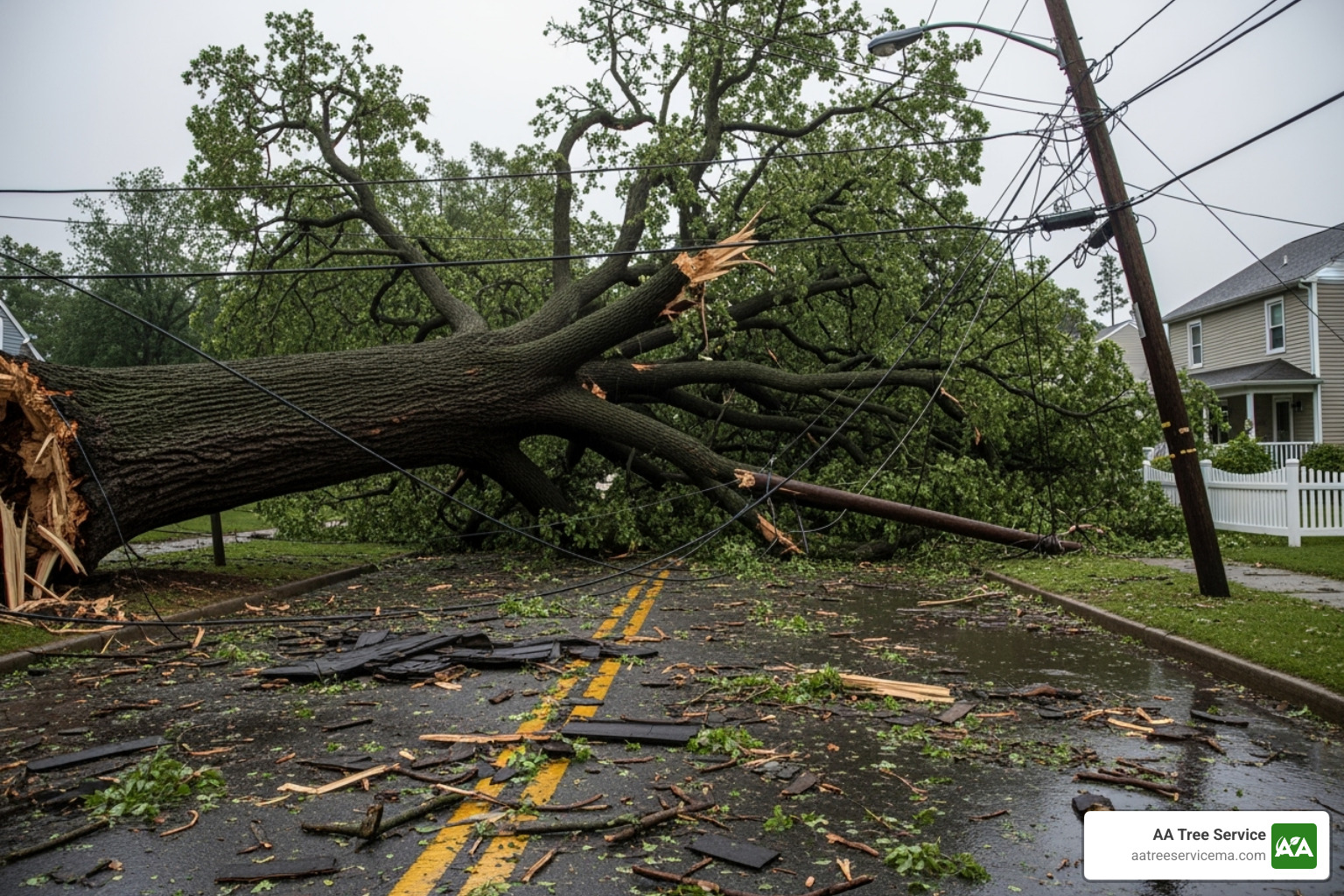
Mother Nature doesn’t check her calendar before sending storms our way, and that’s exactly why 24/7 emergency services are so crucial. When a nor’easter hits at 2 AM or a summer thunderstorm drops a massive branch across your driveway, you need help now—not next Tuesday. Emergency tree services go far beyond regular business hours. Storm cleanup often involves complex, high-risk scenarios where trees are tangled in power lines, crushing structures, or blocking critical access routes. These situations require immediate professional response with specialized equipment and strict safety protocols.
The goal during emergencies isn’t just removal—it’s safe, swift response that minimizes further damage and restores normalcy as quickly as possible. Professional crews know how to assess unstable situations, work safely around utility lines, and protect your property during the cleanup process.
Stump grinding is another specialized service that provides the finishing touch after tree removal. You’re usually left with an unsightly stump that can be a tripping hazard, a lawn mower obstacle, or a haven for pests like termites and ants. Professional stump grinding uses powerful machinery to obliterate the stump, grinding it down 6-12 inches below ground level. This allows you to reclaim the area, fill it with topsoil, and grow grass over it seamlessly.
Cabling and bracing is a proactive, preservation-focused service. For mature trees with structural weaknesses, such as split trunks or heavy, overextended limbs, cables and braces can provide crucial support. An arborist can install high-strength steel cables in the upper canopy to limit limb movement during high winds, and insert threaded rods through weak branch unions to hold them together. This can add decades to the life of a valuable, mature tree, preventing it from becoming a removal candidate.
For immediate assistance when disaster strikes, our emergency tree removal services are always available. You can also learn more about our stump grinding services.
What Defines a Top-Tier Tree Company?
What truly sets apart an exceptional Tree Company from the rest? It boils down to a combination of verifiable expertise, an ironclad commitment to safety, modern operational practices, and an unwavering focus on customer satisfaction. It’s not just about wielding a chainsaw; it’s about being a trusted, long-term partner in caring for your property’s most vital natural assets.
A top-tier company understands that every tree, and every client, is unique. They bring a wealth of knowledge, a safety-first approach, and a dedication to leaving your property better than they found it. This holistic approach is what builds lasting relationships and ensures your landscape thrives for generations. We believe this philosophy is the cornerstone of our business.
You can learn more about our commitment to excellence on our about AA Tree Service page.
Credentials and Expertise
The backbone of any reputable Tree Company is its team’s credentials and expertise. This is the verifiable proof that they possess the knowledge and skill required for complex and often dangerous work. The gold standard in our industry is the ISA-Certified Arborist. These are not just tree cutters; they are tree doctors. To become certified, an individual must have a minimum of three years of full-time experience in arboriculture and pass a comprehensive exam covering everything from tree biology and soil science to safe work practices and tree risk assessment. Furthermore, they must maintain their certification through ongoing education, ensuring they are up-to-date on the latest science and techniques.
Another key credential to look for is accreditation from the Tree Care Industry Association (TCIA). A TCIA-accredited company has undergone a rigorous audit of its business practices, from safety and training to customer service and insurance. It’s a sign that the entire company, not just individual arborists, is committed to the highest standards of professionalism.
Beyond certifications, proper licensing and insurance are non-negotiable. For us, operating in Massachusetts and New Hampshire, this means adherence to all state-specific licensing and registration requirements. More importantly, it means carrying robust General Liability Insurance to cover any potential property damage and Worker’s Compensation Insurance to cover any employee injuries. Hiring a company without both policies exposes the homeowner to catastrophic financial risk. A professional company will always provide proof of insurance upon request.
Finally, experience counts. We bring over 20 years of hands-on experience to every job, ensuring that we’ve seen it all and can handle any tree challenge with confidence and precision. This long-standing presence in the community translates into deep local knowledge of tree species, common pests and diseases, and the unique environmental conditions of Massachusetts and New Hampshire.
For details on our certified experts, visit our certified arborist page. For general information on tree care, you can refer to this resource.
Commitment to Safety and Modern Equipment
Tree work is consistently ranked as one of the most dangerous professions. It involves heavy machinery, powerful cutting tools, and working at extreme heights. This is why a top-tier Tree Company places an uncompromising emphasis on safety. It’s not just a buzzword; it’s a deeply ingrained culture that permeates every aspect of their operation.
A “Safety Above All Else” philosophy is crucial. This means rigorous, documented training for all crew members, adherence to strict safety protocols outlined by the American National Standards Institute (ANSI Z133), the accepted safety standard for arboricultural operations. This includes daily job site briefings, the use of appropriate Personal Protective Equipment (PPE) like helmets and chainsaw-resistant chaps, and meticulous site management to establish a safe drop zone and protect people and property.
Complementing this safety-first culture is the use of modern, well-maintained equipment. Top companies invest heavily in their fleet. This includes specialized equipment such as cranes for zero-impact removal of large trees in tight spaces, aerial lift trucks (or bucket trucks) for safe access to high canopies, and high-capacity chippers and stump grinders to perform tasks efficiently and with minimal impact on your landscape. Our crews are continuously educated on the newest techniques and tools, ensuring that we always use the right equipment for the job, whether it’s a delicate pruning task or a complex, hazardous tree removal.
Eco-Friendly and Sustainable Practices
A leading Tree Company isn’t just about cutting down trees; it’s also about environmental responsibility. We play a crucial role in the lifecycle of urban and suburban forests, and we adopt practices that minimize our ecological footprint and promote a healthier local ecosystem.
One key aspect is responsible debris disposal. After a tree removal or major trimming, there’s a lot of organic material. Instead of sending it to a landfill, we prioritize recycling 100% of the debris. Branches and smaller wood are chipped into high-quality mulch, which can be reused in landscapes to retain soil moisture, suppress weeds, and return nutrients to the earth. Larger logs can be processed into firewood or milled into lumber, contributing to a circular economy.
We also practice Integrated Pest Management (IPM), an environmentally sensitive approach to managing pests and diseases. Rather than indiscriminately spraying chemicals, IPM focuses on understanding pest life cycles and using targeted, low-impact treatments only when necessary. It prioritizes the health of the tree and the surrounding environment.
Furthermore, we contribute to a healthy local ecosystem by advising clients on suitable tree species for planting, especially native varieties that thrive in the Massachusetts and New Hampshire climate and support local wildlife. We also ensure that our operations, from fuel consumption to equipment choices, are as energy-efficient as possible, aiming to reduce our overall carbon footprint. It’s about being good stewards of the environment, one tree at a time.
Understanding the Costs of Tree Services
Let’s address what’s probably on your mind: “How much is this going to cost me?” When you’re considering hiring a Tree Company, pricing naturally becomes a major concern. The good news? Reputable tree service providers understand this completely, which is why transparency and free, detailed estimates have become standard practice in our industry.
We believe in providing free same-day quotes because we know you need to budget for these important property investments. However, here’s the thing about tree service pricing—it’s nearly impossible to give an accurate estimate over the phone. Every tree situation is unique, and an honest, professional assessment requires an on-site visit from a qualified arborist.
Why on-site assessments are non-negotiable: Your tree’s location relative to your house, power lines, septic system, or neighbor’s fence can dramatically change the complexity of the job. A 40-foot oak in an open field is one price. The same tree hanging over your roof with limited access for equipment is an entirely different project requiring specialized rigging or a crane. An arborist needs to evaluate all the variables to provide a safe and accurate plan.
Key factors influencing cost include:
- Size & Height: Taller trees with larger diameters require more time, equipment, and risk to manage.
- Condition: A dead, brittle tree can be more unpredictable and dangerous to climb and dismantle than a healthy one.
- Species: Some trees, like oaks, have much denser wood than pines, making them harder and more time-consuming to cut.
- Location & Accessibility: Is the tree in a tight backyard with no room for a bucket truck? Is it overhanging a delicate structure? Is the ground soft or on a steep slope? These factors dictate the methods and equipment needed, directly impacting the cost.
The reality is that professional tree work involves highly skilled labor, specialized equipment, and significant insurance costs—all of which contribute to pricing. But when you consider that professional tree care protects your property value and keeps your family safe, it becomes clear that this is an investment, not just an expense.
For a general understanding of potential costs in Massachusetts and New Hampshire, you can explore our tree removal cost estimate page.
Average Price Ranges for a Tree Company
Understanding typical pricing ranges can help you budget for tree services, though remember that every situation is unique. The figures below represent average costs based on internet data from various service providers and are not actual costs for AA Tree Service. We always provide detailed, personalized quotes after visiting your property.
| Service Category | Average Cost Range (Based on Internet Data) |
|---|---|
| Tree Trimming | $250 – $1,500+ |
| Tree Removal | $500 – $4,500+ |
| Stump Grinding | $100 – $500+ |
These are general estimates only. Actual prices depend on specific job requirements, tree size, location, and complexity. Always request a personalized quote.
The wide price ranges reflect the enormous variety in tree service jobs. A simple pruning of a small ornamental tree will cost significantly less than removing a massive, storm-damaged maple that’s threatening your home. Size matters tremendously—a 20-foot tree removal might fall on the lower end of our range, while an 80-foot oak in a tight spot requiring crane services could easily exceed the higher end.
Location complexity is another major factor. Trees in tight spaces, near structures, or requiring special equipment access will naturally cost more. New England’s older neighborhoods often present unique challenges that require creative solutions and specialized approaches, which a seasoned Tree Company is prepared to handle.
What to Look for in a Quote
A quality quote from a Tree Company should tell you much more than just the bottom-line price. Think of it as a detailed scope of work—it should clearly outline what you’re getting for your investment and demonstrate the company’s professionalism.
Here’s what a comprehensive quote should include:
- Itemized Services: You want to see exactly what’s included—tree removal, specific pruning techniques, branch chipping, stump grinding, debris hauling, and final cleanup. This transparency helps you compare quotes accurately and ensures there are no surprises.
- Proof of Insurance: The quote should explicitly state that the company is fully insured, and they should be able to produce the certificates for both liability and worker’s compensation insurance immediately upon request. If a company hesitates, consider it a major red flag.
- Clear Timelines: While weather can affect scheduling in Massachusetts and New Hampshire, the quote should provide a realistic timeframe for starting and completing the work.
- Debris Removal Terms: It should specify exactly what will happen to the wood chips and logs. Will they be hauled away, or left for your use? Are there separate costs associated with this?
- Equipment to be Used: For complex jobs, the quote may specify if a crane or other heavy machinery is needed, which justifies a higher cost.
- Payment Terms: The terms should be clear. Be wary of companies demanding large upfront payments or cash-only deals, which can be a sign of an unstable or uninsured operation. Reputable companies typically request payment upon satisfactory completion of the job.
The cheapest quote isn’t always the best value. An unusually low bid may indicate a lack of insurance, unskilled labor, or hidden costs. Quality work, proper insurance, and professional service are worth the investment when it comes to protecting your property and family.
Ready to get started? Request your personalized, free assessment through our request a quote page.
Frequently Asked Questions about Tree Services
Homeowners across Massachusetts and New Hampshire ask us the same questions time and time again. After more than 20 years in the business, we’ve learned that these concerns are universal—and completely understandable. Let’s explore the most common questions we hear and provide some clear, detailed answers.
Why is it important to hire a licensed and insured tree company?
This question gets to the heart of protecting yourself, your property, and your financial well-being. When you hire a licensed and insured Tree Company, you’re not just buying a service—you’re buying peace of mind and a shield against liability.
- Liability Protection (Worker’s Compensation): Tree work is dangerous. If an uninsured worker gets hurt on your property, you, the homeowner, could be held liable for their medical bills and lost wages. This could lead to a lawsuit against your homeowner’s insurance or you personally, potentially costing tens or even hundreds of thousands of dollars. A company’s worker’s compensation insurance protects you completely from this nightmare scenario.
- Property Damage Coverage (General Liability): Even the most skilled professionals can’t control every variable. A sudden gust of wind, an unexpected branch break, or equipment failure can cause damage to your home, fence, car, or neighbor’s property. The company’s general liability insurance covers these costs, saving you from potentially thousands in out-of-pocket expenses and the headache of filing a claim on your own insurance.
- Legal Compliance & Professionalism: Proper licensing demonstrates that the company meets state and local standards and operates as a legitimate business. It’s a baseline indicator of professionalism and accountability. An uninsured, unlicensed operator is working outside the law, and you have little recourse if the job is done poorly or left incomplete.
How can I tell if my tree is a hazard?
Spotting a dangerous tree isn’t always obvious, but your trees often give you warning signs if you know what to look for. Think of it as your tree’s way of asking for help before it’s too late. Conduct a visual inspection from the ground, looking for:
- A Sudden Lean: A trunk that wasn’t leaning before is a major red flag, especially if you notice the ground heaving or cracking around the base, indicating root failure.
- Dead Branches: Large, dead branches in the canopy (often called “widow-makers”) are nature’s time bombs. They can fall without warning in any weather.
- Cracks or Splits: Deep cracks or splits in the trunk or major limbs are significant structural weaknesses that can lead to catastrophic failure during a storm.
- Signs of Decay: Look for mushrooms or other fungal growth on the trunk or at the tree’s base. A hollow trunk, which might sound empty when tapped, indicates internal rot that is compromising the tree’s strength from the inside out.
- Canopy Dieback: Are the leaves at the top of the tree sparse, or are branches bare during the growing season? This can signal root problems or disease.
- Pest Infestations: Look for signs of specific, destructive pests common in New England, such as the D-shaped exit holes of the Emerald Ash Borer or the white, cottony sacs of the Hemlock Woolly Adelgid.
If you see any of these signs, it’s time for a professional assessment. An arborist can determine if the tree can be saved with pruning or support systems, or if it needs to be removed before it fails on its own.
For a thorough evaluation of your trees, check out our tree hazard assessment services.
What is the best time of year for tree trimming in New England?
For most species, New England’s distinct seasons give us a clear answer: the dormant season from late fall through early spring (roughly November to March) is ideal for most structural pruning.
- Less Stress on the Tree: During dormancy, trees are essentially taking a long winter nap. Pruning causes less physiological stress since the tree isn’t actively growing or trying to heal wounds. Come spring, it will be ready to put all its energy into healthy new growth.
- Better Visibility: Without leaves, our arborists have a clear view of the tree’s entire structure. This allows for more precise identification of deadwood, crossing branches, and structural defects, leading to more effective pruning.
- Disease & Pest Prevention: Many tree diseases and insect pests are spread through open pruning wounds during the warmer, active months. Winter pruning minimizes this risk since the pathogens and insects are also dormant.
Of course, safety always comes first. If a branch is broken or threatening your roof, we’ll remove it immediately, regardless of the season. Certain flowering trees, like magnolias or dogwoods, may have specific pruning times to avoid cutting off the next season’s flower buds.
Do I need a permit to remove a tree in Massachusetts or New Hampshire?
This is an excellent question, and the answer varies by town and city. There is no single statewide law in either MA or NH. Many municipalities have their own ordinances, especially concerning “street trees” (those on public property or within a certain distance of a road) or trees in conservation or wetland buffer zones. Some towns may also have regulations regarding the removal of “significant” or “heritage” trees, even on private property.
A professional, local Tree Company will be familiar with the regulations in your specific area and can advise you on whether a permit is required and assist with the application process if needed. It’s always best to check with your local town hall or conservation commission before removing a large tree.
Conclusion: Making the Right Choice for Your Landscape
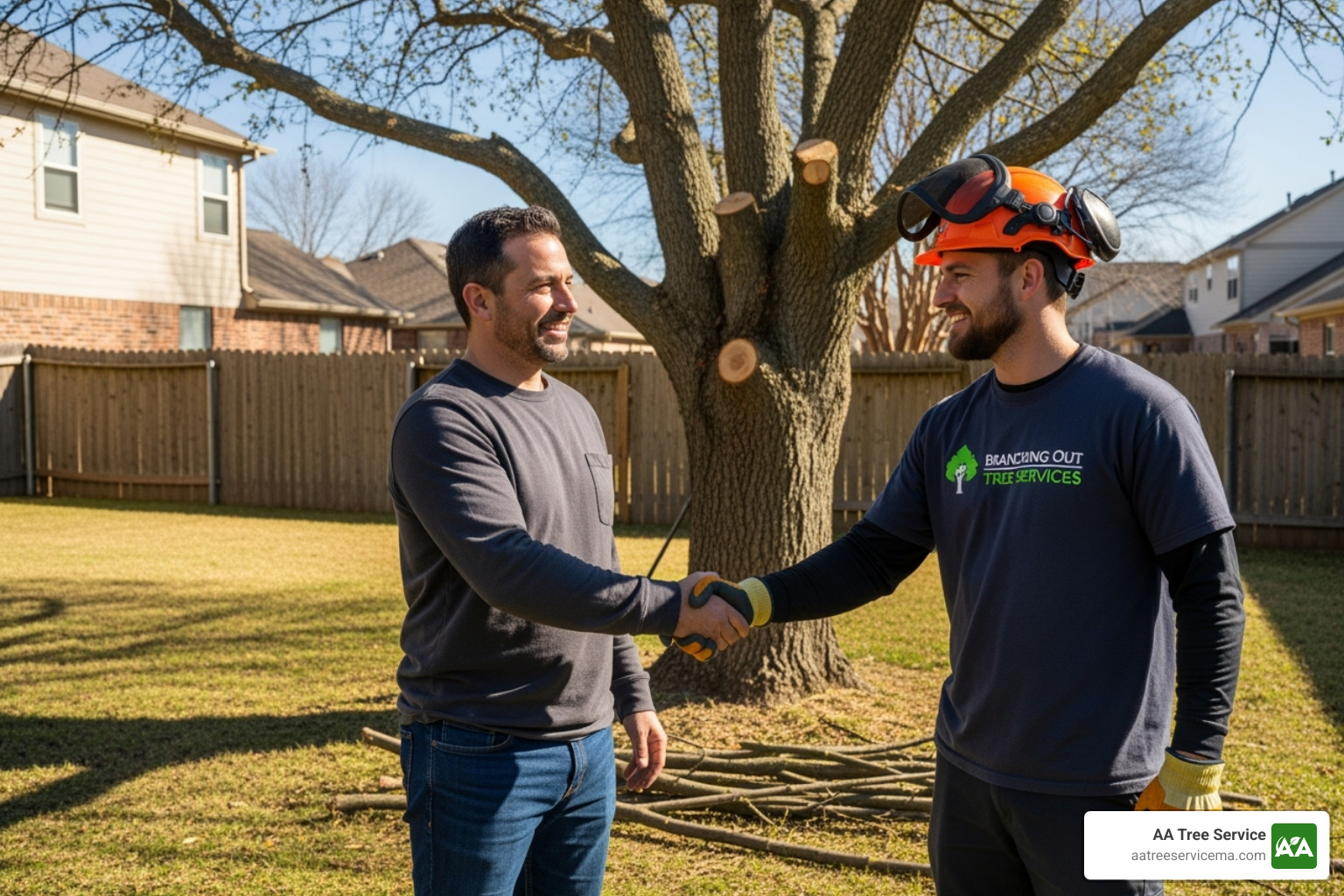
When it comes to your property’s trees, settling for anything less than exceptional service simply isn’t worth the risk. Throughout this guide, we’ve walked through what makes a Tree Company truly outstanding—and it’s about so much more than just showing up with a chainsaw. It’s about a deep commitment to arboricultural science, an unwavering culture of safety, and a genuine partnership with the homeowner.
The right tree service partner brings together decades of experience with the kind of safety-first mindset that protects your family and property. They arrive with modern, specialized equipment, the verifiable expertise of ISA-certified arborists, and the professionalism that turns a potentially stressful situation into a smooth, worry-free experience. They understand the nuances of tree health, from advanced preservation techniques like cabling and bracing to the specific threats posed by pests and diseases in our region.
Think about it: your trees are living investments that can add thousands to your property value when healthy, or cause devastating damage when compromised. The unpredictable New England weather doesn’t give us the luxury of waiting when a tree becomes hazardous. That’s why having a trusted Tree Company in your corner—one that offers 24/7 emergency services and understands our unique climate challenges—is invaluable.
We’ve seen how the best companies distinguish themselves through comprehensive insurance coverage, adherence to national safety standards like ANSI Z133, and a commitment to sustainable practices. They are the ones who provide detailed, transparent quotes, take the time to explain what they’re doing and why, and clean up meticulously when they’re done. They are the professionals you’d feel comfortable recommending to your family and neighbors.
For homeowners across Massachusetts and New Hampshire, AA Tree Service embodies exactly these principles. With over 20 years of experience in our region’s unique conditions, we understand what it takes to keep your trees—and your property—safe and beautiful year-round. Whether you need a routine health assessment, a complex removal, or an emergency storm response, we’re here with the expertise and dedication your landscape deserves.
Ready to experience the difference that true professionalism makes? Learn more about how we can help with your specific needs on our tree removal page.