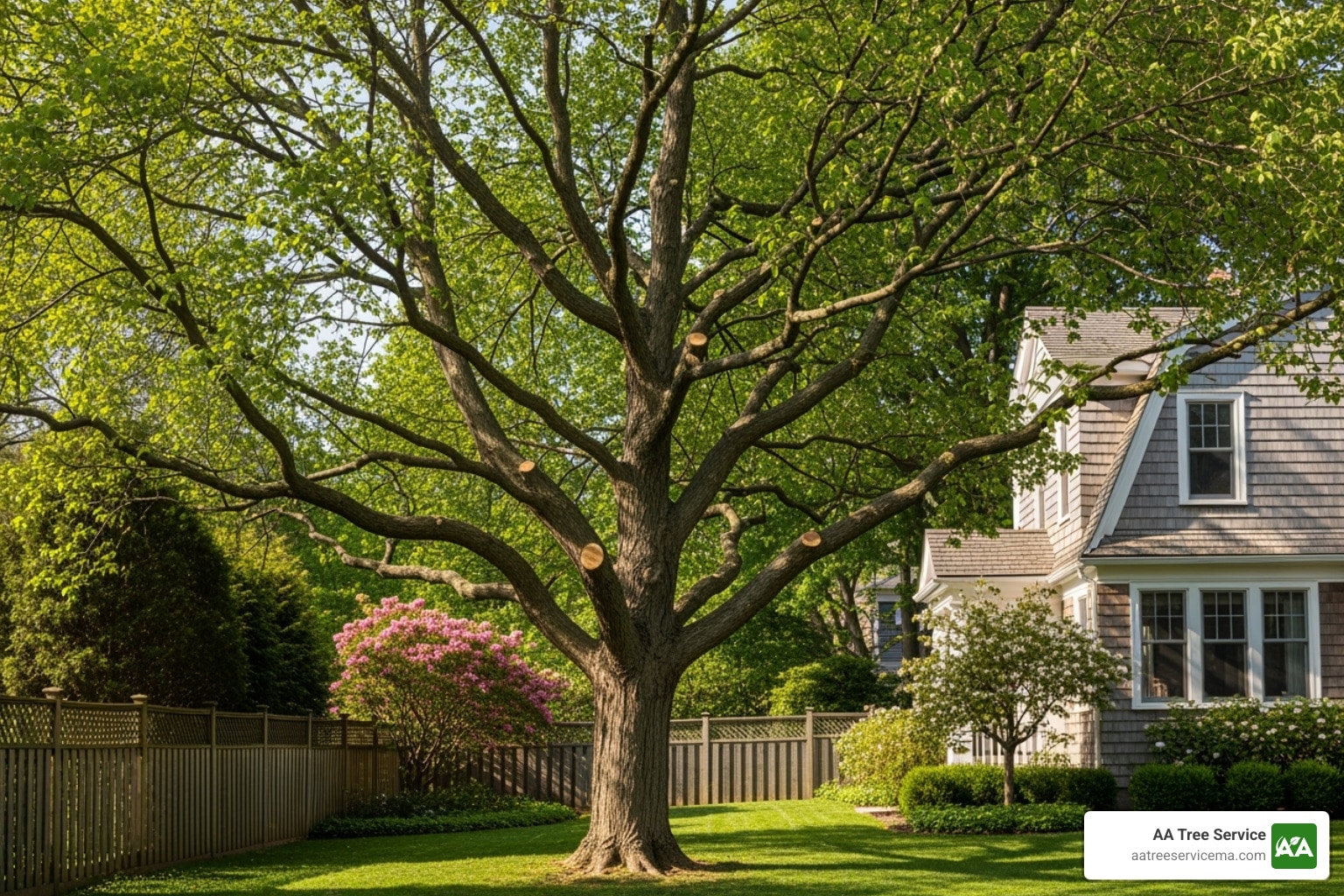
Why Professional Tree Care Matters for Massachusetts and New Hampshire Homeowners
In the picturesque landscapes of Massachusetts and New Hampshire, trees are more than just background scenery; they are vital, living components of your property. Professional tree pruning services are specialized, science-based practices designed to maintain tree health, ensure safety, and improve aesthetics through the strategic removal of specific branches. This is not mere cutting; it’s arboricultural surgery performed with a deep understanding of tree biology.
Key Services Professional Arborists Provide:
- Crown thinning: This involves the selective removal of branches to reduce the density of the canopy. This isn’t just about looks; it lessens the ‘sail effect’ during high winds, reducing the risk of uprooting, and improves air circulation, which is crucial for mitigating fungal diseases like powdery mildew and anthracnose.
- Deadwood removal: Eliminating diseased, dead, or dying branches is a critical safety measure. These weak limbs are the first to fall in a storm, but they also act as an open invitation for wood-boring insects like carpenter ants and termites, as well as decay-causing fungi that can spread to the healthy parts of the tree.
- Crown raising (or lifting): This practice involves removing lower branches to provide clearance for buildings, vehicles, and pedestrians. It’s essential for preventing property damage (like branches scraping your roof) and maintaining safe passage around your home.
- Structural pruning: Especially important for young and middle-aged trees, this service corrects growth patterns to prevent future problems like co-dominant stems (weak, V-shaped unions) or crossing branches that can rub and create wounds.
- Storm damage cleanup: After a New England nor’easter or summer thunderstorm, professionals safely address broken, hanging, or damaged branches that pose an immediate threat.
- Disease prevention: Strategic cuts can halt the spread of diseases like fire blight or black knot. An arborist knows how to make cuts that compartmentalize decay and promote rapid healing.
Your trees are valuable assets that can significantly increase your property value—some studies suggest by as much as 15%. As one industry expert noted, “trees don’t grow leaves they don’t need”—which means every cut has a consequence for their long-term health and stability.
Improper pruning can severely damage or even kill your trees. Homeowners attempting DIY tree work face serious risks, including catastrophic property damage, life-altering personal injury, and irreversible harm to their landscape’s most valuable features. In New England’s challenging climate, where heavy snow, ice storms, and high winds are common, professional care is the most effective way to protect your investment and ensure your trees can withstand the elements.
Professional arborists possess specialized knowledge of tree biology, soil science, proper cutting techniques, and rigorous safety protocols. They understand precisely which branches to remove, the optimal time of year to prune, and how to make cuts that encourage the tree’s natural healing processes rather than inviting decay.
Find more about Professional tree pruning services:
Why Your Trees Need an Expert Touch: The Benefits of Hiring a Professional Arborist
Thinking of trimming that overgrown maple yourself this weekend? While the DIY spirit is admirable, trees are complex, powerful living systems that don’t easily forgive mistakes. Professional tree pruning services are far more than just cutting branches; every cut is a calculated decision based on tree biology and physics.
A certified arborist considers how the tree will compartmentalize and heal the wound, how the new growth will be structured, and how the altered canopy will handle the weight of the next New England ice storm. The physics of tree cutting can be deadly; a seemingly small branch might weigh 200 pounds and swing unpredictably when cut. Trees are under immense tension and can react in surprising, dangerous ways.
When you hire a Certified Arborist Tree Service, you’re investing in expertise that protects your trees, your property, and your family. Professionals understand disease prevention, use proper cutting techniques, and carry the essential insurance and safety equipment to keep everyone and everything protected.
The Dangers of DIY Pruning
In our 20+ years of service, we’ve seen the unfortunate aftermath of DIY tree work in New England, from permanently damaged trees to homeowners suffering serious injuries. It’s simply not worth the risk.
- Improper cuts: This is the most common and damaging mistake. A flush cut, which removes the swollen branch collar at the base of a limb, creates a large wound the tree cannot properly heal. A stub cut, which leaves a branch too long, invites rot and pests to move into the trunk. Both can lead to the slow death of a tree.
- Tree topping: This disastrous practice involves indiscriminately cutting off a tree’s top. It starves the tree by removing a massive portion of its leaf-producing crown and encourages the growth of weak, fast-growing shoots called watersprouts. These sprouts are poorly attached and far more likely to break off in a storm than the original branches.
- Immediate dangers: The risks of personal injury are severe. Ladder accidents are a leading cause of emergency room visits for homeowners. Chainsaw kickback, which occurs when the tip of the saw’s bar hits an object, can throw the saw back at the operator with incredible force. Furthermore, trees near power lines are absolutely not DIY territory; electricity can arc several feet from the line to a ladder or tool, causing fatal electrocution.
- Hidden rot: A branch that looks solid on the outside can be dangerously hollow within. An arborist is trained to spot subtle signs of internal decay, like fungal growth or cracks, that a homeowner would likely miss.
The Professional Advantage: Safety, Skill, and Savings
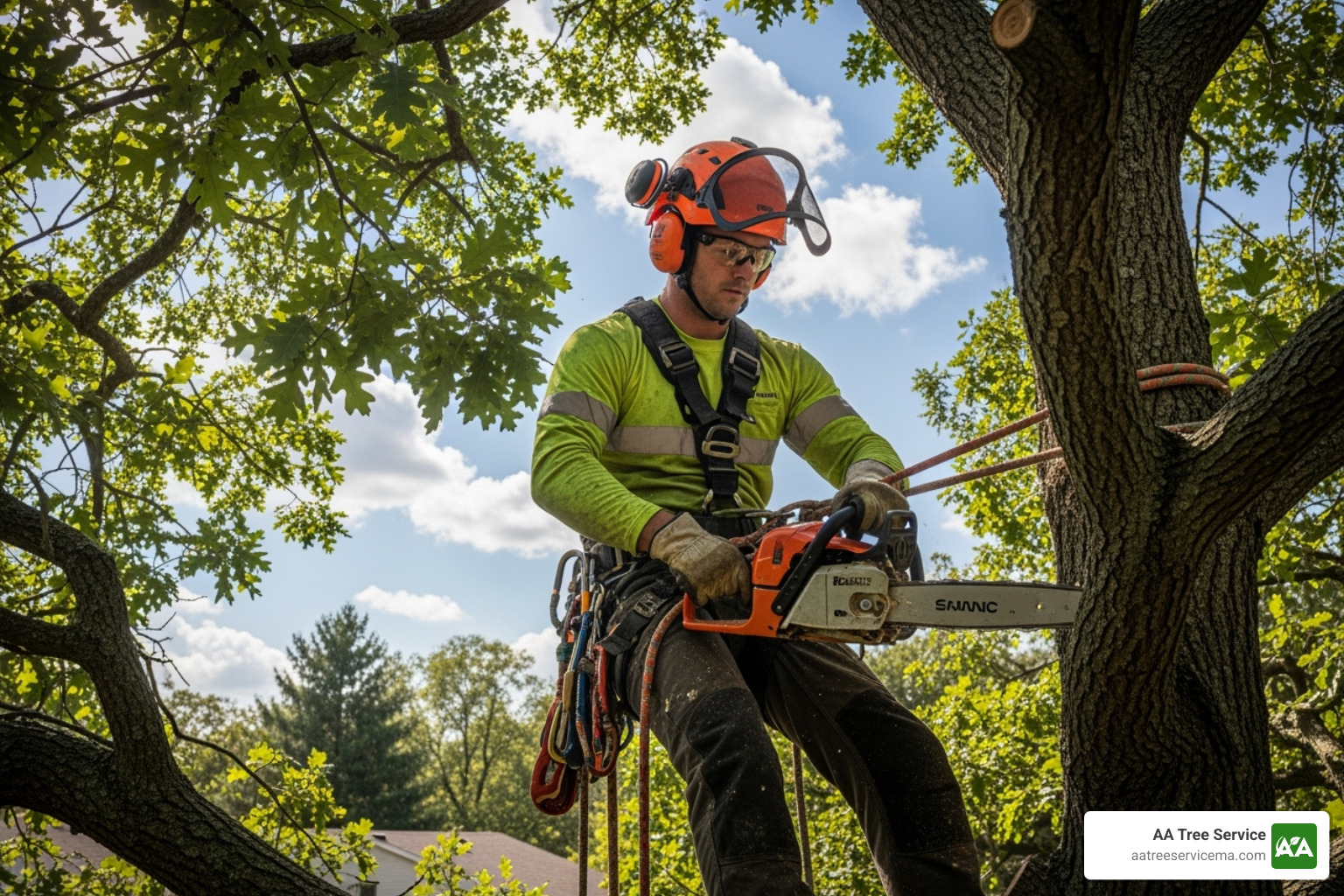
Our ISA Certified Arborists have dedicated their careers to studying tree biology, disease identification, and advanced pruning techniques. We use specialized equipment—from aerial lifts and cranes for safe access to high canopies, to sophisticated rigging systems that allow us to lower massive limbs with precision and control. This ensures the job is done safely, without damage to your home or landscape.
Liability insurance and worker’s compensation are your non-negotiable shields. If we work on your property, you’re fully covered. If an uninsured individual gets hurt or damages your property, you become financially responsible for medical bills and repairs.
The efficiency factor is also significant. A project that could consume your entire weekend and pose constant danger is often just a few hours of safe, methodical work for our experienced crew. We have the right tools, team, and techniques to work quickly and effectively.
The real value, however, lies in preventing costly future problems. Proper pruning now saves you from the enormous expense of emergency tree removal later, prevents devastating property damage, and preserves your property value. Our comprehensive Tree Care Services are a strategic investment in the long-term health and safety of your landscape.
We’ve served Massachusetts and New Hampshire for over two decades. We know what local trees need to withstand New England’s challenging seasons, from heavy ice storms to summer droughts.
A Cut for Every Need: Common Types of Professional Tree Pruning Services
Professional tree pruning services are not a one-size-fits-all solution. A young maple needing guidance requires a vastly different technique than a massive, mature oak encroaching on power lines. After two decades serving homeowners across Massachusetts and New Hampshire, we understand that cookie-cutter approaches are ineffective and often damaging. Our expertise in structural pruning, formative pruning, and hazard reduction makes all the difference in achieving a healthy, safe, and beautiful tree.
We tailor every service to your tree’s specific species, age, condition, and location. You can learn more about our comprehensive approach on our Tree Pruning and Trimming page.
Crown Cleaning and Thinning
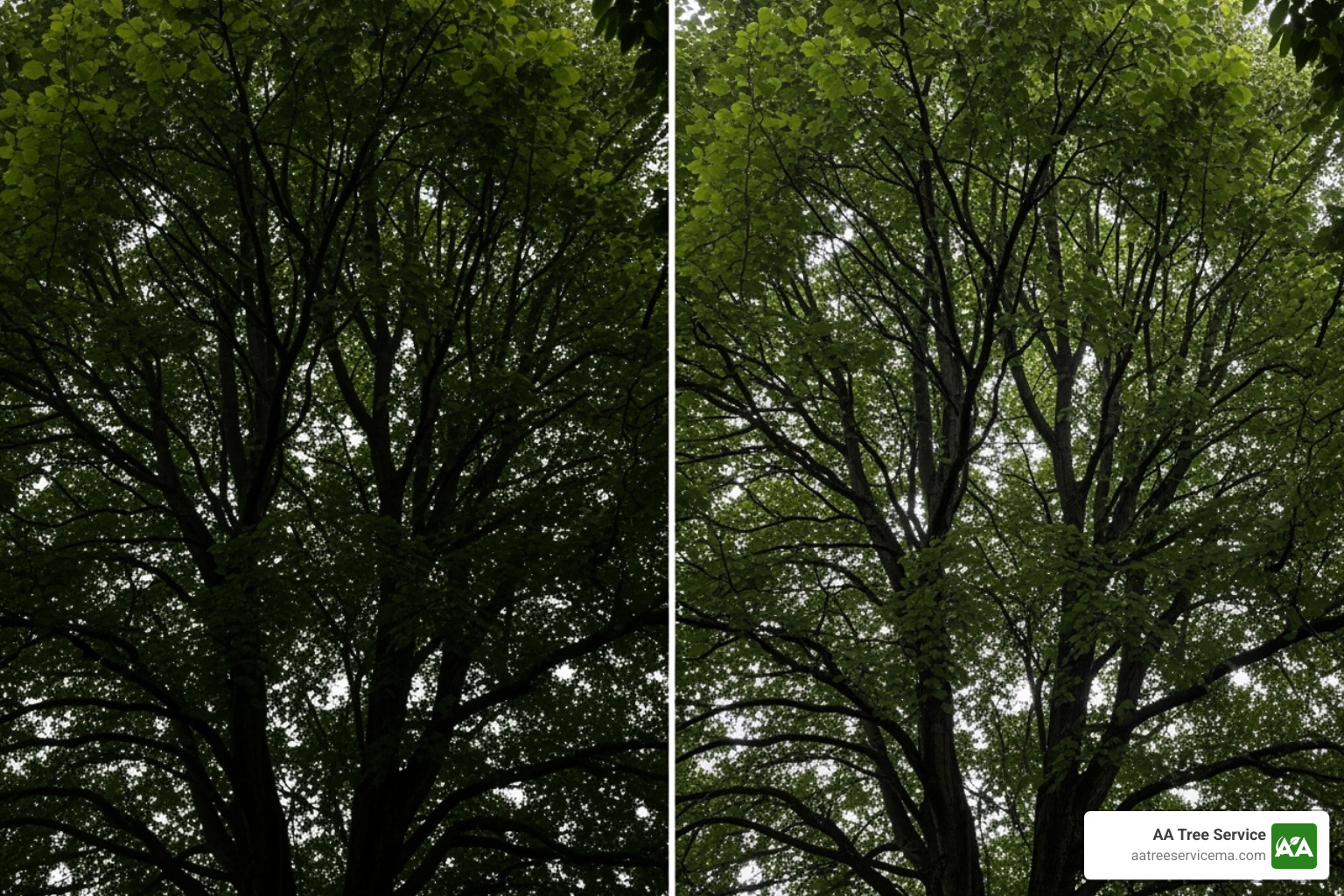
Crown cleaning is the foundational step of tree hygiene. We carefully remove dead, diseased, damaged, and crossing branches. This not only improves the tree’s appearance but also eliminates potential entry points for pests like bark beetles and diseases like cankers.
Crown thinning takes this a step further by selectively removing healthy branches to reduce the overall density of the canopy. This improves air circulation and sunlight penetration, which helps prevent fungal growth and ensures inner foliage remains healthy. Crucially, thinning also reduces weight from heavy limbs and lessens wind resistance, making your tree far more resilient against New England’s powerful storms. This must be done correctly to avoid “lion-tailing”—a harmful practice where inner branches are stripped out, leaving foliage tufts at the ends and making limbs more prone to failure.
Crown Raising and Reduction
When a tree outgrows its space, clearance pruning becomes essential for safety and property maintenance.
Crown raising creates vertical space by removing lower branches to achieve necessary clearance. This could be for pedestrian access (typically 8 feet over a sidewalk), vehicle clearance (14-16 feet over a driveway or street), building clearance to prevent roof or siding damage, and crucial utility line clearance. Keeping branches away from power lines is especially important in MA and NH due to the high risk of outages during ice storms.
Crown reduction is the proper method for reducing a tree’s height and spread when it has become too large for its location. We achieve this by making careful cuts back to lateral branches that are at least one-third the diameter of the stem being removed, ensuring the branch can assume the terminal role and maintain the tree’s structural integrity and natural shape. We never perform tree topping, a destructive practice that creates weak regrowth and invites disease.
Structural Pruning for Future Health
Perhaps the most valuable service for long-term tree health is structural pruning, performed on young to middle-aged trees. The goal is to establish a single, dominant central leader and ensure good branch spacing and attachment. By making small, corrective cuts early in a tree’s life, we can prevent major structural flaws from developing, such as co-dominant stems that are prone to splitting apart later in life. This proactive approach is the most cost-effective way to ensure a tree grows into a strong, safe, and long-lived asset.
Pruning vs. Trimming: What’s the Difference?
Many homeowners use these terms interchangeably, but they refer to different goals.
| Feature | Tree Pruning | Tree Trimming |
|---|---|---|
| Primary Goal | Tree health, structural integrity, and safety | Aesthetics, uniform shape, and neatness |
| Focus | Strategic removal of specific branches (dead, diseased, poorly attached) for the tree’s long-term well-being | Shaping hedges, shrubs, and ornamental trees for appearance |
| Method | Follows arboricultural standards to improve structure, mitigate risk, and encourage healthy growth patterns | Cutting back overgrown branches to maintain a desired size or form; enhancing visual appeal |
| Timing | Often performed during the dormant season for maximum benefit to the tree’s health | Can be done throughout the growing season for maintenance |
| Outcome | A healthier, stronger, safer tree with an extended lifespan | A tidy, well-maintained appearance; controlled size and shape |
Pruning is tree healthcare, focused on longevity and safety. Trimming is landscape grooming, focused on appearance. Both are vital for a well-maintained New England landscape. Our Tree Trimming Services keep your ornamentals looking their best, while our pruning services ensure your large shade trees remain healthy and safe for decades.
Timing is Everything: The Best Seasons for Tree Pruning in New England
The timing of your tree pruning can make the difference between a thriving tree and one that struggles. It’s not about convenience; professional tree pruning services schedule work based on a tree’s biological clock and the unique pressures of New England’s dramatic seasons. Different species have different needs, and pruning at the wrong time can induce stress, expose the tree to disease, or waste its energy reserves. Proper timing, however, promotes vigorous, healthy growth and maximizes the benefits of the pruning.
Winter (Dormant) Pruning: The Gold Standard
For most deciduous trees in New England, the dormant season (typically late November to early March) is the prime time for pruning.
- Better Visibility: With no leaves, the tree’s entire branch structure is visible. This allows our arborists to easily identify weak unions, crossing branches, and other structural defects, enabling precise, effective cuts for long-term health.
- Less Stress on the Tree: Pruning during dormancy is like performing surgery when the patient is asleep. The tree is not actively growing, so the cuts are less of a shock to its system. It can use its stored energy for a strong flush of growth in the spring.
- Reduced Disease Risk: Many plant pathogens and the insects that spread them are inactive in the cold. Pruning in winter significantly lowers the risk of infection at the wound sites. This is especially critical for oak trees to prevent the spread of Oak Wilt, a fatal disease transmitted by beetles that are active in warmer months.
- Vigorous Spring Growth: The tree responds to dormant-season pruning with a burst of strong, healthy growth in the spring, effectively healing the pruning wounds.
Summer Pruning: A Targeted Approach
Summer pruning is performed more sparingly and for specific objectives, as the tree is actively growing and under stress from heat.
- Slowing Growth: Removing leafy branches in summer can help slow the growth of an overly vigorous tree or a specific branch that is outgrowing its space.
- Improving Shape and Clearance: It can be used for minor corrective pruning on ornamental trees or to clear branches that have begun to obstruct a view or walkway during the growing season.
- Removing Storm Damage: Broken branches from summer thunderstorms in Massachusetts and New Hampshire require immediate attention to prevent further damage and ensure safety, regardless of the season.
- Directing Growth: On young trees, small cuts in summer can help direct growth without stimulating the vigorous regrowth that winter pruning can cause.
When to Avoid Pruning: Fall and Early Spring
Generally, fall is the least desirable time to prune. Decay fungi are highly active, and wounds heal slowly as the tree enters dormancy, leaving it vulnerable to infection over the winter. Likewise, pruning in early spring just as buds are breaking can be stressful, as the tree is expending a massive amount of stored energy to produce new leaves. The exception is always the removal of dead, broken, or clearly hazardous limbs, which should be addressed as soon as they are identified.
If you’re curious about species-specific timing, our guide on Pruning an Oak Tree offers detailed insights for MA and NH conditions. For additional seasonal care tips, you can find more tree care tips at the Arbor Day Foundation.
Vetting the Experts: How to Choose a Reliable Tree Pruning Company
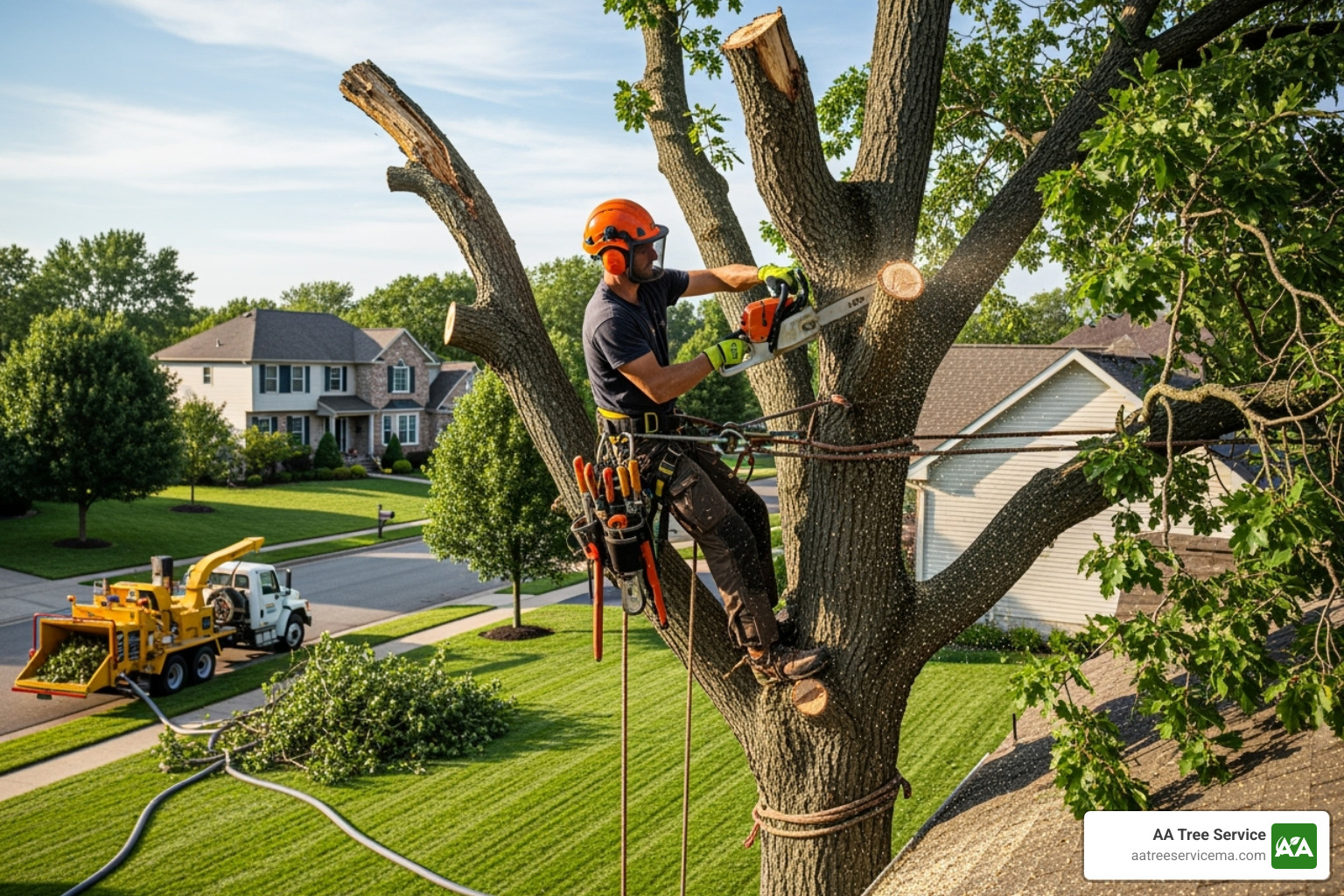
Choosing a company for professional tree pruning services is a critical decision that can protect your property or lead to a costly, dangerous nightmare. We strongly encourage homeowners in Massachusetts and New Hampshire to perform due diligence before hiring anyone to work on their valuable trees.
- Get multiple, detailed quotes. Don’t just choose the lowest bidder; a price that seems too good to be true usually is. A professional quote should be a written, itemized document detailing the exact scope of work, the techniques to be used, a plan for debris removal, and the total cost. Be wary of door-to-door contractors, especially after a storm.
- Check online reviews and the BBB. Look for patterns in customer feedback on sites like Google and the Better Business Bureau. How does the company respond to both positive and negative reviews?
- Ask for local references. A reputable company with a history of quality work in your area will be happy to provide references from satisfied customers.
- Insist on a written contract. A handshake deal offers you no protection. A contract should clearly outline all aspects of the job, including start/end dates, costs, and proof of insurance.
For reliable professionals throughout Massachusetts and New Hampshire, explore our Local Tree Services page.
What to Look for in Professional Tree Pruning Services
When evaluating providers, these qualifications are the mark of a true professional and should be considered non-negotiable:
- ISA Certified Arborist on staff: The International Society of Arboriculture (ISA) certification means an individual has passed a comprehensive exam covering all facets of tree care and must earn continuing education units (CEUs) to maintain their credential. This ensures they are up-to-date on the latest science and best practices.
- TCIA Accreditation: The Tree Care Industry Association (TCIA) offers an accreditation for companies, not just individuals. This is a rigorous, third-party audit that verifies a company’s commitment to safety, ethics, training, and professionalism across the entire business.
- Years of local experience: Companies with decades of experience, like our 20+ years in MA and NH, have encountered nearly every challenge imaginable and know how to handle the specific tree species and weather conditions of our region safely and effectively.
- Strong local reputation: Word travels fast. A company that consistently delivers high-quality work and excellent customer service will have built a strong, verifiable reputation over time.
Insurance and Licensing: Your Non-Negotiables
Never, under any circumstances, hire a tree service without verifying they have proper insurance. This is the single most critical step in protecting yourself from financial disaster.
General Liability Insurance protects your property from damage. If a branch falls on your house, car, or fence, this policy covers the repairs. Ask for a certificate of insurance and verify that the coverage amount is adequate (typically $1 million or more).
Worker’s Compensation Insurance is just as critical. It protects the company’s employees if they are injured on your property. Without it, you could be held liable for an injured worker’s medical bills and lost wages in a devastating lawsuit.
Pro Tip: Ask for the insurance certificates to be sent to you directly from the insurance agency. This prevents you from being shown a fraudulent or expired document by the contractor. We are always happy to provide proof of our comprehensive insurance coverage for your peace of mind.
Understanding the Investment: What Factors Influence Pruning Costs?
When homeowners in Massachusetts and New Hampshire inquire about the cost of professional tree pruning services, the honest answer is always: “It depends.” Tree care is a highly customized service, and every tree and property presents a unique set of circumstances. We provide free, detailed, same-day quotes so you can understand exactly what you’re investing in. Here are the key factors that influence the price:
- Tree Size and Height: This is the most significant cost driver. A small ornamental maple that can be pruned from the ground is a simple job. A towering 80-foot oak requires climbers, complex rigging, and potentially heavy equipment like an aerial lift, all of which increase the time, labor, and risk involved.
- Accessibility: Where is the tree located? A tree in an open front yard is far easier and less costly to work on than one in a tight backyard corner, surrounded by fences, a swimming pool, or a delicate garden that requires extra protection.
- Proximity to Structures and Hazards: Branches overhanging your roof, garage, deck, or power lines dramatically increase the complexity and risk. This requires a highly technical approach, where each piece of wood is carefully cut and lowered using specialized rigging to prevent any damage.
- Tree’s Health and Condition: A healthy tree is relatively straightforward to prune. However, a tree with extensive deadwood, visible decay, pests, or structural defects requires a more cautious, time-intensive approach. A hazardous tree that poses an imminent threat may require a more experienced crew and specialized techniques, affecting the cost.
- Type of Pruning Required: Simple deadwood removal is less expensive than a comprehensive crown reduction or detailed structural pruning, which requires more time and a higher level of arboricultural expertise.
- Debris Removal and Cleanup: Our quotes typically include a full cleanup and hauling away of all debris. The cost is influenced by the volume of wood and brush generated. Some clients may opt to keep wood for firewood or have chips left for mulch, which can sometimes adjust the price.
Average Cost Breakdown
While every job requires a custom quote, we want to provide transparency on what you might expect. Based on general internet data from various sources, here’s what homeowners in the region might see for tree pruning services:
- Small trees under 25 feet: Generally range from $250 to $750.
- Medium trees between 25-50 feet: Often fall between $450 and $1,350.
- Large trees over 50 feet: Start around $750 and can reach $2,250 or more, especially if they are in a difficult location.
Please remember: these are average costs based on internet data and not actual costs for AA Tree Service. We always provide custom quotes after a thorough assessment of your specific situation. Proactive pruning is an investment that can save you thousands in the long run by preventing the high cost of emergency removal and property damage. Our commitment is to deliver exceptional Tree and Shrub Service that provides lasting value for your investment.
Conclusion: Nurturing Your Landscape for a Healthier Tomorrow
We hope this comprehensive guide has illuminated why professional tree pruning services are so much more than just “cutting branches.” Your trees are living, breathing investments that contribute immense value, beauty, and character to your property. Just as you wouldn’t attempt complex DIY plumbing or electrical work, the health and safety of your largest landscape assets deserve the respect and skill of a trained professional.
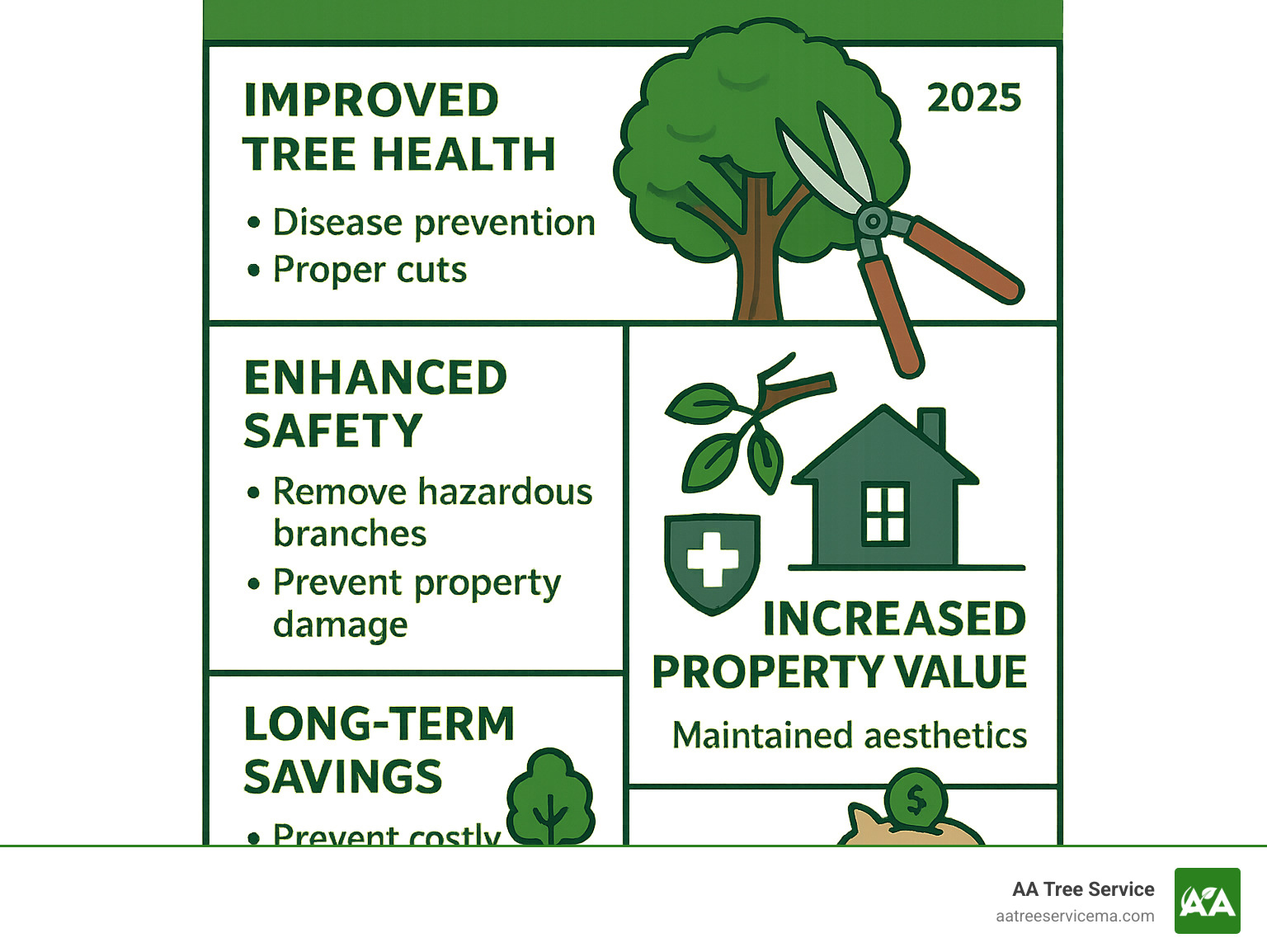
Throughout this article, we’ve explored the critical differences between amateur and expert work, the specific types of pruning like crown thinning and structural correction, the vital importance of seasonal timing, and the non-negotiable need for credentials and insurance. The benefits of professional pruning—improved health, improved safety, increased property value, and significant long-term savings—far outweigh the initial cost.
The importance of professional care is magnified in Massachusetts and New Hampshire, where our trees are constantly tested by harsh weather. A nor’easter or ice storm can turn a neglected tree into a catastrophic liability overnight. Proactive, professional care is not a luxury; it’s essential property management and risk mitigation.
For homeowners in Massachusetts and New Hampshire, AA Tree Service brings 20+ years of dedicated, local experience to every job. We understand that every tree and property is unique and deserves a personalized service plan. From routine pruning to emergencies requiring our 24/7 availability, we provide accessible, reliable, and expert tree care.
Don’t wait for a storm to reveal your trees’ weaknesses. Take the first step towards a safer, healthier, and more beautiful landscape. For expert care and complete peace of mind, explore our Tree Pruning Services and contact us today for a comprehensive, no-obligation consultation. Let our certified arborists help you protect your investment for years to come.