

Why Clear Forest Stumps?
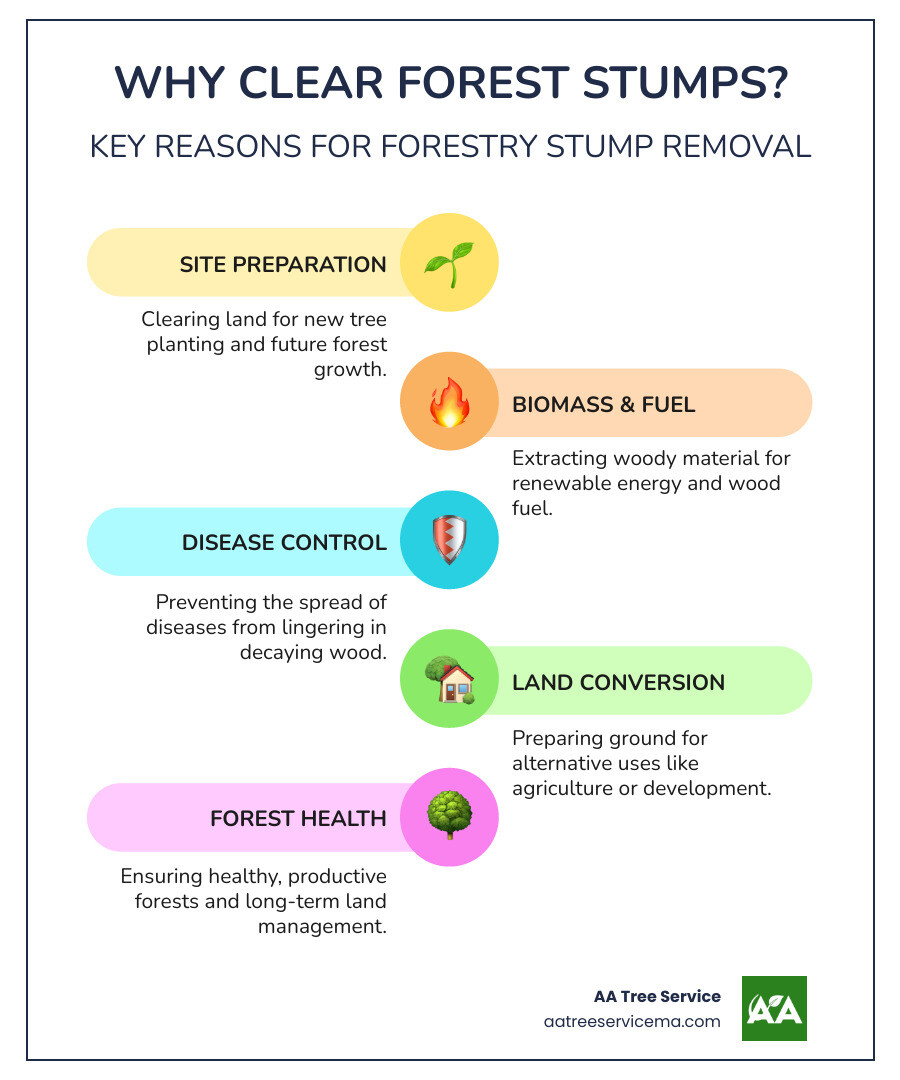
If you’re overseeing timberland, forestry stump removal is the process of eliminating tree stumps and their associated roots after trees have been harvested. Its primary purposes include:
- Site Preparation: Clearing land for new tree planting, making room for future forest growth.
- Biomass & Wood Fuel: Extracting woody material from stumps and roots to use as renewable energy.
- Disease Control: Removing stumps helps prevent the spread of diseases, like those affecting pines, that can linger in decaying wood.
- Land Use Conversion: Preparing ground for other uses, such as agriculture or development, by removing obstacles.
Forestry stump removal isn’t a new concept. Records show that in Europe, people have been digging out tree stumps for hundreds of years. Historically, these stumps were valuable resources, used for everything from wood fuel to producing tar and charcoal.
Today, this practice is vital for managing healthy, productive forests across places like Massachusetts and New Hampshire. It helps ensure the land is ready for its next purpose, whatever that may be.
Simple forestry stump removal glossary:
A Deep Dive into Forestry Stump Removal Methods
When we’re talking about forestry stump removal, it’s clear there’s no single “right” way to get the job done. Instead, we have a wonderful spectrum of approaches, generally falling into two main camps: mechanical methods, which use powerful machines, and natural methods, which gently accelerate decay. The choice truly depends on your specific needs. What are your ultimate goals for the land? What’s your budget looking like? How quickly do you need the stumps gone? And, of course, what are the environmental considerations for your particular site in Massachusetts or New Hampshire?
For instance, are you preparing the land for immediate replanting of a new forest, or are you hoping to harvest the stumps for biomass fuel? Maybe you’re simply clearing the way for future development. Each of these scenarios nudges us toward a particular, effective approach.
How Mechanical Stump Removal Works
When speed and efficiency are key, especially for larger areas, mechanical methods truly shine for forestry stump removal. These methods involve specialized machinery that physically removes the stump from the ground.
One of the most common mechanical methods, even in forestry, is Stump Grinding. This is often used for individual or smaller clusters of stumps, or when you need to clear specific areas very thoroughly. A powerful machine, equipped with a rapidly rotating cutting disc, chips away at the wood. It effectively turns the stump and any surface roots into a pile of wood chips. This process usually goes an inch or so below the soil’s surface, and specialized forestry grinders can even go a foot or deeper underground. It’s super efficient because it gets rid of stumps without a lot of digging, which means less disturbance to the surrounding land.
Imagine this: a study from 2012 on stump grinding in a poplar plantation found that grinding a stump with a 4.8 cm diameter took less than a minute! Without any delays, they could grind an impressive 227 stumps per hour, clearing about 0.82 hectares (that’s roughly two acres) in an hour. This kind of speed makes it incredibly appealing for getting a site ready fast. Plus, the wood chips left behind can be used as mulch, helping the soil recover naturally. If you’d like to dive deeper into how this process works, we have more information about our services right here: More info about stump grinding.
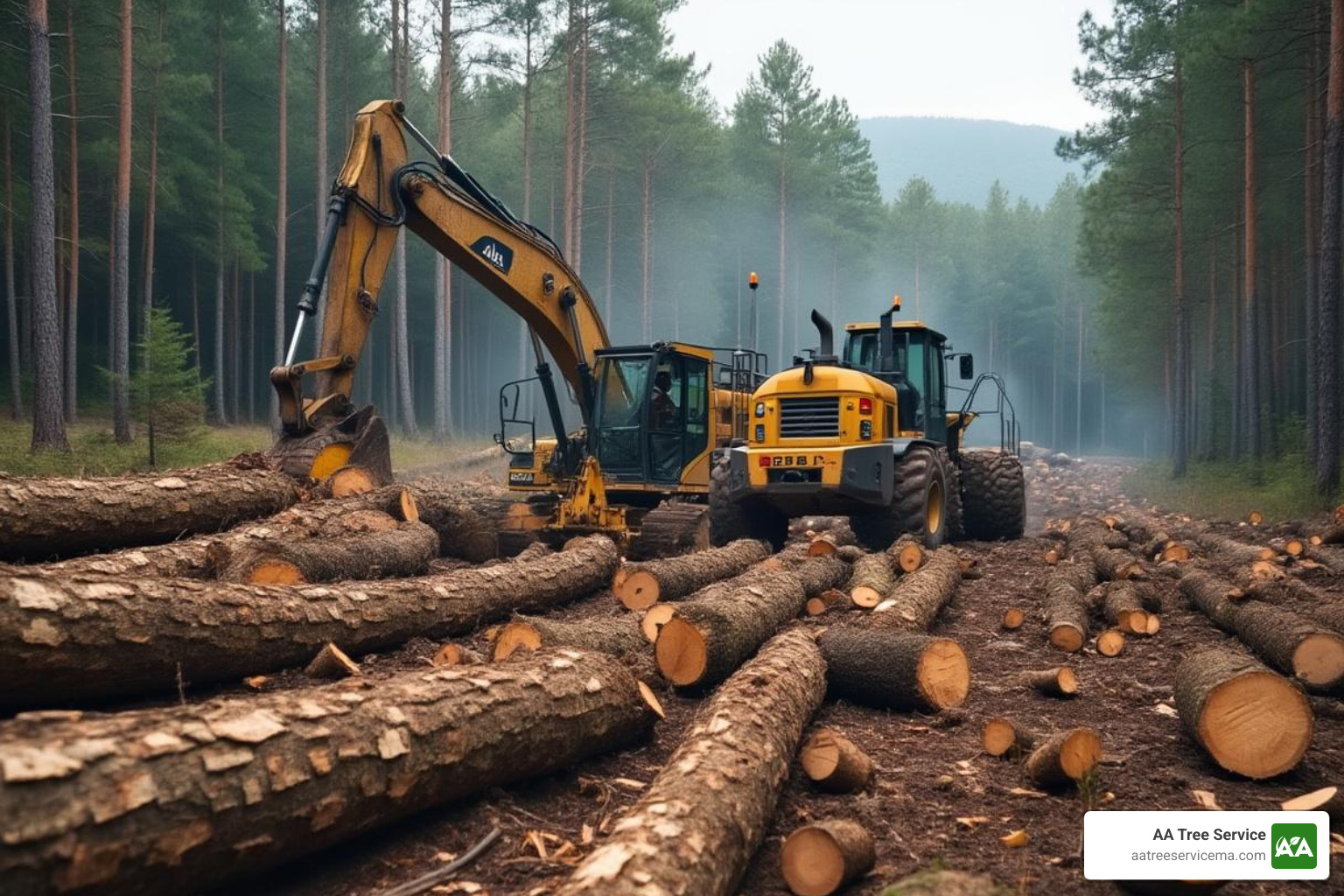
Then there’s Stump Harvesting, which is a more comprehensive approach. This method goes beyond just grinding; it involves completely extracting the entire stump and its attached woody roots. This is often done when the wood itself is a valuable resource, like for supplying biomass power stations. It’s a more intensive form of forestry stump removal, requiring heavy machinery like tracked excavators. These machines, often fitted with hydraulic or mechanical heads, pull the whole stump right out of the ground.
They’ll then typically split the stump and give it a good shake to remove any excess soil. The processed stumps are then often neatly lined up in rows (called windrows) and picked up by another machine to be chipped and transported. This thorough approach ensures there’s absolutely no chance of regrowth, as every bit of the tree is removed.
Specialized Equipment for Forestry Stump Removal
To truly tackle forestry stump removal effectively, especially on a large scale, having the right specialized equipment is absolutely crucial. The right machine isn’t just about power; it’s about making sure the job is done efficiently, safely, and with the least possible impact on the environment.
- Excavator-mounted Hydraulic Heads are incredibly robust attachments that fit onto tracked excavators. They pack an immense amount of power, perfect for pulling out stubborn stumps and their roots, often splitting them right there on site. Many experienced operators will tell you that a hydraulic thumb is “basically a must” for easily grabbing and manipulating those big stumps. Mid-sized excavators, weighing in at around 20 tons (or 25,000-45,000 lbs), are widely favored for their ability to efficiently remove even the largest and most challenging stumps.
- Tractor-mounted Mechanical Heads offer great versatility. These attachments connect to tractors, allowing them to handle a variety of tasks, including stump removal. A common type is the PTO-driven head, which gets its power directly from the tractor’s power take-off.
- When it comes to working in the woods, Tracked Carriers are generally preferred over wheeled machines. Their tracks provide much better stability and traction, especially on tricky terrain like hillsides or rocky ground. Steel tracks, in particular, are often recommended for their durability when navigating areas filled with stumps.
- Mulchers, while not exclusively for stumps, play a vital role in preparing a site. They can efficiently clear above-ground brush and smaller stumps. This can be useful before more intensive stump removal begins, or for tasks like creating firebreaks and maintaining utility lines.
- There are also highly Specialized Stump Cutters designed for dedicated stump removal. Companies like FAE, for example, produce powerful machines specifically for this task. Their FAE 200/SC can shred stumps up to 51 cm (about 20 inches) deep, while the larger FAE 500/SC can go even deeper, reaching 61 cm (24 inches) deep and an impressive 104 cm (over 40 inches) wide. These are truly robust machines, built for specific, demanding stump removal tasks, and they work best with carriers that have higher horsepower. You can learn more about these impressive tools at FAE Stump cutters Introduction.
Choosing the right equipment really comes down to the size of your operation and the specific characteristics of the stumps you’re dealing with – their size, what kind of tree they came from, and their location. For large-scale land clearing, a big dozer can be effective for pushing and piling material, but excavators are often more versatile. They excel at grubbing out individual stumps and can even shake off dirt from roots, which is helpful for proper disposal.
Accelerating Natural Decay (Natural Methods)
While mechanical methods offer incredible speed, sometimes a more gradual, natural approach to forestry stump removal is exactly what’s needed. This is especially true for isolated stumps, or when preserving the surrounding environment is a top priority. These methods are all about helping the stump break down on its own, just a little faster.
One very common and effective natural method involves Drilling Holes in Tree Stumps and then adding agents to speed up the decay. We typically drill several deep holes into the top and sides of the stump, angled downwards. These holes are then filled with materials that encourage decomposition. While there are commercial chemical removers out there, we often lean towards more natural alternatives for forestry settings. Good old high-nitrogen commercial fertilizer, cow manure, or even Epsom salt can work wonders.
Once you’ve applied your chosen agent, we recommend soaking the ground around the stump and thoroughly wetting the top and sides. To keep all that helpful moisture trapped in, cover the wet stump with a plastic tarp. Then, to really hold things in place and help retain moisture, spread a layer of organic mulch (like hay or tree bark) over the tarp. You’ll need to check on it periodically and re-wet it if the mulch dries out, as consistent moisture is key to speeding up the decomposition.

Even with these accelerated methods, natural decomposition takes time. If a tree stump is left completely untreated, it can take up to ten years to fully disappear! Our accelerated methods can significantly reduce that timeline, but patience is still a virtue here. These natural approaches are best suited for specific situations where you don’t need the land cleared immediately. They are perfect when preserving the surrounding soil and ecosystem is your main goal. For more detailed information on these gentle yet effective methods, be sure to visit More info on natural methods.
Comparing the Methods: Which is Right for Your Project?
Choosing the right method for forestry stump removal is a big decision, much like picking the right tool for a specific job. You wouldn’t use a hammer to cut down a tree, right? It all comes down to finding the best fit for your project. We weigh factors like how quickly you need the job done, your budget, how much effort you’re willing to put in, and, of course, the environmental impact.
Let’s break down the primary approaches: Mechanical Grinding, Mechanical Extraction (Harvesting), and Accelerated Natural Decomposition. Each has its own strengths and weaknesses.
| Feature | Mechanical Grinding | Mechanical Extraction (Harvesting) | Accelerated Natural Decomposition |
|---|---|---|---|
| Speed | Fast (minutes to hours per stump) | Fast (hours to days per area) | Slow (months to years) |
| Average Cost | $150 – $600+ (per stump, internet averages) | High (significant equipment, labor, disposal costs) | Low (material costs, DIY labor) |
| Labor Intensity | Moderate (skilled operator, specialized equipment) | High (heavy equipment, multiple steps) | Low (initial setup, periodic reapplication) |
| Environmental Impact | Low-Moderate (soil disturbance, noise, emissions) | Moderate-High (soil compaction, nutrient loss, carbon release, potential erosion) | Very Low (minimal disturbance, promotes natural cycles) |
| End Result | Wood chips, stump below grade; roots remain | Complete stump and root removal; cleared ground | Decomposed organic matter; stump disappears over time |
Cost Discussion
When we talk about costs for forestry stump removal, it’s really important to know that the prices we share here are general averages found online. They are not the specific costs for AA Tree Service. We always recommend getting a free, no-obligation quote for your unique project, especially if you’re in Massachusetts or New Hampshire. This way, you get a clear picture custom to your needs.
For individual stump grinding, internet averages often hover around $6 per inch in diameter. Many services also have a minimum charge, usually ranging from $150 to $200. So, a 25-inch stump might average around $150. However, don’t be surprised if larger, older, or particularly stubborn stumps push that cost much higher—easily into the $600+ range, or even more for very challenging situations. That’s well over three times the average minimum!
Now, for large-scale mechanical extraction or harvesting operations, the costs jump significantly. Think about all that specialized heavy equipment, the fuel, the skilled labor, and then the potential disposal or processing of all that woody material. These kinds of projects are usually priced by the acre or by the volume of material removed, and they can easily run into thousands or even tens of thousands of dollars, depending on how big and complex the job is.
On the flip side, accelerating natural decomposition is generally the most budget-friendly choice. Your main expenses here will be for materials like nitrogen fertilizer, Epsom salt, or manure, which might only be $10 to $50 for a single stump. The biggest investment with this method isn’t money, but time and patience!
So, while mechanical methods come with higher upfront costs, they offer immediate results and clear your land without delay. Natural methods save you money, but they definitely require a long-term perspective. For any significant forestry stump removal project in Massachusetts or New Hampshire, we’re here to provide free estimates to help you understand the true scope and cost.
Sustainability and Environmental Best Practices
At AA Tree Service, we believe that effective forestry stump removal goes hand-in-hand with environmental stewardship. Our operations in Massachusetts and New Hampshire are guided by principles that protect the delicate balance of forest ecosystems. While removing stumps can offer significant benefits for land management, consider the long-term health of the soil, water, and biodiversity.

Key Considerations for Sustainable Forestry Stump Removal
- Soil Health: This is paramount. Intensive stump removal can carry four principal risks to soil sustainability:
- Compaction and Rutting: Heavy machinery can compact soil, reducing its aeration and water infiltration, and creating ruts that impede drainage.
- Erosion: Disturbing the soil can increase the risk of erosion, especially on slopes, leading to topsoil loss.
- Nutrient Loss: Stumps and roots contain essential nutrients (nitrogen, phosphorus, potassium, boron). Their removal can deplete the soil, potentially requiring future fertilization.
- Carbon Loss: Disturbing the soil can lead to the release of stored carbon, impacting the forest’s role as a carbon sink.
- Biodiversity: Deadwood plays a crucial role in forest ecosystems, providing habitat for a wide array of insects, fungi, and microorganisms. Removing stumps can lead to a loss of this potential biodiversity that depends on wood. Understanding The role of deadwood in forest ecosystems is essential for responsible management.
- Water Quality: Operations near streams and rivers require extreme caution. Disturbed soil can lead to increased siltation and pollution of water bodies, impacting aquatic life and downstream water quality. We take great care to avoid such areas.
Best Practices for Responsible Operations
To mitigate these risks and ensure sustainable forestry stump removal, we adhere to several best practices:
- Careful Site Selection: Before any work begins, we conduct a thorough assessment of the site. This involves identifying and avoiding ecologically sensitive areas, archaeological sites, steep slopes, and areas close to streams and rivers. Such planning is crucial for minimizing adverse impacts. Guidance on these aspects is well-documented, and we align our practices with established recommendations for Guidance on site selection and good practice.
- Minimizing Impact: We select the appropriate machinery for the job, favoring equipment that minimizes soil disturbance. For instance, tracked excavators are often preferred in challenging terrains to reduce compaction. We also carefully manage brash and residue. Sometimes, leaving some woody debris on site can contribute to soil health and biodiversity, while other times, it needs to be removed or processed.
- Professional Planning: Every forestry stump removal project, especially large-scale ones, requires meticulous planning. This includes assessing the specific characteristics of the land in Massachusetts or New Hampshire, understanding the local regulations, and developing a strategy that balances efficiency with environmental protection. For comprehensive projects, our professional planning extends to all aspects of Tree Clearing Services, ensuring a smooth and responsible operation from start to finish.
By integrating these considerations and best practices, we ensure that our forestry stump removal services not only achieve your land management goals but also contribute to the long-term health and sustainability of our precious forest resources.
Frequently Asked Questions about Forestry Stump Removal
We often get asked various questions about forestry stump removal, especially concerning the practicalities and outcomes. It’s totally understandable to have questions when you’re thinking about managing large tracts of land! Here are some of the most common ones we hear:
How long does forestry stump removal take?
The time it takes for forestry stump removal really depends on a few things: the method you choose, how many stumps you have, their size, and even the type of terrain. It’s not a one-size-fits-all answer!
- Mechanical Grinding: If you’re looking for speed, grinding is often the way to go. For individual stumps, our powerful grinders can often make short work of them, taking anywhere from 15 minutes to a couple of hours per stump. When we’re talking about large-scale grinding operations for vast areas, we can tackle hundreds of stumps per hour, making it a very quick solution for clearing land.
- Mechanical Extraction (Harvesting): This process, involving heavy machinery like excavators, is also pretty fast once the equipment is on site. An excavator can pull and process a lot of stumps in a single day, clearing significant acreage in a relatively short timeframe. Just remember, the overall project duration will include getting the machinery there, moving the material around, and transporting it off site.
- Natural Method (Accelerated Decay): Now, if you’re not in a hurry, this is your option! Even with methods to speed things up, like adding nitrogen or Epsom salt, decomposition can take anywhere from several months to a couple of years. If you simply leave a stump completely untreated, it could take up to ten years for it to disappear naturally. So, this option definitely requires a good dose of patience!
What is the main purpose of removing stumps in forestry?
The main reasons we perform forestry stump removal are incredibly important for healthy, productive forests and land management. It’s often about setting the stage for what comes next!
One of the biggest reasons is site preparation for replanting. When you clear those old stumps, it makes the ground smooth and ready for new trees, whether you’re planting them by hand or using machinery. Stumps are actually one of the most common obstacles that can slow down or even stop new planting efforts. Removing them ensures a clear path for the next generation of trees.
Another crucial purpose is preventing disease spread. Stumps can sometimes be like little hotels for diseases, such as root rot. If left in place, these diseases can spread to new or even existing healthy trees. Removing the stumps helps break that disease cycle, leading to a much healthier forest. In places like Britain, for example, stumps are often removed specifically to control disease.
Increasingly, harvesting biomass for energy is becoming a major driver. Stumps are a valuable source of woody material that can be used for heat and power generation. By extracting them, we’re tapping into a renewable energy source that would otherwise just decay, contributing to sustainable energy goals. This is a big reason for stump harvesting in many parts of Europe and beyond.
Finally, land use conversion is another key reason. Sometimes, forest land in Massachusetts and New Hampshire is needed for other purposes, such as agriculture, building new homes, or developing infrastructure. In these cases, removing stumps is a necessary step to get the land ready for its brand-new purpose.
Is leaving stumps to rot a viable option in forestry?
While there are certainly some natural benefits to letting stumps decay on their own, it’s often not the most practical or viable option for managed forestry, especially when you have specific goals for your land.
On the positive side, decaying stumps do contribute to soil organic matter and nutrient cycling, which is great for the overall health of the soil. They also provide valuable habitat for a wide variety of insects, fungi, and microorganisms, enriching the forest’s biodiversity. Plus, they can even help the soil store carbon.
However, there are several situations where leaving stumps to rot just isn’t suitable:
- Replanting Schedules: If you need to replant new trees soon, waiting years for stumps to naturally decompose just isn’t practical or economically sound. Time is money, after all!
- Disease Risk: As we mentioned, stumps can be a persistent source of disease. If you leave them in place, you’re essentially keeping that risk around, potentially threatening new plantings or even healthy, mature trees nearby.
- Biomass Harvesting: If your goal is to harvest the stump as valuable biomass for energy, then letting it rot defeats the entire purpose of trying to use that resource.
- Obstruction: Even as they rot, stumps can remain significant physical obstacles. They can get in the way of heavy machinery, future forestry operations, or other land uses. They can also become a tripping hazard and even attract unwanted pests like carpenter ants, beetles, and termites.
So, while we certainly respect the natural decay process, active forestry stump removal is usually the preferred choice when you have clear land management goals, tight timelines, or a need to reduce disease risks and make the most of your forest resources.
Conclusion: Clearing the Way for a Healthy Forest Future
Well, we’ve certainly covered a lot of ground today! As you can see, forestry stump removal isn’t just about getting rid of old wood. It’s a truly critical part of responsible land management. Whether you’re preparing for new forest growth, preventing the spread of diseases, or even harvesting valuable biomass for energy, clearing those old stumps sets the stage for a thriving future.
We’ve explored the various paths you can take, from the powerful, quick methods like mechanical grinding and extraction to the more patient, natural process of accelerated decay. Each approach has its own unique benefits and considerations when it comes to speed, cost, and how it impacts the environment. The right choice for your project truly comes down to your specific goals, your budget, and how committed you are to long-term sustainability.
At AA Tree Service, we believe that proper planning and expert execution are absolutely key. We’re here to make sure that any forestry stump removal project benefits your land without ever compromising its long-term health. We understand the delicate balance needed to clear land effectively while still being great stewards of our precious natural environment.
For those larger projects across Massachusetts and New Hampshire, having professional expertise on your side isn’t just helpful – it’s vital. Our team at AA Tree Service brings over 20 years of experience in tree removal, land clearing, and comprehensive forest management right to your doorstep. We’re equipped with the knowledge, the right machinery, and the dedication to handle even the most challenging forestry stump removal tasks. You can count on us for safety, efficiency, and a deep commitment to environmental best practices.
Ready to clear the way for a healthier forest future on your property? For comprehensive projects, from initial assessment to the final touches, we invite you to explore our Land Clearing services. We’re here to help you get it right.
