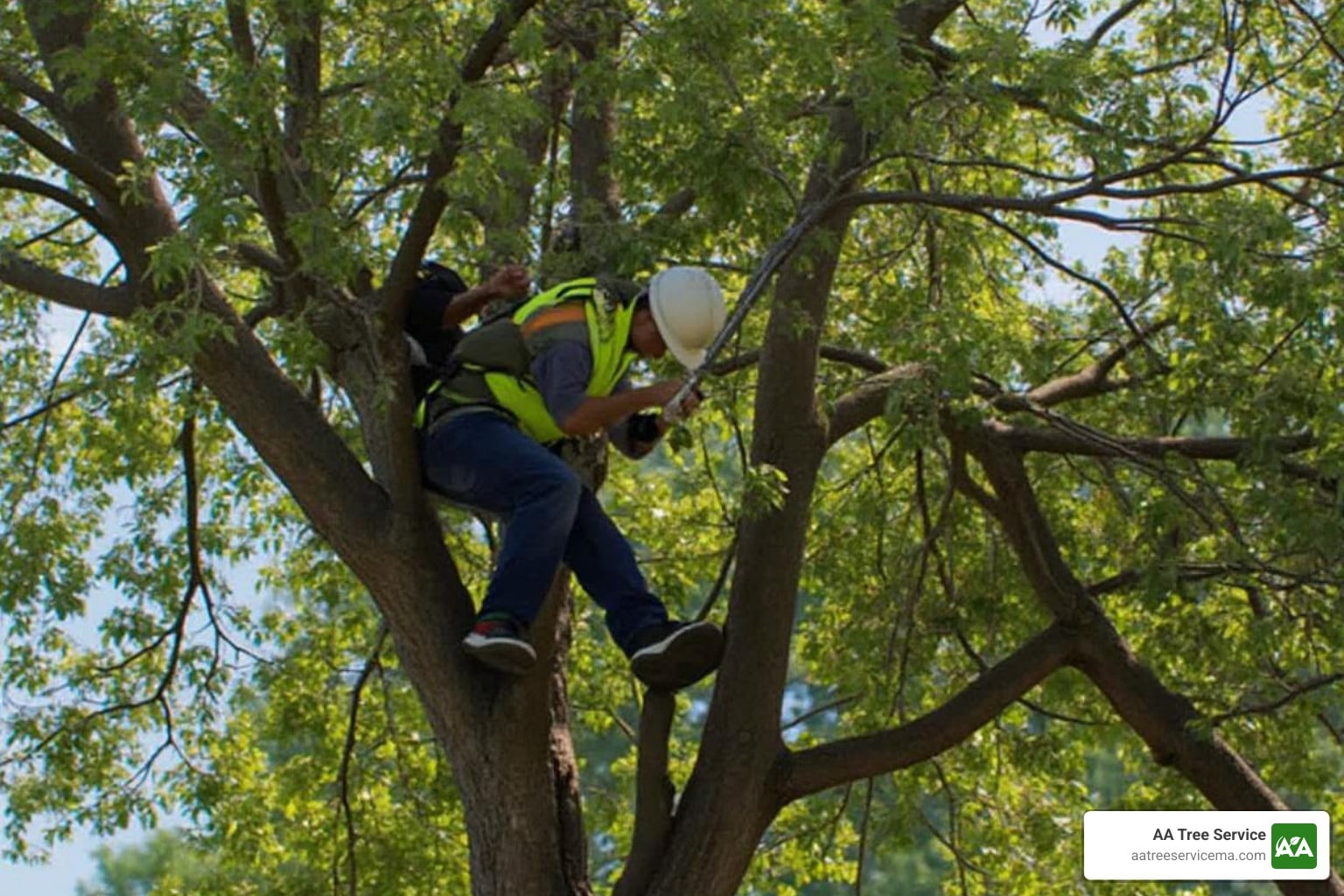
Why Understanding Local Pruning Regulations Matters Before You Cut
Local tree pruning involves more than just proper cutting techniques; it requires understanding your community’s specific regulations, permits, and protected tree ordinances.
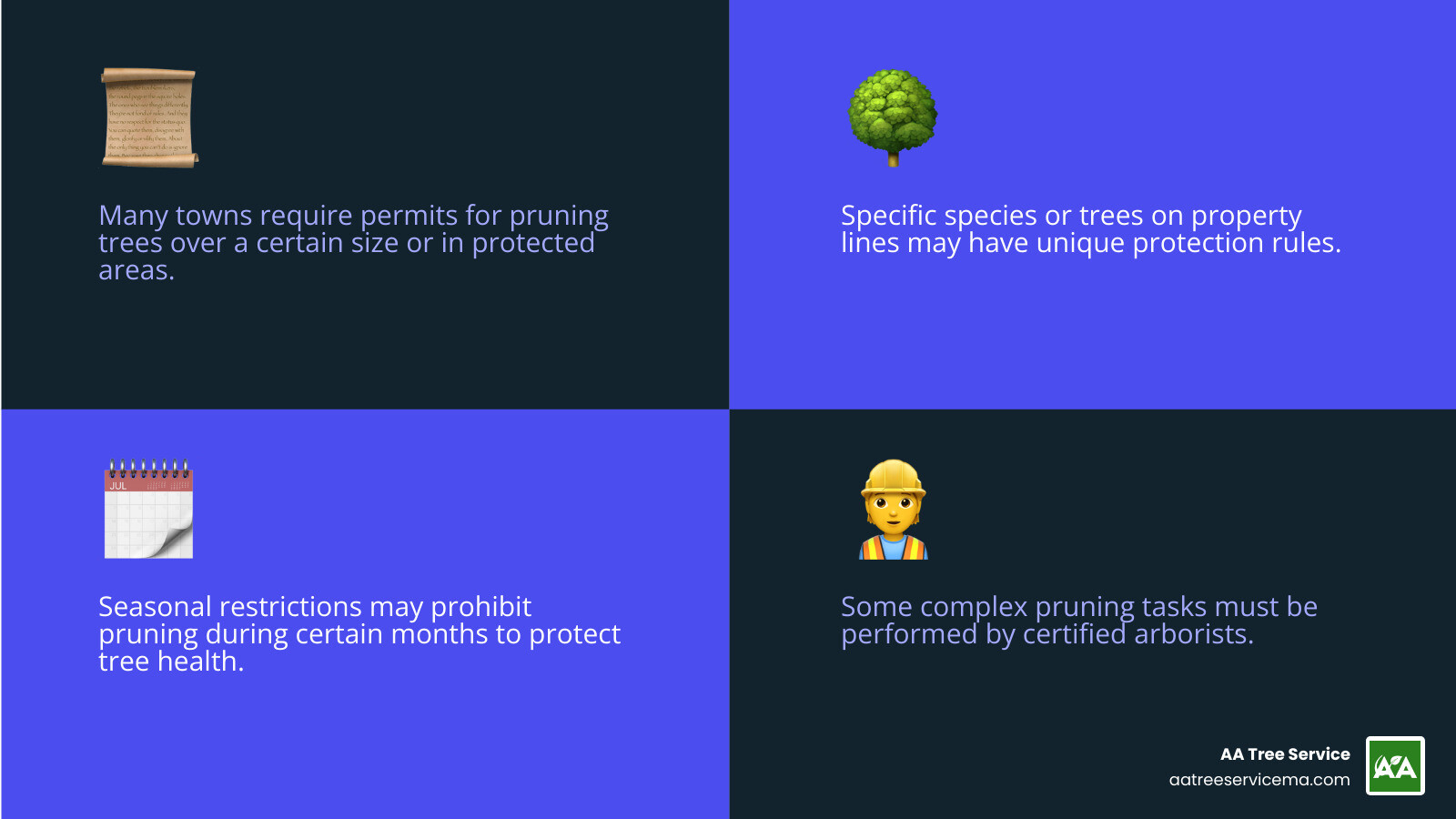
Quick Guide to Local Tree Pruning Regulations:
- Municipal permits – Often required for trees over certain sizes or in protected areas.
- Street tree rules – Special regulations for trees near public roads and sidewalks.
- Protected species – Some trees cannot be pruned or removed without specific permits.
- Property line considerations – Rules exist for trees on or near property boundaries.
- Seasonal restrictions – Some areas may ban pruning during specific months.
- Professional requirements – Certain work must be performed by certified arborists.
Knowing these rules upfront can save you from hefty fines and legal headaches. In Massachusetts and New Hampshire, regulations vary significantly by town. What’s allowed in one community might be prohibited in another, with rules covering everything from branch size to heritage tree protection.
Improper pruning can weaken trees, create safety hazards, and lead to mandatory removal, while violating local ordinances can result in fines from hundreds to thousands of dollars.
Similar topics to local tree pruning:
Why Professional Pruning is Essential for Your Trees
While trees in a forest are self-sufficient, those in our yards and urban environments need extra care. Local tree pruning by a professional is essential not just for aesthetics, but for a tree’s health, your safety, and your property’s value.
Professional pruning offers significant benefits. By removing dead, diseased, or damaged branches, we prevent decay from spreading and encourage healthy new growth. This is vital for the tree’s overall health.
Safety is paramount. Overgrown or weak branches can become serious hazards during storms, potentially damaging your home or causing injury. Professional pruning identifies and removes these risks before they become a problem.
Well-maintained trees also improve curb appeal and can increase your property value. They contribute to a beautiful landscape that looks cared for and inviting. Proper care ensures your trees remain a valuable asset.
Healthy trees are also crucial for the environment. They clean the air, reduce stormwater runoff, and prevent soil erosion. By keeping your trees healthy through professional pruning, you contribute to a healthier urban environment for everyone.
Furthermore, pruning increases a tree’s structural strength. Developmental pruning, especially for young trees, trains them to have a strong central leader and well-spaced branches, helping them resist damage from wind and ice as they mature.
Finally, removing diseased branches promptly can stop infections from spreading throughout the tree and to others on your property. A professional can identify issues you might miss.
For more information on how we can help keep your trees healthy and strong, visit our page on Tree Care Services.
The Difference Between Tree Trimming and Pruning
While often used interchangeably, “tree trimming” and “tree pruning” have distinct purposes. Understanding the difference is key to proper tree care.
Tree trimming is typically done for aesthetics. It focuses on shaping smaller trees, hedges, or shrubs to control their size and give them a tidy appearance. It’s about looking good.
Tree pruning, however, is a more strategic, health-focused process. It involves making precise cuts to remove dead, diseased, or damaged branches to improve a tree’s overall structure, health, and safety. It’s both an art and a science, requiring a deep understanding of tree biology to make beneficial cuts without causing harm.
We prune to manage growth, encourage healthy development, and remove hazardous branches that could pose a risk to your property or family.
For a deeper dive into these services, you can explore our page on Tree Pruning and Trimming.
Signs Your Tree Needs Pruning or Removal
Knowing when your tree needs attention is crucial for maintaining a safe and healthy landscape. Look for these common signs:
- Overgrown Branches: Branches growing too close to your house or power lines, or obstructing views and walkways.
- Dead or Diseased Limbs: Branches without leaves in the growing season, or those with discolored leaves, cankers (sunken areas), or unusual growths.
- Cracks in the Trunk or Major Limbs: Significant cracks or splits indicate structural weakness and can be dangerous.
- Leaning Tree: A sudden or significant lean can signal root problems or structural instability.
- Mushrooms at the Base or on the Trunk: Fungi growing on a tree are a strong indicator of internal decay or root rot.
- Lack of Leaves in Season: If a deciduous tree doesn’t leaf out fully in spring, it could be dead or dying.
- Pest Infestation: Holes in the trunk, sawdust-like material, or visible insects can point to a pest problem.

If you notice any of these signs, it’s best to consult with a professional for an accurate diagnosis and recommendation.
A Homeowner’s Guide to Local Tree Pruning
While we always recommend leaving complex or hazardous tree work to professionals, understanding the basics of local tree pruning can help you know when to call for expert help.
When is the Best Time to Prune in Massachusetts and New Hampshire?
Timing is critical for tree health. The best time for most pruning in Massachusetts and New Hampshire is the dormant season (late winter to early spring). Pruning while trees are “asleep” reduces stress, provides a clear view of the branch structure, and lowers the risk of pest or disease infection through fresh cuts. Dormant pruning is especially important for species like oaks to prevent the spread of oak wilt, a deadly fungal disease transmitted by beetles attracted to fresh wounds in summer.
However, there are exceptions:
- After Storm Damage: Broken or hazardous branches should be removed immediately, regardless of the season, to prevent injury or further damage to property.
- Avoiding Fall Pruning: Heavy pruning in the fall is generally avoided. It can stimulate weak new growth that won’t have time to harden off before the first frost, making it vulnerable to winter damage. Fall wounds also heal slower, exposing the tree to decay fungi that are active in the cool, moist weather.
- Summer Pruning: Light pruning in summer is acceptable for specific goals, like removing suckers or water sprouts, or directing growth on a young tree. However, heavy pruning should be avoided as it removes leaves (the tree’s food factories), which can stress the tree during its active growing season.
- Species-Specific Timing: Flowering trees that bloom in spring (like magnolias, dogwoods, and lilacs) are best pruned after they bloom to avoid removing that season’s flower buds. Summer-flowering trees (like crape myrtles) can be pruned in the dormant season.
For more guidance, you can refer to resources like Annual Tree Pruning Steps from Planting to Maturity.
Foundational Pruning Techniques Explained
Local tree pruning uses several techniques for specific goals. A certified arborist will recommend the right approach for your tree’s needs. Here are the foundational methods we use:
- Crown Cleaning: This is the most common type of pruning. It involves the selective removal of what arborists call the “four Ds”: dead, dying, diseased, or damaged branches. We also remove crossing or rubbing branches that can create wounds and future weak points. This technique improves the tree’s overall health, appearance, and safety by eliminating weak and infectious wood.
- Crown Thinning: This technique is used to reduce the density of live branches in the canopy. By selectively removing branches, we improve light penetration and air circulation, which can reduce the risk of some diseases. More importantly, it reduces the “sail effect,” where a dense canopy catches wind like a ship’s sail, increasing the risk of limb failure or uprooting during a storm. We typically remove no more than 25% of the live canopy at one time, focusing on the outer parts of the crown to reduce weight on the ends of limbs.
- Crown Raising: This involves removing the lowest branches of a tree to provide clearance for pedestrians, vehicles, buildings, or views. It’s a common request for street-side trees or those overhanging driveways and sidewalks. Standard clearances are typically 8 feet above a sidewalk and 14-16 feet above a street, but this can be adjusted based on your specific needs.
- Crown Reduction: This is a technical process used to reduce the height or spread of a tree. It is the proper alternative to the harmful practice of “topping.” In crown reduction, we carefully prune branches back to a strong lateral branch that is at least one-third the diameter of the branch being cut. This ensures the tree can still effectively transport water and nutrients and properly seal the wound. It maintains the tree’s structural integrity and natural form, unlike topping, which creates weak, hazardous regrowth.
- Deadwooding: As a specific subset of crown cleaning, deadwooding is simply the removal of dead branches. This is a critical safety measure, as dead branches can break and fall at any time. It can be performed at any time of year without harming the tree.
- Structural Pruning for Young Trees: This is a long-term investment in a tree’s future. Performed on young to middle-aged trees, it aims to establish a strong central trunk (or “leader”), good branch spacing, and strong branch attachments. By correcting structural flaws early, we prevent future problems like co-dominant stems with included bark, which are highly prone to splitting as the tree matures. This “training” helps the tree develop a durable structure that can withstand storms and live a long, healthy life.
Proper cutting is critical. We use the three-cut method for larger limbs to prevent bark tearing and protect the branch collar, which is essential for the tree’s healing process.
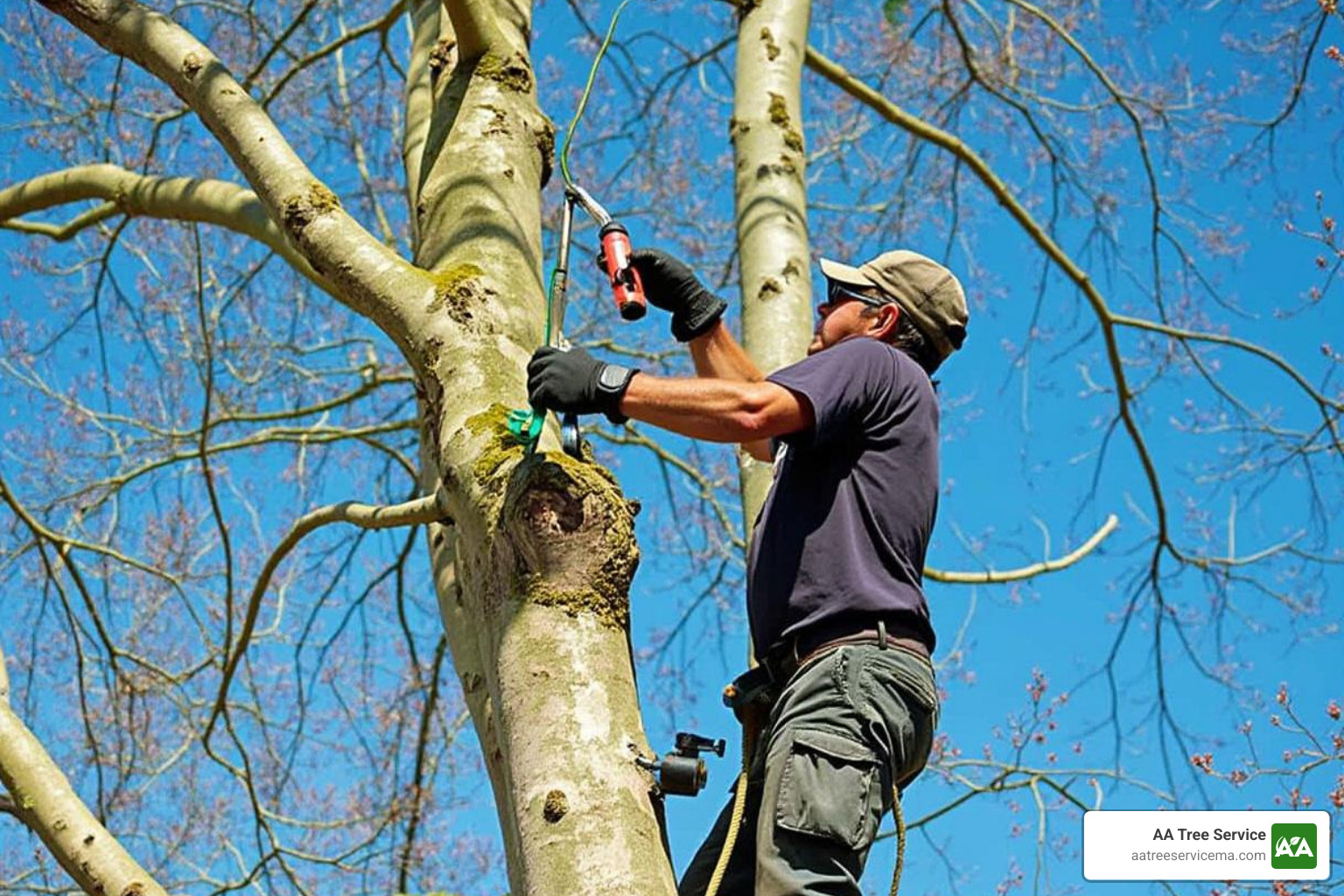
This method ensures a clean cut that allows the tree to compartmentalize and seal the wound effectively.
Understanding Local Regulations in Your Town
Navigating local tree ordinances in Massachusetts and New Hampshire is crucial to avoid fines and legal issues. What’s required in Amesbury, MA, might differ from Amherst, NH.
Here’s what to be aware of:
- Municipal Bylaws: Check with your town’s planning department or conservation commission for ordinances on tree pruning and removal, which often specify when permits are required based on tree size (diameter at breast height), location, or species.
- Tree Removal Permits: Significant pruning (e.g., removing more than 25-30% of the canopy) or removal almost always requires a permit, especially for larger trees, to protect the community’s urban canopy.
- Protected Trees: Some towns protect “heritage,” “historic,” or “specimen” trees due to their size, age, or species. Pruning these requires special permission and must often be supervised by a certified arborist.
- Street Tree Regulations: Trees in the public right-of-way (the strip of land between the sidewalk and the street) are typically owned and managed by the municipality. You cannot prune or remove them without a permit and explicit permission.
- Property Line Considerations: Discuss plans with your neighbor if a tree is on a property line to avoid disputes. While you generally have the right to trim branches overhanging your property, you cannot do so in a way that harms the overall health of the tree.
We are familiar with regulations across the region, including in areas like Lexington, MA. More info about Tree Services in Lexington, MA. We can help you steer these requirements.
Hiring a Qualified Local Tree Pruning Service
When it comes to local tree pruning, hiring a qualified professional is a necessity for any job beyond small, easily accessible branches. Your trees are valuable assets, and their care requires expertise, proper equipment, and a commitment to safety.
What to Look For in a Tree Service Professional
Choosing the right tree service is an investment in your property’s health and safety. Here’s what to look for:
- ISA Certification: This is the gold standard. An ISA Certified Arborist has proven knowledge in the science of tree care and follows a strict code of ethics. You can Find an ISA Certified Arborist near you.
- Insurance and Liability Coverage: This is non-negotiable. Ensure the company has full general liability and worker’s compensation insurance to protect you from financial responsibility for any accidents. Always ask for proof.
- Local Experience: A company with experience in Massachusetts and New Hampshire understands our local tree species, climate, and municipal regulations. AA Tree Service has over 20 years of experience serving communities across MA and NH.
- Positive Reputation and Detailed Estimates: Check online reviews and ask for local references. A professional company will provide a clear, written estimate that details the scope of work and total cost to avoid surprises.
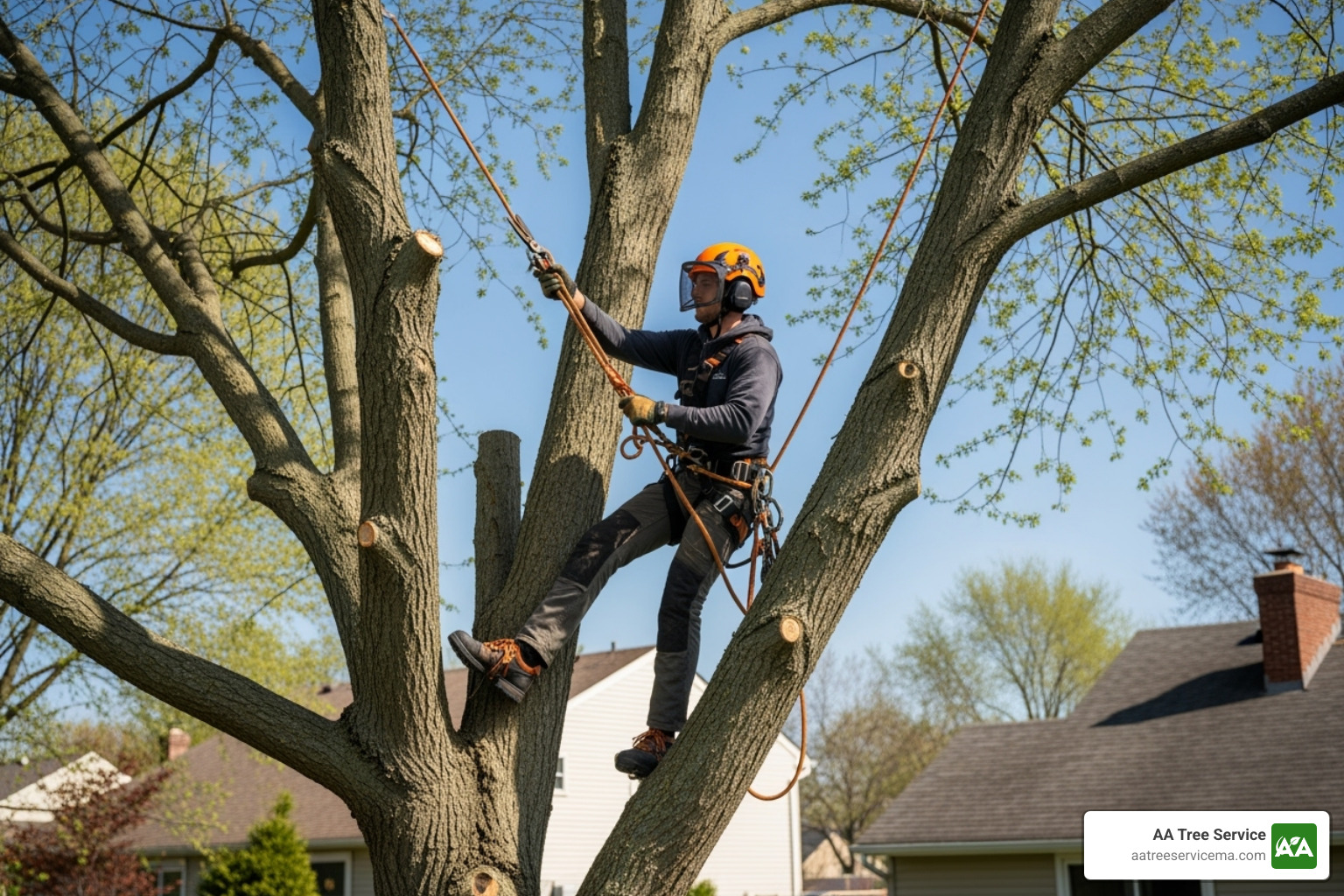
We pride ourselves on meeting these qualifications to provide you with exceptional tree care and peace of mind.
Understanding the Costs of Professional Pruning
The cost of local tree pruning varies based on several factors. Please note: the following are average costs based on internet data and not actual costs for AA Tree Service. For a precise quote, we offer free same-day estimates.
Key factors influencing cost include:
- Tree Size and Type: Larger trees require more time, specialized equipment (like bucket trucks), and a larger crew, which increases the cost.
- Tree’s Health and Condition: A tree with extensive deadwood, disease, or structural issues requires more meticulous and time-consuming work.
- Location and Accessibility: Trees in hard-to-reach areas—near homes, power lines, or on steep slopes—are more challenging and costly to prune.
- Number of Trees: While not always the case, pruning several trees at once can sometimes result in a better per-tree value compared to individual visits.
- Debris Removal: Most professional quotes include the cost of chipping and hauling away all debris.
Considering these factors, average costs for local tree pruning can range widely. A medium-sized tree might cost between $300 to $800, while larger or more complex jobs could range from $800 to $2,500 or more. These are general averages; your quote will reflect the unique needs of your property.
The Dangers of DIY Tree Pruning
While DIY pruning might seem like a way to save money, the risks far outweigh the benefits. We strongly advise against it for anything but the smallest, ground-level branches.
- Personal Injury Risks: Tree work is inherently dangerous. Falls, cuts from saws, and falling branches are common risks for homeowners. Professionals use extensive training and safety gear to minimize these dangers.
- Property Damage: An improperly cut branch can fall on your home, car, or fence, causing costly damage. Professionals have the techniques and equipment to control where limbs fall.
- Incorrect Cuts Harming the Tree: Incorrect cuts, like “topping” or cutting too close to the trunk, prevent proper healing and leave the tree vulnerable to disease, decay, and pests.
- Power Line Hazards: Never attempt to prune trees near power lines. This poses an extreme electrocution risk. Always call a professional arborist or your utility company for this hazardous work.
Tree work is a specialized task. We have the expertise, equipment, and insurance to do the job safely and effectively. For qualified local tree pruning, you can always reach out to us. More info about Local Tree Trimmers in My Area.
Frequently Asked Questions about Tree Pruning
It’s natural to have questions about your trees. Here are some of the most common questions we get asked, along with our expert answers.
How do I know if a tree is diseased or just needs water?
It can be tricky, as some signs of thirst and sickness overlap. A closer look can help tell the tale.
Signs of disease include fungus or mushrooms on the trunk, cankers (sunken, discolored spots on bark), unusual growths, visible pests or insect holes, and bark falling away to reveal dead wood underneath. Signs of dehydration often involve the leaves: look for wilting, curling, or leaves with brown, crispy edges that appear scorched. Brittle branches that snap easily are another sign of thirst. A simple test is to check the soil a few inches down; if it’s bone dry, the tree is likely thirsty.
While you can try deep, slow watering for a thirsty tree to see if it recovers, a suspected disease requires a professional diagnosis. An ISA Certified Arborist can identify the specific pathogen or pest and recommend the right treatment plan. For more tips, see our page on Routine Tree Maintenance.
Can you save a tree that has been damaged in a storm?
Often, yes. The viability of a storm-damaged tree depends on its health before the storm, its species, and the extent of the damage. The first step is a professional assessment. We check for a split trunk, how much of the leafy crown has been lost (if it’s over 50%, removal is often the safest option), the size and location of the remaining wounds, and the tree’s overall structural integrity.
If the damage is limited to a few limbs and the main trunk is sound, professional local tree pruning can remove broken branches and perform corrective pruning to rebalance the tree and promote healing. For trees with some structural weakness but that are otherwise healthy, we can install cables and bracing systems for extra support. If a tree is too damaged or poses too great a risk, removal is the safest and most responsible choice.
We understand storms don’t wait for business hours, which is why we offer 24/7 emergency tree services to respond quickly and secure your property.
What is structural pruning and why is it important for young trees?
Structural pruning is a critical investment for young trees. It’s a specialized type of local tree pruning that guides a tree to grow a strong, stable framework, ensuring its long-term health, safety, and beauty. It is proactive care, rather than reactive repair.
The main goals are to:
- Establish a single, strong central trunk or “leader.”
- Encourage well-spaced branches with strong, U-shaped connections to the trunk. V-shaped connections with included bark are weak and prone to failure.
- Remove or shorten competing leaders and weak, crossing, or poorly attached branches.
- Manage the growth rate of lower branches to ensure they don’t outgrow the main trunk.
This process prevents future problems like splitting trunks or limb failure during storms. It significantly reduces the need for costly and extensive corrective pruning later in the tree’s life and helps the tree better withstand wind, ice, and snow, allowing it to thrive for decades.
What is ‘tree topping’ and why is it so harmful?
Tree topping is the indiscriminate cutting of tree branches to stubs or to lateral branches that are not large enough to assume the terminal role. It’s a harmful, outdated practice that some untrained tree cutters still offer, often as a way to quickly reduce a tree’s size. However, it severely damages the tree and creates long-term hazards.
Here’s why topping is so destructive:
- Starvation: Topping can remove 50-100% of a tree’s leaf-bearing crown. This removes the tree’s ability to photosynthesize, essentially starving it and triggering a survival response.
- Weak, Unstable Regrowth: The tree is forced to grow dense, upright sprouts (called watersprouts or epicormic shoots) just below the cuts. These new limbs are weakly attached to the surface of the old branches and are highly prone to breaking off, especially during storms.
- Decay and Disease: The large, flat wounds created by topping do not heal properly. They expose the wood to pests and decay fungi, which can spread down into the main branches and trunk, rotting the tree from the inside out.
- Increased Future Costs: A topped tree requires constant maintenance to manage the hazardous regrowth. Eventually, the decay and structural weakness will make the tree so dangerous that it must be removed entirely, a far greater expense than proper pruning.
A professional arborist will always use proper crown reduction techniques instead of topping to manage tree size safely and effectively.
Do pruning cuts need to be treated with wound paint or sealant?
This is a common myth. The modern, scientifically-backed answer is no, you should not use wound paint or sealant on pruning cuts. For decades, it was common practice, but research has shown it does more harm than good.
Trees have their own highly effective defense system. When a branch is properly cut, the tree responds by forming protective chemical and physical barriers in the wood to resist the spread of decay. This process is called CODIT (Compartmentalization of Decay In Trees). A clean, proper cut just outside the branch collar allows this natural process to happen efficiently.
Applying sealant or paint actually interferes with this process. These substances can trap moisture and decay-causing fungi against the wound, preventing the wood from drying and creating an ideal environment for rot to begin. They can also crack over time, creating hidden entry points for pests and disease. The best way to help a tree heal is to make a proper pruning cut and let the tree’s natural defenses do their job.
Protect Your Property with Expert Tree Care
We’ve covered the essentials of local tree pruning, from its importance for tree health and safety to navigating local regulations. The key takeaway is that professional tree care is a wise investment for your property.
Regular maintenance, especially professional pruning, keeps your property safe, boosts its value, and contributes to a healthier local environment. It’s about giving your trees the expert care they need to thrive.
When it comes to tree work, safety must always come first. The dangers of DIY pruning are significant, which is why hiring professionals is a necessity for anything beyond the simplest cuts.
Here at AA Tree Service, we are passionate about providing top-notch tree care. With over 20 years of experience serving communities across Massachusetts and New Hampshire, our ISA Certified Arborists are ready to bring their expertise to your home. We’re here to help you protect your property and enjoy a beautiful, safe landscape.
Don’t wait for a small branch to become a big problem. For all your local tree pruning needs, we invite you to reach out for a free, same-day estimate. Let’s work together to help your trees thrive for years to come! Contact us for your professional tree pruning needs today.