Why Natural Stump Dissolvers Are Worth Trying
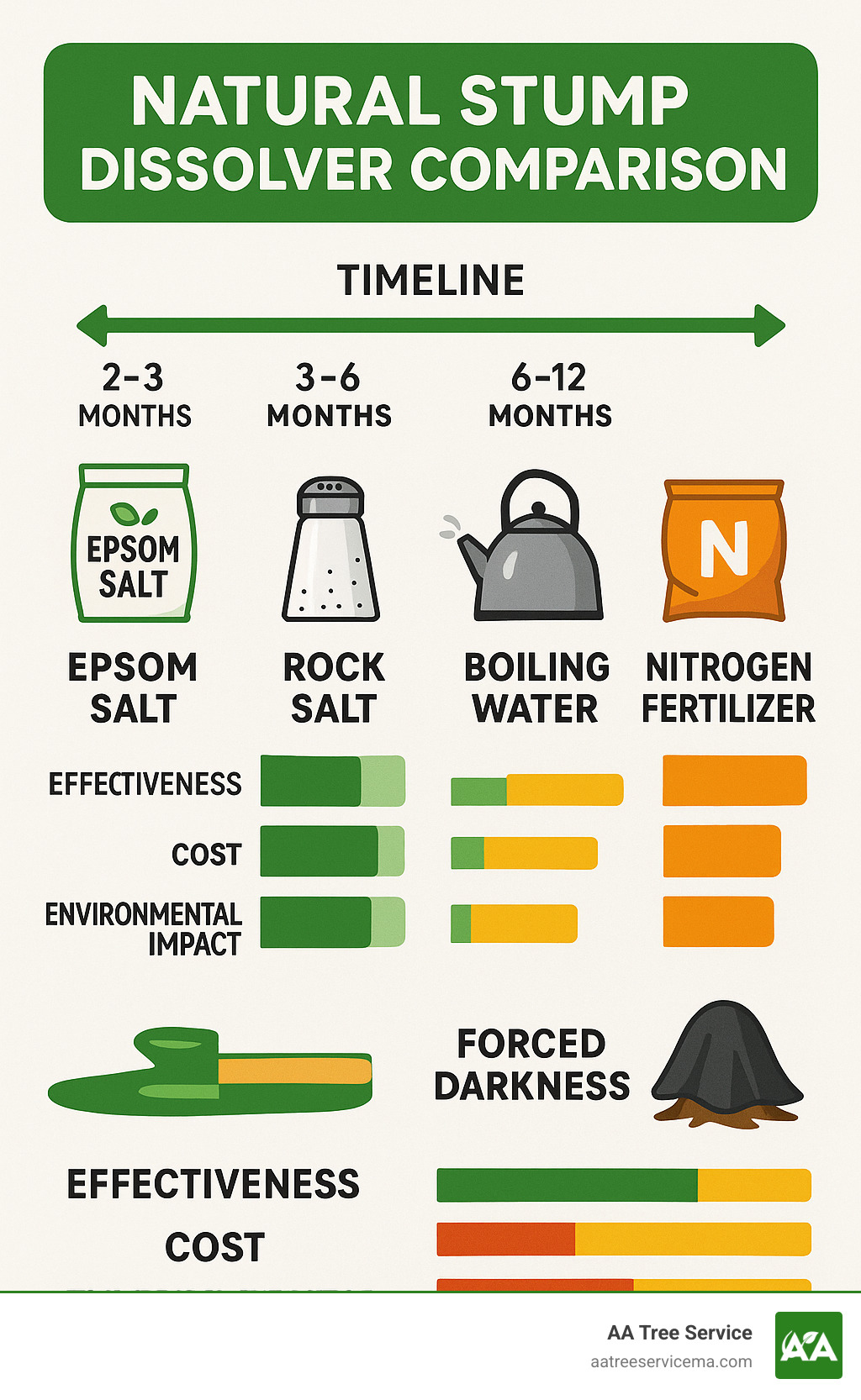
Looking for a natural stump dissolver that actually works? Here are the most effective options:
- Epsom Salt – Dehydrates stumps in 2-3 months, full decay in 6-12 months
- Rock Salt – Similar to Epsom salt but may harm surrounding soil
- Boiling Water – Chemical-free option that weakens wood fibers
- High-Nitrogen Fertilizer – Accelerates decomposition by feeding fungi
- Forced Darkness – Covering with a tarp creates ideal decay conditions
That unsightly tree stump in your yard doesn’t have to be a permanent fixture. Whether it’s creating a tripping hazard for your family, making lawn maintenance difficult, or simply ruining your property’s aesthetics, finding an effective natural stump dissolver is often preferable to mechanical grinding or harsh chemicals.
Many Massachusetts and New Hampshire homeowners are surprised to learn that nature already has efficient systems for breaking down wood – we just need to accelerate them. Natural dissolution methods work by either dehydrating the wood tissue or creating ideal conditions for decomposing organisms like fungi and bacteria to thrive.
The appeal of natural methods is clear: they’re typically more budget-friendly than professional grinding (which can cost $200-$900+), gentler on your soil, and safer for pets, children, and surrounding plants. While they do require patience, the results can be impressive without the noise, mess, and expense of mechanical removal.
“I wish I had known these natural methods sooner,” one homeowner told us after successfully removing a maple stump using Epsom salt. “It took about three months to kill the stump completely and another six months for it to become soft enough to break apart easily.”
While natural stump dissolvers take longer than chemical or mechanical methods, they offer a safe, eco-friendly alternative that many New England homeowners prefer. The key is understanding which method is best for your specific situation and how to apply it correctly.
Easy natural stump dissolver glossary:
– local stump grinding
– local stump removal service
What Is a Natural Stump Dissolver and How Does It Work?
Ever wondered how that massive oak stump in your yard might eventually disappear? A natural stump dissolver is Mother Nature’s way of reclaiming wood—just with a little help from us to speed things up. These are substances or methods that work with nature’s own decomposition processes, without resorting to harsh chemicals or noisy grinders.
Left alone, a tree stump in your Massachusetts or New Hampshire yard might stubbornly hang around for 3-7 years before fully breaking down. That’s because wood decomposition is a complex dance of biological and environmental factors:
The wood’s tough lignin and cellulose structures need fungi and bacteria to break them down. These tiny decomposers require just the right balance of moisture—not too wet, not too dry. They also thrive when there’s a good carbon-to-nitrogen ratio in the wood. As these microorganisms work, they physically weaken the wood fibers, eventually turning that stubborn stump into nutrient-rich soil.
Effective natural stump dissolvers work in two primary ways: some draw moisture out of the stump (essentially dehydrating it to death), while others create the perfect environment for decomposers to thrive and accelerate their work. The beauty of these methods is that they can shrink the decomposition timeline from years to just months, especially in New England’s climate where our seasonal changes actually help the process along.
“I tried both chemical and natural methods on different stumps in my yard,” shares a Concord homeowner. “The natural approach took a bit longer, but my soil stayed healthy and I didn’t worry about my kids playing nearby.”
How a Natural Stump Dissolver Outperforms Harsh Chemicals
While those commercial stump removers with potassium nitrate might promise quick results, natural stump dissolvers offer significant advantages:
Gentler environmental impact: Chemical removers can seep into groundwater and harm beneficial soil organisms. Natural methods, when used correctly, work with your ecosystem rather than against it.
Safer handling: Products with potassium nitrate are oxidizers that create fire hazards and require careful handling. Natural options like Epsom salt are much safer to work with.
Family-friendly solutions: With active kids and curious pets, many Massachusetts homeowners prefer natural methods that don’t require keeping the family away from treated areas.
Better soil health: Instead of leaving potentially harmful residues, natural dissolvers like high-nitrogen compost actually improve your soil quality as they work—a bonus if you’re planning future landscaping.
Budget-conscious approach: Natural methods typically cost between $10-$50, while commercial chemical products often cost more without delivering better results.
As one Nashua gardener told us: “After using chemicals on my first stump and worrying about runoff into my vegetable garden, I switched to Epsom salt. It took about a month longer, but my peace of mind was worth the wait.”
Signs Your Stump Is Ready for Natural Stump Dissolvers
Before you stock up on Epsom salt or cover that stump with a tarp, check if it’s actually ready for treatment. Here’s how to tell if your stump is primed for a natural stump dissolver:
Look for no green shoots or leaves. If your stump is still sprouting, it’s fighting back! Cut off any new growth consistently to exhaust its energy reserves before applying dissolvers.
Check the cambium layer (the thin section between bark and wood). If it’s dry rather than green or moist when scratched, the stump is no longer actively growing.
Watch for peeling or loose bark—this is a clear sign the stump is beginning to surrender to natural decay.
Welcome fungal growth or insect activity. Those mushrooms or busy beetles are signs that nature’s decomposition process has already begun.
Consider the timeline. Stumps that have been cut for at least 12-18 months are ideal candidates, as they’ve already started drying out and breaking down naturally.
For best results in our New England climate, start your natural dissolution project in spring or early summer. This gives the process plenty of warm months to progress before winter arrives, when decomposition naturally slows down.
Patience is key with natural methods—but the environmental benefits and safety advantages make the wait worthwhile for most Massachusetts and New Hampshire homeowners.
Top 5 Natural Stump Dissolvers That Actually Work in New England Yards
After helping countless Massachusetts and New Hampshire homeowners tackle their stump problems, we’ve finded which natural stump dissolvers truly deliver results in our region’s unique climate and soil conditions. Let me share our top five recommendations that have consistently proven effective across New England yards.
Epsom Salt (Magnesium Sulfate)
Epsom salt consistently earns our top recommendation as a natural stump dissolver because it strikes the perfect balance of effectiveness, accessibility, and environmental friendliness.
This humble bathroom cabinet staple works through osmosis, essentially pulling moisture out of the stump and dehydrating any living tissue. As the wood dries out, it becomes a perfect target for nature’s decomposers to break down.
You’ll typically see complete stump death within 2-3 months, with significant decomposition happening over 6-12 months. The application is straightforward: drill several deep 8-10mm holes about 3-4 inches apart across the stump surface, fill them with Epsom salt, add warm water until the salt dissolves, and cover with a tarp to keep rainwater from washing away your work. Reapply monthly, and you’ll soon notice the stump becoming soft and spongy.
At just $5-10 for enough to treat a medium-sized stump, Epsom salt won’t break the bank. Plus, it’s safe for surrounding plants when applied directly to the stump and actually adds beneficial magnesium to your soil as it breaks down.
As one Lexington homeowner told us, “After trying several methods on an old oak stump in our backyard, Epsom salt was the clear winner. It took about four months of regular applications, but by fall, we could break apart the stump with just a shovel.”
Rock Salt (Sodium Chloride)
Rock salt works similarly to Epsom salt but with a few key differences worth noting. This common winter deicer dehydrates the stump while creating a high-salinity environment that prevents microbial growth within the stump itself, forcing decomposition to work from the outside in.
The application method mirrors the Epsom salt approach: drill holes, fill with salt, add water, and cover. Many New England homeowners appreciate that rock salt often works slightly faster than Epsom salt, particularly on our region’s hardwood stumps, with significant decomposition often visible within 2-6 months.
The main drawback? Rock salt can be harsh on surrounding soil and plants if not carefully contained. A Nashua homeowner shared his experience: “I used rock salt on a troublesome maple stump in my yard. It worked well, but I had to be careful to keep it from spreading to my nearby flower beds. The area needed some soil amendments before I could plant there again.”
Boiling Water Shock Method
For the purists among us who want a completely chemical-free approach, the boiling water method offers a simple—if somewhat slower—natural stump dissolver option.
This method works by repeatedly damaging and softening wood fibers through heat shock, making them more susceptible to natural decomposition. The extreme temperature also kills any remaining living cells in the stump.
The process requires some dedication: drill holes into the stump, carefully pour boiling water into them and over the surface, and repeat every few days for several weeks. Many gardeners find that covering the stump with a dark tarp between applications helps retain heat and moisture.
“As an organic gardener in Concord, I was committed to avoiding any chemicals,” one Massachusetts customer explained. “The boiling water method took patience—about three months of regular applications—but eventually softened my birch stump enough that I could break it apart with an axe.”
While this zero-cost method is completely environmentally safe, it does require more frequent attention than other approaches.
High-Nitrogen Compost & Fertilizer
This method takes a different approach by creating ideal conditions for natural decomposers rather than directly attacking the stump. Wood naturally has a high carbon-to-nitrogen ratio that slows decomposition. By adding nitrogen, you essentially set the table for the bacteria and fungi that break down wood.
After drilling holes in your stump, fill them with high-nitrogen materials like blood meal, coffee grounds, or composted manure. Moisten the stump, cover with nitrogen-rich compost, and then top with a tarp to maintain moisture and warmth. Check monthly to replenish your nitrogen sources as needed.
What makes this natural stump dissolver particularly appealing to many New England gardeners is how it improves soil quality while eliminating your stump problem. You’ll typically start seeing visible decomposition within a month, with significant breakdown occurring over 4-12 months.
A Portsmouth resident shared, “I’m an avid composter, and this method aligned perfectly with my gardening practices. I applied a nitrogen-rich compost mixture to my pine stump and introduced some local mushroom spawn. Within a year, the stump was soft enough to plant directly into, creating a unique raised garden feature.”
Forced Darkness & Moisture Trap
Sometimes the simplest approach is the most neat. This completely hands-off method uses no additives at all, making it the most natural of all natural stump dissolvers.
By covering your stump with a light-blocking, waterproof material like a black plastic tarp, you create a warm, dark, moist environment where fungi and other decomposers thrive. Think of it as creating a mini-greenhouse effect that accelerates nature’s own decay process.
Simply cut the stump as close to ground level as possible, cover it completely with black plastic, secure the covering tightly around the base, and add a layer of mulch over the plastic for aesthetics. Then, practice patience—this method typically takes 6-18 months depending on the stump size and wood type.
“This was perfect for a remote corner of my property in Amherst where I wasn’t in a hurry,” shared a New Hampshire customer. “I covered three pine stumps with black plastic and forgot about them for a year. When I checked, they had turned soft and were filled with mushrooms. Nature did all the work!”
While this approach requires minimal effort and zero chemicals, it is the slowest of all natural methods—making it ideal for out-of-the-way stumps where time isn’t a pressing concern.
Step-by-Step Guide: Using an Epsom Salt Natural Stump Dissolver
Since Epsom salt consistently delivers the best results as a natural stump dissolver in our New England climate, I wanted to share my detailed guide based on what’s worked for hundreds of our Massachusetts and New Hampshire customers.
Materials You’ll Need:
Before getting started, gather these simple household items:
- Drill with 8-10mm drill bit (the longer the better, ideally 12+ inches)
- 1-2 pounds of Epsom salt per foot of stump diameter
- Warm water in a watering can
- Waterproof tarp or heavy plastic sheeting
- Rocks or stakes to secure the covering
- Optional: candle wax or wooden plugs
- Optional: mulch for a tidier appearance
Step 1: Prepare the Stump
Start with a clean slate. Clear away all the fallen leaves, twigs, and debris from the stump surface. If possible, use a chainsaw to cut the stump as close to ground level as you safely can – the lower, the better! Finally, clip away any green shoots or sprouts coming from the stump or roots. These little sprouts are the stump’s last-ditch survival attempt, and removing them helps exhaust its energy reserves.
Step 2: Drill Holes in the Stump
Now for the fun part! Create a grid pattern of holes across the entire top surface of the stump. Make each hole about 8-10mm wide (about the diameter of a pencil) and drill as deeply as you can – ideally 8-12 inches down. Space these holes about 3-4 inches apart.
For larger stumps, especially those wider than 12 inches, add some angled holes from the sides that connect with your vertical holes. This creates pathways for the salt solution to reach the heart of the stump and the main roots.
“The drilling is definitely the most labor-intensive part,” laughs Tom from Nashua, NH. “My maple stump took 45 minutes of drilling, but those deep holes made all the difference in how quickly the Epsom salt worked.”
Step 3: Apply the Epsom Salt
Fill each hole completely with Epsom salt – don’t be stingy! Next, pour warm water (not boiling) into each hole until the salt dissolves. You’ll see the solution sink down as the salt dissolves. The goal is to fill each hole without major overflow.
For longer-lasting results, consider sealing the holes with melted candle wax or wooden plugs. This prevents rainwater from diluting your solution and keeps the salt concentrated where you need it.
Step 4: Cover and Protect
Cover the entire stump with a waterproof tarp or plastic sheeting. This creates a mini greenhouse effect that accelerates decomposition while keeping your salt solution from washing away with rain. Secure the covering tightly around the base using rocks, soil, or stakes.
For a more attractive appearance during the months of treatment, you can cover the tarp with a layer of mulch. This also helps keep the tarp in place during New England’s windy days!
Step 5: Maintain and Monitor
Patience is key with any natural stump dissolver. Check your stump monthly and reapply the Epsom salt and water every 4-6 weeks. After about 2-3 months, test how the decomposition is progressing by poking the stump with a screwdriver.
When the stump becomes soft and spongy (typically within 6-12 months), you can start breaking it apart with an axe or shovel. Many of our Massachusetts customers find that after a full year, they can simply dig out the remaining material with hand tools.
Timeline Expectations:
Be patient with this natural process:
– 2-3 months: The stump should be completely dead with no new growth
– 6 months: You’ll notice the outer portions becoming softer
– 9-12 months: Significant decomposition allowing for removal with hand tools
– 12+ months: The stump may be broken down enough to incorporate into your garden soil
“I was skeptical at first,” admits Sarah from Billerica, MA. “But after following this process on our stubborn oak stump, we were amazed at the results. The key was consistency with the reapplications. After about 10 months, we could break apart the stump with just a shovel and planted a beautiful hydrangea in its place.”
For more detailed information about natural approaches to stump removal, visit our Natural Stump Removal page. And if you’re curious about the science behind this method, check out this fascinating research on exhausting tree stump food reserves.
Safety, Environmental Impact & Precautions
While natural stump dissolvers are generally safer than chemical alternatives, they still require careful handling to protect yourself and the environment. Let’s look at how to use these methods responsibly in your Massachusetts or New Hampshire yard.
Safety Precautions:
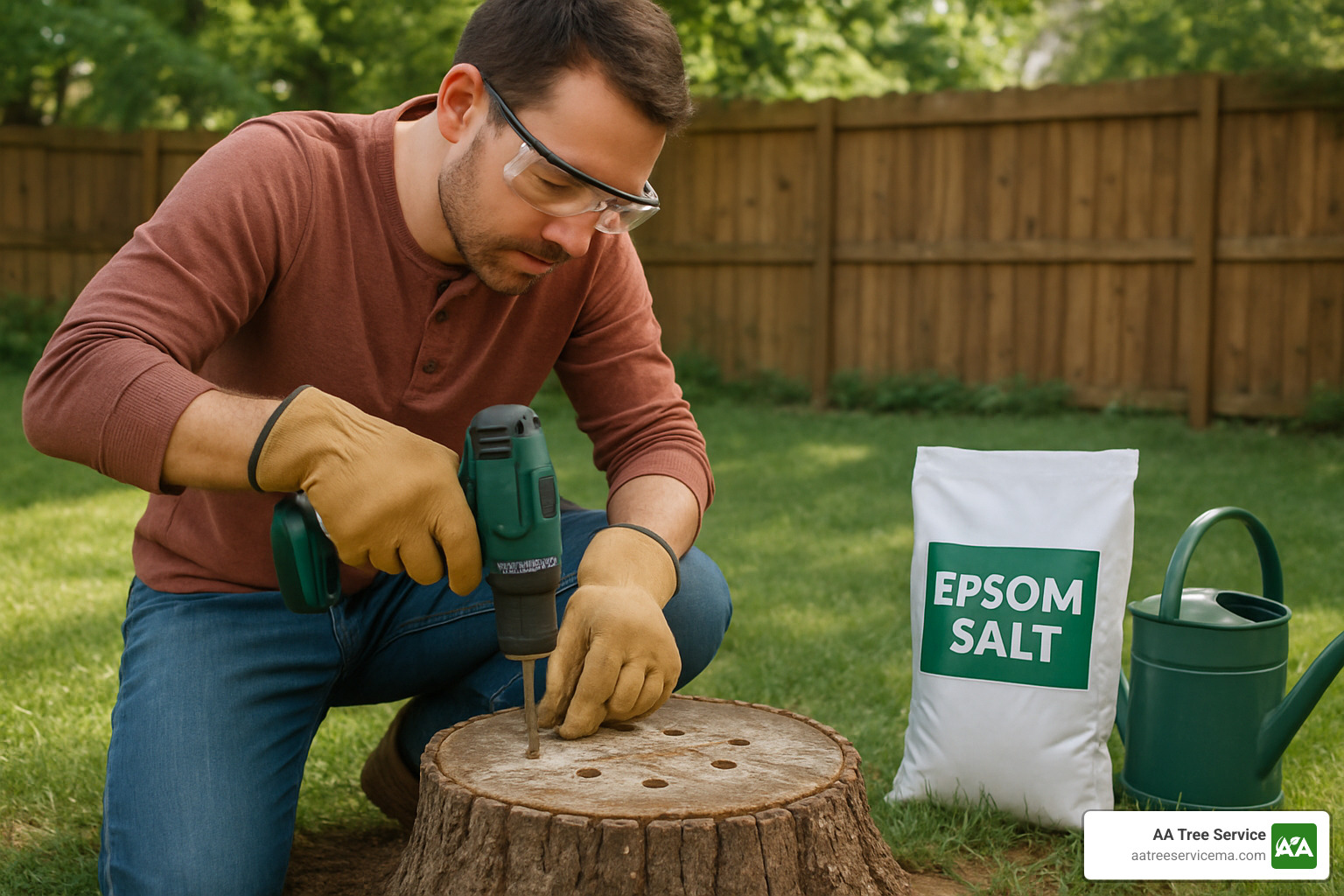
Your safety should always come first. When working with natural stump dissolvers, even gentle ones like Epsom salt, it’s best to wear gloves to protect your skin from irritation. If you’re drilling holes or pouring boiling water, add eye protection to your gear list – those wood chips can fly unexpectedly! Sturdy footwear with good traction helps prevent slips, especially important when you’re carrying hot water or working after rain.
Power tools demand extra attention. Make sure your drill is in good working order and use outdoor-rated extension cords. This might seem obvious, but we’ve seen plenty of preventable accidents over our years of service in New England. If you’re working in dry, dusty conditions (common with older stumps), a simple dust mask can prevent respiratory irritation.
“I learned the hard way about proper footwear,” shared one Concord homeowner. “I was applying Epsom salt to an old maple stump wearing flip-flops, slipped on some loose mulch, and ended up with a sprained ankle. Now I always wear my work boots, even for ‘simple’ yard tasks.”
Keep children and pets away from your project area. While natural stump dissolvers like Epsom salt are relatively safe, they can still cause stomach upset if ingested in large quantities. Store unused materials in clearly labeled containers out of reach of curious hands and paws.
Environmental Considerations:
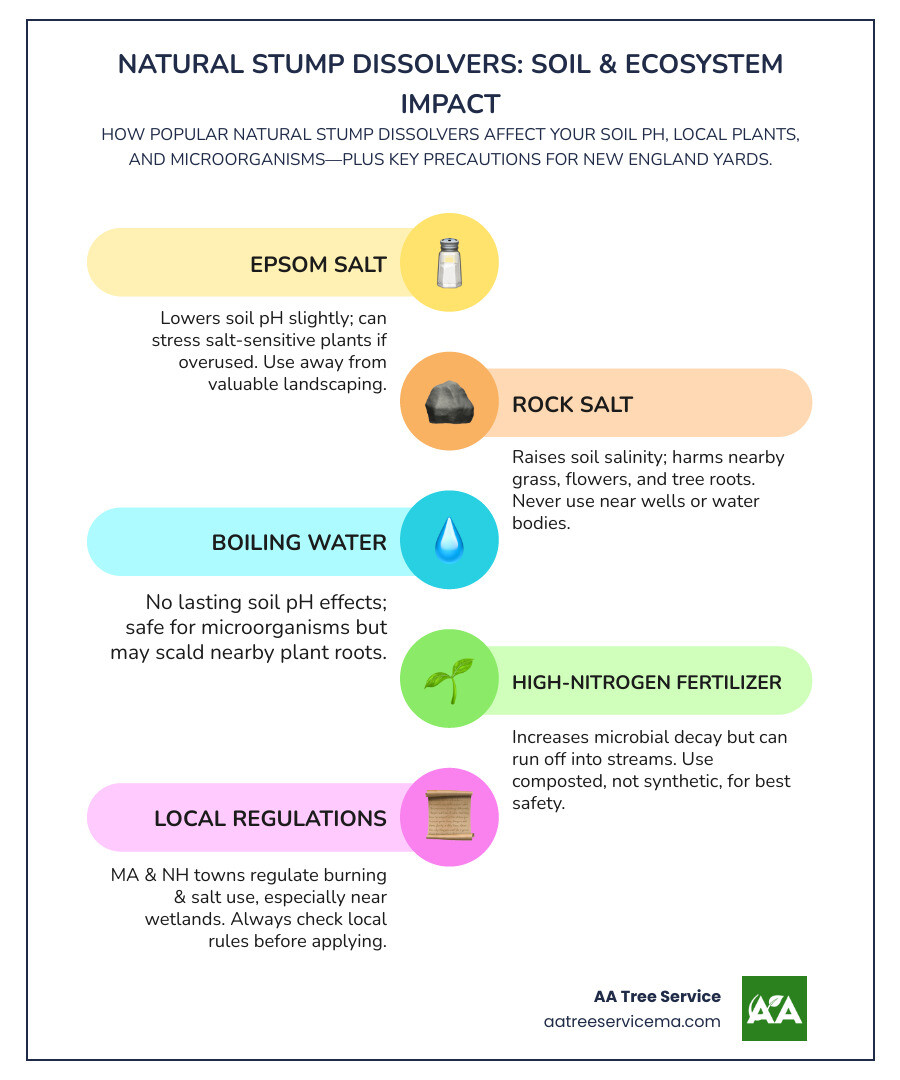
Different natural stump dissolvers affect your soil differently. Epsom salt adds beneficial magnesium while having minimal negative impact. Rock salt, however, can increase soil salinity and harm beneficial organisms – something to consider carefully if you plan to garden in that spot later.
High-nitrogen methods generally improve soil quality as they break down, making them ideal if you plan to plant in that area afterward. Boiling water leaves no lasting soil impact once it cools, making it the gentlest option environmentally.
Timing matters too. Try to avoid applying salt-based methods right before heavy rain to prevent runoff into nearby plant beds or water sources. This is especially important if you live near a water body or have a well on your property. In Massachusetts and New Hampshire’s varied landscapes, what works safely in one yard might cause problems in another.
The root systems of nearby trees and shrubs might extend under your stump area, so monitor surrounding vegetation for any signs of stress after applying salt-based dissolvers. If you notice wilting or yellowing leaves on nearby plants, you might need to adjust your approach.
Local Regulations in Massachusetts and New Hampshire:
Before starting your stump removal project, take a few minutes to check with your local municipality about any regulations. Some towns in Massachusetts and New Hampshire require permits for tree removal work, including stump treatment. This is particularly true in historic districts or conservation areas.
If you’re planning to burn the stump after treatment (a common approach after using a natural stump dissolver to weaken the wood), check your local fire codes first. Many towns in our service area require burning permits, and some prohibit burning entirely during dry seasons or in certain neighborhoods.
“We always recommend checking with your town’s conservation commission before applying any treatments near wetlands or water bodies,” advises our arborist team. “Even natural products can impact sensitive ecosystems if used improperly.”
This is especially important in watershed protection areas, where even natural salt products might be restricted. A quick call to your town office can save you potential headaches (and possibly fines) down the road.
By taking these simple precautions, you can safely use natural stump dissolvers while protecting yourself, your family, and the beautiful New England environment we all cherish. Patience is key – these natural methods take time, but they’re worth the wait for their gentler environmental footprint.
When Natural Isn’t Enough: DIY vs Professional Removal
While natural stump dissolvers work beautifully in many situations, sometimes Mother Nature needs a little mechanical assistance. As much as we love eco-friendly solutions, it’s important to recognize when a stump might require professional intervention.
When to Stay Natural:
Not every stump needs the “big guns” of professional removal. Natural methods remain ideal when you’re dealing with smaller stumps under 18 inches in diameter. If you’re not in a rush to reclaim that space in your yard, and you have the patience to wait 6-12 months for complete decomposition, natural methods offer significant cost savings.
Many of our Massachusetts customers choose natural stump dissolvers for environmental reasons, particularly when the stump is near gardens or sensitive plantings. “I didn’t want any chemicals or heavy equipment near my perennial beds,” explained one homeowner in Andover. “The Epsom salt method was perfect—slow but gentle on my surrounding plants.”
When to Consider Professional Removal:
Sometimes nature simply needs a helping hand. Professional removal becomes the better option when dealing with monster stumps exceeding 18 inches in diameter or when extensive root systems are causing problems with your plumbing or foundation.
Time constraints often drive the decision toward professional services. If you’re preparing your property for sale, planning immediate replanting, or dealing with emergency situations like storm damage, waiting months for natural decomposition isn’t practical.
One Nashua homeowner told us: “After a microburst took down three large pines, we needed the stumps gone quickly to restore our yard. The grinding service took less than two hours for all three stumps—something that would have taken over a year naturally.”
Multiple stumps can also make DIY methods impractical, both in terms of time investment and the cost of materials for treating numerous stumps.
Cost Comparison:
DIY Natural Methods:
The budget-friendly appeal of natural stump dissolvers is undeniable. Most methods cost between $5-$50 total, depending on your approach:
Epsom salt methods typically run $10-$30 (including drill bit and salt), while rock salt can be even cheaper at $5-$25. The boiling water method costs essentially nothing beyond your water bill, and forced darkness using plastic sheeting runs about $5-$20. High-nitrogen fertilizer approaches tend to be the most expensive natural option at $15-$50.
Professional Stump Removal:
Professional services offer speed and convenience at a higher price point. For a single stump, grinding typically costs $100-$400, while complete removal (including major roots) ranges from $300-$1,500 depending on size. Land clearing with multiple stumps can run $500-$3,000+ depending on acreage.
These are average costs based on internet data and not actual costs for AA Tree Service.
The Middle Ground: Rent a Stump Grinder
For the ambitious DIYer who wants faster results than natural methods but isn’t ready to hire professionals, renting a stump grinder offers a middle path. At $100-$200 per day, you can tackle most stumps in a few hours rather than months.
This approach requires physical strength and safety knowledge—these aren’t toys—but can be satisfying for those comfortable with power equipment. As one Merrimack homeowner put it: “I tried the natural approach first but got impatient. Renting a grinder for a day let me finish the job on my timeline while still saving some money.”
“After waiting three months using Epsom salt on a maple stump with limited results, I decided to call AA Tree Service for professional grinding,” explains a homeowner in Chelmsford, MA. “They completed in 30 minutes what would have taken me another six months naturally, and the area was immediately ready for new landscaping.”
The decision ultimately comes down to your specific circumstances: budget, timeline, environmental concerns, and the size and number of stumps you’re dealing with. Many New England homeowners start with natural stump dissolvers and escalate to professional services if results aren’t progressing quickly enough.
For more information about our professional stump grinding services, visit our Stump Grinding page.
Frequently Asked Questions about Natural Stump Dissolvers
How long does a salt-based natural stump dissolver take?
When homeowners ask me about timelines for natural stump dissolvers, I always remind them that Mother Nature works on her own schedule—but we can certainly give her a nudge!
The breakdown process varies quite a bit depending on what you’re working with. Smaller stumps under 12 inches might show significant softening within 6-9 months, while those massive oak giants could take 12-24 months before they’re fully broken down.
The type of tree makes a huge difference too. Those beautiful hardwoods that give New England its famous fall colors—oaks, maples, and hickories—tend to resist decay longer than softwoods like pine or spruce. This is actually why these hardwoods were traditionally used for building homes throughout Massachusetts and New Hampshire!
Freshly cut stumps fight back harder than those that have been weathering in your yard for a year or two. And not surprisingly, applying your natural stump dissolver during the warm, humid months of spring and summer yields much faster results than starting the process as winter approaches.
The secret to success? Consistency. As our head arborist often tells clients: “Many homeowners give up after a couple of months, but the most dramatic decomposition happens between months 6-12 if you’ve been diligent with reapplication.”
In general, expect about 2-3 months to fully kill the stump, 6-12 months before it’s soft enough to break apart with basic tools, and 1-2 years for nature to complete the job.
Are Epsom and rock salt safe for pets and nearby gardens?
When it comes to safety concerns, not all natural stump dissolvers are created equal.
Epsom salt (magnesium sulfate) is generally the more garden-friendly option. It’s actually beneficial to soil in moderate amounts—many gardeners intentionally add it to their soil to provide magnesium for plants. When applied directly into drilled holes, it poses minimal risk to nearby plants. While pets shouldn’t be munching on it (it can cause digestive upset in large quantities), it’s considerably safer than many alternatives.
Rock salt (sodium chloride), on the other hand, requires more caution. This is the same stuff we use on icy roads, and as many New England gardeners have noticed, those roadside plants often struggle in spring. Rock salt can create “dead zones” in soil where nothing will grow for seasons to come. It’s also potentially more harmful if curious pets decide to investigate.
I always recommend these simple precautions regardless of which salt you choose:
– Store any unused product in clearly labeled, sealed containers
– Keep the family dog or cat away from freshly treated stumps
– Cover treated stumps securely with a tarp or plastic
– Be careful not to spill salt on surrounding soil during application
– Give pet paws a quick rinse if they’ve walked through treated areas
“I recommend Epsom salt over rock salt for most residential applications,” our tree care specialist often advises Massachusetts homeowners. “It’s gentler on the surrounding environment while still being effective as a natural stump dissolver.”
Which tree species in MA & NH resist natural stump dissolvers?
Some trees are simply more stubborn than others! In my years working with New England homeowners, I’ve noticed certain native species that seem determined to stick around despite our best dissolution efforts.
Black locust tops the list of challenging stumps. These trees evolved with extremely rot-resistant wood containing natural preservative compounds—the same properties that made them popular for fence posts throughout rural Massachusetts and New Hampshire. White oak stumps are similarly resistant, with dense hardwood that can frustrate even the most patient homeowner.
Black cherry contains compounds that actively fight fungal decomposition, while eastern red cedar’s natural oils make it surprisingly resistant for a softwood. Black walnut contains juglone, which has natural antifungal properties (this is also why not much grows under walnut trees!).
Even moderately resistant species like sugar maple, American beech, hickory, and white pine will take longer than average to break down. The pine’s sticky resin content, in particular, can slow the decomposition process considerably.
For these tough customers, I recommend a multi-pronged approach: drill more holes at closer spacing, combine methods (like Epsom salt plus a darkness cover), reapply your chosen natural stump dissolver more frequently, and most importantly—adjust your expectations. Nature will win eventually, but it might take an extra season.
“In our experience serving New Hampshire and Massachusetts properties,” our team often shares, “black locust and white oak stumps are the most challenging for natural methods. For these species, we often recommend starting with natural methods but being prepared to switch to grinding if results aren’t satisfactory after 6-8 months.”
If you’re dealing with multiple resistant stumps or need the area cleared more quickly, you might want to explore our professional stump grinding services for more immediate results.
Conclusion
There’s something deeply satisfying about solving garden problems in harmony with nature. As we’ve seen throughout this guide, natural stump dissolvers offer thoughtful alternatives to noisy equipment or harsh chemicals – they just ask for a little patience in return.
The journey we’ve taken through these natural methods reveals an important truth for Massachusetts and New Hampshire homeowners: nature already has systems in place to break down wood. We’re simply learning to accelerate what would happen anyway.
Remember these key insights as you tackle that stubborn stump:
First, natural methods truly work, but they operate on nature’s timeline. That beautiful change from solid wood to crumbly, soil-like material typically takes 6-12 months with consistent care. This isn’t a weekend project – it’s more like gardening, requiring occasional attention over seasons.
Second, choosing the right method matters. That 80-year-old oak needs a different approach than a young pine. Consider your stump’s size, species, and surroundings, along with how quickly you need results. While Epsom salt offers that sweet spot of effectiveness, safety, and simplicity for most situations, sometimes combining methods (like salt treatment with a dark covering) can give decomposition a helpful boost.
Safety always comes first – proper gear, checking local regulations, and being mindful of pets and kids around treated areas. What works in coastal Massachusetts might need adjustments in the White Mountains of New Hampshire.
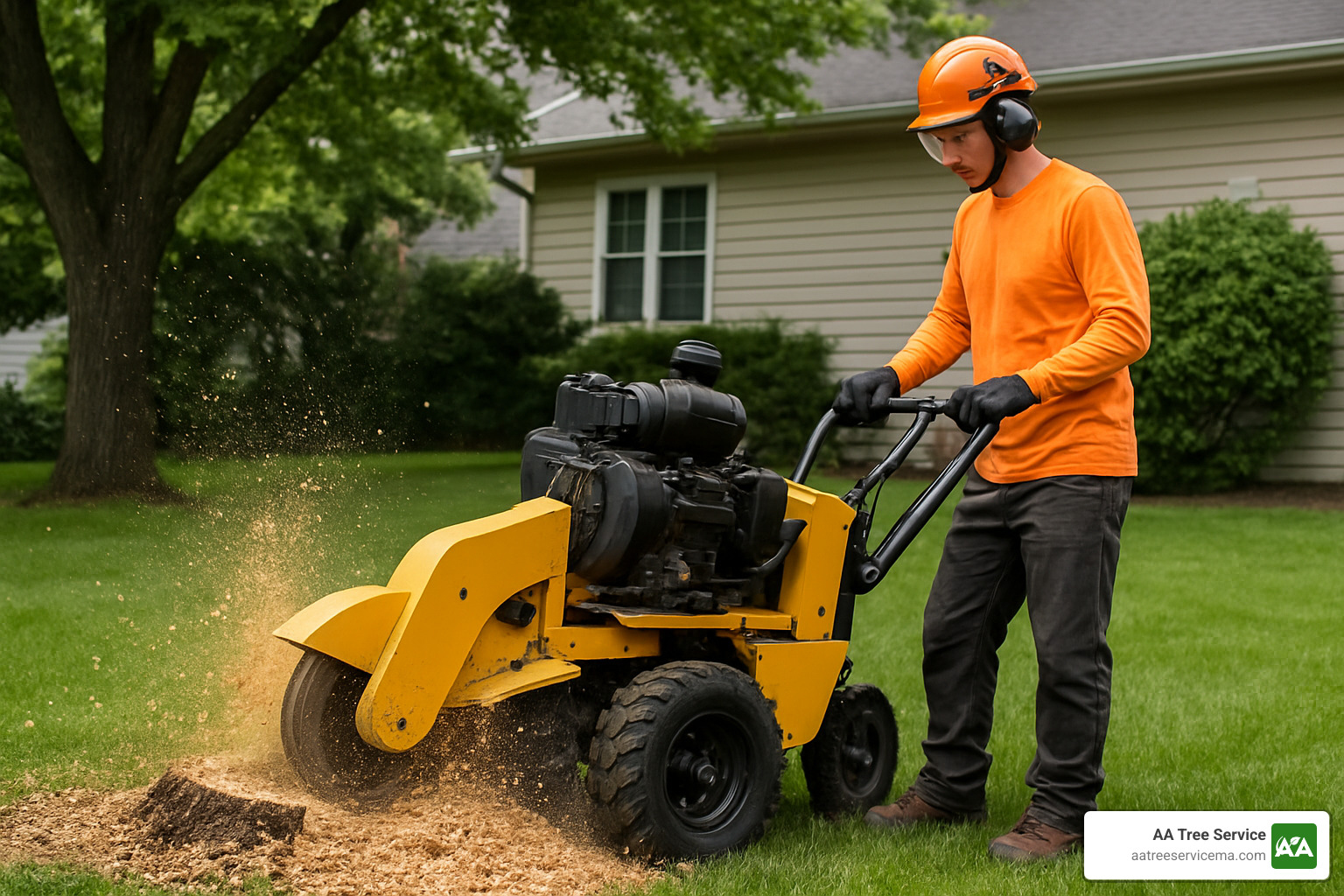
When time is tight or that stump is particularly stubborn, professional removal becomes the practical choice. At AA Tree Service, we’ve been tackling New England’s toughest stumps for over two decades, offering thorough grinding services with same-day quotes throughout Massachusetts and New Hampshire.
Budget considerations matter too. DIY natural approaches typically run $10-$150 all-in, while professional grinding ranges from $200-$900+ depending on complexity. These are average costs based on internet data and not actual costs for AA Tree Service – we’re happy to provide a personalized quote for your specific situation.
Whether you choose the gentle path of a natural stump dissolver or the efficiency of professional removal, that eyesore in your yard doesn’t have to stay. Imagine the possibilities – a new garden bed, expanded patio space, or simply a lawn that’s finally smooth enough for the kids to play without tripping.
For more information about our professional tree services or to schedule a free same-day quote, visit our Tree Removal page or call our team directly. With roots as deep as the trees we care for, we’re here to help with all your New England tree care needs.