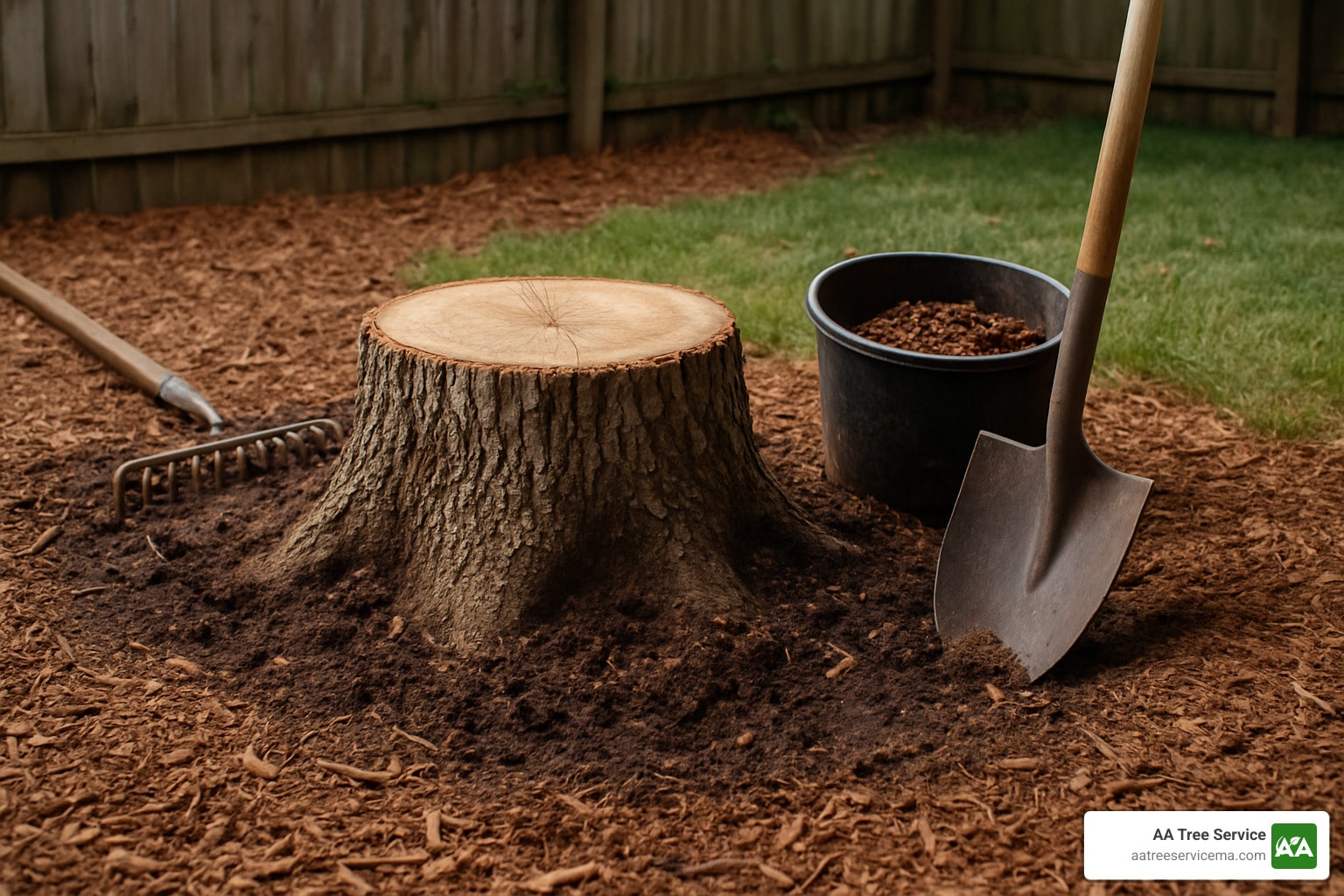
Why Natural Stump Removal Is Your Best DIY Solution
Natural stump removal offers homeowners in Massachusetts and New Hampshire an eco-friendly, cost-effective way to eliminate unsightly tree stumps without harsh chemicals or expensive equipment. After tree removal, those stubborn stumps can become safety hazards, eyesores, and sources of unwanted regrowth that damage your property’s aesthetics and value.
Quick Answer: Top Natural Stump Removal Methods
• Epsom Salt Treatment: Drill holes, fill with magnesium sulfate, wait 2-3 months
• Forced Darkness: Cover with black tarp for 6-18 months to starve roots
• Boiling Water Shock: Pour into drilled holes to kill root systems
• High-Nitrogen Composting: Speed decay with fertilizer and organic matter
• Rock Salt Dehydration: Use sparingly to avoid soil damage
Natural decomposition typically takes 3-7 years without intervention, but these methods can reduce that timeline to just 6-12 months. Unlike mechanical grinding ($100-$400 per stump) or chemical herbicides that risk groundwater contamination, natural approaches protect your family, pets, and surrounding plants while working with nature’s own decay processes.
The humid climate in Massachusetts and New Hampshire actually works in your favor – moisture accelerates the biological breakdown that makes natural stump removal so effective. Whether you’re dealing with a small ornamental tree stump or the remains of a storm-damaged oak, these proven techniques can help you reclaim your yard safely and sustainably.
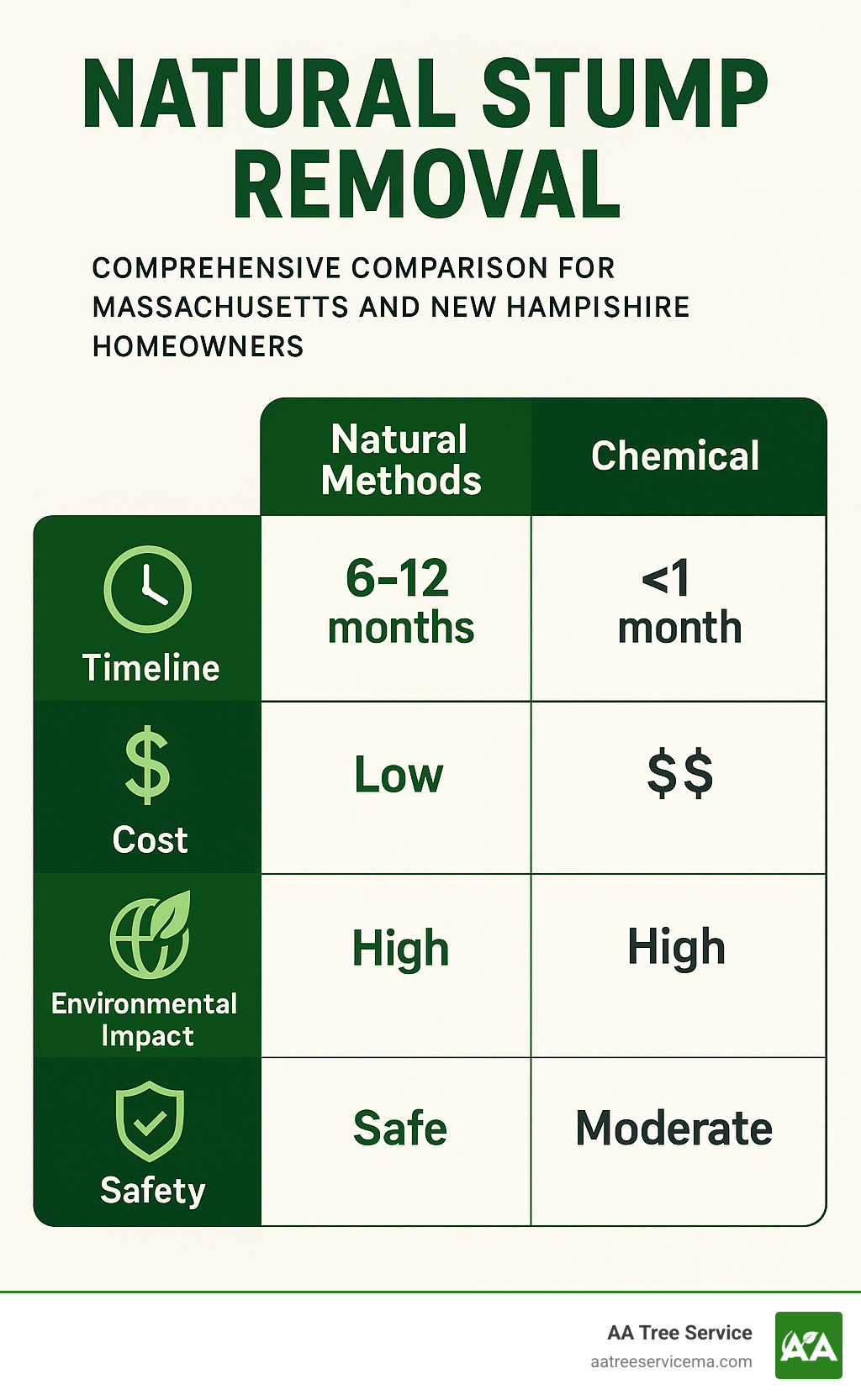
Simple natural stump removal glossary:
Why Choose Natural Stump Removal?
Cutting a tree is only half the job. That leftover stump can sprout, trip kids, dull your mower, and drag down curb appeal. Natural stump removal fixes the problem without the noise, fuel, or groundwater risks that come with mechanical grinding or chemical herbicides.
• Lower carbon footprint – No gas-powered grinders roaring at 90 dB and burning 3-5 gal of fuel per hour.
• Healthier soil – Epsom salt adds magnesium instead of wiping out earthworms the way potassium-nitrate products can.
• Budget friendly – Average internet pricing shows $100-$400 per stump for grinding; natural supplies generally cost under $30 in total.
• Family & pet safe – Magnesium sulfate is used in bath salts; no hazmat suit required.
• Wildlife friendly – Gradual decay supports beneficial insects and fungi that enrich your yard.
• Regulation ready – Many MA & NH towns restrict chemicals near wells, wetlands, or watershed areas.
| Method | Avg. Cost* | Typical Timeline | Environmental Impact | Safety |
|---|---|---|---|---|
| Natural (Epsom) | $15-30 | 2-6 mo | Soil-friendly | Very high |
| Chemical (nitrate) | $50-150 | 1-3 mo | Run-off risk | PPE needed |
| Grinding (mechanical) | $100-1,200+ | Same day | High fuel use | Pro only |
*All prices are average ranges pulled from public internet sources, not AA Tree Service rates.
Natural methods work because they exhaust the stump’s stored carbohydrates or jump-start decomposition. In our humid New England climate, that boost is often enough to see real progress in a single season.
Tools, Materials & Site Preparation
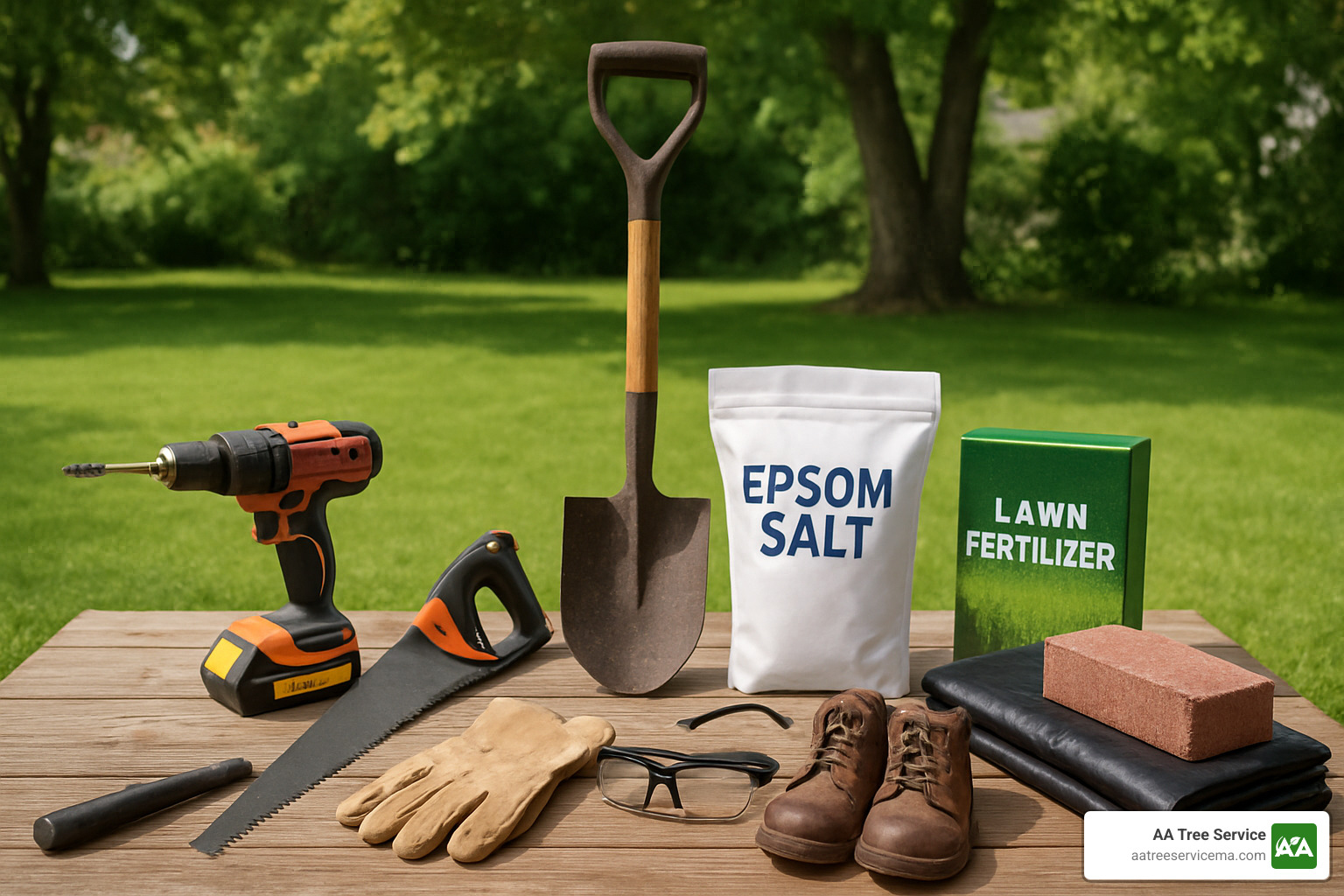
You don’t need a trailer full of rental gear—just common hand tools and a few inexpensive supplies.
Essential toolkit
- Cordless drill + 1-inch spade bit for treatment holes
- Handsaw to cut the stump as low as possible
- Shovel, wheelbarrow, and garden hose
- Safety glasses, work gloves, sturdy boots
Key materials
- Epsom salt (1–2 lb per foot of stump diameter)
- Optional rock salt (use half the Epsom amount and keep 10-ft plant buffers)
- High-nitrogen fertilizer, blood meal, or fish emulsion
- Black UV-resistant tarp or heavy plastic
- Mulch or compost for moisture retention
Money-saving tips
- Buy Epsom salt in 19- to 50-lb bags at farm or hardware stores—cost per pound drops sharply.
- Lawn fertilizer and tarps are deeply discounted around Memorial Day and Labor Day.
- Municipal compost piles often give away rich organic material perfect for stump-top dressing.
Site prep in three quick steps
- Call 811 (Dig Safe) to mark hidden utilities.
- Clear rocks and grade soil so water drains away from, not toward, the stump.
- Rope off the area to keep pets and kids out during treatment.
For projects that feel too large, AA Tree Service is one click away: Stump Removal Service.
Step-by-Step Natural Methods That Work
Below are the five most-used DIY options. Mix and match as needed—combos often cut total time by 30-50 %.
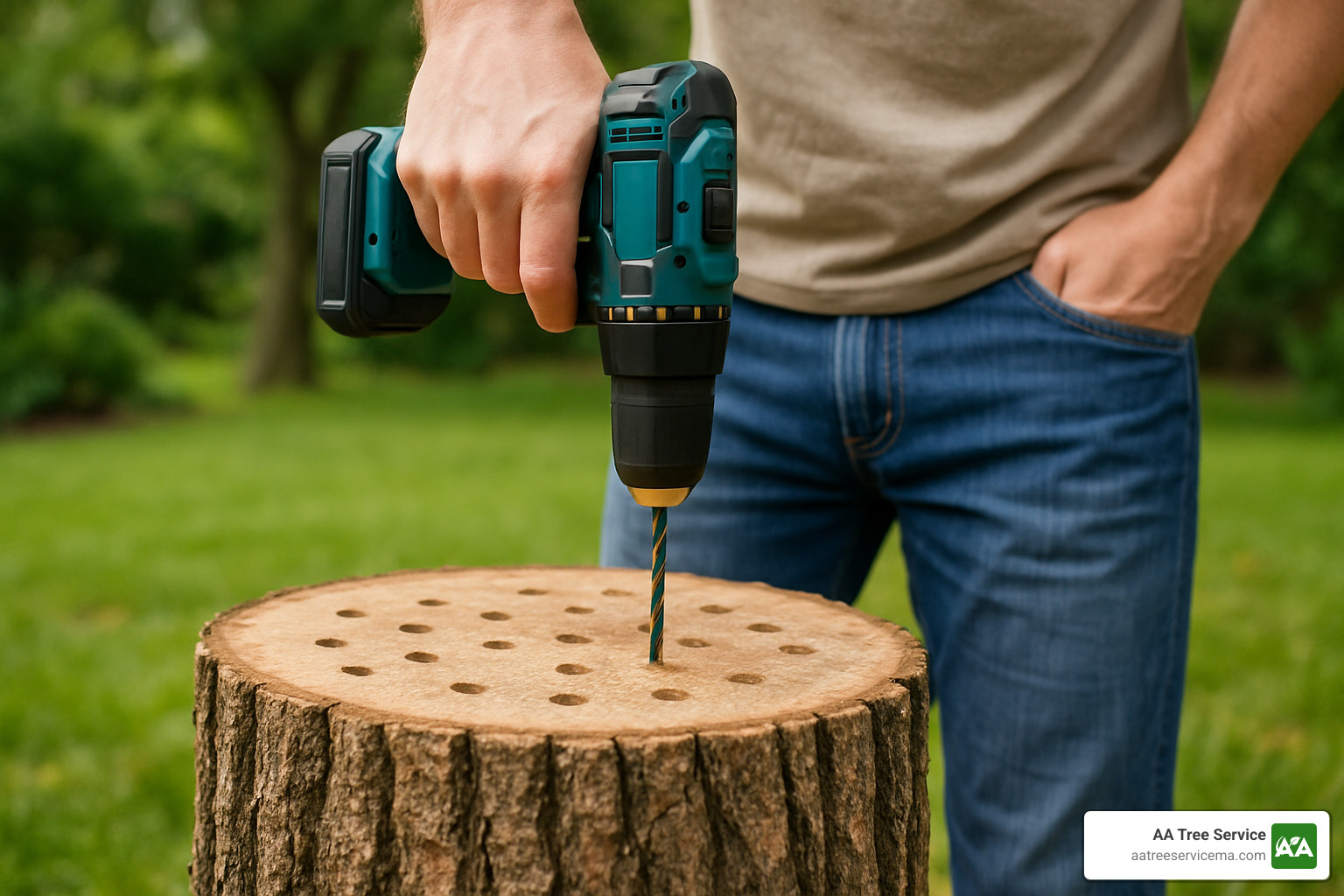
Method 1: Epsom Salt Saturation
- Saw stump as flush to the ground as you can.
- Drill 1-in-wide holes 10-12 in. deep, 4-6 in. apart.
- Fill each hole ¾ full with Epsom salt (≈1 lb per foot of diameter) and top with hot water.
- Cover with tarp; re-wet every 2-3 weeks.
Results: softening in 2-3 months, major breakdown by 6-12 months.
Method 2: Rock Salt Dehydration
Same hole pattern, but use half the quantity. Maintain a 10-ft buffer from ornamentals and flush area after heavy rain to avoid soil salinity build-up.
Method 3: Boiling Water Shock
Expose surface roots, pour boiling water slowly into drilled holes and over roots once a week for 4–6 weeks. Great pre-treatment for small (<12 in) stumps.
Method 4: Forced Darkness & Compost Blanket
Seal the stump under a black tarp weighted with stones; pile 4–6 in. of composted manure on top. Darkness + nitrogen + moisture equals 6–18 months to disappearance.
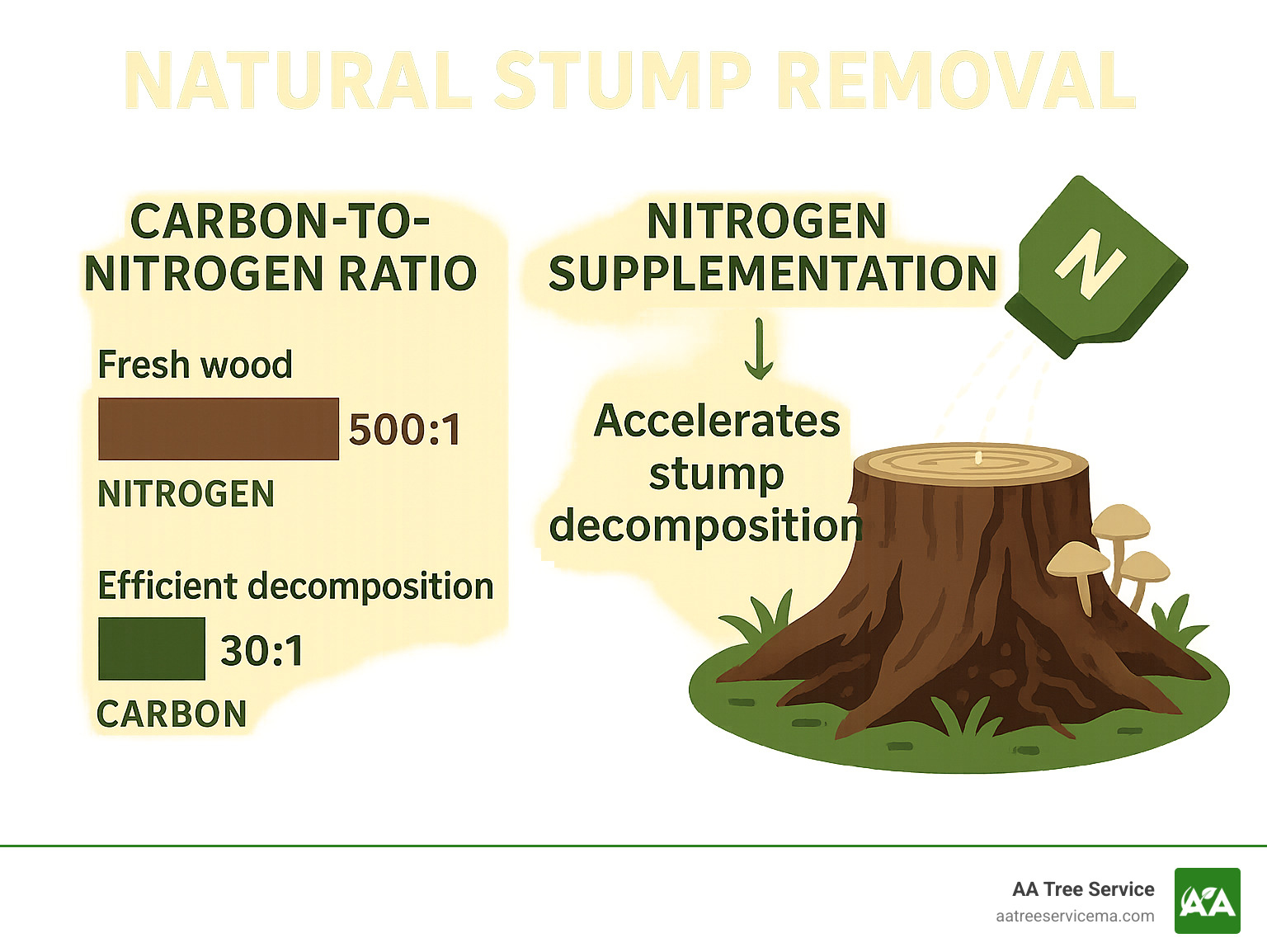
Method 5: Nitrogen-Boosted Rotting
Add high-nitrogen fertilizer (21-0-0, blood meal, or fish emulsion) to holes and around stump base, keep moist, and watch fungi do the heavy lifting. Learn the chemistry here: Scientific research on magnesium sulfate.
Safety, Timing & Environmental Benefits
Protect yourself first: eyewear, gloves, and boots are non-negotiable. When using boiling water, move smaller pots rather than one sloshing cauldron, and keep a hose ready.
Project timing is simple—start between late spring and early fall when soil temps stay above 50 °F. That’s when stump-decay fungi are most active (see research).
Buffer plants by forming small soil berms so salt treatments cannot wash into garden beds. Deep, slow watering helps move any stray salts below root zones.
Knowing you’re done: probe with a screwdriver. If wood crumbles easily and mushrooms appear, the stump is dead; fill the depression and move on.
After the Stump Is Gone: Backfilling & Replanting
A typical stump hole needs 2–6 cu ft of backfill. Mix existing soil with compost for lawns; add aged manure if you’re planting shrubs or veggies.
Best times to reseed grass: early fall or mid-spring in Massachusetts and New Hampshire. Lightly rake, broadcast seed, and keep it damp for 2-3 weeks.
Replanting a tree? Choose a different species to break disease cycles (e.g., swap an oak for a maple or serviceberry). Test soil salinity and pH, flush with fresh water if rock salt was used, and consider mycorrhizal inoculant for faster root establishment.
If you notice new sprouts—common with black locust or tree-of-heaven—repeat a small-scale salt or boiling-water treatment right away. For bigger landscape plans, see our full Tree Care Services.
Frequently Asked Questions About Natural Stump Removal
How long does it really take on a large hardwood?
Expect 12-24 months for stumps over 24 in. in diameter—there’s simply more wood to break down. Speed things up by sectioning the stump with a chainsaw, then combining boiling water, Epsom salt, and forced darkness.
Is Epsom salt safe for pets and veggie gardens?
Yes. Magnesium sulfate is routinely used as a garden supplement. Bury it in drilled holes and cover with a tarp to keep curious pets away. Rock salt works, but keep a 15–20 ft buffer from edible crops and flush soil after treatment.
Can I combine methods?
Definitely. A popular sequence is boiling water (opens fibers), Epsom salt (dehydrates), black tarp (darkness) and high-nitrogen fertilizer (feeds microbes). Staging treatments like this often removes medium-sized stumps within 6–9 months in our New England climate.
Conclusion
Natural stump removal pairs patience with ecology, letting moisture and microbes do the heavy lifting while you spend less than $50 in supplies (based on public internet averages). For many Massachusetts and New Hampshire homeowners, that six-to-twelve-month timeline is a fair trade for silent, chemical-free progress.
Need faster results, multiple large stumps, or simply less DIY? AA Tree Service has over 20 years of local experience, offers 24/7 emergency help, and provides free same-day quotes. See how professional and natural approaches can work together here: Tree Removal.