When Disaster Strikes: Understanding Emergency Tree Removal
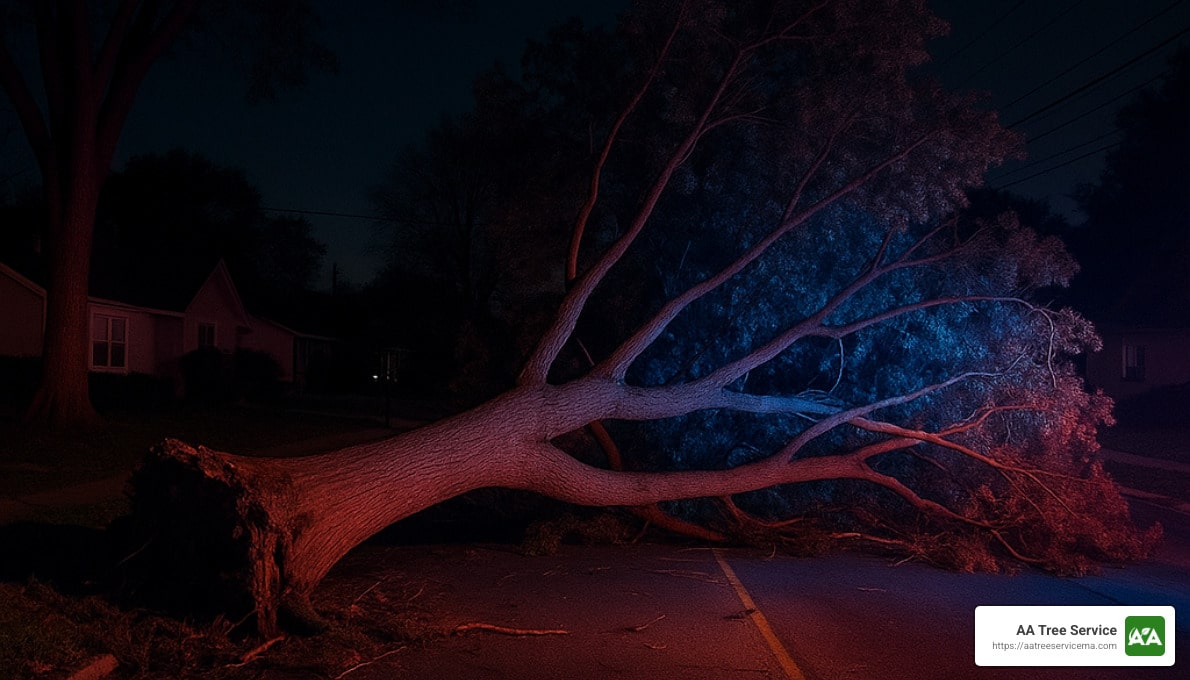
It’s 2 AM, and you’re jolted awake by the sickening crack of splitting wood. The thunderstorm that’s been raging over your Massachusetts home has just sent a massive oak crashing onto your roof. Your heart races as rain begins pouring through the new opening in your ceiling. This isn’t just a tree problem – it’s an emergency.
24-hour emergency tree removal is exactly what the name suggests – professional arborist services available around the clock when trees pose an immediate threat to life or property. These situations can’t wait until morning or the next business day.
When facing a tree emergency in Massachusetts or New Hampshire, here’s what you need to know right away:
| Emergency Tree Removal Quick Guide |
|---|
| 1. Safety First: Stay far away from fallen trees, especially those touching power lines |
| 2. Call Immediately: Contact AA Tree Service’s 24/7 emergency team for rapid response in MA and NH |
| 3. Insurance: Take photos of all damage before anything is moved (if safe to do so) |
| 4. Temporary Protection: Professional crews will tarp damaged areas to prevent further damage |
| 5. Response Time: Expect trained teams to arrive within hours, regardless of time or weather |
The urgency of tree emergencies can’t be overstated. Water damage compounds quickly when trees puncture roofs. Leaning trees can fully collapse without warning. And perhaps most dangerous of all, branches entangled with power lines create life-threatening electrical hazards that require immediate professional attention.
Did you know that tree care is the 5th most dangerous industry in the world? This sobering reality underscores why DIY approaches to emergency tree situations put homeowners at serious risk. Professional arborists train extensively in hazard assessment and specialized removal techniques that keep everyone safe.
“Trees are your asset, but if not taken care of, they can quickly become your liability,” as experienced emergency tree professionals often remind homeowners. This perspective helps explain why immediate response is critical – not just for safety, but also for financial protection.
Fortunately, most insurance companies will cover emergency tree removal costs when a building or vehicle on your property has been damaged. The key is proper documentation and professional handling of the removal. Having a relationship with a trusted tree service before emergencies happen can make this process much smoother.
New England weather is notoriously unpredictable, with hazards in every season – from winter ice storms that overload branches with hundreds of pounds of ice to summer thunderstorms with lightning strikes and powerful winds. This regional reality makes 24-hour emergency tree removal an essential service for homeowners throughout Massachusetts and New Hampshire.
When you need immediate help with fallen or dangerous trees, these specialized services can make all the difference:
– Storm cleanup services
– Emergency tree branch removal
– Fallen tree removal
What Is 24-Hour Emergency Tree Removal & Why Acting Fast Matters
Defining 24-hour emergency tree removal
When disaster strikes in the middle of the night, during a holiday weekend, or in the midst of a raging storm, 24-hour emergency tree removal becomes a lifeline for homeowners. This essential service means having professional arborists available around the clock, ready to respond when trees suddenly become dangerous threats to your safety and property.
Here in Massachusetts and New Hampshire, our unpredictable New England weather can turn a sturdy oak into a looming danger within minutes. That’s why AA Tree Service maintains fully-equipped crews on standby throughout both states, ready to roll out at a moment’s notice.
“We’ve seen it all – from Christmas morning emergencies to 2 AM calls during blizzards,” says our operations manager. “When a 90-year-old maple decides to visit your living room during Sunday dinner, you simply can’t wait until regular business hours on Monday.”
This isn’t just a tree service – it’s a rapid response team trained to handle high-risk situations involving massive weights, complex physics, and often dangerous conditions. Our emergency crews arrive with everything needed to safely address your tree crisis, including specialized equipment for accessing difficult spots, removing heavy sections, and protecting your property from further damage.
When Does a Tree Issue Become an Emergency?
Not every fallen branch warrants a middle-of-the-night call, but certain situations demand immediate attention. You’re facing a genuine tree emergency when:
A tree has crashed onto your home, garage, or vehicle. Every minute counts when your property is exposed to the elements through a damaged roof or when structural integrity might be compromised.
“The worst sound I’ve ever heard was that midnight ‘CRACK-BOOM’ when half our maple tree came through our daughter’s bedroom ceiling during a thunderstorm,” recalls a Lexington homeowner. “Thank goodness she was sleeping in our room that night. The 24-hour emergency tree removal team arrived within 90 minutes and worked through the rain to get that monster off our house.”
Trees or large limbs blocking essential access points represent another true emergency. When your driveway is completely obstructed, preventing you from leaving (or emergency vehicles from entering), immediate clearing becomes necessary.
The most dangerous scenarios often involve the “almost fallen” – those partially broken limbs dangling precariously overhead, sometimes called “widow-makers” for good reason. Similarly, trees suddenly leaning after storms or those with fresh, major trunk splits present imminent collapse risks that can’t wait.
Trees contacting power lines create particularly hazardous situations requiring specialized handling and coordination with utility companies. Never, ever approach these yourself – they demand professional emergency response.
Why 24-hour emergency tree removal beats DIY
The DIY approach might work wonderfully for garden beds and deck staining, but emergency tree removal falls into an entirely different risk category. When facing a tree crisis, attempting to handle it yourself could be one of the costliest mistakes you’ll ever make.
Your safety comes first. Tree care professionals consistently rank among the most dangerous occupations in America – and that’s for trained experts with proper equipment and years of experience. Emergency situations multiply these dangers exponentially. Trees under stress store enormous energy that can release unpredictably, sending massive limbs flying with deadly force when cut incorrectly.
Specialized equipment makes all the difference. That chainsaw in your garage might handle small branches, but emergency removals often require 21-35 ton cranes, bucket trucks reaching 75+ feet, specialized rigging systems, and commercial-grade cutting tools. Professional crews also bring essential safety gear like ground protection mats to prevent property damage during heavy equipment operation.
Insurance complications can get messy with DIY attempts. Many homeowners are surprised to learn their policies specifically exclude coverage for additional damage caused by amateur removal attempts. That $1,200 professional removal fee suddenly looks like a bargain compared to paying out-of-pocket for a collapsed garage roof.
Legal liability extends beyond your property line. Massachusetts and New Hampshire homeowners can face significant legal consequences if DIY tree work damages neighboring properties or, worse, causes injury. Professional services carry extensive liability insurance specifically designed for these high-risk operations.
A Bedford homeowner learned this lesson the expensive way: “I thought I could handle the broken branch hanging over my driveway after that ice storm. One bad cut later, it swung down and smashed through my neighbor’s fence and damaged their car. The few hundred I tried to save turned into thousands in out-of-pocket costs.”
Remember – when trees and storms collide, the safest approach is always to call professionals who provide 24-hour emergency tree removal. Your family’s safety and your property’s protection are worth the call to experts who handle these dangerous situations every day.
More info about Emergency Tree Removal Service
How Professionals Handle Tree Emergencies Around the Clock
When you call AA Tree Service for 24-hour emergency tree removal, you’re not just getting someone with a chainsaw. You’re activating a comprehensive emergency response system backed by decades of experience, specialized equipment, and rigorous safety protocols.
Safety Protocols that Save Lives
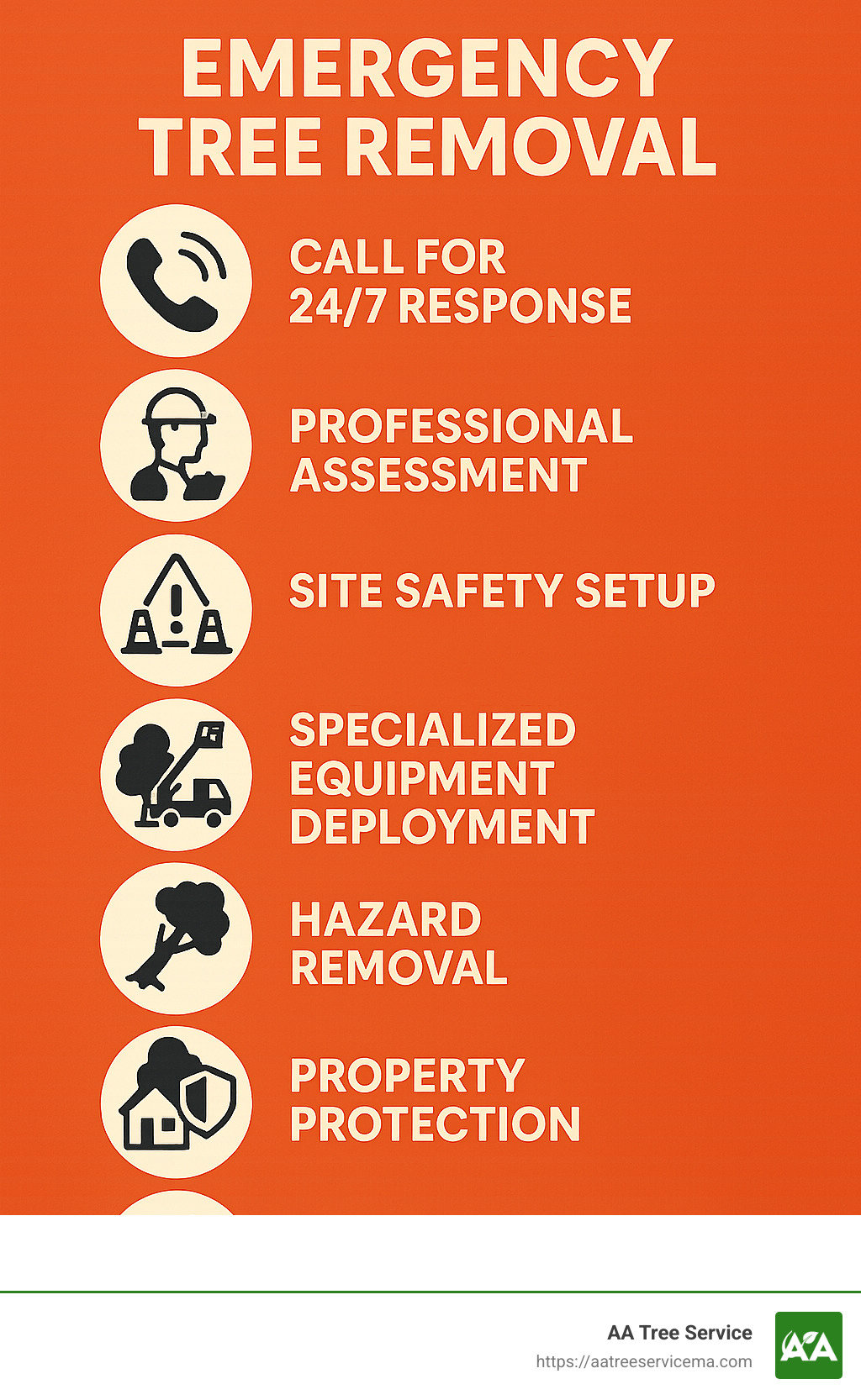
Did you know tree care is the 5th most dangerous industry in the world? This sobering fact is why we take safety so seriously at AA Tree Service. When our team arrives at your emergency, they immediately establish a secure perimeter to protect everyone nearby – your family, neighbors, and curious onlookers.
Our certified arborists perform a quick but thorough assessment, looking for hidden dangers like structural instability, power line contacts, and building damage. We’re checking for everything from the obvious fallen limb to the less visible cracked trunk that might fail next.
Every crew member wears full OSHA-compliant protective gear – helmets with face shields, cut-resistant clothing, fall protection harnesses, and high-visibility garments. We even use communication headsets to ensure clear instructions during noisy operations.
When emergencies affect roadways in Massachusetts or New Hampshire communities, we deploy proper traffic management systems. And for those particularly dangerous situations involving power lines? We work directly with local utility companies, sometimes waiting for lines to be de-energized before proceeding.
As one of our veteran climbers puts it: “We respect trees, but we respect human life even more. That’s why we never skip safety steps, even at 3 AM in a downpour.”
Gear & Techniques You’ll Never Find in a Garage
That chainsaw in your garage might be perfect for backyard pruning, but emergency tree removal requires industrial-grade equipment that few homeowners have ever handled.
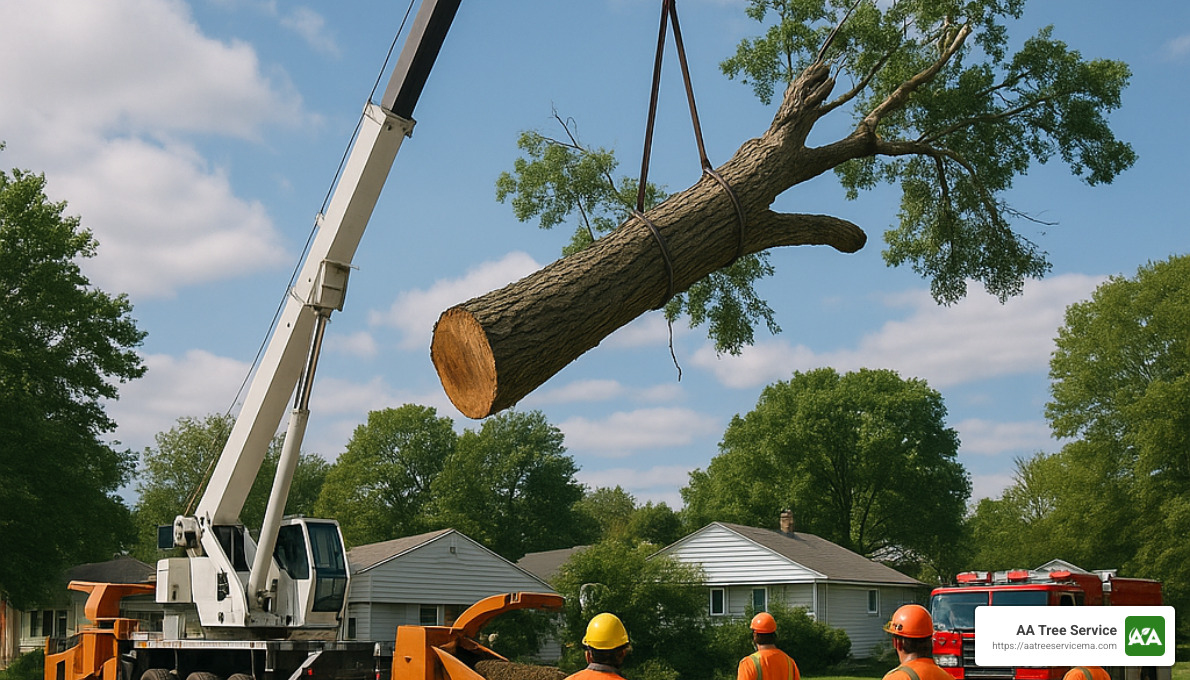
When that massive oak is resting on your roof after a Nor’easter, our team arrives with 21-35 ton cranes capable of lifting multi-ton sections without causing additional damage to your home. Our bucket trucks provide secure aerial access up to 75 feet, while our specialized spider lifts can squeeze through narrow gates to reach backyard emergencies.
“When a 90-foot white pine is leaning on a house at 2 AM in a thunderstorm, you need more than a homeowner’s chainsaw and a ladder,” explains our emergency response team leader. “You need industrial equipment, specialized training, and a team that’s done this hundreds of times.”
Beyond the heavy machinery, we use high-tension rigging systems – complex pulley and rope arrangements that control the descent of heavy limbs with precision. We bring commercial-grade chainsaws with various bar lengths for different cutting needs, and ground protection mats to prevent damage to your property during operations.
For homes already damaged by fallen trees, we carry roof tarping systems to provide immediate temporary protection from the elements. This comprehensive approach is why so many Massachusetts and New Hampshire homeowners trust us with their emergency tree situations. Learn more about our Emergency Tree Removal Service on our dedicated page.
Typical Response Times in MA & NH
When facing a tree emergency, every minute feels like an eternity. Here’s what happens when you call AA Tree Service for 24-hour emergency tree removal:
Your call is answered by a real person – not an answering service – who understands the urgency of tree emergencies. We immediately assess the situation’s severity, prioritizing life-threatening scenarios and structural damage to occupied buildings.
For serious emergencies, we typically dispatch an assessment team within 1-3 hours, depending on your location in Massachusetts or New Hampshire, current weather conditions, and the specific hazards you’re facing. Life-threatening situations get our fastest response, often with crews arriving within an hour in most service areas.
Once on-site, our team conducts a quick but thorough safety evaluation, develops an emergency removal plan, and deploys the appropriate equipment. For situations involving significant structural damage, we implement temporary protective measures like tarping to prevent further water damage.
A Bedford, NH homeowner shared this experience: “After a midnight microburst took down three huge pines onto our roof, AA Tree Service had a team on-site by 2 AM. They tarped the roof to prevent water damage and had the trees completely removed by noon the next day. I couldn’t believe how quickly they responded.”
During major storm events affecting multiple communities across MA and NH, we prioritize based on severity, with immediate attention to situations where lives are at risk. We keep you updated throughout the process, so you’re never left wondering when help will arrive.
The peace of mind that comes from knowing professional help is on the way – regardless of the hour – is why so many New England homeowners keep our number handy during storm season.
Costs, Insurance & Legal Responsibilities in MA & NH
What Determines the Price?
When a tree comes crashing down at midnight during a Nor’easter, cost might be the last thing on your mind – but it’s a question that inevitably arises. 24-hour emergency tree removal costs vary widely based on your specific situation.
Tree size is naturally the biggest factor – that 100-foot pine requires significantly more resources than a 30-foot ornamental. But it’s not just height that matters. The tree’s condition, location, and the complexity of the removal all play major roles in determining what you’ll pay.
Access makes a huge difference too. A tree that’s fallen in your front yard with easy street access costs less to remove than one that’s crashed through your back deck where equipment can’t easily reach. And if your emergency happens at 2 AM on Christmas morning? Yes, after-hours premiums do apply, though reputable companies like AA Tree Service pride themselves on fair pricing even during emergencies.
Equipment needs dramatically impact costs. When a crane becomes necessary to safely lift massive sections off your home, the price naturally increases to cover this specialized equipment. Similarly, if power lines are involved, the complexity and risk escalate quickly.
Based on internet data (not specific to AA Tree Service), emergency tree removal in Massachusetts and New Hampshire typically ranges from $500 for simpler situations to $5,000+ for complex removals. In extreme cases involving massive trees on structures requiring specialized equipment, costs can reach $10,000-$15,000.
As one AA Tree Service customer from Manchester noted: “While I was initially surprised by emergency pricing, once I saw the 12-person crew working in the pouring rain at midnight with a massive crane to get a 90-year-old oak off my roof without causing further damage, I understood the value completely.”
Will My Homeowners Insurance Pay?
Here’s some welcome news during a stressful tree emergency: your insurance will likely cover much of the cost when a tree damages your home or other insured structures.
Insurance typically covers 24-hour emergency tree removal when:
- A tree falls on your home, garage, or other covered structure
- A tree damages covered property like vehicles or fences
- A tree blocks access to your home (sometimes covered as “additional living expense”)
However, don’t expect coverage when trees fall without hitting anything valuable. That massive oak that crashed into your yard but missed your house? That’s typically coming out of your pocket. Similarly, removing threatening trees before they fall usually isn’t covered.
Documentation becomes your best friend during insurance claims. Take plenty of photos (safely!) before work begins. Note weather conditions and the apparent cause of failure. Save all estimates, invoices, and communications.
AA Tree Service works regularly with insurance companies throughout Massachusetts and New Hampshire, often handling direct billing to simplify your claim. Our detailed documentation helps ensure you receive the coverage you’re entitled to.
“The team from AA Tree Service was incredible,” shared one homeowner from Salem. “Not only did they safely remove the pine tree from my roof at 5 AM, but they also took detailed photos for my insurance and explained exactly what happened to my adjuster. They even tarped the roof before leaving to prevent water damage.”
Who Pays If My Neighbor’s Tree Falls?
The tall oak in your neighbor’s yard that you’ve been eyeing nervously for years finally toppled – straight onto your garage. Who’s responsible? The answer might surprise you.
In both Massachusetts and New Hampshire, the general rule follows the property where the tree lands, not where it grew. This means if your neighbor’s tree crashes onto your property, your insurance typically handles it – regardless of whose tree it was.
This “landing zone” rule has important exceptions, however. If you can prove your neighbor knew their tree was hazardous and neglected to address it, liability might shift to them. This is why documenting concerns in writing becomes so important.
Trees growing directly on property lines create another complication, as these are typically considered shared responsibility between neighbors. Local municipal codes in Massachusetts and New Hampshire towns may also affect liability, so checking your specific community’s ordinances is worthwhile.
As one arborist with decades of experience in New England explains: “The best approach is always preventive – if you’re concerned about a neighbor’s tree, have a friendly conversation, followed by written communication if needed. Consider sharing the cost of an assessment from a certified arborist to determine if real hazards exist.”
For complex situations involving property lines or disputed responsibility, consulting with a local attorney familiar with Massachusetts or New Hampshire property law usually proves worthwhile – especially when significant damage has occurred.
Maintaining positive neighbor relationships generally serves everyone better than prolonged disputes. Sometimes the most cost-effective solution is working together, regardless of technical liability.
Your Immediate Action & Prevention Plan
When a tree emergency strikes, knowing exactly what to do can save lives, minimize property damage, and streamline your insurance claim. Let’s walk through what you need to know when facing a tree crisis.
First 5 Minutes After a Tree Falls
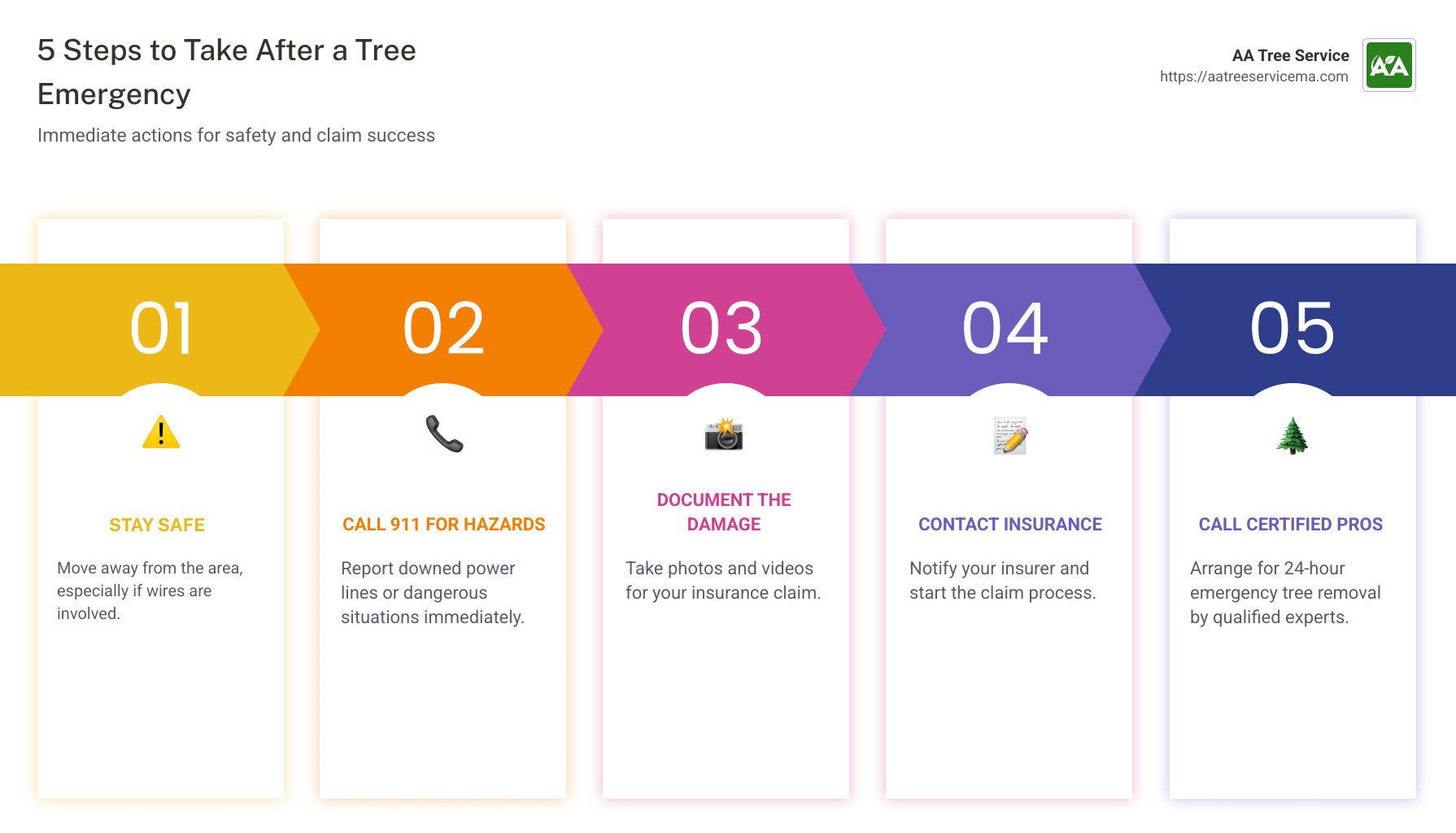
The moments immediately following a tree failure are critical. Here’s your step-by-step emergency response plan:
Prioritize safety above everything else. Move your family and pets away from the damaged area immediately. If the tree has caused significant structural damage to your home, evacuate without delay. Don’t grab possessions – they can be replaced, but you cannot.
Keep your distance from power lines. This cannot be emphasized enough: stay at least 50 feet away from any downed power lines or trees touching electrical wires. Even the ground surrounding a downed line can be energized and deadly.
Make the right calls quickly. For life-threatening situations, call 911 first. If power lines are involved, contact your utility provider immediately:
– Eversource in Massachusetts: 800-592-2000
– National Grid in Massachusetts: 800-465-1212
– Liberty Utilities in New Hampshire: 800-375-7413
– Eversource in New Hampshire: 800-662-7764
Then call AA Tree Service’s emergency line for 24-hour emergency tree removal.
Document everything safely. Take photos and videos from a safe distance to document the damage for your insurance claim. Note the weather conditions and time of the incident, and gather names of any witnesses.
Protect your property if safe to do so. For minor roof damage, carefully placing tarps can prevent water intrusion until professionals arrive. Move valuable items away from damaged areas, and if structural damage is severe, shut off utilities at the main.
Contact your insurance company right away. Report the claim immediately to start the process, get your claim number, and ask specifically about emergency mitigation coverage.
One Massachusetts homeowner shared: “When a tree crashed through our living room during a midnight storm, I panicked. But remembering to call the power company first potentially saved our lives – the responding crew found live wires tangled in the branches.”
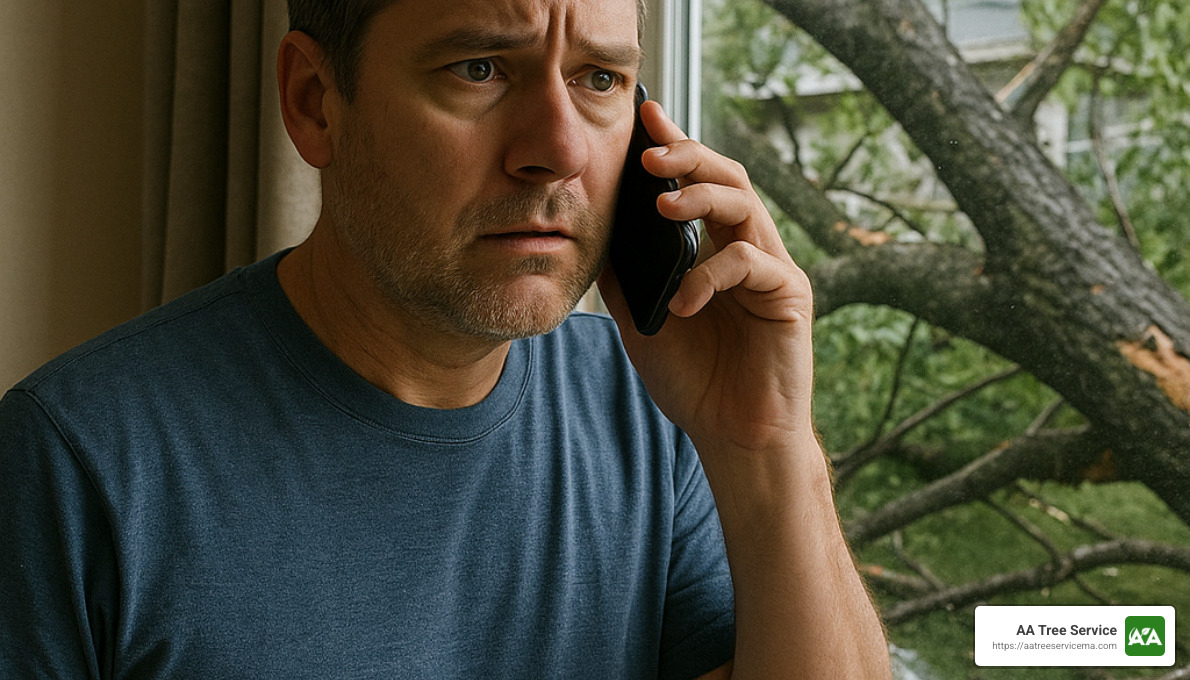
What to Tell the Dispatcher for 24-hour emergency tree removal
When you call for emergency assistance, providing clear, specific information helps us respond more effectively. Our dispatchers need to build a complete picture of your situation to send the right equipment and crew.
Start with your exact location – provide your full address and the nearest cross street. This helps our crews find you quickly, especially in rural areas of Massachusetts and New Hampshire.
Describe the emergency precisely – explain whether you’re dealing with a completely fallen tree, a leaning tree that might fall, or large broken limbs threatening your property.
Detail the impact – tell us if the tree has damaged your home, is blocking your driveway, or is resting on power lines. This helps us prioritize your emergency among others that might be happening during a storm event.
Share any immediate safety concerns – let us know if anyone is trapped, if power lines are down, or if you smell gas. These factors will affect how we approach the situation.
Give us tree information – the approximate size, species (if you know it), and location on your property help us prepare with the right equipment before arrival.
Mention any access challenges – gated communities, narrow driveways, or other access limitations are important for our team to know before arriving with large equipment.
Have your insurance information ready – if you’ve already contacted your insurance company, having your claim number handy will streamline the process.
“The photos you text to our emergency line are incredibly valuable,” explains our dispatch coordinator. “They help us visualize exactly what we’re dealing with and can save precious time in preparing the right response.”
Our dispatchers are trained to provide safety guidance while help is on the way. Follow their instructions carefully, especially regarding safety perimeters around hazardous areas.
Preventive Tree Care Tips for New England Storms
New England’s weather creates unique challenges for trees. From ice storms to nor’easters, our region’s trees face extreme conditions that can turn them from assets to hazards in moments. The good news? Most tree emergencies can be prevented with proper care.
Seasonal vigilance makes all the difference. In spring, examine your trees for winter damage as new leaves emerge. Summer inspections should focus on unusual leaf drop or discoloration that might indicate health issues. Fall is ideal for identifying dead branches before winter snow and ice loading puts extra stress on them. Winter examinations, when trees are bare, reveal structural issues that might be hidden during leafy seasons.
Learn to recognize the warning signs that require professional attention. A suddenly leaning trunk after a storm is an immediate red flag. Cracks or splits in major limbs or trunks often precede catastrophic failure. Mushrooms growing from roots or trunk are nature’s warning sign of internal decay. V-shaped branch unions create weak points prone to splitting during storms. Dead branches larger than two inches in diameter pose significant risk, as do exposed roots or soil heaving around the base of trees.
Professional preventive measures provide peace of mind. Regular pruning by certified arborists removes potentially hazardous limbs before they can fall. For structurally valuable trees with weak unions, cabling and bracing systems provide reinforcement against storm damage. Lightning protection systems can protect tall, isolated trees that might serve as natural lightning rods. Proper soil management improves root health and overall tree stability.
“Many of the emergency calls we receive could have been prevented,” notes our lead arborist. “The oak that falls during a summer thunderstorm often showed warning signs months earlier that an experienced eye would have caught.”
Working with certified arborists provides significant advantages. These professionals undergo rigorous training to identify subtle signs of tree problems before they become emergencies. The modest investment in annual inspections and preventive care typically saves thousands in emergency removal costs and property damage.
Choosing a Reliable Partner
Not all tree services are created equal, especially when it comes to emergency response. When selecting a partner for 24-hour emergency tree removal, several critical factors should guide your decision.
Credentials speak volumes about a company’s professionalism. Look for ISA (International Society of Arboriculture) certification, which indicates specialized knowledge and ongoing education. TCIA (Tree Care Industry Association) membership demonstrates commitment to industry best practices. Always verify both general liability insurance and workers’ compensation coverage – these protect you from liability if something goes wrong.
True emergency capability requires significant resources. A dedicated emergency phone line answered by knowledgeable staff (not just an answering service) is essential. Confirm genuine 24/7/365 availability – including holidays and weekends when emergencies don’t take time off. Ask about response time expectations and whether they have the specialized equipment necessary for complex emergencies. Sufficient crew staffing for after-hours response is crucial – many companies claim 24-hour service but lack the personnel to deliver.
A company’s reputation offers valuable insights. Online reviews specifically mentioning emergency response tell you how they perform under pressure. Ask neighbors or community groups about their experiences with local tree services during emergencies. Companies that hold municipal contracts typically meet higher standards for safety and reliability. Preferred vendor status with insurance companies indicates a track record of quality work and fair pricing.
Clear communication should start with your very first call. The company should provide a straightforward explanation of their emergency assessment process, transparent pricing without excessive “emergency fees,” and written documentation of all work performed.
At AA Tree Service, our 20+ year history of emergency response throughout Massachusetts and New Hampshire is built on these principles. Our ISA-certified arborists, fully-insured teams, and extensive equipment fleet allow us to handle any emergency, from single fallen limbs to complex multi-tree storm damage.
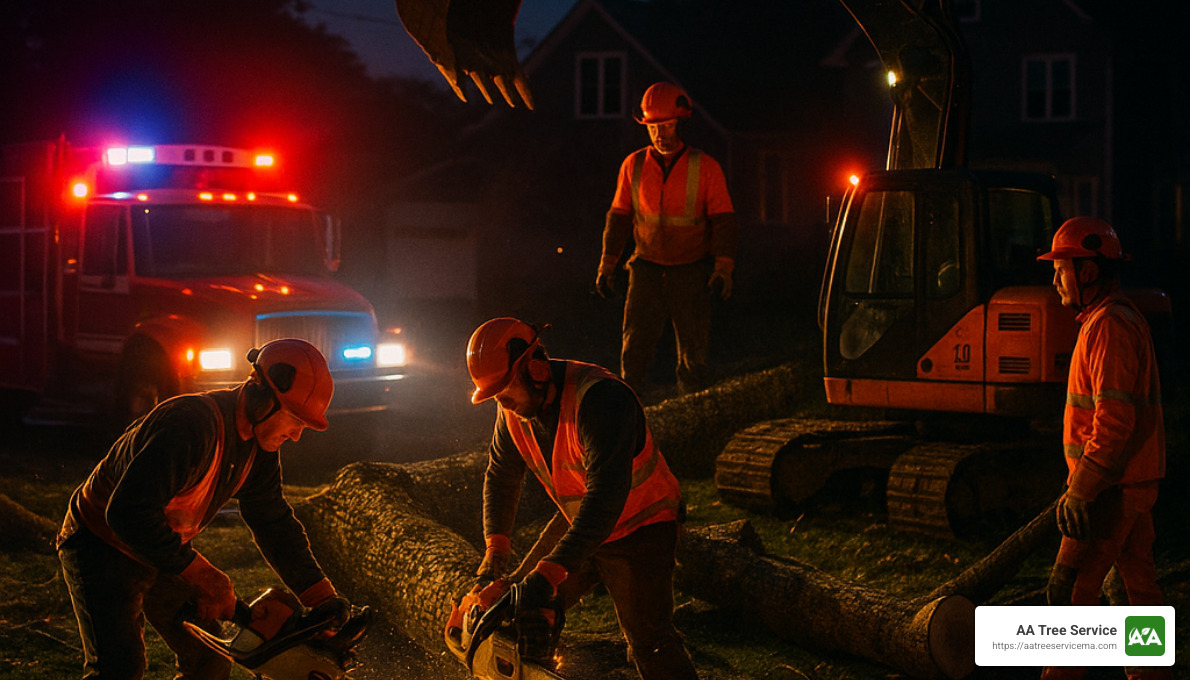
“True emergency service means being there when people need us most,” explains our emergency response coordinator. “We’ve responded during blizzards at 3 AM, on Christmas morning, and in hurricane conditions. That’s the commitment our communities deserve.”
For more information about our comprehensive Emergency Tree Services, visit our website or call our dedicated emergency line.
Conclusion
When disaster strikes in the form of fallen or hazardous trees, every minute counts. 24-hour emergency tree removal isn’t just a convenience – it’s a crucial service that safeguards your family and property during those heart-stopping moments when trees fail.
At AA Tree Service, we’ve dedicated over two decades to building and refining our emergency response capabilities throughout Massachusetts and New Hampshire. When you call us at 2 AM during a howling nor’easter, you’re not getting a drowsy technician – you’re getting a fully-equipped team that trains specifically for these moments.
“The most rewarding part of emergency work is seeing the relief on homeowners’ faces when we arrive,” shares our operations manager. “They’ve often been awake for hours, listening to branches scrape against their roof or staring at a tree that’s crashed through their living room. Just knowing help has arrived means everything.”
New England’s unpredictable weather creates year-round tree hazards that don’t follow a convenient 9-to-5 schedule:
– Winter brings ice storms that transform branches into overloaded, breaking hazards
– Spring delivers thunderstorms with damaging straight-line winds
– Summer surprises with microbursts and occasional tornadoes
– Fall ushers in hurricanes and powerful nor’easters
Whatever Mother Nature throws at your property, our emergency teams stand ready with the equipment, expertise, and experience to handle any tree emergency safely and efficiently.
As you prepare for the unexpected, remember these essential points: always prioritize personal safety by staying clear of fallen trees (especially those touching power lines); document all damage thoroughly for insurance claims; choose only certified, insured professionals for emergency work; invest in preventive care to reduce risks; and most importantly, establish a relationship with a trusted tree service before emergencies happen.
One grateful client from Amesbury, MA, perfectly captured the value of preparation after we removed a massive oak from their home during a midnight storm: “When you’re standing in your living room watching rain pour through your ceiling at 2 AM, you don’t want to be searching for tree services for the first time. Having a relationship with AA Tree Service before the emergency made all the difference – one call, and help was on the way.”
For immediate 24-hour emergency tree removal in Massachusetts and New Hampshire, contact AA Tree Service. For non-emergency tree health questions or preventive care, we offer free same-day quotes and comprehensive arborist consultations.
Because when trees fail unexpectedly, you need more than just someone with a chainsaw. You need a partner with the right tools, training, and commitment to be there 24/7/365, ready to restore safety and peace of mind, no matter when disaster strikes.